A close corporation is a corporation whose shares are held by a small, defined group rather than traded publicly, and whose special close-corporation rules apply only when state law and its charter adopt them. Delaware, for example, limits statutory close corporations to a specified maximum of 30 holders of record.
If a family owns every share and runs the business together, does that automatically give the company special legal status? No, and that gap between how a company operates and what its governing documents establish is where founders often get confused.
For South Florida entrepreneurs, the practical question isn't whether ownership is private. It's whether the chosen structure supports the company's plans for control, investors, succession, and everyday decisions.
Table of Contents
- What a Close Corporation Is and What It Is Not
- Core Features That Set a Close Corporation Apart
- How Ownership Limits and Share Transfers Work
- How Governance Works Without Public Market Rules
- Close Corporation Compared With LLCs and S Corporations
- Close Corporations in Real Businesses
- Decide Whether a Close Corporation Fits Your Business
What a Close Corporation Is and What It Is Not
A close corporation is a corporation whose shares belong to a small, defined group and aren't traded on a public market. Think of a members' club: admission is controlled by membership rules and relationships, not by anyone buying a ticket on an open exchange.
Say a family operates a commercial bakery. The shareholders work in the business, choose its managers, and expect ownership to remain within the family. They might reasonably describe it as a close corporation, but that description doesn't establish which legal rules apply.
Historically, California business-law usage included corporations owned by a sole shareholder or a closely connected group actively operating the business. That descriptive use helps explain the term, but founders shouldn't mistake familiar business language for a formal legal election.
The label and the legal status are different
Closely held describes an ownership arrangement. Statutory close corporation identifies a legal classification available under particular state laws.
The distinction is concrete: the Delaware close-corporation statute establishes specific charter and ownership requirements rather than treating every privately owned corporation as a statutory close corporation. Your company's articles or certificate of incorporation, often called its charter, must work together with the applicable statute.
The bakery's owners therefore need more than agreement among themselves. They need documents that establish the structure they intend to use and reflect the requirements of their state of formation.

Test the common assumptions
- It's just a small corporation. Check ownership concentration and the absence of public trading, not employee headcount, sales, or office size. A company can employ a substantial workforce while keeping ownership within a connected group.
- The label removes corporate formalities. Identify the statute or valid governing provision that permits a particular change. Calling the bakery informal doesn't authorize its owners to ignore required approvals.
- Every closely held business qualifies automatically. Read the filed charter and confirm the state's eligibility requirements. A private ownership arrangement isn't a substitute for a statutory election.
- A close corporation is an S corporation. Test state-law status and federal tax eligibility separately. They answer different questions, even when the same company qualifies for both.
A related misunderstanding concerns liability. Choosing who can own shares isn't the same decision as determining whether owners receive protection from business obligations.
For readers comparing terminology across countries, EndureGo Tax's explanation of limited liability for Australian tradies provides useful context about Australian proprietary companies. It shouldn't be used as a guide to American close-corporation requirements.
Practical rule: Before relying on a business label, locate the document and state-law provision that give it legal effect.
When you ask, “What is a close corporation?” finish with a more specific question: Does my company merely fit the description, or does it have statutory status? Start with the law of the state where the corporation was formed, not just where its owners live.
Core Features That Set a Close Corporation Apart
| Feature | Close corporation | Public corporation |
|---|---|---|
| Number of shareholders | Small, defined group | Often thousands, widely dispersed |
| Share trading | No public market | Traded on stock exchanges |
| Management | Owners often run the business | Management separated from owners |
| Share transfers | Restricted by bylaws or shareholder agreement | Generally free to transfer |
| Formal legal status | Statutory in some states only | Standard corporate form available in every state, with public-market requirements layered on |
These are practical comparisons, not universal rules. Public-company executives can own shares, and a privately owned company can hire professional managers who hold no equity.
Read the features together
Ownership concentration means the identity of each shareholder matters. A shareholder's retirement, divorce, death, or disagreement can change the working relationships inside the business, not just its investment profile.
The absence of a public market also changes an owner's exit options. An owner can't assume there's a ready buyer or a quoted market price for the shares. Owners should discuss valuation and payment terms before anyone needs to leave.
Management overlap adds another complication. Someone may be a shareholder, director, officer, and employee, but those roles aren't interchangeable. Ending someone's employment doesn't necessarily end that person's ownership.
Transfer restrictions address who may join the ownership group. They should explain what an owner must do before selling or otherwise transferring shares, rather than relying on a shared expectation that ownership will stay within the family.
Finally, public trading isn't a separate state entity type. A conventional corporation may remain private or pursue public ownership subject to additional requirements. Statutory close-corporation treatment is a distinct state-law choice.
Map your business to the table
Use a short written inventory:
- Identify the holders. List the people and entities recorded as owners.
- Name the decision-makers. Separate operational managers from people with voting or approval rights.
- Describe the exit process. Write down what would happen if an owner wanted to sell tomorrow.
- Locate the legal status. Check the filed charter rather than relying on a tax return or an old email.
Tip: If the ownership, management, and transfer rows resemble your company, investigate close-corporation planning. That resemblance makes the questions relevant, but it doesn't establish statutory eligibility.
How Ownership Limits and Share Transfers Work
| Structure | Shareholder ceiling | Where the limit comes from | What counts |
|---|---|---|---|
| Delaware statutory close corporation | 30 holders of record | Certificate of incorporation under DGCL §342 | All issued stock excluding treasury shares |
| California statutory close corporation | 35 shareholders | Articles of incorporation under state law | Shares issued and held by shareholders |
| S corporation | 100 shareholders | Federal tax rules administered by the IRS | Shareholders must also be allowable types |
| Regular C corporation | No general statutory shareholder cap | No close-corporation or S-election ceiling merely from C status | Shareholders recorded in the stock ledger |
| LLC | No general statutory cap in most states | Operating agreement and state law | Members holding membership interests |
These ceilings concern different legal classifications, not interchangeable versions of the same test. Under Delaware General Corporation Law §342, the charter's specified maximum cannot exceed 30 holders of record, counting all issued stock except treasury shares; the statute also requires certificated shares.
Count people on the ownership record, not just shares
A large share issuance to an existing holder might leave the holder count unchanged. A smaller issuance to a new investor can increase it.
Employee grants, family transfers, and transfers involving trusts therefore deserve review before execution. Don't assume every trust or family arrangement is counted identically under state corporate law and federal tax rules.
The charter may also impose a tighter ceiling than the statute permits. Use the company's actual documents, not just the statutory maximum, when reviewing a transaction.
Control transfers before they happen
A right of first refusal can require an owner to offer shares to designated existing owners or the company before completing an outside sale. A buy-sell provision can address departure events, valuation, and payment terms.
The details of transferability of shares matter because permission to sell, a contractual purchase right, and the mechanics of recording a transfer aren't the same thing. Operating agreements and bylaws define ownership, management structure, decision-making, investor rights, and exit strategies, using the document appropriate to the entity.
For a company seeking statutory status, use this formation or amendment sequence:
- Confirm availability. Determine whether the formation state offers statutory close-corporation treatment.
- Prepare the charter provisions. Obtain required approvals and file the appropriate articles or certificate, including the permitted holder ceiling.
- Verify eligibility at filing. Reconcile current holders of record with the applicable requirements.
- Update ownership records. Make the stock ledger, shareholder register, and share certificates consistent.
Count holders before authorizing an issuance or transfer, not after someone has signed the paperwork.
Tip: Assign responsibility for maintaining the register. A spreadsheet can help track ownership, but it must match the legally effective records and completed transactions.
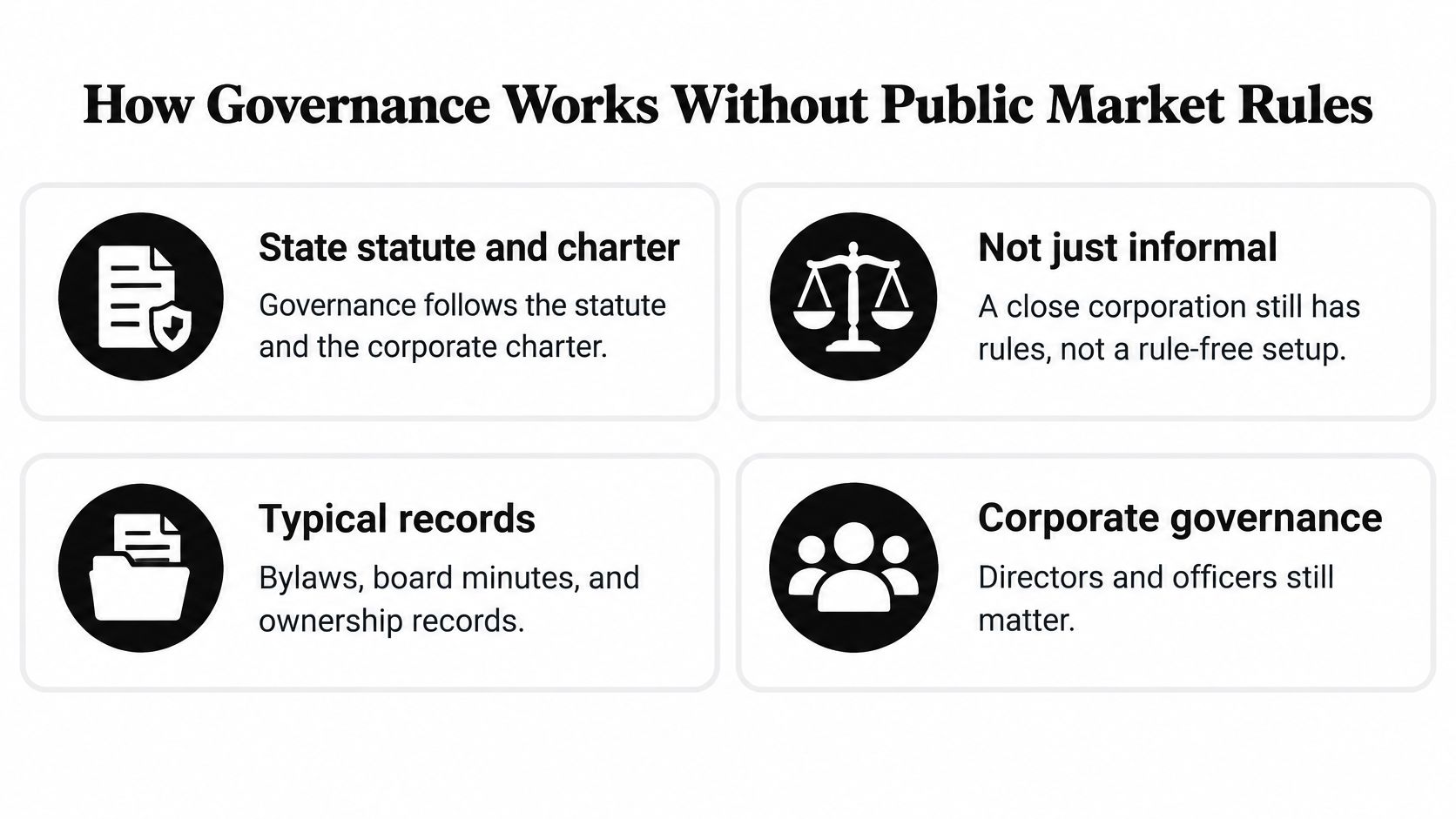
How Governance Works Without Public Market Rules
Start by separating situations that founders frequently combine:
- Closely held in fact. Ownership rests with a limited group, without necessarily invoking a special statutory regime.
- Statutory close-corporation status. The corporation has satisfied the applicable election and eligibility requirements.
- Informal operation. Owners skip documentation or make decisions casually, whether or not the law permits that approach.
Only the middle situation establishes special statutory treatment. The last may describe missing compliance.
Identify what can lawfully change
Some jurisdictions permit shareholders to reorganize decision-making through written agreements. A legal analysis of close-corporation governance explains, for example, South Carolina's provision allowing all shareholders of a statutory close corporation to agree in writing about corporate powers, business management, and shareholder relationships.
That doesn't establish a universal right to eliminate directors, skip meetings, or disregard approval procedures. A Florida founder and a Delaware founder may face different rules even when their businesses look identical.
Ask a narrow question: What can this corporation lawfully relax, and what must it still observe? Review each proposed simplification against the statute, charter, bylaws, and any valid shareholder agreement.
Keep records that explain authority
A useful governance file includes bylaws, board and shareholder minutes, written resolutions, ownership records, and applicable annual reports. Each serves a different purpose: bylaws organize internal procedures, while minutes and resolutions show what authorized people approved.
Understanding what bylaws do for a corporation helps owners avoid treating them as a substitute for every other document. A bylaw provision about voting doesn't itself record approval of a particular transaction.
Build a compliance worksheet with these entries:
- Required action. Identify meetings, consents, filings, and approvals required for this corporation.
- Permitted modification. Record whether a valid agreement can alter the procedure and whose consent is needed.
- Supporting document. Specify where the approval or election will be kept.
- Responsible person. Assign preparation, signature collection, filing, and record retention.
Corporate governance work includes board and shareholder documentation, meeting minutes, resolutions, annual reports, and bylaws. Treat those as distinct tasks rather than a single annual paperwork exercise.
Preserve corporate separateness
Governance flexibility doesn't guarantee protection from personal liability when owners ignore the corporation's separate existence. Commingled personal and corporate bank accounts, undocumented withdrawals, and missing approval records can create avoidable disputes and liability risks.
Tip: Maintain a separate corporate bank account and document owner payments according to their actual purpose. If the company changes its approval process, preserve the signed authority for that change rather than assuming everyone will remember the agreement.
Close Corporation Compared With LLCs and S Corporations
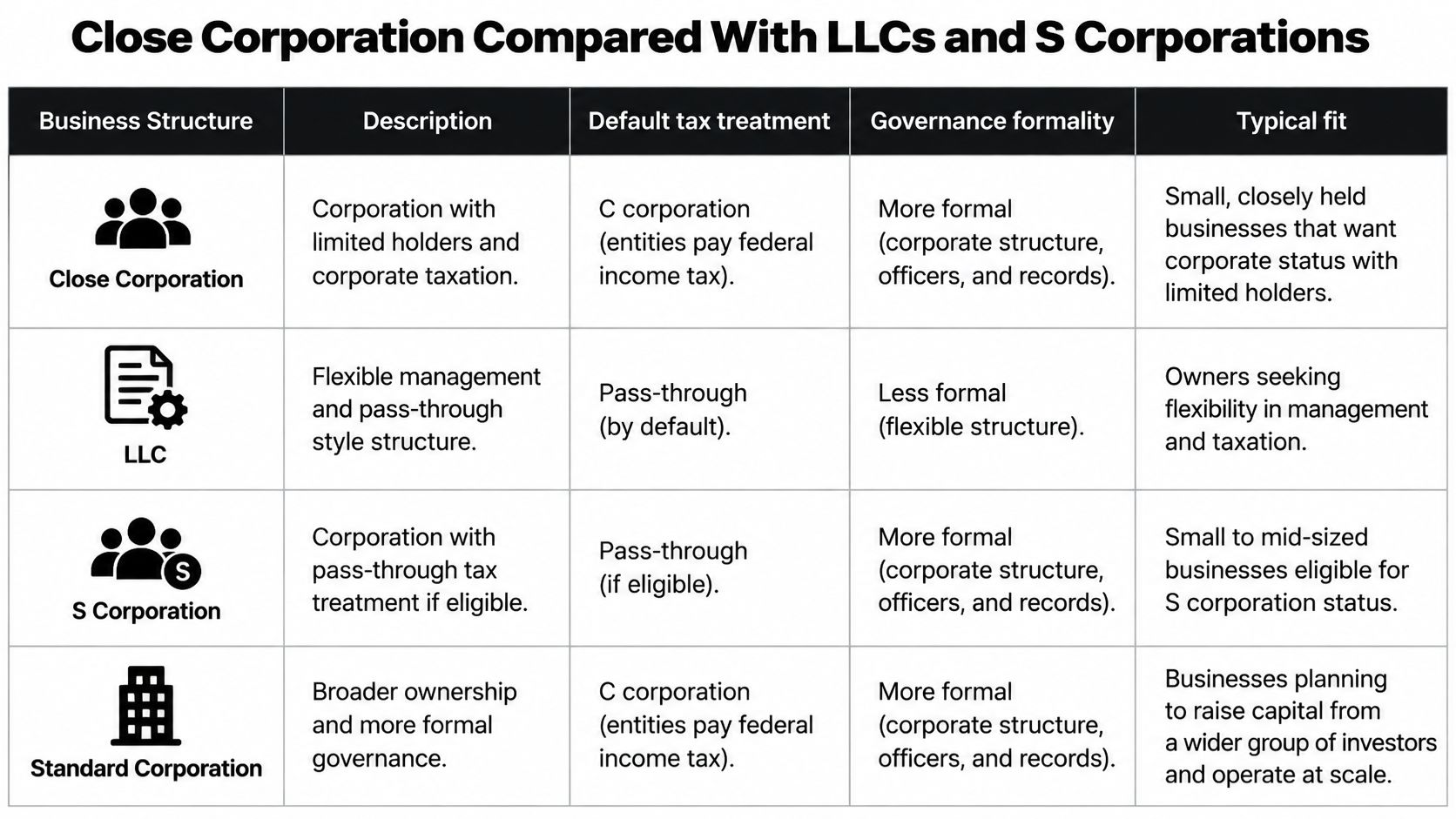
| Structure | Default tax treatment | Governance formality | Typical fit |
|---|---|---|---|
| Statutory close corporation | Corporate tax unless a valid S election applies | Bylaws, board and minutes; some procedures modifiable where state law permits | Small owner-run companies wanting controlled ownership |
| LLC | Generally pass-through treatment; classification differs for single-member and multi-member LLCs | Operating agreement; fewer corporate-style formalities | Small businesses seeking flexible ownership and management |
| S corporation | Pass-through to shareholders under an effective election | A corporation retains corporate formalities; an LLC retains its entity-law rules | Owner-operators considering payroll and tax planning within federal eligibility rules |
| C corporation | Corporate tax on profits | Full corporate formalities | Startups seeking venture capital or stock options |
The table combines entity structures and tax classifications, so its rows aren't mutually exclusive. A statutory close corporation remains a corporation, while S treatment concerns how an eligible entity is taxed.
Separate the state-law and federal tests
The IRS S-corporation eligibility rules permit no more than 100 shareholders and require allowable shareholder types. That federal test is separate from Delaware's 30-holder statutory close-corporation ceiling.
A company can therefore fit within the federal numerical limit yet fail the state close-corporation requirement. It can also satisfy a state ownership rule while having an owner or equity arrangement that doesn't meet S-election requirements.
Don't treat an S election as a method for relaxing corporate governance. Likewise, don't assume close-corporation status creates pass-through taxation.
Match the structure to the owner's plans
An LLC can suit owners who want flexible management and customized economic arrangements. Its operating agreement should still explain authority, distributions, transfers, and exits. Flexibility isn't a reason to leave those subjects unwritten.
An S election may offer tax advantages in an appropriate situation, but eligibility, payroll obligations, and the owners' circumstances require separate analysis. Comparing S corporations and C corporations for small businesses helps distinguish that tax decision from entity formation.
A C corporation, especially in Delaware, is common for startups pursuing venture capital. Founders expecting repeated financing rounds and broader equity participation should consider whether a tightly controlled holder group fits those plans.
For a location-specific example of weighing these choices, Miles Hansford Law Firm's guide to structuring a North Georgia startup illustrates why entity selection requires attention to local law and business goals. It doesn't replace analysis of a Florida company's governing rules.
Decision tip: Choose the legal entity and evaluate the tax election as connected but separate decisions.
Write down your priorities under taxes, management flexibility, ownership control, and investor plans. Then match those priorities to the table rather than choosing whichever label sounds simplest.
Close Corporations in Real Businesses
A family company plans a transfer
Say siblings hold all the shares and operate the company together. An estate-planning proposal would divide an owner's shares among a spouse and separate trusts, potentially exceeding a deliberately low holder ceiling in the charter.
The problem isn't inheritance itself. It's completing transfers without checking their effect on eligibility and existing contractual restrictions.
The document to examine is the shareholder agreement, including transfer restrictions and any right of first refusal. The check is a reconciliation of the proposed recipients, current holders of record, charter ceiling, and transfer paperwork.
An ordinary family transfer won't necessarily threaten statutory status. The actual ownership changes and the company's chosen ceiling determine the issue.
Florida co-founders have no agreement
Consider Florida co-founders who began selling software before documenting their relationship. When they disagree about leaving the business, neither can point to clear terms governing vesting, decision rights, or a buyout.
For a corporation, the relevant document is a shareholder agreement, supported by accurate issuance records and consistent bylaws. It should address ownership percentages, vesting arrangements, approvals, and dispute resolution.
For an LLC facing a comparable co-founder dispute, we draft an operating agreement addressing ownership percentages, vesting, and dispute resolution when the founders have no agreement. The entity determines the document, and the signed terms must match the applicable law.
Employee equity changes a Delaware company's ownership
Suppose a Delaware statutory close corporation sits at its permitted holder maximum. The founders then propose employee share grants that would add another holder.
The problem is whether the proposed issuances are compatible with the company's statutory status. The documents are the charter, stock ledger, and grant paperwork, not just the capitalization summary used in a pitch deck.
Before approving the grants, check who becomes a holder of record and when. Don't confuse an option award with an immediate issuance of shares.
- Review regularly. Reconcile the holder register and transfer provisions during an annual governance review.
- Review before transactions. Repeat the check before grants, financings, gifts, and estate-planning transfers.
These arrangements work best when the ownership documents reflect the people involved, the authority they exercise, and the exits they expect.
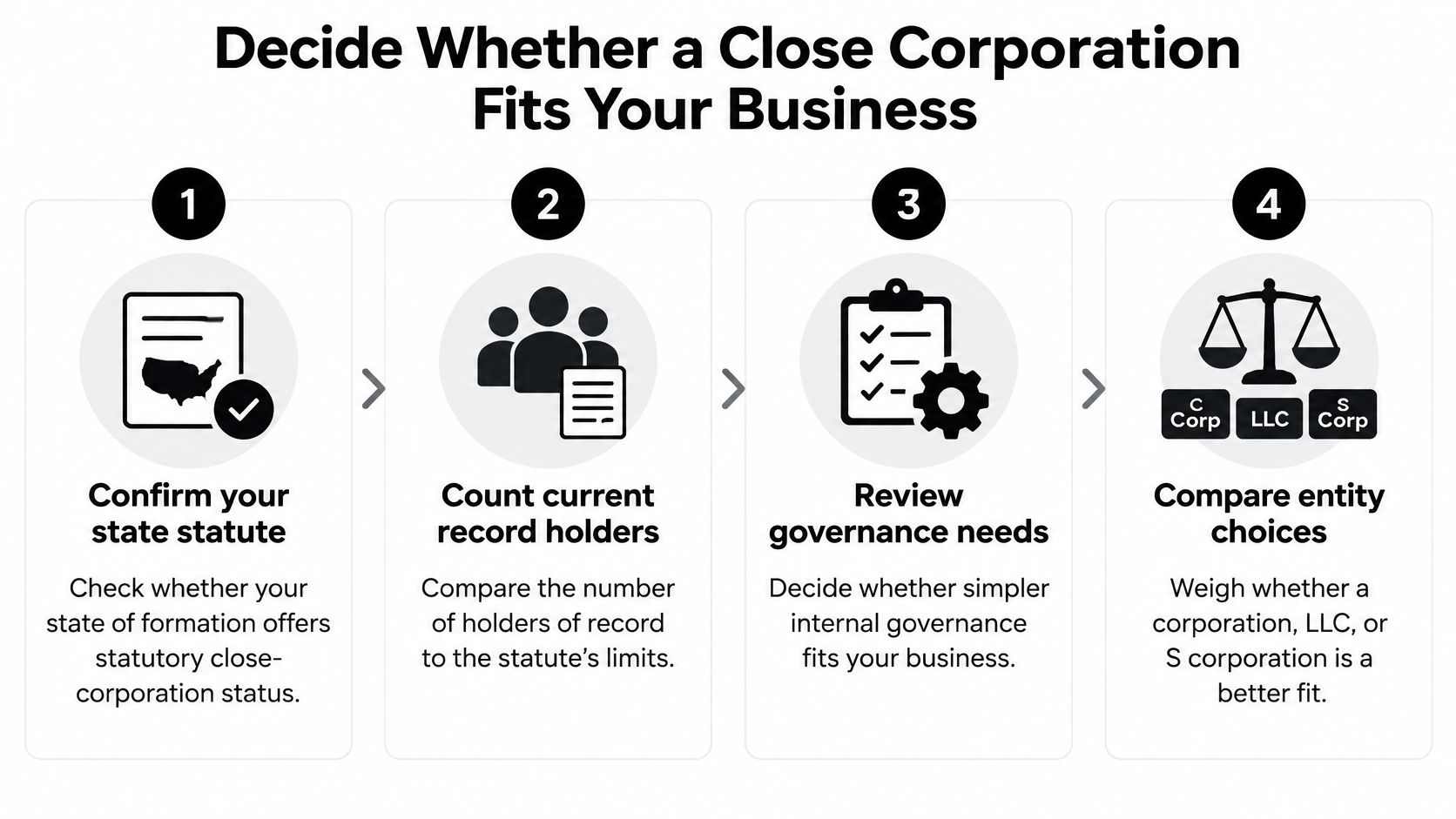
Decide Whether a Close Corporation Fits Your Business
- Confirm your formation state's statute. Determine whether statutory close-corporation status is available and identify the required charter language and approvals.
- Count current holders of record. Reconcile the stock ledger with completed issuances and transfers, then compare the total with the charter and statutory ceilings.
- Map expected ownership changes. Include employee equity, outside investors, family gifts, trusts, and succession arrangements.
- Choose the tax route separately. Evaluate whether an S election is available and compatible with the proposed owners and equity rights.
- Prepare a workable governance file. Coordinate bylaws, a shareholder agreement with transfer restrictions, and a schedule for minutes, consents, and filings.
Choose for the business you intend to build
A close-corporation structure may fit owners who value a stable ownership group and direct participation in management. It may be less suitable when the founders expect frequent equity issuances, changing investors, or an ownership base that will broaden quickly.
Cross-border founders should also resist translating entity names directly between countries. For context, how renn explains autónomo and S.L. illustrates the separate concepts of an individual's working status and ownership of a Spanish company, not an equivalent American close-corporation election.
Keep the register current, review the structure before issuing equity, and separate personal finances from corporate funds. Bring the filed charter, ownership ledger, tax-election records, and existing agreements to a structure review. Those documents make it possible to identify concrete changes rather than debate labels.
Coto & Waddington, Attorneys at Law helps founders compare LLC, S-corporation, and C-corporation options and implement formation and governance documents that fit their ownership plans. Visit Coto & Waddington, Attorneys at Law to arrange a review of your charter, shareholder records, and planned equity changes, with flat-rate legal packages available from initial formation through ongoing general counsel support.