A general counsel is the company's senior in-house lawyer, who advises leadership on legal risk and business decisions and coordinates any outside lawyers the company uses.
You may be facing a vendor agreement that needs signing, a contractor asking about ownership of their work, and a customer requesting stronger privacy commitments. None feels big enough to justify a legal department. Together, though, they raise a practical question: who's connecting these decisions before you commit the business?
Table of Contents
- What a General Counsel Does and Core Responsibilities
- How a General Counsel Runs Legal Work Day to Day
- Who the Client Is and When the Law Limits Advice
- Three Small Business Cases Where Counsel Made the Difference
- Fractional, Full-Time and One-Time Counsel Compared
- Confirm Whether You Need Counsel Before Your Next Contract
What a General Counsel Does and Core Responsibilities
A general counsel, often shortened to GC, combines legal work with business leadership. The U.S. Bureau of Labor Statistics describes corporate counsel as lawyers employed by an organization who advise executives on commercial contracts, patents, taxes, labor agreements, and other business-related legal issues.
A GC works like an air traffic controller. They don't fly every plane, and they don't only inspect wreckage after a crash. They track legal risks across the operation so leadership can choose a workable route.
For a small business, that might mean recognizing that a new customer contract affects insurance coverage, staffing commitments, and data security. Reviewing the document alone won't answer whether the company can deliver what it promises.

Reacting, Reviewing, and Shaping Decisions
The role runs in several modes. Reacting means responding to a demand letter, an employee complaint, or a suspected data incident. Reviewing means examining a contract or policy before someone relies on it.
Shaping a decision means participating before leadership settles on the plan. That's the defining difference between a GC and a lawyer who only receives isolated assignments.
Say your creative agency wants to offer customers an AI-assisted design service. Counsel should help evaluate ownership promises, confidentiality restrictions, and vendor terms before salespeople start selling it. Changing the offer early is usually more manageable than renegotiating promises already made. For a small company, AI governance sits inside this ordinary contract and policy work, not in a separate department.
The job also reaches beyond a conventional legal department. Senior in-house lawyers frequently oversee functions outside legal, and compliance, privacy, ethics, and risk management often land on the same desk. A fractional arrangement covers these same functions on a part-time basis, so a small business gets the same decision support without hiring a full-time lawyer.
Core General Counsel Responsibilities by Area
| Area | What the GC handles | Typical small-business example |
|---|---|---|
| Contracts and transactions | Negotiation, drafting, review, and renewal tracking | Vendor agreements, NDAs, and customer terms |
| Governance and corporate records | Board materials, minutes, and entity maintenance | Shareholder agreements and annual state filings |
| Compliance | Monitoring legal change and internal policy adherence | Licensing rules and industry regulation |
| Privacy and data | Privacy policies, data use rules, and incident response | Website privacy policy and cookie policy |
| Intellectual property | Trademark protection and IP assignments | Brand names and founder-created IP transfers |
| Employment | Hiring documents, worker classification, and HR policies | Contractor versus employee status |
| Risk and disputes | Risk register, escalation, and referrals to litigators | Demand letters and choosing outside litigation counsel |
For a startup, formation documents, founder agreements, and customer contracts often come first. Privacy questions arrive when the business collects customer information. Employment issues begin with the first hire or contractor, not when the company establishes an HR department.
One distinction trips up founders who have never worked with counsel.
Without a legal department, the GC must also distinguish legal ownership from operational ownership. Counsel can draft a records policy, but someone inside the business must maintain the records. Counsel can explain a licensing requirement, but an assigned employee must complete the renewal. Advice without an owner stays advice.
Practical tip: Start by naming an owner for contracts, corporate records, and people-related questions. Otherwise, legal becomes a vague catch-all that nobody actually manages.
Mark which rows in the table already have an owner and which have none. Your repeatable definition is simple: the GC helps the company make legally informed decisions and makes sure someone follows through.
How a General Counsel Runs Legal Work Day to Day
A GC's month follows a repeatable cycle, not just a stream of urgent emails. The ACC's 2023 Chief Legal Officers Survey reported that respondents allocated approximately 18% of their time to legal-risk management and 12% to board and governance matters.
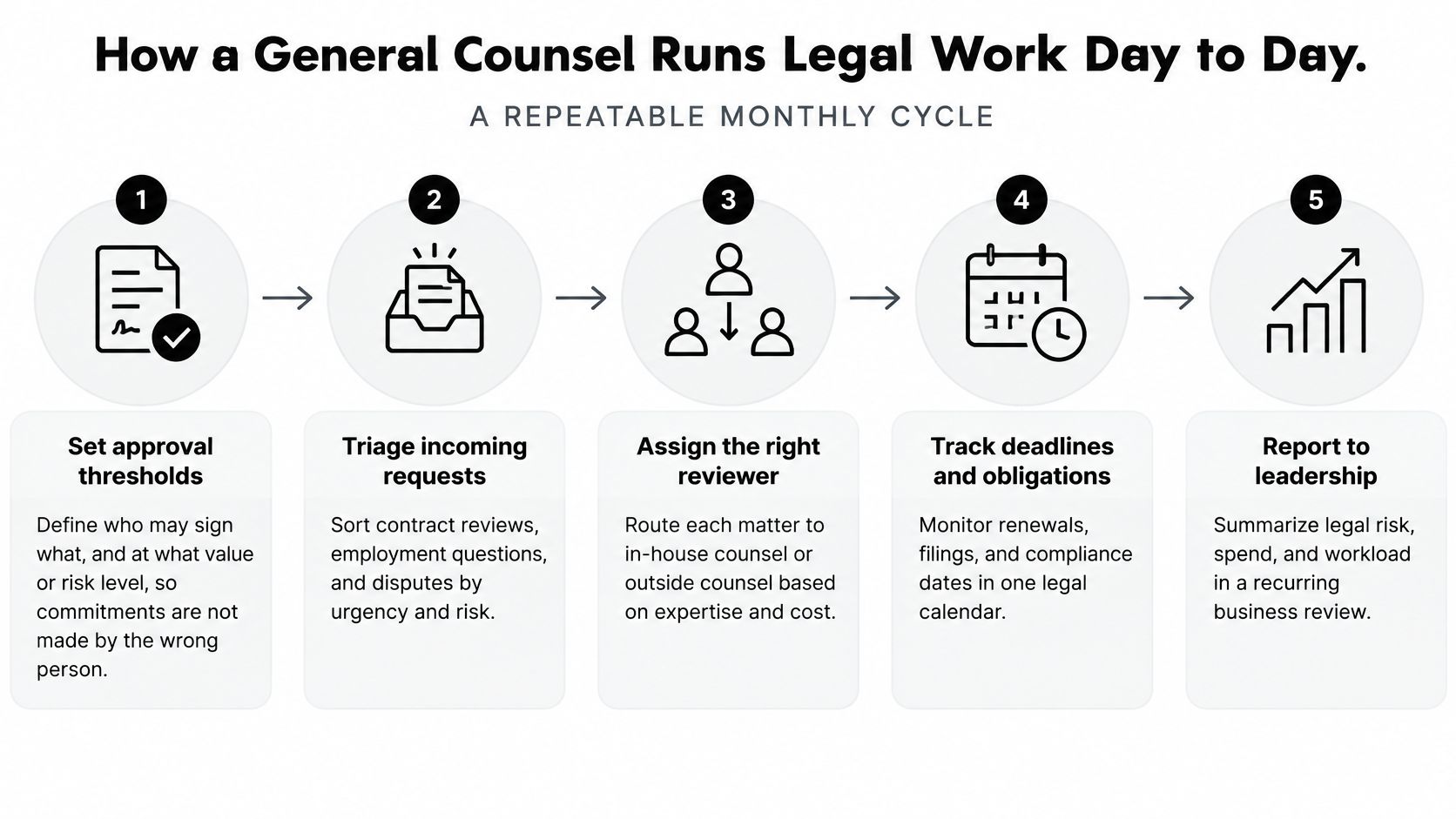
- Set approval thresholds. Define who may sign at each value or risk level so a salesperson doesn't accidentally accept an exceptional liability obligation.
- Create contract intake and a clause playbook. Collect the business purpose, deadline, and proposed terms through one route, with fallback clauses so negotiations don't restart from scratch.
- Maintain an obligation calendar. Track renewals, notice deadlines, and reporting duties so a forgotten cancellation window doesn't create another commitment.
- Keep a risk register. Rank probability, financial impact, reversibility, and response time, then assign an owner and control so known problems don't remain ownerless.
- Review open matters monthly. Ask management what has changed so an approved product plan doesn't become an unreviewed data-collection project.
- Escalate material risks. Bring significant issues to the appropriate board or committee rather than leaving executives unaware until a deadline arrives.
For example, a product team might add customer analytics after the original launch review. Counsel connects the new collection practice to privacy disclosures, vendor terms, and internal access controls before launch.
A structured business contract review should feed this workflow, not sit separately in an inbox. For administrative support, LatHire's resource for businesses looking to hire virtual legal assistants can help distinguish document organization and deadline tracking from work that requires a lawyer's judgment.
Add AI Rules to the Operating System
In the 2025 global General Counsel Report, 41% of general counsel ranked regulatory compliance as their primary legal risk, while undetected hallucinations or inconsistent outputs were the leading generative-AI concern at 35%.
Legal should help define approved uses, confidential-data restrictions, vendor protections, IP controls, employee training, and human review. Add an AI-use policy and an output-review control to the risk register, each with a named owner.
Faster drafting isn't safer drafting unless someone verifies the result before the business relies on it.
The expected output is a decision system: approvals, accountable owners, reliable records, and visible open risks, not a stack of unread memos.
Who the Client Is and When the Law Limits Advice
The GC's client is the organization, not automatically its founders, directors, officers, or employees. Under the organizational-representation principles discussed in the ABA's guidance for in-house lawyers, Model Rule 1.13 requires counsel to act for the entity; required consent to conflicting dual representation must come from an appropriate official other than the individual receiving representation.
That distinction matters when founders disagree. A founder shouldn't assume the company lawyer will protect their personal equity position against the company or another owner.
Privilege Is Not Automatic
Counsel must distinguish legal advice from business advice. Communications made while acting as a businessperson rather than a lawyer may not receive attorney-client privilege protection, and copying counsel doesn't automatically protect an email.
Use the legal retainer agreement to identify the client, scope, and conflict procedures. Establish the same clarity before an internal investigation begins.
The ABA's professional-conduct materials identify duties that apply even when lawyers are employees:
- Confidentiality and conflicts: Model Rule 1.6 and Rules 1.7 and 1.9 govern sensitive information and competing interests.
- Communication and candor: Rule 1.4 and Rules 3.3 and 4.1 address keeping clients informed and truthfulness.
- Supervision and independence: Rules 5.1 through 5.3 address supervision, while Rule 2.1 requires independent advice.
When Counsel Must Escalate
Organizational counsel may need to report suspected violations to higher authority. In some circumstances, applicable professional rules permit external reporting to prevent substantial injury, but that's not a general license to disclose company information.
For lawyers appearing and practicing before the SEC on behalf of issuers, the SEC's discussion of the Sarbanes-Oxley attorney-conduct framework describes mandatory up-the-ladder reporting of material securities violations, fiduciary breaches, and similar violations.
A GC therefore can't approve management's preferred answer. Employment complaints illustrate why this independence matters; Benely's explanation of why HR compliance matters provides useful operational context for founders.
Tip: Create an escalation matrix naming who receives reports about fraud, regulatory breaches, conflicts, and threatened litigation. Have counsel test it before a real incident.
Three Small Business Cases Where Counsel Made the Difference
A founder sees a legal-review invoice and wonders whether the money would be better spent on sales. Then a vendor stops delivering, and the founder opens the agreement to find out whether the company can exit.
The following are illustrative scenarios, not reported client results or promises of a particular outcome. Each shows how counsel's drafting or structuring work can change the company's available options.
A Vendor Stops Delivering
Trigger: A business pays for services, but the vendor repeatedly misses agreed deliverables. The founder wants to end the relationship and recover payments for undelivered work.
Before signing, the GC revised the master services agreement to define performance obligations, termination rights, notice requirements, and payment consequences. When the failure occurs, counsel follows the required notice process and uses those provisions in negotiations.
Illustrative outcome: The business enforces the agreement and recovers costs without litigation. The useful work happened before the disagreement, when both sides were willing to negotiate clear terms.
A Contractor Relationship Looks Like Employment
A founder calls a worker an independent contractor, but the actual working arrangement raises classification concerns. The label in the contract doesn't resolve how the relationship should be treated.
The GC reviews the facts with appropriate employment and tax input, then develops a reclassification strategy and updates the working arrangement and documentation.
Illustrative outcome: Early correction avoids IRS penalties and back-pay exposure in this scenario. That result isn't automatic; counsel must evaluate existing obligations rather than assume a new agreement erases the past.
A Startup Prepares to Raise Funds
Trigger: A startup plans to convert to a corporation for fundraising. Its founders have built valuable software, but the ownership records and IP paperwork are incomplete.
Counsel coordinates the conversion, prepares governance documents, and executes IP assignments. The founder can then give prospective investors an organized record of the entity, ownership structure, and company-owned assets.
Illustrative outcome: Investors receive clean records instead of unresolved questions that interrupt diligence. Counsel can prepare the legal structure, but can't guarantee investment.
Before signing, ask: What happens if the other side fails? How do we exit? Who owns what we create?
Those questions turn general concern into drafting instructions. Across these scenarios, the value comes from making rights, responsibilities, and ownership clear before a dispute or transaction forces the issue.
Fractional, Full-Time and One-Time Counsel Compared
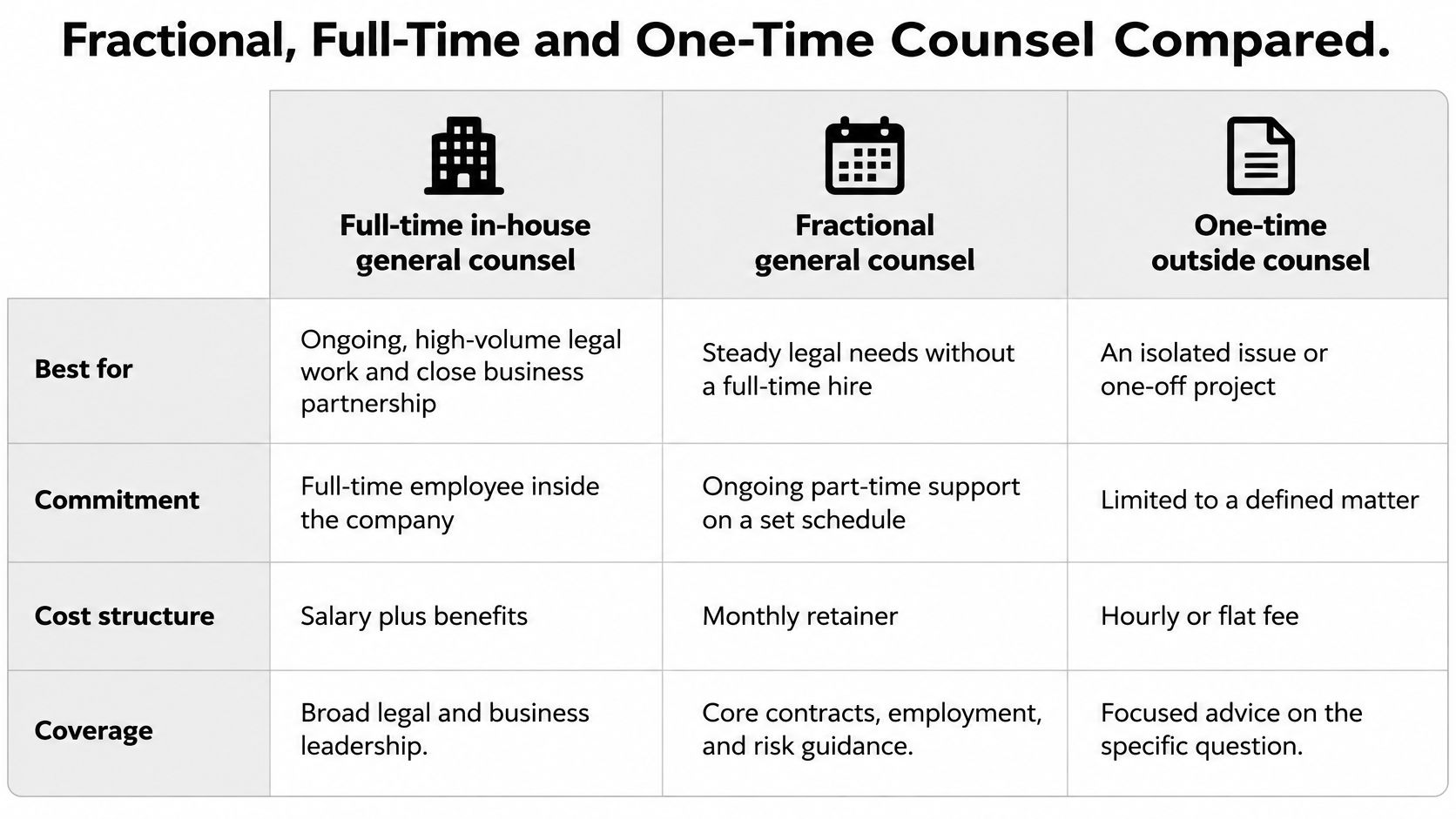
| Option | Coverage | Best fit | Limitation |
|---|---|---|---|
| Full-time in-house general counsel | Daily legal operations and governance inside the company | Companies with high contract volume and several departments | Highest fixed cost |
| Fractional general counsel | Ongoing part-time oversight with recurring advice and deliverables | Startups and small businesses that need frequent advice | Limited hours; litigation still goes to specialists |
| One-time outside counsel | A single matter such as a formation filing or one dispute | A defined project with a clear end | No continuous oversight or early warning |
The central distinction is continuity, not the lawyer's physical location. General counsel provides ongoing oversight; one-time counsel handles an isolated assignment, such as a formation filing or demand letter.
A fractional GC performs the coordinating role on a part-time basis. The business gets recurring legal attention without building a full internal department.
Match the Arrangement to the Workload
Fractional coverage typically includes contract review, entity and ownership changes, employment and contractor questions, privacy, intellectual property, regulatory escalation, and insurance coordination. Counsel also decides when an issue needs a specialist and helps frame the assignment so the business doesn't pay someone to reconstruct the background.
Litigation requires a separate scope and appropriate expertise. The same firm may provide that work, but a recurring advisory engagement shouldn't be treated as unlimited litigation coverage or unlimited on-demand availability.
Fees follow the agreed workload and arrangement. Use a small-business legal fees guide to prepare questions about included work, exclusions, response expectations, and additional matters, then obtain a written scope and estimate.
- Choose one-time counsel when there's a discrete question with a clear endpoint.
- Consider fractional counsel when contracts, hiring, customer data, or investor requests repeatedly need connected decisions.
- Evaluate a full-time hire when the workload requires daily participation across departments and sustained internal management.
Tip: Ask what concrete deliverables the opening phase will produce: a contract playbook, risk register, renewal calendar, and decision log are more useful than a broad promise of access.
A good fit isn't the arrangement with the longest service list. It's the one that gives your business enough attention, clear boundaries, and a practical route for urgent or specialist work.
Confirm Whether You Need Counsel Before Your Next Contract
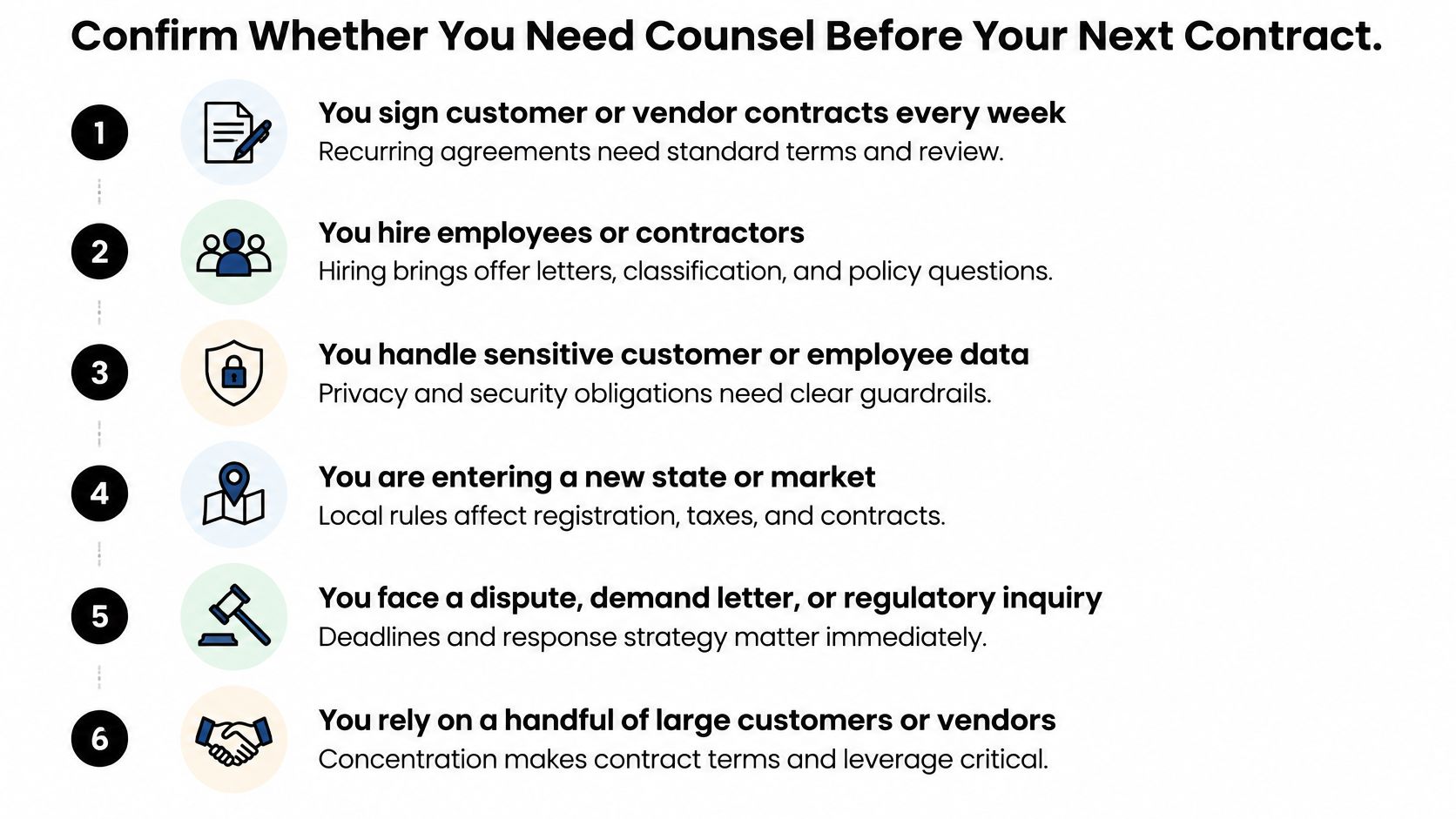
Your business may need general counsel support now if legal decisions are recurring and nobody owns the whole picture. Check which signs apply:
- Frequent agreements: You sign customer or vendor contracts every week.
- Hiring activity: You engage employees or contractors.
- Customer information: You collect data or publish privacy terms.
- Ownership changes: You plan to raise money or change ownership.
- Launch decisions: You're reviewing a new product or brand.
- Growing conflict: A dispute is building.
Count the legal tasks your team handled last quarter. Mark which needed specialist knowledge and which stalled because nobody knew who should decide.
- List recurring tasks and their current owners.
- Set approval thresholds for contracts and spending.
- Choose the support model that matches recurring needs or a defined project.
- Schedule a consultation with Coto & Waddington, Attorneys at Law by calling (786) 228-6361.
Our Fractional General Counsel service provides ongoing legal support for contracts, negotiations, business operations, and strategic decision-making. Bring your pending agreements, ownership documents, and unresolved questions so the discussion starts with actual work rather than hypothetical concerns.
Leave with a named owner for each legal area and a date to review the list. That's a concrete first step toward managing legal work before it becomes urgent.
Coto & Waddington, Attorneys at Law offers small-business general counsel support covering entity formation, custom contracts, IP strategy, regulatory compliance, brand and influencer deals, and dispute prevention. Visit Coto & Waddington, Attorneys at Law to discuss how ongoing counsel could support your next contract and the business decisions around it.