A term sheet lands in your inbox, the valuation looks strong, and then the cap table refresh shows your ownership percentage lower than it was yesterday. Equity dilution is the drop in your ownership percentage when the company issues new shares, even though your share count stays the same. In venture-backed startups, that drop builds across funding stages as each round adds more shares to the pool.
Founders asking what is equity dilution are rarely after a textbook gloss. They want to know whether the offer is fair, where ownership can leak, and whether a smaller piece of the cap table still leaves them richer. The useful split is percentage dilution versus economic dilution: your slice can shrink while the company value grows enough to make that slice worth more.
Table of Contents
- What Equity Dilution Means for Your Ownership
- How to Calculate Your Diluted Ownership Percentage
- Fundraising Rounds and SAFEs That Trigger Dilution
- Option Pools and Other Hidden Causes of Dilution
- Stake Value and Common Misconceptions About Dilution
- Protecting Your Stake With Pro Rata Rights and Anti-Dilution Terms
- Model Your Next Round Before You Sign
What Equity Dilution Means for Your Ownership
Equity dilution is the drop in an existing shareholder's ownership percentage when the company issues new shares or securities that convert into shares, while that shareholder's share count stays the same.
Imagine sharing an eight-slice pizza where you hold two slices, giving you 25% of the pie. Before anyone eats, the chef adds eight fresh slices to make a sixteen-slice pizza. You still hold your original two slices, yet those two slices now make up 12.5% of the whole pizza because the total pie doubled around you.
Startup stock behaves the exact same way. Nobody reaches into your account and confiscates your shares during a fundraise. Instead, the corporation creates new shares for incoming investors, employees, or advisors, expanding the total share pool and reducing the percentage each existing share represents.

Who Feels the Drop and What Else Changes
Every shareholder who doesn't buy into the new issuance absorbs the drop. That group includes founders, early employees holding stock or options, and earlier angel investors who sit out the new round.
Your stake percentage isn't just a vanity number on a spreadsheet. A lower ownership slice directly changes three practical rights:
- Voting power: Smaller ownership means fewer votes on board elections, charter amendments, and major corporate approvals.
- Dividend and liquidation participation: Your proportional claim on distributed profits or exit proceeds shrinks alongside your percentage.
- Future sale proceeds: If the company sells, your share of the payout starts from your diluted stake before any investor preferences apply.
Dilution isn't automatically harmful, though. Fresh capital can fund product launches, key hires, and revenue growth that turn a smaller slice into a much more valuable asset.
Practical tip: Pull your current capitalization table right now and locate your exact ownership percentage on a fully diluted basis before you evaluate any new financing offer.
How to Calculate Your Diluted Ownership Percentage
Calculating dilution comes down to a single division problem. According to the Y Combinator SAFE User Guide, the core formula is diluted ownership percentage = existing shares held ÷ total fully diluted shares after the transaction.
Suppose a founding team holds 8 million of 10 million fully diluted shares, giving them 80% ownership. When the company issues 2.5 million new shares to outside investors, the denominator expands to 12.5 million shares. The founders still hold 8 million shares, yet their stake drops to 64%.
A term sheet can't be judged on that percentage drop in isolation. Pairing the ownership math with a solid grasp of pre-money versus post-money valuation keeps you from giving away a deceptively expensive stake at a low valuation, because a small percentage concession still costs a lot if the implied company value is too low.
Five Steps to Run Your Cap Table Math
Relying on issued common stock alone creates blind spots that blow up right before closing. Follow this five-step routine in a spreadsheet or cap table platform such as Carta or Pulley every time you evaluate a new issuance:
- Gather every equity claim on the books: List every class of issued shares alongside all outstanding stock options, warrants, convertible notes, and SAFEs rather than stopping at common stock.
- Add promised and reserved shares to the base: Include options promised in offer letters that haven't been formally granted yet, plus every unissued share sitting inside your employee option pool.
- Layer in the proposed round: Add the exact count of new investor shares, or the estimated conversion shares for convertibles, that the transaction will generate.
- Divide your shares by the expanded denominator: Take your personal share count and divide it by the new fully diluted total to find your post-closing percentage.
- Stress-test across three financing scenarios: Run the same formula for your proposed round, a smaller raise at the same valuation, and a larger raise at a higher valuation so you can see how much equity each extra dollar costs.
Founder Ownership Before and After Dilution Events
Watching how consecutive issuances compound makes the math concrete. Starting from the 8 million founder shares above, issuing 2.5 million shares in a first raise and another 1.5 million shares in a follow-on issuance changes the cap table as follows:
| Stage | Founder shares | Total fully diluted shares | Founder ownership |
|---|---|---|---|
| Before the round | 8,000,000 | 10,000,000 | 80% |
| After issuing 2.5M new shares | 8,000,000 | 12,500,000 | 64% |
| After a further 1.5M shares | 8,000,000 | 14,000,000 | 57.14% |
Practical tip: Always model your resulting ownership percentage after every proposed issuance rather than focusing solely on the headline number of shares being sold.
Fundraising Rounds and SAFEs That Trigger Dilution
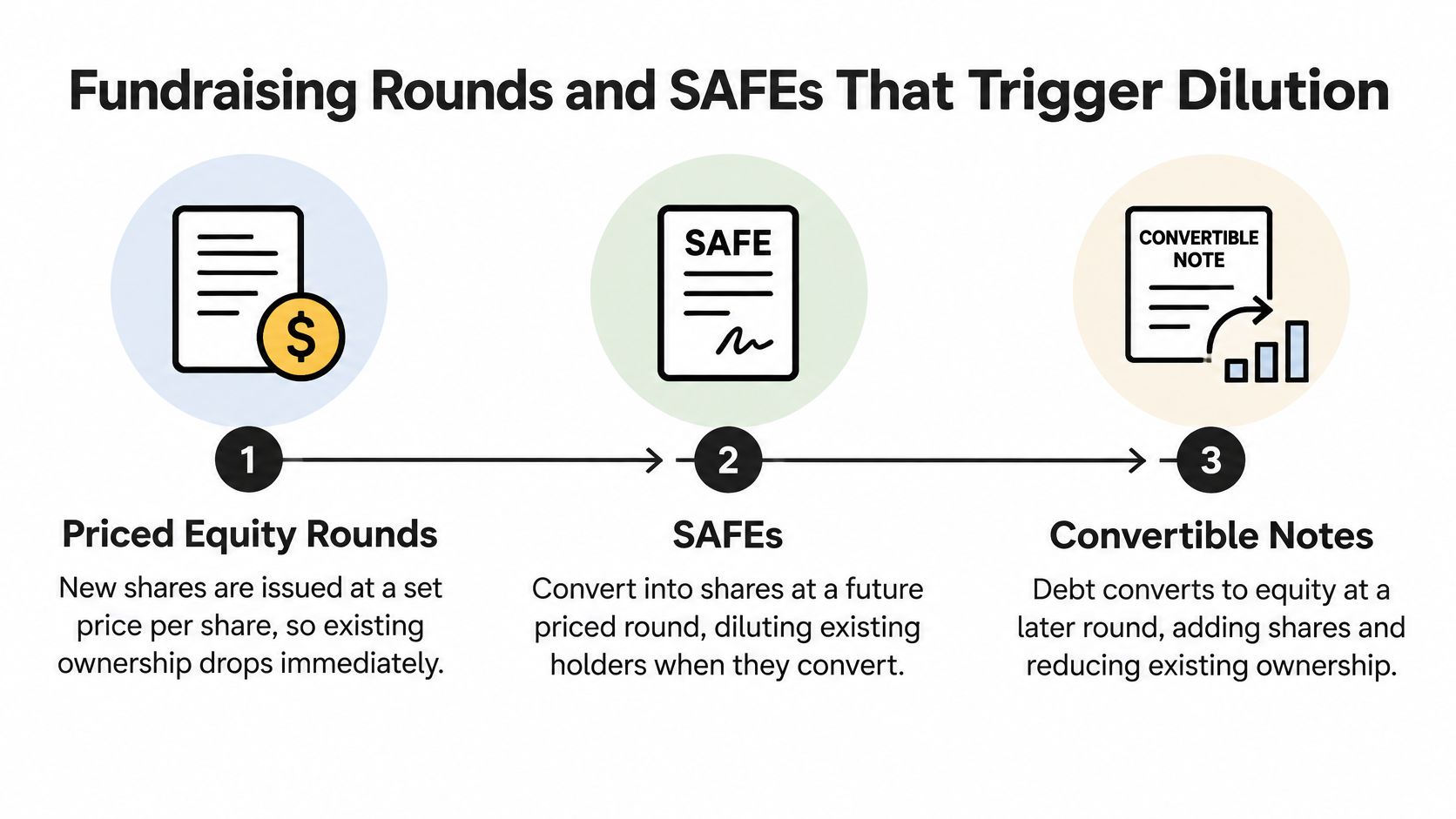
A founder signs a $500,000 SAFE and the cap table does not move. No shares change hands, no percentage drops, and it is easy to forget that the dilution is already scheduled. Early-stage companies raise outside capital through three main instruments, and each one hits your ownership on a different timeline.
- Priced equity rounds: In seed, Series A, or later priced rounds, investors buy newly created preferred shares at a negotiated price per share, so existing ownership drops the day the round closes.
- SAFEs: Short for Simple Agreements for Future Equity, these contracts postpone share issuance until a later priced round, converting into stock based on a valuation cap or discount rate.
- Convertible notes: Structured as short-term debt that accrues interest, convertible notes also defer share creation until maturity or a qualifying equity round, when principal and accrued interest turn into new shares.
How Post-Money SAFEs Stack Dilution
Because a SAFE agreement defers share issuance, founders often underestimate how quickly multiple checks add up. With a post-money SAFE, an investor's approximate ownership equals their check size divided by the post-money valuation cap.
An example in Y Combinator's post-money SAFE guide lays out the math plainly: a $500,000 SAFE at a $10 million post-money cap locks in 5% of the company, and a second $1 million SAFE at a $16 million post-money cap locks in another 6.25%, bringing total equity sold through SAFEs to 11.25%. Because each post-money SAFE measures its share after prior SAFEs but before the next priced round's new cash arrives, every extra SAFE dilutes founders and early employees rather than sharing that cost with earlier SAFE holders.
How post-money SAFEs lock in ownership: A post-money SAFE fixes the investor's percentage relative to existing holders before the new priced-round money enters the company.
Typical Dilution Across Early Funding Stages
Real market figures help you spot outliers without treating averages as rigid rules. After a seed round, the median founding team kept 56.2% of fully diluted equity across rounds raised from 2021 through 2025, based on data Carta published in 2026. At Series A, median dilution reached 20.5% in 2024 according to Carta's 2024 dilution report cited by Founder Ventures.
| Stage | Median dilution | Reported period |
|---|---|---|
| Seed | 20.1% | Q1 2024 |
| Series A | 20.5% | 2024 |
| Series B | 15% | Q4 2024 |
Treat these Carta numbers strictly as observed medians, never as fixed industry targets. Percentage dilution and economic dilution answer different questions: surrendering 20% at a strong valuation can leave your remaining stake worth more than a bigger slice of a company starved of capital. Your actual dilution depends on how much cash you need, your growth rate, and your negotiating position with investors. Staying visible with B2B buyers and potential investors between raises strengthens that position, and software teams who want consistent market updates without pulling product leads off shipping can compare NewsletterAsAService editorial packages while founder energy stays focused on fundraising milestones. A stronger negotiating position improves your dilution outcome.
Practical tip: Keep a running SAFE schedule in a single spreadsheet tab recording every check's purchase amount, valuation cap, discount, pro rata rights, and estimated ownership before you open conversations for a priced round.
Option Pools and Other Hidden Causes of Dilution
The employee stock option pool works like a reserved slice of a pizza. The slice may be meant for future hires, yet founders still see their own slice shrink when that reserve is created or enlarged before a round closes. Lead investors often require a pool sized for the next twelve to eighteen months of hiring.
That timing matters because term sheets usually place the pool inside the pre-money capitalization. Those reserved shares exist before new investors buy in, so current holders, especially founders, absorb that dilution. The incoming investors generally receive the ownership they negotiated without shouldering the new pool.
Common Causes of Dilution and Who Absorbs Them
Equity shrinks from several directions beyond standard investor checks. Mapping every source clarifies which events expand your fully diluted denominator and who shoulders the cost:
| Cause | Adds dilution? | Who usually absorbs it | Example |
|---|---|---|---|
| New priced-round shares | Yes | All existing holders, pro rata | 2.5M new shares on a 10M base |
| SAFE or convertible note conversion | Yes, at conversion | Founders and early holders | $500K SAFE at a $10M post-money cap |
| Pre-money option pool increase | Yes | Mostly founders | Pool added before new investors buy in |
| Option grants from an already-counted pool | No, on a fully diluted basis | Already counted in the pool | Options moved from pool to an employee |
| Promised equity to advisors | Yes | Existing holders | 0.5% promised before the round closes |
| Warrants | Yes, when exercised | Existing holders | Lender warrant for 1% of fully diluted shares |
| Recapitalization or new share class | Yes, if total shares expand | Holders excluded from the new issuance | Reclassification that changes the share count |
The option grant row deserves close attention. If a pool is already counted on a fully diluted basis, moving options from that pool to an employee does not add a fresh slice of dilution. Economic value still shifts once those options vest, because shares that were merely reserved now belong to a person or team.
Promised advisor equity can create a similar surprise. A small commitment made before financing may look harmless at the moment, but if it is added to the cap table near closing, it expands the denominator again. Warrants behave like doors left open. They matter most when exercised, because new shares then enter the count.
Why the Capitalization Definition Changes Everything
Small drafting choices in how a term sheet defines company capitalization can swing ownership percentages dramatically. The Y Combinator SAFE calculator materials explain general SAFE conversion mechanics, including how post-money SAFE ownership relates to the SAFE cap before new priced-round cash arrives.
An option-pool increase before closing can still reduce the percentage a SAFE holder receives at conversion. The reason is straightforward: if more shares are reserved before the SAFE converts, the same SAFE investment is spread across a larger fully diluted base. The investor may still receive the economics tied to the SAFE cap, but the final ownership percentage depends on the capitalization assumptions used at conversion.
This is why two term sheets with the same investment amount and valuation can produce different ownership outcomes. One may assume the existing pool is sufficient. Another may require a new pool, or an expanded one, before conversion and new money. Founders who review only the headline valuation can miss that extra squeeze.
Practical tip: Before accepting any term sheet, request a fully diluted pre-money and post-money cap table listing every security and pool assumption. Calculate ownership at three checkpoints (at conversion, after the option-pool increase, and after the new money), then get written confirmation that the closing documents match those numbers.
Stake Value and Common Misconceptions About Dilution
Focusing purely on your ownership percentage invites bad decisions. Picture a pizza cut into slices: a bigger slice of a small pizza may be less food than a smaller slice of a much larger one. Equity works the same way. Compare two hypothetical founders who take different financing paths:
| Scenario | Founder ownership | Company value | Stake value |
|---|---|---|---|
| Founder A, smaller company | 70% | $5M | $3.5M |
| Founder B, larger company | 40% | $20M | $8M |
Founder A holds 70% of a $5 million business, giving them a $3.5 million stake. Founder B accepted more dilution and owns 40% of a $20 million business, making their smaller slice worth $8 million.
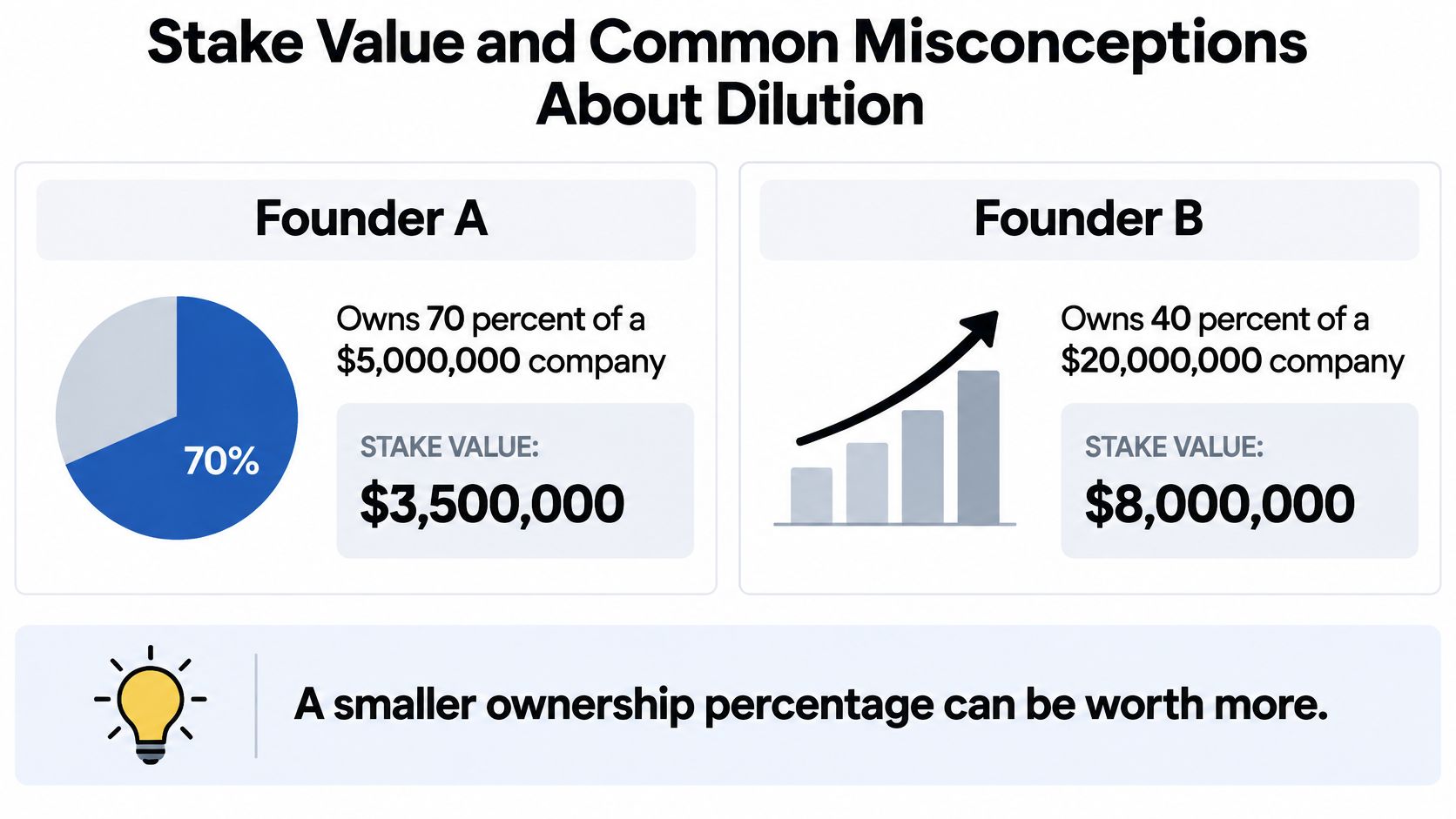
These simplified numbers leave out real-world deal terms like liquidation preferences, investor control rights, and option-pool carve-outs, all of which influence what common stock collects in an exit. Even so, the core contrast holds: percentage dilution measures how much your slice shrank, while economic dilution measures whether the transaction grew or reduced the dollar value of your holdings.
What Private Market Data Shows About Dilution Trends
Giving up equity as you scale is standard operating procedure, not a sign of a broken company. According to Carta's 2026 Founder Ownership Report, the median founding team retained approximately 36% of the company after closing a Series A round. That means founders often keep meaningful ownership after outside money arrives, even though the cap table looks more crowded.
Recent funding conditions also show that dilution shifts with market cycles rather than staying locked at a fixed rate. In Carta's State of Private Markets Q1 2026 report, dilution declined across every funding stage for three consecutive years while startups raised $30.4 billion in Q1 2026 alongside fewer down rounds. Looking further back, Carta's Q4 2024 private markets analysis tracked how median dilution eased between Q1 2019 and Q1 2024, falling from 23% at seed, 24.1% at Series A, and 20.8% down to 16.7% at Series B, with Series B dilution also down from 18.6% the year before.
The practical lesson is to judge the whole financing package. Valuation, round size, liquidation preferences, voting rights, and option-pool treatment all affect the result. A lower dilution percentage can still be a poor outcome if the valuation is weak or investor rights shift control. A higher dilution percentage can still be a good trade if the capital meaningfully increases company value.
Four Common Misconceptions About Equity Dilution
Clearing up a few recurring myths keeps you focused on terms that affect your outcome:
- A smaller percentage is always harmful: Owning less of the company only hurts economically if the new capital fails to raise enterprise value enough to offset the extra shares.
- Dilution only happens in priced rounds: Even without a formal Series A or B, option grants, convertible-security conversions, advisor stock issuances, and recapitalizations all reshape ownership.
- Your share count drops after a fundraise: Issuing new stock expands the total share denominator, leaving your personal share count completely unchanged.
- Authorized shares cause immediate dilution: Authorized shares set the maximum ceiling in the corporate charter. Dilution occurs only when shares are issued. In a simple illustration, a holder with 100 of 1,000 outstanding shares (10%) drops to 5% only after the company issues another 1,000 shares.
Practical tip: Review your charter's authorized-share headroom alongside your fully diluted cap table before approving any financing or option-pool expansion so you don't trigger unexpected charter amendments mid-close.
Dilution is measured on the fully diluted base, not on the shares you can see.
Protecting Your Stake With Pro Rata Rights and Anti-Dilution Terms
Existing shareholders aren't completely passive when a company raises new capital. Two contractual mechanisms shape how dilution lands across future rounds: pro rata rights and anti-dilution provisions.
Pro rata rights, closely related to corporate preemptive rights, give an existing shareholder the contractual option to invest in a future round in proportion to their current stake. If an investor or founder exercises that right and writes a check, their ownership percentage stays level instead of dropping. Without pro rata rights, or without the cash to exercise them, an existing holder absorbs the full dilution of the new issuance.
Anti-dilution provisions work differently. These clauses protect preferred stockholders during a down round, meaning a later financing priced below the prior round's share price, by lowering the conversion price of earlier preferred shares so those investors receive extra shares on conversion. Because anti-dilution protection almost always shields preferred investors at the expense of common holders like founders and employees, the exact formula written into your charter matters enormously.
Four Contractual Checks Before You Negotiate
Run through these four questions whenever a term sheet, SAFE, or side letter lands in your inbox:
- Confirm who gets pro rata rights: Check whether participation rights apply only to major investors above a set dollar threshold or extend broadly to smaller angels, which can crowd out future lead investors.
- Audit existing SAFEs and convertible notes for side letters: Early investors frequently request pro rata side letters alongside a SAFE, and stacking too many creates allocation headaches at Series A.
- Read the anti-dilution language in both the term sheet and the charter: Make sure you understand whether the clause uses a broad-based weighted average formula or a harsher structure that shifts severe dilution onto common stock during a rough market.
- Verify where the option-pool increase sits: Confirm explicitly whether a requested pool top-up is carved out of the pre-money valuation or shared post-money with incoming investors.
Practical tip: Never treat pro rata side letters or anti-dilution clauses as harmless boilerplate. Have startup legal counsel review the exact charter and term sheet language before you sign anything binding.
Model Your Next Round Before You Sign
Clean fundraising starts long before wire transfers clear. Before you commit to a valuation cap or sign a term sheet, walk through this four-step pre-signing routine:
- Model three competing scenarios: Compare the proposed round against a smaller raise at the same valuation and a larger raise at a higher valuation, then inspect all three resulting cap tables side by side.
- Calculate ownership at every conversion step: Map your percentage at SAFE or note conversion, right after any pre-money option-pool increase, and after the new priced-round cash closes.
- Confirm corporate governance basics: Verify your authorized-share headroom, secure the required board and stockholder approvals, and check the post-closing fully diluted cap table before signing.
- Maintain a live convertible schedule: Keep every SAFE and convertible note in one updated tracker showing purchase amount, valuation cap, discount, pro rata rights, and estimated ownership.

Three Questions to Answer Before Saying Yes
Numbers alone don't capture every trade-off in a financing. Before you accept investor terms, put clear answers on paper for three strategic questions:
- What milestones will this capital fund? Tie every dollar raised to specific product, hiring, or revenue goals that will lift company value before your next raise.
- How was the valuation set? Separate a headline pre-money valuation from the effective pre-money value left after option pools and converting SAFEs take their share.
- What control rights come with the check? Weigh board seats, protective provisions, and liquidation preferences right alongside the dilution percentage.
Make one firm rule for yourself and your co-founders: do not sign closing documents until the legal paperwork matches your own cap table calculations in writing. If a spreadsheet says you retain one percentage and the charter language produces another, the charter wins every time.
Getting that alignment right is where experienced startup counsel pays off. At Coto & Waddington, Attorneys at Law, our founder equity services cover structuring founder stock, vesting, option plans, and investor rounds including SAFEs, convertible notes, and Series A financings, alongside fundraising readiness work covering cap table hygiene, SAFE and convertible note review, and due diligence preparation.
Before you sign your next SAFE, convertible note, or priced term sheet, make sure your cap table and closing documents tell the exact same story. Coto & Waddington, Attorneys at Law helps startups structure founder equity, review option plans and convertibles, and clean up cap tables ahead of investor due diligence. Schedule a cap table and fundraising readiness review with Coto & Waddington, Attorneys at Law so you enter your next negotiation with clear numbers and protected terms.