The most popular advice about a software as a service contract template is to download a standard form, change the names, and negotiate the liability cap. That starts in the wrong place. Map the product's features, data flows, and AI functions before editing clauses, because you can't allocate risk sensibly until you know what the service does.
A subscription dashboard, a payment workflow, and a chatbot that retains customer conversations shouldn't use identical terms. The useful template is a map of who controls each activity, who pays when something fails, and how the customer leaves without losing its records.
Table of Contents
- Core Clauses Every SaaS Contract Template Needs
- How to Tailor the Template to Your Services and Customers
- Writing Uptime and Credit Terms You Can Measure
- Data Processing Terms Your Template Needs
- Breach Notice Deadlines to Write Into the Contract
- AI Features, Training Rights and Model Changes
- Confirm Liability and Exit Terms Before You Sign
Core Clauses Every SaaS Contract Template Needs
Core SaaS contract clauses and what to adapt
| Clause | What It Controls | What to Adapt |
|---|---|---|
| Subscription term and renewal | Length, auto-renewal and notice window | Match the notice window to your billing cycle |
| Fees and price changes | Base fee, billing frequency and increase limits | Cap annual increases and state the billing trigger |
| Usage limits | Seats, storage, API calls or records included | Name the metric that matches how you price |
| Service levels and credits | Uptime, support response and remedies | Convert percentages into measurable downtime |
| Customer data and processing | Ownership, permitted use and processing role | Add a processing schedule for personal data |
| Security and breach notice | Safeguards, incident definition and notice timing | Set a short notice deadline |
| AI features and training | Inputs, outputs, model training and model changes | Add an AI rider tied to each feature |
| Intellectual property and license scope | Platform ownership and permitted access | Separate platform IP from customer content and custom deliverables |
| Liability and indemnity | Caps, exclusions and who pays for claims | Align caps with the data and risk you handle |
| Termination and data return | Exit rights, data export and deletion timing | Set a return window measured in days |
These provisions describe a continuing service, not merely permission to install software. Under the NIST cloud computing definition, customers use the provider's applications while the provider controls the underlying infrastructure. Access, operational responsibility, and data handling therefore belong in the same commercial bargain.
Fees buy continuing access. Service levels define the promised performance, while data provisions govern what happens to information the customer loads into the application.
Fix the commercial mechanics first
Put the nonrenewal deadline before the customer becomes committed to the next billing period, with enough time to evaluate any price increase. State whether billing starts at signature, account activation, or production launch, rather than leaving finance and sales to choose different dates.
Usage language needs equal care. If pricing is based on active users, define active users and explain how administrators, suspended accounts, and temporary access count. Storage and API overages need a measurement source, notice process, and clear billing treatment.
Practical rule: A clause isn't finished until the business team can explain how it operates without asking the drafter.
Don't let a broad platform license absorb customer content or separately commissioned deliverables. Identify who owns each asset and what limited rights the other party needs to perform the contract.
Tip: Mark every table row your template leaves blank or vague before editing individual sentences. Those gaps are your negotiation agenda.
How to Tailor the Template to Your Services and Customers
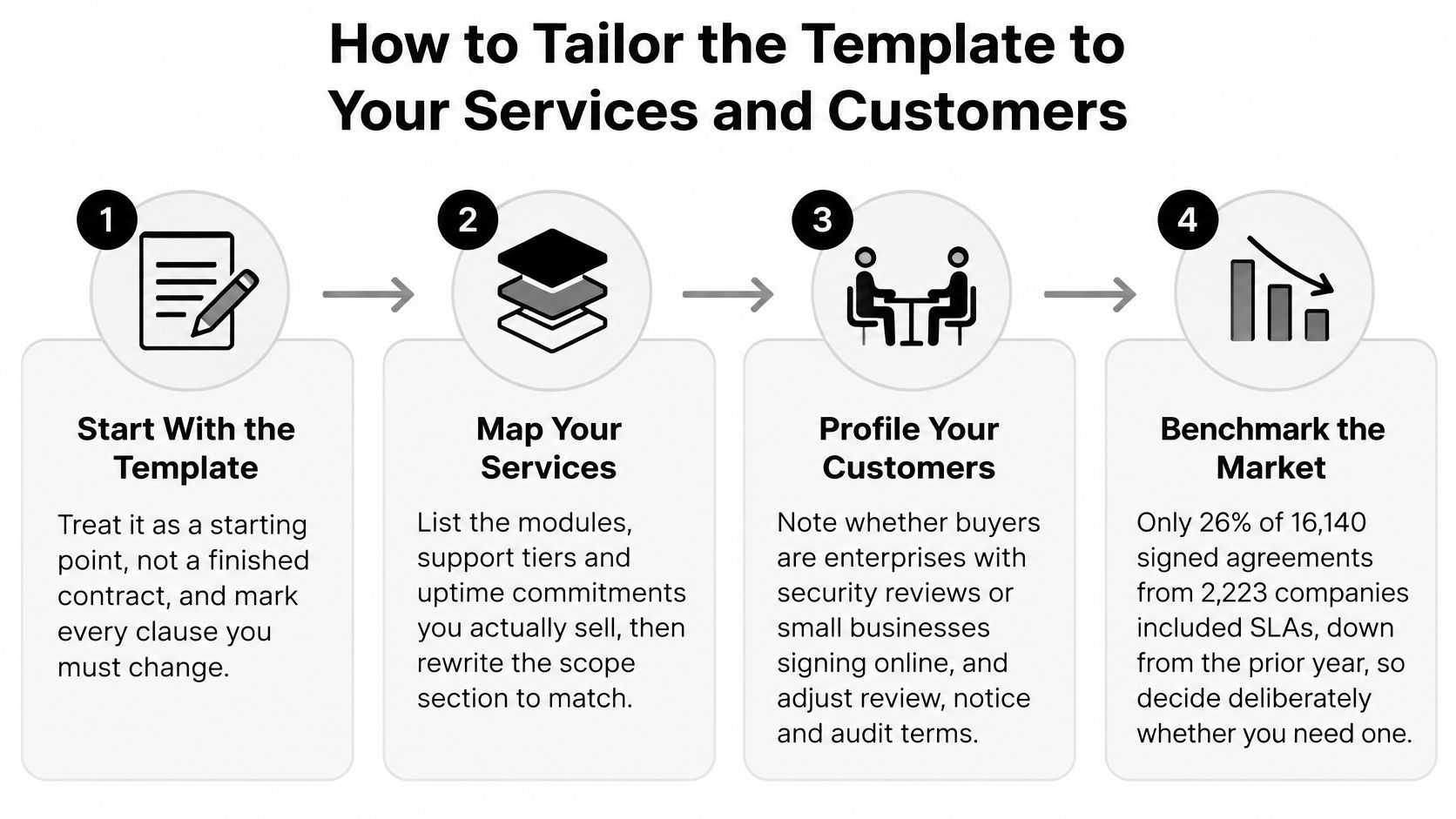
A SaaS template is a risk map, not just a set of standard clauses. Tie each provision to the product feature, customer use, and data flow it governs. Online templates rarely match a specific business model, so customized agreements protect scope, revenue, intellectual property ownership, and termination rights.
Build the draft around actual exposure
Map features and data flows. Track account creation, imports, integrations, support access, exports, and AI tools. For each feature, identify what information it receives and where that information goes.
Classify customer risk. Distinguish internal productivity tools from products used in customer-facing operations or with financial, health, or other regulated information. Different use cases may call for different contract terms.
Set commitments the team can meet. Match support coverage and service promises to the workflow customers buy. A contract should not promise urgent restoration if the team only monitors tickets during business hours.
Allocate financial exposure. Set liability terms and indemnities in light of plausible losses, not only the subscription fee. Consider which party controls the event and can prevent or limit it.
Add relevant exhibits. Include security, data-processing, or AI schedules when a product feature calls for them. Obligations that do not fit the service can create work the team cannot perform.
Compare the customer's form. Record deviations from your approved terms and identify which document controls if provisions conflict. An order form that takes precedence can override a negotiated exhibit.
Risk tier to contract terms
| Risk tier | Uptime tier | Breach and security terms | Liability position |
|---|---|---|---|
| Internal productivity tool | Baseline availability commitment | Standard security schedule and contractual notice | General cap tied to fees |
| Customer-facing tool used daily | Enhanced availability with restoration targets | Prompt contractual breach notice | Higher cap for confidentiality and data breaches |
| Financial or health data | Critical-workflow availability with recovery commitments | FTC Safeguards or Health Breach deadlines where applicable | Data breaches carved out or capped higher |
Use these as drafting positions, not automatic legal requirements. A financial-data product that is not operationally critical may need stronger security terms without the highest availability commitment.
Tip: Maintain a clause log with each change, its reason, and its approver. The finished template should identify the product and customer risk tier it covers, rather than claim to fit every use case.
Writing Uptime and Credit Terms You Can Measure
Uptime commitments and illustrative average-month downtime
| Uptime commitment | Maximum downtime in an average month |
|---|---|
| 99.9% | About 43 min 49 s |
| 99.95% | About 21 min 55 s |
| 99.99% | About 4 min 23 s |
These figures are illustrative conversions. The agreement's measurement period controls: a calendar-month calculation varies with the month's length, and exclusions can materially reduce the downtime that counts.
Define what the monitoring actually measures
A template should connect availability promises to the product features customers rely on. The provider's standard terms set the starting position. For a critical workflow, negotiate stronger commitments only after confirming the provider can deliver them.
- Measurement point: Specify whether availability means a successful login, a functioning API endpoint, or completion of a core transaction. A reachable homepage does not establish that checkout works.
- Monitoring evidence: Name the monitoring source and explain how the parties will resolve conflicting logs. State how partial degradation counts.
- Exclusions: Address planned maintenance, customer configuration, beta features, force majeure, and third-party outages. Avoid excluding every infrastructure supplier if the provider selected and manages them.
- Incident handling: Set separate expectations for acknowledgement, technical response, restoration, and permanent resolution. These are different commitments.
- Remedies: Make credits automatic where practical, or set a workable claim window and evidence requirements.
Master services agreements and statements of work set deliverables, payment terms, acceptance criteria, liabilities, and termination rights. Keep implementation acceptance separate from continuing availability, and use a vendor contract review checklist to check that the documents do not contradict one another.
A credit reduces the service bill. It may not cover the loss caused by an outage.
An outage can interrupt sales, require manual recovery work, or create regulatory exposure, even when the customer receives a contractual credit. A provider, in turn, may resist responsibility for every customer's business losses under a low-priced subscription.
Tip: Set tiered credits, chronic-failure termination rights, and recovery obligations together. Check whether credits are the exclusive remedy for every failure or only for missed availability targets. Preserve appropriate rights for separate security failures, data loss, and material breaches.
Data Processing Terms Your Template Needs
Prepare the data-processing schedule before customer records enter the product. A generic statement that each party follows privacy law doesn't identify what the provider may do with those records.
Where it applies, GDPR Article 28 requires the processor contract to specify the processing subject matter and duration, nature and purpose, personal-data types, data-subject categories, and controller rights and obligations.

Turn the feature map into binding instructions
Identify the parties' roles. Determine whether the customer acts as controller and the provider as processor for each activity. Don't assume the same label covers customer-directed hosting and the provider's independent marketing activities.
Describe the processing. Explain its subject matter, duration, nature, and purpose. For authentication, that might mean using account credentials to manage access, not permission to reuse account information for unrelated advertising.
Inventory people and information. List relevant personal-data types and data-subject categories. Include support attachments, logs, and imported records, not just the fields visible on the signup screen.
Allocate operational duties. Cover documented instructions, confidentiality, security, subprocessors, breach assistance, audit cooperation, deletion or return, and onward transfers. Assign an owner for responding to customer requests.
Use a data processing agreement template as the contractual structure, then populate it from the actual product architecture. Attach a subprocessor list with a change-notification mechanism and address what happens if a customer raises a justified objection.
Don't leave hidden processing outside the schedule
Map authentication, analytics, support access, backups, logging, and AI functions to permitted purposes. Support personnel viewing a customer's screen and an external analytics service receiving event data both deserve attention, even if neither changes the primary product workflow.
A privacy policy isn't a replacement for a binding processor agreement. Likewise, backups aren't an unrestricted exception to deletion obligations: explain retention, restricted use, eventual removal, and what happens if a backup is restored.
Tip: Separate customer instructions from independent provider uses such as telemetry, product improvement, advertising, and model training. A clear record of those decisions makes procurement and compliance reviews more useful than broad assurances that all processing is necessary to provide the service.
Breach Notice Deadlines to Write Into the Contract
Breach notice deadlines by regime and the clause to add
| Regime | Trigger | Notice Deadline | Clause to Add |
|---|---|---|---|
| US state breach notification laws | Breach of personal information meeting the applicable law's conditions | Set by each state law | Immediate customer notice and cooperation on legal notices |
| FTC Safeguards Rule | Covered notification event involving unencrypted customer information affecting at least 500 consumers, as explained by the FTC's Safeguards Rule guidance | As soon as possible, no later than 30 days after discovery | Vendor information needed to meet the FTC deadline |
| FTC Health Breach Notification Rule | Covered breach of unsecured identifiable health information affecting 500 or more individuals, under the FTC's health breach rule explanation | Without unreasonable delay, no later than 60 calendar days after discovery | Escalation duty and third-party notice obligations |
| Contractual trigger recommended | Any suspected unauthorized access | Immediately after discovery | Earlier operational escalation than the legal reporting threshold |
A general confidentiality clause isn't enough. The FTC's breach response guide explains that all US states, the District of Columbia, Puerto Rico, and the US Virgin Islands have breach-notification laws, and warns that inadequate disclosures can create liability under Section 5 of the FTC Act.
Separate vendor escalation from regulatory reporting
The customer's regulatory role determines which legal rows apply. The Safeguards Rule provision concerns covered financial institutions, while the health rule can reach personal-health-record vendors and related entities outside HIPAA.
For the health-rule threshold in the table, FTC notification must occur alongside individual notification; media notification may also apply. Don't treat a regulatory outer limit as permission for the SaaS vendor to remain silent while the customer's reporting clock runs.
Define discovery, the recipient of notices, and the information required in the initial report. Permit staged updates when the investigation is incomplete, but require known facts, containment steps, affected systems, and an identified response contact.
Make the security promise operational
The FTC's data-security guidance supports treating security as an ongoing program, not a certification collected at signing. Attach concrete obligations for access controls, encryption, vulnerability management, training, backups, subcontractors, and evidence preservation.
Tip: Require immediate notice after discovery of suspected unauthorized access. An initial warning can be incomplete without being misleading.
Allocate investigation, remediation, regulatory communications, and notification costs expressly. Have counsel tailor the clause to the data collected, customer locations, and industry rules before signing.
AI Features, Training Rights and Model Changes
A broad AI disclaimer doesn't answer the questions that cause trouble. Conventional licensing and warranty clauses can leave customer data, inputs, outputs, derived data, embeddings, and training data bundled together even though the parties need different rights in each.
The Contracting with AI Vendors guidance recommends addressing training permissions, confidential inputs and outputs, model providers, and material model changes expressly. Those are operational decisions, not matters to leave to a general statement that AI may be inaccurate.

Ask feature-specific questions
- Can the provider train or improve models with customer information? State the default and whether affirmative opt-in is required. Distinguish service delivery from training a model used for other customers.
- Who bears responsibility for inaccurate outputs? Assign human-review duties and prohibited uses, but don't use them to excuse unrelated failures to follow agreed instructions.
- Are prompts retained? Identify retention purposes and deletion mechanics across the application and underlying model provider.
- What happens when the model changes? Define material changes, notice, testing opportunities, and available responses when a replacement affects functionality or data treatment.
Say a support chatbot stores transcripts containing customer complaints and account details. Its rider should address retention, access, confidential outputs, and a separate training opt-in rather than treating every conversation as unrestricted product-improvement material.
An internal analytics feature may need only targeted model-change notice if the underlying data rights, retention, and processing obligations are already adequately addressed. It shouldn't acquire broader training rights merely because another feature uses them.
Use a rider rather than a blanket disclaimer
An optional AI rider should include definitions, no-training or opt-in language, human-review obligations, output-use restrictions, confidentiality, incident reporting, and a specific indemnity. Identify model providers and align the rider with the subprocessor schedule.
Avoid promising exclusive ownership of every output without considering what the provider can grant. Separate contractual allocation between the parties from any guarantee that an output qualifies for intellectual-property protection.
Tip: List every AI feature and the provider behind it before drafting. South Florida companies selling nationally or globally should assess the privacy and AI obligations attached to each customer's use, rather than assuming the same product always creates the same legal exposure.
Confirm Liability and Exit Terms Before You Sign
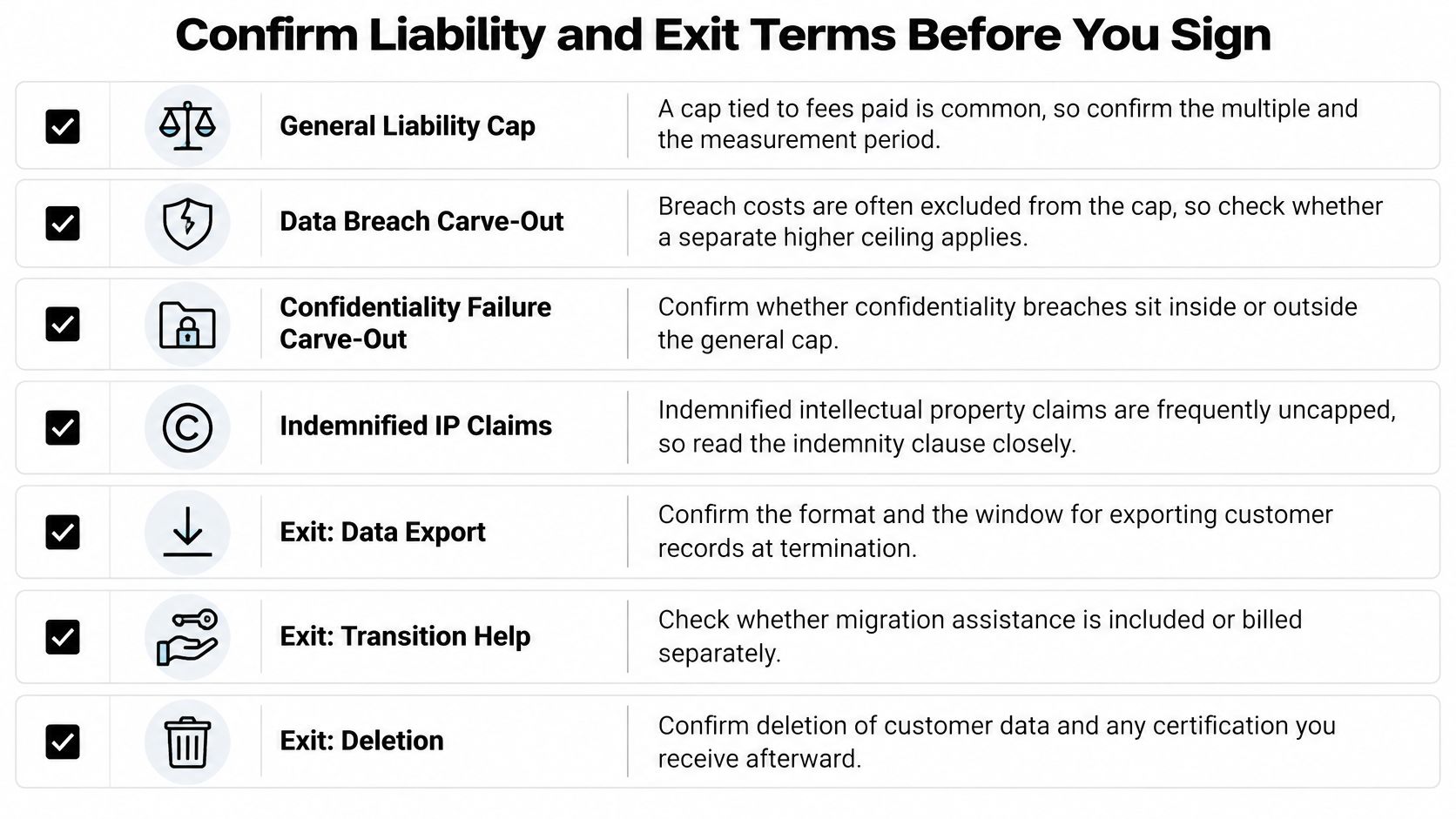
The final review should answer a commercial question: Does the agreement leave either party responsible for a loss it can't control or realistically absorb? A cap tied to fees can be a sensible general position, but it doesn't settle the treatment of confidentiality failures, data breaches, or indemnified intellectual-property claims.
Read the cap alongside the exclusions of damages and the indemnity. A nominally higher ceiling may offer little protection if the contract excludes the very response costs or third-party claims the parties intended it to cover.
Read the liability provisions as a package
Specify the fees used to calculate the cap, the measurement period, and whether the ceiling applies in aggregate. Check whether related events count together and whether an indemnity sits inside the general cap, under a separate higher cap, or outside both.
Higher protection has a commercial cost. A provider accepting broader exposure may need stronger customer-use restrictions, insurance, additional security controls, or different pricing; a customer accepting a low cap may need a narrower permitted use.
For IP indemnities, address notice, defense control, settlement consent, and practical remedies such as replacing infringing functionality. Don't let a settlement impose operational obligations on the customer without its agreement.
Make departure possible in practice
Include termination for cause and chronic SLA failure, with appropriate cure procedures. A termination clause in a service agreement also needs to explain what survives termination and what happens to prepaid fees, outstanding charges, and customer access.
Specify an export format the customer can use, a return window measured in days, and whether transition assistance is included or separately billed. Schedule deletion after return, address retained backups, and require appropriate deletion certification.
Clear drafting can change the dispute outcome. In a vendor dispute involving failed service delivery, general counsel's pre-signature review and revision of the MSA, including clear termination clauses, supported enforcement and cost recovery without litigation. That doesn't guarantee a similar result, but it illustrates why exit language deserves attention before performance deteriorates.
Use the signature checklist
- Confirm the uptime tier matches the product's risk tier and operational capacity.
- Confirm the processing schedule accounts for every feature and subprocessor.
- Confirm breach deadlines match each applicable regime and internal escalation process.
- Confirm the AI rider covers each AI feature and material model-change notice.
- Confirm liability carve-outs match the information and claims at stake.
- Confirm the exit window includes usable export, transition arrangements, and deletion certification.
Tip: Flag every blank, unresolved cross-reference, and vague obligation. Assign an owner to each issue instead of leaving comments that nobody must close.
The decision is binary: ready to sign or needs counsel review. If a material risk remains unassigned, send the marked-up template to a business attorney before the first customer signs.
Coto & Waddington, Attorneys at Law offers contract review, redlining, and negotiation for SaaS deals, with flat, predictable pricing and transparent proposals. Bring your marked-up template, feature map, and unresolved clause log to Coto & Waddington, Attorneys at Law so we can align the agreement with your subscription model, data obligations, and exit requirements.