Authorized stock is the maximum number of shares a corporation is legally permitted to issue, set in its certificate of incorporation or charter. A charter can authorize hundreds of millions of shares even when most of them have never been sold to anyone.
You're probably looking at a formation questionnaire, a Delaware charter, or a draft term sheet, and a blank asks how many shares the company should authorize. It feels like an ownership question. The number instead describes capacity, not who owns what.
Authorized stock works like headroom in a parking garage: the spaces exist on paper long before any car parks in them. Founders size that reserve at formation for future investors, employee equity and acquisitions, then confirm it again before every raise, because running out mid-round forces a charter amendment and stalls the closing.
Table of Contents
- What Authorized Stock Means for Your Corporation
- Authorized, Issued and Outstanding Shares Compared
- How Companies Authorize and Size Shares at Formation
- Amending Authorized Shares When You Run Out
- Reading Authorized Shares in a Term Sheet or Filing
- Common Mistakes and Your Pre-Raise Check
What Authorized Stock Means for Your Corporation
A founder opens her charter, reads that the company authorizes 10,000,000 shares, and assumes that number says something about ownership. It doesn't. Nobody owns an authorized share until the corporation issues it. That figure is a ceiling on what the company can issue in the future, which makes it a planning reserve rather than a description of the cap table today.
Authorized stock is the maximum number of shares a corporation is legally permitted to issue under its certificate of incorporation or charter. It works like a credit limit on a card. The limit is not money spent. Issued shares are what has been charged so far, and outstanding shares are what holders still carry after any buybacks. Shares the company repurchases sit in treasury, which is why issued can run larger than outstanding.
Under Delaware's General Corporation Law, the charter must state the total number of authorized shares and, when more than one class exists, how many shares each class carries, along with par-value information. A company can authorize shares at formation and issue only part of them, holding the rest for later financing, employee equity, or an acquisition.
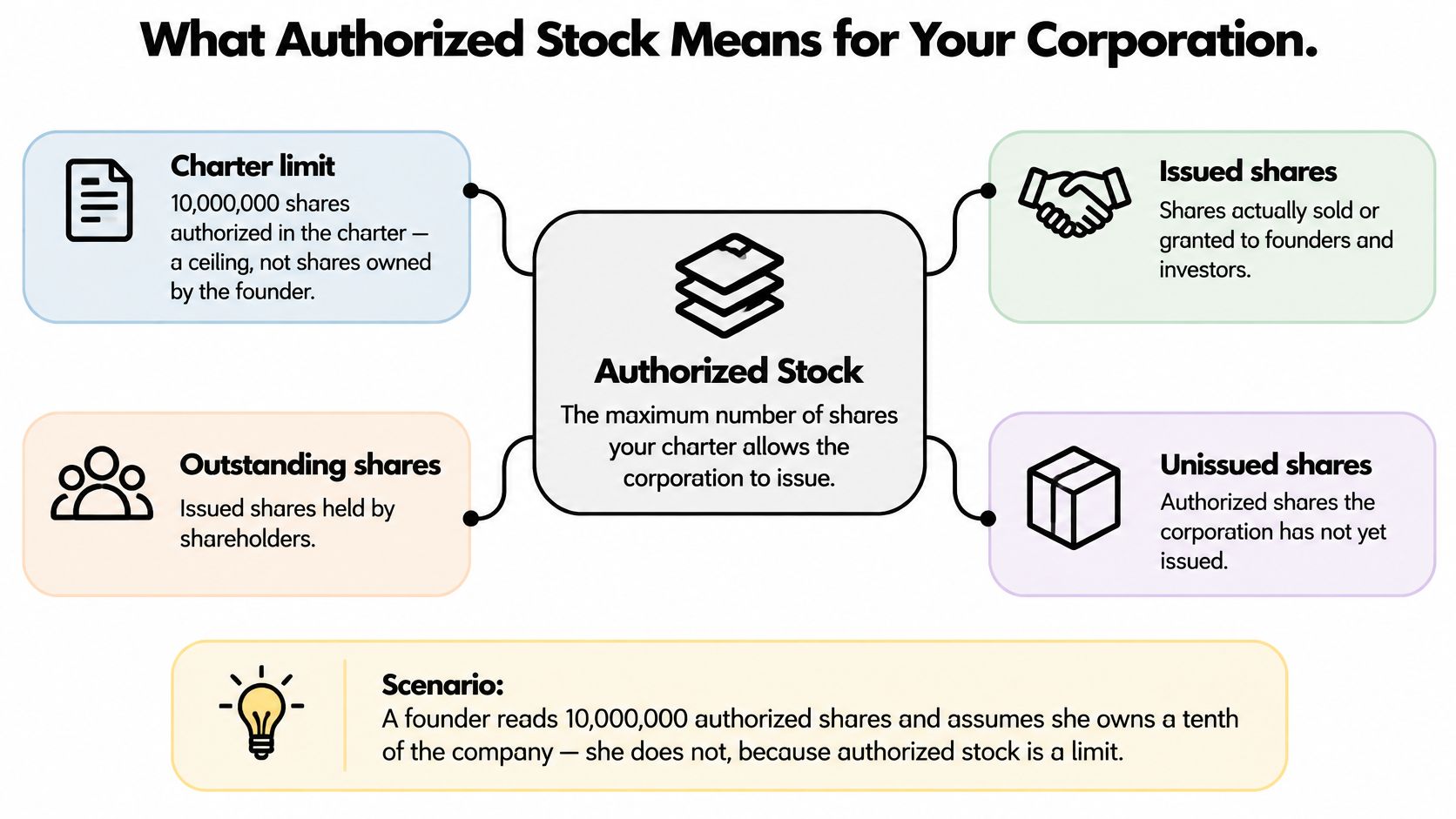
That reserve framing is the part founders miss. A corporation routinely authorizes far more shares than it has ever issued, and issued in turn runs at least as high as outstanding. The authorized total sets legal capacity for future issuances. It does not set ownership percentages, valuation, or dilution on its own. Those outcomes depend on how many shares have been issued and the rights attached to each class, so a large authorized number on a charter tells you the company's headroom, not its ownership.
Practical rule: Pull the charter before any negotiation. Write down the authorized total, the per-class split, and how many shares people actually hold today.
If part of that reserve is meant to cover a future acquisition, decide early whether you expect to choose between asset and stock purchases. A stock deal often means issuing shares as currency, while an asset deal usually doesn't. That choice changes how much unissued capacity you should keep in hand before your next raise.
Authorized, Issued and Outstanding Shares Compared
Four counts show up in every serious capitalization conversation. Mix them up and a founder percentage, a voting tally, or an option grant is wrong before the first signature.
| Share count | What it counts | Example figure |
|---|---|---|
| Authorized | Maximum the charter permits | 1,000,000,000 |
| Issued | Shares sold or granted, including treasury shares | 316,781,000 |
| Outstanding | Issued shares held by stockholders, excluding treasury | 159,422,000 |
| Unissued authorized | Authorized minus issued | 683,219,000 |
Walk the filing row by row
An SEC filing's share accounting reported 1,000,000,000 authorized common shares, 316,781,000 issued shares, and 159,422,000 outstanding shares. Start at the ceiling. One billion is what the charter allowed, not what anyone owned. Move to issued. 316,781,000 shares had been sold or granted, and that bucket still includes shares later repurchased and held in treasury. Move to outstanding. Only 159,422,000 remained in stockholders' hands.
Subtract outstanding from issued and the gap is 157,359,000 shares. That gap is treasury stock. The formula is straightforward: outstanding shares = issued shares − treasury shares. Authorized shares can sit far above both. Unissued authorized stock is authorized minus issued, here 683,219,000. Those shares belong to no founder and no investor. They aren't outstanding ownership until the corporation issues them.
What each count actually drives
Voting power and ownership percentages are measured against outstanding shares, or against fully diluted shares when options, warrants, and convertibles are in the deal. They aren't measured against the charter ceiling. A founder who owns 600,000 outstanding shares does not own 600,000 divided by the authorized total. That division produces a figure that means nothing for ownership.
Dilution math, financing negotiations, and equity-plan capacity all use the tighter counts. An option pool that looks tiny against a billion authorized shares can be a large slice of the outstanding base. Before you grant options or sign a stock purchase agreement, reconcile the charter, board consents, stock ledger, cap table, treasury-stock records, and any convertible instruments. A mismatch can stall diligence or mean the company can't validly issue the securities it just promised.
Authorized at least equals issued, and issued at least equals outstanding. If your spreadsheet breaks that order, stop and find the missing treasury entry or the extra issuance before you talk numbers with an investor.
How Companies Authorize and Size Shares at Formation
Authorized shares are legal capacity held in reserve. They aren't a pile of stock the founders already own. For a startup, that reserve usually has to cover five jobs at once.
Founder issuances at formation come first. List every recipient and every share before you pick a round number. An employee option pool comes next, usually stated as a percentage of the fully diluted count, not as a slice of the authorized ceiling. Conversion shares for SAFEs or convertible notes have to be in the reserve even though those instruments aren't stock yet. A new preferred class for a priced round needs its own authorized block, often before a single preferred share is sold. Acquisitions and later rounds need a modest cushion so you aren't amending the charter the week a deal is supposed to close.
An LLC is flexible for many small businesses, an S-Corp may offer tax advantages, and a C-Corp, especially in Delaware, is common for startups seeking venture capital. If you're weighing a Florida filing against a Delaware charter, start with the Florida corporation filing path and decide the share structure in the same pass. The state of formation doesn't change the planning question. You still have to size the reserve before the first grant.
Six steps to set the number
- List every founder issuance and its recipient. Include vesting and any repurchase right in the same note. A share that can come back to the company still counts as issued until it does.
- Add the planned option pool. Write down whether that percentage is measured on a pre-money or post-money basis before you lock the charter. Investors and founders often use those phrases for different math, and the difference moves the number of shares you must authorize.
- Add the next round and any SAFE or note conversion. Use the conversion cap and discount you signed, not a guess you'll "fix at the priced round."
- Add a modest reserve for an acquisition or a follow-on round. Headroom prevents a rushed amendment. A number that looks arbitrary makes investors ask what you're hiding.
- Set the par value and split the total into common and preferred. Par value is a charter figure, not a statement of what the company is worth.
- Confirm the totals in the certificate of incorporation. Delaware requires the total and the per-class numbers to be stated there. If the charter and the cap table disagree, the charter wins until you amend it.
What real charters look like
As of December 31, 2024, one SEC-reporting company had 250 million common shares and 10 million preferred shares authorized, with no preferred shares outstanding, in its SEC equity note. That filing is a clean illustration of a preferred class reserved before any preferred is sold. You don't have to issue a class just because you authorized it.
Too few shares forces a charter amendment before a round or an equity grant. Too many shares confuses founders and investors who treat the authorized total as dilution. Leave headroom, and be ready to explain the number in one sentence.
European founders sometimes meet a different constraint. Discussions of minimum capital under the EU proposal are about cash the company must have, not about how many shares a U.S. charter may issue. Don't import that idea into a Delaware or Florida corporation. Authorizing shares doesn't deposit money, and it doesn't prove the company has assets.
Amending Authorized Shares When You Run Out
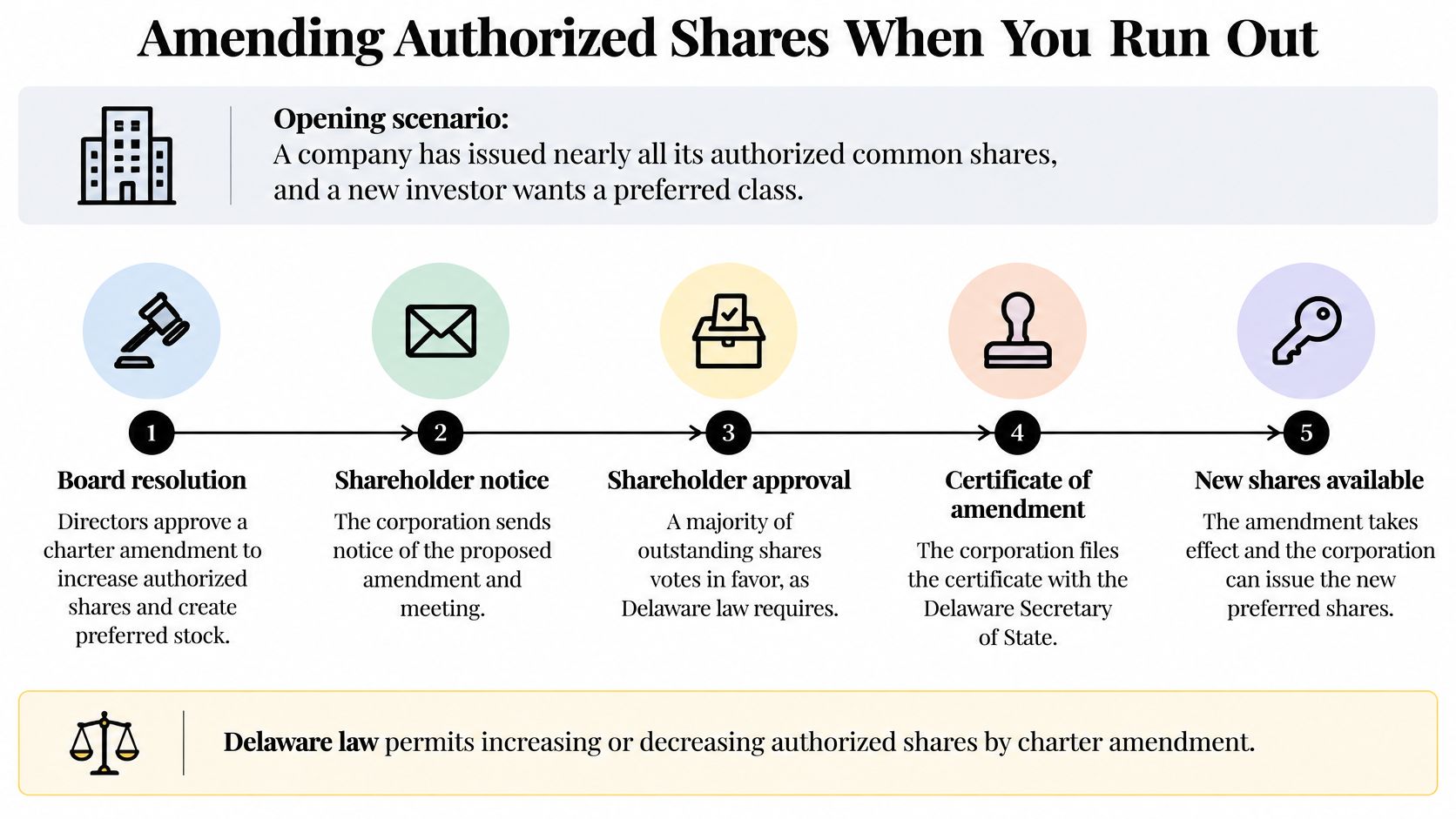
A company has issued nearly all of its authorized common shares, and a new investor wants a preferred class. The board is ready to say yes this afternoon. That vote, by itself, does not create the shares.
Delaware law permits a corporation to amend its certificate of incorporation to increase or decrease authorized capital stock, reclassify stock, change the number or par value of shares, or subdivide or combine issued shares. The Delaware amendment statute makes the process a sequence, not a switch the board can flip.
The sequence that actually changes the ceiling
- The board adopts a resolution that sets out the amendment and declares it advisable. The resolution should name the new total, the class split, and any change in par value.
- The proposal goes to the stockholders entitled to vote. Check the charter for a class vote. Preferred holders sometimes have a separate say even when common holders control the company.
- Statutory notice goes out. A meeting or written consent that skips notice requirements is a diligence problem later, even if everyone in the room agreed.
- Stockholders approve. Until that approval exists, the old ceiling is still the law of the company.
- The amendment is filed with the state. Approval that sits in a folder doesn't increase capacity.
- Update the cap table and the stock ledger so they show the new capacity, the new class, and what remains unissued.
Board approval alone is not enough. The stockholder process and the filing have to be finished. Before a financing, compare the cap table with the charter and confirm that enough authorized shares remain for the issuance and for every conversion or option obligation. A rushed amendment means extra meetings, a filing queue, and investors waiting while counsel reconciles records. Keeping a reserve avoids that scramble. Authorizing far more than any plan can support makes the same governance conversation harder, because people argue about a number that was never tied to a use.
Calculate headroom now. Authorized minus issued minus shares reserved for the pool, SAFEs, notes, and the round. If that figure is thin, confirm the amendment steps with counsel before a term sheet is signed, not after.
Reading Authorized Shares in a Term Sheet or Filing
When a term sheet or a filing shows a huge share number, ask which count it is and where it lives. The charter states the authorized total and the per-class split, with par value. The cap table should show issued and outstanding shares by holder and class. In a public company's annual report, the balance sheet and the equity notes list authorized, issued, and outstanding counts for each class.
As of December 31, 2024, one SEC-reporting company had 2.3 billion common shares and 100 million preferred shares authorized, for 2.4 billion total authorized shares, in its SEC filing. Those figures are capacity. They aren't a statement of who holds the company.
| Class | Authorized shares as of December 31, 2024 |
|---|---|
| Common | 2.3 billion |
| Preferred | 100 million |
| Total authorized | 2.4 billion |
Four checks before you accept a percentage
- Find the authorized total and the class split in the charter. If the term sheet's share number isn't in that document, it isn't the ceiling.
- Find issued and outstanding counts in the cap table or, for a public company, in the equity note.
- Confirm that any gap between issued and outstanding is treasury stock, not a missing holder or a double-counted grant.
- Ask whether the term sheet percentage uses outstanding shares or fully diluted shares. A SAFE agreement doesn't show up in outstanding shares until it converts, but it does show up in a fully diluted percentage. Signing the wrong base is how a "20 percent" round becomes something else at the spreadsheet.
Ownership is the holding divided by the outstanding base, or by the fully diluted base if that's the deal you struck. Dividing by the authorized total, including a multi-billion share ceiling, will make every founder look like a rounding error. That math is wrong, and investors who know capitalization will notice it in the first diligence call.
Common Mistakes and Your Pre-Raise Check
Two mistakes still blow up closings.
The first is treating authorized stock as a measure of value. A historical and modern reading of Delaware practice shows a charter that authorized 100,000,000 total shares, split into 90,000,000 common and 10,000,000 preferred, each with a par value of $0.01, and an aggregate par value of $1,000,000, as described in a history of Delaware's General Corporation Law. That does not mean 100 million shares were sold, and it does not mean the company holds $1 million in assets. Aggregate par is arithmetic on the charter. It isn't cash in the bank.
The second is believing a board vote raises the ceiling. A resolution that never reaches the stockholders, and a stockholder vote that is never filed, leaves the old number in place. The company then promises shares it isn't allowed to issue.
Habits that keep the records usable
- Keep a running cap table with authorized, issued, outstanding, and reserved columns. Update it when a grant is approved, not when someone remembers at diligence.
- Attach the board consent to every issuance. Delaware practice lets a resolution set the maximum shares, the period they may be issued, and the minimum consideration, which is how you issue founder shares, option shares, and financing shares at different times without an open-ended blank check. Delaware's issuance statute recognizes consideration in cash, tangible or intangible property, a benefit to the corporation, or a combination.
- Document what the company received when shares are issued for services or intellectual property. Name the property or the benefit, the recipient, and any vesting or repurchase terms.
- Reconcile before a SAFE or a note closes, not after the investor wires. A conversion that doesn't fit inside authorized shares becomes an amendment project with the round already in motion.
The three-count check
Before you raise, run three counts and stop if any one fails. Authorized shares must cover issued shares plus every share reserved for the option pool, SAFEs, notes, and the next round. Outstanding shares are the base for ownership, unless the term sheet clearly uses a fully diluted base. Unissued capacity after those reserves tells you whether you need an amendment before term sheets are signed.
Then pull the current charter, reconcile the stock ledger to the cap table, and decide. If capacity is short, amend first. If the records don't match, clean them before an investor's counsel finds the gap.
We help founders get that file ready. Fundraising readiness for us means cap table hygiene, SAFE and convertible note review, and diligence preparation, including disclosure schedules, governance protocols, contract audits, and closing checklists. When a startup converts to a corporation for a raise, we manage the conversion, prepare the governance documents, and execute the IP assignments so the share cap and the cap table describe the same company.
Coto & Waddington, Attorneys at Law works with South Florida founders on capitalization, founder equity, and the charter math behind a raise, including the authorized-share reserve this guide walks through. Bring your charter, cap table, and any signed SAFEs or notes, and we will reconcile the counts before the next round. Visit Coto & Waddington, Attorneys at Law to book a capitalization review.