A diligence request lands in your inbox on a Tuesday, and between the bank statements and the IP assignments sits one line: "Please send your capitalization policy." You attach the equipment spreadsheet your bookkeeper built, the one with the dollar threshold and the depreciation lives. Two days later the lawyer asks again, because she meant the other thing.
Both requests are legitimate. Capitalization carries two meanings inside a growing company, and they collide in the same quarter. One decides whether a purchase becomes an asset on the balance sheet or an expense on the income statement. The other decides who owns the company, how much of it is reserved for future hires, and what a new investor's percentage measures.
One written policy can cover both, with shared approvals and a single set of records. What follows is a working capitalization policy example you can adapt, along with the definitions, thresholds and traps that decide whether it survives a financing.
Table of Contents
- Sample Capitalization Policy Template
- Authorized, Issued and Outstanding Shares Explained
- Thresholds That Decide Whether to Expense or Capitalize
- Lease Thresholds and Materiality
- How to Approve and Record an Equity Issuance
- Option Pool Sizing and Dilution Scenarios
- Tax Basis, Month-End Close and Common Gaps
- Adopt Your Capitalization Policy Before the Next Round
Sample Capitalization Policy Template
A founder buys a $3,000 server in March and, in the same quarter, promises 40,000 options to an engineer who starts in April. Both are policy decisions. Neither has a written rule behind it, and the two records that should capture them live in different places: the server sits in a fixed-asset register or an expense account, while the options sit in a cap table spreadsheet someone built over a weekend.
Accounting capitalization answers a narrow question: does this cost become an asset, or does it hit the income statement now? It turns on a dollar threshold, a minimum useful life, a depreciation method and an asset register.
Equity capitalization answers a different one: how is ownership authorized, issued, reserved and diluted? It turns on the charter, board consents, the stock ledger and the cap table.
Where Most Templates Stop
Search for a capitalization policy example and you'll find the asset side, mostly. Template packs pair a dollar threshold with an approval workflow and an annual review, which is useful if your only question is whether to expense a laptop (accounting policy manual templates). Founders need the ownership side just as badly, and it's the side investors test first.
The Template Itself
Eight sections, each with an owner and a review cycle. Nothing here is decorative; every row exists because some transaction will eventually need it.
| Policy section | Sample wording | Owner | Review |
|---|---|---|---|
| Scope and definitions | Defines authorized, issued, outstanding, reserved and fully diluted shares; covers equity and fixed assets | Board and CFO | Annually |
| Authorized capital | Charter authorizes 10,000,000 common shares; any increase needs board and stockholder approval | Board | At each charter amendment |
| Equity issuance | No share, option or SAFE issued without board consent, signed agreement and cap table update | Board and counsel | Each issuance |
| Option pool | Pool reserved and refreshed according to a documented dilution forecast | Board and compensation committee | Each financing |
| Fixed-asset threshold | Tangible items capitalized above $2,500 or $5,000 per invoice or item, based on financial statement status | CFO or controller | Annually |
| Tax basis tracking | Book and tax basis tracked separately wherever rules diverge | CFO and tax advisor | Quarterly |
| Records and reconciliation | Asset register and equity ledger reconciled to the trial balance | Controller | Monthly |
| Rule 701 monitoring | Rolling 12-month grants and sales tested against the $1 million, 15% and $10 million limits | Legal and finance | Monthly |
Adapting the Numbers to Your Charter
The $10,000,000 authorized figure is a placeholder. Replace it with the number in your articles of incorporation, and confirm the share count your state filing approved before you promise anything against it.
Then check one fact about your own books: whether you prepare an applicable financial statement. That single answer moves your threshold between $2,500 and $5,000 per invoice or item, and the policy should say which applies rather than leaving a controller to guess in April.
Adopt the document by board resolution with a date and a version number, so a later amendment is visible rather than remembered. Then test every row with two questions: does a named person own it, and is there a verifiable trigger that tells that person to act?
Adoption test: if a row has no owner and no trigger, it isn't policy. It's a sentence someone will ignore during the first busy quarter.
Authorized, Issued and Outstanding Shares Explained
Four terms do all the work in ownership math, and they're not interchangeable.
Authorized shares are the ceiling written into the charter. They're permission, not ownership.
Issued shares are shares the company has created and delivered. Issued shares can include shares held in treasury, which is why "issued" and "outstanding" never substitute for each other.
Outstanding shares are the ones investors currently hold, carrying the rights that attach to the class.
Fully diluted capitalization adds reserved option pool shares and convertible instruments to the outstanding base.
| Term or scenario | Example figure | What it counts toward |
|---|---|---|
| Authorized common shares | 10,000,000 | Maximum the charter allows; not ownership |
| Issued to founders | 2,000,000 | Outstanding and held by founders |
| Reserved for option pool | 1,500,000 | Fully diluted; not outstanding until granted |
| Authorized but unissued | 6,500,000 | Available for future financing; excluded from outstanding |
| Investor buys 1,000,000 new shares, outstanding base | 33.3% | 1,000,000 divided by 3,000,000 outstanding |
| Same shares, fully diluted base | 22.2% | 1,000,000 divided by 4,500,000 fully diluted |
That last pair is the whole lesson. One million shares is a third of the company on an outstanding base of 3,000,000 and a fifth on a fully diluted base of 4,500,000. Same certificate, same money, two very different governance conversations.
Your policy should therefore document the authorized classes, voting rights, par value, who may issue, the repurchase and retirement rules, and how unissued equity is treated. Delaware, where most funded startups incorporate, expressly lets a board retire shares that were issued but are no longer outstanding (Delaware General Corporation Law).
Standing rule: every ownership percentage in a board deck, an investor update or a term sheet names its denominator in the same sentence as the number.
Thresholds That Decide Whether to Expense or Capitalize
The threshold question sounds simple. Is $3,000 of equipment an asset or an expense? The answer depends on which rule your company is permitted to use.
| Situation | Threshold | Treatment |
|---|---|---|
| IRS safe harbor, applicable financial statement | $5,000 per invoice or item | Expense qualifying tangible-property purchases |
| IRS safe harbor, no applicable financial statement | $2,500 per invoice or item (prior threshold $500) | Expense qualifying purchases if consistently applied |
| Policy-set fixed-asset threshold | Company-chosen amount, documented and applied consistently; useful life over one year | Capitalize and depreciate above threshold; land treated separately |
| Lease recognition | Policy-set threshold below which leases are not recognized | Leases over 12 months: right-of-use asset and liability; 12 months or less: short-term exception |
| Components forming one functioning asset | Judged in aggregate, not per item | Capitalize as a single asset |
The $2,500 figure applies to companies without an applicable financial statement, for tax years beginning on or after January 1, 2016, and it replaced a prior $500 threshold. The $5,000 figure applies where an applicable financial statement exists. Whichever you use, the amount has to be deducted for financial-accounting purposes or consistently reflected in your books, and the policy should name your status explicitly (IRS tangible property regulations).

The Elements That Travel With the Number
A threshold alone is not a policy. Deloitte's guidance on capitalization-policy questions lays out the surrounding pieces: the asset classes covered, the monetary threshold, a minimum useful-life requirement, included costs, the depreciation method, componentization of replacements, impairment and disposal procedures, and approval and record-retention controls (Deloitte's capitalization policy guidance).
Two Worked Examples
A $3,200 laptop falls under a $5,000 threshold, so it's expensed in the month it's placed in service. Record it on the expense line that matches its use, and note the threshold judgment in the close file so nobody recharacterizes it a year later.
A $6,000 piece of equipment with a five-year life is capitalized and depreciated. Straight-line, that's $1,200 a year and $100 a month once it's in service. Both numbers are illustrative, but the pattern is the point: the threshold decides the path, and the useful life decides the pace.
Items above the threshold don't automatically become assets. They still run through the ordinary tests for repairs, supplies, improvements and other deductible costs, and the capitalization call has to be defensible against those rules.
Practical habits that keep the policy honest: apply the threshold per invoice or item rather than per purchase order, review it annually for materiality, and reconcile the register to the general ledger every month. For teams handling regulated or clinical equipment, keeping clinic equipment records tax-ready shows what a defensible record set looks like. Founders who mix personal and company spending during the first year should also tighten business expense tracking before the first audit or financing.
Lease Thresholds and Materiality
Leases need their own rule because the standard forces a right-of-use asset and a lease liability onto the balance sheet for any lease longer than 12 months. Short-term leases of 12 months or less get an exception, which is why so many small companies structure around them (FASB's lease accounting standard).
FASB acknowledged that entities may adopt reasonable capitalization thresholds below which lease assets and liabilities are not recognized, precisely to reduce the administrative burden. That permission comes with a condition that trips people up: materiality has to be assessed in aggregate across similar leases, not lease by lease.
Three decisions belong in the written policy.
The threshold itself. Pick a number and say whether it's tied to your property, plant and equipment threshold or to a separate liability-recognition threshold. Either choice is defensible; drifting between them is not.
The aggregation method. Say that similar leases are grouped and tested together.
The documentation point. Record the judgment at each lease commencement and each renewal, so the reasoning survives the person who made it.
Sizing note: a $10,000 threshold with a $6,000 copier lease excludes that lease on its own. Twenty copier leases totaling $120,000 are a different conversation, and the policy should require recognizing them when the group is material.
A company that writes the threshold into policy, ties it to the fixed-asset rule, reviews it annually and keeps the materiality memo in the policy file has an answer ready when an auditor asks why a lease is off balance sheet.
How to Approve and Record an Equity Issuance
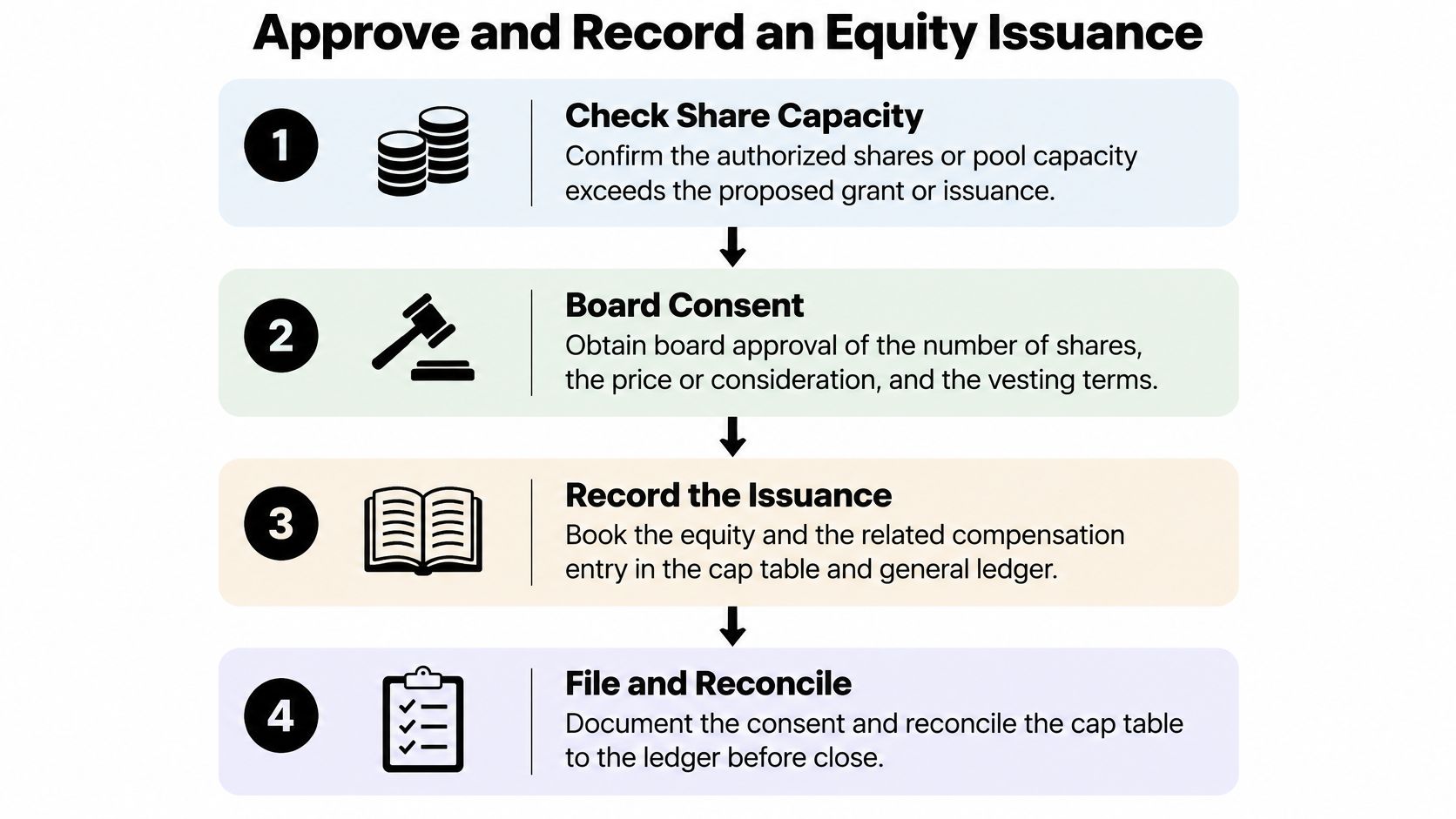
An equity issuance ties ownership records to formal approvals and accounting entries. If a founder promises shares before checking the company's authorization, the cap table may show ownership the company was not yet able to issue. Follow the process from capacity through filing, and keep the approvals, denominator and records connected.
Confirm capacity. Check authorized shares or the available option-pool balance before making a promise. If the issuance would exceed the charter's authorized shares, amend the charter first; approval and filing take time and can delay a closing.
Obtain board consent. The resolution should state the number of shares, their price or other consideration, and any vesting terms. A vague resolution approving “the grant” leaves room for disagreement about what the board authorized.
Execute the agreement. Match the signed terms to the board consent before treating shares as issued. For a stock issuance, review the stock purchase agreement terms against the approved price, share count and vesting provisions.
Record the issuance. Update both the stock ledger and cap table. State the denominator used for each ownership percentage, such as issued and outstanding shares, so readers can tell what the percentage measures.
Calendar the 83(b) election. For restricted stock, the election must be filed within 30 days of the grant. Record responsibility for the filing and retain proof with the issuance documents.
Track the rolling total. Compensatory offerings in any consecutive 12-month period are exempt only within the greatest of $1 million, 15% of total assets, or 15% of the outstanding securities of the class. Keep the calculation with the records, since each new grant changes the total.
Monitor disclosure requirements. Aggregate sales above $10 million in that 12-month period require additional disclosure to investors. That figure replaced the former $5 million threshold, as explained in Taft's summary of the Rule 701 amendments. Start legal review as the total approaches the threshold, rather than waiting until it has been crossed.
Support the valuation and accounting entry. Document the value used for stock-based compensation and record the corresponding journal entry. The cap table tracks ownership; it does not replace the accounting records.
File by issuance date. Keep the consent, signed agreement, ledger extract and valuation memo together. Organized records make it easier to confirm that the approval, ownership figures and accounting treatment agree.
Bookkeeping support can help keep equity entries and compensation expense current. A company may work with Hire Bookkeepers to maintain these records, while ensuring each issuance has a complete approval trail.
Option Pool Sizing and Dilution Scenarios
A hiring plan can look affordable on paper while the option pool runs short before the next financing. Set the pool against expected roles and grants, then show how those grants change ownership alongside the accounting records for equity awards.
| Stage | Benchmark or action | Dilution treatment | Refresh trigger |
|---|---|---|---|
| First non-founder hire | About 1.5% equity benchmark (Carta-based) | Size the pool before the offer; track unallocated shares | Before extending the offer |
| Fifth hire | About 0.3% equity benchmark (Carta-based) | Include the unallocated pool in the dilution forecast | When grant pace exceeds the forecast |
| Priced seed round | Investor-driven pool increase | Show the pool shuffle pre-money versus post-money | During term sheet negotiation |
| Later refresh pool | Set grants by role, stage and geography | Return repurchased and forfeited shares to the pool | At each annual compensation review |
Why a Single Benchmark Misleads
Carta's H2 2025 compensation data reports that median initial equity grants for individual contributors rose nearly 11% over two years (Carta startup compensation data). Benchmarks also put a first non-founder hire near 1.5% and a grant near 0.3% by the fifth hire. Treat these as reference points, not promises: role, stage, geography and hiring pace all affect the amount a company may need.
A pool set once at formation can become inadequate as hiring plans change. Forecast grants by role and timing, and review the remaining balance before it forces a pool increase into financing negotiations.
What the Dilution Forecast Should Show
Keep three scenarios in the policy file: pre-seed hiring, a priced seed round and a later pool refresh. For each, record founder ownership before and after, the unallocated pool carried forward, and the effect of any investor-driven increase. Use the same fully diluted share denominator throughout the comparison, so the percentages can be checked against the cap table.
Pre-money and post-money treatment can change founder percentages at seed. Unallocated shares count in the fully diluted total even before grants are made. Vesting schedules and repurchases of unvested shares also affect the forecast: returned shares go back into the pool rather than disappearing, so account for forfeitures when estimating the available balance.
Refresh rule: Review the pool when its unallocated balance falls below the forecasted need for the next hiring window.
Investor rights can affect who maintains an ownership percentage as the pool changes. State which denominator applies to those rights, and explain how preemptive rights work in a financing, so the ownership calculation is clear before an issuance.
Tax Basis, Month-End Close and Common Gaps
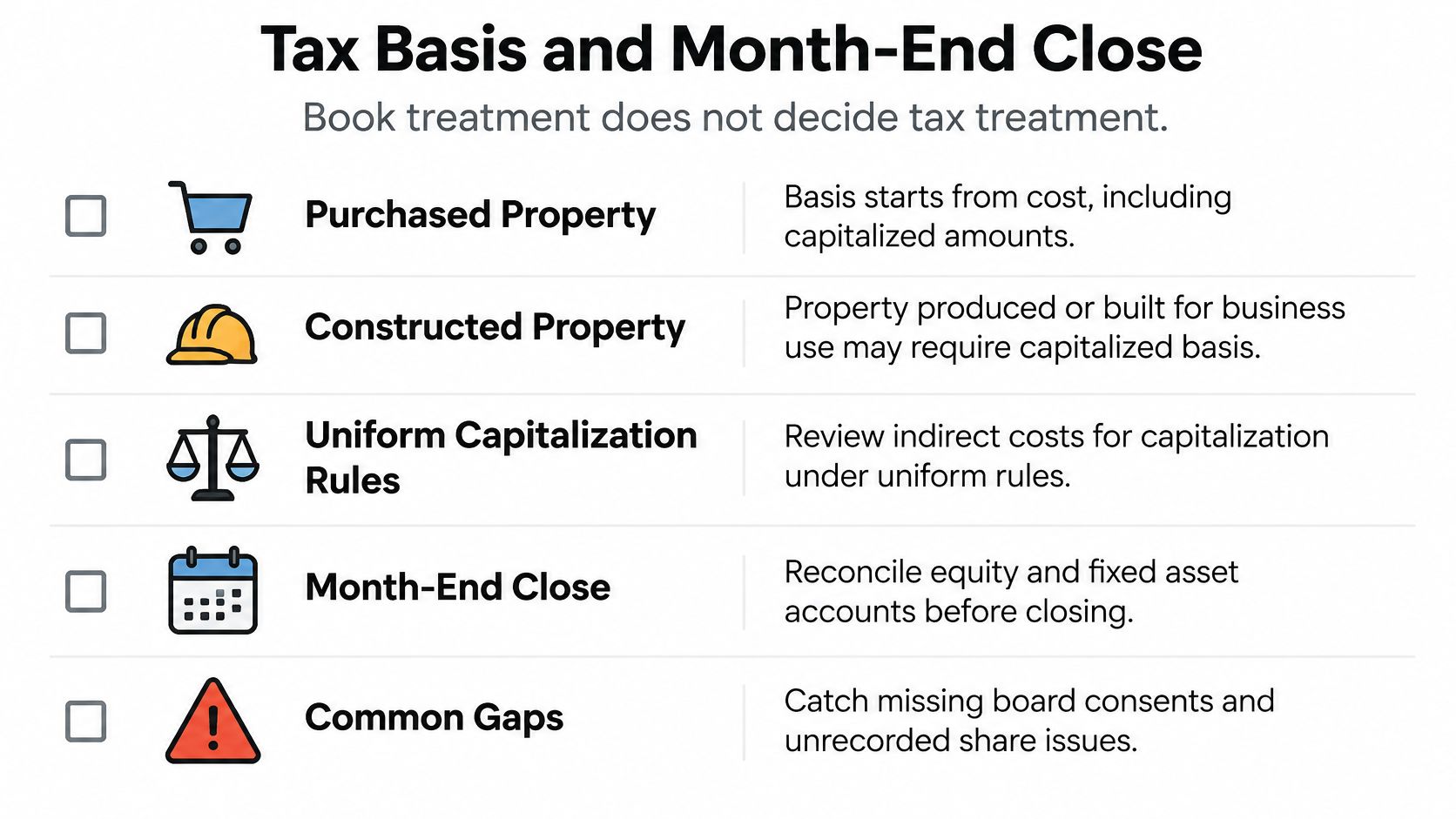
Book treatment doesn't decide tax treatment. Purchased property generally takes a basis from its cost, property you produce or construct for business use may require basis capitalization, and uniform-capitalization rules can require direct costs plus allocable indirect costs to be capitalized (IRS Publication 551 on basis of assets). Where the two sets of rules diverge, track capitalized tax basis separately instead of reconciling the difference at year end.
The Records Checklist
- Invoices, contracts, production records and placed-in-service dates for each capitalized asset.
- Asset register fields: description, serial number, location, custodian, in-service date, cost, accumulated depreciation and disposal data.
- The allocation methodology used for indirect costs, written down rather than implied.
- Executed subscription or purchase agreements for every equity issuance.
- Board or member approvals plus the stock or unit ledger that reflects them.
- Option and warrant records with vesting terms and any acceleration provisions.
- Documentation of the consideration received for each issuance, including services rendered in exchange for shares.
- Stock basis records that owners keep for their own returns, which the IRS Form 7203 instructions treat as the taxpayer's responsibility.
What Month-End Close Should Prove
Reconcile the asset register and the equity ledger to the trial balance. Investigate every addition and disposal rather than accepting a roll-forward. Document each capitalization judgment in a sentence or two, with the person who made it. Then keep the whole package for both the financial statements and the tax filings, since one set of records has to support two audiences. A repeatable close sequence helps here, and Loopfour's walkthrough of a deterministic month-end close is a useful structure to copy.
The Gaps and Their Fixes
A spreadsheet cap table treated as the whole policy. The spreadsheet records history; the policy decides what goes in it. Fix: adopt the full written policy and keep the spreadsheet as an output.
Undefined denominators. A percentage without a stated base will be read differently by a founder and an investor. Fix: name the base in every document that carries a percentage.
A pool sized once and never revisited. Fix: tie a pool review to the hiring forecast at every financing.
Thresholds applied inconsistently. Fix: apply the dollar threshold per invoice or item, every year, to every class of purchase.
Informal approvals by email or verbal agreement. Fix: no share, option or SAFE is treated as issued until board consent exists in writing.
Rule 701 totals that reset instead of rolling. Fix: a monthly rolling 12-month calculation covering awards across all plans and agreements.
An undocumented lease threshold. Fix: write the lease number into the policy and keep the materiality memo beside it.
Mixed book and tax basis. Fix: a separate tax basis schedule maintained quarterly with your tax advisor.
The gap that matters most in a financing is narrow and unforgiving: complete documentation of every issuance. Investors and acquirers test the cap table against signed consents and agreements, and a single undocumented grant can hold up a closing while everyone reconstructs a decision made three years earlier.
Adopt Your Capitalization Policy Before the Next Round
The work is smaller than it looks if you sequence it. Confirm the charter's authorized shares and pool capacity. Adopt the policy by board resolution with a version date. Set the threshold according to your financial statement status. Rebuild the cap table so every percentage states its denominator. Schedule the monthly Rule 701 check and the annual threshold review, then assign an owner to each of the eight sections.
Three habits keep it current. Start with the cap table, because it exposes ownership errors fastest and everything else builds on it. Revisit the document at every financing, when the pool, the denominators and the investor rights all shift at once. Keep one folder for consents, agreements and ledger extracts, organized by date rather than by topic.
Timing tip: the cheapest moment to fix a capitalization record is before a term sheet exists. After that, every correction is a negotiation.
If the ownership side of the policy needs help, our fundraising readiness work covers cap table hygiene, SAFE and convertible note review, and due diligence preparation, and our founder equity work covers structuring founder stock, vesting, option plans and investor rounds. Book a policy review before your next round, while the documents are still yours to organize.
A written capitalization policy is the cheapest insurance a founder can buy, and the two halves of it, assets and ownership, work best when one document governs both. Coto & Waddington, Attorneys at Law helps South Florida founders build that document properly, from the charter and board consents behind each issuance to the vesting, option pool and cap table math an investor will test in diligence. If your equity lives in a spreadsheet and your approvals live in an inbox, schedule a flat-rate policy and cap table review with Coto & Waddington, Attorneys at Law before the next round turns a small gap into a closing condition.