In 2025, 71% of organizations surveyed by CreatorIQ and Sapio Research increased their influencer-marketing investment year over year, according to TubeFilter's coverage of the data report. Budget lines that used to sit on a founder's personal card now sit in a marketing plan with quarterly targets and a named owner.
The paperwork hasn't kept up. Most creator deals still start in a direct message: a rate, a shipping address, a promise to post next week. Then the post goes live without a disclosure, someone wants to run it as a paid ad, and nobody can prove what was agreed.
An influencer agreement contract closes that gap, and it's shorter than most founders expect. What follows is clause by clause: what each provision must say, where drafts fail, and what to refuse to sign.
Table of Contents
- Influencer Agreement Clauses at a Glance
- Why Written Terms Protect Brands and Creators
- Deliverables and Payment Terms That Hold Up
- Usage Rights and Paid Amplification Terms
- Disclosure Duties Brands Cannot Hand Off
- Claims, Authenticity and Banned Practices
- Termination, Remedies and Governing Law
- Confirm These Terms Before You Sign
Influencer Agreement Clauses at a Glance
An influencer agreement contract is the single document that fixes what the creator delivers, what you pay and when, who may reuse the content and for how long, how the sponsorship is disclosed, and how the deal ends if it goes sideways. It isn't the creative brief, the invoice, or the product shipment, though each of those should attach to it.
Once money, free product, or an affiliate code changes hands, the deal is a commercial transaction with disclosure duties attached to it. A message thread proves nothing six weeks later when the post is late, the tag is missing, or your paid media team wants to boost a video you never licensed. The table below is the checklist the rest of this article unpacks, one row at a time. Read the third column first, because that's the gap that appears in most drafts.
| Clause | What the contract must specify | Gap that appears most often |
|---|---|---|
| Deliverables | Post count, format, platform, posting window, revision rounds | A vague "one post" with no format or date |
| Compensation | Fee, payment milestones, approval deadline, late-payment terms, kill fee | Payment tied to nothing the brand can check |
| Usage rights | Channels, license period, territory, paid amplification, edits | "Perpetual" rights buried in an ownership clause |
| Disclosures | Exact wording, placement, platform tag, language for each market | "FTC-compliant" with no wording attached |
| Claims | Approved product claims, substantiation source, pre-publication review | Creator improvises results or experience |
| Authenticity | Bans on bots, purchased followers, fake testimonials, sentiment-based pay | Silent on how metrics are verified |
| Termination and remedies | Cure period, takedown deadline, clawback, record retention | No exit route if the creator stops delivering |
| Governing law | Governing state or country, venue, markets the campaign reaches | Cross-border reach assumed rather than stated |
The two rows that cause the most damage are disclosures and usage rights, because both fail without clear warning. A late post is obvious. A buried hashtag or an unlicensed ad campaign surfaces months later, usually in a letter from someone else's lawyer.
Same clauses, different depth. A nano-creator doing one Reel for product and a small fee needs a one-page version. An agency running a six-month ambassador series needs the full set plus a compliance schedule for each market. The rows don't change; the page count does.
Score what you have. Open your current template and rate each row as clear or vague. If a term can't be pointed to with a specific number, date, or piece of approved wording, it's vague, and it's a decision you've handed to a future dispute. If you're building from a blank page, this contract guidance for DTC growth teams covers the template architecture before you customize the terms.
Why Written Terms Protect Brands and Creators
A skincare startup ships a kit worth a few hundred dollars and settles the fee in a message thread. The post runs with no disclosure tag, no approved wording, and no mention of reuse. Two weeks later the founder wants that post behind paid spend. Nothing in the exchange says she can.
A written agreement closes that gap. It turns a casual promise into duties both sides can see, check, and enforce. Deliverables become countable items. Payment becomes a trigger, not a mood. Reuse becomes a license with a start date and an end date.
Name the material connection in the first paragraph
The FTC's endorsement guidance requires influencers to clearly and conspicuously disclose a material connection with an advertiser when consumers would not reasonably expect that relationship and the connection could affect how they evaluate the endorsement. Payment, free products, discounts, employment, and personal or family relationships all count.
Put that definition in your own words in the opening paragraph, then attach the exact tag or sentence the creator must use. A recital that a material connection exists ends the later argument about whether the deal needed a label at all.
Treat disclosure, claims, and usage rights as duties the brand runs and monitors, not boilerplate the creator signs. Name who checks the live post, who compares the wording to the approved claim, and who confirms the license window before anyone boosts the content. Refuse a draft that only says the creator "will comply with applicable law." That sentence names no tag, no reviewer, and no deadline.
Indemnity does not move regulatory exposure off the brand. If regulators treat the post as your advertisement, a creator's promise to cover losses does not change who published it. Keep indemnity for third-party claims the creator caused. Do not sign a clause that treats it as a substitute for your own disclosure check, claim review, or usage log.
The permit analogy
A building permit is the approved plan an inspector measures the work against. An influencer agreement works the same way. When a post goes wrong, the contract shows whether the creator breached a stated duty or whether you never set one.
Volume does not make the document optional. In 2024, 36% of influencer marketers reported that the average creator contract consisted of a single one-time post, according to Traackr's State of Creator Relationships report. One post still needs a format, a date, a disclosure, a license period, and a payment trigger.
When a brand deal arrives without clear terms, rebuild it around deliverables, usage rights, approval windows, and staged payments. The same four levers apply whether the deal is one post or twelve. For page-based assets rather than people, contract terms for meme page partnerships adjust the same structure to different metrics.
If the creator is paid as a contractor rather than through a vendor agreement, check the influencer terms against an independent contractor agreement template so the IP assignment and payment schedule do not contradict each other.
Practical rule: If a sentence in the agreement cannot be checked after the fact, rewrite it until it can.
Two questions decide every dispute: what must each side do, and what can each side enforce?
Deliverables and Payment Terms That Hold Up
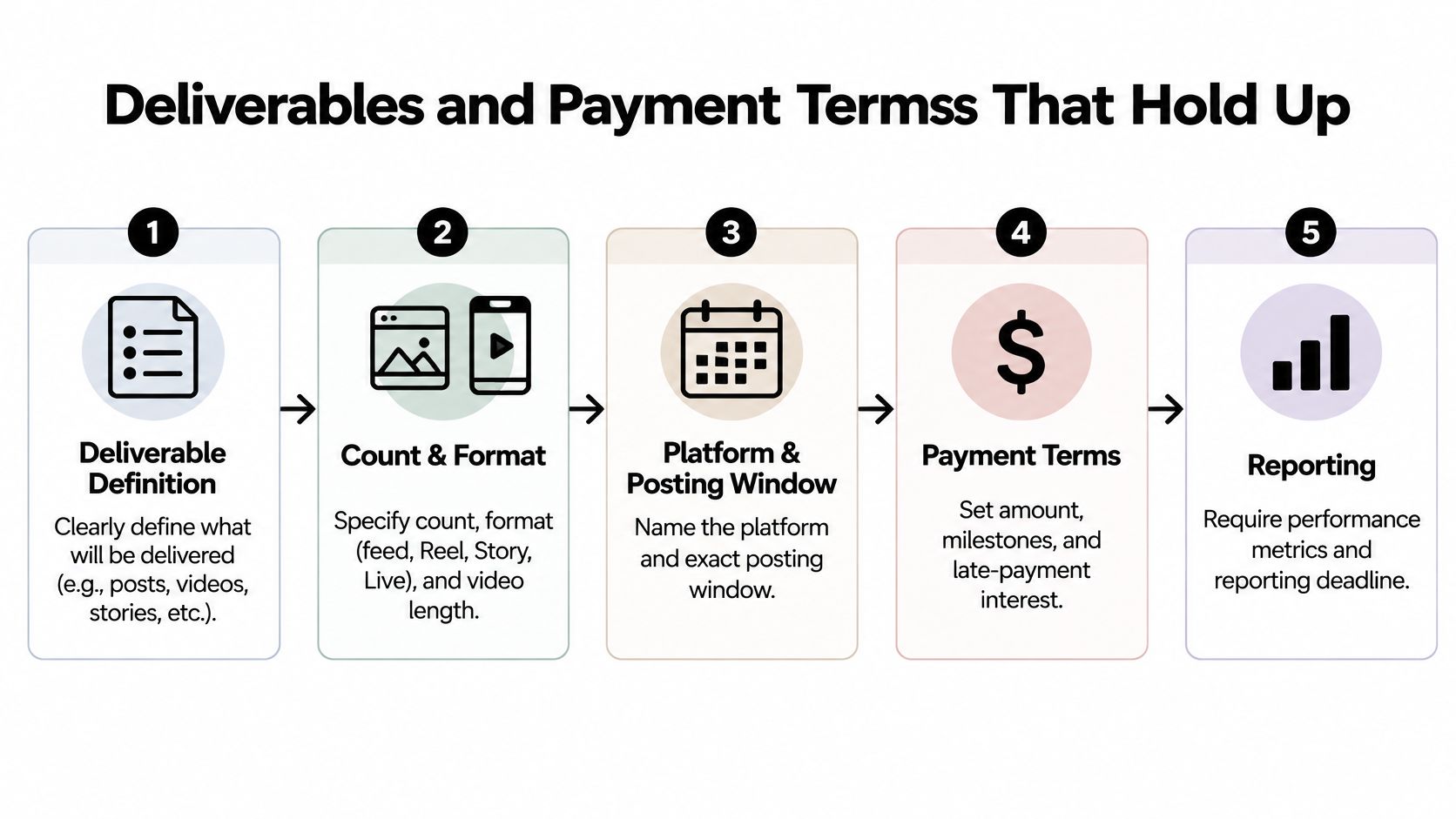
"One post" is where disputes start. Not because creators lie, but because one post has no format, no platform, no date, and nothing verifiable attached to it. The drafting order below matters, since payment terms built on an undefined deliverable have nothing to attach to.
Define the deliverable in countable units
Write the term so a stranger could verify it. Three Instagram Reels of 20 to 45 seconds posted to @handle between March 3 and March 10, one round of revisions, and a screenshot of insights delivered within five business days of posting. That's a deliverable. Name the platform, the format, the length, the posting window, the revision limit, and the report you expect.
Build payment as a sequence
- Price the deliverable, then sanity-check the scope. As a benchmark, brands spent an average of $202 per influencer collaboration in 2025, based on more than 15,000 collaborations analyzed by Collabstr's 2025 influencer marketing report. A deal priced far above that needs a documented reason, such as exclusivity, paid usage, or a longer production cycle.
- Split the fee into milestones. A deposit on signing and the balance after the approved post goes live is a workable default. Tie each milestone to an event, not a calendar month.
- Set a brand approval deadline. Three business days is standard. State what happens if your team misses it: content is deemed approved and the payment trigger still fires. Silence from the brand shouldn't stall the creator's invoice.
- Define late payment. Specify interest, the invoice process, and whether posting pauses for unpaid invoices.
- Add a kill fee. If you cancel after work begins, the contract should already say what the creator keeps. Without it, cancellation becomes a negotiation you'll lose on goodwill.
- Separate product from expenses. Product value, shipping, props, and travel are distinct from the fee, and each needs its own line and its own tax treatment.
Tie bonuses to measurement, not to enthusiasm
Performance bonuses are legitimate when the metric is objective: verified reach, tracked conversions through a unique code or link, or a defined click threshold. They're a compliance problem when payment depends on the creator saying something positive. Before you write a reach target into the contract, get clear on how verified views differ from results, because platform view counts and actual conversions diverge sharply.
The whole flow fits in five beats: draft, brand review window, approval, publication, milestone payment. Keep the publish date and the correction deadline in the same clause so neither one gets missed.
Tip: Put the posting window and the takedown deadline in one clause. Brands remember the first and forget the second.
Usage Rights and Paid Amplification Terms
The creator owns the photos and videos they make. What you're buying is a license, and every way you use the content is a separate right with its own price. Drafts that collapse all of this into a single ownership sentence create the most expensive disputes in the file, because the brand assumes it bought more than it did.
| Usage category | What the contract must define | Usual pricing approach |
|---|---|---|
| Organic repost on brand channels | Channels, start date, end date | Included in base fee, stated in writing |
| Whitelisting or creator-handle ads | Ad account access, spend limits, end date, removal confirmation | Separate fee |
| Paid amplification of an organic post | Budget, platforms, duration, renewal consent | Separate fee |
| Edits or cutdowns | Approval rights, no changes that create misleading claims | Separate fee or approval-based |
| Sublicensing to agencies or retailers | Named third parties, territory, duration | Separate fee |
| Post-termination use | Express license period and sunset date | Negotiated; never vague "perpetual" language |
Take the rows in order when you draft. Organic reposting is the cheapest right and the one to grant first, but it still needs named channels and an end date. Whitelisting is a different animal: you're running ads from the creator's handle, which means ad account access, a spend cap, an end date, and written confirmation that the ads came down. Paid amplification of an organic post doesn't come free with the post, and a video performing well doesn't create the right to boost it.
Edits deserve their own sentence. You can cut a 60-second video into a 15-second cutdown, but no edit may create a claim the creator didn't make or a result the product can't support. Sublicensing to a retailer or media agency needs the third parties named, because a license that travels without notice is a license you can't control.
Continued use after the campaign ends depends on an express license period with a sunset date. If your agreement says perpetual in the ownership clause and ninety days in the schedule, you have a fight, not a term.
Usage rights are a licensing question before they're a marketing one, and the drafting habits that make any content license enforceable apply here, as covered in this guide to Florida licensing agreement law for IP, brand, and content licensing.
The practical test comes after the campaign. You should be able to list every place the content still runs and the date each right expires. If nobody can produce that list, the license is unmanaged.
Tip: Set an ad-account access end date and require written confirmation that whitelisted ads have been removed. Access that never gets revoked is use that never gets licensed.
Disclosure Duties Brands Cannot Hand Off
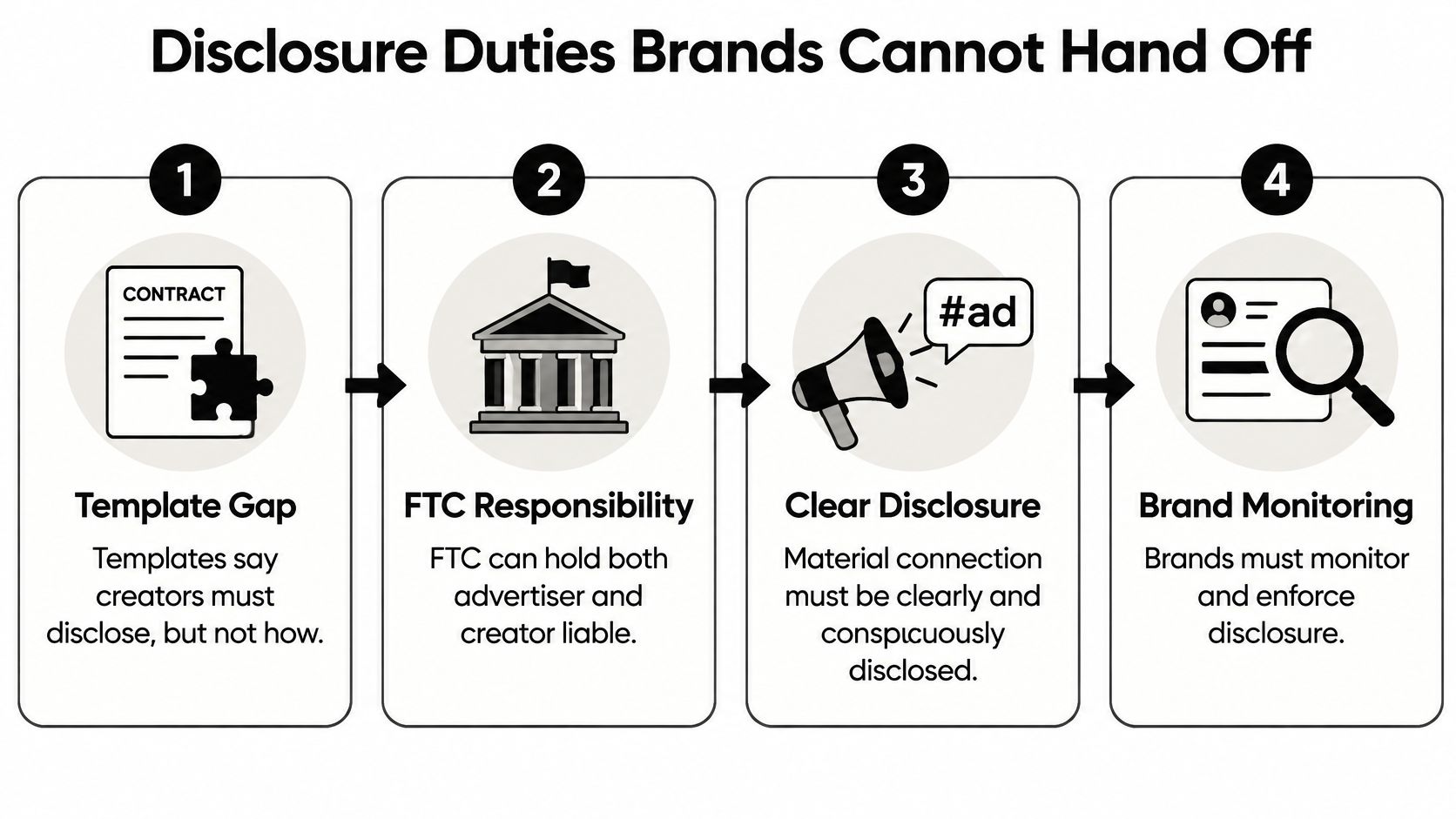
Most templates say the creator must disclose. Almost none say how, where, in what words, or who checks. That's the gap that matters, because the obligation doesn't belong to the creator alone.
The FTC Endorsement Guides reach both sides of the deal. Both parties may face liability when an endorsement contains deceptive or unsubstantiated claims, and both may be liable when a paid or material relationship isn't clearly and conspicuously disclosed. The FTC indicates that advertisers should provide guidance and take steps to discourage or prevent noncompliance, which turns training, written brand guidelines, monitoring rights, and audit cooperation into operating duties rather than boilerplate.
Write the wording, not the principle
- Exact tag or sentence. Name the approved hashtag and the approved plain-language line. "FTC-compliant disclosure" is not a term anyone can perform.
- Placement. First lines of the caption, visible without clicking more. For video, on-screen text long enough to read plus a spoken line in the opening seconds.
- Every format, including the small ones. Stories, Lives, affiliate links, discount codes, and gifted product all need the same treatment as a feed post.
- Multilingual campaigns. Require disclosure in each language the audience reads, with equal prominence. A Spanish caption with a buried English tag isn't disclosure.
- Indemnity stays narrow. An indemnity can address creator-caused violations, but it can't reliably move regulatory exposure off the advertiser, which stays responsible for its own advertising practices.
Run approval as a workflow
- Creator submits the draft caption and video with the disclosure already in place.
- Brand checks the wording, the placement, and every factual claim against the approved-claims sheet.
- Creator corrects anything flagged, in writing.
- Content publishes on the agreed date.
- Brand saves a screenshot of the live post to the campaign file.
Name the person on each side who signs off before publication. A shared inbox is not an approver.
Sample caption line: "Paid partnership with [Brand Name]. I received a fee and free product from [Brand Name]." Place it before any other text and never behind a more link.
Platform mechanics belong in the contract too. Instagram's branded content rules require creators to use the "Paid partnership with" label and tag the business partner when content involves an exchange of value, and the brand receives a tag request the first time a creator adds them, which the brand must approve before the label appears, per Instagram's branded content help page. Decide who initiates the tag, who approves it, what happens if the platform delays or denies approval, and require the disclosure to survive any repost or boost.
Claims, Authenticity and Banned Practices
Drafts forbid false claims in general terms and never say who checks them. That's the wrong shape. A claims clause works when it names the prohibited practices, attaches the approved language, and gives the brand a remedy that doesn't require litigation.
Start with the banned list, stated plainly: bots, purchased followers, engagement pods, fabricated comments, AI-generated personas, undisclosed third-party participation, and invented reviews or testimonials. The FTC's 2024 Consumer Reviews and Testimonials Rule prohibits creating, selling, purchasing, or procuring fake reviews or testimonials, buying reviews conditioned on a particular positive or negative sentiment, certain undisclosed insider testimonials, and selling or purchasing fake indicators of social-media influence. Those prohibitions give the clause teeth, and they map directly onto contract controls.
- Authentic accounts and genuine experience. The creator uses real accounts and has used the product before describing it.
- Verification rights. The brand can request account analytics, audit screenshots, suspend deliverables, claw back fees, and terminate for falsified metrics or testimonials.
- Pay tied to deliverables, not opinions. Posts, Stories, usage rights, and reporting are deliverables. A required favorable opinion is not.
- Bonuses separated from sentiment. Verified reach and tracked conversions are fine metrics. Payment conditioned on a positive review is a regulatory problem wearing a bonus label.
Claims need a source the brand actually holds
Endorsers shouldn't describe personal experience with a product they haven't tried, and shouldn't make claims requiring proof the advertiser doesn't possess, per the FTC's advertising and endorsement guidance. So limit the creator to approved claims, and keep the substantiation for performance, health, income, environmental, or comparative statements on your side of the file.
Attach an approved-claims sheet to the agreement and give the brand authority to reject anything beyond it. Florida's consumer protection statute reaches the same conduct from a different direction, which is why the claims clause and the review workflow have to agree with each other; this overview of the Florida Deceptive and Unfair Trade Practices Act is the starting point.
Tip: Mark every line in the approval checklist as either personal opinion ("I like the texture") or factual claim ("lasts 12 hours"). Only the second category needs substantiation, and separating them stops reviewers from arguing taste.
Termination, Remedies and Governing Law
A brand paid a lifestyle creator for one Reel. The posting window came and went, the post finally appeared three weeks late, and when the brand asked for it to come down, the creator left it up. The agreement had no takedown deadline, no cure period, and no clawback. The brand's only remedy was another message.
Write the exit before you need it. Termination triggers should cover material compliance failure, repeated disclosure violations, falsified metrics, unpaid invoices, and failure to deliver by a stated date. Fixable breaches get a short cure period, measured in days, not good intentions. Then state what happens to the content: takedown within a set number of hours, removal of whitelisted or boosted ads, and clawback of fees for undelivered work.
Record retention belongs in the same clause. Require the creator to keep copies of posts, disclosure approvals, and performance reports for a defined period. The FTC can investigate practices that are unfair or deceptive under the FTC Act when advertising principles aren't followed, and its endorsement materials note that noncompliance may contribute to an investigation even though the Guides themselves aren't regulations, per the FTC's endorsements and reviews guidance. Records are how you answer one.
Governing law and reach
A European enforcement sweep shows why geography can't be assumed. Consumer-protection authorities in 22 European Union member states reviewed 576 influencers' posts, and 97% published commercial content while only 20% systematically identified it as advertising; authorities earmarked 62% of the influencers for further investigation, according to the European Commission's sweep findings. A campaign that reaches audiences in other markets can trigger consumer-disclosure rules, trader-registration requirements, platform labeling, and substantiation duties all at once.
So name the markets covered, the governing state or country, and the venue. Choose a forum the brand can reach, and pair it with a platform-specific compliance schedule.
Clear termination language pays for itself. In a vendor dispute we handled, the vendor failed to deliver services, and because the agreement had been reviewed before signing with clear termination clauses in place, the outcome was contract enforcement and cost recovery without litigation. Influencer deals follow the same logic.
Confirm These Terms Before You Sign
Run this list against the draft before anyone gets paid.
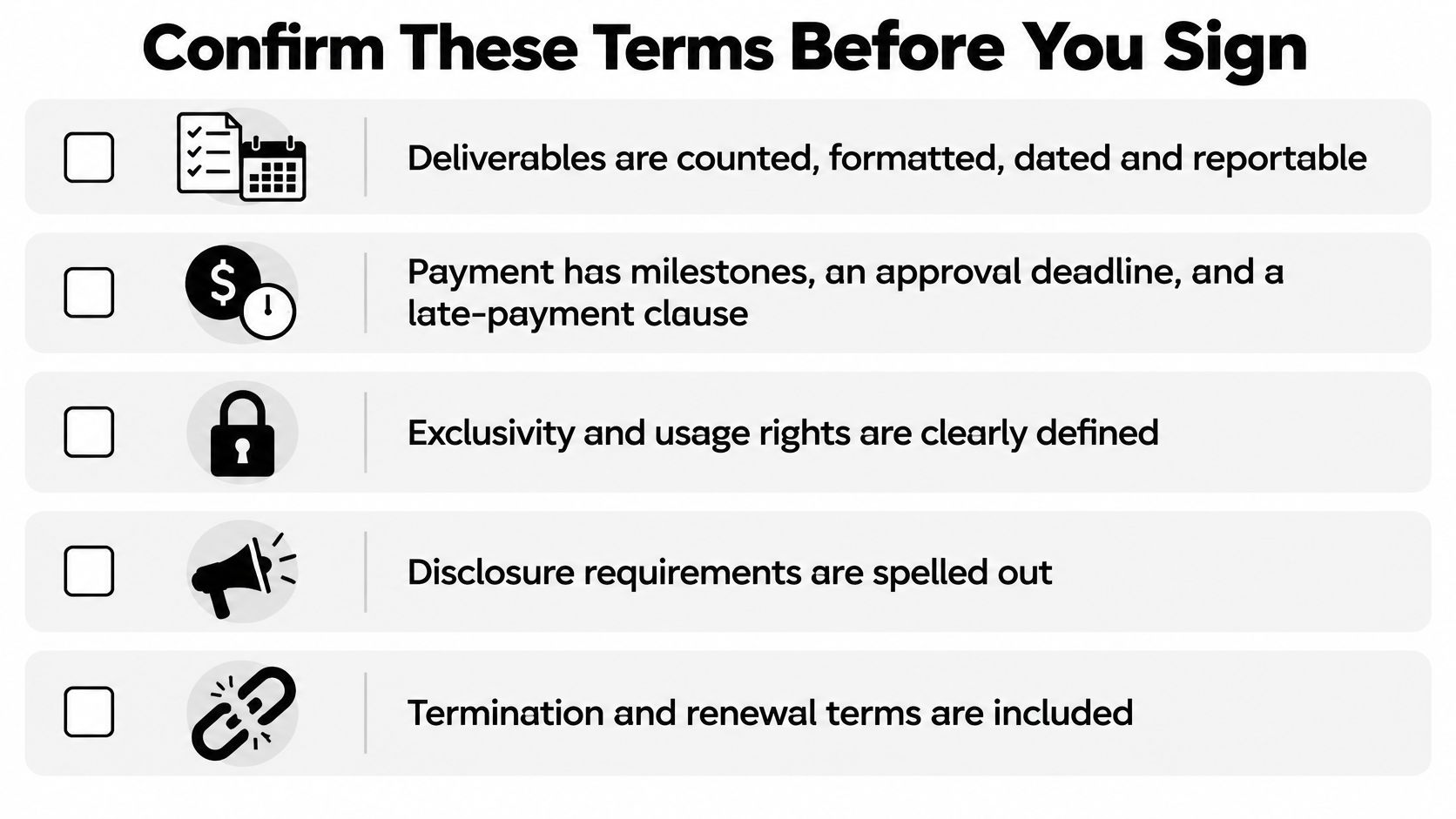
- Deliverables are counted, formatted, dated, and reportable.
- Payment has milestones, an approval deadline, and a late-payment rule.
- Each usage right has a channel, a territory, start and end dates, and its own fee where paid media applies.
- Disclosure wording, placement, and platform tags are written into the contract, not referenced.
- Approved claims are attached, and substantiation sits with the brand.
- Fake engagement and sentiment-based pay are prohibited, with verification rights attached.
- Termination triggers, takedown deadlines, clawback, and record retention are defined.
- Governing law, venue, and covered markets are named.
Two habits keep this work usable. Keep one signed version for each deal, archived with its approved-claims sheet, so a renewal doesn't restart from a message thread. And log every approval with a date and a name, because an undated approval is a rumor.
The contracts work behind this list aren't exotic. They're the same structures that hold any commercial deal together: master service agreements, statements of work, subscription and retainer terms, vendor and client contracts, influencer and affiliate agreements, and brand deals. Before the creator starts work, have counsel read the draft against each row above.
Coto & Waddington, Attorneys at Law drafts and reviews influencer and affiliate agreements and brand deals as part of its Contracts for Growth work, aligning scope, payment milestones, usage rights, approval windows, and termination remedies so the claims clause and the approval workflow don't contradict each other. The firm also provides general counsel support for small businesses, covering entity formation, custom contracts, IP strategy, regulatory compliance, and dispute prevention when a campaign goes sideways. Send us the draft and the approved-claims sheet before launch, and visit Coto & Waddington, Attorneys at Law to start the review.