An unchanged valuation can still leave founders owning less of their company. If an investor requires a larger option pool before closing, founders can absorb additional dilution without any reduction in the stated pre-money price. The headline valuation isn't the ownership result.
Understanding pre money vs post money valuation starts with simple arithmetic. Making a sound financing decision requires something more: identifying which shares, options, SAFEs, and notes enter the ownership calculation, and testing whether the business can support the price before its next raise.
Table of Contents
- Pre-Money and Post-Money Valuation Side by Side
- How One Headline Produces Two Ownership Results
- When the Option Pool Dilutes Founders First
- Pre-Money SAFEs Versus Post-Money SAFEs
- When a Higher Valuation Creates Later Risk
- Median Pre-Money Valuations by Round
- Confirm the Valuation Basis Before You Sign
Pre-Money and Post-Money Valuation Side by Side
An unlabeled valuation is not a deal. Pre-money valuation is the agreed value of the company immediately before new investment. Post-money valuation includes that new cash.
The basic relationships, in words, are:
- Post-money valuation equals pre-money valuation plus new cash invested.
- New investor ownership equals cash invested divided by post-money valuation, not divided by the pre-money figure.
- Pre-money valuation equals post-money valuation minus the new investment.
Say a company raises $2 million at an $8 million pre-money valuation. Its post-money valuation is $10 million, and the investor owns 20% because $2 million divided by $10 million equals 20%. Existing holders collectively retain 80%, assuming no other capitalization changes.
Pre-money versus post-money at a glance
| Item | What it measures | How to calculate it | $2M at $8M pre-money |
|---|---|---|---|
| Pre-money valuation | Company value before new cash | Post-money minus new investment | $8 million |
| Post-money valuation | Company value after new cash | Pre-money plus new investment | $10 million |
| New investor ownership | Share purchased by the check | Investment divided by post-money | 20% |
| Existing holders together | What remains if nothing else changes | 100% minus new investor share | 80% |
These are transaction values, not bank balances. Post-money valuation doesn't mean founders can sell their shares for that amount, or that the company has generated equivalent operating value.

Work Backward From the Promised Percentage
Consider a different hypothetical offer: $2 million at $10 million pre-money. Post-money becomes $12 million, so the investor receives approximately 16.67%, while existing holders collectively retain approximately 83.33%.
If that same investor instead expects 20% for the $2 million check, the implied post-money valuation is $10 million. Subtract the investment, and the implied pre-money valuation is $8 million. Those promises aren't interchangeable.
Practical rule: Label every offer pre-money or post-money before comparing prices. Then check whether the promised ownership matches the arithmetic.
Choosing the valuation itself is a separate exercise. A software founder evaluating comparable businesses might consult BootstrapArena's current SaaS revenue multiples, while checking whether the companies share similar revenue quality, growth, and risk. A multiple may help frame negotiations, but it doesn't determine the financing denominator.
Use the table as a first-pass term-sheet check, not as a substitute for a complete capitalization model. Its clean result assumes there aren't additional securities or pool changes affecting ownership.
How One Headline Produces Two Ownership Results
A valuation label can change the economics even when the check size and headline number stay fixed. In a priced round, a $5 million investment at $20 million pre-money produces $25 million post-money and gives the investor 20%, as explained in Carta's share dilution guide.
Now treat that same headline as a hypothetical $20 million post-money offer. The $5 million check purchases 25%, and the implied pre-money valuation falls to $15 million. Nothing changed except what the stated valuation includes.
The smaller hypothetical comparison is equally revealing. A $1 million investment at a $4 million pre-money valuation leaves existing holders with 80%. If $4 million is post-money instead, existing holders retain 75%, and the implied pre-money valuation is $3 million.
Same headline, different founder result
| Stated deal | If the number is pre-money | If the number is post-money | Founder gap |
|---|---|---|---|
| $1 million at a $4 million valuation | Post-money $5 million; existing holders 80% | Implied pre-money $3 million; existing holders 75% | 5 percentage points |
| $5 million at a $20 million valuation | Post-money $25 million; investor 20% | Investor 25%; implied pre-money $15 million | 5 percentage points |
| $2 million promised 20% with no basis stated | Consistent with $8 million pre and $10 million post | Not consistent with a $10 million pre-money round | Reverse-calculate before signing |
The founder gap assumes founders hold all the existing equity. If employees or earlier investors already own shares, the retained percentage belongs to those existing holders collectively, not just to the founders.
Translate the Price Into Shares
In a priced financing, the pre-money valuation helps establish the investor's price per share. Divide the agreed pre-money valuation by the transaction's defined fully diluted pre-money share count to determine that price.
That share count is the critical detail. Include more securities in the denominator while holding the pre-money valuation constant, and the price per share falls. The investor then receives more shares for the same cash investment.
A capitalization table records ownership, but a financing decision requires a pro forma cap table, meaning a model of ownership under the proposed transaction. Request a version that identifies:
- Existing equity: Founder shares, employee shares, and prior preferred stock.
- Convertible securities: Outstanding SAFEs and convertible notes, with their conversion assumptions.
- Additional rights: Warrants, granted options, and reserved option-pool shares.
- Transaction adjustments: Pool increases and the exact denominator used for each ownership percentage.
Don't accept an unexplained mismatch between a promised percentage and the basic financing calculation. Require the model to show whether conversions, pool treatment, or another adjustment explains it, and have the documents corrected if they don't reconcile.
Apply the label test to every headline in the comparison table. Two valuations aren't meaningfully comparable until both identify whether they're pre-money or post-money and use consistent capitalization assumptions.
When the Option Pool Dilutes Founders First
An employee option pool can dilute founders before the investor's money arrives. When a financing requires the pool to be included in pre-money capitalization, existing holders absorb that increase before the new investor purchases shares.
Consider a hypothetical company whose founders own all existing shares. Before receiving a $1 million investment at a $5 million post-money valuation, it creates an option pool representing 10% of the pre-investment company. Founders then hold 90% on that fully diluted basis.
The investor purchases 20% of the post-financing company. The founders' 90% interest is multiplied by the 80% remaining after investment, leaving them with 72%. The pool is diluted too, ending at 8%.
Founder ownership stack with a 10 percent pool and $1M round
| Holder | Before pool | After pool | After $1M round |
|---|---|---|---|
| Founders | 100% | 90% | 72% |
| Option pool | 0% | 10% | 8% |
| New investor | 0% | 0% | 20% |
| Total | 100% | 100% | 100% |
Distinguish Pool Timing From Pool Measurement
This example starts with a pool measured before investment. It isn't the same as requiring a pool of that size after closing while making existing holders fund its creation beforehand. The latter structure requires a different share calculation.
Nor does reserved equity necessarily mean someone already holds issued shares. A fully diluted model can include unissued shares reserved for future awards, alongside granted options and outstanding stock. Fundpilot's guide to calculating fully diluted shares offers useful context for organizing those categories.
An unchanged pre-money valuation doesn't prove that founder ownership is unchanged.
Negotiate the pool through concrete questions rather than accepting a standard percentage:
- Size: Build a role-by-role hiring plan for the next 12 to 18 months. Account for the available ungranted balance before requesting additional capacity.
- Timing: State whether the increase occurs before or after investment, and identify which holders absorb it.
- Included options: Specify how the documents count unissued reserves, granted awards, and other equity commitments.
In the hypothetical above, increasing the pre-investment pool to 15% would reduce founder ownership further without requiring a different headline valuation. A refresh at the same pre-money price can have the same directional effect.
The goal isn't to eliminate employee equity. It's to fund a defensible hiring plan while making its ownership cost visible before closing.
Pre-Money SAFEs Versus Post-Money SAFEs
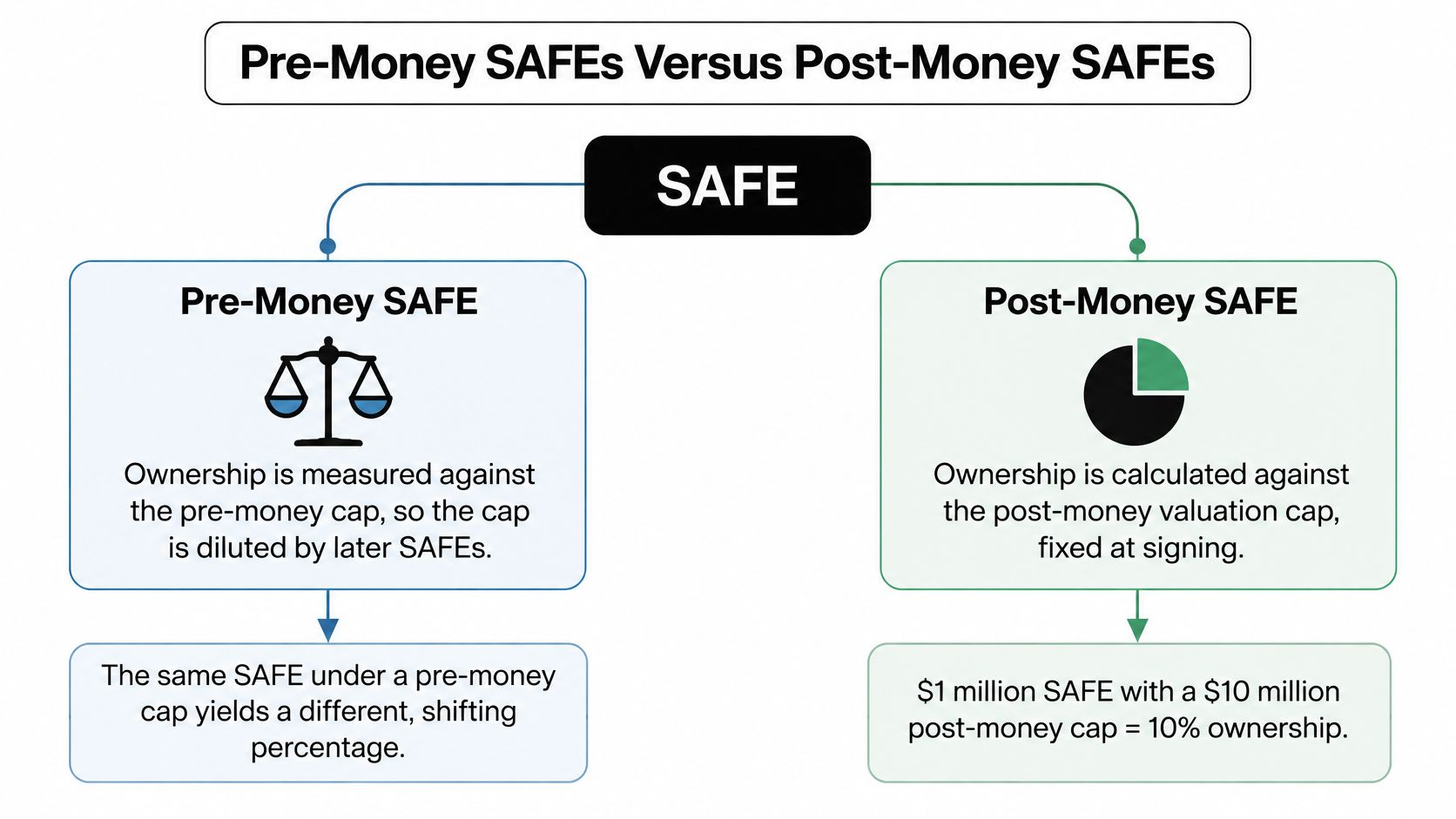
A SAFE, or simple agreement for future equity, requires a different analysis from an immediate purchase of priced shares. A valuation cap helps determine conversion economics; it isn't automatically the company's current valuation or an unconditional promise of permanent ownership.
Under a post-money SAFE, a $1 million investment with a $10 million post-money cap implies approximately 10% ownership before dilution from the subsequent priced round, according to Carta's comparison of pre-money and post-money SAFEs. That approximation assumes the applicable cap mechanics govern the calculation.
Multiple post-money SAFEs generally don't dilute one another before the priced round. Instead, their combined ownership primarily dilutes founders and other existing holders. The distinction makes aggregate dilution easier to measure, but doesn't make it inexpensive.
Compare Clarity With Flexibility
Consider a separate hypothetical stack. A $500,000 post-money SAFE with a $5 million cap represents approximately 10% before the priced round when the cap governs conversion. Another $500,000 SAFE at the same cap can represent another approximately 10%, leaving the pre-financing holders near 80% before further financing dilution.
A pre-money SAFE doesn't establish the same final ownership percentage. Other SAFEs or convertible instruments can dilute that investor before conversion, so the eventual result depends on the instruments issued and the conversion mechanics.
The trade-off is clearer ownership economics versus greater uncertainty. Post-money instruments give investors a more measurable position and let founders track the aggregate dilution more directly. Pre-money instruments may preserve flexibility, but founders can't responsibly evaluate them one at a time.
For terminology and document structure, our explanation of what a SAFE agreement is provides a starting point. The signed instrument still controls how capitalization and conversion are defined.
Model the Entire Stack Together
Ask counsel to prepare a conversion schedule, not just a total of money raised. It should identify each instrument's governing terms and show how those terms interact:
- Different valuation caps: Determine which conversion price applies to each investment.
- Discount provisions: Test their operation against the priced-round share price.
- Capitalization definitions: Identify how each instrument treats other convertibles and option-pool changes.
- Financing outcomes: Compare different round sizes and conversion results before relying on an ownership estimate.
South Florida founders raising from several angel groups shouldn't assume that using a standardized form answers the denominator question. Obtain legal review before treating any cap-based estimate as guaranteed ownership, particularly when the financing history includes different documents or negotiated amendments.
When a Higher Valuation Creates Later Risk
The highest post-money number isn't automatically the best deal. A founder may retain more ownership today yet accept a price the business can't support before its next financing.
If performance falls short, the next raise could involve a down round, liquidation-preference complications, pressure to reprice employee options, or disagreements about investor control. Those outcomes aren't inevitable, but founders should evaluate them before accepting a price that depends on aggressive execution.
The financing discussion should connect ownership, operating milestones, and governance.

Separate Ownership From Control
Economic dilution concerns your share of the equity. Control dilution concerns your ability to make decisions, and it doesn't follow ownership percentages neatly.
An investor's board seat, veto rights, protective provisions, and information rights can affect management even without majority ownership. Founder-vesting terms can also change a founder's practical position after a departure or dispute.
Before accepting the price: Ask what valuation the business can realistically grow into before its next financing.
Answer with runway, milestone timing, revenue quality, comparable transactions, and the likelihood of obtaining the next check. For an app startup, product scope belongs in that analysis: RapidNative's startup app development guide can help frame development planning, which should feed into the company's own budget and financing milestones.
Stress-Test the Next Raise
A stronger valuation headline can coexist with fewer completed financings. In the third quarter of 2025, total median pre-money valuation increased 11.11% from the prior quarter while venture deal count declined 14.25%, according to Stout's Venture Capital Industry Update.
That quarter isn't a pricing target for your company. It illustrates why founders shouldn't interpret rising valuations alone as evidence that fundraising has become easier.
Model a flat or down next round before accepting protective provisions that look harmless only when prices rise. Review the resulting ownership, applicable anti-dilution adjustments, liquidation waterfall, and required investor approvals. Then decide whether today's reduced dilution justifies tomorrow's financing constraints.
Median Pre-Money Valuations by Round
Market medians provide a reference point, not a price your startup is owed. According to Osler's 2024 Deal Points Report, median U.S. pre-money valuations in 2024 were $16.0 million for seed, $43.4 million for Series A, $108.9 million for Series B, $222.3 million for Series C, and $416 million for Series D.
2024 median U.S. pre-money valuations
| Round | Median pre-money valuation |
|---|---|
| Seed | $16.0 million |
| Series A | $43.4 million |
| Series B | $108.9 million |
| Series C | $222.3 million |
| Series D | $416 million |
A Miami or Fort Lauderdale seed founder shouldn't treat the seed median as an entitlement or as proof that a lower offer is unfair. These figures describe completed U.S. deals, not the appropriate value of one South Florida business.
The stage comparison is easier to scan visually.

Use the Benchmark to Ask Better Questions
Start with the round you're raising, rather than choosing the stage whose benchmark best supports your preferred price. Then compare the proposed pre-money valuation with the relevant median and investigate meaningful differences.
A business with recurring, diversified revenue presents different risks from one relying on a short-term customer contract. Runway, customer concentration, product readiness, and the amount being raised also influence the negotiation. A stage label doesn't resolve those differences.
- Normalize the basis: Compare pre-money figures with pre-money figures, rather than placing a post-money offer beside a pre-money benchmark.
- Write down ownership: Put the investor's proposed percentage beside the valuation and check it against investment divided by post-money.
- Investigate outliers: Ask what company-specific evidence supports a premium or discount, including the securities and rights attached to the financing.
Use a benchmark to identify questions, not to settle them. A seemingly attractive premium may require an oversized pool or demanding investor protections, while a lower price may fund a credible milestone with workable terms.
The useful conclusion isn't that an offer is above or below median. It's whether the complete transaction provides enough capital on terms the company can support.
Confirm the Valuation Basis Before You Sign
Accept a pre-money or post-money quote only after the ownership percentage, option pool, and convertible instruments reconcile to a defined fully diluted capitalization model. A verbal explanation isn't enough if the term sheet, conversion schedule, and ownership spreadsheet use different assumptions.
At Coto & Waddington, Attorneys at Law, we structure founder stock, vesting, option plans, and investor rounds involving SAFEs, convertible notes, and Series A financings. Our fundraising-readiness work includes cap table hygiene, SAFE and convertible note review, and due diligence preparation.
Make the Documents Match the Model
Clean financing math also depends on clean ownership records. Missing IP assignments, unclear ownership, wrong entity selection, and policy gaps are common do-it-yourself issues that can surface during fundraising or audits. Resolve those issues alongside valuation review so the diligence file supports the ownership being presented.
Our guidance on equity financing for startups addresses the legal structure surrounding these investment decisions. The practical objective is to connect the commercial promise to the documents and the post-closing cap table.
Use this confirmation list before approving the financing:
Label the valuation basis. Identify pre-money or post-money explicitly in the term sheet and the applicable stock purchase agreement, note, or SAFE. Don't rely on a pitch-deck label when the operative documents define something different.
Reconcile the promised ownership. Divide new cash by the post-money figure for the basic priced-round check. Investigate any mismatch and document the adjustments that explain it.
Confirm option-pool treatment. Identify whether the pool increase happens before the round and whether its target is measured before or after closing. Specify how granted options and unissued reserves enter the calculation.
Stack every SAFE and note. Include valuation caps, discounts, and other applicable conversion terms. Show ownership before the transaction, after each instrument's modeled conversion, after any pool refresh, and after the priced equity round.
Review control separately. Assess board seats, veto rights, protective provisions, information rights, and founder vesting. Make sure the governance arrangement remains workable when founders and investors disagree.
Test the next financing. Connect the accepted price to the runway and milestones the investment will fund. Include a less favorable fundraising outcome so the decision doesn't depend entirely on the optimistic forecast.
Keep the assumptions attached to the model, including the financing size, conversion treatment, pool definition, and rounding approach. Before anyone signs, the founders, investor, and counsel should be able to identify the same ownership result from the same documents.
Coto & Waddington, Attorneys at Law offers founder equity structuring, cap table hygiene, SAFE and convertible note review, and fundraising due diligence preparation. Before anyone signs, visit Coto & Waddington, Attorneys at Law and send your draft term sheet and current cap table so we can review the valuation basis and model the dilution before you commit.