A Miami founder has finally reached the point every startup wants to reach. Customers are paying, the product has traction, and an investor is offering $750,000 for 20% of the company. The check could fund hiring, sales, and product development. The ownership percentage could also shape every later round, board decision, and exit conversation.
That's the core question behind equity financing for startups. It isn't just, “Can I raise money?” It's, “Which capital source fits my company, which instrument gives investors enough protection, and how much of my future should I sell to reach the next milestone?” This guide gives you the framework to answer those questions before a term sheet lands on your desk.
Table of Contents
- The Founder's Dilemma Behind Every Equity Deal
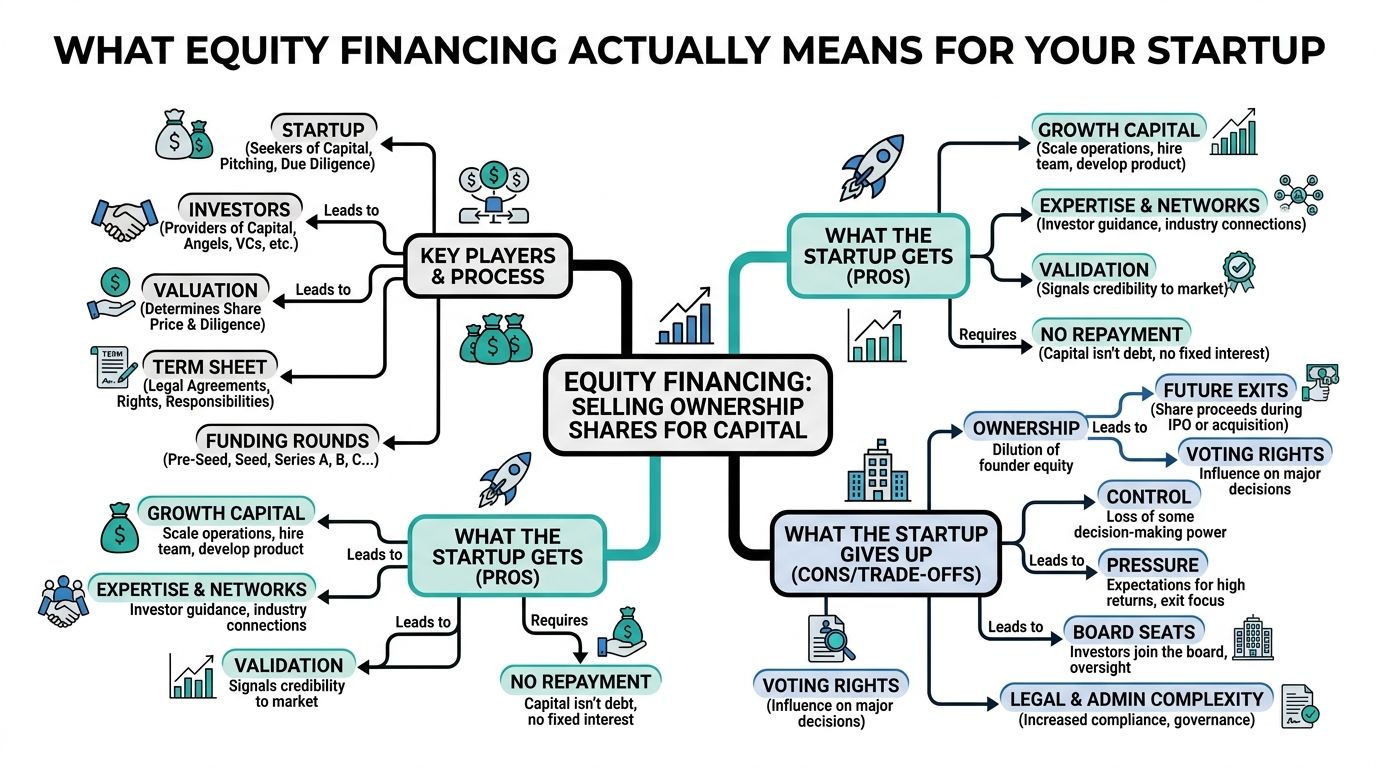
- What Equity Financing Actually Means for Your Startup
- Comparing Angels, Seed Funds, VCs, and Crowdfunding
- How SAFEs and Convertible Notes Really Work
- Cap Table Math and the Real Cost of Dilution
- The Fundraising Process From Cap Table Cleanup to Closing
- Founder Mistakes to Avoid and Your Next Steps
The Founder's Dilemma Behind Every Equity Deal
The Miami founder in that scenario has two competing priorities. The company needs cash now, but the founder also knows that ownership is a limited resource. Once shares, options, or conversion rights leave the founder's control, they generally won't come back because the company grows faster.
A $750,000 investment for 20% implies a $3 million post-money valuation and a $2.25 million pre-money valuation. That math is straightforward. The strategic consequences are not. The founder must consider whether the investor brings customers, recruiting help, industry credibility, or follow-on financing, or whether the company is selling a large portion of itself to extend runway.
Founder rule: Never evaluate a financing offer by cash amount alone. Price the money, the investor relationship, the control terms, and the dilution together.
The right funding source depends on the company's stage and the founder's objectives. An angel may be ideal when the business needs an early believer who can make introductions. A venture capital fund may be appropriate when the company is pursuing aggressive growth and can support institutional governance. Regulation Crowdfunding may fit a consumer company whose customers can become investors and advocates.
The instrument matters just as much as the investor. Priced equity establishes valuation and ownership immediately. A SAFE can close quickly, but its conversion terms may create a much larger ownership obligation later. A convertible note adds debt features, including interest and maturity provisions, which can create pressure if the next round takes longer than expected.
Founders should also treat fundraising as a communication exercise. Investors want to understand the company's story, market, and leadership judgment, while founders need to communicate terms without overselling or creating compliance problems. Resources on executive thought leadership articles can help founders sharpen the public narrative that supports investor outreach, but the narrative must always match the legal and financial reality.
Smart founders spend equity deliberately. They raise enough capital to reach a meaningful business milestone, preserve negotiating power, and avoid trading a permanent ownership stake for temporary relief.
What Equity Financing Actually Means for Your Startup
Think of your company as a pie. At formation, the founders hold the entire pie. Equity financing sells slices to investors in exchange for cash, and the company uses that cash to build products, hire employees, acquire customers, or expand into new markets.
Debt works differently. A lender expects repayment, usually with interest, while the founder keeps ownership unless the company defaults and enforcement rights apply. Equity investors generally don't receive scheduled repayment, but they receive a permanent ownership interest and may obtain voting, information, consent, or board rights.
The vocabulary that controls the deal
Pre-money valuation is the agreed value of the company before new investment. Post-money valuation is the pre-money valuation plus the new capital, subject to the specific deal mechanics. If a company has a $2.25 million pre-money valuation and receives $750,000, the post-money valuation is $3 million.
Fully diluted ownership includes the equity that may exist after accounting for issued shares, options, warrants, and convertible securities. Founders who negotiate from an issued-share count instead of a fully diluted count often underestimate how much ownership the financing will consume.
The distinction between pre-money and post-money also matters for SAFEs. A pre-money structure may leave the final ownership percentage uncertain until conversion, while a post-money structure is designed to give investors clearer ownership treatment relative to other SAFEs. That clarity can make the investor's position easier to understand, but it can also place more dilution directly on founders.
The 2025 funding environment shows why founders are competing nationally, even when they build locally. CB Insights' 2025 venture trends report reported $469 billion in global startup and venture funding in 2025, up 47% year over year after two years of decline. The same source reported that U.S. startups raised $328 billion, about 70% of global funding.
Another figure in that report placed 2025 investment at $425 billion across more than 24,000 private companies, making it the third-highest venture financing year on record, with U.S. startups raising roughly $274 billion, or 64% of the global total. The figures differ by methodology, but the message is consistent. Capital is flowing, and it remains concentrated in major markets.
South Florida founders benefit from a stronger local ecosystem, but they shouldn't limit outreach to local investors. Miami and Fort Lauderdale can provide relationships, talent, and regional credibility. National angels and funds may provide deeper capital and sector-specific expertise. Your cap table should reflect the value of the capital, not the investor's ZIP code.
Comparing Angels, Seed Funds, VCs, and Crowdfunding
The investor who fits your company depends on more than check size. Each capital source brings a different expectation about pace, governance, reporting, and future fundraising.
| Funding Source | Typical Stage | Check Size | Founder Trade-Off |
|---|---|---|---|
| Angel investors | Formation, pre-seed, and seed | Individual early-stage checks | Personal judgment, mentorship, and flexible relationships, but investor quality varies |
| Seed funds and accelerators | Pre-seed and seed | Pool-based early-stage financing | Structured support and introductions, often paired with a focused program or ownership expectation |
| Venture capital | Seed through later growth rounds | Larger institutional financings | Significant growth capital, but stronger ownership targets, reporting, governance, and possible board involvement |
| Regulation Crowdfunding | Early-stage or community-driven raises | Capital from a broad investor group | Market validation and customer participation, paired with disclosure, intermediary, and compliance obligations |
Angels and seed investors
Angels often invest before a company has enough operating history for institutional underwriting. They may decide based on the founder, product insight, customer evidence, or personal familiarity with the market. Choose angels who can help the company, not merely those who can wire funds.
Seed funds and accelerators bring a more organized process. They may offer mentoring, investor introductions, hiring support, or a concentrated network. Read the documents carefully. A program's brand doesn't eliminate the need to understand its ownership terms, follow-on rights, or governance provisions.
Venture capital
Venture capital works best when the company can plausibly support rapid expansion and a later institutional financing path. A VC may expect preferred stock, protective provisions, information rights, a board seat, or approval rights over significant company actions. Those terms can be reasonable, but founders should understand the control package before focusing on the headline valuation.
South Florida companies can approach regional funds while also pursuing national investors already looking at Miami. The strongest approach is usually targeted outreach, not a mass email campaign. Match the investor's stage, sector, geography, and portfolio strategy to the company's actual needs.
Regulation Crowdfunding
Regulation Crowdfunding offers a different path. A company can raise up to $5 million in any 12-month period, and the SEC measures that offering cap on a rolling basis from each closing, as explained in the SEC's Regulation Crowdfunding overview. Investors face annual investment limits based on income and net worth.
For example, the SEC's issuer guidance states that a non-accredited investor with either annual income or net worth below $124,000 can invest the greater of $2,500 or 5% of the greater amount. If both income and net worth are at least $124,000, the investor can invest up to 10% of the greater amount. The SEC also explains that accredited investors aren't subject to those investment limits, while non-accredited investors' total purchases across Regulation Crowdfunding offerings can't exceed $124,000 in a 12-month period in the relevant SEC interpretation.
Use crowdfunding when the community itself strengthens the business. Don't use it to avoid a difficult institutional raise if your company needs a concentrated lead investor.
For a South Florida founder weighing securities compliance and offering structure, this SEC registration guide for businesses provides useful legal context. The first door to knock on should be the one that matches the company's stage, capital requirement, and desired relationship with investors.
How SAFEs and Convertible Notes Really Work
SAFEs and convertible notes let a startup receive money before negotiating a full priced equity round. That speed is useful, but it doesn't make the economics disappear. The ownership calculation arrives later, often when the company has less flexibility.
Consider a $250,000 SAFE with a $10 million valuation cap. If the next priced round values the company above that cap, the SAFE converts using the cap rather than the higher round valuation, giving the early investor a more favorable price and more shares than a new investor paying the full round price. If the round valuation is lower than the cap, the lower round valuation may control, depending on the agreement.
A convertible note with the same $250,000 principal, a 5% interest rate, and a $10 million cap has an additional moving part. Interest accrues under the note terms and can increase the amount converting into equity. The note may also include a maturity date and remedies or negotiation pressure if no qualifying financing occurs.
Where founders get surprised
Valuation caps and discounts protect early investors against the risk that the company's next round is priced much higher. For founders, that protection means the investor may convert at a lower price per share, which increases the number of shares issued during conversion.
Stacked SAFEs create the most common modeling failure. Each agreement may have a different cap, discount, or definition of the capitalization used for conversion. When several instruments convert at the same time, the founder can discover that the ownership sold was materially larger than the amount suggested by any single SAFE.
The pre-money versus post-money distinction is especially important. With a post-money SAFE, the investor's ownership is calculated with greater certainty relative to other post-money SAFE holders, while later SAFE investors generally don't dilute one another. That structure is easier for investors to understand, but founders absorb the resulting dilution more directly.
Choose a SAFE when speed and simplicity matter, the company can tolerate deferred valuation work, and the terms are standardized and modeled. Choose a note when the parties need debt mechanics, an interest provision, or a maturity framework. Neither instrument is automatically founder-friendly.
Model before signing: List every SAFE and note, then calculate conversion under multiple priced-round valuations and financing sizes. If the cap table changes materially, renegotiate before the money arrives.
Cap Table Math and the Real Cost of Dilution
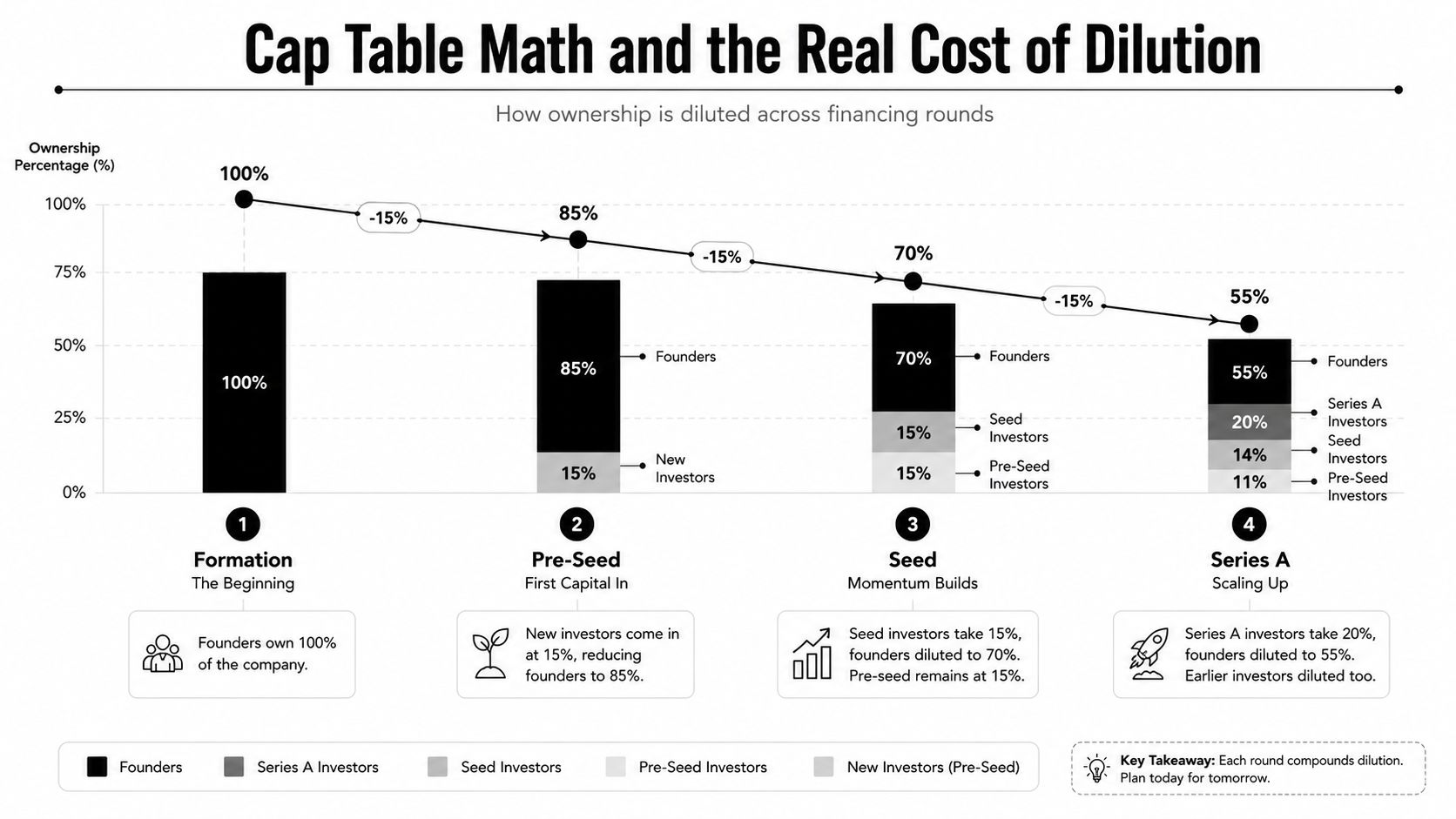
Dilution compounds multiplicatively, not additively. If a founder sells a percentage in one round, the next investor takes a percentage of the company that remains, not merely a percentage deducted from the founder's original stake.
Startup-capital benchmarks report median dilution of approximately 8.5% at pre-seed, 13.8% at seed, and 17.9% at Series A, with median pre-money valuations of approximately $5 million, $12 million, and $32 million, respectively, according to startup dilution benchmarks. These are reference points, not automatic pricing rules.
Work through the ownership sequence
Start with 100% founder ownership. If a pre-seed financing transfers 8.5% of the company, the founders retain 91.5%. If the next round transfers 13.8% of the company, the founders retain 86.2% of their pre-round ownership, which is approximately 78.9% of the company before considering other securities and pool changes. A Series A dilution event then applies to the remaining ownership again.
The precise result depends on the instrument, option pool, transaction structure, and capitalization definitions. The broader benchmark guidance states that a founder can move from 100% at formation to roughly 35%–45% after Series A, even when valuation rises materially, because multiple rounds and option-pool expansion compound together. The founder has more money and a more valuable company, but owns a much smaller share.
The option-pool shuffle
An option pool gives the company equity reserved for future employees. Investors often ask for the pool to be increased before their investment, making it a pre-money item. That means the founders bear the dilution from the new pool before the investor's ownership is calculated.
The benchmark guidance identifies option-pool expansion of approximately 5%–10% as a frequent additional source of dilution and explains why a pre-money pool effectively makes founders fund part of the employee incentive reserve. Negotiate the pool against a realistic hiring plan, not an abstract future headcount.
Practical rule: Review the term sheet on a fully diluted basis before accepting it. Your spreadsheet should show founders, existing investors, options, warrants, SAFEs, notes, and the proposed new financing in one pro forma cap table.
Raise only what the company needs to reach the next valuation inflection point. Over-raising early can lock in a lower valuation base and permanently reduce founder ownership across later rounds. Before discussing preemptive rights and future participation, review this explanation of preemptive rights for startup investors, then model how those rights could affect later financings.
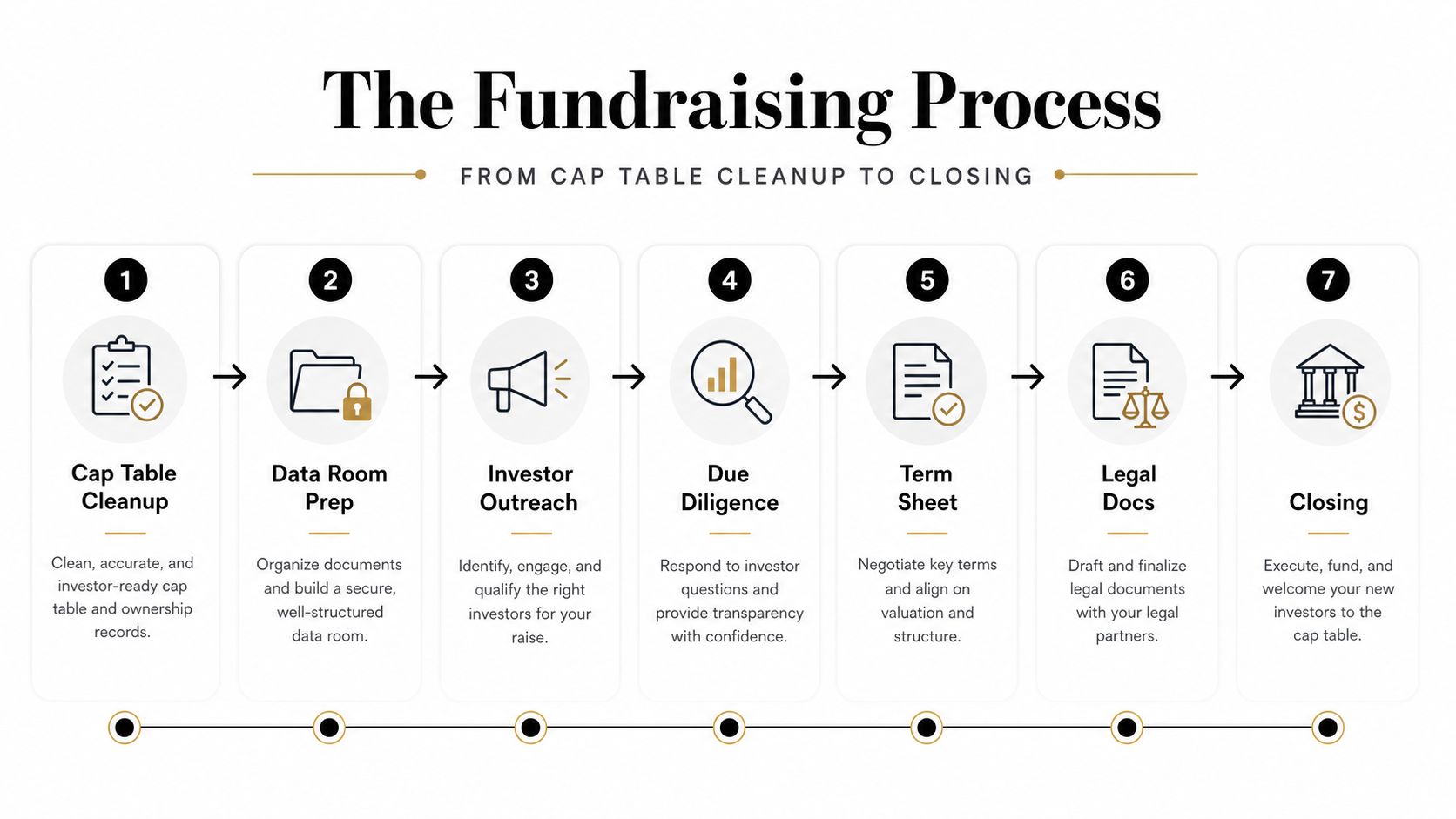
The Fundraising Process From Cap Table Cleanup to Closing
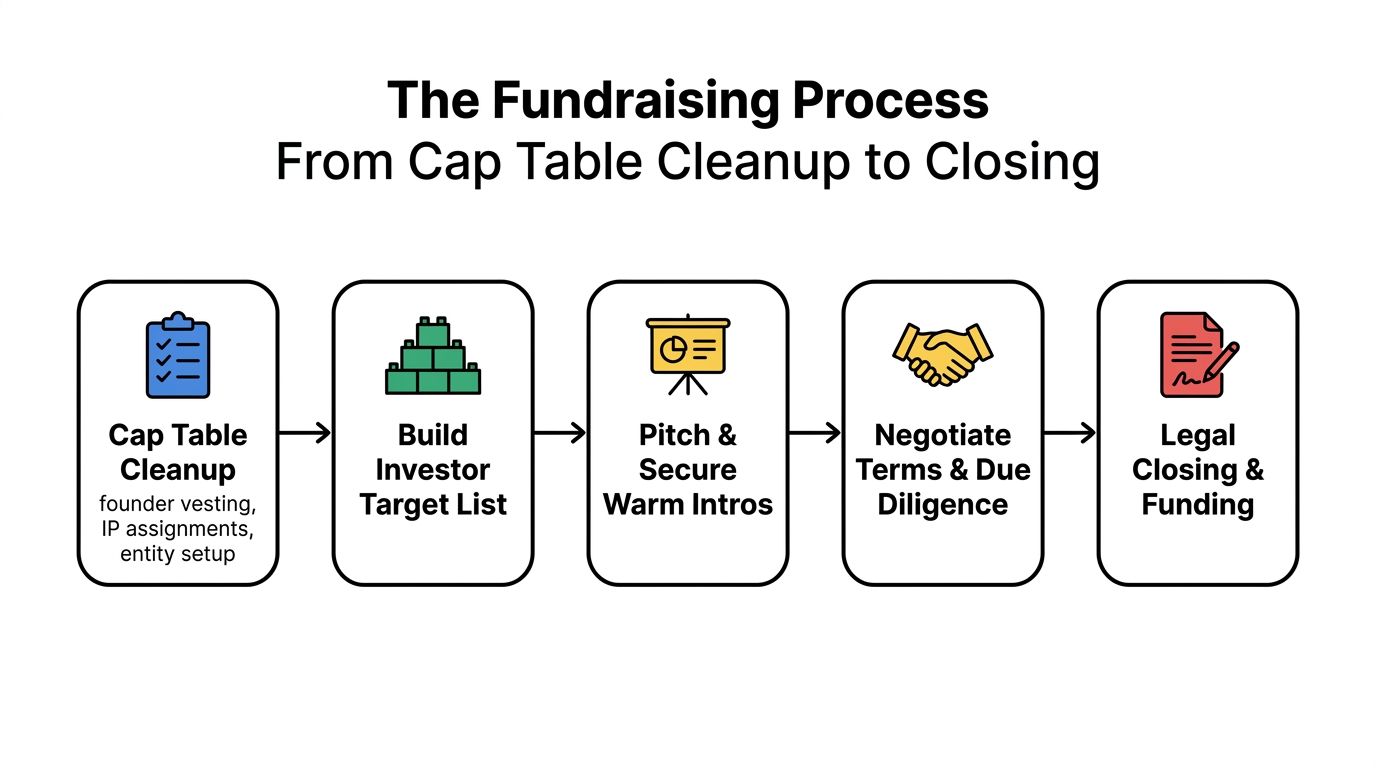
A good raise starts before the pitch deck. Investors and counsel will find missing founder stock documents, unassigned intellectual property, inconsistent ownership records, and incomplete corporate approvals. Fix those problems before they become a point of negotiation for the buyer of your equity.
Start with corporate housekeeping
Confirm the entity's state, ownership records, founder vesting, intellectual property assignments, and material contracts. A Delaware or Florida entity can work, but the choice should match the company's investors, tax situation, operations, and long-term plans.
Then prepare a fully diluted cap table. Include issued shares, promised equity, option reserves, warrants, SAFEs, notes, and any side letters. Don't wait for an investor to identify a missing instrument. A clean model gives you the ability to compare term sheets before you commit.
Build the financing package
Your materials should explain the product, customers, market, business model, team, current capitalization, financing objective, and use of proceeds. Financial records should support the story. A practical founder's financial due diligence checklist can help organize the accounting and operational materials investors commonly request.
Outreach should be targeted. Build a list of angels, seed funds, accelerators, and VCs whose investment approach fits your stage. Warm introductions help, but a credible direct approach can work when the company's thesis and materials are precise.
Negotiate and close carefully
The term sheet sets the commercial framework, but it isn't the closing. Counsel must review valuation, security type, liquidation preference, board rights, protective provisions, information rights, option-pool treatment, pro rata rights, and conversion mechanics.
For Regulation Crowdfunding, the SEC requires offerings to run through an SEC-registered intermediary, and issuers must disclose business information, use of proceeds, financial condition, officers and directors, and certain ownership information, as described in coverage of the SEC's crowdfunding rules.
The legal closing typically includes securities compliance, subscription or purchase documents, investor questionnaires where applicable, board and shareholder approvals, updated bylaws or operating documents, and an accurate post-closing cap table. A properly prepared stock purchase agreement can prevent ambiguity about what the investor purchased and what the company promised.
Flat-fee startup counsel can make this stage more predictable, but the scope should be explicit. Ask who handles diligence, cap table modeling, securities filings, investor comments, closing mechanics, and post-closing records.
Founder Mistakes to Avoid and Your Next Steps
Over-raising at a weak valuation base gives the company more cash but can make every later round more expensive in ownership. Raise against a milestone, not a vague desire for extra runway. A smaller, well-timed round can preserve negotiating power if it gets the company to a stronger valuation inflection point.
Signing stacked SAFEs without conversion modeling creates a deferred ownership problem. Founders often accept each check separately and discover the combined effect only when investors demand a priced round. Maintain one fully diluted model that includes every cap, discount, interest provision, and conversion trigger.
Creating the option pool pre-money without negotiation shifts employee-reserve dilution onto founders. Ask what hiring plan justifies the pool, whether the pool can be sized to near-term needs, and how the percentage is calculated.
Using boilerplate documents can produce disputes over voting rights, conversion terms, information rights, or who owns the company's intellectual property. Standard forms are useful starting points, not substitutes for reviewing the transaction against your actual cap table and business.
Before signing a term sheet, have your ownership modeled on a fully diluted basis and have every SAFE, note, option-pool term, and governance provision reviewed by startup counsel. For Miami and Fort Lauderdale founders, Coto & Waddington, Attorneys at Law offers founder-focused representation for financing rounds, equity issuance, SAFE agreements, convertible notes, cap table management, and corporate diligence, with flat-fee options and English or Spanish support.
Coto & Waddington, Attorneys at Law can review your term sheet, model the fully diluted ownership outcome, and prepare the agreements needed to close your financing. Visit Coto & Waddington, Attorneys at Law before you accept investor funds so you can negotiate from an accurate cap table and raise with confidence.