You hired a marketing agency, a developer, or a fractional operator to move faster. Six months later, performance has slipped, invoices have not, and you want out. Then you read the agreement you signed and discover you cannot leave without paying for months of services you no longer want. That is usually the first time a founder learns what the termination clause in service agreement language was doing.
Table of Contents
- Why the Termination Section Deserves More Attention
- What a Termination Clause Actually Does
- For Cause and For Convenience Compared
- Notice Periods and Cure Mechanics That Hold Up
- What Happens After the Notice Goes Out
- How Termination Rights Interact With Noncompetes and Non-Solicits
- Sample Language and a Negotiation Checklist
- Founder Action Plan and When to Get Counsel Involved
Why the Termination Section Deserves More Attention
A Miami based startup signs a marketing agency's master service agreement on a Friday afternoon. The founder reviews scope, monthly fees, and deliverables, then flips to the signature page. Buried near the back, the contract auto renews unless the client cancels by a deadline that will pass before the results disappoint. No termination for convenience right, no defined breach standard, no duty to hand over campaign data.
When the founder tries to exit, the agency holds the ad account, creative source files, and audience lists until the renewed term is paid in full. The startup can hire a replacement agency, but it can't rebuild history it doesn't control. Then a non-solicit clause nobody read blocks the new team from bringing over the strategist who managed the account. Pay two vendors or go dark. That was the menu.

What Skimming the Exit Terms Costs You
Founders skim exit language because it reads like boilerplate, and vendors count on that. A long notice period, a quiet renewal, silence on data return. Each one protects the provider's revenue better than any sales call. In the deals I negotiate, the fight is rarely over whether you can terminate. It's over what happens in the thirty days after notice goes out and which restrictions follow you out the door.
- Locked in fees: You're paying through a renewed term even after you've lost confidence in the work.
- Blocked access: Credentials, customer data, and work product stay with the vendor while you argue.
- Transition chaos: A new provider starts from zero because handover duties were never defined.
- Stray restrictions: A surviving non-solicit or noncompete limits who you can hire or call after you leave.
Practical rule: Negotiate your exit while both sides still like each other. Once performance fails, the advantage shifts to whoever controls the term and the data.
Tip: Before you sign, read the termination and renewal sections first, not last. If you can't explain in one sentence how you exit, how much notice you owe, and what you get back, the clause isn't ready.
What a Termination Clause Actually Does
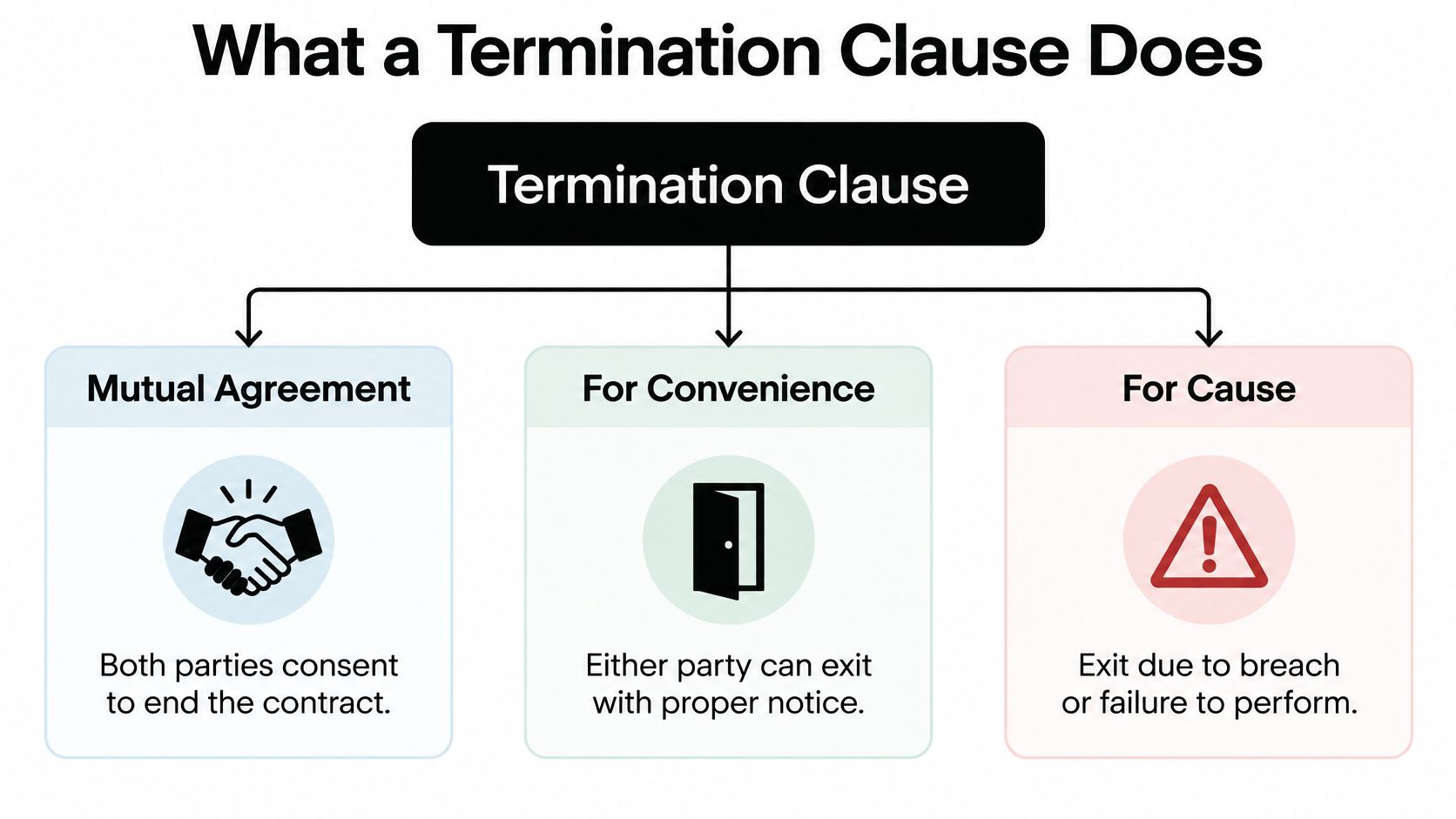
A termination clause is your agreed exit ramp. It replaces guesswork with a procedure, it states who can end the relationship, for what reasons, and what happens on the effective date. Without it, you're arguing about implied rights, seriousness of breach, and whether continued performance waived your complaint.
History explains why precision helps. In English contract law, the Heyman v Darwins principle on accepting repudiation reflects that repudiation by one party doesn't automatically end a contract, the other party must elect to accept it and treat the agreement as terminated, with the decision issued on February 20, 1942. A later decision reinforced that the election must be clearly and unequivocally communicated. A written clause avoids forcing a founder to prove that level of repudiation in a vendor fight.
The same drafting instinct appears in Uniform Commercial Code section 2-309 on indefinite duration. That provision addresses contracts involving successive performances and indefinite duration, requires reasonable notice unless the parties agree otherwise, and invalidates a waiver of notice if enforcing it would be unconscionable. Article 2 primarily governs sales of goods, but the lesson travels well. A continuing service relationship should state duration, renewal, triggers, and notice instead of relying on silence.
Four Building Blocks
- Trigger: Convenience, material breach, insolvency, nonpayment, or missed service levels.
- Notice: Who receives it, by what method, and how many days before exit.
- Cure mechanism: Whether the breaching party gets time to fix the problem.
- Effective date: The exact day obligations to perform new work stop.
Termination isn't the same as expiration. Expiration is the term running out, termination is a party cutting it short under a right in the contract. That distinction matters because accrued payment, confidentiality, intellectual property, and dispute resolution duties should survive either event. If you're still mapping the broader contract, start with what belongs in a service agreement and compare it with customer facing policies for B2B engagements to see how exit rights are disclosed in practice.
Tip: Draft survival language on purpose. Don't assume a duty lives on after termination unless the agreement says so.
For Cause and For Convenience Compared
Most negotiations come down to two different kinds of exit. Termination for convenience lets a party leave without proving fault. Termination for cause requires a reason the contract recognizes, usually material breach, insolvency, or repeated nonperformance.
Publicly filed agreements show how varied the mechanics can be. In publicly filed service agreements showing convenience notice examples, convenience termination commonly requires advance written notice, with examples including 30, 60, and even 5 days, while cause based termination typically requires notice describing the breach and a defined cure period. One disclosed agreement uses a 30 day cure period, another uses 15 days and allows immediate termination for insolvency or bankruptcy. Those numbers aren't interchangeable. They allocate who bears disruption.
For Cause vs. For Convenience at a Glance
| Dimension | Termination for Cause | Termination for Convenience |
|---|---|---|
| Fault required | Yes, a contract trigger must occur | No, no allegation of breach needed |
| Proof burden | Higher, document the breach and notice | Lower, follow notice procedure |
| Speed | Slower if a cure period applies | Predictable, set by notice window |
| Cure right | Usually yes for curable breaches | Not applicable |
| Provider protection | Opportunity to restore performance | Time to plan staffing and wind down |
| Founder risk | Terminating too early creates a dispute | Paying during a long notice period |
A longer notice window helps a provider reassign staff and finish work cleanly. It hurts a customer who needs to cut spend quickly or replace a failing vendor before a launch. A cure period does the opposite work, it prevents a hair trigger exit over a fixable miss, but it also keeps you tied to a provider you've already lost trust in.
Which One Should a Startup Demand
Insist on both when you can. Cause protects you when performance breaks down. Convenience protects you when strategy, budget, or headcount changes and fault is hard to prove. If a vendor resists convenience entirely, push for it after an initial commitment period, or tie it to individual statements of work so you can pause one workstream without ending the whole relationship.
Also decide scope. Can you terminate one statement of work, one service line, or only the entire agreement? Partial termination is often more useful than an all or nothing right, especially with IT, marketing, and operations vendors who touch several parts of the business.
Tip: If nonpayment is a cause trigger for the provider, negotiate the same clarity for yourself on missed deadlines and service levels. One sided cause definitions are a red flag, not a compromise.
Notice Periods and Cure Mechanics That Hold Up
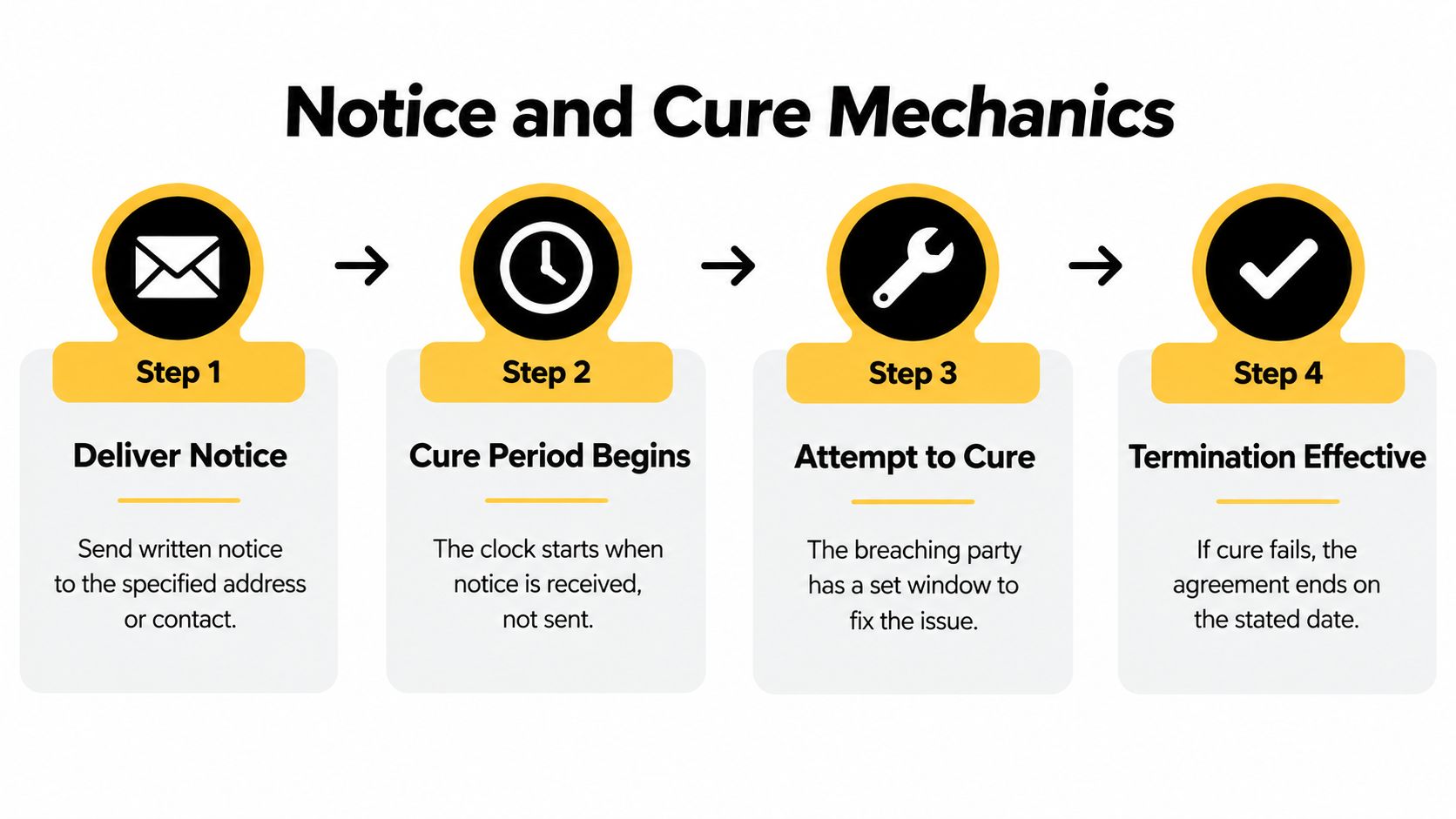
A founder emails her dev shop: "We're terminating for cause, effective Friday." The message lands in the account manager's inbox. The contract required written notice to a corporate address and a mandatory cure period, and neither happened. When the vendor sues, her termination is the breach. I've watched versions of this play out across more service contracts than I can count.
Termination fights rarely turn on whether someone was unhappy. They turn on whether notice went to the right person, said the right thing, and gave the contractually required time to cure. Paper the file before you pull the trigger.
Federal acquisition rules offer a useful benchmark for drafting discipline. Under federal acquisition rules on cure before termination, before terminating a fixed price contract for certain performance failures, the contracting officer must send written notice identifying the failure and allow at least 10 days to cure, unless a longer period is reasonably necessary. Termination may proceed only if the failure remains uncured after that period. Private agreements aren't bound by that regime. The structure is still worth borrowing.
What a Defensible Cure Notice Contains
Every cure notice I've seen survive a dispute answers four questions in plain terms. Which deliverable, deadline, or standard was missed? Which contract section or statement of work created that duty? What exactly must be fixed, stated as concrete corrective action rather than a general demand to improve? And how many calendar days does the provider have, with the clock defined as running from sending or from receipt?
Federal guidance stresses the same discipline. The guidance on cure notice contents and timing calls for realistic deadlines and clear identification of failures. Apply that logic privately. A vague complaint that work is unsatisfactory doesn't start a reliable cure clock. A dated notice identifying missed reports, broken response times, or unpaid amounts does.
Some breaches shouldn't get a cure window at all. Fraud, confidentiality violations, unlawful conduct, and insolvency can justify immediate termination because trust or legal compliance is already gone. Recurring late delivery sits somewhere else: a second or third instance of the same miss should convert a curable problem into cause without restarting a full cure cycle.
Don't write reasonable opportunity to cure and consider the job done. Reasonable is what lawyers argue about after the relationship has collapsed.
One drafting point gets skipped constantly. Build an escalation path into the clause itself: informal escalation to the account manager first, then formal notice to the contractual address. Require delivery proof for the formal step. A Slack message to a project channel is not a termination record, and it won't read like one to a judge.
What Happens After the Notice Goes Out
A Miami SaaS company gives its offshore dev shop 30 days' notice on a Monday. By the following week, the lead developer has been reassigned to another account, the shared drive is in disarray, and requests for admin credentials go unanswered. Nothing in the contract obligates the vendor to do anything except stop billing.
That's the gap. A clause that only declares the relationship over handles the legal exit and ignores the operational one, which is the part that costs you money.

Write the Handoff Into the Clause
A termination provision that holds up answers these questions before anyone sends notice:
| Open item | What the clause should fix |
|---|---|
| Final payment | Compensation for work through the effective date, and whether prepaid fees get refunded, credited, or forfeited |
| Data and files | Delivery of source files, credentials, exports, and documentation, plus the required format and deadline |
| Transition help | How long assistance runs, who the named contact is, and whether it's billed at the existing rate |
| Access control | When you revoke vendor access to systems, ad accounts, code repositories, and customer records |
| Survival | Which duties continue, including confidentiality, IP licenses, indemnities, audit rights, and dispute provisions |
Template guidance often lists transition help and final payment as topics, as reflected in template guidance on transition assistance and final payment, but it rarely allocates timing, cost, or responsibility when cooperation stalls. Make those allocations before exit, and tailor them to the vendor type. For software and IT vendors, specify export format and deletion duties. For marketing and creative agencies, draw the line between working files and finished deliverables. For fractional operations, require handover of processes, vendor contacts, and open tasks.
Payment terms deserve the same precision. State whether wind down fees apply, how the final invoice gets calculated, and whether disputed amounts may be withheld. Then connect the clause to the letter you'll send. If you're ending an individual contractor relationship, guidance on how to write a contractor termination letter keeps the communication consistent with the contract's notice method. If the vendor claims your exit was wrongful, you'll want to understand how Florida treats breach of contract claims before positions harden.
Tip: Pay undisputed amounts through the effective date unless counsel advises otherwise. Withholding everything may feel like bargaining power, but it often gives the vendor a cleaner claim than the one you're trying to escape.
How Termination Rights Interact With Noncompetes and Non-Solicits
A Miami SaaS founder terminates her outsourced sales agency on thirty days' notice. The paperwork is clean. Two weeks later she tries to hire the rep who ran her pipeline and learns the agreement bars soliciting the agency's personnel for two years. The termination right worked exactly as drafted. The business still couldn't move.
That collision is where exit strategy meets restrictive covenants. Service agreements routinely attach post-termination obligations to the exit clause: non-solicitation of staff, customer restrictions, hiring limits, or rules about work product you already paid for. I've watched founders win the wrongful termination argument and lose the hiring fight that followed, because nobody read the survival language before the notice went out.
The enforcement picture adds another layer. Under the FTC noncompete rule history and vacatur, the FTC's 2024 nationwide noncompete ban is not enforceable after a federal court's August 20, 2024 order, and the FTC moved in September 2025 to dismiss its appeals and accept vacatur. Noncompetes now rise or fall under state law, which turns on reasonableness, legitimate business interests, duration, geography, and the relationship between the parties. Florida sits toward the enforcement-friendly end of that spectrum, which cuts both ways depending on which side of the restriction you occupy.
Four questions decide whether termination leaves you room to operate. Who is restricted: the company, you personally, your employees, affiliates formed later? What is restricted: hiring, soliciting customers, competing, using defined confidential information? When does the clock start: signing, termination, or last payment? And does cause matter, meaning do the restrictions fall away if the provider materially breached first?
Check the answers against your non-solicitation agreement obligations before you sign, not after you've recruited a replacement. Contractors, agencies, advisors, and outsourced sales teams each carry different mobility risk. A two-year customer non-solicit may be defensible for a senior sales contractor holding real relationships and overbroad for a short-term creative vendor.
Ask for carve outs in writing while the deal is still friendly: general advertising, unsolicited applications, and customers you brought to the relationship. A clause can leave termination legally available while making the business move behind it impractical.
Sample Language and a Negotiation Checklist
Sample language won't replace counsel, but it shows what clear drafting looks like. Adapt the structure, not just the words, and align every number with the service's delivery cycle.
Plain English Starting Points
- For cause: Either party may terminate if the other materially breaches this agreement and fails to cure within the stated cure period after written notice describing the breach in reasonable detail.
- For convenience: Either party may terminate all or part of the services for convenience on the stated number of days' prior written notice.
- Immediate events: Either party may terminate immediately on written notice if the other becomes insolvent, makes an assignment for creditors, or admits inability to pay debts as they mature.
- Survival and handover: On termination, provider will return or securely delete client data as directed, deliver completed work product, and cooperate with transition for the agreed period.
Notice what each line does. The cause clause creates proof and cure duties. The convenience clause creates predictability. The insolvency clause removes delay when the counterparty may be unable to perform. The survival clause prevents the most common post exit fight, who keeps what.
Compensation design affects bargaining power too. If fees turn on results or milestones, your termination language should state how partial performance is measured and paid, a point explored in drafting guidance on outcome-based pay for services. Don't let a payment model reward a vendor for work that becomes unusable after exit.
Negotiation Checklist
- Confirm the trigger: Define material breach with examples tied to the service.
- Fix the notice period: Use calendar days and a delivery method you'll use.
- Define cure: State start date, required correction, and treatment of partial or recurring cure.
- Plan offboarding: Cover data export, credentials, files, and transition rates.
- Check survival and restrictions: Align confidentiality, IP, and non-solicit duties with real risk.
Tip: Ask counsel to match the cure period to operational reality. A short window may be too brief for technical remediation, and too long for a critical security failure.
Founder Action Plan and When to Get Counsel Involved
Before you sign or renew, make five decisions deliberately. Choose whether you need convenience, cause, or both. Set a notice window you can live with if cash tightens. Define cure so a provider gets fairness without endless resets.
Then plan the handoff and audit the restrictions. Confirm who owns data and work product, how you'll receive them, and whether any noncompete or non-solicit survives the exit. Check renewal separately. Automatic renewal is its own trap if cancellation deadlines and methods are buried.
On that renewal point, in an FTC filing on automatic renewal laws, about half of U.S. states had enacted automatic renewal laws requiring clear disclosures and easier cancellation, with rules commonly focused on consumer contracts and possible exemptions for particular service contracts. Don't assume one national rule protects your business agreement. Check the governing state and customer type.
Mistakes That Trigger Disputes
- Silence on duration: No one knows whether the deal is indefinite, fixed term, or auto renewing.
- Vague cure language: The parties argue about whether a complaint counted as notice.
- No data return duty: The vendor holds accounts or files hostage during transition.
- Unchecked restrictions: You can terminate, but you can't hire or sell without a new fight.
Bring counsel in before signing when the vendor touches software, customer data, revenue, or core operations. Bring the draft agreement, statements of work, pricing, and any side promises made by email. That's enough for a focused review of exit rights, renewal, payment, and handover, without turning a routine vendor deal into a drawn out negotiation.
Tip: Calendar the renewal cancellation deadline the day you sign. A well drafted clause doesn't help if your team misses the notice date.
If you're signing, renewing, or trying to exit a service agreement, Coto & Waddington, Attorneys at Law reviews termination, renewal, data return, and restrictive covenant language for South Florida startups and small businesses before those clauses become disputes. Bring your draft or current agreement for a practical, founder minded contract review, and visit Coto & Waddington, Attorneys at Law to schedule a consultation.