You're probably in one of two situations right now. A customer finally sent over the contract that could generate real revenue, or a vendor dropped a “standard agreement” into your inbox and wants it signed today. In South Florida, that often happens fast, across English and Spanish conversations, with a founder trying to keep sales moving while also protecting the company they're building.
That's exactly where business contract review matters. Not as a slow legal ritual, but as a founder skill. If you run a Miami e-commerce brand, a Fort Lauderdale agency, a Brickell SaaS startup, or a family business expanding into new markets, the contract in front of you affects cash flow, liability, intellectual property, and sometimes even future fundraising or exit options.
Table of Contents
- Beyond the Fine Print Why Contract Review Is a Core Business Skill
- The Pre-Review Checklist What to Know Before You Read Word One
- Decoding the Deal A Clause-by-Clause Review Guide
- Common Red Flags and Negotiation Starting Points
- When to Call for Backup DIY Versus Hiring an Attorney
- Your Go-Forward Plan and Final Checklist
Beyond the Fine Print Why Contract Review Is a Core Business Skill
Founders often treat contracts like cleanup work. Sales closes the deal, operations wants to start, and legal review becomes the last box to check. That approach causes problems because contracts don't just document the deal. They define how the deal works when money is late, deliverables change, a relationship goes sideways, or a buyer acquires your company.
The financial stakes are bigger than most founders expect. The average business loses 9.2% of its annual revenue due to contract mismanagement, and poor agreement management drains approximately $2 trillion per year in global economic value, according to a 2024 study summarized by Tracking Contracts' CLM statistics review. That's why business contract review isn't just legal housekeeping. It's a revenue protection system.
What founders usually miss
A contract can subtly affect issues that matter far beyond one transaction:
- Cash flow timing: A strong sale can still hurt your company if payment terms are vague or delayed.
- Ownership of work product: If your company builds software, designs, content, or processes, unclear IP language can transfer more than you intended.
- Exit flexibility: Assignment and change-of-control language can create friction later when investors, acquirers, or strategic partners appear.
- Operational risk: A vague scope of work invites disputes because each side thinks the deal says something different.
Practical rule: Review contracts like an operator, not just like a signer. Ask what this document will force your team to do six months from now.
In South Florida, I see an added layer. Many businesses negotiate in one language and sign in another. If your team discusses terms in Spanish but the final paper is in English, don't assume everyone shares the same understanding of scope, timelines, or termination rights. Bilingual businesses need clarity at the conversation stage and the drafting stage.
Contract review is part of the job
Founders don't need to become litigators. They do need to understand what a contract does to strategic advantage, risk, and decision-making. That's part of learning what a business attorney does for growing companies. Good review shortens disputes, improves negotiation posture, and helps you say yes to the right deals faster.
A contract that “looks standard” can still contain one-sided business terms. Standard for whom is the better question.
The Pre-Review Checklist What to Know Before You Read Word One
A founder's biggest review mistake is starting with the clauses before getting the facts straight. If you don't know who the parties are, what the deal is supposed to achieve, and who has authority to sign, you can spend an hour marking up language that doesn't solve the actual risk.
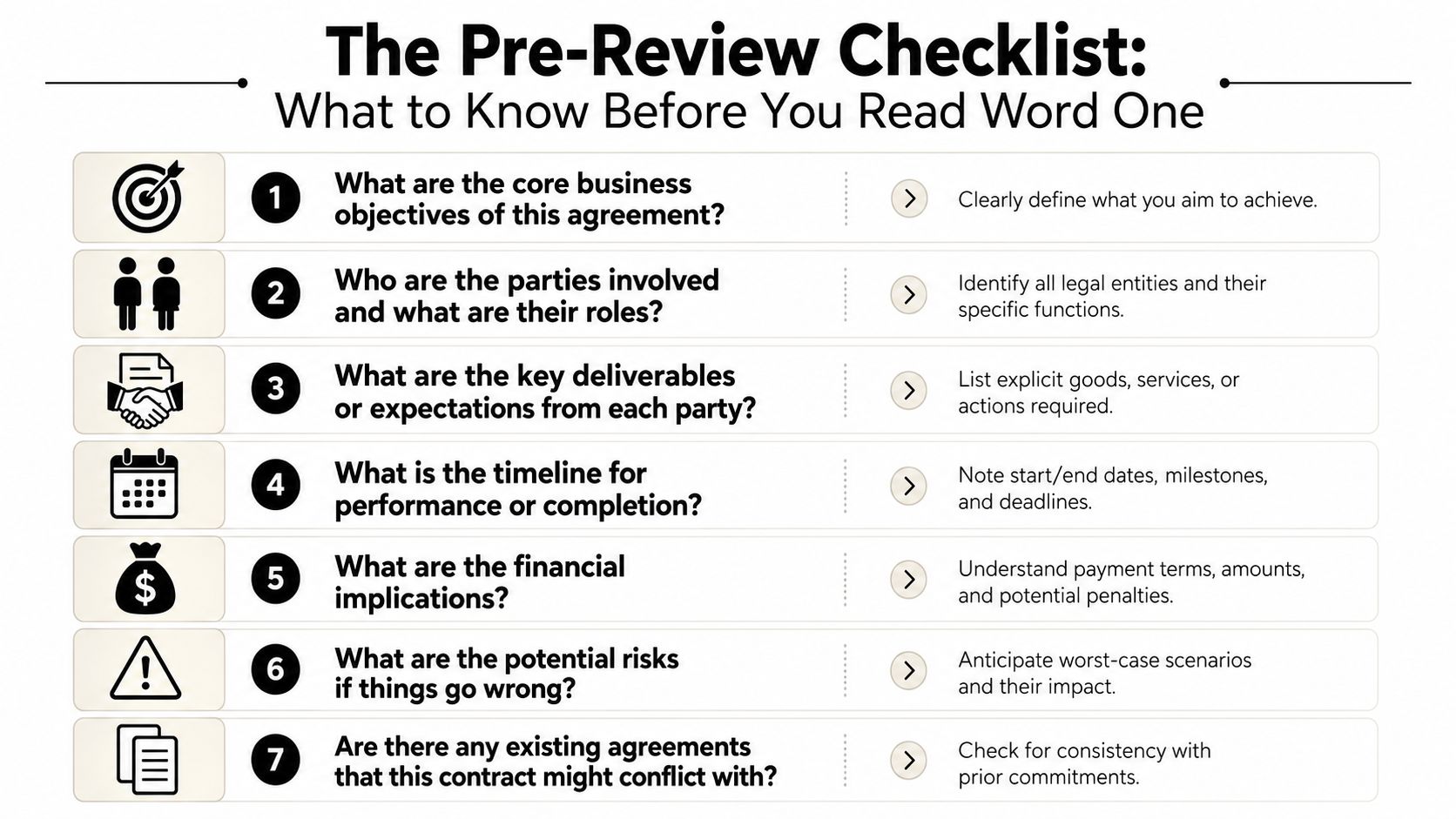
Use this as your pre-read filter.
Start with identity and authority
In Florida, this comes first. Every business contract review must start by verifying the other party's exact legal entity name against the Division of Corporations/Sunbiz database. Failure to confirm this and the signer's authority can render the agreement void or create unintended personal liability, as noted in this Florida contract review guidance.
That sounds technical, but it's practical. If the contract names “Sunrise Media” when the entity is “Sunrise Media Group LLC,” you may have a collection problem later. If the signer doesn't have authority under the company's operating agreement, bylaws, or resolutions, the paper may create avoidable disputes before performance even begins.
Ask these questions before reading the legal terms
- What is the business goal? Are you buying speed, exclusivity, recurring revenue, a pilot opportunity, or long-term access to a customer?
- Who is involved? List every legal entity, not just every brand name.
- What must each side do? Reduce the deal to plain English deliverables.
- When does performance start and end? Include milestones, renewals, notice windows, and dependencies.
- What could go wrong operationally? Late payment, missed specs, data misuse, scope creep, and early termination all belong on the table before legal markup begins.
- Does this conflict with another agreement? Existing investor rights, prior exclusivity terms, channel partner arrangements, or contractor IP terms can clash with new paper.
If you can't explain the commercial deal in five plain sentences, you're not ready to review the contract language.
A practical founder worksheet
I like founders to create a simple pre-review note with three columns:
| Question | Your answer | Why it matters |
|---|---|---|
| Legal parties | Exact entity names and signer roles | Prevents enforceability and authority issues |
| Business objective | What success looks like | Keeps review focused on the real deal |
| Non-negotiables | Terms you can't accept | Speeds redlines and internal alignment |
This step is especially useful in bilingual settings. If one founder, one operations lead, and one outside salesperson all describe the deal differently, the contract will reflect that confusion.
Tips before you open the redline
- Pull the Sunbiz record first: Confirm the exact entity name before reviewing the signature block.
- Collect side emails and proposals: Terms often live outside the draft. Bring them into the review.
- Identify your walk-away points: Price may be flexible. Unlimited liability may not be.
- Check signing authority early: Don't wait until the final page.
- Flag formality issues: If the agreement touches a category that must satisfy writing and signature requirements under Florida law, verify those requirements at the start, not after a dispute.
Preparation saves time because it changes the review from reactive to strategic.
Decoding the Deal A Clause-by-Clause Review Guide
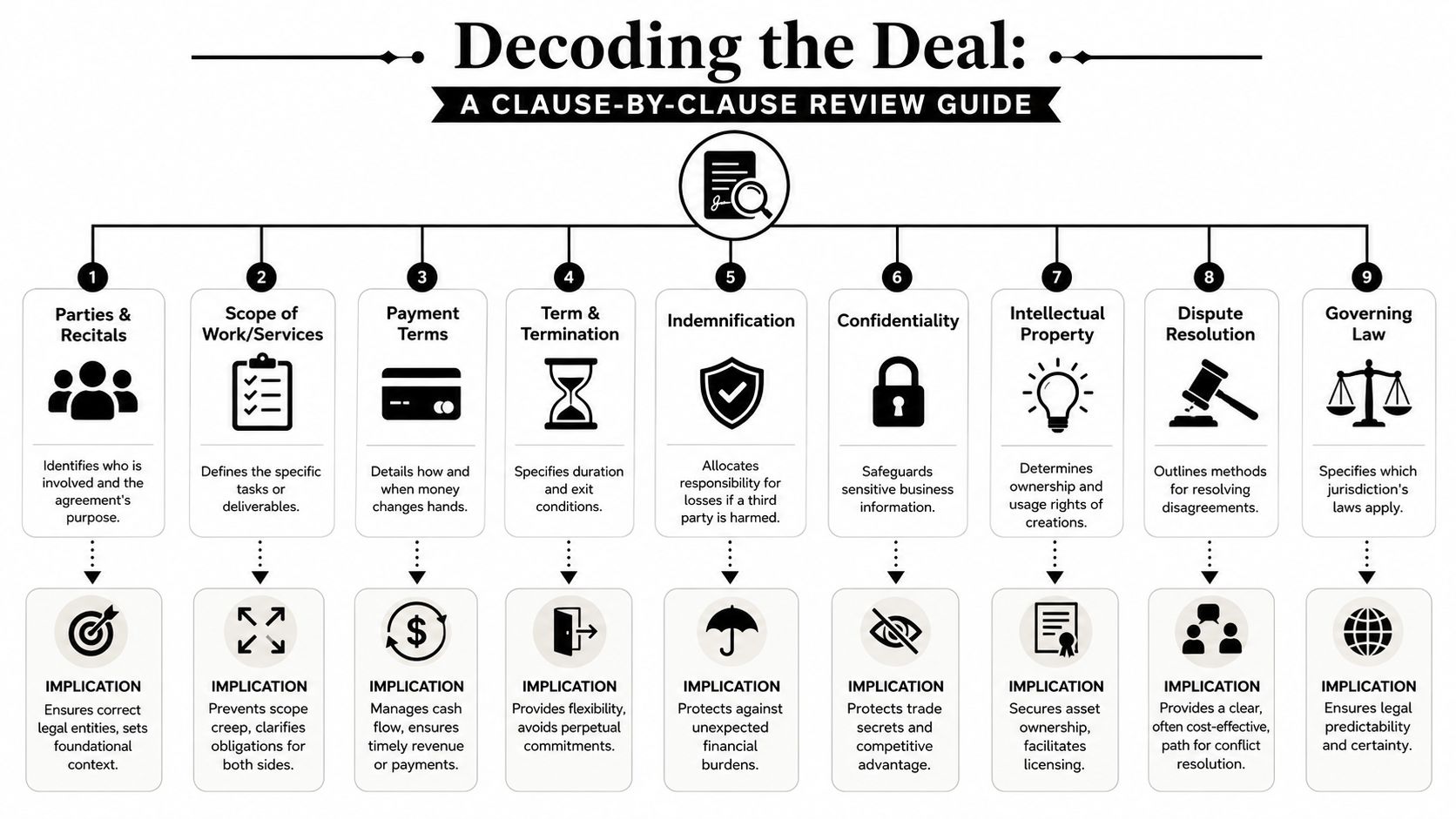
Once the prep work is done, read the agreement clause by clause. Don't skim for dramatic terms only. Most founder pain comes from ordinary provisions that look harmless when the relationship is friendly.
This visual helps frame the clauses that deserve the closest attention.
Parties and scope
What it means: The opening sections identify who is bound and what the deal is for. If the parties are wrong or the scope is fuzzy, the rest of the contract becomes harder to enforce sensibly.
For founders, the scope of work is where scope creep starts. A marketing agreement that says the agency will provide “full support” is a dispute waiting to happen. A SaaS implementation agreement that promises “integration assistance” without defining responsibilities usually leads to finger-pointing.
Pro tip: Attach exhibits. A scope exhibit with deliverables, deadlines, assumptions, and approval steps does more work than three paragraphs of vague promises.
Payment terms and cash flow
What it means: This clause answers when you invoice, when payment is due, what happens if work pauses, and whether refunds, credits, or offsets apply.
A founder should read payment terms with a cash flow lens. Net terms, milestone structure, acceptance criteria, and dispute rights all affect how fast revenue turns into usable cash. On the buy side, watch for prepaid commitments that lock you in before the vendor proves performance.
What to look for:
- Trigger for payment: Signature, delivery, acceptance, or a calendar date
- Dispute process: Can the customer withhold the whole invoice because one item is contested?
- Late payment language: Is there a practical enforcement mechanism?
- Auto-renew billing: Is renewal tied to clear notice periods?
Intellectual property and confidentiality
What it means: These clauses control ownership, use rights, and secrecy obligations. In startup work, they can be more valuable than the price term.
If your company creates code, designs, content, training materials, branding, or internal tools, don't rely on business assumptions. “Work made for hire,” assignment language, retained rights, background IP, and license-back provisions can produce very different outcomes. Confidentiality terms should also align with how your team handles sensitive information, especially if contractors, overseas teams, or shared tools are involved.
A founder should know the answer to one simple question before signing: after this project ends, who owns what?
Pro tip: Separate pre-existing IP from new deliverables. If your company brings proprietary templates, software modules, or methods into the engagement, say so expressly.
For a deeper look at how these provisions fit together, this guide on common clauses in a contract is useful background.
Liability, indemnification, and termination
What it means: These are the risk-allocation clauses. They decide who pays when something goes wrong and how either side can exit.
A limitation of liability clause usually caps exposure. Without a cap, a modest contract can carry outsized downside. Indemnification shifts responsibility for third-party claims. That can be appropriate, but only when tied to conduct your company controls. Termination language decides whether you can leave the relationship if the other side underperforms, changes priorities, or becomes impossible to work with.
Here's a practical reading table:
| Clause | Good sign | Concern |
|---|---|---|
| Limitation of liability | Clear cap and reasonable carve-outs | No cap or one-sided exceptions |
| Indemnification | Narrow, conduct-based, mutual where appropriate | Broad duty to protect the other side from its own behavior |
| Termination | For cause plus workable cure period, and sometimes for convenience | Long lock-in with few exit rights |
Governing law and disputes
What it means: These clauses decide which law applies and where or how disputes get resolved. For a South Florida company, a contract requiring a faraway forum can change the economics of enforcement.
For Florida deals, also review restrictive covenants carefully. Non-compete and non-solicitation clauses must comply with Florida Statutes Section 542.335, and the scope, duration, and geographic limits must be reasonable and explicitly defined to be enforceable. Vague language or overly broad geographic restrictions without specific timeframes can be voided by a court, as explained in this Florida non-compete overview.
If your company is a Delaware entity operating in Florida, review governance assumptions too. Delaware corporate norms often shape internal authority and investor expectations, while Florida law may still control certain operational or enforcement questions in the contract itself. Founders should make sure those two worlds don't collide on paper.
Common Red Flags and Negotiation Starting Points
Most bad contracts don't look dramatic. They look polished, familiar, and “standard.” The red flags usually hide in clauses that are broad, undefined, or unevenly drafted.
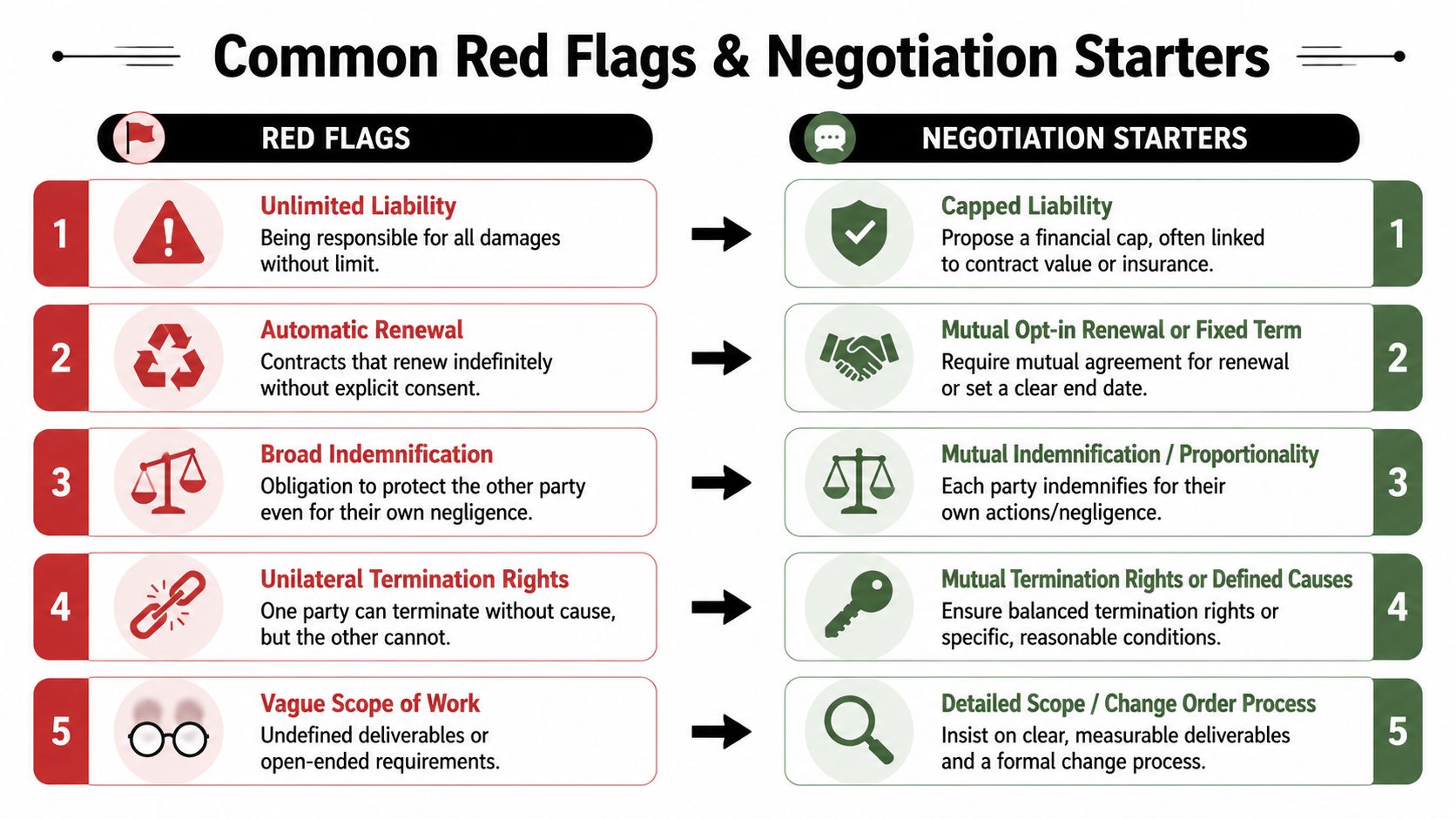
This side-by-side chart captures the patterns that show up most often.
A disciplined review process matters because up to 40% of contract disputes arise from ambiguous language or missing provisions, particularly in payment, liability, and indemnification clauses, and organizations using standardized playbooks see review time reductions of up to 87.5% according to Malbek's contract review analysis. The lesson for founders is simple. Don't rely on instinct alone. Use a checklist and a repeatable review method.
Five clauses that deserve pushback
Unlimited liability: If the contract makes your company responsible for all damages without a realistic cap, the downside can dwarf the value of the deal.
Sample response: “We can accept liability for our direct breaches, but we need a reasonable cap tied to the agreement.”Automatic renewal: Renewal terms often slip by because they sit near the back. If the notice window is narrow, you can get trapped in another term before the founder team even notices.
Sample response: “Let's convert renewal to mutual written agreement, or set a fixed term with a clear notice period.”One-sided indemnity: Some drafts require your company to defend the other party broadly, even when the claim partly arises from their actions.
Sample response: “Indemnity should be limited to third-party claims caused by our breach, negligence, or infringement, and it should be reciprocal where appropriate.”Unilateral termination rights: If they can terminate at will and you can't, they control the relationship while you carry the staffing and delivery burden.
Sample response: “Termination rights should be mutual, or limited to defined events with a cure period.”Vague scope of work: Here, founders lose margin. “Support as needed” and “commercially reasonable efforts” often become arguments later.
Sample response: “We're happy to perform the listed services, but additional work should go through a written change order.”
Contracts become expensive when the business team says, “That's not what we meant,” and the paper doesn't back them up.
A South Florida founder lens
In local startup and family-business deals, the practical red flags are often relational. A founder may hesitate to negotiate because the counterparty is a major customer, a friend-of-a-friend investor, or a bilingual commercial partner who says the paper is routine. That's exactly when careful business contract review helps. You can stay collaborative while still fixing the terms that matter.
A useful way to frame redlines is to connect them to operational clarity, not distrust. For example:
| Red flag | Better framing in negotiation |
|---|---|
| Unlimited liability | “We need a risk allocation that matches the size of the project.” |
| Vague deliverables | “Let's define acceptance criteria so both teams know when work is complete.” |
| Broad confidentiality exceptions | “We need the information-handling rules to match how our teams actually operate.” |
One issue founders should not ignore
Assignment and change-of-control language deserves special attention in startup contracts. A clause that blocks assignment without consent can become a real problem in financing, reorganization, or acquisition discussions. Founders should ask whether an internal reorganization, merger, or sale of the company would trigger consent rights, termination rights, or a pricing advantage for the other side.
Tip: If a clause affects ownership, transfer, investor rights, or an eventual exit, slow down and negotiate it before the relationship starts.
When to Call for Backup DIY Versus Hiring an Attorney
Some contracts are reasonable to review yourself first. Others should go to counsel immediately. The key is knowing the difference before a risky clause slips through because everyone is in a hurry.
This comparison is a good working model.
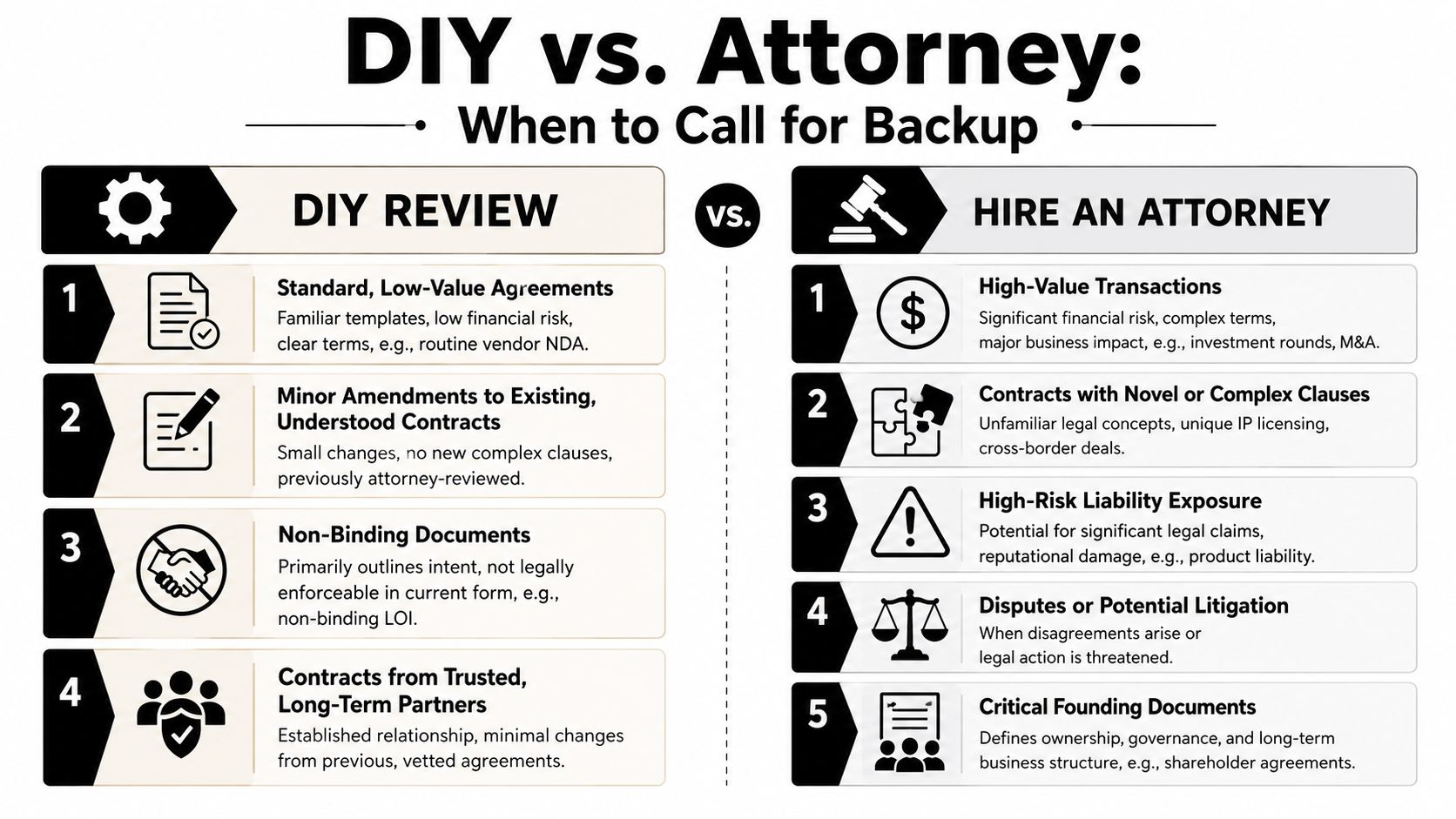
A practical decision matrix
| DIY first pass makes sense when | Hire an attorney now when |
|---|---|
| The agreement is familiar and low risk | The contract affects equity, control, or ownership |
| You've seen the template before and understand the terms | The draft includes unusual IP, licensing, cross-border, or governance provisions |
| Changes are minor and the business deal is straightforward | The dollar value or liability exposure could hurt the company materially |
| The document is non-binding or mostly commercial | There's already a dispute, threatened claim, or major imbalance in leverage |
A founder can often do the first pass on a routine NDA, a simple vendor form, or a short amendment to a contract that was already reviewed properly. That first pass should focus on business terms, not legal heroics. Mark what looks off, gather background documents, and identify the clauses that touch payment, ownership, termination, and liability.
Cost, tools, and judgment
For budgeting, the average flat fee for a business contract review in Florida is $460.00 based on recent project data, according to ContractsCounsel's Florida business contract review cost guide. That gives founders a useful benchmark when deciding whether paying for review is cheaper than carrying avoidable risk.
Technology can help with the first pass. If you want a faster issue-spotting workflow before sending a draft to counsel, an automated contract review tool can help surface terms that deserve a closer look. It's useful for organization and preliminary spotting, but it should not replace legal judgment on deal-specific risk.
Use software to find language. Use counsel to decide what that language means for your business.
Good reasons to escalate immediately
- You're signing on behalf of a Delaware corporation with Florida operations: Internal authority, board approvals, and contract obligations need to line up.
- The contract affects IP ownership: Founders should not guess at assignment, licensing, or retained-rights language.
- There's meaningful liability exposure: Product, service, compliance, or data-related risk usually deserves counsel.
- The paper touches fundraising, acquisition, or control rights: These terms can outlive the current deal.
For founders who want predictable outside help rather than ad hoc emergencies, small business legal services can make more sense than handling each contract in isolation. Coto & Waddington, Attorneys at Law offers contract review as part of its business law work for South Florida companies, including flat-fee and ongoing support structures.
Your Go-Forward Plan and Final Checklist
A solid business contract review process doesn't need to be complicated. It does need to be deliberate. The founders who handle contracts well usually do four things consistently: they prepare before reading, they review the clauses that drive business risk, they flag red lines early, and they negotiate in plain language.
Your working checklist
- Confirm the parties: Verify entity names and signer authority before anything else.
- Write the business deal in plain English: If your team can't easily summarize the agreement, the draft is probably missing something.
- Review the key clauses with business consequences: Focus on scope, payment, IP, confidentiality, liability, termination, assignment, disputes, and governing law.
- Track signed obligations: Put renewal dates, notice periods, payment triggers, and deliverables into a spreadsheet or contract management tool.
That last step matters more than founders think. Contract review is not finished at signature. A signed agreement creates deadlines, restrictions, and renewal traps. Even a simple spreadsheet with columns for counterparty, effective date, renewal notice date, payment timing, and key obligations is better than letting PDFs disappear into email folders.
A final practical tip
If your company uses contractors or virtual assistants, make sure your contract process scales down as well as up. A small agreement can still create confidentiality, IP, and scope problems if it's vague. For founders tightening that workflow, these Approved Lux tips for VA contracts are a useful operational supplement.
Business moves quickly in Miami, Fort Lauderdale, and across South Florida. Your contracts should support that speed, not expose you to preventable risk. Review them like part of the business, because they are.
If you're signing a high-stakes customer, vendor, employment, partnership, or founder agreement, Coto & Waddington, Attorneys at Law provides bilingual, founder-focused counsel for South Florida businesses. The firm works with startups and small companies on formation, contracts, corporate matters, and ongoing legal support, with practical communication and predictable pricing.