You paid the state filing fee, downloaded your stamped Articles of Incorporation, and ordered business cards with "Inc." after your company name. Then an urgent vendor invoice arrived before your corporate bank account cleared, so you paid it from your personal checking account and made a mental note to sort it out later. A week after that, your new landlord asked you to co-sign the office lease so you could get the keys before Monday.
That sequence happens in thousands of startups and family businesses every month, and it exposes the biggest myth in small-business law. Most founders assume that filing incorporation papers creates an unbreakable wall around their house, personal savings, and retirement accounts. It doesn't.
Liability in a corporation isn't a one-time filing you finish at launch. It's an operating habit you maintain every week through clean bookkeeping, disciplined signatures, and documented board decisions. Outright fraud grabs headlines, yet ordinary bookkeeping slips, informal owner withdrawals, and routine personal guarantees move corporate debt back onto founders' personal balance sheets far more often.
Table of Contents
- Who Carries Liability When a Corporation Owes Money
- How the Corporate Shield Was Built
- Formalities That Keep the Shield in Place
- When Courts Pierce the Corporate Veil
- Personal Guarantees and Your Own Wrongful Acts
- Directors and Officers Face Their Own Liability
- Choose Your Next Step Before a Dispute Arises
Who Carries Liability When a Corporation Owes Money
A corporation's debts belong to the corporation, which means shareholders usually lose only the capital they invested rather than their home or personal savings. That protection is the core promise of incorporation, though it never applies uniformly to every person wearing a hat inside the business.
Because founders often serve as shareholder, director, president, and sole salesperson at the same time, you can't guess your exposure by looking only at your stock certificate. Match every role you hold against the table below to see where the corporate shield stops.
| Party | Generally liable for | Typical limit |
|---|---|---|
| Shareholders | Company debts and obligations | Amount invested in the company |
| Directors and officers | Their own breaches of duty, fraud or misconduct | No shield for personal wrongdoing |
| Owner who signed a personal guarantee | The guaranteed debt or lease | Full guaranteed amount, which may exceed the investment |
| The corporation | Its contracts, debts and legal claims | Its own assets |
| Employees acting as agents | Their own negligent or unlawful acts | Personal, unless the company is also liable |
Think of a corporation as a sealed steel container built to hold business contracts, vendor balances, and commercial lawsuits. Your personal bank accounts and real estate sit safely outside that container only while the lid stays bolted shut. The moment you punch holes in the walls through sloppy transfers or sign an obligation in your own name, creditors reach straight past the container to your personal net worth.
How to Read Your Exposure Before Signing
Limited liability doesn't spring into existence automatically just because you print "Corporation" on an invoice or register a domain name. According to the Cornell Law School Legal Information Institute, limited liability is created and governed by state statutes that require ongoing entity maintenance and legal compliance, capping a shareholder's ordinary economic risk at the amount invested only while those rules are respected.
Use the table above as a pre-signature filter rather than an abstract chart. First, locate your ownership row as a shareholder, where your downside stays capped at your equity contribution. Next, check whether the task in front of you puts you into the director, officer, agent, or guarantor row, because any action in those rows overrides shareholder protection.
Many founders don't realize how quickly board-level mistakes strip away that protection when cash gets tight. For a practical breakdown of how statutory and management obligations cross into individual responsibility, Stewart Accounting Services publishes a clear overview of when directors become personally liable.
Pre-signature check: Before your pen touches any lease, credit application, or vendor contract, locate your row in the liability table and ask whether that single signature moves you from protected shareholder into unprotected guarantor.
How the Corporate Shield Was Built
In the late nineteenth century, a London bootmaker named Aron Salomon converted his sole proprietorship into a company registered under the United Kingdom's Companies Act 1862. He held nearly all the shares himself while his wife and five children held one share each to satisfy the statutory minimum. When the boot business later collapsed under unpaid debts, creditors demanded that Mr. Salomon pay the shortfall out of his own pocket, arguing the company was just a sham alias for one man.
In 1897, the House of Lords disagreed in a unanimous ruling in Salomon v. A. Salomon & Co. Ltd.. The Lords held that once a company is properly incorporated, it becomes an independent legal person distinct from its shareholders, even when a single founder dominates every operational decision. Company debts belonged exclusively to the company, not to Mr. Salomon personally, cementing the modern doctrine of separate corporate personality and the shield lawyers call the corporate veil.
Three Legal Layers Separating You From the Business
That ruling works because corporate law stacks three distinct boundaries between a business and the humans who own it:
- Statutory creation of a new person: State law brings a separate legal entity into existence on the date of incorporation, complete with its own taxpayer identification number and legal standing to sue or be sued.
- Entity ownership of assets and contracts: The corporation itself holds title to inventory, bank balances, equipment, and commercial leases, and it assumes the legal obligations tied to those contracts.
- Shareholder ownership of economic rights: Founders don't directly own the company's delivery van or cash balance; they own shares, which represent an economic and voting interest in the entity.
Say a manufacturing startup orders raw materials from a regional supplier on net-60 terms, and a major customer cancels before the startup can collect enough revenue to pay. Because the purchase order runs between the supplier and the corporation, the supplier can pursue the startup's bank accounts, receivables, and warehouse equipment, not the founder's personal checking account.
The timeline from Victorian England to modern startup law is remarkably direct. The Companies Act 1862 created the statutory registration framework, the 1897 House of Lords decision confirmed that even one-owner companies qualify for separate legal status, and today's U.S. corporate and LLC statutes build that exact separation into default business law.
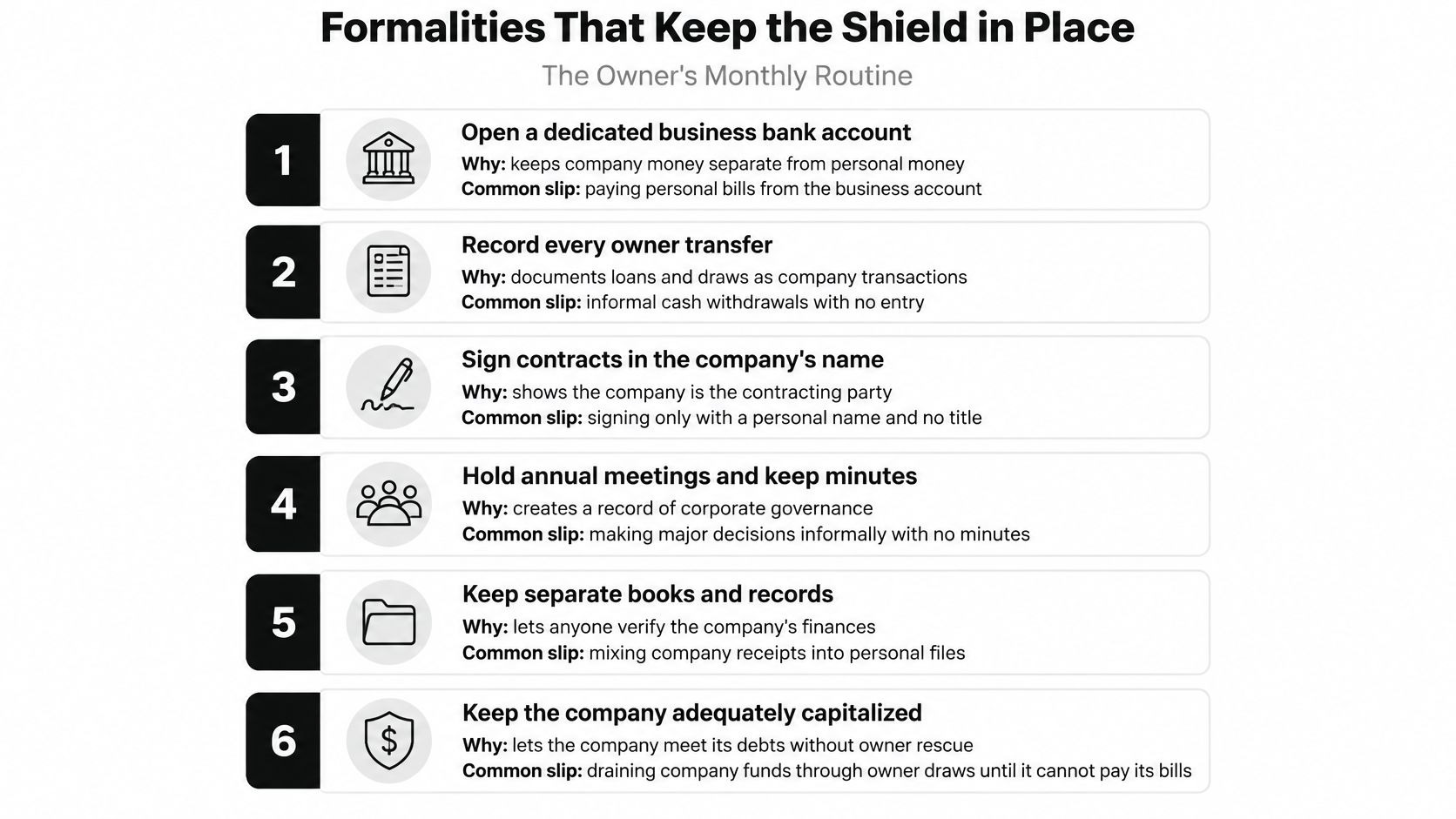
Treat that legal separation as a condition you re-earn every single business day, not a trophy you won on formation day. The statute hands you the shield, yet your day-to-day operational conduct determines whether a judge lets you keep it when creditors come knocking.
Formalities That Keep the Shield in Place
Too many owners file their incorporation documents, stick the binder on a shelf, and never touch corporate governance again until a lawsuit or investor audit hits. That neglect is exactly what plaintiffs' lawyers look for during discovery. As an analysis in the Cornell Law Review explains, courts weighing whether to disregard a corporate entity look for concrete operational failures, including ignored formalities, mixed shareholder and corporate assets, personal use of company property, unpaid declared dividends, and siphoned funds.
You don't need a massive legal department to stay on the safe side of those factors. You need a repeatable monthly routine backed by clean internal records.
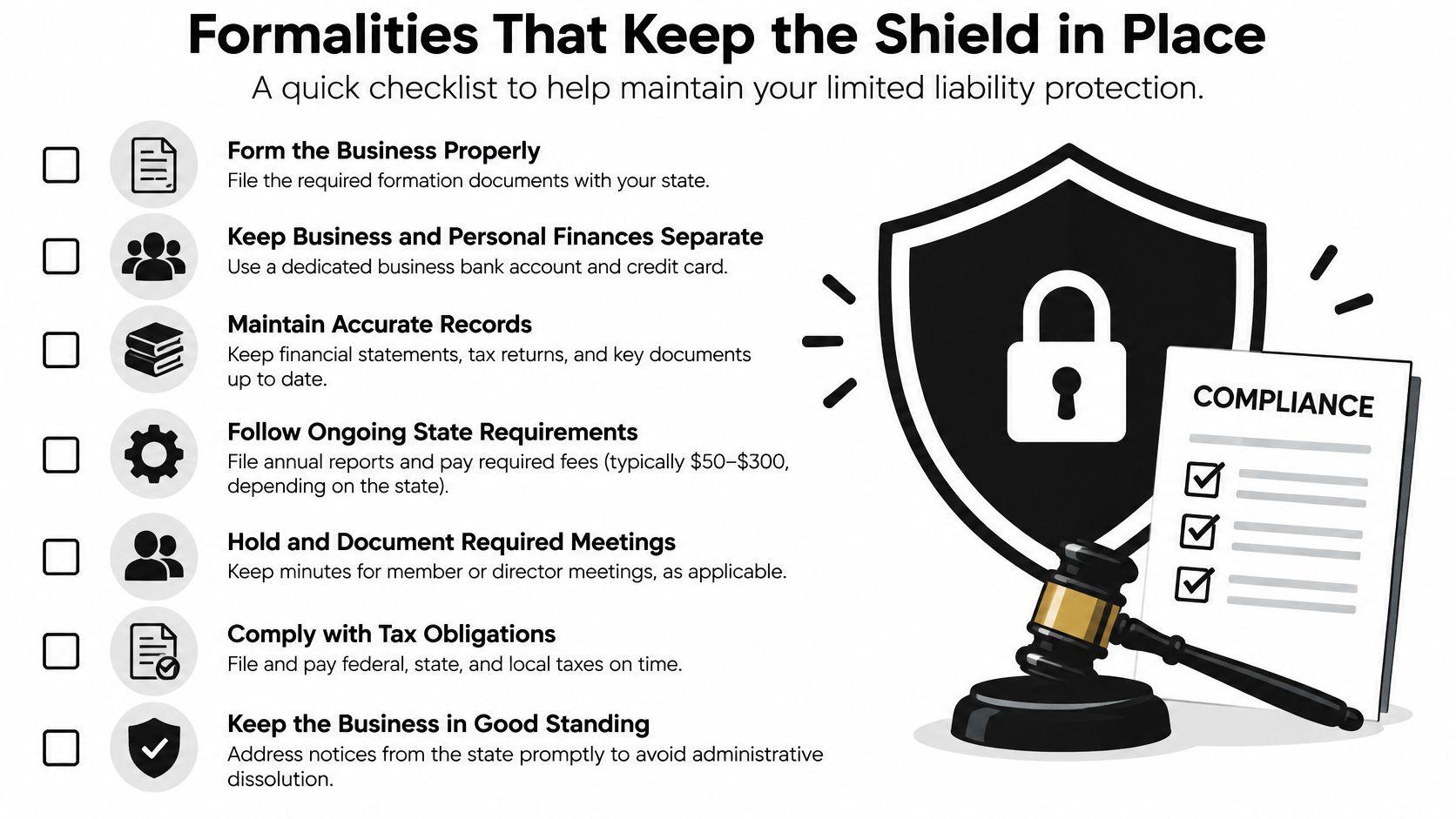
The Seven-Step Monthly and Annual Routine
- Run every business dollar through a dedicated corporate bank account. Open a separate checking account and credit card in the corporation's exact legal name the day you receive your EIN, because mixing money is the fastest way to prove the entity isn't genuinely separate. The classic slip is swiping the company debit card for family groceries or paying a vendor from your personal Zelle account because you're in a rush.
- Sign every contract in the company's full legal name alongside your corporate title. Write "Acme Robotics, Inc., by Jane Doe, President" on signature blocks so the counterparty has zero doubt which legal person is bound. Leaving off the company name or your title invites a creditor to argue you contracted personally.
- Document every capital contribution, owner loan, and reimbursement in writing. Whenever you put cash into the business or pull money out beyond regular payroll, back it with a dated promissory note, contribution receipt, or expense report specifying repayment terms. Treating the operating account like a personal ATM with vague "owner transfer" memos destroys your paper trail, especially inside family-owned companies where relatives rely on informal handshakes instead of written loan agreements.
- Approve major decisions, distributions, and related-party deals in written minutes or resolutions. Operating agreements and bylaws define ownership, management structure, decision-making, investor rights, and exit strategies, so your major transactions must follow the voting rules inside those governing documents. If your corporate binder is thin, review what bylaws for a corporation actually require before approving office leases, equipment financing, or contracts with another business you own; verbal agreements over coffee leave no legal evidence that the board acted.
- Match every invoice and receipt to your monthly bank statements. Use cloud accounting software like QuickBooks Online or Xero to attach PDFs to each transaction before the month closes. Putting receipts in a shoebox for a year-end catch-up almost guarantees missing documentation when an auditor asks what a large vendor wire paid for two years ago.
- Pay dividends strictly as declared and recorded. Never pull uneven sums out of retained earnings whenever personal bills spike; wait until the board declares a distribution on the record and pays shareholders in proportion to their equity classes.
- Audit your corporate records once a year against state filing requirements. Confirm your annual report, franchise tax, registered agent, and officer listings are current with the Secretary of State. Ongoing compliance work, including audit schedules, internal control checklists, and board or minute book maintenance for Florida and Delaware entities, keeps small administrative gaps from snowballing into involuntary dissolution.
The Outsider Audit Test
Set a recurring calendar block on the first Friday of every month for a 45-minute compliance reconciliation. Check your bank feed for stray personal charges, file signed contracts in a dedicated cloud folder, and draft short written consents for any major commitments made over the past thirty days.
Could a neutral outsider open your accounting software and minute book tomorrow and tell, without asking you a single question, which entity owned every asset and formally approved every payment?
If the honest answer is no, fix the documentation now while cash flow is healthy and nobody is threatening litigation.
When Courts Pierce the Corporate Veil
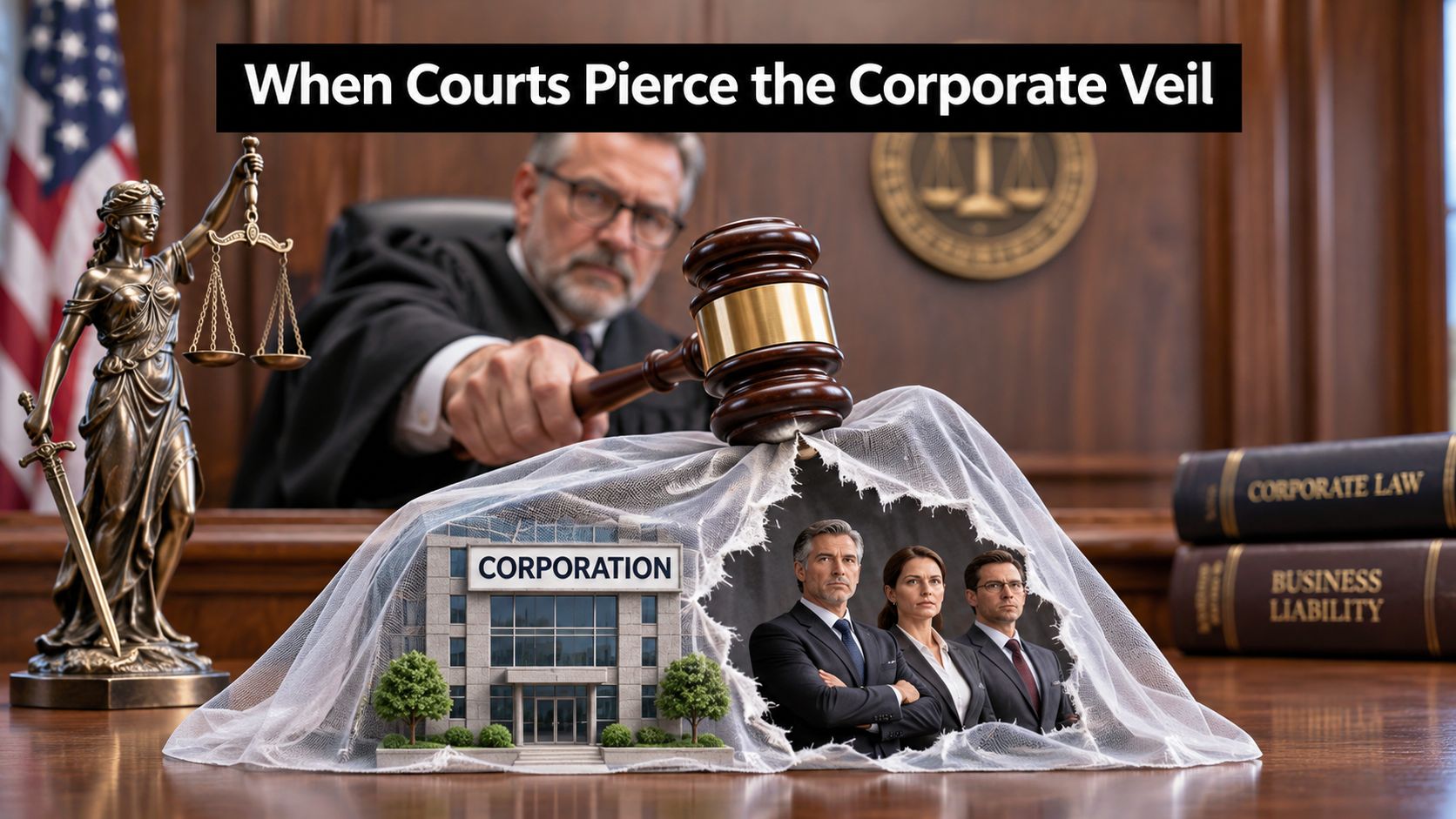
Piercing the corporate veil is an equitable remedy that strips away limited liability and lets creditors pursue an owner's personal assets directly. Courts don't hand out that remedy casually. As the Cornell Law School Wex encyclopedia on piercing the corporate veil notes, judges start with a strong presumption against disregarding the corporate form and usually intervene only when owners abuse the entity, intermingle personal and business finances, undercapitalize the venture at launch, or use the corporation to commit fraud or evade existing obligations.
A failing business doesn't automatically lose its shield. Business insolvency happens constantly without any misconduct: in 2025, England and Wales recorded 23,938 registered company insolvencies, including 18,525 creditors' voluntary liquidations, according to the UK Insolvency Service. According to a Thomson Reuters analysis of veil-piercing cases, courts typically require a combination of owner domination, intentional or unjust misuse of the entity, and concrete harm to creditors, rather than mere financial failure or thin early capital.
Here's how judges view the everyday conduct patterns that trigger veil-piercing claims in court.
| Conduct | Why it matters | Signal in the records |
|---|---|---|
| Commingling funds | Blurs owner and company assets | Personal and business transactions in one account |
| Undocumented transfers to owners | Looks like siphoning | Payments with no loan agreement or resolution |
| Company paying personal expenses | Treats company property as personal | Personal items booked as company costs |
| Moving assets while debts stay unpaid | Can evade creditors | Distributions made before creditors are paid |
| Capital far below foreseeable debts | Company cannot meet obvious obligations | Little capital at formation and early insolvency |
| Ignoring corporate formalities | Entity operates as the owner's instrument | No minutes, approvals or annual records |
Ordinary Business Failure Versus Entity Abuse
Family-owned businesses and closely held companies land in this danger zone more often than venture-backed startups, usually without any criminal intent. Owners who run two or three sister entities frequently share payroll staff, warehouse space, vendor accounts, and even a single master bank account to save banking fees. From a creditor's perspective, those shortcuts look identical to deliberate asset shuffling.
Compare two struggling restaurants that both shut their doors owing substantial unpaid balances to food distributors. Restaurant A started with reasonable working capital, kept clean QuickBooks ledgers, paid its founder a documented W-2 salary, and failed solely because neighborhood foot traffic collapsed after a road closure. Restaurant B deposited daily credit-card batches into the owner's personal savings account, paid the owner's home mortgage out of the business checking account, and wired its remaining cash reserves to the owner's spouse two weeks before locking the doors.
A judge will almost certainly protect Restaurant A's owner from those unpaid food invoices. Restaurant B's owner handed the distributors a textbook veil-piercing complaint on a silver platter.
Because veil-piercing standards vary sharply by state, treat the table above as an operational risk map rather than a universal legal formula. Delaware courts apply a notoriously high bar before piercing, while states like California and Florida weigh alter-ego factors differently depending on whether the underlying claim involves a contract or a tort.
Immediate cleanup rule: The day you spot a red flag in your books, such as an accidental personal travel charge on the corporate card, fix it in writing immediately by repaying the company and logging a clear journal entry; a transparent correction beats an unexplained transfer every time.
Personal Guarantees and Your Own Wrongful Acts
Many founders assume that as long as their corporate veil stays intact, creditors can never touch their personal bank accounts. That assumption is flatly wrong. The corporate shield only blocks vicarious liability for the corporation's obligations; it never protects you from obligations you personally promise to pay or wrongful acts you personally commit.
Landlords, commercial banks, and equipment lessors know that a two-year-old corporation has limited credit history and few hard assets. To close that risk gap, they slip a personal guarantee into the back pages of the lease or line of credit. Consider a straightforward hypothetical example: you sign a personal guarantee on a commercial office lease costing $5,000 a month over a 36-month term. That single signature locks you into $180,000 in direct personal exposure the instant the company defaults, no matter how immaculate your corporate minutes or accounting ledgers are, and that obligation survives even after the corporation shuts down.
Direct personal liability also arises independently of any guarantee whenever you commit a personal wrong or breach certain statutory duties:
- Personal torts committed on company business: If you text while driving to a client pitch and injure a pedestrian, you're personally liable for your own negligence alongside the corporation.
- Trust-fund payroll taxes: In many jurisdictions, including under U.S. federal tax law, responsible corporate officers who withhold income and payroll taxes from employee paychecks and fail to remit those funds to tax authorities owe the unpaid trust-fund portion personally.
- Contracts signed in an individual capacity: Signing a vendor agreement without naming the corporation as the contracting party leaves you personally on the hook for the invoice.
Parent Companies and Subsidiaries Under United States v. Bestfoods
The same divide between indirect veil-piercing liability and direct operational liability governs corporate groups, holding companies, and startups running separate subsidiaries. In United States v. Bestfoods, the U.S. Supreme Court ruled that a parent corporation isn't automatically liable for a subsidiary's conduct merely because it owns or controls the subsidiary, unless grounds exist to pierce the corporate veil. However, the Court made clear that a parent company that actively steps in and manages the subsidiary's relevant operations can be held directly liable in its own right as an operator.
If you run a holding company above an operating subsidiary to ring-fence intellectual property or real estate, don't blur the two entities in daily life. Keep approvals, employee payroll, vendor contracts, and regulated compliance duties clearly assigned to the proper company.
Take three concrete actions this week to contain your direct personal exposure:
- Inventory every personal signature and guarantee. Pull every office lease, SBA loan, vendor credit application, merchant processor agreement, and corporate credit card contract, and log each guarantee in a master spreadsheet.
- Map entity roles across affiliates. Write down exactly which legal entity signs customer contracts, employs workers, owns copyrights and patents, processes customer data, and holds regulatory licenses.
- Negotiate limits before signing the next guarantee. Push back on unlimited guarantees by requesting a fixed dollar cap, a rolling 12-month "good guy" cap on leases, or an automatic release trigger once the company hits a revenue or net-worth milestone.
Keep your guarantee schedule inside your main corporate binder so no personal commitment gets forgotten if you resign, bring in co-founders, or sell the company. Before you sign any new personal guarantee, have a business attorney review its dollar cap, duration, and release triggers so a single commercial deal doesn't jeopardize everything you own outside the business.
Directors and Officers Face Their Own Liability
A chief executive can avoid every personal guarantee, keep the bank accounts separate, and still end up personally named in a lawsuit because of one sloppy board approval. That is the part founders underestimate. Shareholders may be insulated from company debts, but directors and officers carry their own exposure through fiduciary duties, and plaintiffs do not need to pierce the corporate veil to sue the people who made the decision.
As the Cornell Law School Wex entry on fiduciary duty outlines, authorized corporate decision-makers owe three core obligations:
- Duty of obedience: Stay within the lawful authority granted by the company's charter, bylaws, and applicable statutes.
- Duty of loyalty: Put the corporation's financial and strategic interests ahead of your own wallet, side ventures, or family ties.
- Duty of care: Make decisions in good faith with the diligence and prudence a reasonable person would exercise under comparable circumstances.
The exposure usually grows out of ordinary process, not theatrical fraud. An officer who steers a lucrative client inquiry to a private side business diverts a corporate opportunity. A director who votes to hire her brother's marketing agency without disclosing the relationship hides a conflict. A board that approves a major acquisition without reading the financial statements fails the care standard. Freezing out a minority shareholder out of spite points to bad faith. If you sit on a startup board, understanding what triggers a breach of fiduciary duty helps you spot personal exposure before casting a controversial vote.
Boards also face oversight liability when they let new tools spread through the company without controls. In the 2026 WTW Global Directors and Officers Survey Report, 56% of global directors-and-officers survey respondents rated AI and machine learning as very or extremely important risks, up from 48% in 2024 and 51% in 2025. AI-related securities litigation is rising, and even small firms outside the tech sector can face misrepresentation claims, privacy breaches, IP disputes, or biased hiring outputs if leadership lets staff deploy generative AI tools without vendor reviews, human oversight, and documented usage rules.
Financial distress sharpens that scrutiny. Continuing to incur debt when the business has no realistic path to solvency can expose board members to statutory penalties depending on the jurisdiction. Lighthouse Consultants' practical guide on how to protect yourself from wrongful trading liability gives directors a clear view of the warning signs and documentation habits required when cash reserves start shrinking.
Governance Process Versus Insurance Limits
Courts evaluate fiduciary claims by examining both the fairness of the outcome and the rigor of the decision-making process. A reasonable decision can still look corrupt or careless if the paper trail is thin. Protect the board with a consistent habit before major transactions: disclose potential conflicts at the start of the meeting, circulate material financial data in advance, weigh competing alternatives, record the board's reasoning in formal minutes, and let disinterested directors handle votes on related-party deals.
Then back that process with the right contractual layers: charter exculpation clauses, corporate indemnification agreements, and Directors and Officers liability insurance. Treat them as protection for honest decision-making, not permission to act carelessly. Under corporate statutes and standard insurance exclusions, charter protections, indemnification, and D&O policies generally will not shield you from duty-of-loyalty violations, bad-faith acts, intentional misconduct, criminal or statutory violations, or improper personal financial gains.
Indemnification and D&O insurance can fund a defense and protect the balance sheet. They do not forgive disloyalty, bad faith, intentional misconduct, statutory violations, or improper personal profit.
The practical rule is simple. Before a vote, ask what file would exist if the decision were attacked two years later: the materials reviewed, the conflicts disclosed, the alternatives considered, and the exact reason the board chose one path over another. If that file is thin, the personal risk is already higher than the filing cabinet suggests.
Choose Your Next Step Before a Dispute Arises
Waiting for a demand letter or an investor due-diligence audit is the worst time to discover holes in your corporate protection. Right now, pick one of three concrete paths based on where your business stands:
- Lock in your current structure: If your entity type fits your tax and fundraising plans, commit to the monthly bank reconciliation, written resolutions, and annual state compliance routine starting this month.
- Fence off personal guarantees: If personal signatures on leases or credit lines are your biggest vulnerability, prioritize negotiating dollar caps, time limits, or release triggers at your next renewal or refinancing.
- Restructure or convert your entity: If your business has outgrown a sole proprietorship, informal partnership, or mismatched entity setup, evaluate choosing the right business structure with legal and tax counsel before signing larger commercial agreements.
Test whichever path you select with a single blunt question: which exact records in my files today would prove to a judge that the corporation, not me personally, assumed this obligation? Once you answer that question, confirm two governance safeguards right away: verify that your D&O insurance limit matches your current contract, employment, regulatory, and financing exposure, and make sure every director conflict gets recorded in the minutes before any vote takes place.
Tools like an AI legal assistant for business owners from LegesGPT can help you organize corporate checklists and draft preliminary questions ahead of a compliance audit, yet software can't replace jurisdiction-specific counsel when personal wealth is exposed. Arrange a thorough liability review with a business attorney licensed in your state of formation before a dispute surfaces. At Coto & Waddington, Attorneys at Law, we help clients choose the right entity (LLC or corporation) to optimize taxes, governance, and ownership, and we routinely uncover do-it-yourself gaps like missing IP assignments, unclear ownership, wrong entity selection, and policy flaws that surface during fundraising or audits.
This article provides general information and isn't legal advice for your specific jurisdiction or circumstances.
Protecting your personal assets starts with getting your entity structure, governing documents, and compliance habits in order before a creditor or co-founder challenges them. Coto & Waddington, Attorneys at Law advises startups, small businesses, and family-owned companies on Florida and Delaware entity formation, corporate bylaws, operating agreements, minute-book maintenance, and ongoing fractional general counsel support designed around real operating risks. Schedule a liability and governance review today by visiting Coto & Waddington, Attorneys at Law.