You've registered an LLC, opened a bank account, and started serving customers. Then a potential investor asks for a capitalization table, your accountant raises the possibility of an S corporation election, and a lawyer mentions that venture funding may require a Delaware C corporation. Suddenly, the “simple” formation decision feels like it controls every future move.
That reaction is justified. Choosing a business structure isn't a one-time paperwork task. It's a sequenced decision tied to liability, taxes, ownership, financing, and the company's next stage of growth. The structure that fits a solo consultant may become inefficient once the business hires employees. The structure that works for a family-owned restaurant may block a technology company from accepting institutional investment.
The practical question isn't which entity is universally best. It's which legal form and tax treatment fit the business now, and what event would justify changing them later.
Table of Contents
- Why the Right Business Structure Shapes Everything That Follows
- The Five Core Entity Types and What They Actually Mean
- The Decision Criteria That Drive Entity Selection
- Florida Versus Delaware and Where You Should Form
- Two Founder Scenarios That Change the Answer
- Filings Timelines and First Year Compliance
- Common Mistakes and When to Bring in Counsel
Why the Right Business Structure Shapes Everything That Follows
A South Florida founder once formed a single-member LLC for a new technology business, then ran personal and business expenses through overlapping accounts. Six months later, the founder began negotiating a seed round. The investor wanted a C corporation, a clean capitalization table, and equity documents that the LLC hadn't been designed to issue. The conversion forced the team to unwind tax elections and reconstruct ownership records. The founder lost two months and ultimately lost the term sheet.
That scenario is common in substance, even when the details differ. Founders choose an entity because it's fast, inexpensive, or familiar, then discover that the decision also affects personal liability, profit taxation, equity ownership, investor eligibility, governance, and annual compliance costs. The IRS identifies sole proprietorships, partnerships, corporations, and S corporations as core business structures, while an LLC can receive several different federal tax classifications through election or default treatment (IRS business structures guidance).
The decision changes as the company matures
A nonemployer business may prioritize speed and low administration. The SBA's small-business profile reports that sole proprietorships account for 86.3% of U.S. nonemployer firms, while S corporations represent 53.0% of small employer firms. That contrast reflects a practical pattern. Owners often reconsider their structure when they add payroll, take on greater liability, or begin formal tax planning.
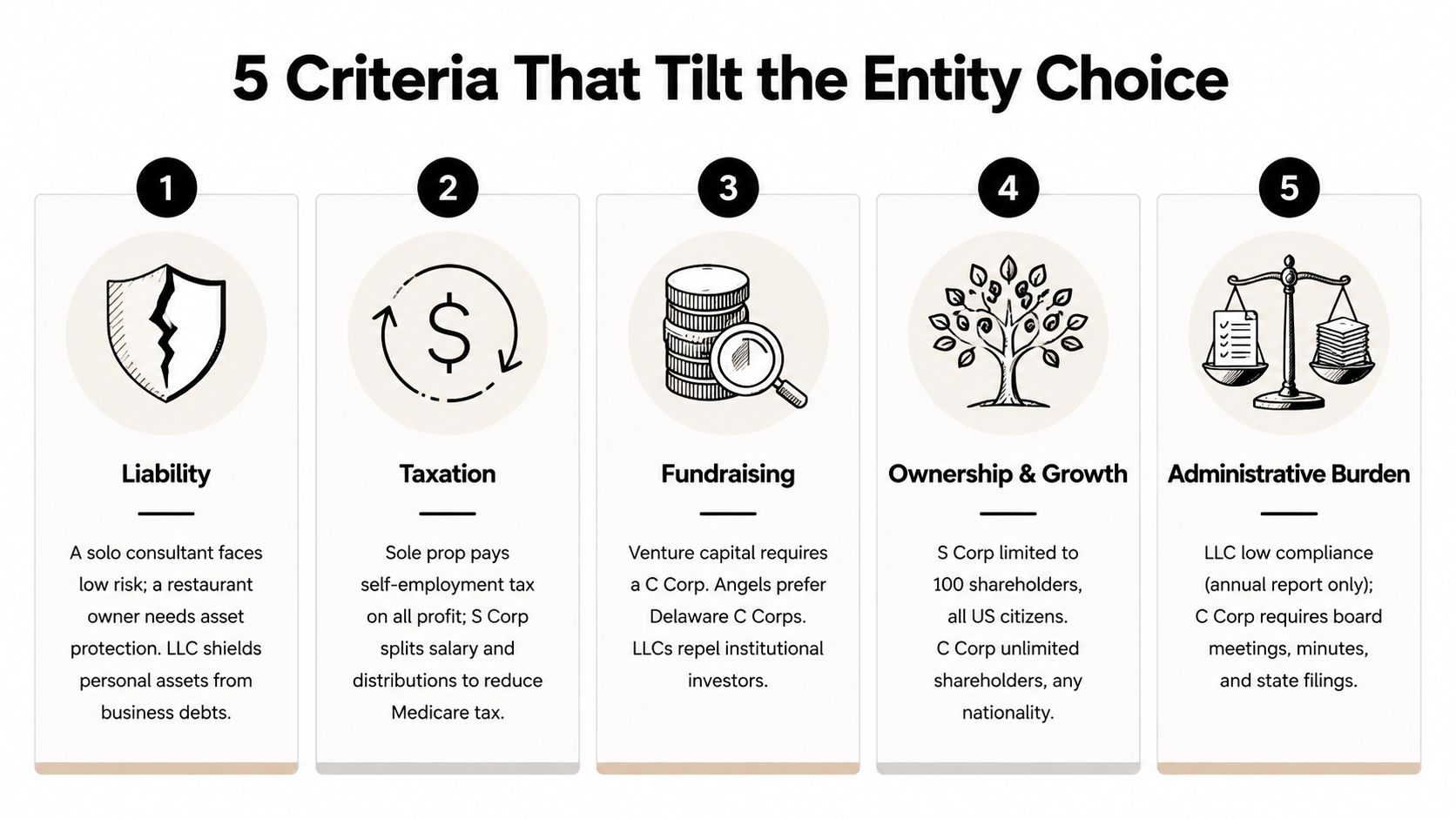
At each stage, ask the same five questions:
- Who bears the risk? Are personal assets exposed to contracts, employees, customers, leases, or lawsuits?
- How should profits be taxed? Do you need default pass-through treatment, corporate taxation, or a later S corporation election?
- Who needs to own equity? Will the company have family members, foreign owners, passive investors, employees, or institutional funds?
- How much administration can the business support? Separate returns, payroll, annual reports, minutes, and registered-agent obligations require time and money.
- What capital comes next? A bank loan, family investment, angel round, SAFE, or venture round can point toward different structures.
Practical rule: Choose today's structure with tomorrow's financing and ownership plan in view, but don't pay for complexity the business has no realistic need to support.
A structure should make the next stage easier, not force an early conversion or create tax work that outweighs its benefits. That's why entity selection works best as a sequence: choose the legal wrapper, apply the appropriate tax treatment, operate it properly, and review the decision when revenue, headcount, owners, or financing plans change.
The Five Core Entity Types and What They Actually Mean
The IRS commonly discusses five structures founders compare: sole proprietorship, partnership, limited liability company, S corporation, and C corporation. The critical distinction is that some are state-law entities, while others describe federal tax treatment.
A sole proprietorship generally exists when one person conducts business without forming a separate state-law entity. The owner controls the operation, but the business and owner aren't legally separate. A partnership involves two or more owners and may take different state-law forms, including a general partnership or a limited-liability form. The governing agreement matters because ownership, management, contributions, and distributions need clear rules.
An LLC is created under state law by filing formation documents with the relevant state agency. It's a flexible legal container. Depending on its owners and elections, an LLC may be taxed federally as a sole proprietorship, partnership, C corporation, or S corporation. That flexibility is why an LLC can be a sensible starting point for a business that wants liability protection without immediately adopting full corporate formalities.
An S corporation is not a separate state-law entity. It's a federal tax election available to an eligible corporation or LLC. The IRS explains that S corporations pass corporate income, losses, deductions, and credits through to shareholders, while eligibility includes no more than 100 shareholders, domestic status, and one class of stock (IRS S corporation guidance).
A C corporation is a state-law corporation that receives the default corporate tax treatment unless another election applies. It files Form 1120, issues stock, and operates as a separate legal entity. Corporate profits can be taxed at the company level, and distributions can create another tax layer for shareholders, a mechanism commonly called double taxation (Wolters Kluwer comparison of S and C corporations).
Legal form versus tax treatment at a glance
| Entity Type | State-Law Form | Default Federal Tax Treatment | Key Limitation |
|---|---|---|---|
| Sole proprietorship | No separate entity filing | Owner reports business activity personally | No liability separation |
| Partnership | Partnership formed by two or more owners | Pass-through partnership taxation | Governance and partner liability can create disputes |
| LLC | State-law entity formed by filing articles | May be taxed as sole proprietorship, partnership, C corporation, or S corporation | Tax flexibility requires careful classification |
| S corporation | Corporation or LLC with federal election | Pass-through taxation through shareholders | Ownership and stock-class restrictions |
| C corporation | State-law corporation | Corporate taxation under Form 1120 | Potential double taxation and greater formalities |
Nonprofits and professional corporations also exist, but they serve specialized purposes and don't fit the standard comparison for most operating businesses. For a focused discussion of the tax and operational differences, see this LLC versus S corporation guide.
The first decision is therefore the legal form. The second is the tax overlay. Those decisions can happen at the same time, but they don't have to.
The Decision Criteria That Drive Entity Selection
Founders often choose an entity after looking at formation cost or tax treatment alone. That order creates problems. Evaluate the business's risk, expected profit, ownership plans, financing path, and administrative capacity together, then decide whether the legal form and tax election should happen now or later.
Liability is the first filter
A solo consultant with professional liability insurance has a different exposure profile from a restaurant owner signing a commercial lease, hiring staff, and serving the public. An LLC or corporation can separate business obligations from personal assets, but the separation depends on treating the entity as a real business. Separate accounts, contracts signed in the company's name, accurate records, and appropriate insurance all support that protection.
Tax treatment must match actual profit
An LLC's default tax treatment may fit a business with uncertain or irregular profit. An S corporation can divide owner compensation between wages and distributions, but that benefit brings payroll, an election, and reasonable-compensation analysis. The IRS distinguishes the filings: a C corporation files Form 1120, while an LLC electing S corporation status files Form 1120-S (IRS structure and filing information).
The timing matters. A founder may form an LLC first, establish reliable books and payroll processes, and evaluate an S corporation election after profit becomes consistent. Electing too early can create compliance work without a meaningful tax benefit.
Ownership determines what remains possible
Two active founders may fit an LLC or partnership if the operating agreement clearly addresses control, contributions, distributions, deadlock, and a founder's departure. A company planning to raise venture capital usually needs a C corporation because investors expect stock, a familiar cap table, and equity instruments suited to institutional financing. S corporations restrict shareholder eligibility and stock classes, which can interfere with complex fundraising.
Compliance has a real price
A single-member LLC generally requires less governance than a corporation with directors, officers, shareholder records, payroll, and formal minutes. Each filing and administrative process needs an owner inside the business. A structure that appears inexpensive on formation day can become costly if the company later needs a rushed conversion. Unnecessary corporate formalities also consume time and professional fees.
Financing should influence the sequence
Identify the next likely capital source: customer revenue, a bank, family members, angel investors, or venture capital. That answer may determine whether flexibility matters more than investor familiarity. The Allied Tax Advisors business structure guide provides another reference for comparing common entity options before committing to an election.
Profit is usually the first quantitative question. Practitioner guidance identifies an approximate $50,000 to $60,000 or higher annual net-income zone where S corporation treatment may deserve analysis, provided profit is consistent enough to support reasonable salary and distributions. Other comparisons identify a broader inflection zone, including roughly $75,000 to $80,000 or more, while an independent analysis places the point around $100,000. Those ranges show why no threshold is an automatic rule (independent LLC and S corporation tax-gap analysis).
The test is practical: will the expected tax benefit exceed payroll, accounting, filing, and reasonable-compensation costs? If the answer is unclear, delay the election and revisit it when the profit pattern and financing plan are easier to measure.
Florida Versus Delaware and Where You Should Form
South Florida founders often assume Delaware is automatically more advantageous. It isn't. Delaware is useful for a particular financing and governance path, while Florida is often the cleaner choice for a local operating business.
Florida generally fits a solo founder, family business, local professional practice, or pre-revenue company that expects to operate primarily in Florida. Delaware may make sense when a lead investor requires it, institutional counsel expects it, or the company is deliberately building a venture-backed corporate structure.
The practical comparison
| Factor | Florida | Delaware |
|---|---|---|
| Local operating business | Efficient for businesses based in Florida | Requires attention to foreign qualification when operating elsewhere |
| Investor expectations | Suitable for many closely held businesses | Familiar to venture investors and startup counsel |
| Court system | Florida courts handle local disputes | Delaware's Court of Chancery is known for specialized corporate disputes |
| Privacy and administration | Depends on the filed entity and public records | Registered-agent and public-record considerations still apply |
| Ongoing obligations | Florida reports and local compliance apply | Delaware franchise-tax and registered-agent obligations apply |
A Florida filing may be preferable for a Miami consulting firm that has no investor on the horizon. A Delaware C corporation can be appropriate once a lead investor makes Delaware formation a closing condition. Delaware's corporate law and Court of Chancery predictability appeal to venture counsel, but that benefit doesn't justify forming there merely for prestige.
Founders should also distinguish formation from address requirements. A nonresident or remote owner may need a compliant business address rather than a commercial mail receiving agency, and this guide to non-CMRA addresses for non-residents can help clarify the issue.
For formation mechanics and strategic reasons companies use Delaware, see this Delaware incorporation benefits overview. The choice should follow the financing plan. If the business is bootstrapped and local, Florida often avoids unnecessary layers. If a venture round is close and the investor expects a Delaware C corporation, form for the transaction rather than converting under pressure.
Two Founder Scenarios That Change the Answer
Two founders can answer the same five questions and reach opposite conclusions. The difference usually comes from growth path, capital source, owner relationships, and timing.
The Miami SaaS company
Three co-founders are building a software platform in Miami and targeting a Series A within eighteen months. They expect outside investors to evaluate the company, review the cap table, and receive equity. A Delaware C corporation is the logical starting point because venture capital investors generally expect corporate stock, familiar governance, and financing documents built for institutional ownership.
The founders should also address restricted stock and equity compensation early. An 83(b) election must be filed within 30 days of receiving restricted stock, and failing to meet that deadline can create serious tax consequences as shares vest. Incentive stock options, a clean cap table, founder vesting, intellectual-property assignments, and board approvals should be designed before the first financing, not reconstructed afterward.
A C corporation may create a corporate tax layer when profits are distributed, but a venture-backed company often retains cash for growth rather than distributing operating profits. Its principal objective is to remain financeable and avoid a forced conversion when the lead investor is ready to close.
The Boca Raton restaurant group
Three siblings own a growing restaurant group in Boca Raton. They have a commercial lease, a small line of credit, and no institutional investors. Their most urgent needs are liability separation, clear management rights, predictable distributions, and a process for handling disagreement.
A Florida LLC provides a flexible legal form, while an operating agreement can define voting, authority, transfers, buyouts, deadlock, and what happens if one sibling stops working in the business. Once profit becomes steady, the owners can evaluate an S corporation tax election. The relevant benchmark is a broad roughly $60,000 to $80,000 annual net-profit range, not a guarantee, because payroll administration and reasonable compensation can outweigh savings at lower or inconsistent profit levels.
The same checklist produces a different answer because the restaurant isn't seeking venture financing and the siblings need contractual flexibility. The SaaS company needs investor-ready equity. Neither structure is “better” in isolation. Each is sequenced around the owners' next material decision.
Filings Timelines and First Year Compliance
Formation should be handled as a calendar, not a single online purchase. The state filing creates the entity, but the business still needs federal identification, governance documents, tax elections, licenses, banking, and recurring reports.
The formation sequence
- File with the state. For a Florida profit corporation, the plan calls for Articles of Incorporation filed with the Division of Corporations at $35, while a Florida LLC uses Articles of Organization at $125. Florida approvals generally take roughly two to five business days. A Delaware C corporation has a $109 minimum filing amount and is typically available the same day. Confirm current fees and processing times before filing because state requirements can change.
- Obtain the EIN. Apply to the IRS for the employer identification number. The application is free and is often issued the same day.
- Choose the federal tax treatment. Form 2553 handles an S corporation election, Form 8832 handles entity classification, and an 83(b) election applies to restricted stock. The 83(b) deadline is 30 days from the relevant stock transfer.
- Adopt governing documents. An LLC needs an operating agreement. A corporation needs bylaws, initial consents, stock records, and an organized capitalization table.
- Open dedicated banking. Use the EIN and formation records to establish an account used only for company activity.
- Register for required licenses and taxes. Check city, county, state, sales-tax, professional, and industry-specific requirements.
- Track annual obligations. Florida corporations file annual reports by May 1, while Florida LLCs have a deadline on the third Monday in February. A registered agent is required wherever the entity is registered.
A first-year calendar should assign an owner to every deadline. Founders budgeting for formation should also account for licenses, banking, registered-agent services, accounting, insurance, and technology, not just the state fee. This key startup expenses guide is a useful planning resource for building that broader budget.
Common Mistakes and When to Bring in Counsel
The most expensive entity mistakes usually happen after formation. They arise when owners treat the filed document as proof that the business is separate, assume a tax election creates a new legal entity, or postpone ownership rules until the first conflict.
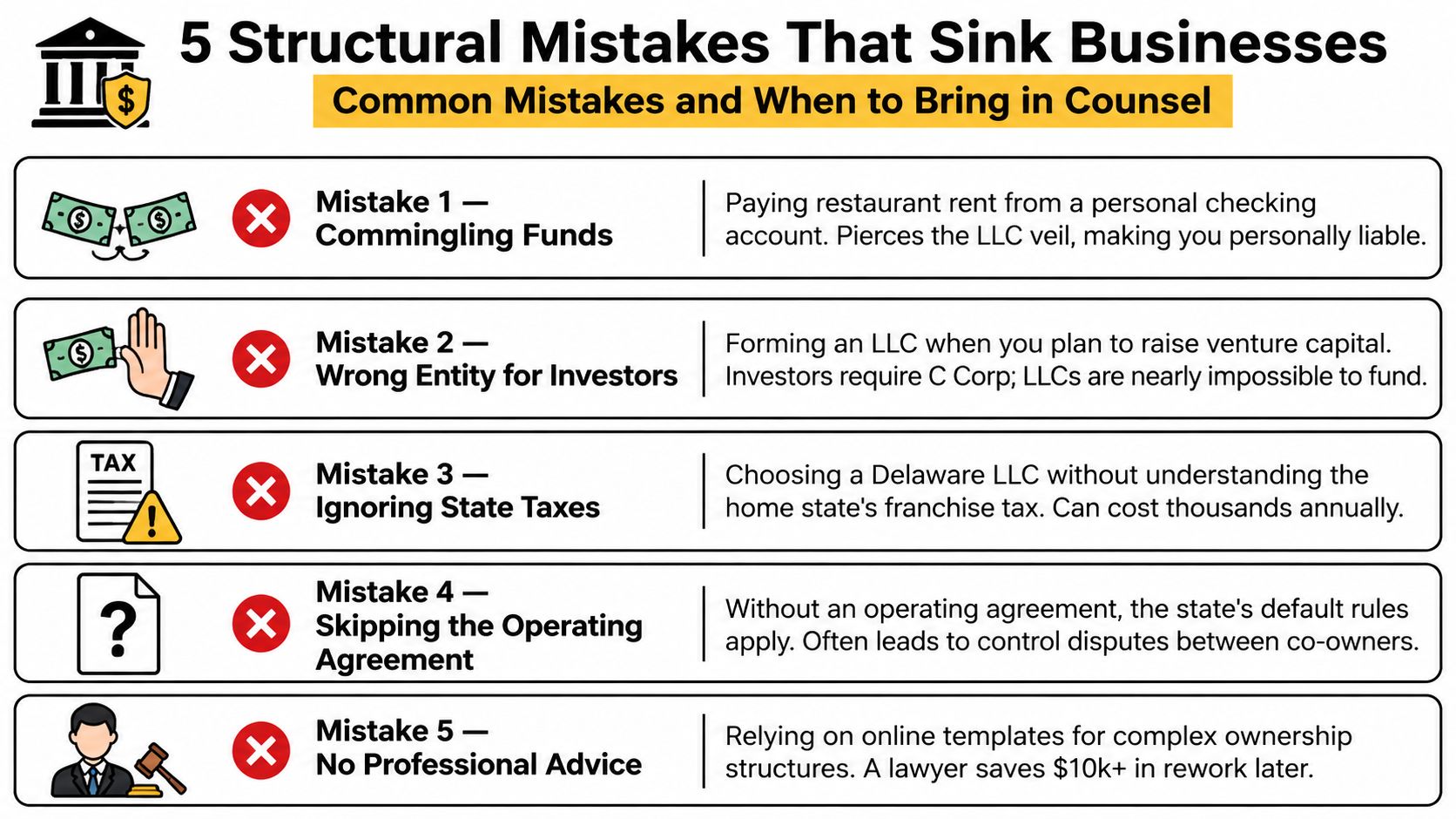
Five problems that create avoidable damage
- Commingling funds. Paying restaurant rent from a personal card, depositing investor wires into an account with no separate books, or using company funds for personal expenses can undermine liability protection. In Florida litigation, poor separation may support an argument for piercing the LLC or corporate veil.
- Choosing the wrong investor vehicle. An LLC can work for an owner-operated business, but a venture-backed company may need a C corporation with stock, founder equity records, and financing documents suited to institutional investors.
- Ignoring state obligations. Forming in Delaware doesn't eliminate Florida compliance when the company operates in Florida. The business may have Delaware obligations and Florida foreign-qualification responsibilities.
- Skipping the operating agreement. State default rules won't reflect your family arrangement, founder vesting, management authority, distribution policy, or exit plan. Co-owners need those rules before disagreement arrives.
- Electing S corporation status too early. The possible payroll-tax benefit is income-dependent. If net profit is below the range where savings exceed payroll and accounting costs, the election can add complexity without delivering a meaningful advantage.
The 83(b) election deserves separate attention for founders receiving restricted stock. Missing the 30-day filing deadline can prevent the intended tax treatment and create a problem that cannot be repaired by amending the operating agreement or issuing a new board consent.
When professional review earns its keep
Bring in counsel before signing formation documents if you're planning a SAFE or priced financing, assigning intellectual property among multiple founders, working with a nonresident co-founder, or operating in a regulated industry. Those situations involve more than selecting a filing type. They require ownership restrictions, tax coordination, contract authority, intellectual-property assignments, securities analysis, and a governance plan.
A business attorney can also help identify the review points that should trigger a future restructuring: the first employees, a new owner, a major lender, expansion into another state, an investor requirement, or a potential sale. Coto & Waddington, Attorneys at Law provides formation and governance support for Florida and Delaware LLCs, S corporations, and C corporations, including operating agreements, bylaws, capitalization, contracts, and ongoing business counsel. You can also review the firm's small-business legal services before deciding what level of support fits your company.
Coto & Waddington, Attorneys at Law helps South Florida founders choose and implement a business structure around liability, tax timing, ownership, and financing plans, rather than treating formation as a generic filing. Visit Coto & Waddington, Attorneys at Law to discuss your Florida or Delaware entity, operating agreement, tax-election timing, or upcoming investment before the wrong structure becomes a deal problem.