
You're sitting in front of Florida's Sunbiz filing portal with a business name selected, a bank account waiting, and one deceptively simple question: should the company be an S corporation or a C corporation? A solo consultant, a family-owned shop, and a venture-backed software founder may all face the same filing screen, but they're not solving the same legal or financial problem.
The right choice affects how profits leave the business, who can own shares, how investors enter the cap table, how losses are used, and how much after-tax value may remain at exit. This guide approaches S corp vs C corp for small business from the perspective that matters most to founders: not only what reduces this year's tax bill, but what preserves flexibility when the business reinvests, raises capital, or sells.
Table of Contents
- Why Founders in Miami and Beyond Stop on This Question
- The Origins of the S Corp and C Corp
- Side-by-Side Comparison of S Corp and C Corp
- How Taxes Actually Differ in Practice
- Forming an S Corp or C Corp in Florida and Delaware
- QSBS, Exit Value, and the Reinvestment Question
- Choosing the Right Structure for Your Business
Why Founders in Miami and Beyond Stop on This Question
On a warm afternoon in Brickell, a solo marketing consultant and the founders of a two-person artificial intelligence startup could be looking at the same Florida filing page. The consultant wants to invoice clients, pay herself efficiently, and protect personal assets. The startup founders are already thinking about outside capital, preferred shares, dilution, and a possible acquisition.
A rushed answer can create problems long after formation. Choosing an S corporation without checking the ownership plan can make a later investment difficult. Copying a Delaware C corporation structure from a friend's startup can create unnecessary complexity for a closely held service business that expects to distribute most of its earnings. Forming in one state while operating in another can also leave a founder responsible for foreign qualification and ongoing state filings.
The state filing itself doesn't determine whether a corporation receives S treatment. A corporation generally begins under the default corporate tax regime, and the owners then make a federal tax election if the company qualifies. That distinction matters because the legal entity, tax classification, ownership rules, and exit strategy all interact.
Practical rule: Choose the structure around the business you're building, not the business your friend built.
Three profiles will keep the analysis grounded:
- The solo operator, such as a Miami consultant or agency owner who expects active profits and limited outside ownership.
- The family shop, such as a bakery or local service company owned by relatives who expect regular distributions.
- The investor-backed venture, such as a software company planning institutional funding and a future acquisition.
A Florida corporate attorney can help connect formation documents, ownership terms, contracts, and tax elections before the first deal is signed. Founders can also review small business legal services from Coto & Waddington when they need formation and ongoing business counsel.
The Origins of the S Corp and C Corp
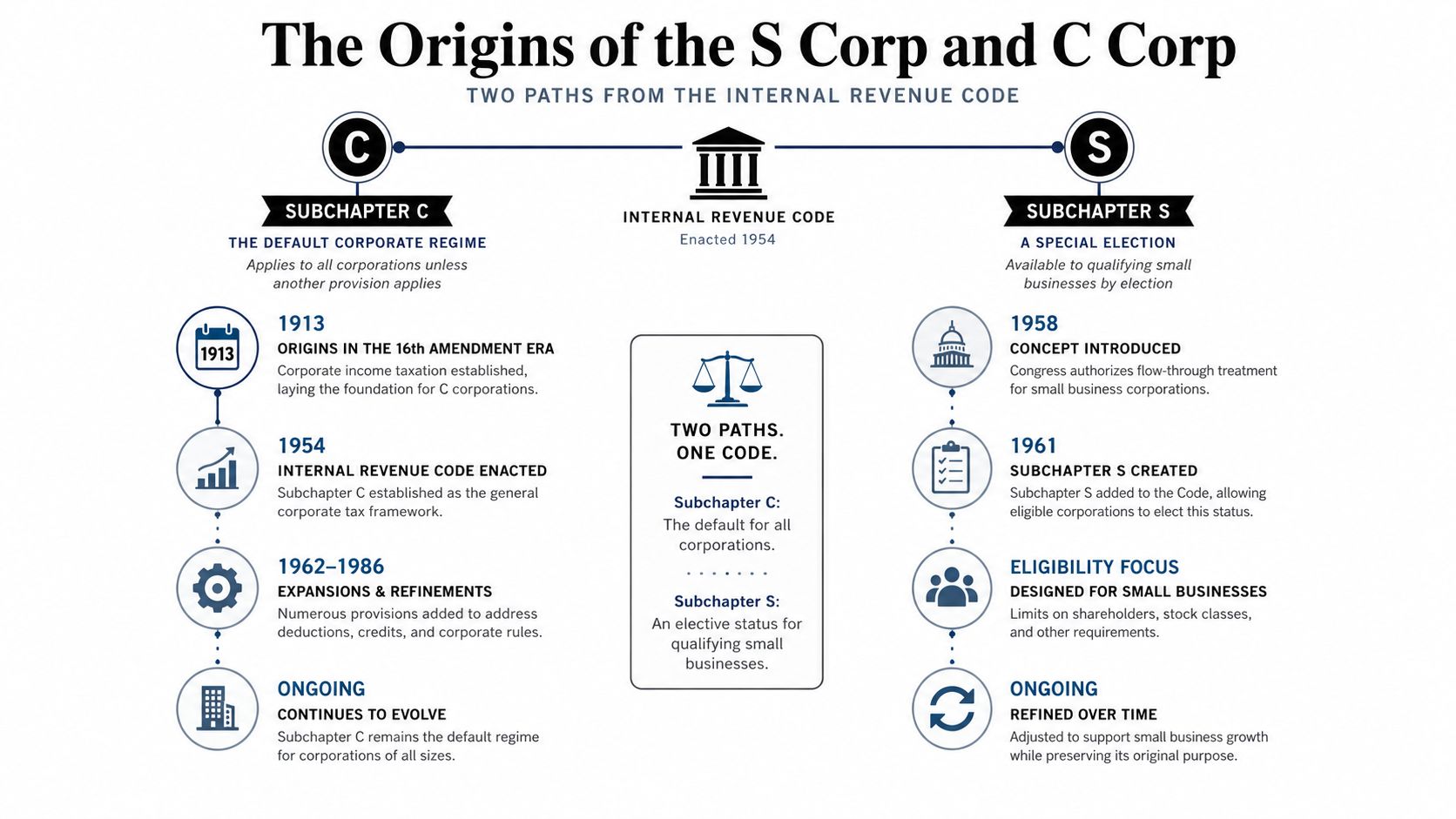
A Miami consultant deciding how to preserve cash for growth faces a different choice from a family bakery distributing steady profits or a software startup courting institutional investors. The dividing line starts in the Internal Revenue Code, not in the state filing.
Subchapter C is the default federal tax regime for corporations. A corporation formed under Florida or Delaware law generally receives that treatment unless it makes a valid election for another classification. The state-law entity and the federal tax election are separate decisions.
Congress created Subchapter S in 1958 for qualifying small businesses that wanted the corporate form while allowing corporate income, losses, deductions, and credits to pass through to shareholders for federal tax purposes, as described in the IRS overview of S corporation statistics.
What the S election changes
The S election changes an eligible corporation's federal tax treatment. It does not create a different state-law entity, remove corporate formalities, or permit unlimited stock classes. The corporation still needs sound formation documents, stock records, governance procedures, and ownership that fits the election.
Later tax-law changes increased its appeal. The Tax Reform Act of 1986 made S status more attractive relative to C corporations. The Small Business Job Protection Act of 1996 expanded the maximum number of shareholders from 10 to 75. For a solo operator or family shop, those rules can fit the ownership plan. They can create friction for an investor-backed venture seeking preferred stock or broader participation.
Why the history still matters
The underlying trade-off remains practical. An S corporation generally passes taxable business activity to its shareholders. A C corporation pays tax at the corporate level and may impose another tax when profits are distributed. That difference affects payroll planning, retained cash, investor fit, and the value of a future exit.
IRS data shows that by tax year 2003, S corporations represented about 61.9% of all corporations filing Form 1120-S, with nearly 3.3 million S corporation returns filed that year. The figures explain its popularity among closely held businesses, but a common structure is not automatically the right structure for a founder planning to reinvest earnings or sell the company.
Side-by-Side Comparison of S Corp and C Corp
Both structures begin with incorporation under state law. Both can provide a liability shield when the owners respect corporate separateness, maintain records, and avoid treating the company bank account as a personal wallet. The major differences arise from federal tax classification, ownership flexibility, and the company's expected use of capital.
| Dimension | S Corp | C Corp |
|---|---|---|
| Federal tax treatment | Corporate income, losses, deductions, and credits generally pass through to shareholders for federal tax purposes. The corporation files Form 1120-S. | The corporation files Form 1120 and is taxed at the corporate level. Dividends may create a second shareholder-level tax. |
| Personal liability | Shareholders generally receive a corporate liability shield if the corporation is properly maintained. | Shareholders generally receive the same corporate liability shield if the corporation is properly maintained. |
| Ownership | No more than 100 shareholders, subject to eligibility rules; only allowable shareholders; generally one class of stock. | No comparable federal limit on the number or type of shareholders; multiple classes of stock are available. |
| Investor compatibility | Restricted ownership and one-class stock rules can complicate institutional investment. | More suitable for venture funds, foreign persons, corporate investors, and preferred stock arrangements. |
| Loss treatment | Losses may pass through, subject to basis, at-risk, and passive-activity limits. | Losses remain at the entity level as net operating losses, subject to applicable limitations. |
| Profit extraction | Active owner-employees generally receive wages plus distributions, with payroll-tax rules applying differently to each. | Employees receive wages, while dividends are paid from corporate earnings and may face shareholder-level taxation. |
| Governance | Corporate formalities still apply, including bylaws, directors, officers, stock records, and minutes. | The same core corporate formalities apply, often with more elaborate financing and preferred-stock documents. |
The broader small-business pattern supports this distinction. A Treasury analysis reported that between 1982 and 2000, the share of non-farm businesses taxed as S corporations rose from less than 4% to more than 11%, while SBA-cited IRS data historically placed pass-through entities such as partnerships and S corporations at about 16% of small businesses, compared with 3% organized as C corporations. Those historical figures appear in the IRS business tax statistics.
Liability reminder: The S election doesn't create the liability shield. Incorporation and proper corporate conduct do.
For the solo operator, the S corporation's limits may be manageable. For the family shop, the ownership rules require careful documentation. For the investor-backed venture, the one-class rule and shareholder restrictions can become an obstacle before the first financing round.
How Taxes Actually Differ in Practice
The S corporation's practical advantage is often described as payroll-tax arbitrage. That phrase can sound like a loophole, but the legal structure is more precise: an owner who performs services generally receives W-2 wages, and remaining profit may be distributed separately. The salary is subject to applicable payroll taxes, while distributions generally aren't subject to self-employment tax, provided the arrangement follows the rules.
The IRS requires reasonable compensation for shareholder-employees who provide services. The relevant standard is compensation ordinarily paid for like services by like enterprises under like circumstances, as summarized in this discussion of S corporation reasonable compensation.
| Tax Item | S Corp | C Corp |
|---|---|---|
| Business income | Generally passes through to shareholders for federal tax purposes. | Taxed at the corporate level. |
| Owner wages | Service-providing owners must receive reasonable W-2 compensation, subject to payroll taxes. | Employee-shareholders receive wages subject to payroll taxes. |
| Distributions or dividends | Remaining distributions generally aren't subject to self-employment tax, but they don't replace reasonable wages. | Dividends may be taxed again to shareholders after corporate tax. |
| Losses | May pass through subject to basis, at-risk, and passive-loss restrictions. | Stay at the corporate level as NOLs, generally carried forward indefinitely but limited to 80% of taxable income in future years. |
| Reinvestment | Profits generally pass through and can create personal tax even if cash remains in the business. | Earnings can remain inside the company, with the second shareholder-level tax generally deferred until distribution. |
Treasury research quantified the difference between the structures. Weighted evenly across firms, the average effective rate was 15.2% for S corporations, compared with 25.3% if those same firms were taxed as C corporations. Weighted by dollars of net income, the comparison was 23.1% under current S corporation rules and 30.1% under C corporation taxation, as reported in the IRS's business tax statistics materials.
The comparison doesn't mean every owner receives the same result. A solo consultant with consistent active profit may benefit from separating salary and distributions. But an owner who underpays wages and labels nearly everything a distribution creates an audit risk. The salary needs support, such as comparable compensation data, job duties, time records, and a consistent payroll process.
A C corporation has a different calculation. The company pays federal corporate tax at 21%, and shareholders may pay tax again on dividends or shareholder-level gains, as explained in C corporation taxation and double taxation. For a venture that retains earnings to hire employees, build technology, or expand, deferring dividend taxation can change the reinvestment math. For a family business that distributes most profits, the second layer becomes harder to ignore.
If an existing company is reconsidering its classification, a conversion requires coordinated legal and tax work. A founder should review the consequences before changing status through a resource on C corp to S corp conversion, rather than treating the election as a routine form.
Forming an S Corp or C Corp in Florida and Delaware
The formation path depends first on where the corporation is created and where it operates. Florida and Delaware use different filing systems, but neither state filing alone creates S tax status.
Florida formation
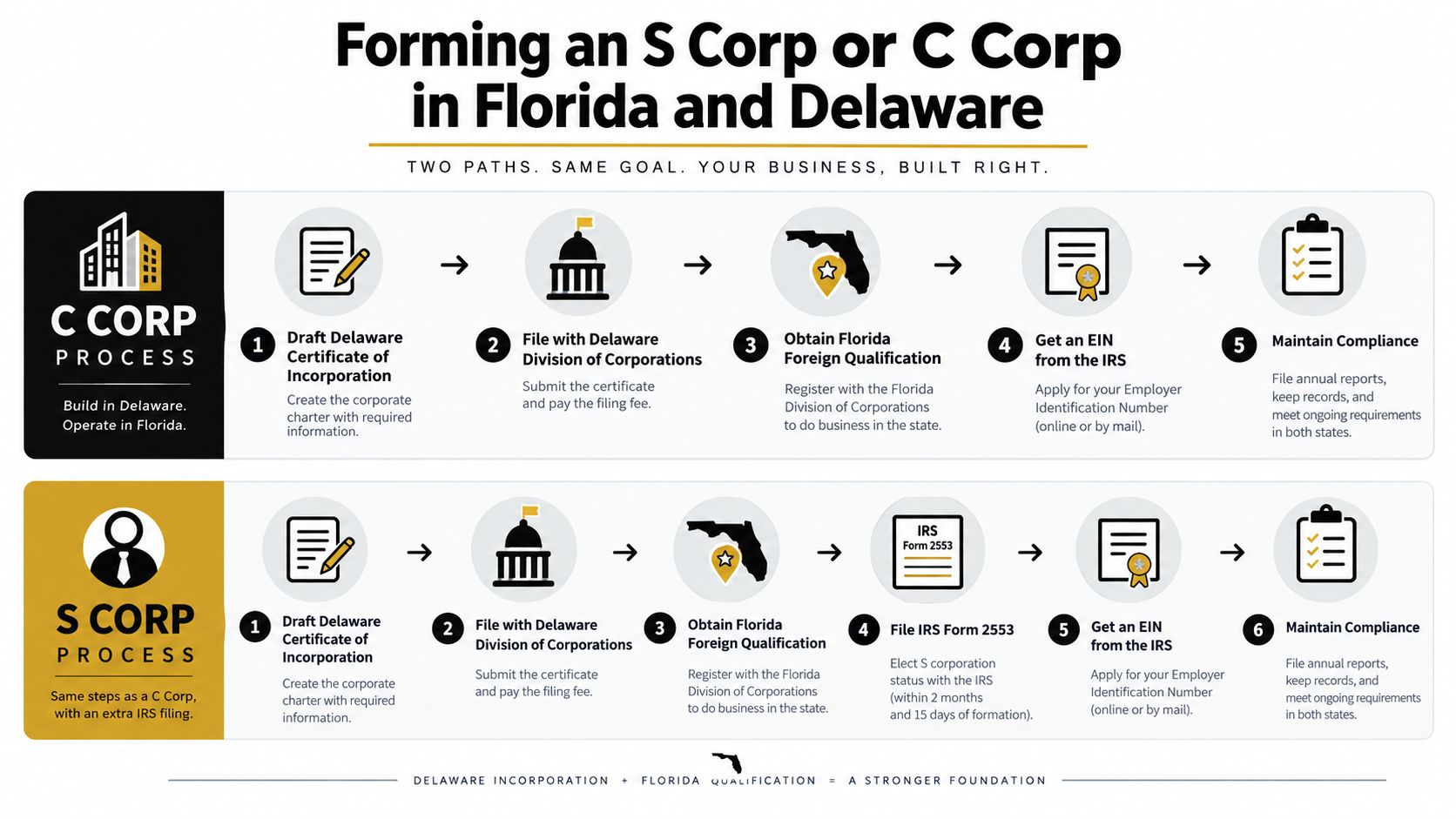
A Florida founder typically files Articles of Incorporation with Sunbiz, identifies the corporation's registered agent and registered office, authorizes shares, and pays the applicable state filing charges. After filing, the company should obtain a federal EIN, adopt bylaws, appoint directors and officers, issue stock, and document the organizational meeting through written minutes or consents.
Florida corporations also face an annual report obligation. The Florida registered office fee listed for this process is $138.75, so founders should budget for that filing obligation instead of treating formation as a one-time administrative event.
Delaware formation with Florida operations
A Delaware corporation files its Certificate of Incorporation with the Delaware Division of Corporations and maintains a Delaware registered agent. If the company conducts business from Miami, Fort Lauderdale, or elsewhere in Florida, it may also need Florida foreign qualification, a Florida registered agent, and ongoing Florida filings.
That structure is common for investor-backed startups, but it creates two states to manage. Founders should understand the ongoing compliance cost and document trail before choosing Delaware because another startup did.
The same formation analysis applies if a founder is comparing U.S. incorporation with offshore options. A resource on registering a company in the Cayman Islands may help explain the mechanics of that alternative, but offshore registration doesn't eliminate U.S. tax, ownership, reporting, or operating obligations for a Florida-based business.
The S election
After forming an eligible corporation, the owners file IRS Form 2553 to elect S treatment. For a new corporation, the election generally must be filed within 75 days of formation or the beginning of the tax year for which it should apply. The IRS provides a late-election relief procedure, but relying on relief is less reliable than tracking the deadline from the start.
All required shareholders generally must consent. That detail causes trouble when a founder adds a co-founder, transfers shares, or assumes that signing the stock purchase agreement automatically handles the tax election. Before filing, confirm the cap table, shareholder types, stock class, and consent signatures. Delaware founders can review Delaware incorporation benefits alongside Florida foreign-qualification requirements before selecting the jurisdiction.
QSBS, Exit Value, and the Reinvestment Question
The strongest C corporation argument may appear years after formation, when a buyer or investor evaluates the company. Section 1202 Qualified Small Business Stock, commonly called QSBS, is available only for qualifying C corporation stock. The potential benefit can exclude up to $10 million or 10 times the shareholder's basis in qualifying circumstances when the stock has been held for at least five years, according to the cited C corporation and S corporation strategy analysis.
The rules are technical. Eligibility can depend on the company's assets, business activity, issuance history, shareholder circumstances, and holding period. S corporation shareholders generally don't receive QSBS treatment, so a founder who starts as an S corporation may not be able to recreate the same planning opportunity later without significant restructuring.
The reinvestment question points in the opposite direction from the distribution question. S corporation income generally passes through to shareholders each year, which can create personal tax even when the company retains cash for equipment, hiring, or expansion. A C corporation can retain earnings inside the entity, pay corporate tax, and defer the shareholder-level tax that typically accompanies a later dividend.
That doesn't automatically make the C corporation cheaper. A business that distributes most profits to its owners may face the full force of the two-layer model. The better question is what the company will do with its cash.
Three exit paths
- Hold and distribute: The family shop or solo agency expects regular owner distributions. S treatment often deserves close attention, subject to eligibility and reasonable compensation.
- Sell the company: A founder should compare stock and asset sale outcomes, basis, deal structure, and possible QSBS treatment before choosing a classification.
- Raise outside capital: A startup expecting venture funding usually needs C corporation flexibility, including multiple stock classes and ownership by entities or foreign investors.
Delaware remains a common choice for funded startups because its corporate framework is familiar to investors and supports advanced stock arrangements. A Florida operating company can still use Delaware incorporation, but it must handle Florida qualification and ongoing compliance.
Choosing the Right Structure for Your Business
The best recommendation changes with the founder's profile.
The solo Miami consultant
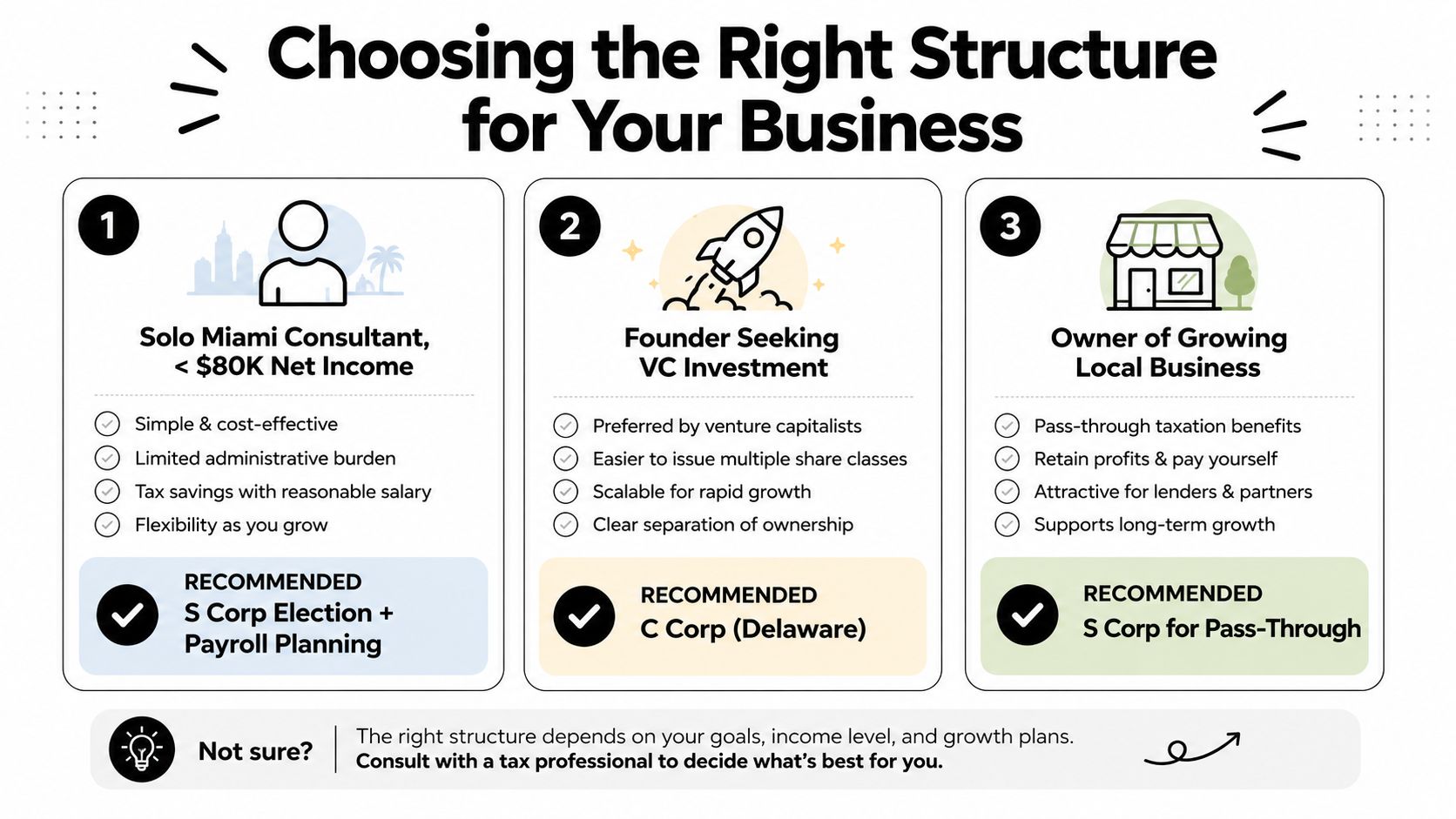
A solo consultant with under $80K in net income may prefer a corporation with an S election and disciplined payroll planning, especially when the business has enough profit to justify the added administration. The owner can separate defensible W-2 compensation from remaining distributions, while avoiding the investor and preferred-stock issues that drive venture formation.
The decision still needs a realistic cost check. Payroll processing, tax preparation, bookkeeping, annual reports, and legal maintenance can reduce the practical benefit. A C corporation generally makes little sense for a solo operator who expects to distribute nearly all operating profits and has no outside funding plan.
The family-owned bakery
A bakery with two family shareholders and steady profit distributions may fit the S corporation profile, but the family should verify every ownership rule before filing. The IRS generally permits individuals, certain trusts, and estates as shareholders, while partnerships, corporations, and nonresident alien shareholders aren't permitted. Family aggregation can help with the shareholder limit, because an individual and spouse, and qualifying family members under the tax rules, may be treated as one shareholder for that test, according to the IRS Form 2553 instructions.
The owners also need reasonable compensation records for anyone working in the bakery. Paying only distributions because the owners are related is not a substitute for documenting market-based wages.
The investor-backed SaaS startup
A software startup preparing for a Series A and eventual acquisition should generally evaluate a Delaware C corporation first. Venture funds and other institutional investors often need ownership flexibility, preferred stock, and a capitalization structure that an S corporation can't comfortably provide. The C corporation also preserves a possible QSBS path if the company qualifies and the founder plans early enough.
Before signing formation documents, review:
- Revenue trajectory and expected cash retention.
- Investor pipeline, including foreign or entity investors.
- Exit horizon and likely buyer.
- Current and proposed owner count.
- State of operation and foreign-qualification needs.
- Whether the company needs preferred and common stock.
- Whether founders can maintain contemporaneous corporate records.
Before operating, have an experienced Florida corporate attorney and tax professional model the distribution, reinvestment, financing, and exit scenarios. Confirm eligibility, obtain the required shareholder consents, file Form 2553 within 75 days when S treatment is intended, and complete Florida foreign qualification before the company signs its first client contract if it was formed in Delaware.
Coto & Waddington, Attorneys at Law helps South Florida founders evaluate and form LLCs, S corporations, and C corporations in Florida and Delaware, while coordinating contracts, capitalization, compliance, and ongoing corporate counsel. Visit Coto & Waddington, Attorneys at Law to discuss your ownership plan, reinvestment strategy, and intended exit before you file.



