You find the note in a kitchen drawer, or on the back of a legal pad, or folded into an envelope with the bills. It's handwritten, signed, and it says who gets the house, who gets the car, or who should care for the children. That moment feels responsible. It feels like you handled the hardest part.
In probate, though, that same note can become a fight over whether it means anything at all. In about half of the United States, a holographic will is recognized, but not everywhere, and not always in the same way Hofstra Law Review. Florida is one of the states that does not accept that shortcut, which is why a generic sample can be more dangerous than helpful. The core question isn't whether the handwriting looks sincere. It's whether the document will survive probate where the decedent lived.
Table of Contents
- The Notepad Will and the Trap Behind It
- What a Holographic Will Is
- Annotated Sample of Holographic Will Templates
- Why Florida Specifically Rejects Holographic Wills
- Common Reasons a Holographic Will Fails in Probate
- Holographic Will vs Formal Will vs Living Trust
- Practical Steps Before You Rely on Any Sample of Holographic Will
- When a Sample Is Not Enough and What to Do Next
The Notepad Will and the Trap Behind It
A man sits alone at the kitchen table after midnight and writes out his wishes in plain language. He names his daughter, leaves the condo to his son, and signs his name at the bottom because he wants to “make it official.” That kind of moment is common, and it explains why the sample of holographic will keeps showing up online as if it were a safe fix.
The trap is that a handwritten note can look complete and still fail for a very basic reason. In many states, the law does not care that the writing was sincere. It cares whether the state recognizes holographic wills at all, whether the document is fully handwritten and signed, and whether the probate court can accept it under local rules Western & Southern.
A handwritten will is only useful if the court where it matters is willing to treat it as a will.
That's where families get blindsided. A document that seems perfectly understandable to the person who wrote it may be useless to the personal representative, the probate judge, and the heirs who have to live with the result. Florida is the clearest example, because a handwritten note that might work elsewhere can be thrown out here. The danger of a template is that it gives people confidence before it gives them legal protection.
What a Holographic Will Is
A holographic will is a handwritten will, usually unattested, meaning no witnesses are required in jurisdictions that recognize it. The key point is straightforward, the testator writes the material terms and signs the document in their own hand. That is the working definition you need before probate rules start narrowing the field Hofstra Law Review.
The basic legal test
In states that accept holographic wills, the court usually looks for two things. First, the document must be handwritten. Second, it must be signed by the testator. California focuses on whether the signature and material provisions are in the testator's handwriting, while Michigan requires the date plus the signature and material portions in the testator's handwriting California Probate Code.
That makes a holographic will different from a typed will and different from an oral, or nuncupative, will. A typed document can fail because it is not handwritten. An oral statement can fail because it is not a written testamentary instrument at all. A holographic will works more like a handwritten note that may carry legal force only if the state statute allows it and the probate court can verify what was written and by whom.
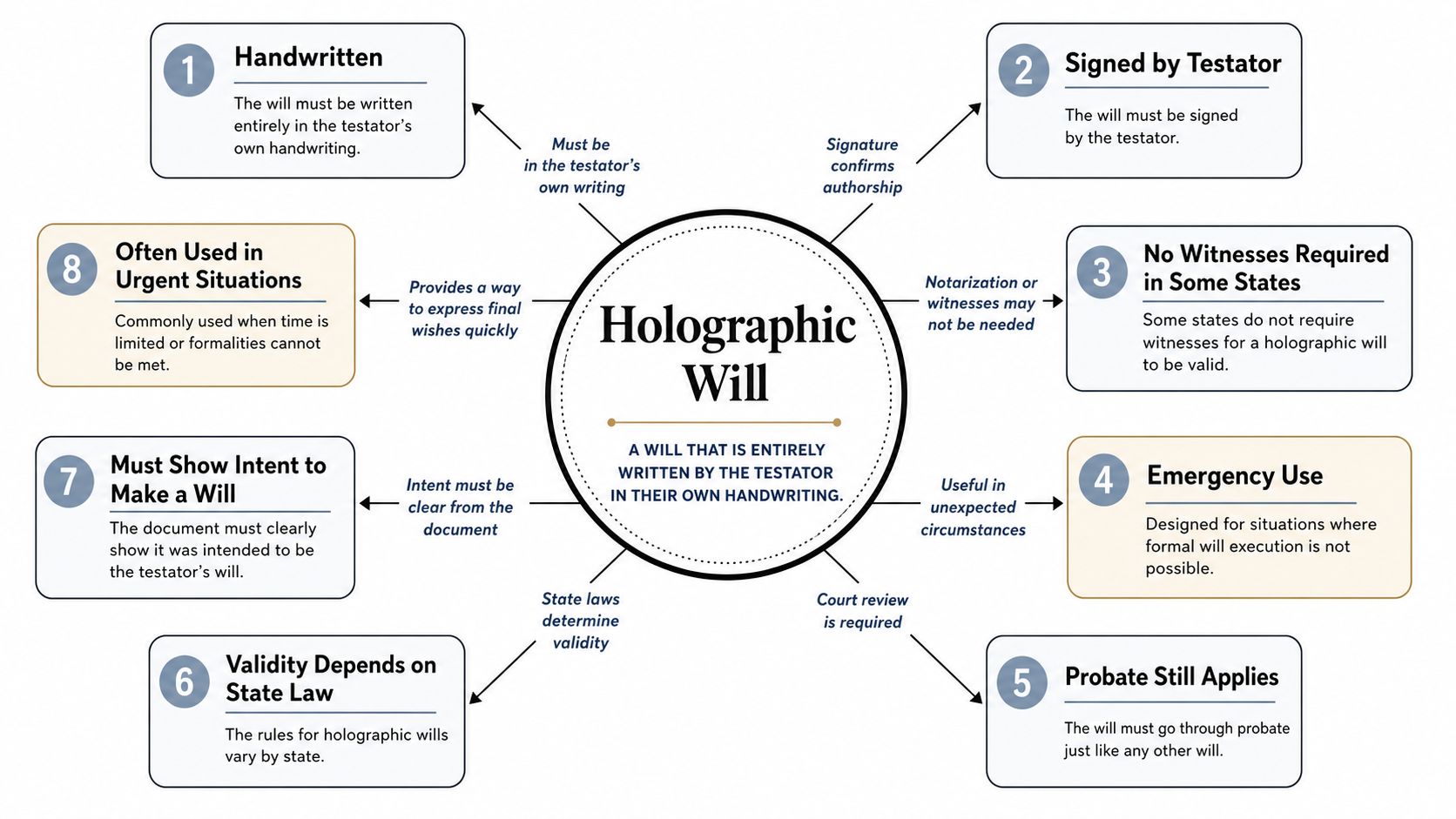
Practical rule: if the state's statute does not recognize a handwritten will, the quality of the handwriting does not matter.
Annotated Sample of Holographic Will Templates
A handwritten will can look tidy on the page and still fail in probate if the state does not allow it. In Florida, that problem is immediate, because the document has no legal value without the formal execution rules that Florida requires. In states that do recognize holographic wills, the court still looks closely at handwriting, intent, and whether the paper says enough to control a real estate plan.
A weak handwritten will often reads like a family note. A stronger one uses clearer gift language, identifies the person making the will, and states who should handle the estate. Even then, the document can still be rejected where witnesses are required, or where the court cannot verify that the handwritten parts carry testamentary intent.
Minimal sample
I, Maria Lopez, write this as my last will.
[This identifies the testator and the document's purpose.]
I give my jewelry to my daughter, Ana Lopez.
[This names one beneficiary and one gift.]
I sign my name below.
[Signature is the core authenticity marker.]
Maria Lopez
[Signed by the testator in handwriting.]
Stronger sample
I, Maria Lopez, of Miami, Florida, declare this to be my last will and testament.
[Identity plus intent.]
I give my home furnishings to my daughter, Ana Lopez.
[Specific gift with a named beneficiary.]
I give the rest, residue, and remainder of my estate to my son, Carlos Lopez.
[This is the residuary clause, which catches assets not listed elsewhere.]
I appoint Ana Lopez as personal representative.
[This names the person who will carry out the estate administration.]
If I die while my children are minors, I appoint Ana Lopez as guardian.
[This adds guardianship language.]
Maria Lopez, March 1, 2026
[Signature and date, which can matter when there are multiple documents.]
What both versions leave out matters as much as what they include. There are no witnesses, no notarization, and no self-proving affidavit. There is also no express revocation of prior wills. Utah Legal Services notes that holographic wills often include details such as full-name identification, residence, marital status, spouse and children, distributions, personal representative, guardian for minor children, date, and signature, but those details still do not cure a defect in a state that rejects handwritten wills.
| Clause Element | Minimal Sample | Stronger Sample |
|---|---|---|
| Testator identity | Present | Present with residence |
| Beneficiary gift | One named gift | Specific gift plus residue |
| Fiduciary appointment | Missing | Personal representative named |
| Guardianship language | Missing | Included for minors |
| Date | Missing | Included |
| Witnesses | None | None |
| Notarization | None | None |
Why Florida Specifically Rejects Holographic Wills
A handwritten note may look orderly on the page and still fail the moment it reaches a Florida probate judge. Florida Statutes section 732.502 requires two attesting witnesses, so a holographic will is not recognized here even if it would be valid in the state where it was drafted Florida Probate Code summary. That detail catches a lot of families off guard after a move into Florida, or after a death that occurs here.
I have seen a Miami resident keep a handwritten will in a desk drawer and assume the paper would control the estate. The family finds it after death, hands it to the personal representative, and then learns the document likely cannot be admitted to probate. At that point, the court is not weighing fairness. It is checking whether the document meets Florida's formal execution rules.
Why domicile matters
The decedent's domicile usually drives the probate analysis, not the place where the note was written. A handwritten will can be effective in one state and rejected in another. Texas allows a will written wholly in the testator's handwriting without subscribing witnesses, while Utah is broader about what counts as a valid holographic will, and New York limits recognition to narrow categories such as certain military personnel, mariners, and people accompanying armed forces during war or armed conflict Cornell Law School Wex.
A person who moves to South Florida after writing a handwritten will elsewhere should not assume the old document carries over automatically. That cross-border issue is one reason handwritten templates create so much confusion for families who expect one paper to work everywhere.
Florida probate also shows why the witness requirement matters in practice. The probate process in Florida requires formal proof, and the court will look for the execution steps Florida law demands rather than informal assurances from relatives.
Common Reasons a Holographic Will Fails in Probate
A handwritten will often breaks down for reasons that have nothing to do with whether the person really meant it. The paper may be authentic, but the language may leave too much room for argument, the property may not be described with enough precision, or an earlier document may still be controlling. Probate turns informal wording into hard questions, and every loose phrase becomes a point of conflict.
The recurring failure points
- Unclear beneficiaries: A phrase like “my kids” or “my nephew” can create uncertainty if there is any dispute about who was meant, especially in blended families or when several people fit the description.
- No residuary clause: If the document names one item and says nothing about the rest, anything left over can pass by intestacy.
- Prior wills left in place: If the handwritten paper does not clearly revoke earlier wills, the family may be stuck with conflicting instructions.
- Proof problems: If the original is missing, altered, or hard to read, it becomes harder to prove what the decedent wrote and whether the document reflects the final version.
- Unclear asset descriptions: “The house” or “my account” may not be enough if the person owned more than one property or more than one financial account.
- No backup plan for a failed gift: If a named beneficiary dies first, or a gift cannot be carried out as written, the will may leave the family without direction for that asset.
These are the kinds of defects that show up in real probate fights. A handwritten document can look simple and still create a mess if the family has minors, real property, or mixed family lines, as shown in this real-life probate example. The problem is rarely the handwriting itself. The problem is that the will does not give the court enough clean instructions to administer the estate without argument.
The same issue shows up in day-to-day probate work in Florida. The Florida probate process forces the estate to prove what the document means, what property it covers, and whether another writing changes the result. If the paper leaves gaps, the court does not fill them with guesswork.
A sample can look complete on the page and still fail where it matters most, in the administration of the estate. Minor drafting mistakes turn into major disputes once relatives start comparing versions, questioning handwriting, or arguing over which assets the testator intended to give away. That is the part families usually do not see until after death.
Holographic Will vs Formal Will vs Living Trust
A holographic will, a formal will, and a revocable living trust solve different problems. A handwritten will is the quickest to create, but it carries the most uncertainty. A formal will adds execution safeguards. A funded revocable living trust shifts assets outside probate, which is why it's often the more effective privacy tool for families who want smoother administration.
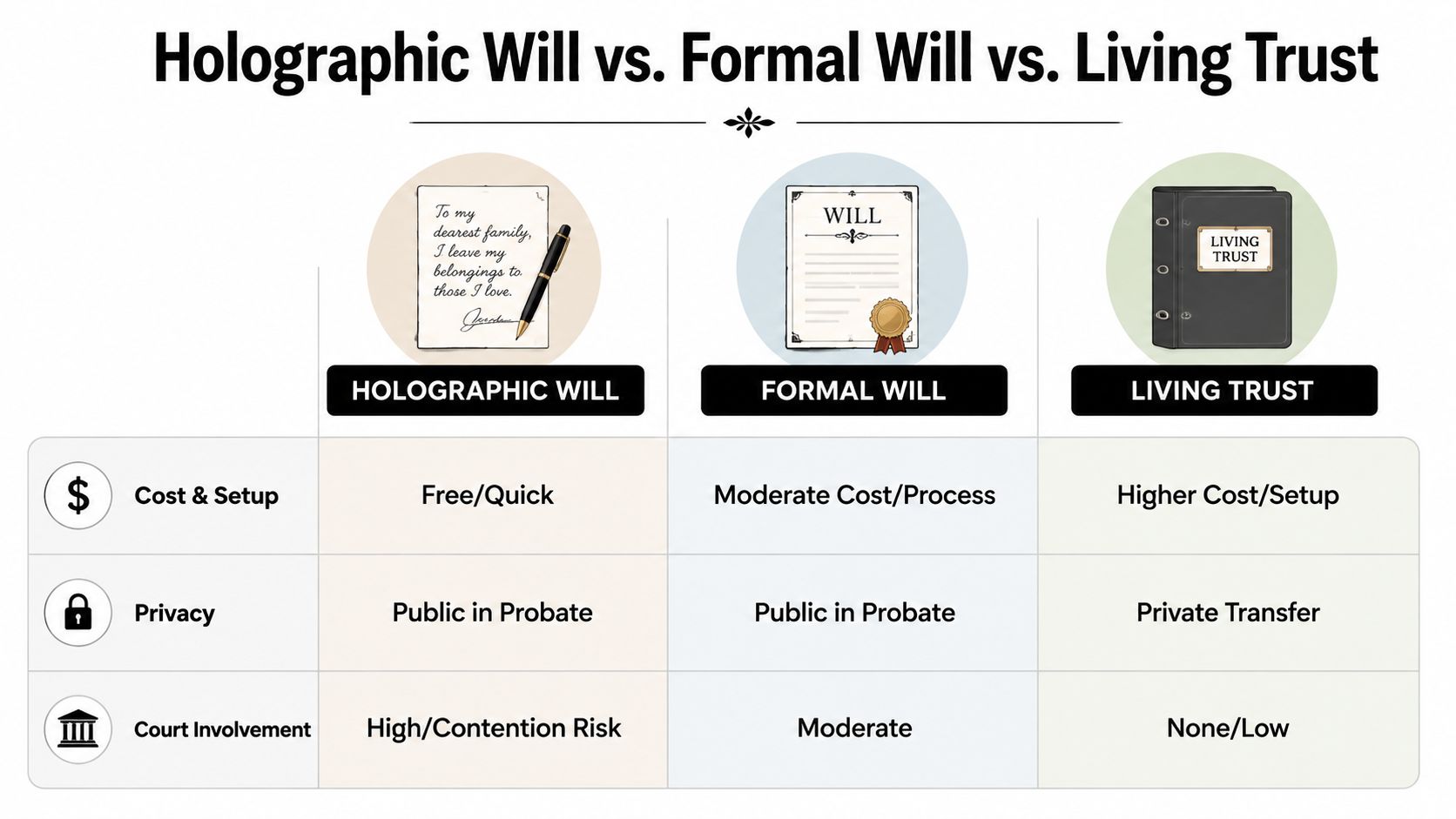
| Feature | Holographic Will | Formal Will | Living Trust |
|---|---|---|---|
| Cost & setup | Free or quick | More process | More setup |
| Privacy | Public in probate | Public in probate | Private transfer |
| Court involvement | High risk of contention | Moderate | Low |
| Asset handling | Limited flexibility | Better structure | Better for funded assets |
What families often overlook
A will, whether handwritten or formal, usually still goes through probate. A trust can avoid that process for properly titled assets, which is why the successor trustee role matters so much after death. If you want a plain-English explanation of that duty, the successor trustee role explained resource is useful context.
A holographic will should be treated as an emergency or jurisdiction-specific tool, not the default plan. It can work in some states, but it is not a substitute for the structure a formal will or trust provides. If you are comparing document forms, the Florida last will and testament forms page helps show why execution details matter so much here.
Practical Steps Before You Rely on Any Sample of Holographic Will
Start with the state where the testator is domiciled, because that's the law that usually controls probate. If that state requires witnesses, a handwritten sample won't save you. If the state allows holographic wills, the next step is to make the document as clear as possible, because ambiguity turns into delay.
- Confirm the governing state: Check where the person lives, not just where the paper was written.
- Date the document clearly: A clear date helps resolve conflicts with later papers.
- Sign in the expected handwriting: The signature should match the form the local court is looking for.
- Name beneficiaries precisely: Use full names whenever possible.
- Store the original safely: A fireproof location is better than a desk drawer.
- Tell the personal representative where it is: A hidden will helps no one.
- Review after life changes: Marriage, divorce, births, deaths, and moves can change the whole plan.
If any one of those steps feels uncertain, you've moved past DIY territory.
A sample of holographic will is educational. It is not legal advice, and in a state like Florida, using it as a substitute for a valid witnessed will can leave the family with nothing but a rejected document. If you want a more structured starting point, the will and trust template resource shows how quickly a generic form reaches its limits.
When a Sample Is Not Enough and What to Do Next
A handwritten sample can help you understand the shape of a will, but it can't tell you whether the document will survive probate. That matters most in Florida, because the state rejects holographic wills outright and requires formal witness execution instead. It also matters when the estate includes real property, minor children, blended families, or assets that cross state lines.
The practical takeaway is simple. Use the sample to learn the language, not to substitute for the plan. If you live in South Florida and your family depends on a document that has to work the first time, the safer move is a customized estate plan with the right execution formalities.
Coto & Waddington, Attorneys at Law helps South Florida families turn uncertain handwritten intentions into estate plans that hold up in Florida. If you're dealing with a sample of holographic will, or you're not sure whether your current documents would survive probate, visit Coto & Waddington, Attorneys at Law to schedule a consultation and get bilingual, flat-fee guidance from a Miami and Fort Lauderdale team that understands how these cases play out.