Drafting a Florida last will and testament isn't just for the wealthy or the elderly. It’s the single most important tool any adult can use to control who gets their property, who cares for their children, and how their affairs are settled. While DIY forms are everywhere online, Florida's legal requirements are notoriously strict. A small mistake can invalidate the entire document.
Why a Florida Will Is Not Optional
A will is your personal instruction manual for what happens after you're gone. If you don't have one, the State of Florida makes all the decisions for you under its "intestacy" laws. Trust me, the state's plan for your family and assets probably won't match yours.
This forces your loved ones into a legal process that can create family arguments, drain assets on unnecessary expenses, and cause long, stressful delays.

Creating a will is a final act of care. It delivers clarity and peace of mind when your family needs it most. Think of it as the ultimate protection for the people you love and everything you've worked for.
The Power to Control Your Legacy
Your will is the only way to make sure your specific wishes are legally binding. This foundational document gives you direct control over three critical areas:
- Appointing Your Personal Representative: In Florida, this is the person responsible for managing your estate—paying final bills, gathering assets, and distributing them as you directed. This role is called an "executor" in other states.
- Designating Guardians for Minor Children: For any parent, this is the most important reason to have a will. You decide who raises your children if something happens to you. Without a will, a judge who doesn't know you or your family will make that life-altering choice.
- Specifying Your Beneficiaries: You can leave specific property, cash, or percentages of your estate to anyone—family, friends, or a charity you support. Without a will, your best friend or favorite nephew might get nothing.
Expert Tip: When choosing a Personal Representative, don't just default to your oldest child. We’ve seen this cause immense family friction. Pick the person who is most organized, financially responsible, and level-headed enough to manage the process without emotion clouding their judgment.
Understanding Wills, Trusts, and the Probate Hurdle
It's vital to know where a will fits into the bigger picture. A will must go through a court-supervised process called probate. While probate is designed to validate the will and oversee the estate, it’s also public, can take months or even years, and can be expensive.
You can learn more about the specific steps and challenges of this legal process in our guide to the probate process in Florida.
A trust, on the other hand, is a separate legal tool that holds your assets for your benefit. For many families, a properly funded trust allows the estate to bypass probate entirely, ensuring privacy and a much faster, smoother settlement.
Actionable Tip: Taking the time to create a legally sound will is one of the most responsible things you can do. It's an essential first step for every adult.
If you're unsure whether a simple will is enough for your situation or if a trust might be a better fit, don't guess. Contact Coto & Waddington for a consultation to build a plan that truly secures your legacy and protects your family's future.
Understanding the Essential Elements of a Valid Florida Will
Getting the legal formalities right is the single most important part of creating a will in Florida. A simple mistake here can invalidate the entire document, effectively erasing your final wishes and leaving the State of Florida to decide how your assets get divided.
We'll break down exactly what the Florida statutes demand to make your Florida last will and testament forms legally binding. The process is precise, but it's not complicated once you understand the key pieces. These requirements exist to prevent fraud and ensure the document genuinely reflects the final intentions of the person who created it.
The In-Writing and Signature Rule
First and foremost, a Florida will must be in writing. This may sound obvious, but it’s a critical point—Florida does not recognize oral wills (known as nuncupative wills) or unwitnessed handwritten wills (holographic wills). Your intentions must be captured on paper.
After it’s written, you, the testator (the person making the will), must sign it at the very end. If you are physically unable to sign, you can direct someone else to sign on your behalf, but this must be done in your presence and at your explicit direction. Think of your signature as your official stamp of approval on the document.
The Critical Role of Witnesses
This is where many DIY wills fall apart. Under Florida Statute 732.502, your will signing absolutely must be witnessed by at least two credible witnesses. These witnesses are confirming that they saw you sign the will or that you acknowledged to them that the signature on the document is, in fact, yours.
Crucially, the witnesses must also sign the will in your presence and in the presence of each other. This is often called the "line of sight" rule. In practice, this means everyone should be in the same room, watching each other sign the document in a single, uninterrupted ceremony.
Pro Tip: Always coordinate your signing ceremony to happen in one room at one time. Have the testator sign, then have the first witness sign, and then the second. This simple act eliminates any future questions about whether the "presence" requirement was met.
Choosing Your Witnesses Carefully
Not just anyone should serve as a witness. While a beneficiary can technically witness a will in Florida without voiding the entire document, it's a terrible idea. Doing so swings the door wide open for other family members to challenge the will, claiming the beneficiary-witness exerted undue influence over you.
The best practice is always to use two disinterested witnesses. These are people who have absolutely no financial stake in your will. Good choices often include:
- Neighbors who are not named in your will
- Coworkers or friends who are not beneficiaries
- Staff at a law firm who are not related to you
Actionable Tip: Choosing disinterested witnesses is a powerful, simple step to safeguard your will against future legal battles. It shows foresight and helps protect your family from unnecessary disputes down the road.
Before you finalize your will, you'll need to name a few key people to carry out your wishes. Understanding their roles is crucial.
Key Roles in Your Florida Will
| Role | Responsibility | Key Consideration |
|---|---|---|
| Personal Representative (Executor) | Manages your estate, pays debts, and distributes assets according to your will. | Must be trustworthy, organized, and willing to handle legal and financial tasks. |
| Beneficiaries | The people, charities, or entities who will inherit your assets. | Be specific. Name them clearly to avoid ambiguity and potential disputes. |
| Guardian (for Minor Children) | Cares for your minor children if you are the last surviving parent. | This is arguably the most important decision for parents. Choose someone who shares your values. |
| Trustee (if creating a trust) | Manages assets held in a trust for your beneficiaries. | Needs financial acumen and a strong sense of fiduciary duty. |
Selecting the right people for these roles is just as important as drafting the document itself. A great will with a poor executor can lead to serious problems for your heirs.
Speeding Up Probate with a Self-Proving Affidavit
One of the most valuable additions to a Florida will is a self-proving affidavit. This is a separate statement attached to the will that you and your witnesses sign in front of a notary public. It’s not required for the will to be valid, but it makes the probate process dramatically faster and easier for your family.
Without this affidavit, the probate court will likely need to track down one of your original witnesses to testify or sign an oath confirming the signing was legitimate. With the affidavit, the court accepts the will as valid on its face. This simple step saves your loved ones immense time, stress, and money.
Imagine a Miami small business owner whose will was signed incorrectly—without disinterested witnesses or a self-proving affidavit. Their family could be forced into a costly, lengthy court battle, potentially jeopardizing the business's future. A 2024 Florida probate study found 60% of contested wills stemmed from ambiguities in DIY forms, costing heirs an average of $25,000 extra in legal fees. You can discover more insights about the costs associated with Florida estate planning by reviewing recent studies.
Taking these steps ensures that the Florida last will and testament forms you complete will stand up in court, protecting your assets and your family's future.
If you have any questions about these specific requirements or want to ensure your will is executed flawlessly, the team at Coto & Waddington is here to help. A proper legal review provides the peace of mind that your final wishes will be honored without complication. Contact us today.
Alright, let's get practical. Moving from the "what" to the "how," we're going to walk through the actual process of filling out a standard Florida will form, clause by clause. While the specific layout might vary a little from one form to another, the essential parts are always the same. Getting these details right is the difference between a will that works and one that causes chaos in court.
To make a will legally binding in Florida, you have to follow a clear, three-part process. It’s simpler than you might think, but every step is mandatory.
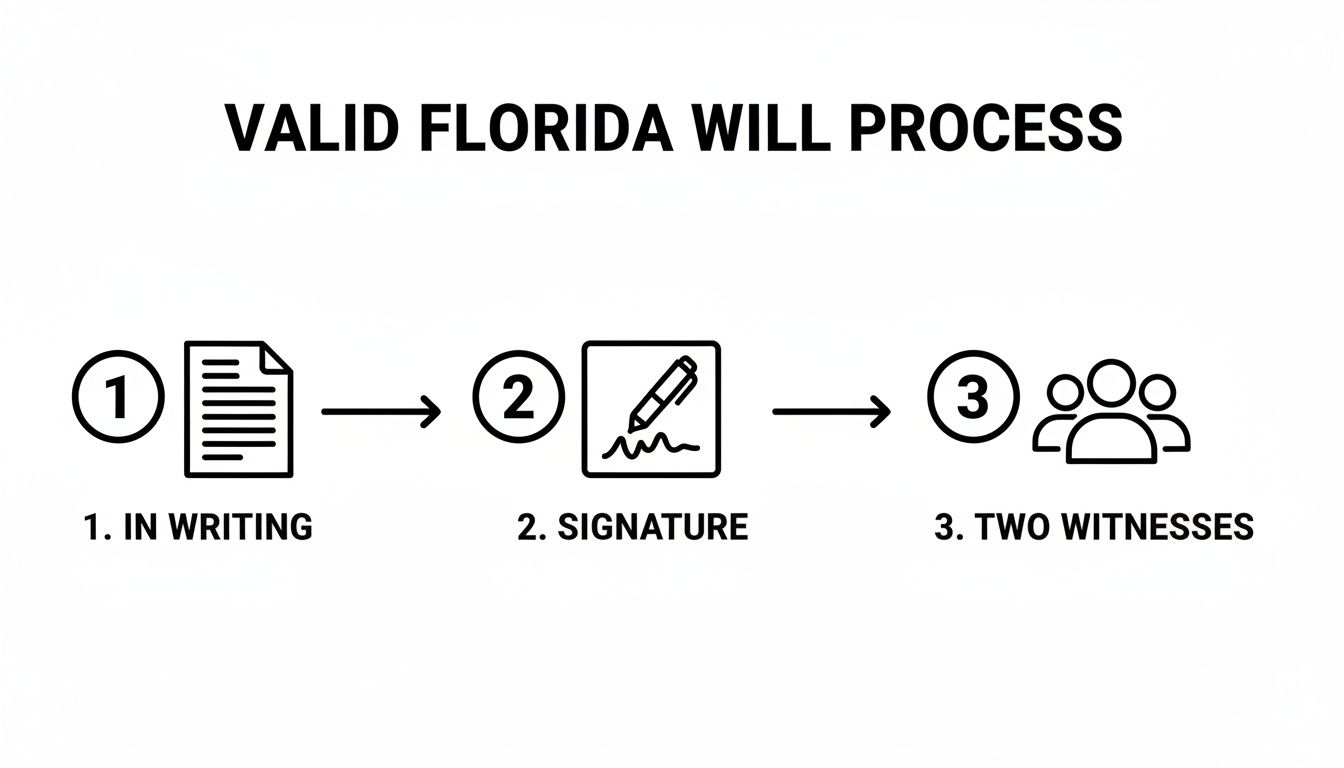
As you can see, the law is unambiguous: a Florida will must be a physical written document, signed by you, and then signed by two witnesses in your presence. If you miss even one of these requirements, the entire will can be thrown out.
The Opening Declaration
Every will starts with a declaration or exordium clause. This is the opening paragraph where you state your full legal name, your city and county of residence, and declare that the document you're signing is, in fact, your last will and testament. It also serves to cancel out any previous wills or codicils (amendments) you might have signed in the past.
Expert Tip: This clause seems simple, but it’s powerful. It officially establishes your identity and your intent, shutting down any potential confusion with old, outdated documents.
Appointing a Personal Representative
After deciding who gets what, your next most important decision is choosing who will manage your estate. This person is called the Personal Representative (what many other states call an "executor"). Their job is to gather all your assets, pay off your final debts and taxes, and distribute whatever is left to your beneficiaries.
This is not a role you hand out lightly. Don't just default to your oldest child or a close sibling out of obligation. The best person for the job might not be who you think.
Practical Tip: Your Personal Representative should be:
- Trustworthy and Responsible: This is non-negotiable. They will have complete control over your assets.
- Organized and Diligent: Probate involves a mountain of paperwork and strict deadlines. Disorganization can be disastrous.
- A Florida Resident: While you can appoint an out-of-state resident, it makes the probate process much more complicated and expensive. It’s almost always better to choose someone local.
- A Calm Communicator: They will have to deal with grieving family members, creditors, and lawyers. A level head is critical.
Always, always name at least one successor Personal Representative. If your first choice can't or won't serve, this backup ensures your estate can be managed without the court stepping in to appoint someone you might not have chosen.
Nominating a Guardian for Minor Children
For any parent with minor children, this section is the entire reason to have a will. Here, you nominate the person (or people) you trust to raise your kids if you're gone. If you don't make this choice, a judge who doesn't know you, your children, or your family will make this profoundly personal decision for you.
Actionable Tip: Think carefully about your choice. Consider their parenting style, values, financial stability, and even where they live. Most importantly, you must have a frank conversation with your chosen guardian to make sure they are willing to take on this incredible responsibility. Just like with your Personal Representative, always name an alternate. For a complete picture of the documents your plan should include, our estate planning documents checklist is a great starting point.
Detailing Specific Gifts or Bequests
This is where you can give particular items or set amounts of money to specific people or charities. These are known as specific bequests, and the absolute key here is clarity. Vague language is a recipe for family fights and expensive court battles.
Let’s look at what not to do—and how to fix it:
Vague: "I give my car to my son." (Which car if you have two? What if you have more than one son?)
Clear: "I give my 2023 Toyota Highlander, VIN 12345ABC, to my son, David Miller."
Vague: "I leave some money to my niece." (How much is "some"? Which niece?)
Clear: "I give the sum of $10,000 to my niece, Sarah Jones."
Actionable Advice: For items like jewelry, art, or furniture, consider creating a separate "personal property memorandum." Florida law allows your will to refer to this separate, signed list. This is a great tool because you can update the list whenever you want without having to formally amend your entire will.
The All-Important Residuary Clause
So, what happens to everything else? After the specific gifts are handed out and all the estate's debts are paid, the rest of your property is handled by the residuary clause. This is a critical catch-all that directs where the "residue" of your estate goes. It is arguably the most important clause in the entire document because it covers assets you forgot about or acquired after you signed the will.
Without a residuary clause, any leftover property is distributed according to Florida's intestacy laws—the state's default plan—which may be the last thing you wanted. A standard residuary clause might say: "I give all the rest, residue, and remainder of my estate to my spouse, Jane Doe, if she survives me. If she does not survive me, I give all the rest, residue, and remainder of my estate to my children, in equal shares."
Completing your Florida last will and testament forms correctly requires precision and foresight. If you're struggling with the language or aren't sure how to structure these clauses for your unique family dynamics, don't guess. At Coto & Waddington, we help clients draft clear, effective wills that provide genuine peace of mind. Contact us to learn more.
When to Consider a Trust Instead of Just a Will
While every estate plan needs a will, it's crucial to understand its biggest limitation: a will all but guarantees your estate will end up in probate court. Probate is the court-supervised process for validating a will, and from our experience, it's almost always public, often expensive, and notoriously time-consuming.
This is exactly where a revocable living trust becomes a powerful tool for many Floridians.
A will only springs to life after you pass away. A trust, on the other hand, is active the moment you create and fund it. Think of it as a private container you build to hold your assets. You transfer the title of your property—your home, bank accounts, investments—into this container, which you continue to control as the trustee.
The Power of Probate Avoidance
The single most important benefit of a trust is its ability to bypass the probate process entirely. Because the assets are owned by the trust, not by you personally, there's nothing for the probate court to administer when you die.
This creates several massive advantages for your family:
- Privacy: Probate is a public record. Anyone can walk into the courthouse and find out the value of your estate, what you owned, and who your heirs are. A trust keeps all of your family's financial matters completely private.
- Speed: Trust administration is handled privately and efficiently. Your hand-picked successor trustee can manage and distribute assets to your beneficiaries in a matter of weeks, not the year or more that probate often takes.
- Cost Savings: While setting up a trust has an upfront cost, it frequently saves your family a small fortune by avoiding court costs, administrative fees, and certain legal expenses tied to a formal probate.
Expert Tip: Trusts are not just a niche tool anymore. We're seeing a clear trend in Florida estate planning toward adopting revocable living trusts, driven almost entirely by the desire to avoid probate. A well-drafted trust can sidestep court oversight, potentially saving 5-10% of your estate's value in fees and slashing settlement times from over a year to as little as 60 days.
Planning for Incapacity, Not Just Death
A revocable living trust offers another powerful protection that a will simply can't: planning for incapacity.
If you become unable to manage your own finances due to a sudden illness or injury, your chosen successor trustee can step in immediately to pay your bills and manage your assets. This avoids a humiliating and expensive court proceeding where your family would have to ask a judge to declare you incompetent and appoint a guardian.
Expert Tip: A trust is a proactive tool for life's biggest what-ifs. It creates a seamless transition of management not just at death, but also during a period of incapacity, giving you and your family tremendous peace of mind.
Busting the "Only for the Wealthy" Myth
There's a persistent myth that trusts are only for the ultra-rich. That’s just not true. A trust provides immense value for everyday Florida homeowners and business owners. If you own a home in South Florida, your property alone likely has enough value to make avoiding probate a huge financial win for your heirs.
Consider this real-world scenario we see often: a Miami tech entrepreneur with a blended family (children from a previous marriage).
- With a Will Only: His will directs assets to his new spouse and children. But upon his death, business operations could be frozen during the long probate process. The public nature of the proceedings might also expose sensitive family dynamics to public view.
- With a Trust: He places his home, business interests, and investment accounts into a revocable living trust. He creates specific, detailed instructions inside the trust to provide for his spouse while ensuring his children from his first marriage inherit their intended share. A "pour-over" will is also created to catch any forgotten assets and move them into the trust. This structure gives him far greater control, privacy, and protection for everyone involved.
The differences between these two foundational planning tools are significant. To help you decide on the right approach, it’s worth digging into the fundamental distinctions and seeing real-world examples of the difference between a will and a trust.
While a trust offers many advantages, it's also important to understand the different types. You can learn more about the critical differences in our article on revocable vs. irrevocable trusts to see which might be right for you.
Deciding between a simple will and a comprehensive trust is a critical financial decision. If you own property or have a family situation that demands privacy and control, a trust is very likely the superior option.
Don't leave your legacy to the default settings of the probate court. Contact Coto & Waddington today for a consultation to discuss whether a will or a trust is the right foundation for your estate plan.
How New 2026 Florida Laws Can Simplify Your Estate
For most Florida families, the word “probate” brings up thoughts of long delays, frustrating legal hurdles, and high costs. But a major change in state law, set to take effect in 2026, is about to rewrite that story for many estates.
This isn’t just a minor legal tweak; it’s a shift that makes having a well-drafted Florida last will and testament form more powerful than ever.

The update centers on a streamlined probate process called summary administration. Think of it as an express lane for settling an estate—faster and far less expensive than formal probate. The big news is that Florida is doubling the number of people who can use it.
The New $150,000 Threshold
Effective July 1, 2026, a new law (CS/SB 1500) will officially raise the threshold for summary administration from $75,000 to $150,000 in non-exempt assets. This is a game-changer. It means an estimated 40% of all Florida estates that would have been forced into a long, costly court process can now be settled in a matter of weeks.
You can dig into the full legislative analysis to see how these new probate rules could affect your estate plan.
What this means for you is simple: with some careful planning right now, your estate could qualify for this simplified path. That translates into thousands of dollars in saved legal fees and months of spared heartache for your loved ones.
A Real-World Miami Scenario
Let's look at a common situation we see in our practice. Picture a retired couple in their late 60s living in the Miami area. Their home is paid off, which makes it exempt homestead property that doesn't count toward the limit.
Their other assets include:
- A joint savings account with $60,000
- An investment portfolio valued at $80,000
- Two cars, which are also exempt from the calculation
The total of their non-exempt assets is $140,000. Under the old rules, their estate would have been too large for summary administration, forcing their family into a formal probate process that could easily drag on for a year and eat up 5% or more of the estate’s value in fees.
The 2026 Game-Changer: With the new law, their $140,000 estate now falls comfortably below the $150,000 summary administration threshold. Their heirs can use the simplified probate process, potentially settling everything in just a few months for a fraction of the cost.
This is why strategic planning is so crucial. A clear, properly executed will, combined with an estate value that falls under this new limit, is one of the most powerful gifts you can give your beneficiaries.
Pro Tip: Now is the perfect time to take stock of your non-exempt assets—bank accounts, investments, and any real estate that isn't your primary home. If your total is hovering near or just over the new $150,000 limit, you may be able to use planning tools like lifetime gifts to ensure your estate qualifies.
By understanding and acting on these upcoming changes, you can position your estate to take full advantage of a simpler, faster, and more affordable settlement process for your family.
If you’re unsure whether your estate will qualify or want to explore strategies to meet the new threshold, the team at Coto & Waddington can provide the clarity you need. Contact us for a consultation to align your estate plan with these beneficial new laws.
Take the Next Step to Protect Your Legacy
We've covered the mechanics of a Florida will, but the real takeaway is this: a will is more than just a document. It's the foundational instruction manual you leave for your family, and its true power comes from getting the legal details exactly right.
Don't underestimate how easily things can go wrong. We see it all the time. A do-it-yourself Florida last will and testament form might seem like a quick, cheap solution. The problem is that one small mistake—a forgotten signature, a vaguely worded clause, or an improperly chosen witness—can invalidate the entire document. This can throw your final wishes into a costly and emotionally draining court battle for the people you were trying to protect.
Your Plan Needs to Be as Unique as Your Life
Every family is different. Your assets, your business interests, and your personal relationships create a unique financial picture. Your estate plan has to reflect that reality.
A generic template simply can't account for complex family dynamics, business succession goals, or the specific protections needed for your assets in South Florida. Personalized legal guidance ensures your plan is built for your life, not a hypothetical one.
Expert Tip: Taking action today is the ultimate peace of mind for tomorrow. A legally sound will isn't just about paperwork; it's about providing absolute clarity and security for your loved ones during what will already be a difficult time.
As you think about protecting your future, it's also smart to consider comprehensive estate management. This broader view ensures all the pieces of your financial life—from your will to your investments—are working together to secure your legacy.
Secure What You've Built with Confidence
If you are a professional, an entrepreneur, or the head of a family in South Florida, you've worked too hard to leave your legacy to chance or to the state's default rules. A thoughtfully crafted will is your final, and most important, act of care.
Ready to build a plan that works? The team at Coto & Waddington is here to help you create a clear, effective estate plan that truly protects your assets and your family.
Contact us for a consultation. Let’s get it right from the start.
Frequently Asked Questions About Florida Wills
When it comes to Florida last will and testament forms, a few key questions always come up. Getting straight answers is the only way to move forward with real confidence. Here are the most common issues we see in our practice and the practical guidance we provide.
What Happens if I Die Without a Will in Florida?
If you pass away without a valid will, Florida law says you have died “intestate.” This means the State of Florida decides who gets your property, following a rigid formula laid out in the intestacy statutes.
Actionable Tip: Your assets will go to your closest living relatives, but the state’s plan often doesn’t match what people actually want. For example, your spouse might be forced to split the inheritance with your children, or assets could end up with a distant cousin you haven’t spoken to in years. A will is the only way to override these default rules and guarantee your property is distributed exactly as you intend.
How Can I Change or Update My Will?
Life changes, and your will should change with it. In Florida, you have two ways to legally update your will:
- Execute a New Will: The cleanest and most effective method is to create an entirely new will. This new document should include specific language stating that it revokes all previous wills and codicils, which prevents any confusion down the road.
- Create a Codicil: A codicil is a separate legal document that acts as an amendment to your existing will, rather than a full replacement. It must be signed and witnessed with the exact same formalities as the original will—in writing, signed by you, and witnessed by two people.
Our Pro Tip: For major life events like a divorce, a new marriage, or the birth of a child, creating a new will is always the better choice. We generally advise clients to use a codicil only for minor changes, like swapping out a Personal Representative or making a small specific gift.
Where Should I Store My Executed Will?
A will is worthless if your family can’t find it after you’re gone. The original signed document is what the probate court requires, and a copy won’t suffice. Storing it in a bank safe deposit box is a classic mistake—your family might need a court order just to access the box, causing serious delays.
Actionable Tip: The best practice is to keep the original in a secure, fireproof, and waterproof location at home. Crucially, your Personal Representative must know exactly where it is. It's also smart to give a copy to your Personal Representative and your attorney to keep in their files.
A will that holds up in court requires a precise understanding of Florida law. While do-it-yourself forms are out there, one small error can create massive headaches and disputes for your family. The attorneys at Coto & Waddington specialize in crafting clear, effective estate plans for South Florida families and entrepreneurs. Schedule a consultation today by visiting https://cotowaddington.com and make sure your legacy is protected.