The core difference between franchising and a ground-up startup comes down to a single question: do you want a proven roadmap or total creative freedom? A franchise gives you a recognized brand and a working business model, but it comes at the cost of ongoing fees and strict operational rules. An independent business offers complete autonomy but forces you to build a brand from scratch, carrying all the risk yourself.
Franchising Explained: A Founder's Introduction

At its heart, franchising is a legal and business relationship. The owner of the brand (the franchisor) grants a license to an individual or group (the franchisee) to operate a business under that brand's name. Think of it less like starting a business and more like buying into a pre-built operational system.
The franchisor hands you the playbook—their trademark, products, and documented business processes. In exchange for this blueprint, you pay an upfront franchise fee and a percentage of your revenue through ongoing royalties. It’s a model designed to give you everything from marketing plans to supply chain logistics.
Two Core Franchising Models
It’s important to understand the two main ways franchising is structured. Each one offers a very different level of control and brand involvement, and where your business idea fits will become clear.
Business Format Franchising: This is what most people picture when they hear "franchise." The franchisee gets the entire operational system—the brand, the marketing strategy, the training manuals, everything. Fast-food chains like Subway, fitness studios like Orangetheory Fitness, and hotels like Hilton all use this model.
Product Distribution Franchising: Here, the relationship is more like a supplier-dealer arrangement. The franchisee's main job is to sell the franchisor's products. Think of a local car dealership or a soft drink bottling company. They use the brand’s name and logo but have much more freedom in how they run the actual business.
The right model depends entirely on your industry and what you, as a founder, want to achieve. The trade-offs become obvious when you compare them side-by-side.
| Feature | Business Format Franchise | Product Distribution Franchise |
|---|---|---|
| Primary Focus | Operating a complete business system | Selling a specific product line |
| Control Level | High (Franchisor dictates most operations) | Moderate (More franchisee autonomy) |
| Support Provided | Comprehensive training, marketing, ops | Primarily product supply and branding |
| Best For | Founders seeking a turnkey business | Founders with existing sales/distribution |
Why Franchising Continues to Grow
One of the biggest draws of franchising is its undeniable economic momentum and track record. The U.S. franchise market is projected to expand to roughly 845,000 establishments by the end of 2026, with over 12,000 new businesses expected to open that year alone. This growth fuels an economic output of more than $921.4 billion, reinforcing its reputation as a lower-risk path to business ownership. You can find more details in the complete 2026 economic forecast.
Key Insight: Franchising is fundamentally a trade-off. You give up creative control in exchange for a lower-risk operation with a built-in customer base and a field-tested playbook. It’s a powerful strategy, but it’s not for every entrepreneur.
For founders in competitive markets like South Florida, this pre-built structure can be a huge leg up. But this journey is governed by dense, complex legal agreements. For guidance, you can check out our detailed guide on setting up a business in Florida.
Founder's Tip: Before you even start looking at franchise opportunities, be honest with yourself about your tolerance for rules. If you're an innovator who thrives on experimentation, the rigid structure of most franchise systems will almost certainly lead to frustration.
Navigating the pros and cons of franchising demands careful thought and experienced guidance. If you're ready to explore whether this path is right for you, our team can help you understand the legal landscape.
Ready to discuss your business goals? Contact Coto & Waddington for a consultation today.
The Strategic Advantages Of Buying A Franchise
When you dig into the pros and cons of franchising, the advantages can feel immediate and powerful. The biggest draw is stepping into a business with instant brand recognition. Instead of pouring years and a massive marketing budget into building trust from scratch, a franchisee inherits a name that customers already know.
That built-in brand equity dramatically shortens the runway to getting profitable. It often means an immediate customer base, cutting down the uncertainty and high failure rates that plague new, unknown businesses. Think about it: opening "Jane's Burger Shack" means fighting for every single first-time customer. Opening a McDonald's gives you the benefit of decades of global marketing on day one.
An Operational Playbook For Success
A franchise gives you much more than a logo. You get a proven operational system. The franchisor has already refined the business model, taking most of the guesswork out of your day-to-day operations. You’re handed a complete playbook to run the business effectively from the moment you open.
This roadmap typically includes:
- Standardized Procedures: Detailed manuals covering everything from product preparation and customer service scripts to precise cleaning schedules.
- Pre-Negotiated Supply Chains: You get access to vetted suppliers with bulk pricing on inventory and equipment—terms an independent startup could only dream of.
- Technology Systems: Established Point-of-Sale (POS), inventory management, and CRM software are almost always part of the package.
This structured environment is why franchises consistently report higher success rates than independent businesses. You aren't just buying a name; you're buying a field-tested process designed for repeatable success.
A key advantage is risk mitigation. The franchisor has already made the costly mistakes, figured out what works, and distilled those lessons into a system you can follow. Your role is to execute that system flawlessly.
Built-In Training And Support
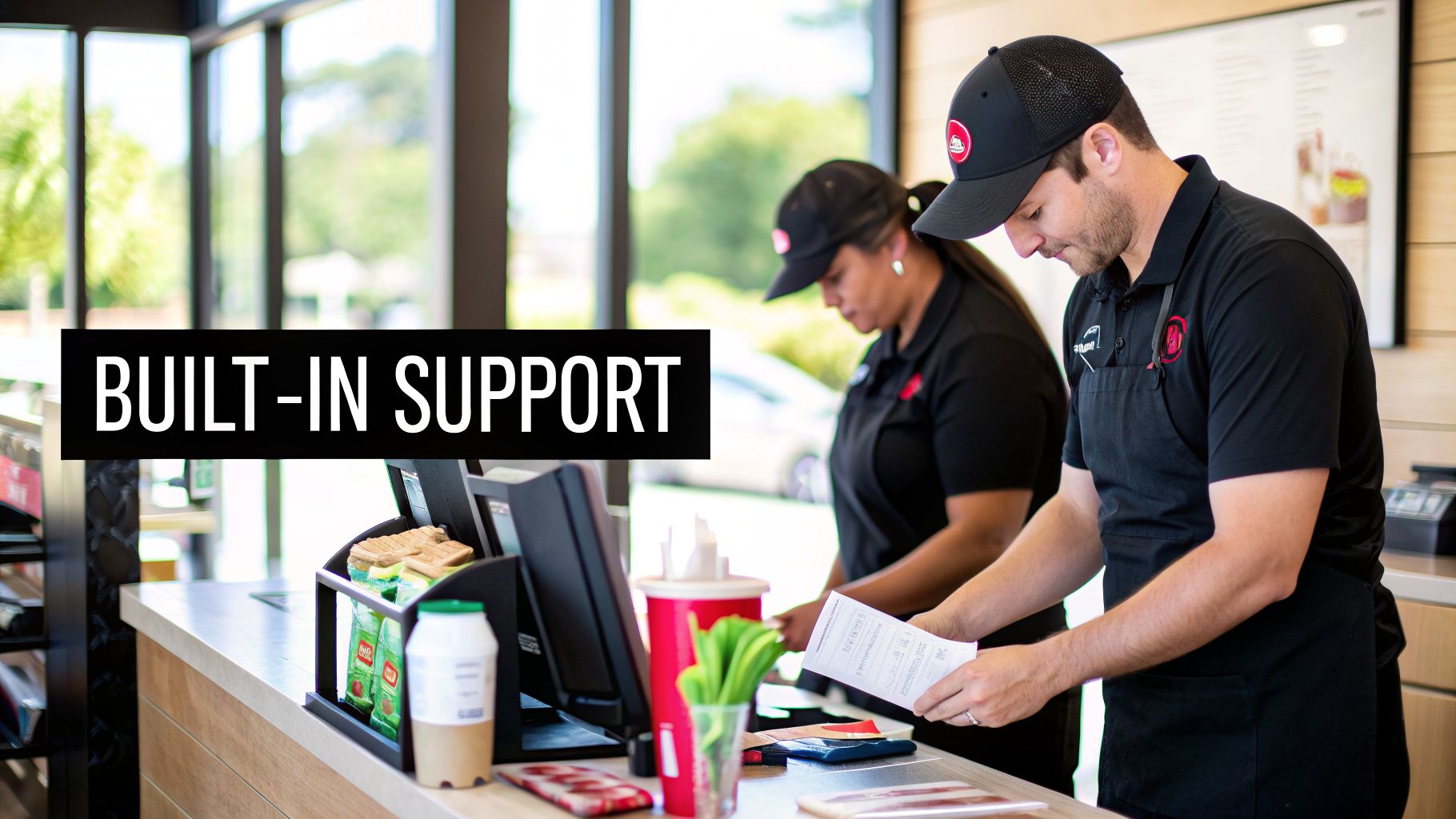
One of the most underrated benefits of franchising is the comprehensive training and ongoing support. Most franchisors provide initial training programs that cover every aspect of the business, getting you and your key staff ready before the doors even open. That support doesn't stop after the grand opening.
For example, most franchisees benefit from:
- National and Regional Marketing: You contribute to a central marketing fund that pays for large-scale advertising campaigns you could never afford alone.
- Ongoing Mentorship: A dedicated field consultant or corporate contact is usually available to help you troubleshoot problems and optimize performance.
- Peer Network: You join a network of fellow franchisees who can offer battle-tested advice and share what's working in their own locations.
This safety net is invaluable, especially for first-time business owners who might not have deep experience in finance, marketing, or HR.
Founder's Tip: When vetting a franchise, ask pointed questions about the support system. More importantly, speak with existing franchisees about the actual quality and responsiveness of the corporate team. A great brand with poor support can be just as risky as going it alone.
Ultimately, these advantages—brand power, a proven system, and continuous support—are what you pay for with your franchise fee and royalties. But these benefits are not guaranteed; they are contractual rights. It is absolutely critical to ensure they are clearly defined and protected in your franchise agreement.
Considering a franchise? Let our experienced business attorneys review your FDD and franchise agreement to ensure your investment is protected. Schedule a consultation with Coto & Waddington today.
The Financial And Operational Drawbacks Of Franchising
While buying a franchise can feel like a shortcut to business ownership, it's crucial to understand what you're giving up. The pros and cons of franchising are a balancing act, and the drawbacks often hit the two things entrepreneurs value most: financial independence and creative control.
These aren't minor details—they're fundamental trade-offs baked into the franchise model. Before you get anywhere near a franchise agreement, you need to weigh these disadvantages with your eyes wide open.
The True Cost Of Entry
The first reality check for many prospective franchisees is the staggering upfront cost. Franchising is rarely a low-cost path to entrepreneurship. Beyond the initial franchise fee, you'll face a cascade of mandatory expenses that can make an independent startup look like a bargain.
Understanding this initial investment is a huge part of evaluating any franchise opportunity. You'll need to figure out how to finance a franchise early on, as these outlays create a high-pressure environment from day one.
These aren't just suggestions; they are non-negotiable costs dictated by the franchisor. They almost always include:
- Initial Franchise Fee: This is the one-time payment you make just for the right to use the brand name and operating system.
- Real Estate and Build-Out: You'll be on the hook for securing a location and building it out to the franchisor’s exact, often expensive, specifications.
- Equipment and Inventory: Franchisors mandate the purchase of specific equipment and initial stock, usually from a list of approved vendors who may not be the cheapest.
- Training and Grand Opening Marketing: You’ll pay for your initial training and will be required to fund a local marketing blitz to launch the business.
This financial structure is one of the biggest cons of franchising. Initial franchise fees can run anywhere from $20,000 to $100,000, but the total investment to get the doors open frequently soars to between $250,000 and $1 million or more. For many business types, that's far more capital than you'd need for a comparable independent venture.
To put this in perspective, here’s how the numbers might stack up for a small retail business.
Franchise Vs Independent Startup Initial Cost Comparison
This table compares the estimated initial and ongoing costs for a hypothetical small retail business as both a franchise and an independent startup to illustrate the financial trade-offs.
| Cost Category | Franchise Model (Estimate) | Independent Startup (Estimate) | Key Consideration |
|---|---|---|---|
| Initial Fee | $35,000 (Franchise Fee) | $500 (LLC Filing) | The franchise fee is pure overhead for brand access; it doesn't buy any physical assets. |
| Build-Out & Real Estate | $150,000 – $300,000 | $50,000 – $150,000 | Franchisors have strict, often costly, design and construction standards you must follow. |
| Equipment & Signage | $75,000 (Mandated vendors) | $40,000 (Sourced competitively) | As an independent, you can shop around for deals or buy used equipment. Franchisees usually can't. |
| Initial Inventory | $50,000 (From approved suppliers) | $30,000 (Sourced freely) | You lose the ability to negotiate with suppliers or find more cost-effective inventory options. |
| Grand Opening Marketing | $15,000 (Mandatory spend) | $5,000 (Discretionary) | Franchisors require a specific marketing spend, whether you think it's effective for your location or not. |
| Total Initial Cost | $325,000 – $475,000+ | $125,500 – $225,500+ | The franchise model requires significantly more upfront capital for a similar-sized business. |
The numbers make it clear: the franchise path demands a much higher initial investment, which translates to greater financial risk from the start.
The Strain Of Ongoing Fees
Your financial obligations don't stop once you're open for business. A franchise agreement locks you into a series of recurring fees that are skimmed directly off your top-line revenue, regardless of whether you're actually making a profit. For many franchisees, this becomes the most challenging part of the business.
Key Takeaway: The royalty fee is based on your gross sales, not your profit. During a slow month where you barely break even, you still owe the franchisor their full percentage, which can easily turn a small profit into a real loss.
These relentless fees typically include:
- Royalty Fees: This is the big one, usually 4% to 12% of your gross monthly sales. On a business generating $1 million in annual revenue, that’s $40,000 to $120,000 a year sent straight to the franchisor.
- Marketing Fees: Expect to pay another 1% to 3% of gross sales into a national advertising fund. You have little to no control over how this money is spent.
- Technology Fees: These are monthly charges for using the franchisor's required software, POS systems, or online booking platforms.
- Forced Upgrades: Many agreements require you to perform major renovations or equipment upgrades every few years to keep your location in line with evolving brand standards. These can cost tens of thousands of dollars out of your pocket.
Loss Of Autonomy And Operational Rigidity
Beyond the cash drain, the most significant operational drawback is the loss of entrepreneurial freedom. The very system that provides a turnkey business model also puts you in a creative straitjacket. You aren't an innovator shaping a business; you're an operator executing someone else's playbook.
This rigidity touches almost every part of your business. You often can't adapt your menu or product list to local tastes. You can't run a unique promotion you know would work in your community without getting corporate approval. Everything from the paint on the walls to the uniforms your employees wear is dictated by the operations manual.
Worse, you are contractually obligated to use specific vendors, even if you find a local supplier who is cheaper, faster, or offers better quality. This lack of control is a major source of frustration for founders who thrive on agility and smart decision-making.
And remember, your business is chained to the brand's reputation. If the franchisor gets caught in a scandal or another franchisee on the other side of the country delivers terrible service, your business can suffer from the fallout. You have all of the risk with none of the control.
Founder's Tip: Before committing, be honest with yourself about your personality. If you have a strong vision and need the freedom to make your own strategic calls, the restrictive nature of a franchise will likely feel suffocating. This is a critical factor in the pros and cons of franchising debate.
Making the right choice means weighing these very real financial and operational constraints against the perceived benefits.
Need help reviewing a Franchise Disclosure Document to understand the true costs? Contact our team at Coto & Waddington for a founder-focused legal review.
Navigating The Complexities Of Franchise Law

While the financial and operational pros and cons get all the attention, it’s the legal framework where your rights and obligations are truly set in stone. A franchise agreement isn't just another contract; it's the binding blueprint for your business relationship, often for a decade or more. Overlooking the fine print here is one of the costliest mistakes a new franchisee can make.
Before you’re even allowed to sign an agreement, federal law requires the franchisor to give you a Franchise Disclosure Document (FDD). This is a massive legal disclosure mandated by the Federal Trade Commission (FTC), designed to provide a transparent look into the franchise system, its finances, and its leadership. You must receive it at least 14 days before you’re asked to sign anything or pay a single dollar.
Decoding The Franchise Disclosure Document
Think of the FDD as the franchise's full story, broken down into 23 required sections called "Items." Every Item is important, but a few give you a direct window into the financial and operational reality you’re about to step into. They reveal the true health of the brand and what you can honestly expect.
Pay close attention to Items 19 and 17. They are incredibly revealing.
- Item 19 Financial Performance Representations: This is where the franchisor has the option to share data on the sales or profits of existing locations. If they provide it, you need to dissect it. Is the data showing gross revenue or actual net profit? Does it reflect the average franchisee or just the top 5%?
- Item 17 Renewal, Termination, And Transfer: This section dictates how your relationship with the brand ends. It outlines your rights (or lack thereof) to renew your agreement, the specific conditions that allow the franchisor to terminate your contract, and what happens if you want to sell your franchise.
Key Insight: A franchisor choosing not to provide an Item 19 isn't an automatic red flag—many don't. But if they do provide financial data, it demands intense scrutiny. You have to understand exactly what those numbers represent and if they're a realistic benchmark for a brand-new franchisee like you.
Common Red Flags In The Franchise Agreement
After the FDD comes the franchise agreement itself. Be warned: this document is almost always drafted to protect the franchisor, not you. Your job, with the help of a franchise attorney, is to identify the clauses that pose the biggest threat to your investment and your future.
Here are a few common red flags we see all the time:
- Overly Broad Non-Compete Clauses: A non-compete is standard, but it must be reasonable. A clause that bars you from working in any similar business across a massive geographic area for a decade after you leave is designed to cripple your ability to earn a living if things don't work out.
- Vague Termination Rights: The agreement needs to spell out the exact, objective reasons you can be terminated. Ambiguous language like "failure to operate in the best interest of the brand" gives the franchisor far too much subjective power to kick you out of the system.
- One-Sided Dispute Resolution: Always check where and how you must resolve disputes. A clause forcing you to travel to the franchisor’s home state for costly arbitration can make it practically impossible to ever defend your rights.
Understanding Florida’s Franchise Legal Landscape
State-specific laws add another layer of complexity. For instance, Florida is a non-registration state. Unlike many other states, this means franchisors aren't required to register or file their FDD with a state agency before they can start selling franchises here.
This reality puts a much greater burden of due diligence squarely on your shoulders. Without that state-level oversight, it becomes absolutely critical to have an experienced attorney analyze the FDD and franchise agreement for fairness, accuracy, and full compliance with federal law. To see the full value a legal professional brings, you can learn more about what a business attorney does in our comprehensive guide.
Founder's Tip: Never, ever treat a franchise agreement as a non-negotiable form. Every clause is in there for a reason, and many can be improved. Even when a franchisor claims their agreement is set in stone, a sharp attorney can often negotiate critical concessions in an addendum, like better terms for your specific territory or lease arrangements.
The legal side of franchising is a minefield of potential pitfalls. Protecting your investment begins and ends with a thorough, professional review of the documents that will govern your business for years to come.
Don't sign a franchise agreement without a full legal review. Contact Coto & Waddington for a consultation to protect your future as a franchisee.
Evaluating Alternatives To The Franchise Model
The rigid rulebook and high price tag of franchising aren't right for everyone. For many founders, the trade-offs tilt heavily toward the “cons,” especially for those who value creative freedom and financial agility.
Thankfully, the franchise model is just one path to owning a business. By comparing it against independent startups, licensing, and other partnerships, you can get a much clearer picture of what truly fits your goals, budget, and tolerance for risk. This isn’t just a business structure choice; it’s about picking the right environment for your specific entrepreneurial style.
Independent Startup The Path Of Total Control
Going it alone as an independent startup is the classic entrepreneurial story. You have absolute creative and operational control. Every single decision—from the business name to the marketing strategy—is yours to make.
This complete autonomy is the main draw for founders with a strong vision who want to build something from the ground up.
But all that freedom comes with a tremendous amount of risk. Key drawbacks include:
- No Brand Recognition: You start with zero market presence. Building customer trust is a massive investment of both time and money.
- Building Systems From Scratch: There is no playbook. You’re responsible for inventing every operational process, from finding suppliers to creating your own training guides.
- Higher Failure Rate: Without a proven model, independent startups face a much higher rate of failure, especially in the first few years of operation.
This path is best for founders with a truly unique business idea, a high tolerance for risk, and the grit to build a brand from nothing. To protect that identity, it's critical to understand how to trademark a business name early in your journey.
Licensing Agreements A Lower-Cost Alternative
A licensing agreement can feel like a middle ground. It's far less rigid than a franchise but offers more structure than a pure startup. In a licensing deal, one company (the licensor) grants another (the licensee) permission to use its intellectual property—like a trademark or patent—for a fee.
Unlike a franchise, a licensing agreement does not come with a comprehensive business system or ongoing support. The licensor's primary concern is that you use their brand correctly, not how you run your day-to-day operations. A t-shirt company licensing a movie logo is a perfect example.
Key Insight: The crucial difference is scope. A franchise sells you an entire business system. A license sells you the right to use a specific piece of intellectual property. This makes licensing a much simpler, lower-cost, and less restrictive arrangement.
Franchising Vs Other Business Models A Strategic Comparison
Deciding between these models requires an honest look at your goals, resources, and how much control you're willing to give up. The table below breaks down the core differences to help you make a more informed choice.
| Growth Model | Upfront Cost | Operational Control | Brand Recognition | Best For |
|---|---|---|---|---|
| Franchising | High | Low (Dictated by franchisor) | Instant & Established | Founders who want a turnkey, proven system and are willing to follow strict rules. |
| Independent Startup | Variable | Total (Full autonomy) | None (Built from scratch) | Visionary founders with a unique idea and high risk tolerance. |
| Licensing | Low-Moderate | High (Outside of IP use) | Varies (Leverages existing IP) | Businesses wanting to use a recognized brand on their own products without buying a full system. |
This isn't a decision to take lightly. Each path comes with its own set of legal and financial trade-offs that can define the future of your business.
Founder’s Tip: Don’t confuse licensing with franchising. A franchise relationship is heavily regulated by federal and state law, involving extensive training and support. A licensing deal is a much simpler contract focused solely on the use of intellectual property, leaving you to manage the rest of your business on your own.
Choosing the right path requires a frank assessment of what you truly want. If you desire a proven roadmap and are comfortable executing a pre-defined strategy, franchising is a powerful option. If your primary goal is to innovate and maintain full control over your creation, an independent startup is the only way. If you simply want to leverage an existing brand to boost your own product, a licensing agreement is likely the most efficient route.
Unsure which business model best fits your goals? Our team helps founders navigate these critical decisions. Schedule a consultation with Coto & Waddington to discuss your legal strategy.
Your Decision Checklist And Next Steps
So, you’ve weighed the pros and cons. Now it’s time to move from analysis to action. Deciding whether to buy a franchise isn’t about finding a "perfect" opportunity—it’s about finding the right fit for your capital, your tolerance for risk, and the life you want to build.
This process starts with a clear-eyed assessment of your own goals and limitations. Before you ever look at a single Franchise Disclosure Document (FDD), you need to get brutally honest with yourself.
Key Questions To Ask Yourself
Your answers to these questions will become your filter, immediately ruling out franchises that don't align with what you actually want to achieve.
- Financial Readiness: Have I honestly calculated my total liquid capital? Am I truly prepared for both the high initial investment and the relentless drain of ongoing royalty payments?
- Tolerance for Rules: Am I someone who thrives with a proven playbook, or will I resent being told exactly how to run my business by a franchisor with strict operational mandates?
- Long-Term Goals: Do I see myself as a hands-on operator of a single location, or is my ambition to build a multi-unit empire? Critically, does this franchise model even allow for that kind of growth?
- Market Viability: Have I done the local research to confirm people in my community will actually pay for this brand’s products or services? Is there genuine demand here?
This decision tree helps visualize how your core goals—whether it's gaining brand access, maintaining full control, or something in between—should point you toward a specific business model.

As the chart shows, if your primary objective is to plug into an established brand and its proven systems, franchising is the most logical path forward.
Your Next Steps For Due Diligence
If you’ve determined that franchising is the right move, it's time to begin a methodical, professional due diligence process. Don’t skip a single step.
Founder's Tip: The most valuable intel you will get won't come from the franchisor's sales team. It will come from the people already in the trenches. Make it a priority to speak with at least five current franchisees—and if you can find them, a few former ones—to get the unfiltered truth about profitability, support, and the corporate culture.
Follow this checklist to move forward with confidence:
- Research Franchisors: Start identifying brands that fit your industry focus and budget. Request their FDDs, as this is the foundational document for your entire review.
- Speak with Franchisees: Use Item 20 of the FDD to contact current owners. Ask them bluntly about their real-world numbers, their relationship with the corporate office, and whether they’d do it all again.
- Analyze Local Marketing Needs: Success doesn’t happen in a vacuum. You need to understand how you’ll attract local customers. For example, learning how to master local SEO for franchises can make or break your first year's revenue.
- Engage Legal Counsel: This is non-negotiable. Partner with an experienced business attorney to conduct a deep-dive review of the FDD and the final franchise agreement. This step is your single best defense against a bad investment.
Making a smart decision requires blending personal introspection with a rigorous, professionally-led investigation.
Ready to take the next step? Contact Coto & Waddington for an expert legal review of your franchise documents to ensure you're making a sound investment.
Frequently Asked Questions About Franchising
Founders considering a franchise often face the same handful of high-stakes questions. Getting clear, practical answers is non-negotiable before you sign any agreement or invest a single dollar.
Here are our answers to the critical points every prospective franchisee must confront.
What Is The Most Common Reason A Franchise Fails?
In our experience, franchise failure almost always comes down to a fundamental gap between the founder’s expectations and the on-the-ground reality of running the business. This often starts with undercapitalization—entrepreneurs simply run out of cash before the location becomes profitable.
Another major cause is an inability or unwillingness to follow the franchisor’s rigid system. Many entrepreneurs chafe under the strict rules. Finally, we see failures rooted in poor due diligence, especially when a founder fails to speak with enough current and former franchisees to get an unfiltered view of the operation.
Can I Negotiate The Terms Of A Franchise Agreement?
While the core of the deal—the business model, brand standards, and royalty fees—is almost always non-negotiable, other terms can be. Franchisors need to maintain uniformity across their system, but an experienced franchise attorney can spot areas for improvement specific to your situation.
A Note For Founders: We advise clients to focus negotiation efforts on a few key areas. This might include sharpening the definition of your protected territory, securing specific lease addendums, or achieving more favorable terms for renewal or transfer rights down the road.
How Much Working Capital Do I Really Need?
This is the question where so many new owners get into serious trouble. The Franchise Disclosure Document (FDD) will detail the initial franchise fee and build-out costs, but that’s just the start. You must have 6 to 12 months of operating expenses in the bank as working capital.
This is your lifeline. It covers payroll, rent, inventory, loan payments, and your own living expenses until the business can generate enough cash flow to support itself. Underestimating this figure is one of the fastest ways to put your new franchise in jeopardy.
Making the right decision on a franchise requires deep legal and financial analysis. The team at Coto & Waddington helps founders review franchise agreements and navigate the legal complexities to protect their investments. Ready to ensure you're making a sound choice? Schedule your consultation.