
To properly trademark a business name, you need to run a clearance search to confirm it's available, file an application with the U.S. Patent and Trademark Office (USPTO), and make it through the entire examination process. Once you do, you gain nationwide legal ownership and the exclusive right to use that name for your specific goods or services.
Why Trademarking Your Name Is a Critical Business Move

So many founders think that registering an LLC or filing a DBA in Florida is all they need to lock down their brand. This is one of the most common and costly mistakes I see. While those steps are essential for operating legally, they give you almost no real protection for your brand name beyond state lines.
A federal trademark, on the other hand, elevates your name from just an identifier to a valuable, legally defensible asset. It establishes presumptive nationwide ownership, a serious advantage in a crowded market.
A Tale of Two Startups
Picture this: you launch "Artisan Wave," a Miami-based e-commerce shop selling handcrafted jewelry. You’ve built a solid local following and are starting to see real traction online. Then, a few months later, a company in Seattle pops up selling similar products under the name "Artisan Waves."
If you don't have a federal trademark, your options are limited and incredibly expensive. You’d have to try and prove you established your brand in their market first, which is a tough legal fight to win.
Key Takeaway: Now, imagine the same scenario but you have a registered trademark for "Artisan Wave." Everything changes. Your federal registration is public notice that you own the name. A simple cease and desist letter, with the weight of your trademark behind it, is usually enough to make the Seattle company rebrand, protecting your market and stopping customer confusion in its tracks.
This one proactive step is what separates a business owner from a true brand builder.
Seizing Your Competitive Edge
Securing your brand is more urgent than ever. The practical reality is that global trademark offices are swamped. As of early 2025, the USPTO has a backlog of over half a million pending applications. This pushes the initial review time to an average of 6–7 months.
For South Florida entrepreneurs, those delays mean getting your application in the queue now is the only way to get ahead of the competition. Find out more about the current trademark landscape and why speed is so critical.
To get that edge, you have to think like a brand owner from day one. It’s a shift in mindset:
- Your name is an asset: It’s not just a name; it’s an investment that builds goodwill and real value over time. Protect it just like you would your inventory or equipment.
- Think nationally, act locally: Even if you’re starting small, choose a name that can grow with you across the country without triggering legal battles later.
- Prioritize protection early: The cost of trademarking is a tiny fraction of what you’d spend on rebranding or, worse, litigation.
Learning how to trademark a business name is about building a legal shield around your company's most important asset: its reputation. For Florida startups, understanding these nuances is the first real step toward building a brand that lasts. You can learn more about specific trademark and brand protection strategies for Florida startups in our 2025 legal guide.
Don't wait for a competitor to force you into a corner. The best time to secure your brand was yesterday. The next best time is right now.
Tip: Start by picking a distinctive name. Generic or descriptive names like "Miami Jewelry Store" are much harder—and sometimes flat-out impossible—to trademark.
Ready to take the next step in protecting your business? Contact us to discuss how we can help secure your brand's future.
Conducting a Comprehensive Trademark Clearance Search
Before you spend a single dollar on an application, you have to do your homework. A thorough trademark clearance search is the most important pre-filing step you can take. It’s a background check for your brand, designed to gauge the risk of rejection or, even worse, a lawsuit for infringing on someone else's rights.
A quick Google search won't cut it. You have to dig much deeper to see if another business is already using a similar name for related products or services. The legal standard isn't about finding an identical match—it's about the likelihood of confusion. If a consumer might mistake your brand for another, you have a problem.
The Knockout Search at the USPTO
Your first stop is always the U.S. Patent and Trademark Office's own database. The goal here is a “knockout search” to find any obvious conflicts that would immediately disqualify your name. You'll use the Trademark Electronic Search System (TESS) to check for all registered and pending trademarks.
This is your primary tool for spotting direct conflicts before you waste time and money on a doomed application.
But don’t just search for your exact name. The USPTO examiner will look for anything that looks similar, sounds similar, or has a similar meaning.
- Phonetic Equivalents: If you’re thinking of "Kwik Fix," you absolutely need to search for "Quick Fix."
- Spelling Variations: For a name like "BluWave," you must also look for "Blue Wave."
- Synonyms and Translations: Want to trademark "Luna"? You'd better check for "Moon," too.
Tip: Get comfortable with wildcards in your TESS search. Searching for "Sun*" will pull results like "Sunlight," "Sunny," and "Sunshine." This casts a wider net and helps you uncover potential conflicts that a more narrow search would miss.
Expanding Your Search Beyond Federal Records
Getting a clean result on the federal search is a great start, but it’s not the end of the road. Trademark rights can be established simply through use in commerce, even without a federal registration. This is where state and common law searches come in.
State-Level Searches
A business operating only within a single state might just register its trademark there. For us here in Florida, that means checking the Florida Division of Corporations' Sunbiz portal. Every state has a similar database for registered business names and state-level trademarks.
Common Law Searches
Now you have to put on your detective hat. Common law rights are built by simply using a name in the marketplace. You’re looking for unregistered businesses using a name that could cause a conflict. Good places to dig around include:
- Search Engines: Go deep. Look past the first page of Google, Bing, and DuckDuckGo.
- Social Media: Check usernames, handles, and page names on Instagram, Facebook, LinkedIn, TikTok, and X (formerly Twitter).
- Domain Names: Use a domain registrar to see if web addresses similar to yours are already taken and, more importantly, actively being used.
A complete search paints a clear picture of the competitive landscape. To keep everything organized, a checklist is your best friend. The table below breaks down the key areas to cover.
Trademark Clearance Search Checklist
A structured approach is the only way to ensure you don't miss a critical conflict. Use this checklist as your guide to cover all the essential bases during your search.
| Search Type | Where to Look | What You're Looking For |
|---|---|---|
| Federal "Knockout" | USPTO TESS Database | Registered and pending trademarks that are identical, similar-sounding, or have a similar meaning. |
| State-Level | State Secretary of State or Division of Corporations (e.g., Florida's Sunbiz) | Registered business names, LLCs, corporations, and state-level trademarks. |
| Common Law | Google, Bing, DuckDuckGo (deep search) | Unregistered businesses actively using a similar name for related goods or services. |
| Social Media | Instagram, Facebook, LinkedIn, TikTok, X | Handles, usernames, and page names that are in use and could create consumer confusion. |
| Domain Names | Domain Registrars (e.g., GoDaddy, Namecheap) | URLs that are not just parked but are attached to an active website in a similar industry. |
After running through these steps, you'll have a much stronger sense of whether your name is truly available. For a complete walkthrough of this process, our Florida Trademark Playbook offers an in-depth guide from clearance to enforcement.
Is a DIY Search Enough?
Doing these initial searches yourself is a smart, cost-effective first step. It's great for weeding out names with obvious, show-stopping conflicts.
However, a professional search conducted by a trademark attorney goes much, much deeper. We use specialized software and, more importantly, bring years of experience analyzing results in the context of complex trademark law. An attorney can interpret whether a similar name in a related industry truly poses a risk of "likelihood of confusion"—a nuanced judgment call that software can't make.
Deciding to trademark a name is a serious investment in your brand's future. A proper clearance search is your best insurance against a costly rejection or a future legal battle.
Tip: If your DIY search reveals even a single potential conflict, stop and consult an attorney. It's far cheaper to get an expert opinion now than to face an infringement lawsuit later.
If your own searches raise any red flags, or if you operate in a crowded industry, investing in a professional opinion is always a wise move. Don't leave your brand's foundation to chance. Contact us for a comprehensive trademark clearance search today.
Filing Your Application with the USPTO
After your clearance search gives you the all-clear, it’s time for the main event: filing your application with the United States Patent and Trademark Office (USPTO). This is the formal step where you ask the federal government to grant you exclusive, nationwide rights to your business name. The process is detailed, but if you break it down, it's far less intimidating than it sounds.
The whole thing happens online through the USPTO's Trademark Electronic Application System (TEAS). This portal guides you through every required piece of information, from your contact details to paying the government filing fees.
Defining Your Goods and Services
This is easily one of the most critical steps. You have to clearly identify the goods and services your trademark will cover. This isn't just a simple description; it defines the entire legal scope of your protection. A registration is only as strong as the "identification of goods and services" it's built on.
To make things smoother, the USPTO provides a pre-approved list called the Trademark ID Manual. I always recommend clients stick to the descriptions in this manual—it helps streamline the examination process and avoid unnecessary pushback from the examiner.
- Be Specific: Instead of a vague term like "clothing," you’d get granular: "T-shirts, hoodies, and hats."
- Be Accurate: Only list goods or services you are actually providing right now or have a genuine, documented plan to offer soon. Overreaching here can put your entire application at risk.
Getting this right is fundamental. The classes you select and the descriptions you provide draw the legal fences around your brand.
Are You "In-Use" or "Intent-to-Use"?
You'll need to decide on the filing basis for your application. There are two main paths, and the one you choose depends entirely on where your business stands today.
- Use-in-Commerce: You file under this basis if you are already selling goods or services across state lines using the business name. This is the most direct route to getting registered.
- Intent-to-Use (ITU): This is for businesses that have a real, bona fide intent to use the name soon but haven't launched yet. An ITU application is a fantastic tool. It lets you reserve your spot in line while you're still finalizing product development or marketing strategies.
If you go the ITU route, just remember your mark won’t officially register until you actually start using it in commerce and submit proof to the USPTO by filing a "Statement of Use."
This infographic shows why the search process we discussed earlier is so foundational. It has to happen before you even think about filing.
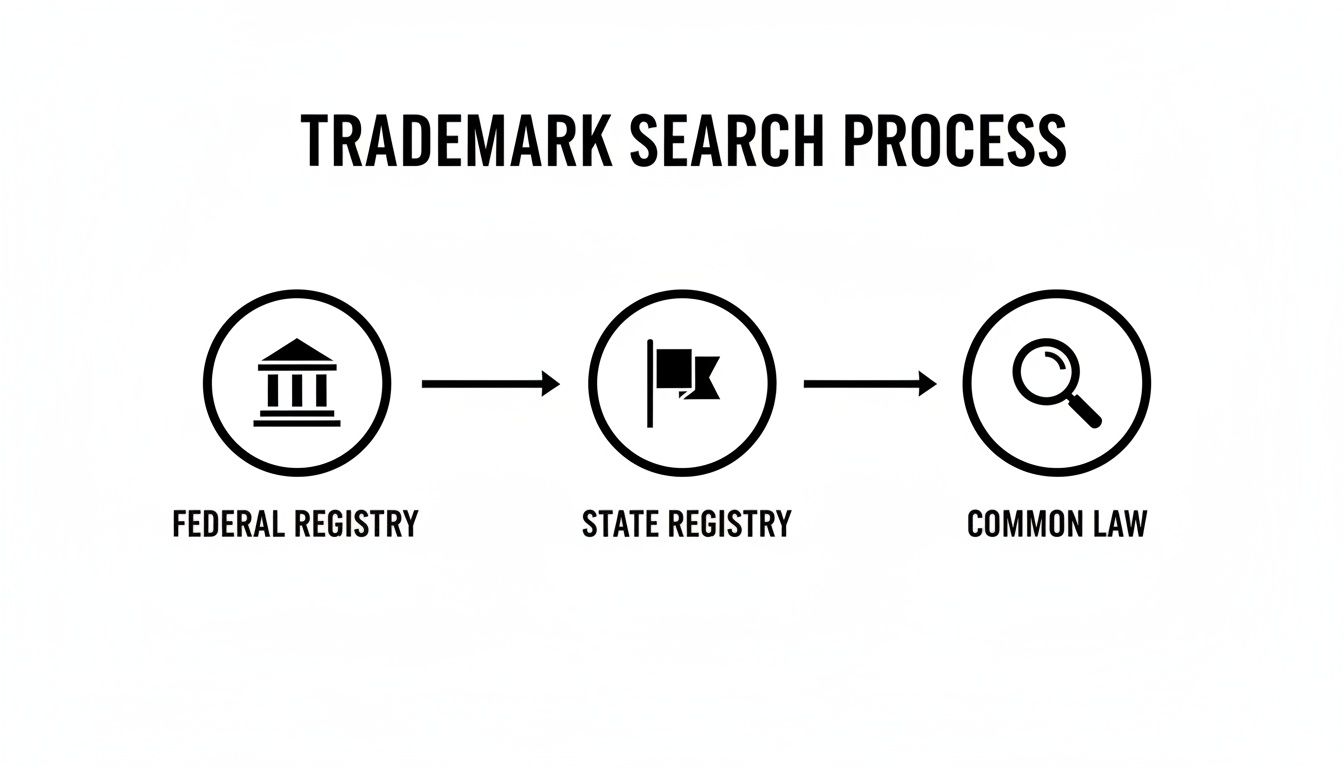
As you can see, checking the federal database is just one layer of the investigation needed to make sure your name is truly clear for use.
Submitting a Proper "Specimen" of Use
For any "in-use" application, you have to provide concrete proof that you're using the name out in the wild. The USPTO calls this proof a specimen. The right kind of specimen depends on whether you're selling a product or a service.
- For Goods: A photo of your product with the trademark clearly visible on the item or its packaging is the gold standard. A screenshot from your e-commerce site also works well, as long as it shows the name right next to a picture of the product and has a functional "add to cart" button.
- For Services: A screenshot of your website advertising the services under the name is perfect. Marketing materials like brochures are also acceptable if they show that direct connection between the name and the service being offered.
Key Takeaway: The specimen has to show your trademark being used to actually sell something. A logo on a business card or company letterhead usually won't cut it for services, because it just identifies the business—it doesn't show the mark being used in the act of offering or selling those services.
Filing quickly is especially vital in fast-moving industries. For example, the research and technology sector pulls in the largest share of non-resident trademark applications globally, at 19.3%. Filings for new tech like NFTs and virtual goods literally doubled between 2021 and 2022. For tech founders here in South Florida, that trend sends a clear message: you have to move fast to protect your IP. You can discover more insights about these global IP filing trends and what they mean for your business.
Tip: Check everything twice. Simple typos in your name or address can create major delays. If you write your own description of goods/services instead of using the pre-approved list, you're almost guaranteed to get an Office Action from the examiner asking for clarification.
Navigating the USPTO application demands real attention to detail, but it's a logical, step-by-step process. If you take the time to get each piece right upfront, you'll save yourself from frustrating delays and potential rejections later on.
If you’re ready to file but want an expert to handle the details, our team can manage the entire application for you. Contact us today to get started.
What to Expect After You File Your Application
You’ve navigated the clearance search, perfected your application, and officially hit "submit" on the USPTO website. Congratulations—that’s a huge step. But learning how to trademark a business name also means understanding what comes next, which is often a long waiting game.
The period after filing is where many founders get anxious. The silence from the USPTO isn't a bad sign; it's just part of a methodical, often lengthy, review process. Setting realistic expectations for this timeline is key to managing the journey without unnecessary stress.
The Trademark Examination Timeline
Once your application is in the queue, it's assigned to a USPTO examining attorney. This is where the real scrutiny begins. The examiner's job is to ensure your application complies with all federal laws and that your proposed name doesn't create a "likelihood of confusion" with any existing registered trademarks.
Due to significant backlogs, you can typically expect to wait several months for this initial review.
Tip: Be patient but proactive. Don't just file and forget. You should regularly check your application’s status using the Trademark Status and Document Retrieval (TSDR) system on the USPTO website. This is your official window into the process.
After the examiner’s review, one of two things will happen: your application will be approved for publication, or you'll receive an Office Action.
Demystifying the USPTO Office Action
Receiving an official-looking letter from the USPTO titled "Office Action" can be alarming, but it's not a final rejection. Think of it as a request for more information or a chance to fix an issue. In fact, they are quite common.
Office Actions fall into two main categories:
- Procedural Issues: These are often minor and relatively easy to fix. Common examples include needing a clearer description of your goods/services or submitting a better specimen of use.
- Substantive Refusals: These are more serious. A substantive refusal means the examiner believes your mark legally cannot be registered, often due to a likelihood of confusion with another mark or because your name is merely descriptive.
Responding to a substantive refusal requires a well-crafted legal argument. This is where many DIY filers run into trouble, as it demands a deep understanding of trademark case law. For a detailed breakdown of potential expenses during this process, explore our guide on the cost to file a trademark for a startup in Florida.
Analyzing and Responding to an Office Action
Let's walk through a real-world scenario. Imagine you filed for the name "Sweet Bloom" for your online flower delivery service. The examiner issues an Office Action citing a likelihood of confusion with a registered mark, "Sweet Blossom," which is used for a chain of brick-and-mortar floral shops.
A strong response would involve building a legal argument showing why consumers wouldn't be confused. You could argue:
- Different Channels of Trade: Your service is exclusively online, while theirs is entirely in-person.
- Different Connotations: The words "Bloom" and "Blossom," while related, have distinct visual and conceptual differences in marketing.
- No Evidence of Actual Confusion: Point out that both businesses have coexisted without any documented instances of customers mixing them up.
This kind of strategic response is your opportunity to advocate for your mark and push the application forward.
From Publication to Registration
If the examiner approves your application (either initially or after you've successfully responded to an Office Action), your mark gets "published for opposition." This opens a 30-day window for any party who believes they would be harmed by your registration to object.
If no one opposes your mark during this period, you’re in the home stretch. The USPTO will issue your official Certificate of Registration, and your business name will finally have the full protection of a federal trademark.
This entire process, from filing to registration, can easily take a year or more, especially if you encounter an Office Action. Understanding this timeline from the start helps you plan accordingly and stay focused on building your brand.
Pro Tip: Mark your calendar with the response deadline for any Office Action you receive—it's typically six months. Missing this deadline will cause your application to be abandoned, forcing you to start all over.
Navigating the post-filing stage requires diligence. If you've received an Office Action and are unsure how to proceed, don't guess. Contact us today for a professional review of your case and a strategy for your response.
Maintaining and Enforcing Your Trademark Rights

Successfully registering your business name is a huge win, but it’s the beginning of a new responsibility, not the finish line. A trademark certificate isn't a "set it and forget it" asset. To keep your rights strong and enforceable, you have to actively use, maintain, and police your mark.
Think of it like owning a property. You wouldn't just buy a house and never check on it again. You have to maintain it to preserve its value, and the exact same principle applies to your intellectual property.
Keeping Your Trademark Alive with the USPTO
The USPTO requires you to periodically file proof that you are still using your trademark in commerce. These maintenance filings are non-negotiable. If you miss a deadline, your registration will be canceled, and you'll have to start the entire application process from scratch.
The most critical filing is the Declaration of Use (Section 8), which must be filed between the fifth and sixth years after your registration date. You'll need to submit this declaration again between the ninth and tenth years, and then every ten years after that.
Key Takeaway: The "use it or lose it" principle is fundamental to trademark law. If you stop using your name in commerce for an extended period (typically three years), your mark can be legally considered abandoned, making it vulnerable to cancellation.
Actively Policing Your Brand in the Marketplace
Beyond government filings, the real work lies in enforcement. It's on you—the trademark owner—to monitor the market and stop others from using a confusingly similar name. The USPTO does not police infringement for you.
Proactive monitoring is your first line of defense. Here are some actionable tips to get started:
- Set Up Google Alerts: Create alerts for your business name and any common variations. This is a simple, free way to get notified when your name appears online.
- Periodically Search Online: Regularly search social media platforms, domain registries, and app stores for your name. Look for anyone operating in a similar space that could cause customer confusion.
- Monitor Industry Publications: Keep an eye on trade magazines and websites in your field to spot new competitors who might be encroaching on your brand.
This constant vigilance is more important than ever. The trademark landscape is intensely competitive, with an estimated 11.7 million applications filed globally in 2024. The United States alone saw 836,457 application classes filed, making it crucial for South Florida businesses to be proactive.
This data highlights why securing and actively defending your trademark is so vital—the marketplace is only getting more crowded. You can discover more insights about these global trademark trends and what they mean for your strategy.
Taking Action Against Infringement
When you find someone using a similar mark, your first move is usually to send a cease and desist letter. This formal letter, typically drafted by an attorney, notifies the infringing party of your trademark rights and demands that they stop using the conflicting name.
In most cases, a well-written cease and desist letter is enough to resolve the issue without needing to go to court. It puts the other party on notice and shows you’re serious about protecting your brand.
Tip: Always use the ® symbol next to your name once it's officially registered. For pending applications, use the ™ symbol. This signals to everyone that you claim rights to the name and are serious about protecting it.
Protecting your trademark is an ongoing commitment. It requires organization to meet filing deadlines and diligence to monitor the marketplace. For many founders, this is where partnering with a firm that specializes in brand protection becomes a smart investment.
Ready to ensure your trademark remains a strong, valuable asset? Contact us today to discuss a strategy for maintaining and enforcing your brand rights.
Founder FAQs: Trademarking Your Business Name
As you dive into the trademark process, the same practical questions always seem to pop up. Here are the most common ones we hear from founders, with straightforward answers to help you protect your brand smartly.
How Much Does It Really Cost to Trademark a Name?
This is usually the first question on a founder's mind, and the answer has two parts: what you pay the government and what you pay for legal help. It’s tempting to try the DIY route to save a few bucks, but a single mistake can get your application tossed out, forcing you to pay the government fees all over again with no refund.
USPTO Filing Fees: These are non-refundable and run between $250 to $350 per class of goods or services. So, if you’re selling branded t-shirts (Class 25) and offering graphic design services (Class 42), you’re paying for two separate classes.
Legal Fees: Bringing in a law firm gives you professional guidance and a strategic partner. Many firms, including ours, offer flat-fee packages for trademark work, so you know exactly what you’re spending. This investment covers a deep-dive search, a correctly filed application, and a strategy to significantly boost your odds of success.
Think of legal help not as a cost but as an insurance policy. The price of a properly filed trademark is a tiny fraction of what it costs to rebrand your entire company or fight a legal battle you could have avoided.
Tip: When budgeting, always account for potential Office Action responses or maintenance filings. The initial application fee is just the first step in the financial journey of owning a trademark.
Can I Trademark a Name That Is Already in Use?
The classic lawyer answer: it depends. Trademark rights in the U.S. are a complex dance between who was "first to use" a name and who was "first to file" a federal application. The two most important factors are geography and the specific goods or services you’re offering.
For example, if "Sunrise Bagels" is a single-location bakery in Boston, and you want to launch "Sunrise Software Solutions" from your office in Miami, you can almost certainly register the name. The entirely different services and separate markets make it almost impossible for a consumer to get confused.
The Legal Standard: It all comes down to the "likelihood of confusion." If another business is using a similar name for completely unrelated services in a different part of the country, you might be in the clear. But this is a very nuanced legal call that needs a professional assessment to make sure you aren't stepping on their common law rights.
What Happens If My Trademark Application Is Rejected?
Getting a rejection from the USPTO, known as an Office Action, feels like a huge blow, but it's often not the end of the road. The first step is to figure out if it's a non-final or a final refusal.
A non-final refusal is an invitation to argue your case. The USPTO examiner will explain the problem—maybe your name is too descriptive, or they think it conflicts with another mark—and you have six months to submit a legal argument to change their mind. Plenty of applications that get an initial "no" are eventually approved after a strong, well-reasoned response.
If that response doesn't work, the examiner will issue a final refusal. Your options get narrower here, but you're not out of moves yet:
- File an Appeal: You can take your case to the Trademark Trial and Appeal Board (TTAB), which is essentially a court inside the USPTO.
- Rebrand: For some founders, the most practical choice is to cut their losses, pick a more distinctive name, and start the process over with a stronger mark.
Tip: If you get an Office Action of any kind, call a trademark attorney. Right away. An experienced lawyer can size up the rejection, tell you if it's beatable, and craft the kind of legal argument that gives you the best possible shot at saving your application.
Do I Really Need a Lawyer to Trademark My Business Name?
Legally, no, you don't. You're allowed to file a trademark application yourself. But the process is a minefield of legal nuances and procedural traps that are incredibly easy for a non-lawyer to fall into. One small mistake can cause major delays or a flat-out rejection.
An attorney brings real value to every single step:
- Professional Clearance Search: They go way deeper than a simple Google search, running a comprehensive analysis to give you a clear assessment of your risks.
- Strategic Application: They know how to accurately define your goods and services to give you the broadest protection while minimizing the odds of a refusal.
- Office Action Response: This is where an attorney is an absolute game-changer. They can analyze the legal reasons for the rejection and write a persuasive response built on trademark law and past cases.
Ultimately, hiring a lawyer is about managing risk. It’s an investment in making sure one of your company's most valuable assets—your brand name—is locked down and protected from day one.
Tip: Ask any potential attorney if they offer flat-fee packages. This provides cost certainty and helps you budget for this crucial investment without worrying about surprise hourly bills.
Protecting your brand is one of the most important moves you can make for your business. At Coto & Waddington, Attorneys at Law, we bring the founder-minded strategy and legal expertise needed to secure your trademark and defend your assets.
Ready to secure your brand? Visit us at https://cotowaddington.com to get started.


