A founder in Miami hires a sales lead, hands over the customer pipeline, pricing strategy, and product roadmap, then watches that employee join a competitor after leaving. The founder opens a downloaded non-compete agreement template and finds a nationwide restriction, a vague definition of “competing business,” and no answer for what happens if the employee works remotely from another state.
That document may look protective. It may also be too broad for the role, mismatched to the worker's jurisdiction, or missing the payment and notice mechanics that affect practical enforceability. A useful non-compete agreement template is not a form to sign unchanged. It's a drafting system that connects the business interest, the worker's actual access, the restricted conduct, and the law governing the relationship.
Table of Contents
- Why Florida Founders Reach for a Non Compete Agreement Template
- Anatomy of a Non Compete Agreement Template You Can Trust
- Customizing the Template for a Florida Startup Step by Step
- Enforceability Under Florida Law and the 2026 Patchwork
- Smarter Alternatives When a Non Compete Will Not Hold Up
- Negotiation Tips Before You Sign the Template
- Final Checklist and When to Hire a Florida Business Attorney
Why Florida Founders Reach for a Non Compete Agreement Template
A former sales lead can take relationships, pricing knowledge, and account history without taking a single physical file. A former engineer can remember product architecture without copying source code. That's why founders often reach for a non-compete before they've identified the specific risk they're trying to control.
The better question isn't merely whether Florida permits non-competes. It's whether the particular clause is narrow enough to address a legitimate business interest without preventing ordinary competition. A form that bars an employee from working “in any capacity” for a competitor usually creates more risk than protection. A clause tied to defined customers, products, services, or confidential information gives a court something concrete to evaluate.
The issue matters beyond one startup. The Federal Reserve Bank of Minneapolis reported that about one in nine adult workers had a non-compete in 2022, while FTC-related estimates placed coverage at roughly 30 million U.S. workers, or about 20% of the workforce. Those figures show why courts, regulators, and employee lawyers scrutinize boilerplate. A business may be using a familiar clause, but familiarity doesn't make the clause valid.
Why a downloaded form falls short
A generic form commonly fails in four places:
- Role mismatch: It applies executive-level restrictions to a junior employee who has no access to sensitive strategy.
- Scope mismatch: It covers an entire state or industry even though the company serves a narrower customer base.
- Jurisdiction mismatch: It ignores the worker's residence, work location, and state salary rules.
- Exit mismatch: It says nothing about termination without cause, severance, garden leave, or written notice.
Florida founders also need a separate trade-secret strategy. A practical trade secret protection framework should work alongside, rather than hide behind, a restrictive covenant.
This guide focuses on the working document: the clauses worth keeping, the provisions courts commonly narrow, the state-specific checks needed in 2026, and the alternatives that may protect the business more effectively. Before signature, replace every bracketed field, confirm the worker's jurisdiction and compensation, and have counsel review any multi-state or high-risk arrangement.
Anatomy of a Non Compete Agreement Template You Can Trust
A reliable template follows the business logic of the relationship. It starts with who is signing, identifies what the company is protecting, and only then describes the restraint.
Put the facts before the restriction
Parties and relationship. Name the legal employer, the worker, the role, and the effective date. Identify whether the person is an employee, independent contractor, founder, executive, or seller in a business transaction. The FTC's 2024 final rule treated the definition of “worker” broadly, covering employees, independent contractors, externs, interns, volunteers, apprentices, and sole proprietors who provide services, so the template shouldn't assume that only payroll employees matter. The Congressional Research Service summary of the FTC rule explains the rule's broad coverage and limited sale-of-business exception.
Protectable-interest recital. State the actual interest, such as customer relationships, confidential pricing, trade secrets, or a narrowly defined product strategy. Don't write that every company asset is confidential. The recital should match the information the worker can access and the harm the company reasonably fears.
Definitions. Define “confidential information,” “competitive business,” “restricted activities,” “customer,” and “territory.” Avoid circular language. If “competing business” means every company offering software, the definition may sweep far beyond the startup's actual market.
Draft the restraint with precision
Restricted activities. Describe the work the person can't perform, not every job at every competitor. A sales lead might be restricted from soliciting named customer accounts for a defined product line. That's more defensible than barring the person from serving as a receptionist, consultant, or investor for an entire industry.
Geography and duration. Connect geography to the company's real customer footprint. Remote work makes a county-based restriction harder to justify when customers are distributed online. Duration should be tied to how long the information remains competitively valuable, not copied from another contract.
Consideration and exit triggers. State what the worker receives in exchange for signing, and specify whether continued employment, a promotion, equity, a bonus, severance, or garden leave supplies consideration. If termination without cause triggers payment, write the amount or formula clearly and state when payment stops.
Severability and blue-pencil language. Include a provision addressing whether an invalid restriction can be narrowed or removed. Courts differ in whether they partially enforce, rewrite, or void an overbroad covenant, so the clause shouldn't promise an outcome the governing law won't permit.
Written notice. Add a notice block identifying who must receive notice, the permitted delivery methods, and the deadline. Notices to affected workers were a central compliance feature of the FTC's 2024 rule, which stated that employers would need to inform workers when existing non-competes would not be enforced.
The following table makes the salary and duration checks concrete. “Typical max duration” is a drafting reference, not a universal safe harbor.
| State | Salary Threshold (2026) | Typical Max Duration | Senior-Executive Carve-Out |
|---|---|---|---|
| Florida | No threshold stated here | Durations over two years face a rebuttable presumption of unreasonableness under Florida law | Analyze separately |
| Illinois | $75,000 for non-competes, $45,000 for non-solicits | Tailor to the interest | Apply the statute and facts |
| Colorado | $130,014 for non-competes, $78,008.40 for customer non-solicits | Tailor to the interest | Limited, fact-dependent |
| Washington | Above $120,559.99 reported for 2026 employee earnings | Keep the term narrow | State-specific analysis required |
For a broader review of how terms operate inside a contract, founders can consult this guide to contract clauses, then have counsel adapt the form to the governing jurisdiction.
Customizing the Template for a Florida Startup Step by Step
Treat customization as an approval workflow, not a fill-in-the-blanks task. Every restriction should answer three questions: what is the company protecting, what did this worker access, and where could the worker realistically cause competitive harm?
Start with the worker and the interest
First, identify the worker's classification and work locations. A Miami-based SaaS company hiring a remote sales lead in Texas should not select “Florida” merely because the founder works in Florida. Record the employee's home state, assigned office, customer territory, and expected travel pattern.
Next, document the interest. For a Brickell creative agency, the concern may be a client list, campaign pricing, or pending pitches. For a product startup, it may be source code, unreleased features, or technical methods. If the employee doesn't receive sensitive information, a non-compete may be difficult to justify even if the employee has a senior title.
Set the geographic scope by looking at the company's actual market. A local agency serving South Florida clients needs a different analysis from a SaaS company selling nationally. Don't use “anywhere in the world” because the company has a website. Tie the territory to customers, accounts, products, or services the employee handled.
Add the economic and exit checks
Before signature, run an income check and a jurisdiction selector. Illinois requires earnings above $75,000 for an enforceable non-compete and uses a lower $45,000 threshold for non-solicitation agreements, with the non-compete floor remaining $75,000 in 2026, according to the Illinois non-compete threshold guidance. Colorado reports a $130,014 2026 threshold for non-competes and $78,008.40 for customer non-solicitation provisions, as summarized in the 2026 non-compete index.
Choose a duration that reflects the information's useful life. A founder may begin analysis within a range such as six to twenty-four months, but the final term should follow the interest and applicable law. Add a payment, severance, or garden-leave trigger where the role is unusually sensitive or the governing law makes compensation relevant.
Finish the document, then test it
Cross-reference confidentiality and invention assignment provisions instead of forcing every protection into the non-compete. For contractors, use a separate independent contractor agreement template and reconcile the restrictive covenant with ownership and confidentiality terms.
Before signature, swap out:
- Names and dates: Legal entity, worker, role, effective date, and signing date.
- Business interest: Specific customer, product, trade-secret, or relationship concern.
- Restricted activity: Exact work the worker cannot perform.
- Territory: Actual customer or operating footprint.
- Duration: The selected term and any payment or leave trigger.
- Jurisdiction fields: Governing law, work state, residence, and required notices.
Enforceability Under Florida Law and the 2026 Patchwork
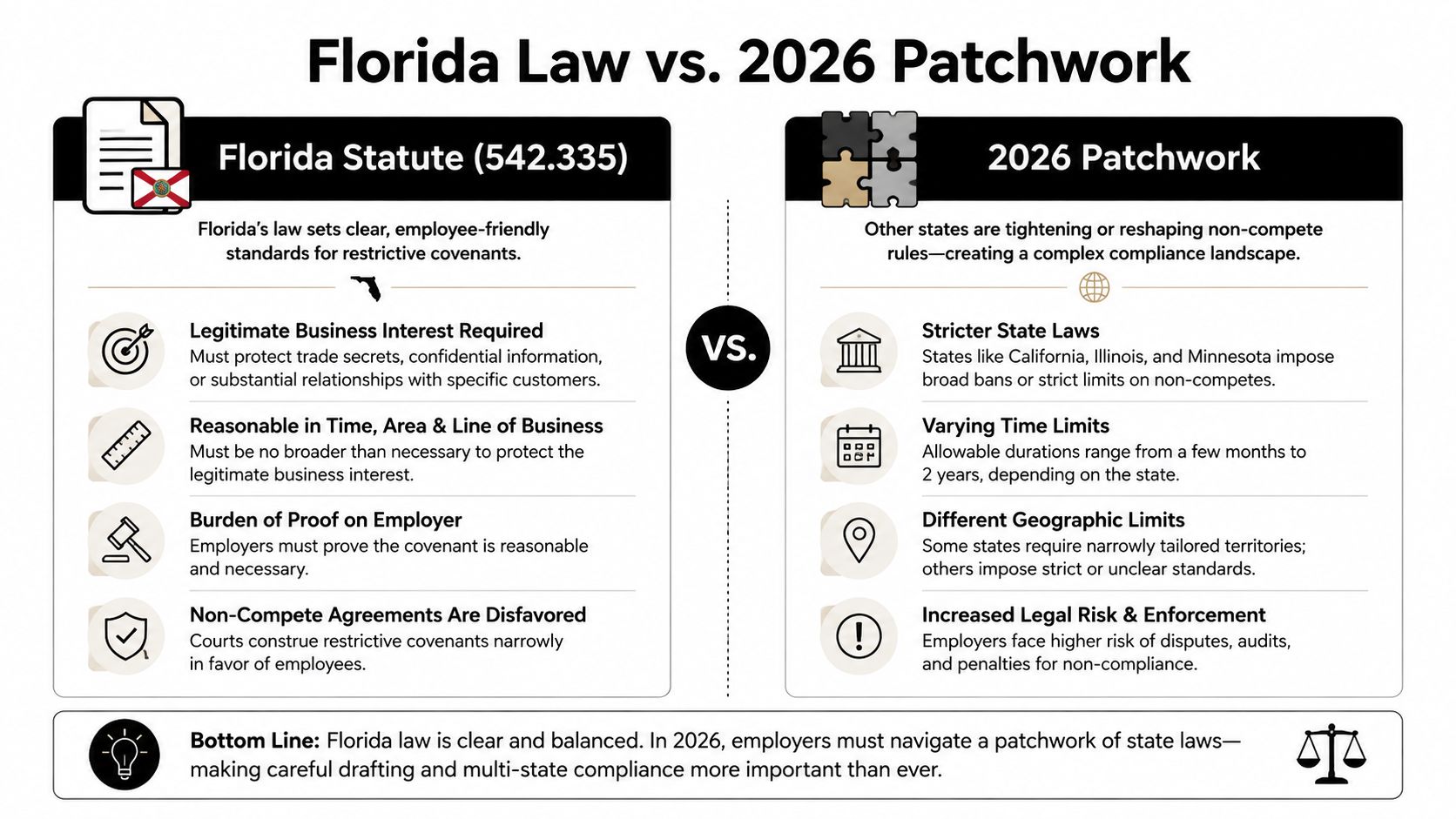
Florida's statute gives founders a framework, not a blank check. Under Florida Statutes Section 542.335, the employer generally must identify a legitimate business interest and show that the restraint is reasonably necessary to protect it. Confidential information, trade secrets, substantial customer relationships, and specialized training may support a restriction when the facts match the language.
Florida law also treats a duration above two years as subject to a rebuttable presumption of unreasonableness for many post-employment restraints. That doesn't mean every shorter clause survives. A nationwide ban on work, an undefined competitor, or a restriction covering activities the employee never performed can still invite a narrowing order or defeat.
What courts examine in the document
A judge will look at the relationship between the interest and the restraint. If the employer claims customer relationships, the agreement should identify the relevant customers or explain the employee's role in developing them. If the employer claims confidential information, the company should use access controls and confidentiality practices that support the assertion.
Consideration matters when the worker signs after employment begins. Continued employment may be relevant under the applicable law, but a promotion, bonus, equity grant, severance right, or other benefit should be described accurately. The template should also state what happens after termination without cause, particularly when the company expects the restriction to remain active.

Federal policy does not replace state analysis
The FTC announced a final rule on April 23, 2024, declaring that employers could not enter into new non-competes with workers and stating that existing non-competes for the vast majority of workers would become unenforceable after the rule's effective date. The rule was scheduled for 120 days after Federal Register publication, and the FTC compliance guide listed September 4, 2024 as the effective date, with notice requirements for affected workers. The FTC announcement of the non-compete rule provides the agency's stated framework.
The rule hasn't taken effect as a nationwide operating rule, so founders still need a state-by-state process. The FTC's rule materials also state that senior executives represented less than 0.75% of workers, illustrating how narrow that carve-out was intended to be. In 2026, the agency's targeted enforcement approach includes a consent order barring one company from using non-competes for 10 years while freeing 18,000 workers, as described in the FTC non-compete rule library.
State divergence creates separate drafting issues. Virginia's 2026 change addresses certain terminated workers unless severance or other monetary compensation was provided at signing. Washington's near-total ban is scheduled to take effect June 30, 2027, and Tennessee restricts non-competes for lower-paid workers, according to this 2026 federal and state overview. A Florida startup with a remote employee in Seattle can't rely on the same clause used for a Miami employee.
Smarter Alternatives When a Non Compete Will Not Hold Up
The strongest restrictive-covenant package is often the smallest one that addresses the actual risk. A junior salesperson who knows customer contacts may not need a non-compete. A customer non-solicitation clause, paired with confidentiality protections, can target the conduct that worries the founder without blocking unrelated employment.
Match the tool to the risk
Confidentiality agreement. Use this for nonpublic pricing, product plans, credentials, source code, customer information, and internal processes. Define confidential information carefully and exclude information that is public, independently developed, or lawfully obtained elsewhere.
Invention assignment. Use this for engineers, designers, and product staff whose work may become company intellectual property. Pair the assignment with an NDA and a clear process for disclosing inventions created during the relationship.
Customer non-solicitation. Use this when the concern is the loss of named accounts or relationships. Limit the provision to customers the worker contacted, managed, or learned about through confidential information. Don't turn it into a disguised ban on serving an entire market.
Employee non-solicitation. Use this when a departing manager may recruit a team. The clause still needs careful scope and should not automatically prohibit ordinary hiring activity unrelated to targeted solicitation.
Garden leave. Use paid non-working time to preserve continuity during a sensitive transition where the business can support the cost. The agreement must state the payment, duties, benefits, and duration clearly.
Trade-secret enforcement. The Defend Trade Secrets Act may provide a federal route for qualifying misappropriation, but it doesn't replace access controls, exit procedures, or a customized contract. A company that cannot identify its confidential information will struggle under any theory.
For a founder hiring scarce technical talent, recruiting context can also help frame a narrower package. Resources such as Underdog.io for software engineers are useful when comparing hiring options, but the employment agreement still needs its own intellectual-property and confidentiality analysis.
Practical rule: Confirm the worker's state, compensation, termination scenario, and any severance obligation before relying on a non-compete. If those facts are uncertain, start with confidentiality, invention assignment, and targeted non-solicitation terms.
Negotiation Tips Before You Sign the Template
Negotiation reveals whether the template reflects a real business need or inherited boilerplate. An employee's lawyer will usually press on the restricted activities, geographic radius, duration, confidential-information definition, consideration, and choice of law.
The founder's counter-move should price the risk rather than defend every word:
- Restricted activities: Limit the clause to the products, services, accounts, or duties the employee handled.
- Geography: Replace a national restriction with the customer territory or market the worker served.
- Duration: Shorten the term when the information becomes stale quickly. A longer term needs a stronger factual explanation.
- Confidential information: Remove generic language that labels public knowledge confidential. Specificity improves credibility.
- Consideration: Offer a defined benefit, such as a bonus, equity treatment, severance right, or garden leave, when the business needs stronger protection.
- Choice of law: Choose a governing law that has a real connection to the relationship, and confirm that local law won't override it.
A founder may win a signature by refusing every change, yet inherit a clause the employee won't respect and a court won't enforce. A narrower agreement can preserve goodwill, reduce confusion during departure, and make the company's position easier to explain.
Narrower is stronger, and clearer is cheaper to enforce.

Record the final negotiation in writing. Keep the redlines, the business-interest explanation, the compensation discussion, and the agreed jurisdiction with the signed document. Those records can matter when someone later asks why the company selected a particular scope.
Final Checklist and When to Hire a Florida Business Attorney
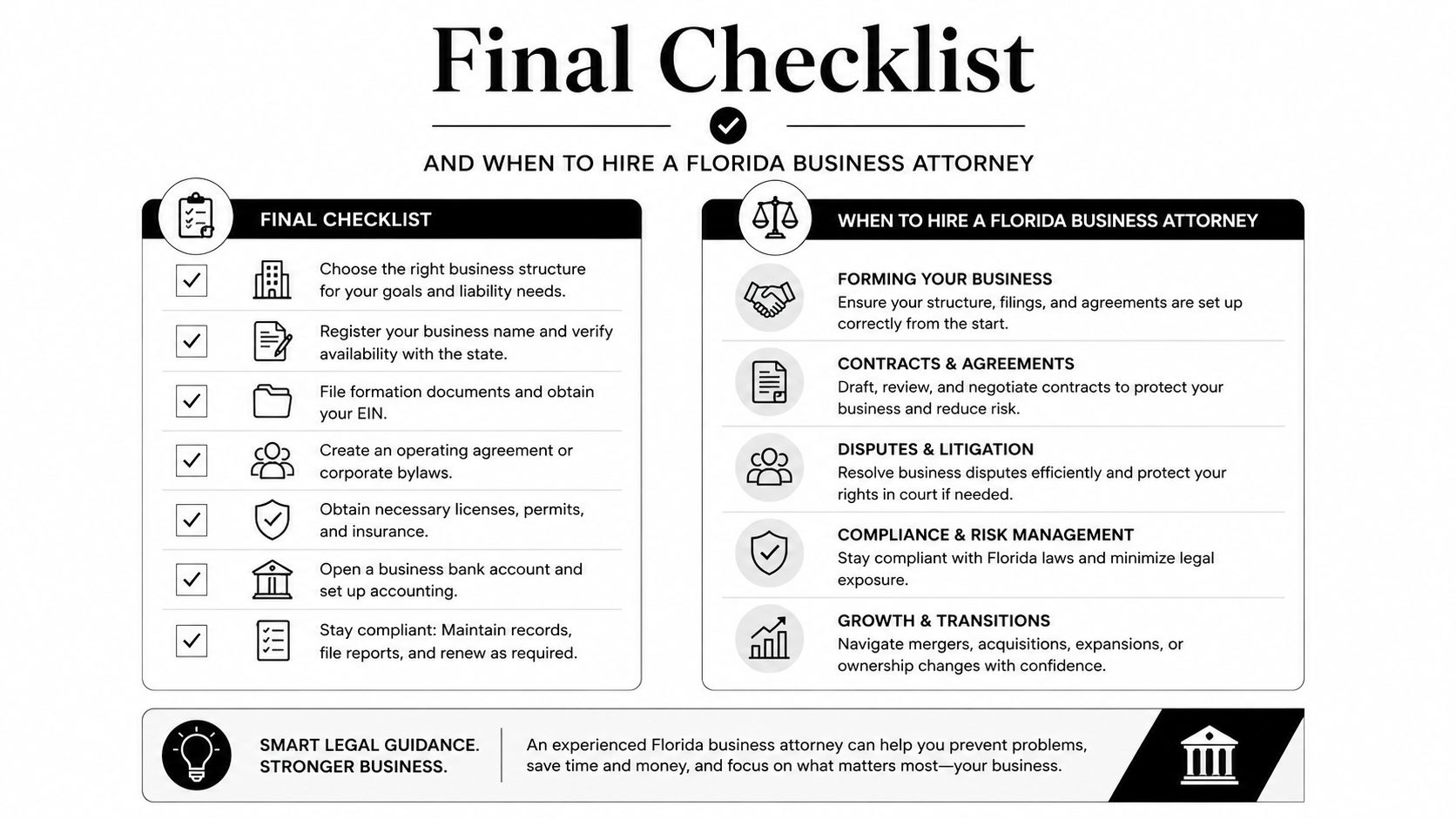
Before signature, verify:
- Parties: Legal names, role, classification, and effective date are correct.
- Interest: The document identifies the specific business interest at risk.
- Scope: Restricted activities, customers, products, geography, and duration are customized.
- Economics: Consideration, severance, garden leave, and termination triggers are stated.
- Jurisdiction: The worker's location, salary gate, governing law, and notice requirements are checked.
- Enforcement mechanics: Severability, blue-pencil language, confidentiality, and written notices are included.
- Execution: Everyone signs the final version, not an earlier draft.
Stop customizing and call counsel when the workforce spans states, the agreement includes founder equity, the transaction involves a sale of business, a senior-executive carve-out matters, or the worker can access source code or customer lists. Those facts can change the drafting strategy.
Coto & Waddington, Attorneys at Law helps Florida startups and small businesses draft jurisdiction-aware non-competes, confidentiality agreements, invention assignments, and related contracts. Visit Coto & Waddington, Attorneys at Law to schedule a practical review before you circulate or sign your template.