
You probably already know where your business value sits. It's in the Shopify data no competitor has, the customer acquisition playbook your team refined through trial and error, the pricing logic inside your software, the supplier relationships that took years to build, or the source code only a handful of people can access.
The problem is that many South Florida founders protect those assets casually. They use an NDA, share files through whatever cloud tool is easiest, let contractors keep broad access longer than necessary, and assume trust will cover the gaps. It won't. Trade secret protection works when legal documents, technical controls, and employee practices all line up. If one layer is missing, enforcement gets harder and operational risk rises fast.
For startups in Miami, Fort Lauderdale, and the surrounding market, that's not a theoretical issue. Teams move quickly, work remotely, use freelancers, and collaborate across borders. That speed helps growth. It also creates openings for leaks, copycats, and evidence problems when something goes wrong.
Table of Contents
- Identifying Your Company's Crown Jewels
- Building Your Legal Fortress with Contracts
- Implementing Practical Security Measures
- Creating a Culture of Confidentiality
- Responding When a Secret Is Stolen
- Take the First Step to Protect Your Business
Identifying Your Company's Crown Jewels
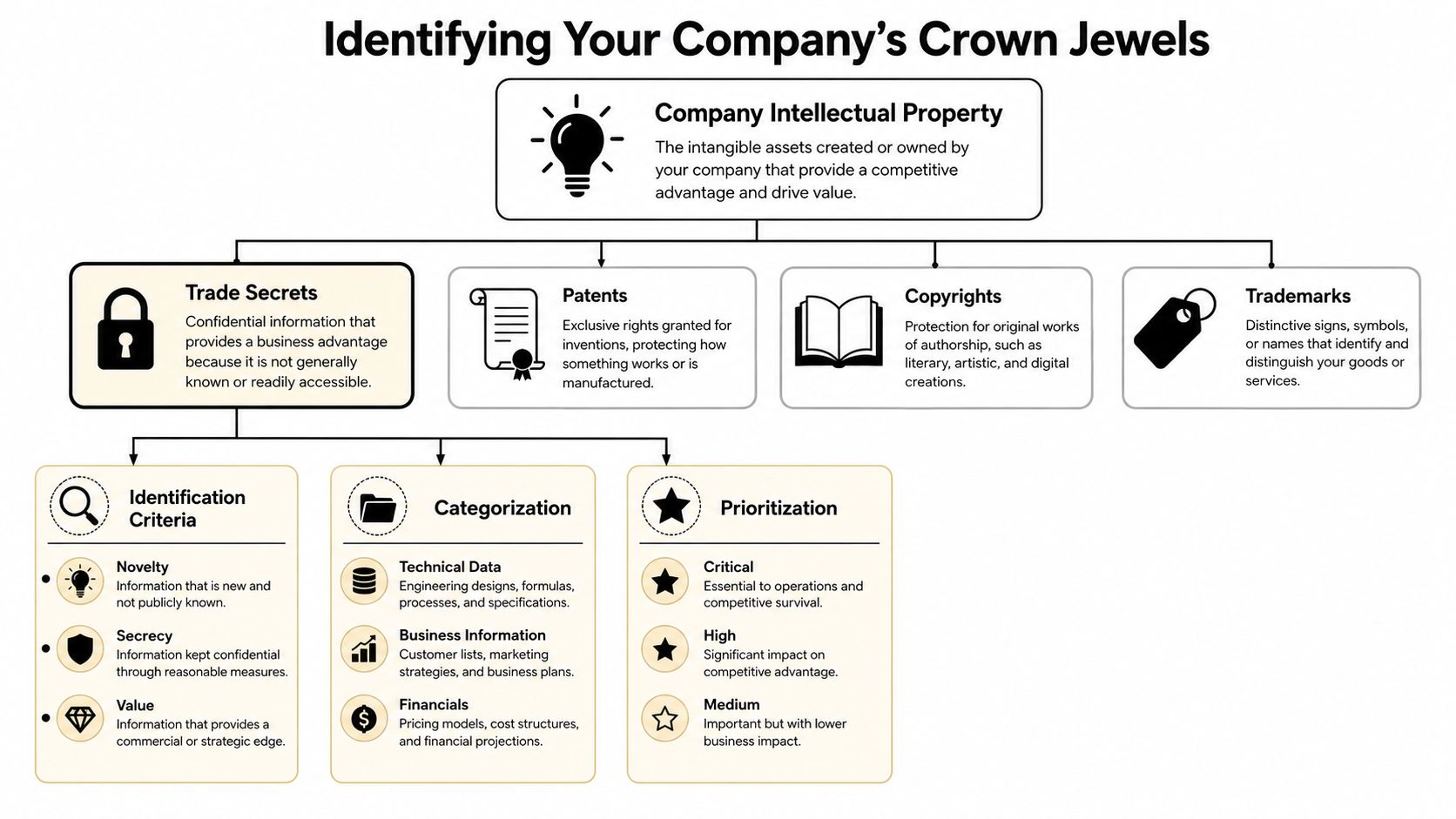
A startup can't protect everything equally. That's why the first step in trade secret protection is deciding what information gives the business an edge.
What actually qualifies as a trade secret
In practical terms, a trade secret is information a competitor would want and can't easily get on their own. That can include source code, internal algorithms, customer segmentation data, ad strategy, pricing formulas, manufacturing methods, vendor terms, unreleased product roadmaps, and specialized operating procedures.
The legal definition matters because founders often confuse “important” with “protected.” Under the federal Defend Trade Secrets Act, information only qualifies if two things are true at the same time: you took reasonable steps to keep it secret, and it has independent economic value because it isn't generally known or readily ascertainable by someone who could benefit from it. That standard is explained in this DTSA definition overview.
Practical rule: If you'd struggle to explain who had access, how it was stored, and why it mattered competitively, you probably haven't defined the trade secret tightly enough.
That's where many early-stage companies slip. A founder says, “our whole platform is confidential,” but everyone in the company has access, contractors downloaded pieces onto personal devices, and nothing is labeled or segmented. In court, that broad claim usually weakens the case instead of helping it.
A founder audit that works in the real world
A useful audit starts with categories, not legal jargon. Pull your leadership team together and list the information that would hurt the company if a former employee, vendor, or competitor got it tomorrow.
Use a short inventory like this:
| Category | Startup example | Ask this question |
|---|---|---|
| Technical data | source code, architecture, internal tools | Could a competitor build faster with this? |
| Commercial data | customer lists, pricing logic, supplier terms | Would this shorten someone else's sales cycle? |
| Strategic data | launch plans, market positioning, playbooks | Would this let another company copy our next move? |
After that, rank each item. Some information is critical because the business depends on it. Some is high priority because it would create competitive harm if leaked. Some is only routine confidential information and doesn't need the same treatment.
A few tips make this process much more effective:
- Separate trade secrets from general know-how. Employees can leave with experience in their heads. They shouldn't leave with your protected files, private methods, or internal datasets.
- Assign an owner to each asset. Someone should be responsible for approving access, checking storage, and updating the inventory.
- Tie each asset to a business use. If your team can't explain why secrecy creates value, that item may not deserve trade secret treatment.
- Document where each asset lives. GitHub, Google Drive, Slack exports, CRM reports, local devices, and shared folders all count.
For founders who are sorting out how trade secrets fit within a wider IP strategy, this guide to protecting intellectual property helps frame when secrecy makes more sense than patents, copyrights, or trademarks.
In South Florida, this exercise matters even more because startups often operate with blended teams. You may have an in-house developer in Miami, a freelance marketer in Latin America, a warehouse partner in Broward, and a growth consultant with access to analytics. If you haven't identified your crown jewels, access spreads before anyone notices.
Building Your Legal Fortress with Contracts
Contracts are your first legal perimeter. They don't replace operations, but they set the rules, provide influence, and produce the paper trail a court expects to see.

The contracts every startup should have
Most founders think “NDA” and stop there. That's too narrow. A workable contract stack usually includes employee confidentiality terms, invention assignment language, contractor agreements, vendor restrictions, and nondisclosure provisions for prospective partners or buyers.
Here's what deserves attention:
- Employee agreements. These should define confidential information clearly, require return of materials, address ownership of work product, and confirm ongoing duties after employment ends.
- Independent contractor agreements. If a developer, designer, or consultant touches sensitive material, the contract should address confidentiality, IP assignment, permitted use, and deletion or return when the project ends.
- Vendor agreements. If a third party handles customer data, product specs, or internal processes, your contract should limit access and restrict reuse.
- Standalone NDAs. These work well for early conversations with advisors, potential collaborators, and acquirers, but they need to match the actual exchange of information.
Founders often download a form and move on. That creates two problems. First, the document may not fit how your business works. Second, vague contracts make enforcement harder when the dispute involves code repositories, analytics exports, training data, or informal Slack-based collaboration.
If you're pressure-testing your current forms, reviewing a solid non-disclosure agreement template can help you spot missing provisions before they become expensive.
Where NDAs fail founders
An NDA matters. It just doesn't solve the whole problem.
Data from the DTSA and the USPTO toolkit makes the blind spot clear: if a competitor acquires information through reverse engineering, R&D, or marketing analysis, that is not misappropriation, even if a founder assumes an NDA should block the outcome. The same USPTO guidance underscores that courts look closely at whether the company used reasonable measures in practice, especially in digital environments, not just on paper, as described in the USPTO trade secrets IP toolkit.
A signed NDA doesn't stop independent development. It only helps if the facts show actual misuse of protected confidential information.
That distinction matters a lot in South Florida's startup scene. E-commerce brands test fast. SaaS teams launch similar features quickly. Agencies, contractors, and overseas support teams move between clients. If you rely only on contract language, you may still lose because the other side claims they built the same result independently.
A stronger contract strategy does two things. It narrows the room for misuse, and it supports the argument that you treated the information like a secret from day one. That means defining confidential categories, limiting use to the business relationship, requiring prompt return or deletion, and tying access to role and purpose.
One practical tip. Don't make every clause identical across every relationship. A warehouse vendor shouldn't get the same data rights as a product engineer. A fundraising NDA shouldn't look like an employment agreement. The more precisely your contracts reflect operational reality, the more credible your trade secret protection becomes.
Implementing Practical Security Measures
A contract tells people what they're allowed to do. Security controls make it harder for them to do the wrong thing in the first place.

The controls courts expect to see
Founders don't need a Fortune 500 security budget to build defensible trade secret protection. They do need discipline.
One point is hard to ignore: in 85% of upheld DTSA cases, courts cited documented technical controls such as encryption and access logs as decisive evidence of reasonable protection, while 60% of failed cases lacked that documentation. The same source also notes that digital shadowing, where employees copy secrets to personal devices, accounts for 22% of leakage incidents, which is why device management and transfer controls matter. Those figures appear in this NIST cybersecurity framework update discussion.
That doesn't mean every startup needs a full enterprise stack on day one. It means you should be able to show specific, routine controls such as:
- Access limits. Only the people who need a dataset, repository, or financial model should have access.
- Multi-factor authentication. If a tool stores valuable data, turn MFA on.
- Encryption and logging. Sensitive systems should preserve evidence of who accessed what and when.
- Device rules. Personal devices, USB transfers, and unsanctioned cloud backups need clear restrictions.
- Physical controls. Offices, storage rooms, printed documents, and visitor access still matter.
Good security doesn't have to be complex. It has to be consistent, documented, and tied to your actual risk points.
If you want a non-legal view of internal threat prevention, Sentry Private Investigators' playbook is a useful operational read because it focuses on the small failures that often lead to larger losses.
A lean startup security checklist
A startup can build a credible baseline with a short, enforceable checklist.
- Lock down your file structure. Don't keep crown-jewel information in broad shared folders.
- Reduce admin privileges. Employees typically do not need download, export, or repo-cloning power across the entire company.
- Separate work from personal tech. If the team uses laptops or phones for confidential work, there should be clear rules on retention and monitoring.
- Review vendor access. Agencies, freelancers, and software providers often end up with more information than they need.
- Keep logs long enough to investigate. If you discover suspicious behavior, evidence disappears quickly when no one planned ahead.
A short comparison helps founders decide what's reasonable:
| Weak practice | Stronger practice |
|---|---|
| Shared master drive for the whole team | Segmented folders by role and need |
| No record of downloads or exports | Access logs and alerts for unusual activity |
| Contractors using personal storage | Company-approved storage with controlled permissions |
For businesses that need a practical baseline, data security best practices can help connect legal requirements to day-to-day systems without turning your company into a compliance maze.
One tip we give often: start with the assets you ranked as critical. Protect those first. Founders get stuck when they try to secure everything at once and end up implementing nothing well.
Creating a Culture of Confidentiality
Most trade secret losses don't start with a movie-style espionage plot. They start with ordinary behavior that nobody corrected early enough.
An employee forwards a document to a personal email for convenience. A manager drops sensitive files into an open shared folder. A departing contractor keeps old credentials active because no one owns offboarding. That's why culture matters. If your team doesn't understand what must stay private and how to handle it, your legal and technical work won't hold up well under pressure.
Train people like confidentiality is part of the job
Trade secret protection has to be visible in onboarding, daily workflows, and manager expectations. It can't live only inside the handbook or buried in an offer letter.
A strong training program is simple and specific. Show people what counts as confidential. Explain where it can be stored, who can access it, and what they should do before sharing it with a vendor, freelancer, or outside advisor. Use examples they recognize, such as CRM exports, ad account data, internal dashboards, vendor terms, and unreleased product specs.
Accidental leakage accounts for 38% of trade secret misappropriation cases in federal courts, often tied to employee turnover or unsecured cloud sharing. In DTSA cases, 72% of plaintiffs with thorough documentation such as NDAs, access logs, and training records secured injunctive relief, versus 28% without, according to WIPO trade secrets guidance.
Those numbers point to a practical lesson. Training isn't just risk reduction. It becomes evidence.
A useful training cadence includes:
- New-hire orientation. Explain confidentiality obligations in plain language and tie them to the employee's actual tools and duties.
- Manager reinforcement. Team leads should know how to approve sharing and when to escalate concerns.
- Scenario-based refreshers. Cover situations like sending files to a personal drive, using AI tools with internal information, or sharing data with a new freelancer.
Employees usually don't leak information because they want to sabotage the company. They leak it because nobody translated the rules into daily behavior.
Offboarding is where many companies lose control
A calm departure can still create serious risk. The employee who resigns on good terms may still keep files, retain account access, or sync data across devices without fully realizing the consequences.
Treat offboarding as a legal, IT, and HR event at the same time. That means cutting access promptly, collecting devices, confirming return or deletion of company information, and reminding the departing worker of continuing confidentiality duties in writing.
This process works best when ownership is clear:
| Function | What they should do |
|---|---|
| HR | deliver reminders, collect acknowledgments |
| IT | revoke credentials, preserve logs, recover devices |
| Legal or leadership | review risk, send follow-up if needed |
One practical tip for founders. Keep a short departure certification ready for employees and contractors. It should confirm they returned company property, no longer have access to systems, and haven't retained confidential information. That doesn't solve every problem, but it creates a cleaner record if a dispute starts later.
Responding When a Secret Is Stolen
Even with strong controls, a founder may still face the call nobody wants. A key employee resigned and downloaded files. A vendor launched something suspiciously similar. A competitor appears to have internal information they shouldn't have.
When that happens, speed matters. The theft of trade secrets costs the U.S. economy an estimated $300 billion annually, according to the Commission on the Theft of American Intellectual Property. For an individual startup, the harm usually shows up as lost strategic advantage, delayed fundraising, customer confusion, or a product advantage that suddenly isn't unique anymore.
The first moves matter most
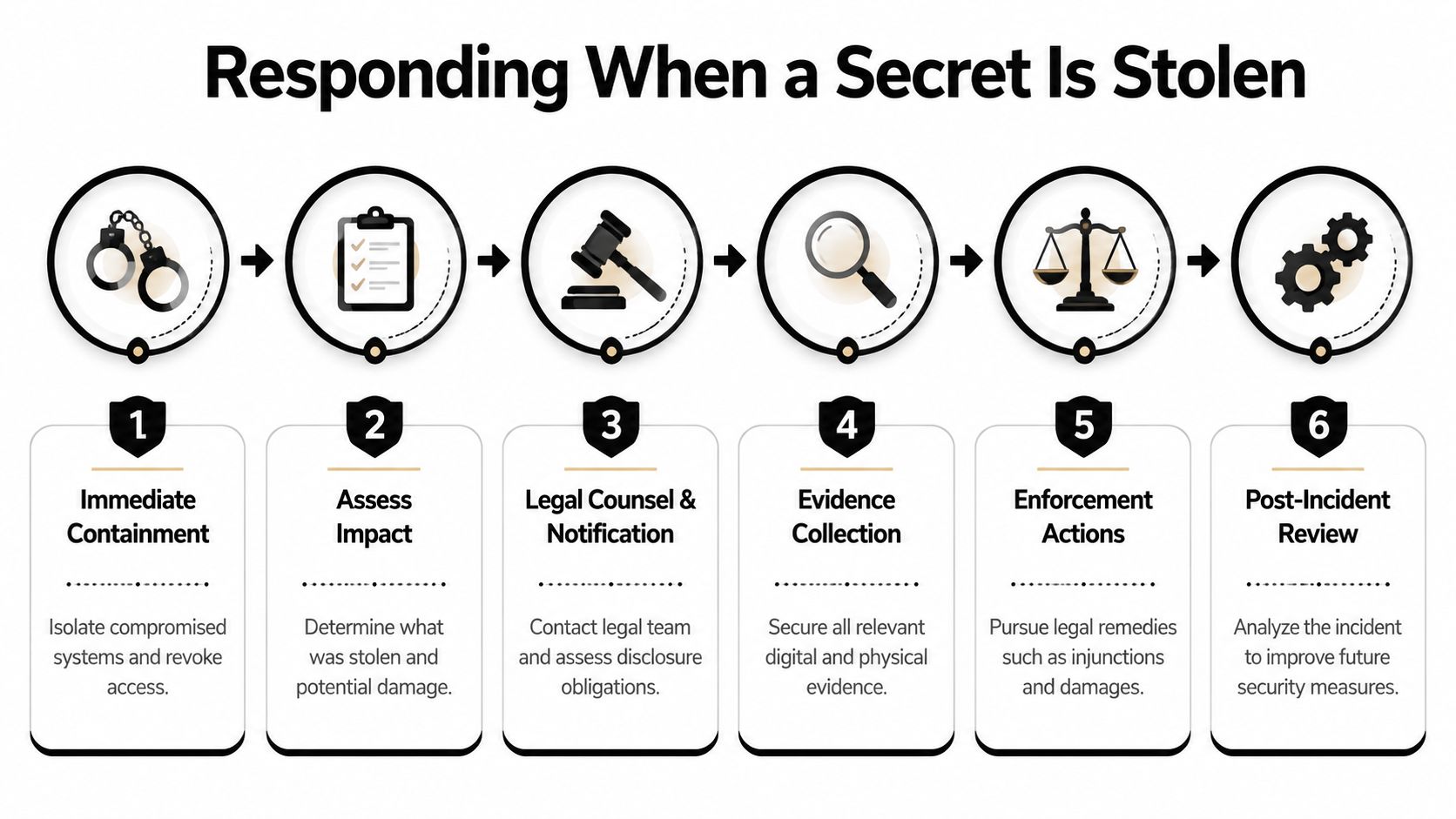
The first mistake many companies make is acting emotionally. They accuse people too early, wipe devices, shut down accounts without preserving evidence, or send aggressive messages before counsel reviews the facts.
A better response looks like this:
- Contain the issue. Suspend unnecessary access, isolate affected systems, and stop further sharing.
- Preserve evidence. Save logs, emails, chat messages, device records, downloads, and file histories.
- Identify the secret. Be specific about what information is involved. “Our confidential business” is too vague.
- Limit internal discussion. Too many side conversations create confusion and can complicate fact gathering.
- Call counsel early. Timing affects injunction strategy, evidence handling, and how you approach the other side.
The legal path depends on the facts. Under the DTSA, a business may seek court orders to stop use or disclosure and, in some cases, pursue stronger emergency remedies. But those tools work best when the company can show a clear secret, reasonable protection measures, and credible evidence of threatened misuse.
Litigation, leverage, and business reality
Not every theft claim should become a lawsuit. Some situations call for immediate emergency action. Others are better handled through a preservation demand, forensic review, negotiated return, or a structured settlement that protects the business without a prolonged fight.
Founders should weigh a few questions before charging ahead:
- Can you identify the secret with precision?
- Do your records show it was protected?
- Is there active risk of use or disclosure right now?
- Will litigation protect the business objective, or mainly punish past conduct?
That last question matters. Sometimes the goal is to stop a launch, recover data, preserve investor confidence, or keep a customer relationship intact. Litigation is one tool. It isn't always the whole strategy.
One tip that saves time and boosts effectiveness: prepare an incident-response folder before you need it. Include key contracts, system ownership information, access maps, vendor contacts, and your offboarding records. When a problem lands, founders rarely have the luxury of building order from scratch.
Take the First Step to Protect Your Business
The strongest trade secret protection programs don't rely on one fix. They combine clear identification of sensitive assets, contracts that match how the company operates, technical safeguards that create real barriers, and employee practices that hold up when people leave or relationships sour.
That layered approach is especially important in South Florida. Founders here move quickly, hire flexibly, and often build with a mix of employees, contractors, agencies, and overseas support. Those choices can be smart. They also create more access points, more handoffs, and more opportunities for a secret to leave the business undetected.
If you're not sure where to start, start small and start now. Inventory the information that drives your edge. Restrict access to what matters most. Update the agreements people are signing. Tighten offboarding. Train managers to treat confidentiality as part of operations, not just legal housekeeping.
For companies that want outside help implementing that framework, Coto & Waddington, Attorneys at Law can assist with confidentiality agreements, startup contracts, and trade secret handling procedures as part of a broader business counsel strategy. The right legal support should fit the stage of the company and work alongside your technical and HR systems, not apart from them.
A few final tips for founders:
- Don't wait for a dispute to define your trade secrets. Do that work before anyone leaves.
- Don't assume loyalty is a control. Access rules and documentation matter more.
- Don't overprotect everything. Focus on the assets that create actual competitive value.
- Don't treat offboarding as paperwork. It's one of the highest-risk moments in the company lifecycle.
If your company would be meaningfully harmed by a copied process, leaked list, reused dataset, or exported repository, you already have a trade secret issue. The only question is whether you're handling it proactively or waiting for someone else to expose the gap.
If you're building or scaling a business in South Florida and need a practical trade secret protection plan, contact Coto & Waddington, Attorneys at Law. We help founders put the legal, operational, and confidentiality pieces in place before a preventable leak turns into a lawsuit or a lost competitive advantage.


