An injunction is a court's stop or go order, and for a Florida business it can be the fastest way to halt an immediate threat before the damage spreads. In Florida protection cases, the court must set a hearing within 15 days of filing, and in business injunction fights 40–60% of preliminary injunctions in business cases involve bonds exceeding $50,000, which is why speed and cost planning matter from the start.
You may be dealing with a departing employee who copied client data, a vendor who's violating exclusivity terms, or a former partner who still controls logins, bank access, or customer accounts. In those moments, a normal lawsuit often moves too slowly. The law of injunction matters because it gives a judge the power to order someone to stop, or in some cases to do, something now.
For Florida founders, that power is valuable, but it's never automatic. Judges expect precise evidence, a clean legal theory, and a practical reason why money later won't fix the problem today.
Table of Contents
- When Your Business Faces an Immediate Threat
- What Is the Law of Injunction A Business Owner's Guide
- The Three Flavors of Injunctions TROs Preliminary and Permanent
- The Four Pillars Winning an Injunction in Florida
- Injunctions in Action Real World Business Scenarios
- The Founder's Playbook Seeking or Defending an Injunction
- After the Ruling Enforcement Alternatives and Your Call to Action
When Your Business Faces an Immediate Threat
A founder learns on Monday morning that a key employee resigned on Friday night. By noon, clients are forwarding strange emails. By afternoon, the company realizes the employee may have taken a confidential contact list to a direct competitor.
Another business owner finds out a co-founder changed passwords, cut off access to payment platforms, and started moving company money. A breach like that can disrupt payroll, vendor relationships, and customer trust before a complaint is even drafted.
Why injunctions matter in the first hours
An injunction is the legal system's emergency brake. It's designed for situations where waiting for a final judgment would leave the winning party with a hollow victory.
For a Florida business owner, that usually means one of these problems:
- Trade secret exposure: Source code, pricing data, customer lists, or internal playbooks are leaving the company.
- Contract interference: A former partner, reseller, or employee is violating restrictions that protect the business.
- Brand damage: Another business is using a confusingly similar name, logo, or online presence.
- Control disputes: Someone with account access is freezing operations or redirecting assets.
Practical rule: If the damage gets worse each day, an injunction may be the right remedy. If the dispute is mostly about a bill that can be calculated and paid later, it usually isn't.
Not every crisis begins in court. Sometimes a sharply drafted demand can stop misconduct before litigation becomes necessary. In the right case, a Florida cease and desist letter strategy can preserve strategic advantage, frame the legal issues, and create a record before you ask a judge for emergency relief.
What founders often get wrong
The biggest mistake is delay. The second is showing up with conclusions instead of evidence. Judges want the timeline, the contracts, the screenshots, the access logs, the emails, and the sworn statement tying those facts together.
The practical lesson is simple. If your business is under immediate pressure, treat it like an operational emergency and a legal one at the same time.
What Is the Law of Injunction A Business Owner's Guide
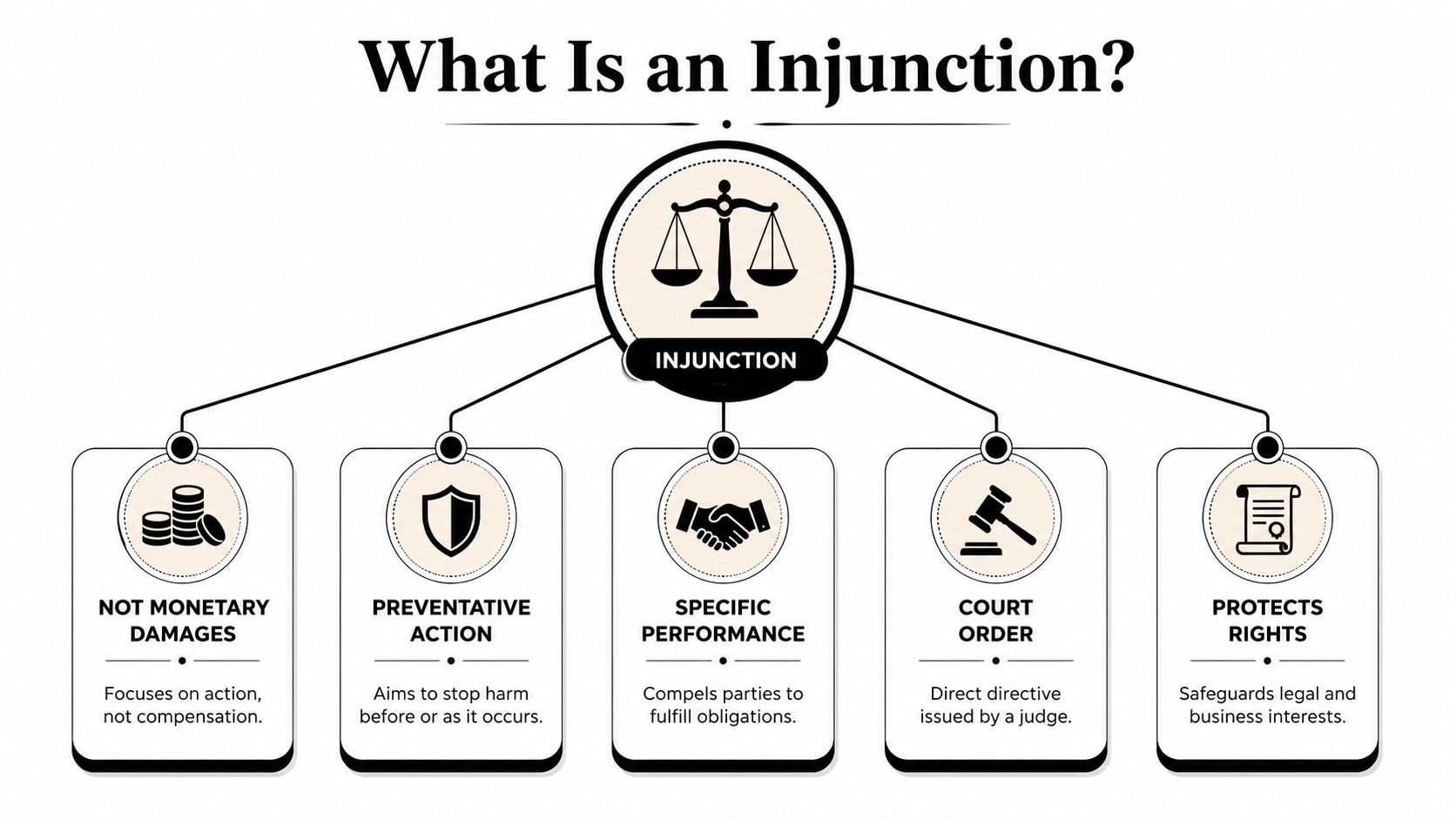
Money damages are the insurance payout after the warehouse burns. An injunction is the fire extinguisher. That's the clearest way to understand the law of injunction in a business dispute.
A damages claim asks the court to compensate you after the loss. An injunction asks the court to prevent the loss from continuing, or to stop it before it becomes irreversible. In founder disputes, that distinction matters because some losses don't convert neatly into dollars. A leaked client list, a copied product launch, or a damaged brand can keep hurting long after the first incident.
Why it's called an equitable remedy
An injunction is an equitable remedy, not just a routine claim for money. The concept comes from a long legal tradition. The history of injunctions in English equity, with roots in Roman interdicts helps explain why courts treat this remedy as powerful and exceptional.
That history still shapes modern practice. Judges don't issue injunctions because a party feels wronged. They issue them when the legal remedy, usually money, won't adequately protect the right at stake.
How that plays out in business disputes
In practice, an injunction usually fits when the dispute centers on conduct, not only compensation.
| Dispute type | Money alone may be enough | Injunction may be necessary |
|---|---|---|
| Unpaid invoice | Often yes | Usually no |
| Stolen client list | Usually no | Often yes |
| Ongoing trademark misuse | Usually no | Often yes |
| Missed delivery payment | Often yes | Sometimes no |
| Locked company accounts | Usually no | Often yes |
Founders should think about the remedy before filing the case. If the goal is to stop access, freeze misuse, preserve confidentiality, or hold the line until the court can sort out ownership, an injunction is often the only tool that matches the business problem.
The best injunction requests are narrow, specific, and tied to a clearly defined business harm.
Broad requests often fail because they read like punishment. Strong requests read like protection. A court is far more likely to enforce “stop using these credentials, this customer list, and this code repository” than “stop interfering with my business in any way.”
The Three Flavors of Injunctions TROs Preliminary and Permanent
Not all injunctions do the same job. The right form depends on how fast the harm is moving, what evidence you already have, and where the case stands procedurally.
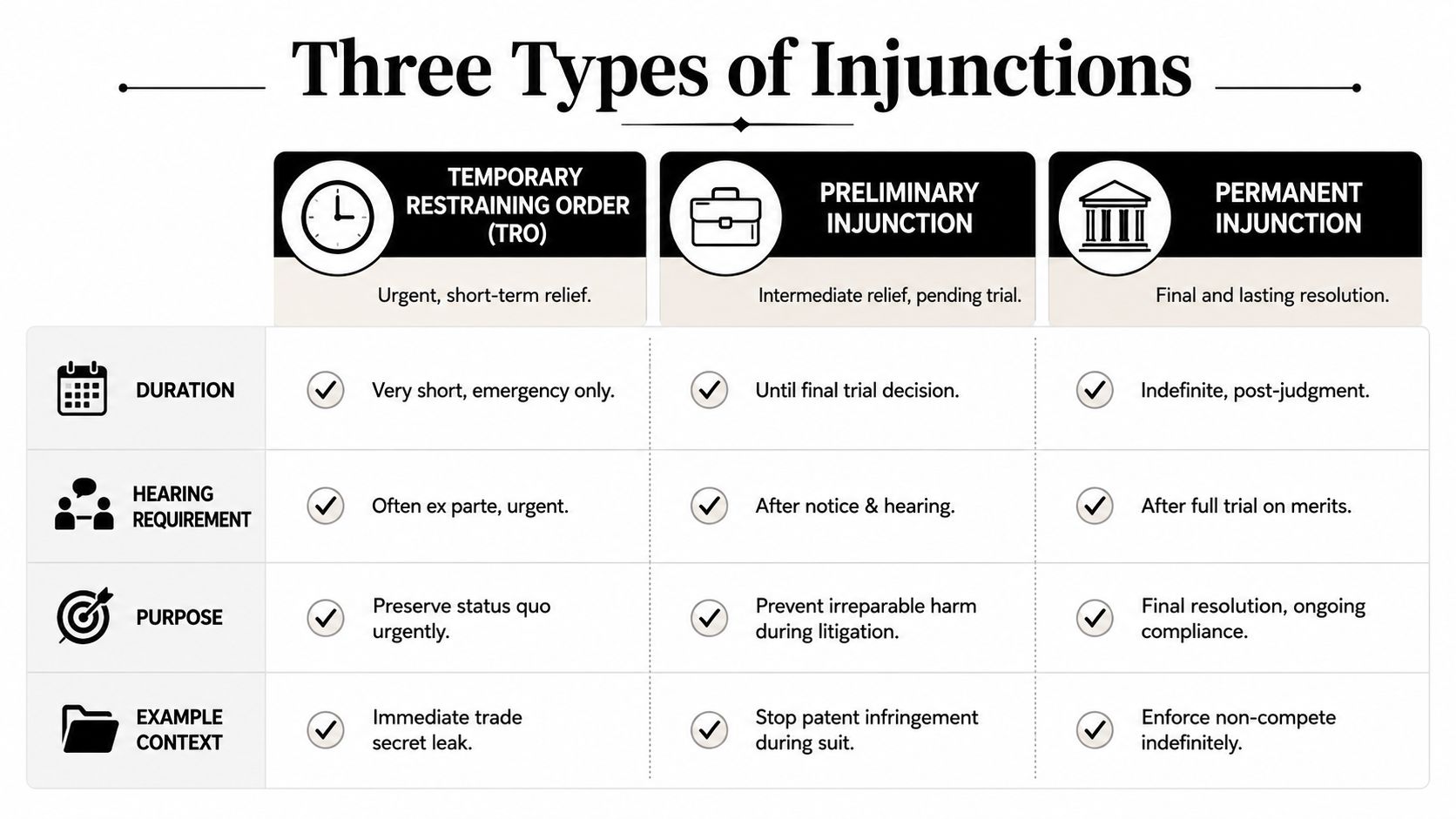
The practical sequence usually runs from immediate emergency relief to longer-term control.
TRO when the threat is happening now
A Temporary Restraining Order, or TRO, is the fastest form of relief. It's the tool for situations where waiting even a short time could make the harm much worse.
According to this practical guide to injunctions and enforcement, TROs are emergency ex parte measures when harm is time-sensitive, preliminary injunctions maintain the status quo pending trial, and permanent injunctions are issued post-trial as final judgment. The same source notes that violating an injunction can expose a party to contempt proceedings, monetary sanctions, civil or criminal penalties, and even imprisonment.
A TRO makes sense when:
- Credentials are being changed: Banking, payroll, Amazon, Shopify, Stripe, or admin access is being cut off.
- Data is actively moving: Files are being exported, forwarded, or uploaded outside the company.
- A launch is imminent: A competitor is about to use your protected material in a way that can't be unwound cleanly.
Preliminary injunction when you need a court-supervised pause
A preliminary injunction is the middle phase. It doesn't end the case. It freezes the practical situation while the litigation continues.
This is often the most important hearing in a business injunction case because it can establish a position of strength for the rest of the dispute. If the court orders a former employee to stop contacting clients, using proprietary information, or competing in violation of a valid agreement, that order can reshape settlement conversations immediately.
What works here is a focused record. The side that presents the cleaner story usually has the advantage.
Permanent injunction when the court reaches final judgment
A permanent injunction comes at the end, after trial or another final merits determination. The court then decides that ongoing compliance is part of the final remedy.
That's especially relevant in intellectual property disputes. In patent history, a study of 899 judicial opinions found permanent injunctions were awarded in 91.2% of cases involving infringement of a valid patent. The same analysis found zero cases in which judges applied a four-factor test when granting a permanent or preliminary injunction in that historical patent record.
A founder should choose the injunction type based on timing and evidence, not emotion. Urgency without proof won't carry the day.
The Four Pillars Winning an Injunction in Florida
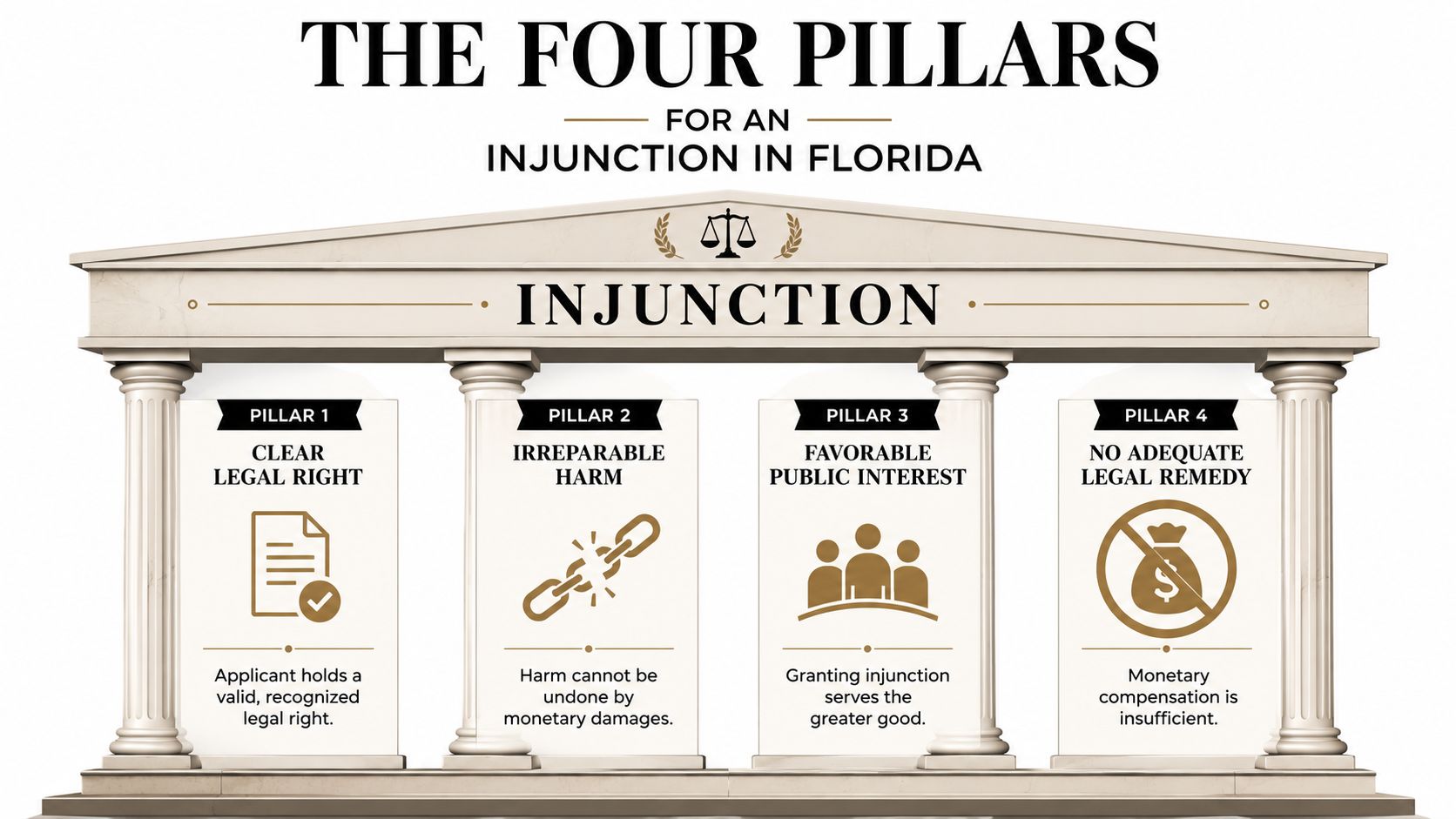
Florida courts require petitioners seeking a temporary injunction to prove four elements: irreparable harm, no adequate remedy at law, substantial likelihood of success on the merits, and public interest. That standard is summarized in the Florida temporary injunction guide.
Those words sound formal. A judge hears them as practical questions.
Can you show harm money won't fix
Irreparable harm is usually the first pressure point. If the court believes money later can make you whole, emergency relief gets much harder.
For a startup, irreparable harm often looks like loss of control, loss of confidentiality, or loss of customer trust. A copied list of enterprise prospects can't be unshared. Source code can't be made secret again once it spreads. Access to payment tools can't stay blocked without immediate operational consequences.
Good proof is concrete:
- Screenshots and exports: Show what was taken or where it went.
- Platform records: Account lockouts, access changes, or login events matter.
- Sworn statements: A detailed affidavit is usually more persuasive than a dramatic accusation.
Why isn't a damages lawsuit enough
The second pillar overlaps with the first, but it's different. No adequate remedy at law asks why a later money judgment won't solve the actual problem.
If your claim is “they owe me under the contract,” the court may view damages as adequate. If your claim is “they're using confidential material to convert my customers right now,” the answer changes.
A useful founder-level test is this: if the misconduct continues for the next stretch of litigation, can your business still function normally? If the answer is no, that supports injunctive relief.
Courts reject mere fear of harm. They want evidence of imminent, certain injury, not a speculative worst-case scenario.
Are you likely to win the underlying case
The third pillar is substantial likelihood of success on the merits. You don't need to win the entire lawsuit at the injunction stage, but you do need a credible, supported claim.
Under Rule 65's four-factor framework in federal court, courts look for likelihood of success, irreparable harm, balance of equities, and public interest, and they require evidence rather than generalized fear. In practice, that means your documents have to line up. The contract must say what you claim it says. The policy must be signed. The trademark use must be provable. The timeline must make sense.
What usually hurts founders here:
- Overbroad non-compete language
- Missing assignment or IP ownership documents
- Poorly preserved digital evidence
- Inconsistent emails or texts
Does the injunction help the public interest
The last pillar is public interest. In private business disputes, this often sounds abstract, but judges do weigh it.
A narrow order protecting confidential information or preventing misleading branding usually fits public interest more comfortably than a sweeping order that blocks lawful competition. Florida judges are more receptive when the requested relief protects legitimate rights without overreaching.
For protection injunctions in Florida, procedure matters too. The Florida courts overview on injunction hearings states that a hearing must be scheduled within 15 days of filing and failure to appear results in automatic dismissal. Business cases follow different procedures, but the lesson is universal. If the court sets an emergency hearing, preparation and attendance are not optional.
Injunctions in Action Real World Business Scenarios
The law becomes easier to understand when you put it inside actual business pressure. South Florida founders usually encounter injunction disputes in a few repeat categories.

Trade secrets leaving with a departing engineer
A Miami software startup learns that a developer is joining a competitor. Hours later, the company sees unusual repository activity and internal file transfers. The problem isn't only that someone may have breached a contract. The primary threat is that code, architecture, and deployment practices may no longer be exclusive.
That's where a TRO can be the right move. The company's immediate goal isn't a damages number. It's to stop use, preserve systems, and lock down evidence. A founder dealing with this kind of risk should also tighten operational controls and revisit trade secret protection for Florida businesses before the next employee departure turns into a litigation emergency.
A non-compete dispute with live client poaching
A Fort Lauderdale agency loses a senior salesperson who immediately starts contacting core accounts. If the agreement is narrow and defensible, an injunction may be the only practical tool because each client conversation can deepen the damage.
When seeking injunctive relief, founders often overplay their hand. A more effective approach typically involves a precisely defined request. Stop solicitation of identified clients. Stop use of confidential pricing. Stop use of internal sales materials. Courts are generally more receptive to a narrow commercial restraint than to a request that looks like an effort to punish someone for changing jobs.
Brand confusion that keeps spreading online
A Broward e-commerce business discovers a rival using a highly similar brand identity across storefronts and social media. Every day the confusion remains, customers may be diverted and reviews may attach to the wrong business.
In that setting, an injunction can force speed into a dispute that would otherwise drift. Platforms move on their own timelines. Customers don't wait for a final judgment. The business needs a court order that addresses present conduct.
In business injunction cases, the winning strategy is usually restraint. Ask for the exact relief needed to protect the company, nothing broader.
The Founder's Playbook Seeking or Defending an Injunction
Injunction fights are won in the details. They are also expensive to mishandle. Founders should prepare for the legal test and the cash consequences at the same time.
Existing guidance on Rule 65(c) often understates the bond issue. Yet the Department of Justice archive page discussing injunction security is cited here for the point that 40–60% of preliminary injunctions in business cases involve bonds exceeding $50,000. For an early-stage company, that can be as important as the legal merits.
Seeking an injunction
If you're the party asking the court for emergency relief, move in a disciplined sequence:
- Freeze the evidence: Preserve Slack messages, Google Workspace records, GitHub activity, CRM exports, payment platform notices, and device logs.
- Collect the paper trail: Pull signed contracts, NDAs, invention assignment agreements, vendor terms, and account ownership records.
- Draft for precision: The proposed order should identify the conduct to stop, the assets or data involved, and the people bound by the order.
- Address the bond early: If cash is tight, explain hardship and why a lower bond is appropriate based on the record you have.
- Organize the filing process: If your team needs a cleaner system for assembling supporting papers, reviewing drafts, and tracking deadlines, structured workflow management for motions can help avoid avoidable errors.
Defending against one
If you're on the receiving end, don't waste time arguing only that the other side is upset or overreacting. Attack the legal foundation.
- Challenge irreparable harm: Show the claim can be measured in money or that the alleged harm is speculative.
- Contest scope: Narrow overbroad requests. Judges often dislike vague restraints on “interference” or “competition.”
- Undercut likelihood of success: Point to weak drafting, unsigned agreements, inconsistent ownership records, or unenforceable restrictions.
- Push the bond issue: If the plaintiff's request could materially damage your operations, ask the court to require meaningful security.
For non-compete cases, the quality of the contract is usually the battlefield. Weak drafting creates openings fast. Founders and employers should review Florida covenants not to compete before they need to enforce them under pressure.
What works and what doesn't
What works is speed plus proof. What doesn't is rushing in with a broad grievance and hoping the judge fills in the gaps.
A startup that shows the court a clear timeline, authenticated exhibits, sworn facts, and a narrow requested order is in a far better position than a business that relies on suspicion and urgency alone.
After the Ruling Enforcement Alternatives and Your Call to Action
Winning the order isn't the end of the problem. Enforcement matters. If the other side ignores the injunction, the court can use contempt powers, sanctions, and other coercive tools to force compliance. That's why injunctions remain among the strongest remedies in civil practice.
Founders should also think carefully about scope. Questions about nationwide relief come up often in e-commerce and tech disputes. The safest practical assumption is that broad relief is harder to hold than many founders expect, so the better strategy is usually to draft a request that directly ties the remedy to the actual parties, conduct, and harm in front of the court.
The preventive work that makes injunctions easier
The businesses best positioned for emergency relief usually did the unglamorous work early:
- Clear IP ownership documents
- Signed NDAs and confidentiality terms
- Tight access controls for code, CRM data, and finance tools
- Narrow, defensible restrictive covenants
- Written policies for offboarding and credential recovery
The strongest injunction file usually starts months before the dispute, with good contracts and clean records.
If you're facing a live threat, act quickly. If you're not in a dispute today, use that breathing room to fix the documents and processes that a judge will eventually want to see.
If your Florida business is dealing with trade secret theft, a contract breach, a partner dispute, or another fast-moving threat, Coto & Waddington, Attorneys at Law can help you assess whether an injunction is the right move, what evidence to preserve, and how to protect the company before the damage grows. A strategic consultation now can put you in a far stronger position than an emergency filing later.