The most popular advice about forming an S corporation is also the source of many avoidable mistakes: “Just file Form 2553.” In Florida, that instruction skips the most important part. An S corporation isn't created by one state filing. You first form an underlying business entity, then make a separate federal tax election, and each step has its own timing and compliance consequences.
That distinction matters for a Miami consultant, a Fort Lauderdale agency, or a family-owned business moving from sole proprietorship to a formal structure. A clean entity record, accurate shareholder information, timely IRS filing, payroll, bookkeeping, and Florida reporting all need to line up. Before filing anything, understand what the election does, what it doesn't do, and whether the added administration fits the business.
Table of Contents
- Why Forming an S Corp Is Actually Two Steps
- Eligibility Rules You Must Meet Before Filing
- Filing Sequence From Entity Formation to S Election
- Florida Compliance Layers After Federal Approval
- When S Corp Status Adds Value Versus Complexity
- Common Pitfalls and Your Next Steps
Why Forming an S Corp Is Actually Two Steps
Forming an S corp isn't a single legal act. The first step is creating the business entity under state law. In Florida, that commonly means forming a corporation or an LLC with the Florida Division of Corporations. The second step is making a federal S corporation tax election by filing Form 2553 with the IRS and obtaining acceptance.
The IRS describes the distinction directly in its guidance on S corporations. An entity becomes an S corporation only after it files Form 2553 and the election is accepted. State formation and federal tax classification are related, but they aren't interchangeable.
The two filings answer different questions
The state formation filing answers, “What legal entity exists?” It establishes the organization, identifies its registered agent, and creates the public state record. The federal election answers, “How will this eligible entity be taxed for federal purposes?” It doesn't replace the formation document, operating agreement, bylaws, stock records, or other governance materials.
Confusing the steps can create several problems:
- Wrong effective date: The IRS may treat the election as effective on a date different from what the owner expected.
- Incomplete ownership records: Form 2553 requires shareholder details that may not match the entity's actual records.
- Unplanned tax treatment: A newly formed LLC may continue under its default federal classification unless it makes the appropriate election.
- Administrative gaps: The company may open a bank account or sign contracts before its legal and tax records are consistent.
Practical rule: Don't describe the business as an S corporation merely because you formed an LLC or corporation. Use that label after the federal election has been properly filed and accepted.
A founder who forms a Florida corporation in the spring but delays the tax election may not receive the intended treatment for the current tax year. Another founder may file Form 2553 before the entity's ownership and tax classification are settled, then discover that the form doesn't accurately reflect the business.
The same discipline applies to financial records. Establish a system for organizing receipts, invoices, payroll records, and shareholder reimbursements from the start. A dedicated resource on small business receipt management can help owners build that recordkeeping habit before tax preparation becomes a scramble.
The sensible sequence is straightforward: choose and form the entity, obtain its federal identification information, document ownership, file the election, and then maintain the company as a separate business. The election is a planning tool, not a substitute for corporate housekeeping.
Eligibility Rules You Must Meet Before Filing
Before preparing Form 2553, confirm that the entity and its ownership structure fit the federal rules. Eligibility isn't just a matter of checking a box. The IRS examines the type of entity, the shareholders, and the economic rights attached to ownership.
Start with the entity itself. A corporation can potentially elect S status, and an LLC may generally need to be treated as a corporation for federal tax purposes before making the election. That classification step should be coordinated with the formation documents so the effective dates don't conflict.
Review the ownership before submitting the election
S corporation ownership must satisfy restrictions on who can hold shares and how the equity operates. In practical terms, founders should review:
- Shareholder identity: Confirm each owner's legal name, address, and taxpayer identification information.
- Ownership records: Make sure the share count and acquisition information match the stock ledger or membership records.
- Ownership type: Review whether any owner is an entity or other holder that may not qualify.
- Economic rights: Confirm that owners have the same rights to distributions and liquidation proceeds.
Form 2553 requires each shareholder's name, address, taxpayer ID, share count, acquisition date, and tax year end. Treat those fields as a reconciliation exercise, not clerical filler. A mismatch between the form, the stock ledger, and the ownership agreement can create questions later.
The one-class-of-stock rule is a frequent danger point. The problem isn't limited to visibly different share classes. Side agreements, disproportionate distribution rights, preferred economic arrangements, or contract terms that create different financial rights can threaten eligibility even when the cap table appears simple. The IRS explains the Form 2553 requirements and related qualification issues in its Form 2553 guidance.
Fix structural problems before filing
Suppose a founder promises one owner priority distributions in a private side letter while giving another owner ordinary shares. That arrangement should be reviewed before the election. The practical fix may involve revising the agreement, correcting the equity records, or choosing a different tax classification.
The same caution applies to startup financing. A structure designed for outside investors, preferred returns, or complex economic rights may be a poor fit for S status. Don't force an election onto an ownership arrangement that was built for a different capital strategy.
Before signing Form 2553, have the attorney, accountant, and owners review the same ownership documents. That coordinated review is usually more efficient than repairing an election after the company has already filed returns under inconsistent assumptions.
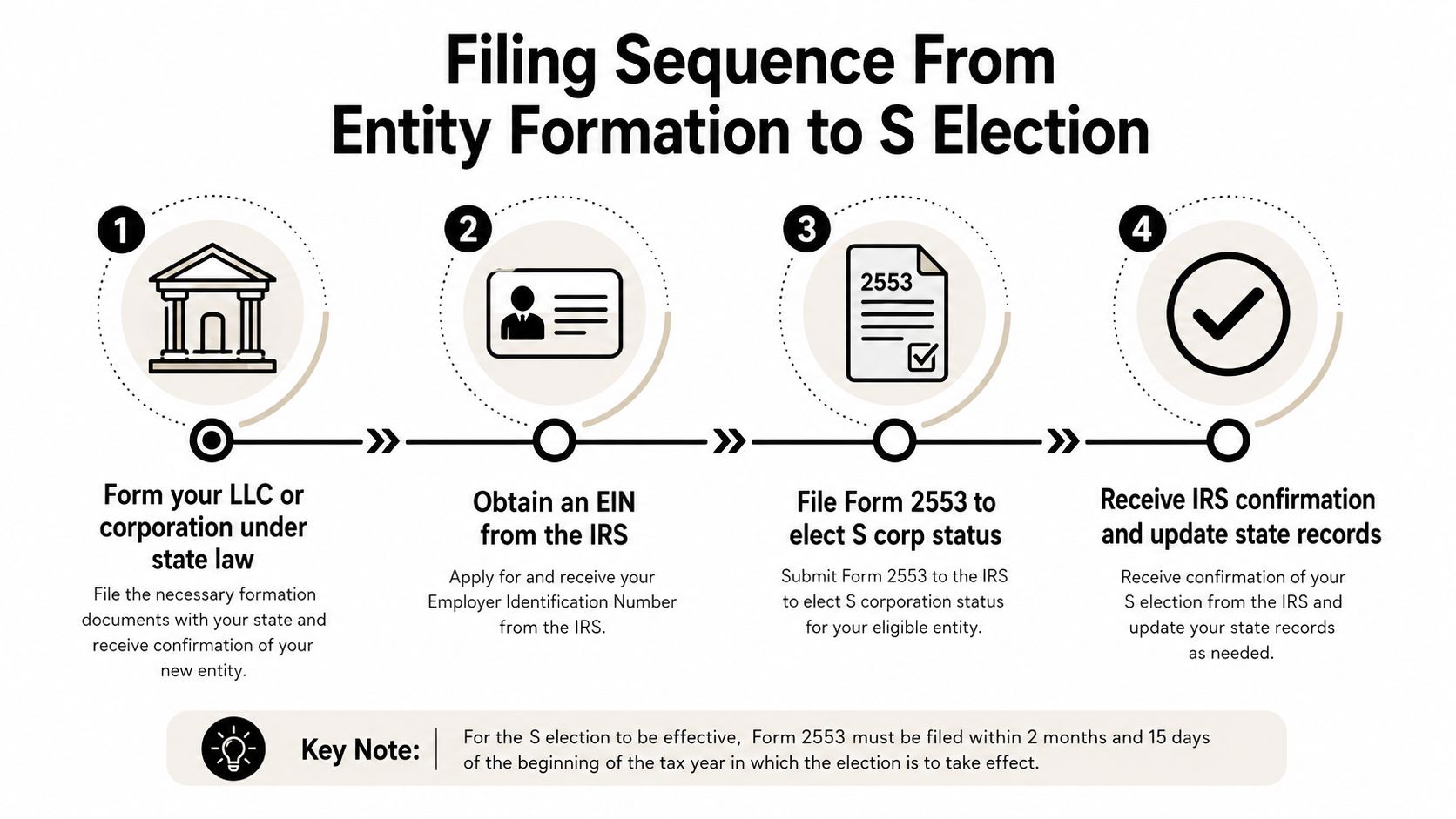
Filing Sequence From Entity Formation to S Election
The safest way to handle the process is to treat it as a documented sequence rather than a single online task. Each stage should produce a record that supports the next stage.
Start with the Florida entity
Choose the legal structure first. A corporation generally uses articles of incorporation, bylaws, incorporator action, stock issuance records, and shareholder approvals. An LLC uses articles of organization and an operating agreement, along with records showing the members and their ownership interests.
An LLC seeking S corporation taxation may need the appropriate federal corporate classification before Form 2553 is filed. That decision should be made with tax counsel or a CPA because the legal entity and the federal tax status serve different purposes.
Build the federal and ownership file
After formation, obtain the entity's EIN and organize the core records. The file should contain the filed state document, governing agreement, ownership ledger, initial resolutions or consents, EIN confirmation, and the tax information needed for Form 2553.
Use this checklist before transmission:
- Confirm the entity name and EIN. They must correspond to the legal entity making the election.
- Verify every shareholder's information. Form 2553 calls for each shareholder's name, address, taxpayer ID, shares, acquisition date, and tax year end.
- Obtain required shareholder consent. The ownership record and signed election should tell the same story.
- Select the intended effective date. Don't assume the filing date and effective date are identical.
- Review the tax year. A calendar-year business generally needs to plan around the beginning of that tax year.
- File and preserve proof. Keep a complete copy of the signed form and evidence of timely mailing, faxing, or other permitted delivery.
- Track IRS confirmation. Update the tax preparer, payroll provider, bank, and state compliance calendar after acceptance.
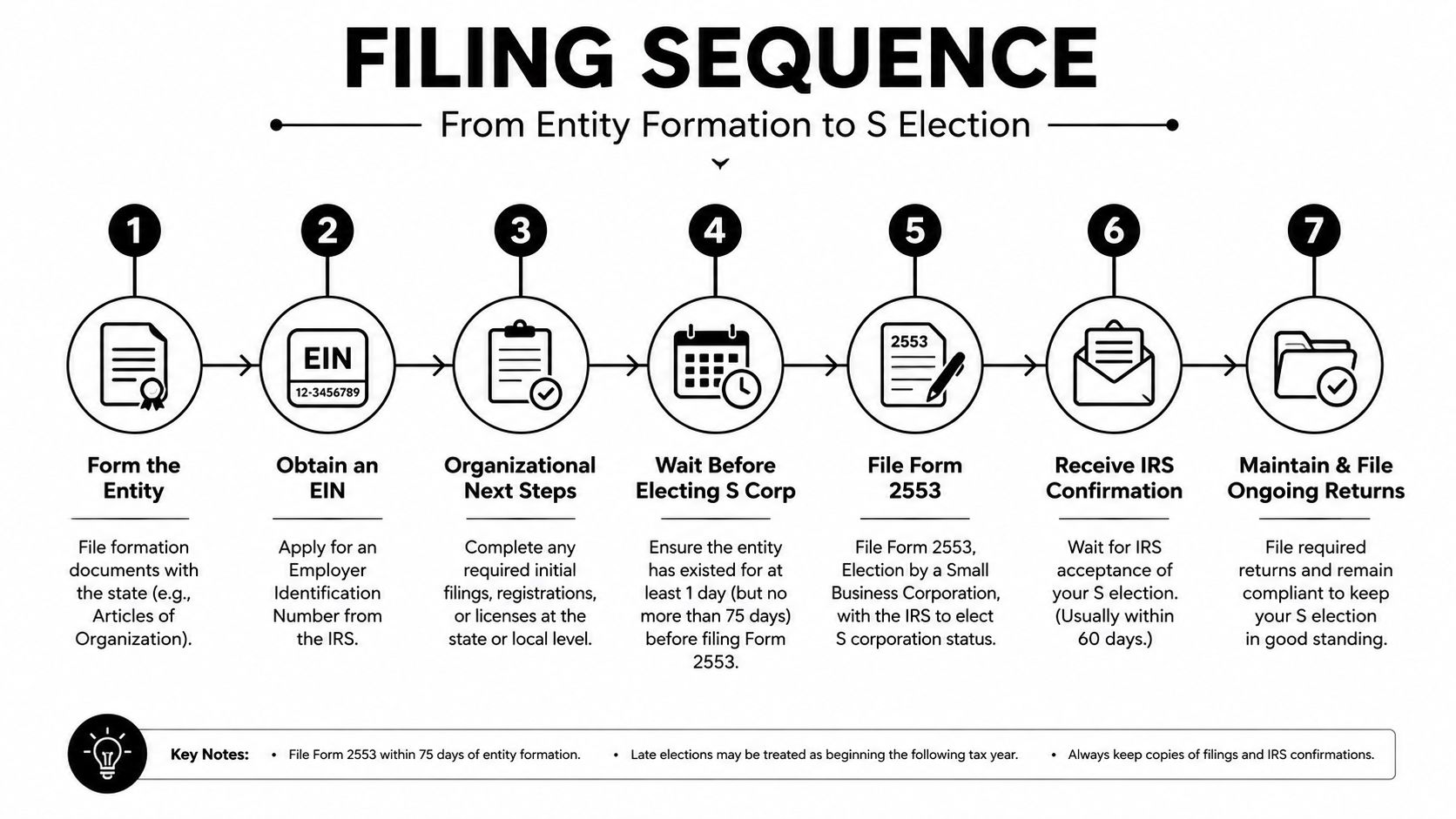
The central timing rule comes from the IRS Form 2553 instructions. Form 2553 must be filed no more than 2 months and 15 days after the beginning of the tax year in which the election is intended to take effect, or at any time during the prior tax year. For a calendar-year business, that generally places the deadline around March 15.
That deadline isn't a suggestion. If the company misses it, the intended tax treatment may not apply when expected. The IRS may provide limited relief in qualifying circumstances, including situations where Form 1120-S and Form 2553 are filed within 3 years and 75 days after the effective date, but relying on relief is a poor operating strategy. Treat the 75-day window as a hard deadline and retain proof that the filing was made on time.
For Florida founders who want help coordinating state formation documents with the federal election, the Florida corporation filing service provides a useful starting point for organizing the state-law side of the sequence. The tax election still requires careful review of the entity's ownership and federal requirements.
Florida Compliance Layers After Federal Approval
IRS acceptance doesn't close the file. It changes the federal tax treatment, but the Florida entity still has state-law obligations, and the business must operate consistently with both systems.
A Florida corporation generally needs to maintain its state records and complete the state's required annual reporting. An LLC also has its own state reporting obligations. Those filings preserve the entity's active status and update public information. Federal S status doesn't eliminate them.
Separate the federal and Florida questions
Florida founders often hear that the state has no individual income tax and assume the S election creates no further state concerns. That conclusion is too broad. The company may still face entity-level obligations, employment-related filings, sales and use tax responsibilities, local requirements, and recordkeeping duties depending on what it sells, where it operates, and how it employs people.
State treatment can also differ from federal treatment. Some states impose separate S corporation elections, franchise taxes, or entity-level requirements even after the IRS approves Form 2553, as explained in this discussion of state-level S corporation election issues. Florida's practical compliance picture should be reviewed on its own terms rather than imported from a national checklist.
That means the post-approval handoff should include more than forwarding the IRS letter to the accountant. Ask the team handling the company to confirm:
- Annual reports: Put the Florida filing obligation on a recurring calendar.
- Payroll registration: Set up the accounts and filings required for employees and shareholder-employees.
- Sales tax status: Determine whether the business's products or services trigger registration and collection duties.
- Local licenses: Check county and municipal requirements for the business location and activity.
- Banking and bookkeeping: Keep business transactions separate and classify distributions, reimbursements, and payroll correctly.
- Corporate records: Preserve consents, meeting records, ownership changes, and tax documents together.
Watch for mismatched records
A company can have an accepted federal election and still create problems through inconsistent operations. For example, the bank may show one legal name, the payroll account another, and the state record an outdated principal address. Those mismatches make ordinary administration harder and can complicate a later sale, financing, audit, or ownership transition.
If past-due filings, tax notices, or unresolved state and federal issues already exist, a specialized resource on Florida tax debt resolution and IRS issues may help identify the right professional path. Don't wait for a notice to force the review. A short compliance audit after federal approval can prevent a collection problem from becoming a transaction problem.
When S Corp Status Adds Value Versus Complexity
S status can be useful, but it isn't automatically the right answer for every Florida business. The decision should reflect the company's profit pattern, owner involvement, payroll needs, ownership plans, and tolerance for compliance work.
A service business with one active owner may find the election attractive when profits are stable and the owner is ready to maintain payroll and formal records. The potential planning benefit comes from separating compensation for services from shareholder distributions, but that separation must be documented and administered correctly.
A new venture with irregular revenue may get little practical value from the election while taking on payroll, bookkeeping, tax return, and governance responsibilities. If the business expects outside investors or wants multiple economic rights, S status may also conflict with its financing plans.
Compare the operating realities
| Business situation | S status may fit | S status may be a poor fit |
|---|---|---|
| Owner-operated service company | Predictable profits and willingness to run payroll | Revenue is uncertain and administrative cash is limited |
| Family business | Simple ownership and consistent distribution policy | Informal side arrangements create unequal economic rights |
| Startup seeking capital | Closely held structure with compatible ownership | Investors expect preferred economics or complex equity |
| Established small company | Reliable records and professional tax support | Books are mixed with personal spending and records are incomplete |
The IRS recognizes S corporations as a long-established pass-through business form and has tracked them in corporate filing data for decades. That history doesn't make the election universally suitable. It does show that the structure is established, formal, and dependent on consistent reporting, as reflected in the IRS filing-status-change guidance.
Evaluate the cost of being correct
The election can add payroll administration, employment filings, annual tax preparation, shareholder approvals, and state-specific compliance. Those tasks aren't optional extras. They are part of the operating model.
Owners should also understand compensation discipline. A shareholder who works in the business can't take distributions and ignore payroll. Compensation should reflect the services performed and remain consistent with the company's records and tax reporting. The right amount depends on the facts, the role, the industry, and the work performed, so it shouldn't be selected from a generic internet formula.
For a broader comparison of corporate tax classifications, review the difference between an S corp and a C corp. The better question isn't “Which label saves the most tax?” It's “Which structure supports this company's ownership, cash flow, hiring, financing, and exit plans without creating obligations the team won't maintain?”

Common Pitfalls and Your Next Steps
Most formation problems aren't caused by an obscure tax theory. They come from ordinary execution failures: the owner files late, skips consent, mixes funds, forgets payroll, or assumes federal approval handles Florida compliance.
The cure is a written operating checklist. Assign each task to a person, save the evidence, and review the calendar with the CPA and attorney before the first return is prepared.
Correct the problems early
- Missed election deadline: Determine whether late-election relief may apply, then prepare the required filings and explanation rather than assuming the election is effective.
- Incomplete shareholder approval: Obtain written consent and reconcile it with the ownership ledger and Form 2553.
- Payroll delay: Set up payroll for shareholder-employees promptly and document compensation decisions.
- Mixed finances: Use dedicated business accounts, business cards, and clear reimbursement records.
- State compliance lapse: Confirm Florida annual reporting, tax registrations, licenses, and employment obligations.
The S corporation pitfalls guidance from Tax Attorney Stephen A. Weisberg is useful background for identifying recurring compliance weaknesses. It shouldn't replace advice based on the company's documents and actual operations.
Maintain the file after formation
Keep the signed formation documents, EIN confirmation, Form 2553, IRS response, shareholder consents, stock or membership records, payroll reports, tax returns, and state filings in one organized repository. Receipt software can support transaction records, but it can't decide whether an owner payment is payroll, a distribution, or a reimbursement. That classification requires a sound process.
Schedule a post-formation review when ownership changes, the company adds investors, the business begins operating in another state, or the owners change compensation. Those events can affect eligibility, reporting, and governance.
South Florida founders who want counsel on formation documents, ownership structure, contracts, and ongoing business compliance can review small business legal services from Coto & Waddington. The right review focuses on the actual entity, owners, election date, payroll process, and Florida obligations, not a generic “S corp package.”
Before filing, gather the proposed entity name, ownership information, governing documents, intended tax year, and business activity description. Then have a Florida business attorney and tax professional confirm that the structure works together and that the election deadline is protected.
Coto & Waddington, Attorneys at Law helps South Florida founders form and structure Florida businesses, coordinate entity documents with the federal S election, and address contracts and ongoing compliance. Visit Coto & Waddington, Attorneys at Law to discuss your proposed ownership structure, filing timeline, and next steps.