A holding company LLC is a parent company created for one main job: to own other companies, which we call subsidiaries. It doesn’t sell anything or offer services directly. Instead, its entire purpose is to hold ownership stakes in the operating businesses that actually do the work.
For entrepreneurs with multiple ventures, this structure isn't just a legal tool—it's a fundamental strategy for protecting what you've built and organizing your empire for growth.
Understanding the Holding Company LLC

Think of it like this: your holding company LLC is the trunk of a tree. Each of your businesses—a rental property portfolio, an e-commerce brand, a consulting firm—is a separate branch. The trunk supports every branch, but if one gets sick, the disease is contained. It doesn't infect and kill the entire tree.
This is the essence of using a holding company for asset protection. It creates a powerful legal barrier, what lawyers call a "corporate veil," between your different business ventures. Risk is isolated, meaning a lawsuit or financial crisis in one subsidiary won't drag down the parent company or its other, healthier subsidiaries.
The Power of Separation
Holding companies, especially when structured as LLCs, have become a cornerstone for smart risk management. We see it all the time with founders in dynamic markets. An entrepreneur might form a holding company that owns 100% of several subsidiary LLCs, each running a completely different business.
If one of those subsidiaries gets hit with a major product liability lawsuit, the holding company's assets are shielded because it has no part in the day-to-day operations. Liability is trapped at the subsidiary level. This is how you protect the parent company's equity from the creditors of one struggling venture.
This separation is what makes the model so effective. The holding company’s main assets are simply its ownership interests in the subsidiaries. Meanwhile, the operating companies hold all the assets and liabilities tied directly to doing business, such as:
- Real estate and expensive equipment
- Intellectual property, including trademarks and patents
- Customer contracts and accounts receivable
Holding Company vs Operating Company at a Glance
To really get a feel for this, a side-by-side comparison is helpful. The table below breaks down the fundamental differences between a holding company and the operating businesses it owns.
| Characteristic | Holding Company LLC | Operating Company (Subsidiary) |
|---|---|---|
| Primary Role | Owns assets, including other companies, intellectual property, or real estate. | Conducts day-to-day business operations (e.g., sales, services, manufacturing). |
| Main Activity | Manages its ownership stakes and provides centralized administrative or financial oversight. | Interacts with customers, hires employees, and manages operational tasks. |
| Risk Exposure | Low and indirect. Liabilities are generally contained within the subsidiaries. | High and direct. Bears the full operational risk, including lawsuits and debts. |
As you can see, the roles are entirely distinct by design. The holding company owns, and the operating company does.
Beyond this basic setup, some LLC structures are designed for even more specific goals. A Family Limited Liability Company, for example, is a powerful tool for families looking to manage wealth across generations while maintaining strong asset protection.
Pro Tip: When you form your holding company, be explicit in its operating agreement. State clearly that its purpose is strictly to hold assets and not to engage in active business operations. This simple step goes a long way in reinforcing the corporate veil and strengthening your legal protections from day one.
It's time to stop leaving your hard-earned assets exposed. A proper legal structure is the foundation of a resilient business. The team at Coto & Waddington has the expertise to help you design a holding company structure that secures everything you've built. Schedule a consultation with our team today to get started.
The Strategic Benefits of a Holding Company Structure

Once you understand what a holding company is, the next question is always: why would you actually use one? The answer isn't just about legal theory. It's about practical strategies that directly impact your risk, financial options, and ability to grow over the long term.
The core reason founders adopt a holding company LLC is to build firewalls between their different assets. This strategic separation gives you three main advantages that every business owner should know.
Superior Asset Protection
The most powerful benefit is the robust asset protection you get from legally compartmentalizing your businesses. Let’s say you own a successful e-commerce brand and decide to launch a separate trucking company to handle logistics. If both businesses are under one LLC or tied directly to you, they are dangerously exposed.
If one of your trucks is involved in a serious accident, the lawsuit could go after the assets of both the trucking business and your profitable e-commerce brand. Your entire life's work is on the line.
A holding company completely changes this picture. You place each business into its own separate subsidiary LLC, with the parent holding company owning both. Now, risk is isolated. A lawsuit against the trucking subsidiary is contained within that single legal entity, and its creditors can’t touch the assets of the parent company or your e-commerce brand.
A holding company acts like a series of watertight compartments on a ship. A breach in one compartment doesn't sink the entire vessel, allowing the rest of your business portfolio to sail on, unaffected by the localized damage.
Beyond this structural shield, you can fortify your defense even further by securing the right business insurance for your LLC.
Pro Tip: To make this protection hold up in court, you have to treat each company as a separate entity. This means each subsidiary needs its own bank accounts, separate financial records, and must follow all corporate formalities. This diligence is what prevents a court from “piercing the corporate veil” and dismantling your asset protection.
Enhanced Financial Flexibility and Tax Advantages
Beyond just protecting what you have, a holding company structure also creates major financial and tax efficiencies. When you structure the holding company as an LLC, it gets the benefit of pass-through taxation. Profits and losses from the subsidiaries "pass through" the holding company to the owners' personal tax returns, which lets you avoid the double taxation that often comes with C-Corporations.
This setup also lets you move capital strategically. Think of the holding company as a central bank for its subsidiaries. It can pull dividends from a highly profitable business and use that cash to fund a promising new venture or support another subsidiary that needs a cash infusion—all without chasing down external financing.
This is often done with simple inter-company loans. For example:
- Your established consulting firm (Subsidiary A) generates $200,000 in excess profit.
- This profit is paid as a dividend to the holding company.
- The holding company then loans $100,000 to your new software startup (Subsidiary B) to fund its development.
This internal financing keeps both wealth and control inside your business ecosystem. As you map out your tax strategy, it’s also wise to understand the key differences between an S Corp and C Corp to ensure you’re making the most informed decision.
Simplified Ownership and Legacy Planning
Finally, a holding company radically simplifies how you manage, grow, and eventually transfer your business interests. Instead of juggling ownership stakes in multiple disconnected companies, you, your partners, or your family only need to manage the ownership of one entity: the holding company.
This centralized ownership brings several key operational wins:
- Easier to Sell Business Units: If you decide to exit one of your businesses, you just sell that specific subsidiary LLC. The transaction is clean and doesn't disrupt the ownership or operations of the holding company or your other ventures.
- Attracting Investors: Investors appreciate this clean structure. They can invest at the holding company level to get a piece of the entire portfolio, or they can put money into a specific subsidiary that perfectly aligns with their goals.
- Simplified Estate Planning: Transferring your business legacy to the next generation becomes far less complicated. Instead of dealing with multiple complex ownership transfers for each company, you can simply transfer membership interests in the single holding company.
Pro Tip: Your holding company’s operating agreement is the master document for your entire enterprise. Work with an attorney to clearly define how new subsidiaries are added, how capital is managed, and exactly what happens during an ownership transfer. A little foresight here prevents major disputes down the road.
Powerful Holding Company Examples in the Real World
The theory behind a holding company is great, but seeing how it works in the real world is what really brings it all together. This isn't just a strategy for global conglomerates; it’s a proven framework that everyday entrepreneurs and investors use to build wealth and protect what they’ve earned.
By looking at both massive corporations and Main Street businesses, you can see how these principles scale. The logic is the same whether you’re managing billions or just a few valuable assets.
The Global Giants: Berkshire Hathaway and IHC
When you think of a holding company, Warren Buffett’s Berkshire Hathaway is probably the first name that comes to mind. It’s the perfect model of centralized ownership with decentralized operations. Berkshire itself doesn’t sell insurance or operate railways—it owns the companies that do, like GEICO and BNSF Railway.
This setup lets Buffett and his team do what they do best: allocate capital. They focus on moving money to the subsidiaries that can generate the strongest returns, while the leadership at each individual company runs its own day-to-day business. The result is a massively diversified and resilient empire where a problem in one industry doesn’t bring down the whole ship.
Over in Abu Dhabi, the explosive growth of International Holding Company (IHC) shows just how powerful this structure is for rapid, aggressive expansion. Starting in 1998, IHC’s market cap skyrocketed to $240 billion by 2026, with its stock growing an unbelievable 42,000% between 2021 and 2026. This was all fueled by strategic acquisitions across dozens of sectors. You can learn more about IHC’s journey on Wikipedia.
Key Takeaway: The lesson from giants like Berkshire and IHC is simple. Use your holding company for high-level strategy and capital decisions. Then, empower your operating companies to focus on execution and excel in their respective fields.
Relatable Examples for Founders and Investors
You don’t need an office in Omaha to make this strategy work. The exact same model is a game-changer for small business owners, real estate investors, and families looking to organize their assets. The goals are always the same: isolate risk and position for growth.
Let’s break down two common scenarios where a holding company LLC makes all the difference.
1. The Savvy Real Estate Investor
Imagine an investor, Sarah, who owns three rental properties. If she holds them all in her personal name or under a single business LLC, she’s taking a huge risk. A single slip-and-fall lawsuit at one property could put all three homes—and her personal savings—on the line.
A much smarter approach is to create a holding company, "Sarah Holdings LLC." This parent company then owns three separate subsidiary LLCs, one for each rental:
- "123 Main St LLC"
- "456 Oak Ave LLC"
- "789 Pine Ln LLC"
Now, if a tenant files a lawsuit related to the Main Street property, the liability is firewalled inside "123 Main St LLC." Her holding company, the other two properties, and her personal assets are shielded from the claim.
Pro Tip for Real Estate Investors: Each property LLC must have its own separate bank account to collect rent and pay its own bills. Never mix funds between the subsidiaries or with the holding company. This financial discipline is absolutely critical for keeping your liability protection intact.
2. The Multi-Faceted Tech Founder
Think of a tech founder, David, who built a successful software company. Now he sees new opportunities and wants to launch a high-ticket consulting service while also licensing his brand’s intellectual property (IP).
Lumping all three ventures into a single company is a disaster waiting to happen. A contract dispute with a consulting client could legally threaten his most valuable asset—the software IP.
The holding company structure neatly solves this:
- Parent: "Innovate Holdings LLC"
- Subsidiary A: "Innovate Software LLC" (Owns the code and runs the software business)
- Subsidiary B: "Innovate Consulting LLC" (Manages all client services)
- Subsidiary C: "Innovate IP LLC" (Holds all trademarks, patents, and copyrights)
This structure does more than just isolate risk; it creates immense flexibility. David could one day sell the consulting business without disrupting the software company. He could also license the brand's IP to other businesses through the dedicated IP holding company.
Pro Tip for Founders: Use inter-company agreements to legitimize the structure. For instance, "Innovate Software LLC" should have a formal licensing agreement to "rent" the trademarks from "Innovate IP LLC." These internal contracts are proof that you’re operating your entities as separate, legitimate businesses.
As these examples show, a holding company LLC is an incredibly flexible and powerful tool for any entrepreneur who is serious about protecting their hard-won assets and building a scalable business empire.
Ready to build your own protective structure? Schedule a consultation with our team today to design a holding company strategy that fits your unique goals.
How to Form Your Holding Company LLC Step by Step
Alright, you understand why you need a holding company. Now comes the most important part: building it correctly. Forming your holding company LLC isn't just about filing paperwork; it’s the practical process of constructing the financial fortress that will protect your entire portfolio of assets.
Think of this as a strategic checklist. We'll walk through the mission-critical steps, from picking the right state to capitalizing your new entity without making the rookie mistakes that can unravel your asset protection.
Step 1: Choose the Right State for Formation
Where you form your LLC is the first major decision, and it has long-term consequences. For most founders, the choice boils down to two options: your home state (like Florida) or a state known for its powerful business laws, like Delaware.
For many entrepreneurs, especially those with operations concentrated in a single state, forming in your home state is the most direct and cost-effective path. If your subsidiary businesses and properties are all here in Florida, creating a Florida LLC as your holding company keeps tax and compliance duties much simpler.
On the other hand, Delaware is the undisputed champion for companies with complex ownership, national ambitions, or plans to raise venture capital. Its specialized Court of Chancery provides predictable, expert legal rulings, making it the top choice for businesses aiming for an IPO or major outside investment.
The underlying logic of a holding company—centralized ownership, decentralized operations—is the same whether you're a global giant or a local investor. This structure scales beautifully.
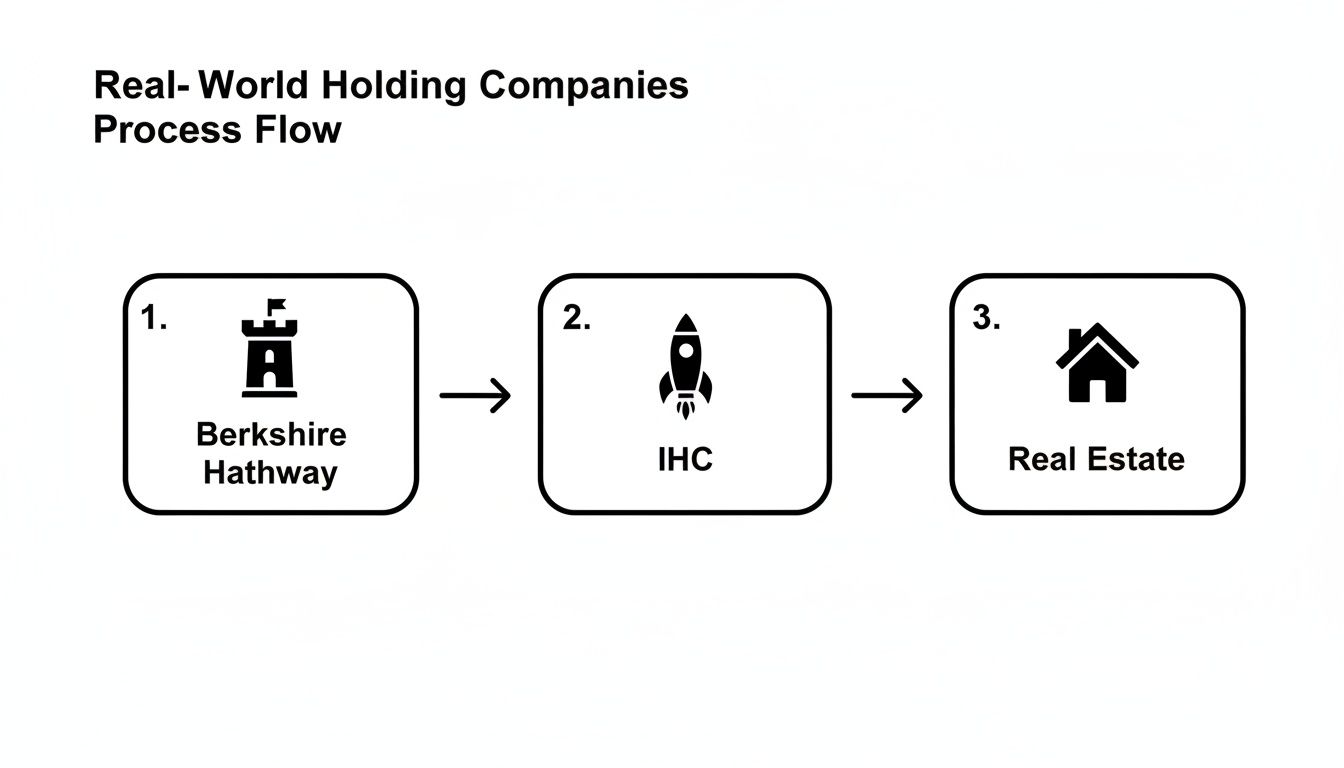
As you can see, the strategy used by Berkshire Hathaway isn't so different from the one a savvy real estate investor uses to shield each property from the liabilities of the others.
Florida vs Delaware for Your Holding Company LLC
Deciding between Florida and Delaware depends entirely on your goals. Here’s a direct comparison of the factors that matter most to entrepreneurs when choosing a legal home for their holding company.
| Factor | Florida LLC | Delaware LLC |
|---|---|---|
| Simplicity & Cost | Generally more affordable and straightforward for Florida-based founders. No need for a registered agent in another state. | Higher initial and annual franchise tax costs. Requires a Delaware registered agent, adding another administrative layer and fee. |
| Privacy | Member/manager information can be publicly accessible, offering less anonymity. | Allows for greater anonymity. The names of LLC members and managers are not required to be listed on public formation documents. |
| Legal Environment | Solid and reliable business laws, but courts are generalist. Disputes can take longer and be less predictable than in Delaware. | The Court of Chancery is a specialized business court. Its judges are experts in corporate law, leading to faster, more predictable outcomes. |
| Investor Appeal | Perfectly acceptable for local investors, family funds, and self-funded ventures. | The gold standard for venture capitalists and institutional investors, who are familiar and comfortable with its laws. |
For most of our clients with operations focused in South Florida, a Florida LLC offers the right balance of protection and simplicity. However, if your long-term plan involves raising significant venture capital from outside the state, Delaware is a conversation we need to have.
Step 2: File the Paperwork and Draft an Operating Agreement
Once you’ve picked a state, the next step is filing the "Articles of Organization" with the Secretary of State. This is the document that officially brings your LLC into existence. While filing is a simple administrative task, the next step is where the real legal strategy comes into play.
For a detailed walkthrough on the state-specific filing process, check out our guide on how to form an LLC in Florida.
Your Operating Agreement is the single most important document for your holding company. This is the private rulebook for your entire structure. A weak or generic agreement is an open invitation for future disputes. It must be drafted with precision to define:
- Ownership: Who owns what percentage of the holding company.
- Management: How key decisions are made and who holds the authority to make them.
- Distributions: The exact process for how profits from subsidiaries flow up to the holding company and out to the owners.
- Capital Contributions: How the company is funded and what happens when more capital is needed.
Pro Tip: A robust operating agreement should explicitly state that the LLC’s purpose is to act as a holding company and must outline procedures for acquiring, managing, and selling subsidiary companies. Never, ever use a one-page template for this.
Step 3: Open Bank Accounts and Capitalize the Company
Respecting the "corporate veil" is non-negotiable, and it starts with total financial separation. Your holding company must have its own dedicated bank account. It cannot share an account with you personally or with any of its subsidiaries.
Mixing funds—known as "co-mingling"—is the fastest way to give a court a reason to pierce the corporate veil and make your personal assets vulnerable.
After opening the account, you must properly capitalize the company. This means formally funding it with enough capital to conduct its business (which, in this case, is owning other companies). This initial contribution must be documented in your operating agreement and is then used to purchase the ownership interests in your operating subsidiaries. This transaction is what creates the formal parent-subsidiary relationship.
A holding company is an incredibly powerful tool for asset protection and growth. But its effectiveness is completely dependent on meticulous setup and disciplined maintenance. By following these steps and treating the legal formalities with the seriousness they deserve, you can build a structure that scales with your ambition.
Common Pitfalls and How to Avoid Them
Setting up a holding company is just the first step. The real work—and the real protection—comes from maintaining it correctly. We see it all the time in our practice: founders invest in creating a powerful structure only to undermine it with simple, avoidable mistakes.
These errors can lead to a court "piercing the corporate veil," which means the legal separation between you and your companies is ignored. Suddenly, the assets you thought were shielded are completely exposed. Let's walk through the most common traps and how you can sidestep them.
Pitfall 1: Piercing the Corporate Veil
The whole point of this structure is legal separation. But if you treat your companies like personal piggy banks, a court will, too. Piercing the veil happens when a judge decides your companies aren't truly separate entities but just an “alter ego” for you or for each other, which completely voids your liability protection.
This is almost always caused by two major mistakes: co-mingling funds and ignoring corporate formalities. Co-mingling is as simple as using one company's bank account to pay another's bills or mixing business cash with your personal finances. Ignoring formalities means you're not keeping separate records, holding annual meetings, or documenting major decisions.
Pro Tip: Impose strict financial discipline from day one. Every single entity, from the holding company down to the smallest subsidiary, needs its own separate bank account. All money that moves between your companies must be documented with formal loan agreements or service contracts to prove they operate at arm's length.
Pitfall 2: Using a Generic Operating Agreement
Downloading a one-size-fits-all operating agreement off the internet is one of the biggest risks you can take. These templates are not built to manage the complex relationship between a parent company and its subsidiaries, and they almost always fail to address the critical issues a holding structure creates.
A weak agreement leaves massive gaps. It creates ambiguity around how profits flow from a subsidiary up to the parent, or how key decisions are made across the entire family of companies. That ambiguity is exactly what a creditor needs to challenge the legitimacy of your entire setup.
Your operating agreement should be a custom blueprint that clearly defines:
- The exact process for profit distributions and capital contributions.
- The specific roles and authority of managers in the holding company versus the subsidiaries.
- Clear procedures for adding, selling, or dissolving subsidiary companies.
Pro Tip: Your holding company's operating agreement is the constitution for your business empire. Work with an attorney to draft a document that explicitly maps out its role as a holding company and how it governs its subsidiaries. This initial investment is what prevents incredibly expensive legal battles down the road.
Pitfall 3: Neglecting Compliance and Maintenance
Forming your LLCs isn’t a "set it and forget it" activity. Each company in your structure has ongoing state requirements that must be met every single year. Forgetting to file an annual report or pay a franchise tax for just one subsidiary can get that company administratively dissolved by the state.
An inactive or non-compliant company has zero liability protection. It becomes a weak link in your asset protection chain, creating a vulnerability that could expose your other companies. Think of your holding structure like a high-performance engine; it needs regular maintenance to run properly and keep you safe.
Statistically, holding companies are a dominant force, allowing decentralized empires to weather market volatility. The Fortune Global 500 firms, many of which rely on holding structures, generated $41.7 trillion in revenue, proving the model's power and resilience. You can read more about the scale of these global companies on Fortune.com.
Pro Tip: Create an annual compliance calendar for your entire corporate family. Set hard deadlines and reminders for every filing and fee payment for the holding company and each subsidiary. Treating compliance as a non-negotiable routine is the key to making your asset protection last.
Avoiding these pitfalls isn't about complex legal maneuvers—it's about discipline. By treating each company as a distinct legal person and respecting the formalities, you ensure your holding company LLC delivers the robust protection it was designed to provide.
If you’re ready to ensure your business structure is built and maintained the right way, our team is here to help. Schedule a consultation with our team today and get the peace of mind that comes with founder-minded legal strategy.
Secure Your Legacy with Strategic Legal Guidance
A holding company LLC isn't just another legal filing; it's the architectural blueprint for a lasting business empire. We've walked through how this structure can shield your assets, create serious financial flexibility, and give you a platform to grow without putting everything at risk. For ambitious founders ready to protect what they've built, it’s the logical next step.
But while the concept is powerful, execution is everything. The difference between a fortress and a house of cards comes down to disciplined planning and a real understanding of corporate law.
Your Next Step Toward Lasting Protection
A properly managed holding company delivers on its promises. The risks of getting it wrong, however, are just as real. From maintaining pristine, separate bank accounts to drafting an ironclad operating agreement, every single detail matters. This is how you effectively isolate business risks, manage capital across your ventures, and create a simple ownership structure for future growth or an eventual exit.
The goal is to build a corporate structure so solid that it not only supports today's businesses but also provides a concrete foundation for the next generation. It’s about converting your hard-won success into a secure, transferable legacy.
Getting this right requires a partner who thinks like a founder but executes with the precision of a seasoned attorney.
Tips for a Secure Future
As you weigh this powerful strategy, keep these non-negotiable rules in mind:
- Prioritize a Custom Operating Agreement: Never settle for a generic template. Your operating agreement is the constitution for your entire enterprise. It must be custom-drafted to govern the parent-subsidiary relationships and protect your interests.
- Enforce Strict Financial Discipline: Keep completely separate financial records and bank accounts for each and every entity. Any money moving between companies must be formally documented as a loan or a service payment to maintain the corporate veil. No exceptions.
- Establish a Compliance Calendar: You must track all annual report deadlines and state fees for every LLC in your structure. Consistent, timely compliance is the only way to ensure your liability protection remains intact.
This disciplined approach is what makes a holding company LLC work. Just as a well-planned estate secures wealth for your family, a well-structured holding company secures your business legacy. For more on protecting your assets, see our guide on trusts and estates in Florida.
Take Action with Expert Guidance
Building a holding company is a defining moment for any serious entrepreneur. It marks the transition from just running a business to building a durable empire. The details are what separate success from failure, and getting them right from day one is the key to real, lasting protection.
If you are ready to take this critical step, you don't have to navigate it alone. Schedule a consultation with our team today to partner with legal experts who will help you design and implement a founder-focused strategy that secures your assets and prepares your business for whatever comes next.
Frequently Asked Questions About Holding Company LLCs
As you explore this powerful structure, it’s natural to have questions. A holding company LLC is a strategic move, and getting the practical details right is what separates a strong shield from a house of cards. Here are the clear, direct answers to the most common questions we hear from founders.
How Much Does It Cost to Set Up and Maintain This?
Think of the cost not as a single fee, but as an investment in multiple layers of legal armor. The total price is a collection of expenses for each separate legal entity you create.
Your initial setup will involve state filing fees for the holding company itself, plus each subsidiary LLC you place under it. After that, you'll have ongoing maintenance costs, which typically include:
- Annual Report Fees: Every LLC in your structure must file an annual report with the state to stay in good standing.
- Registered Agent Services: If you form your LLCs in a state where you don't have a physical office, you’ll need a registered agent service for each one.
- Franchise Taxes: Some states, like Delaware, impose an annual franchise tax on LLCs.
Pro Tip: While these costs add up, they are the price of real asset protection. Using a flat-fee legal service makes your setup and compliance costs predictable, which helps you budget effectively and avoid the surprise bills that can derail an early-stage venture.
Can My Existing Business Become a Subsidiary?
Yes, absolutely. This is one of the most common ways founders use this structure, and you don’t have to start over from scratch. The process is straightforward: you form a new holding company LLC and then formally transfer the ownership of your existing operating business to it.
We accomplish this with a legal document called an Assignment of Membership Interest. This document legally moves your ownership from you (as an individual) to your new holding company. Your original business now operates as a wholly-owned subsidiary, neatly protected under the holding company’s umbrella.
Action Step: If you have an existing business, consult with a lawyer to ensure the ownership transfer is documented correctly. This step is critical to establishing the parent-subsidiary relationship legally.
When Is the Right Time to Set Up a Holding Company?
The best time to create a holding company is before you add major risk or complexity to your business world. It’s always smarter—and far less expensive—to be proactive rather than scrambling to separate assets after a lawsuit or liability has already appeared.
You should seriously consider setting one up if you are about to:
- Launch a second business and need to keep its liabilities completely walled off from your first.
- Buy a significant new asset, like a commercial property or valuable intellectual property, that you want to shield from the risks of your operating companies.
- Isolate a high-risk venture (such as a construction or logistics company) from a more stable business with healthy cash reserves.
Action Step: The right time is when you have valuable assets that are worth protecting from the risks of another part of your enterprise. Evaluate your portfolio now to see if you've reached that point.
A holding company LLC is a powerful tool for protecting your assets and building a scalable business empire, but the details are everything. At Coto & Waddington, Attorneys at Law, we deliver founder-focused legal strategy to make sure your structure is built to last.
Ready to secure your legacy? Schedule a consultation with our team today.