You and your co-founder are probably in one of two places right now. You're either moving fast, building product, splitting work naturally, and telling yourselves you'll paper things later. Or you've already downloaded a founders agreement template, opened it, and realized the hard part isn't the document. It's the conversation the document forces you to have.
That's exactly where most early teams get stuck in Miami, Fort Lauderdale, and across South Florida. Two people can agree on the idea and still disagree on almost everything that matters once money, ownership, pressure, and outside opportunities enter the picture. A template helps, but only if you use it the right way. Its primary value isn't filling blanks. It's using the agreement to surface assumptions about control, equity, time commitment, intellectual property, and what success looks like for each founder.
Table of Contents
- Why Your Startup Needs More Than a Handshake
- Anatomy of a Founders Agreement What to Include
- How to Fairly Divide Equity and Set Vesting Terms
- Defining Roles Protecting IP and Making Decisions
- Handling Founder Exits with a Buy-Sell Agreement
- Your Next Step From Template to Tailored Agreement
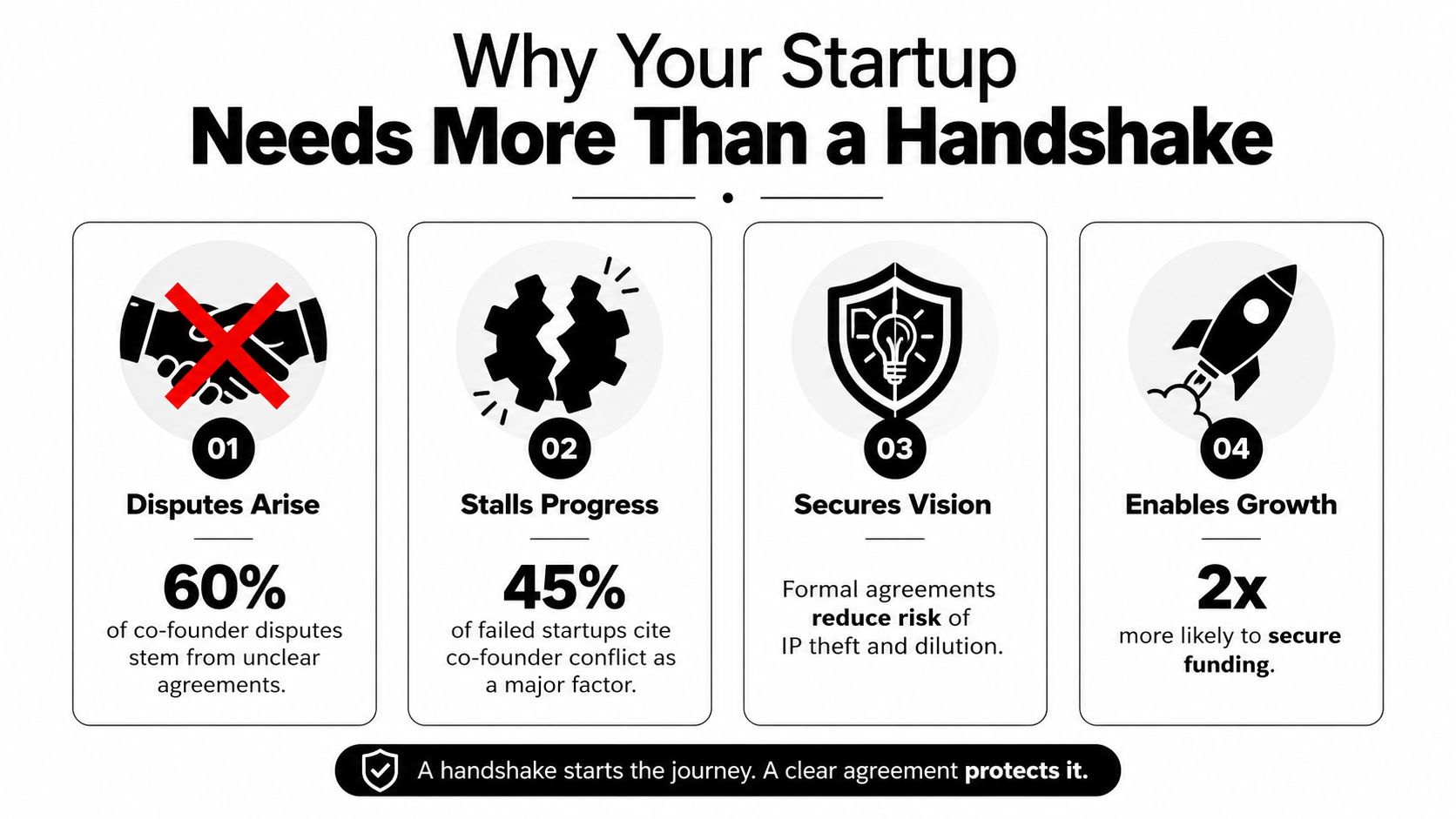
Why Your Startup Needs More Than a Handshake
A handshake works when nothing changes. Startups change constantly.
One founder takes a salaried role elsewhere for a few months. Another starts working nights and weekends while still calling themselves full time. A developer says the code was written before the company existed. A spouse asks what happens if the business is sold. A potential investor asks who owns the IP and whether founder equity is vested. That's when informal understandings break down.
Over 65% of startup failures are directly linked to founder conflict or the absence of a clear founders agreement, according to Swisspreneur's discussion of founders agreements. That number tracks with what startup lawyers see in practice. The problem usually isn't bad faith at the beginning. It's unspoken assumptions colliding later.
A template is a conversation tool
A good founders agreement template does one important job well. It puts the uncomfortable questions on the table before they become expensive.
That means asking things like:
- Who is full time: Not who hopes to be full time, but who is committing.
- Who is putting in cash or equipment: If someone contributes money, software licenses, hardware, or customer relationships, write it down precisely.
- Who owns pre-existing work: Code, branding, domain names, designs, and data sets need a clear path into the company.
- What happens if someone leaves early: If you don't answer that now, you're leaving it for the worst possible moment.
Practical rule: If a clause feels awkward to discuss, that clause probably belongs in the agreement.
South Florida founders often build in fast-moving environments. A Wynwood consumer brand can launch with a Shopify store and contract creatives in days. A Brickell fintech team can build a prototype while working from a shared workspace and talking to angel investors the same month. Speed is useful. Sloppiness isn't.
What a handshake can't do
A handshake can't document ownership. It can't assign IP. It can't establish vesting. It can't create a process for deadlocks or exits. And it won't help much when you're raising capital beyond venture capital and a lender, angel, or revenue-based financing partner asks to review your formation and founder documents.
The practical tip here is simple. Use the template early, before momentum and money harden positions. Don't treat it as a trust test. Treat it as operating discipline. The founders who handle these conversations when the company is still small usually preserve both the business and the relationship.
Anatomy of a Founders Agreement What to Include
A founders agreement template shouldn't read like mystery legal prose. At its best, it's a checklist of the issues your team must resolve with specificity. If the template is too short, that's usually a warning sign. PandaDoc notes that even a simple founders agreement template typically runs around 16 pages and covers roughly twenty to thirty issues.
Start with ownership and consideration
The first block of terms should answer a basic question. Who owns what, and what are they giving in exchange?
That usually includes:
- Equity allocation: The percentage or share count for each founder.
- Capital contributions: Cash, equipment, software, customer introductions, or other assets contributed at the start.
- Time commitment: Full time, part time, transition period, or milestone-based involvement.
In practice, generic templates often fail South Florida teams in such situations. One founder says, "I'm bringing the concept and industry contacts." Another says, "I'm building the product and handling operations." Both may be right, but unless the agreement translates those contributions into legal and economic terms, resentment starts building early.
Protect the company's core assets
The next part should lock down ownership of what the business is creating.
That means the agreement needs to address:
- Pre-existing IP: Any code, content, brand assets, or processes created before the company.
- Future IP: Everything developed during the founder's work for the business.
- Confidential information: Customer lists, pricing, internal documents, and proprietary workflows.
A founder's laptop is not a safe place for the company's legal ownership. If the product lives in GitHub, Figma, Google Drive, or a registrar account under one person's name, the business has a real problem until that ownership is formally transferred.
For founders operating across borders, it also helps to review how startup organizing documents differ in other markets. A useful comparison point is this UAE & MENA startup charter, especially for teams with international co-founders or expansion plans.
Build governance into the document
The agreement also needs rules for how the founders will run the company, making the document practical rather than just theoretical.
A standard founder agreement template should cover:
- Roles and titles: CEO, CTO, COO, or whatever structure reflects reality.
- Voting rights: Who votes, when, and on what.
- Major decision approvals: Which actions require everyone to agree.
- Dispute resolution: What happens when the founders are stuck.
A major baseline here is vesting. A standard founder agreement template legally mandates a 4-year vesting schedule with a 1-year cliff period, which is treated as the industry standard for founder equity alignment in Promise Legal's founder agreement template discussion. The point isn't punishment. It's protection. If someone leaves before the cliff, the company isn't left carrying dead equity forever.
A founders agreement works best when it answers the questions founders are most tempted to postpone.
Tip: Before you customize any founders agreement template, have each founder mark the three clauses they care about most and the three they least understand. That alone will expose where negotiation time needs to go.
How to Fairly Divide Equity and Set Vesting Terms
Equity negotiations rarely blow up because founders can't do math. They blow up because equity is standing in for recognition, influence, sacrifice, and future control.
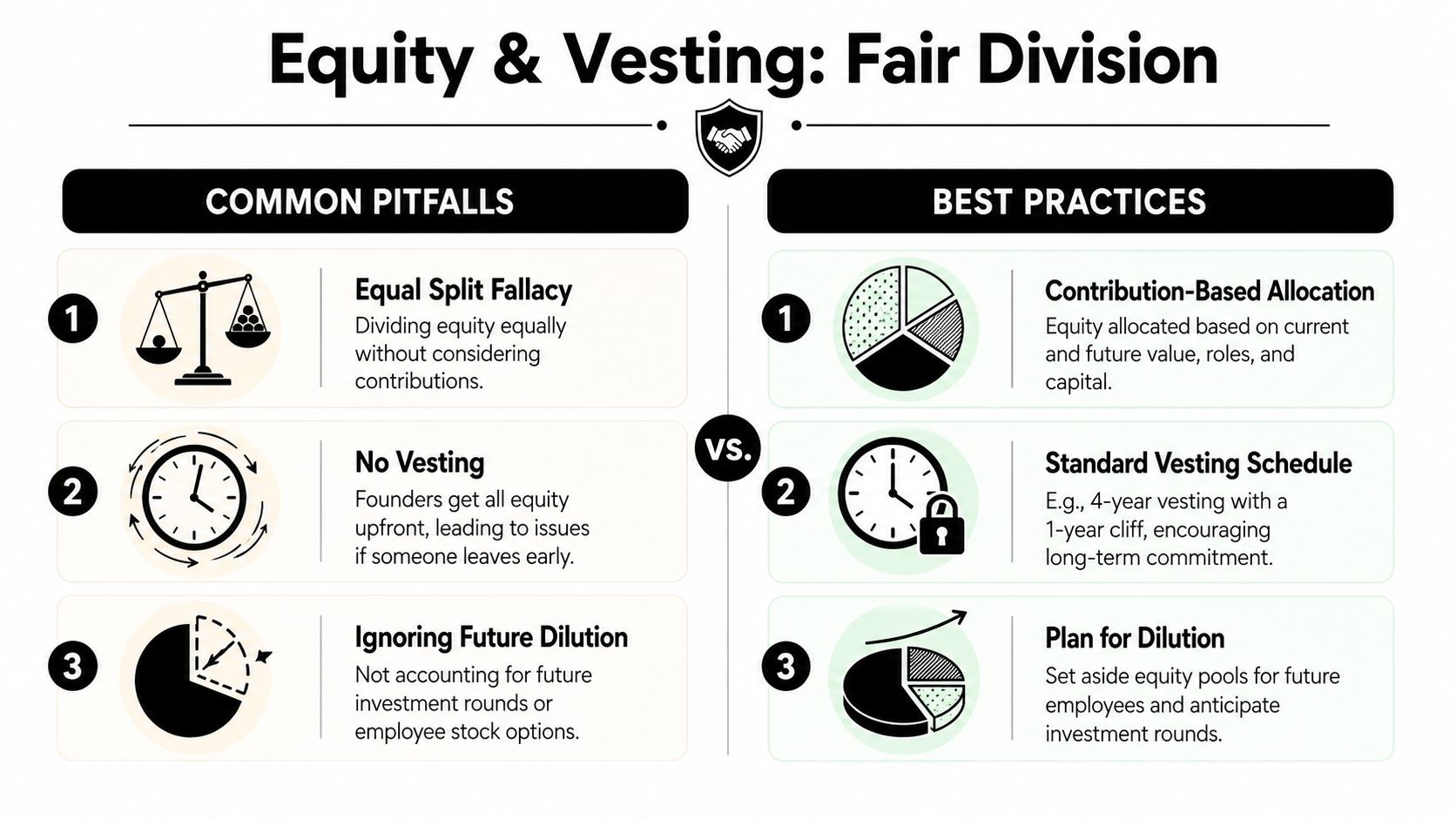
A lot of early teams in South Florida default to a clean split because it feels diplomatic. Two founders go 50/50. Three founders divide evenly. It feels efficient and fair in the moment. Later, one person is effectively carrying the business, another is part time, and the "fair" split becomes the source of daily friction.
Why equal is not always fair
Misalignment, not just legal drafting, causes many founder disputes. Fi.co reports that 70% of founder conflicts stem from misaligned goals and that startups with documented vision alignment protocols show 35% higher retention rates among founding teams over 12 months.
That matters because equity is partly a legal allocation and partly a statement of what the founders believe the company needs to win. If one founder wants a fast exit and another wants a long operating runway, a clean split won't fix that disagreement.
A practical way to negotiate the split
Use the founders agreement template after you've had a structured business conversation, not before. A simple process works better than arguing percentages in the abstract.
Define each founder's role in plain English.
Don't start with ownership. Start with who is building product, who is selling, who is funding early operations, and who is accountable for execution.List current contributions separately from future commitments.
Prior work matters, but future work usually matters more. A founder who built the prototype but can't stay engaged full time shouldn't be treated the same as a founder who will run the company day to day.Document constraints transparently.
If someone has another job, immigration considerations, family obligations, or a side business, say it now.Decide what success means.
Revenue growth, fundraising, lifestyle business stability, acquisition, or long-term brand building can all be rational goals. They are not the same goal.Tie the final split to vesting.
Ownership should be earned over time, not handed out in a way that the company can't fix later.
The cleanest founder negotiations happen when each person can explain not only what they want, but why the company benefits from that structure.
Comparing common equity approaches
| Approach | What works | What usually goes wrong |
|---|---|---|
| Equal split | Fast, simple, low-friction at formation | Ignores uneven time, risk, or operational load |
| Contribution-based split | Better fit when founders bring different assets or roles | Can devolve into arguments over how to value non-cash contributions |
| Dynamic or adjustable split | Useful when contributions are expected to change materially | Harder to administer and easy to misunderstand without careful drafting |
There isn't one universally correct model. There is only a model the founders understand, accept, and can defend later.
For the papering side, equity often gets implemented through restricted stock documents rather than just a memo in the founders agreement. If you're reviewing mechanics alongside your template, it's worth understanding how a stock purchase agreement fits into the founder equity package.
Make the cap table real
Founders also need to see how vesting affects ownership over time. Abstract percentages create false confidence. A simple cap table example usually makes the issue click.
- Founder A: full-time operator, larger equity grant, subject to vesting
- Founder B: technical founder, comparable grant, subject to vesting
- Founder C: part-time strategic founder, smaller grant, subject to vesting
- Employee pool: reserved early so future hires don't force an emergency renegotiation
A standard structure uses a 4-year vesting period with a 1-year cliff, and Failory's explanation of founders agreements notes the practical effect clearly. If a founder leaves before the one-year cliff, they receive zero equity. If they leave after that point, they keep only the portion vested through their service period.
Tip: Put the equity rationale in writing, even if it's a short internal memo. When memories change, contemporaneous notes help founders remember why the split made sense at the time.
Defining Roles Protecting IP and Making Decisions
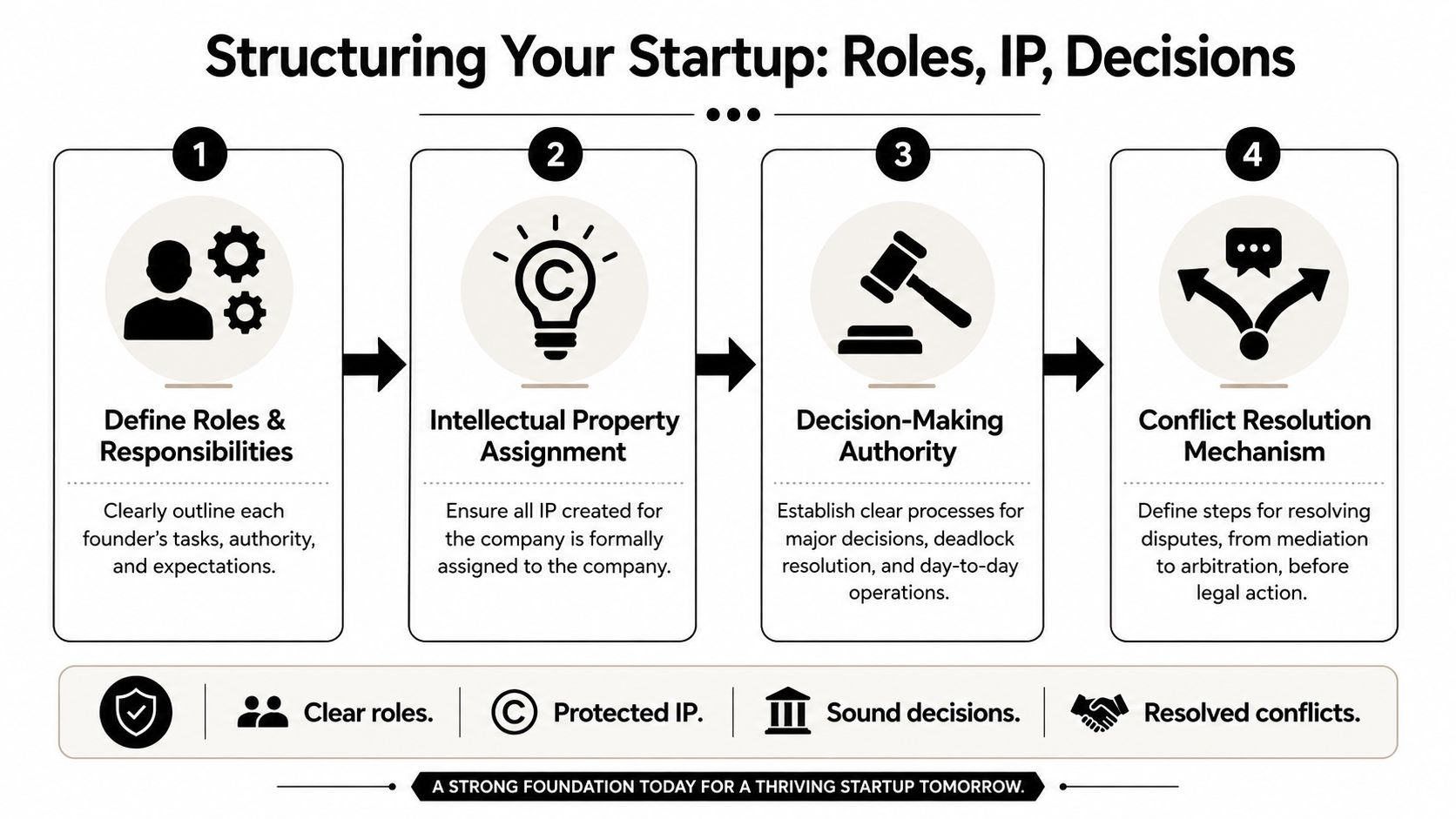
Once founders settle ownership, significant operational risk shows up elsewhere. People step on each other because authority is fuzzy. Product assets sit in personal accounts. Basic company decisions get delayed because nobody agreed on who decides what.
Roles should describe actual authority
A title without authority doesn't solve much. "CEO" can mean final say on strategy, or it can mean the person who talks to investors while every decision still requires group approval.
A better approach is to define:
- Primary responsibilities: Sales, engineering, finance, operations, hiring, compliance.
- Authority limits: What each founder can approve alone.
- Time expectations: Full time, part time, or transition schedule.
- Reporting rhythm: Weekly founder meeting, monthly budget review, product roadmap signoff.
In practice, a Miami e-commerce founder might control vendor relationships and channel strategy, while the technical co-founder owns platform architecture and security decisions. That division works only if both sides agree where one domain ends and the other begins.
IP belongs in the company not in a founder's laptop
This issue causes more investor panic than founders expect. If the domain, source code, design files, or trademark application sit under an individual's name, there is avoidable cleanup work before financing, licensing, or sale discussions.
The founders agreement should require assignment of:
- Pre-incorporation work that relates to the business
- All future work product created for the company
- Associated accounts and registrations, such as domain names, repositories, and brand assets
For a practical overview of the business side of this issue, this Domain Drake IP guide is a useful companion to founder planning. And if you need a legal overview of common protection tools, review this discussion of how to protect intellectual property.
Decision rules prevent avoidable fights
The most common structural mistake is skipping a real dispute process. Yousign's guide to building a founder agreement identifies the omission of clear conflict resolution mechanisms, such as mandatory mediation or arbitration, as the most common pitfall because it creates prolonged deadlocks.
That problem is preventable if the agreement separates decisions into categories.
| Decision type | Better approval standard |
|---|---|
| Routine operations | Simple majority or assigned founder authority |
| Significant financial commitments | Supermajority or specified founder approval |
| Major strategic actions such as selling the company | Unanimous consent |
If everything requires unanimous consent, the business slows down. If nothing does, one founder can take actions the others never agreed to.
Tip: Add a deadlock ladder. Start with a founder meeting, then written issue framing, then mediation, then a final mechanism if mediation fails. Teams rarely regret having that roadmap. They often regret not having it.
Handling Founder Exits with a Buy-Sell Agreement
Founder exits feel remote when the company is new. They become very real when someone burns out, relocates, loses conviction, or has to step away for personal reasons. That's why the buy-sell section matters. It gives the business a process before emotions drive the outcome.
A well-drafted clause isn't just about removing a departing founder. It's about preserving the company and giving everyone a fair path through a hard moment.
What usually triggers the clause
Most founder agreements should address several exit scenarios:
- Voluntary departure: A founder wants out.
- Termination for cause: Misconduct, serious breach, or other specified conduct.
- Long-term disability or death: The company needs a transfer mechanism.
- Persistent failure to meet agreed commitments: This needs careful drafting, but it shouldn't be ignored.
One problem with generic templates is that they often make every exit feel punitive. That's shortsighted. A LinkedIn analysis of 2,500 startup founder breakups found that 62% of departing founders report feeling "punished" by standard exit clauses, and agreements including mediation-first clauses reduce legal disputes by 41%.
How teams set a fair buyout process
The smartest buy-sell clauses do two things at once. They define the trigger, and they define the economics.
Common valuation approaches include:
- Fixed formula: Useful when the company is early and wants predictability.
- Mutual agreement at the time of exit: Works when founders still communicate well.
- Independent appraisal: Better when trust is low or the business has become more valuable and complex.
A practical example helps. Two founders start a service business in South Florida. After growth, one wants to leave and join family abroad. If the agreement says only that the company "may repurchase" shares, that leaves too much uncertainty. If it sets a clear process, with timing, valuation method, payment structure, and treatment of vested versus unvested equity, the founders can move through the breakup without freezing operations.
For a deeper look at the mechanics, review this explanation of what is a buy-sell agreement.
A founder exit clause should protect the company without turning the departure into a vendetta.
Tip: Include a payment structure the company can afford. A theoretically fair buyout that forces a cash crisis doesn't help the remaining founders or the departing one.
Your Next Step From Template to Tailored Agreement
A founders agreement template is useful. It gives structure, prompts negotiation, and helps founders stop avoiding the issues that matter. But it is still only a tool.
The moment your situation gets even slightly custom, the risks increase fast. Maybe one founder built valuable IP before the company existed. Maybe the team spans Florida, Latin America, and another jurisdiction. Maybe one founder is part time. Maybe you're preparing for outside investment, licensing deals, or a trademark filing. Those aren't edge cases in South Florida. They're normal startup facts.
Founders must be honest. If the template leaves you debating what a clause means, your agreement isn't finished. If the equity split depends on side conversations, your agreement isn't finished. If your IP chain of title still lives across personal accounts and old invoices, your agreement isn't finished.

A practical final checklist helps:
- Stress-test the assumptions: Ask what happens if a founder leaves, stops contributing, or disagrees with a major decision.
- Match documents to reality: Titles, ownership, and IP should reflect how the business operates.
- Review before fundraising: Investors and counterparties don't like cleanup projects.
- Write down non-legal expectations: Vision, commitment level, and success metrics belong in the conversation even if they are handled outside the strict operative clauses.
The best use of a founders agreement template is to make the hidden issues visible. The best next step after that is legal review that turns those decisions into enforceable, coherent documents.
If you're building in South Florida and need a founders agreement that reflects how your company operates, Coto & Waddington, Attorneys at Law helps startups turn rough templates and founder conversations into specific, practical agreements. The firm advises founders on formation, contracts, capitalization, IP protection, and ongoing business counsel with clear communication and founder-minded strategy.