Think of a buy-sell agreement as a “business prenup” for you and your co-owners. It's a legally binding contract that lays out a clear, agreed-upon plan for what happens if a partner has to leave the business—whether due to death, retirement, disability, or even a serious falling-out. This isn't a sign of mistrust; it's a roadmap for keeping the business stable when the unexpected happens.
Why Your Business Needs a Buy Sell Agreement

Let’s play this out. You’ve poured years into building a successful company with your partner. Then, tragedy strikes, and they suddenly pass away. Without a buy-sell agreement, you could wake up one day and find yourself in business with their spouse, their kids, or another heir who knows nothing about your industry and has zero interest in running the company.
This scenario isn’t just awkward; it’s a recipe for disaster. It leads to operational paralysis, bitter conflicts, and total chaos. A buy-sell agreement is your defense, creating a predetermined exit strategy that answers the toughest questions before they become emergencies. It’s about ensuring a smooth transition that protects everyone involved: the departing owner (or their family), the remaining owners, and the business itself.
The High Cost of Not Having an Agreement
The consequences of skipping this document are real and financially devastating. For small and family-owned businesses, the lack of a formal plan can sink the entire enterprise.
According to business continuity surveys, a staggering 70% of closely held businesses without a buy-sell agreement face ownership disputes after a partner's death or disability. These conflicts result in an average 30-50% loss in the company's valuation from forced sales and litigation costs.
That statistic highlights a painful truth we see in our practice all the time. Without an agreement, you risk losing a massive chunk of your company’s value to legal battles or being forced into a fire sale just to resolve the situation. You can explore more about these case study findings and see how to protect your business from a similar fate.
To put it simply, a buy-sell agreement handles several critical functions that provide security and stability, which is especially important for startups and family businesses here in South Florida.
To give you a clearer picture, here’s a quick summary of what a buy-sell agreement really does for you and your company.
The Buy Sell Agreement At a Glance
| Key Function | Why It Matters for Your Business |
|---|---|
| Creates a Guaranteed Market | It ensures a departing owner or their heirs have a ready and willing buyer for their shares at a fair, pre-agreed price. No desperate searching for a buyer. |
| Prevents Unwanted Partners | The agreement restricts who can own shares, keeping ownership out of the hands of competitors, inexperienced heirs, or even a divorced spouse. |
| Establishes a Fair Valuation | It locks in a clear method for valuing the business, which stops arguments over what the company is worth during a stressful time. |
| Ensures Business Continuity | By providing a clear roadmap, it allows the company to keep operating without interruption during an ownership change. |
This table covers the core benefits, but the real value is the peace of mind that comes from knowing your business is protected from its own internal crises.
Pro-Tip: The best time to create a buy-sell agreement is right at the start of your business partnership. But if you didn’t, it’s never too late to put this crucial protection in place.
Ultimately, having a buy-sell agreement is about smart planning and mutual respect. It’s a foundational document that secures the legacy you and your partners are working so hard to build.
Ready to protect your business? Don't wait for a crisis to force your hand. Contact a business law attorney to discuss creating a buy-sell agreement that safeguards your company’s future.
The Three Main Types of Buy-Sell Agreements
You get it—a buy-sell agreement is the “business prenup” that saves companies from chaos. Now, the question is, which one is right for you? Every business has its own DNA, but these agreements generally come in three flavors.
Picking the right structure is a strategic decision. It dictates who buys, how they buy, and where the money comes from. Let’s break down the practical differences to help you decide which model best protects your South Florida business.
Cross-Purchase Agreements
A cross-purchase agreement is the most direct approach, and it works beautifully for businesses with just a few owners. Here, the owners themselves personally agree to buy out a departing partner's shares.
Imagine you and two partners own a design agency in Miami. With a cross-purchase agreement, if one partner leaves, you and the other remaining owner are contractually bound to buy that person's equity. It’s a simple, owner-to-owner transaction.
Pros:
- Major Tax Advantage: Remaining owners get a "step-up" in cost basis. If you buy shares for $100,000, your new basis is $100,000. When you sell them later, you only pay capital gains on the growth above that price, saving you a significant amount in taxes.
- Simple for Small Teams: With two or three owners, this is clean and easy to manage.
Cons:
- An Administrative Nightmare: The complexity explodes as you add owners. A business with five partners would need 20 separate agreements (or life insurance policies) to cover every possible buyout combination. It becomes unmanageable fast.
- Funding Problems: What if one partner is 60 and the other is 30? The younger partner might not be able to afford the buyout price or the higher life insurance premiums on the older partner. This disparity can make the agreement impossible to execute.
Entity-Purchase Agreements
An entity-purchase agreement, also called a redemption agreement, flips the model. Instead of the owners buying the shares, the business entity itself—your LLC or corporation—is obligated to buy them back.
Think of a popular Fort Lauderdale restaurant with six partners. Rather than the five remaining owners scrambling to pool their funds, the restaurant company uses its own cash or a corporate-owned life insurance policy to purchase the departing partner’s shares. The company absorbs the equity.
With an entity-purchase agreement, the company handles the entire buyout. This centralizes the process, avoids the mess of multiple individual agreements, and keeps the transition clean for businesses with many owners.
This is the go-to structure for companies with more complex ownership. The business only needs to own one life insurance policy per owner, making it far easier to administer than the tangled web of a cross-purchase plan.
Hybrid Agreements
What if you want the tax benefits of a cross-purchase but the simplicity of an entity-purchase? You can have both. A hybrid agreement, often called a "wait-and-see" agreement, offers maximum flexibility by blending the two approaches.
This structure creates a specific order of operations. First, the business gets the right of first refusal to buy the shares (the entity-purchase part). If the company can't or chooses not to, the remaining owners then have the option to buy the shares themselves (the cross-purchase part).
Pro-Tip: Hybrid agreements are perfect for businesses expecting changes. If you’re not sure what your company’s cash flow or ownership structure will look like in five years, this flexibility allows you to make the smartest financial decision when a trigger event actually happens.
Choosing the right structure is a critical decision that directly impacts your taxes, funding strategy, and administrative burden. There is no one-size-fits-all answer.
Ready to determine the best structure for your company? The ideal choice depends on the number of owners, your tax goals, and your vision for the future. An experienced business attorney can help you weigh these factors and draft an agreement that’s built to protect your company.
Key Events That Trigger a Buy Sell Agreement
A buy-sell agreement sits quietly in your company’s files until a specific event “triggers” it, setting the buyout process in motion. These trigger events are the absolute heart of the document, defining the exact circumstances when a partner’s shares must be sold.
Most business owners think of the obvious ones, like death or retirement. But a truly protective agreement anticipates a much wider range of scenarios that can throw a modern business into chaos. Defining these triggers with precision is what prevents confusion, heated arguments, and costly litigation when a crisis hits.
Life Events and Personal Changes
Some of the most common triggers have nothing to do with the business itself—they’re tied to an owner's personal life. When these events happen, a well-drafted buy-sell provides a critical shield, protecting the company’s ownership and stability.
- Death of an Owner: This is the most fundamental trigger. The agreement forces the sale of the deceased owner’s shares to the company or the remaining owners, ensuring heirs don’t become unwilling or unwanted business partners.
- Disability: A long-term disability can leave a business in limbo. Without a clear definition in place, partners can argue endlessly over whether an owner is truly unable to fulfill their duties.
- Divorce: A contentious divorce puts business assets directly at risk. An agreement can trigger a mandatory buyout if a court orders an owner’s shares to be transferred to an ex-spouse, keeping ownership locked within the founding team.
- Personal Bankruptcy: If an owner files for bankruptcy, their company shares could be seized by creditors. A trigger forces a sale back to the business or its partners, protecting the company from outside claims.
Pro-Tip: Your agreement’s definition of “disability” needs to be crystal clear. To avoid future disputes, specify the exact length of absence (e.g., 180 consecutive days) and how it’s determined (e.g., certification from two physicians or qualifying for long-term disability insurance benefits).
The diagram below shows the different types of agreements we discussed previously, all of which are activated by these kinds of trigger events.
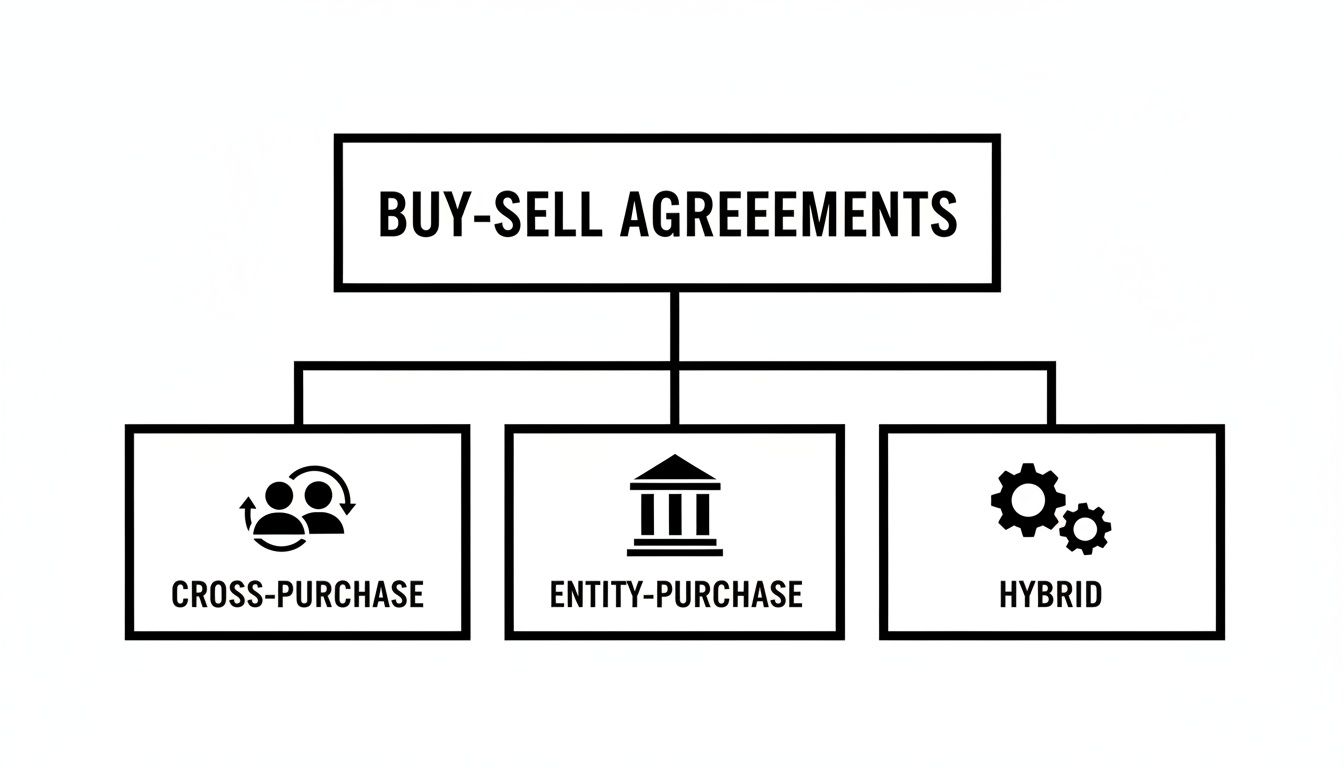
As you can see, a single set of triggers can be handled through different structures—a Cross-Purchase, Entity-Purchase, or Hybrid model—depending on what makes the most sense for your business.
Business-Related Trigger Events
Beyond an owner’s personal life, certain professional events can also force an ownership change. Planning for these scenarios protects the company’s operational integrity and strategic direction. It ensures that when a partner’s journey with the business ends, it happens on your terms, not theirs.
Here are a few crucial business-related triggers to consider:
- Voluntary Retirement or Resignation: An owner who wants to leave should have a clear and orderly path to sell their shares. The agreement must specify the notice period and valuation process to ensure a smooth transition.
- Involuntary Termination: Sometimes, a partnership just sours. The agreement needs a process for removing a partner for cause—things like fraud, breach of fiduciary duty, or the loss of a required professional license—which forces the sale of their shares.
- Shareholder Deadlock: In a 50/50 partnership, a major disagreement can bring the entire business to a grinding halt. A “shotgun” or “Russian roulette” clause can be a powerful trigger here. One partner makes an offer to buy out the other at a specific price; the second partner must either sell their shares at that price or buy the first partner’s shares for the same amount.
These triggers aren’t about preparing for the worst-case scenario. They’re about maintaining control over your company’s destiny, no matter what happens.
Ready to secure your business against the unexpected? The first step is to sit down with your co-owners and have a frank discussion about these potential triggers. An open conversation today can prevent a painful and expensive dispute tomorrow.
How to Properly Value Your Business for a Buyout
Setting the right price is almost always the most heated part of a buy-sell agreement. Get it wrong, and you’re looking at bitter disputes, or even litigation, that completely defeat the purpose of having the agreement in the first place. This is where many partnerships break down. We’re going to demystify business valuation so you and your partners can land on a price that’s fair for everyone.
Think about it. Imagine using a business valuation from five years ago to buy out a partner today. Your South Florida tech startup has since doubled its revenue and landed major clients. That old number would be a massive windfall for the remaining owners, but it would completely shortchange the departing partner who helped build that new value. This is why getting the valuation method right isn't just a detail—it's everything.
The Danger of Outdated Valuation Methods
Relying on an outdated valuation method is a recipe for disaster. We see it all the time in older agreements: a fixed price or a simplistic formula that loses touch with reality the moment the ink is dry. As markets shift and your business evolves, these rigid approaches can lead to catastrophic mispricing.
Research shows that fixed-price or formula-based mechanisms, used in up to 60% of outdated agreements, often ignore market fluctuations and can undervalue a company by 200% or more over time. On the other hand, a proper appraisal is the gold standard. Courts reject rigid formulas in nearly 70% of litigated cases because they just don't reflect reality. You can find more details on why modern valuation methods are critical in this in-depth analysis from Stout.
Let's walk through the three main approaches to business valuation so you can pick the right one for your company.
Formula-Based Valuation
A Formula-Based Valuation uses a predetermined mathematical equation to set the price. It might be something like a multiple of annual revenue, a percentage of book value, or another metric you all agree on. For example, your agreement might state the buyout price is "three times the average annual net profit over the last three years."
This method feels simple and objective, which is why a lot of business owners gravitate toward it at first. The problem is its rigidity. A formula that seemed fair when you were a two-person startup in a garage won't accurately capture your company's value after years of growth, new product lines, or major industry changes. It’s a snapshot in time that can’t adapt.
Agreed-Upon Value
The Agreed-Upon Value method is exactly what it sounds like. All the owners meet periodically—usually every year—to agree on a specific dollar value for the company. That value is then recorded in a document called a "Certificate of Agreed Value" and attached to the buy-sell agreement.
The key to making this method work is consistency. If the owners fail to update the value, most agreements include a backup provision that defaults to another method, often a third-party appraisal, after a certain period (e.g., 18 months).
This approach forces regular, healthy conversations among partners about the company's financial state and where it's headed. But it relies entirely on everyone's ability to reach a consensus, and as any business owner knows, that isn't always easy.
Third-Party Appraisal
The Third-Party Appraisal is widely considered the gold standard for fairness and accuracy. With this method, the buy-sell agreement states that when a trigger event happens, a qualified, independent business appraiser will be hired to determine the company's fair value.
This approach takes emotion and personal bias out of the equation. The valuation is handled by an impartial expert whose only job is to get the number right. To make sure this process runs smoothly, your agreement needs to be crystal clear on a few points:
- Valuation Standard: Specify whether the valuation will be based on Fair Market Value (FMV), Fair Value, or another standard. FMV is the most common and represents the price a willing buyer would pay a willing seller on the open market.
- Appraiser Selection: Detail how the appraiser will be chosen. Will the buyer and seller have to agree on one person? Or will each side hire their own, with a third appraiser stepping in to resolve any major differences?
- Valuation Date: Pinpoint the exact date for the valuation, like "the last day of the month in which the trigger event occurred."
Yes, this method costs more than the others upfront. But that cost is a tiny price to pay to avoid a drawn-out, expensive legal fight down the road. The right valuation method is a core component of a strong business exit strategy plan for any owner.
Pro-Tip: No matter which method you lean toward, talk to your attorney and a CPA. They can help you select and define a valuation process that actually fits your company's unique DNA and protects every owner's financial interests.
Ready to determine the fair value of your business? A clearly defined valuation method is your best defense against future disputes. Let’s talk about how to build a fair and accurate valuation process into your buy-sell agreement.
Smart Ways to Fund Your Buyout Agreement
A buy-sell agreement is just a piece of paper without the money to back it up. After you’ve hammered out the trigger events and valuation methods, the next—and arguably most critical—step is figuring out how the buyout will actually get paid for.
This funding mechanism is the engine that makes the whole agreement work. Get it right, and you have a smooth transition. Get it wrong, and you’re looking at a financial crisis.

Let’s walk through the most common strategies we see South Florida business owners use, each with its own advantages and potential pitfalls.
Life and Disability Insurance
For most businesses, life and disability insurance is the go-to funding tool, especially for buyouts triggered by an owner's death or permanent disability. It’s a clean and surprisingly cost-effective solution.
The structure is straightforward: either the business or the individual owners buy insurance policies on each other. When a trigger event occurs, the policy pays out a tax-free death benefit, providing immediate, liquid cash to buy out the departing owner’s shares.
This method is brilliant because it prevents the company from having to drain its operational savings or scramble to get a loan under duress. When you're looking into policies, a key decision is understanding the difference between permanent and temporary coverage, often framed as a choice between term vs. whole life insurance.
Here's a quick tip: With a cross-purchase agreement, each owner buys a policy on every other owner. With an entity-purchase agreement, the business itself buys a single policy on each owner—a much simpler setup if you have more than two or three partners.
Sinking Funds or Company Cash
Another option is to build a sinking fund. Think of it like a dedicated corporate savings account. The business (or the owners) regularly sets aside cash into this account, which grows over time specifically to cover a future buyout.
The main advantage here is control. You own the money, it’s on your books, and you aren’t paying ongoing insurance premiums.
But this strategy has its own risks. It can take years, even decades, to save enough to cover the business's full valuation. If a buyout is triggered unexpectedly early, you’ll be short. Plus, all that cash is tied up and can’t be reinvested into growing the business.
Installment Payments and Bank Loans
What happens if you don’t have a pile of cash or an insurance policy ready to go? That’s where installment plans and bank loans come in.
- Installment Payments: Your buy-sell agreement can specify that the buyout price will be paid to the departing owner or their estate in chunks over several years. This is usually structured with a promissory note that lays out the interest rate and payment schedule, making the purchase far more manageable for the remaining owners.
- Bank Loans: The company or the remaining owners can go to a bank and secure a loan to finance the purchase. This gets you the cash immediately, but it also adds debt to the company’s balance sheet. A huge downside is that you have to qualify for the loan at the time of the buyout, which is never a guarantee.
The best approach often involves a combination of these methods. For example, you might use an insurance payout as a down payment and then finance the rest through an installment note. This creates a flexible, resilient plan that can adapt to different scenarios.
Comparison of Buyout Funding Methods
Choosing a funding method isn't just about picking one option; it's about building a strategy that secures the company's future. The table below compares the most common approaches to help you see which might be the best fit.
| Funding Method | Best For | Pros | Cons |
|---|---|---|---|
| Life & Disability Insurance | Buyouts triggered by death or disability. | Immediate, tax-free cash payout; cost-effective; predictable. | Only covers specific triggers; ongoing premium costs. |
| Sinking Fund | Disciplined companies with stable cash flow. | Full control over funds; no third-party approvals needed. | Takes a long time to build; ties up capital; may be insufficient if needed early. |
| Bank Loan | Businesses with strong credit and financials. | Provides immediate cash for the full buyout amount. | Adds debt; requires loan approval (not guaranteed); interest costs. |
| Installment Payments | Situations where immediate cash is unavailable. | Spreads the financial burden over time; manageable payments. | Departing owner/estate takes on credit risk; delays full payment. |
Each funding method has unique tax implications for both the buyer and the seller, making it critical to get professional guidance. A poorly structured plan can create unintended financial headaches down the road.
Pro-Tip: Don’t rely on just one funding method. A hybrid approach, such as using an insurance payout for a down payment and financing the rest with an installment note, provides flexibility and resilience.
Ultimately, your funding strategy is what gives your buy-sell agreement its power. Don’t leave it to chance. A well-designed plan protects the financial future of every owner involved and ensures the business you’ve all worked so hard to build can survive and thrive. Contact a financial advisor and business attorney today to structure a funding plan that aligns with your agreement.
Your Step-by-Step Guide to Creating an Agreement
Alright, you know what a buy-sell agreement is and why your business can’t survive without one. You’ve seen the moving parts—triggers, valuation, funding. Now it's time to build it. Putting this critical document together isn't a single task; it’s a deliberate process. For a South Florida business owner, this checklist is your roadmap to creating an agreement that actually protects your company when it matters most.
Think of it this way: you wouldn't use a generic blueprint to build on a prime piece of Miami real estate. Your business is just as unique. A one-size-fits-all template simply won't cut it.
Step 1 Start the Conversation with Co-owners
The first move is to sit down with your partners and have a real conversation about the future—especially the uncomfortable "what ifs." Discussing death, disability, or divorce is never easy, but ignoring these topics is a surefire way to invite disaster down the road.
Use this meeting to get on the same page about your goals. Is the plan to keep the business in the family? Do you see a sale to an outside party in your future? This initial talk sets the foundation for every decision you’ll make from here.
Pro-Tip: Frame this discussion around mutual protection, not a lack of trust. This agreement is a tool to safeguard everyone’s investment and the years of hard work you've all put in.
Step 2 Assemble Your Professional Team
Drafting a buy-sell agreement is absolutely not a DIY project. You need a team of trusted advisors to navigate the legal, financial, and tax minefields. Your "dream team" should include:
- A Business Attorney: They will draft the legal document, making sure it’s ironclad under Florida law and customized to your exact situation.
- A Certified Public Accountant (CPA): Your CPA provides essential insight into the tax consequences of different agreement structures and funding choices.
- A Financial Advisor: This professional is key for structuring the funding, particularly if you’re using life insurance policies to back the agreement.
Step 3 Choose Your Agreement Structure and Triggers
With your team in place, it’s time to make the big decisions. You’ll choose between a cross-purchase, entity-purchase, or hybrid agreement based on how many owners you have and your tax strategy. At the same time, you must spell out the specific trigger events that put the agreement into motion, covering everything from death and disability to divorce and bankruptcy.
Pro-Tip: Be painfully specific. Instead of just writing "disability," define it as the inability to perform duties for 180 consecutive days, as certified by two physicians. Vague language is a breeding ground for future legal battles.
Step 4 Define Valuation and Funding
Next, you need to decide exactly how your business will be valued when a trigger event happens. Will you use a fixed formula, a value agreed upon each year, or a third-party appraisal? As we’ve covered, an independent appraisal is almost always the fairest and most defensible route.
Once you know how to price the shares, you have to figure out how to pay for them. This is where you lock in your funding mechanism, whether it’s life insurance, a sinking fund, an installment plan, or a bank loan.
Key Insight: Your valuation method and your funding strategy are two sides of the same coin. An agreement to buy shares at a high price is useless if the money isn't there to make the purchase. Your funding plan must be realistic and capable of supporting your valuation.
Step 5 Draft Review and Sign the Agreement
Your attorney will now take all these decisions and draft the formal agreement. This is where you rely on their expertise to make sure every detail is captured correctly and legally binding. Once the draft is ready, every single owner—and their own advisors—must review it with a fine-tooth comb.
After making any final revisions, it’s time to make it official. When you get to the signing stage, it's crucial to understand the electronic signature legal requirements to ensure the document is fully valid. Proper execution is the final step in putting this powerful protection in place.
Step 6 Schedule Regular Reviews
A buy-sell agreement is a living document. It is not a "set it and forget it" contract. Your business will grow, its value will change, and the dynamics between partners can shift. Schedule a formal review at least once a year with your partners and attorney to ensure the terms, valuation, and funding are still right for the business.
Final Tip and Call to Action: Fight the urge to download a generic template online. A cheap or free form cannot account for the unique DNA of your business, the specifics of Florida law, or your partnership's actual goals. To get an agreement that works, you need one as unique as your company. For more on this, check out our guide on how to write a business contract.
Ready to build your business prenup? Don't risk your company's future on a generic form. Contact a business law attorney to craft a buy-sell agreement that provides real protection for you and your partners.
Frequently Asked Questions About Buy-Sell Agreements
Once founders grasp the concept of a buy-sell agreement, the practical questions start. We hear the same ones from business owners across South Florida, so we've put the answers right here to give you the clarity you need.
Do We Need an Agreement for a Small LLC?
Absolutely. In fact, it's arguably more critical for small businesses.
Without a formal agreement, if your partner leaves, passes away, or becomes disabled, you could find yourself forced into business with their spouse or heirs under Florida's default state rules. This scenario almost always leads to operational chaos and a complete loss of control.
A buy-sell agreement is the clear, pre-negotiated roadmap that prevents this. It’s one of the most affordable ways to protect what is likely your most valuable asset.
Pro-Tip: Never assume state laws have your back. A custom agreement ensures your wishes—not the state's default rules—are followed during a transition. This is the only reliable way to preserve control within a small partnership.
What Does a Buy-Sell Agreement Cost?
The cost varies, but that's the wrong way to look at it. You have to see it as an investment in your company's survival, not an expense.
The price of drafting a solid, enforceable agreement is a tiny fraction of what you would pay for litigation, valuation fights, or a forced liquidation of your company down the line. The real question isn't "what does it cost," but "can you afford not to have one?"
Tip: Ask potential attorneys about their pricing structures. Many firms now offer flat-fee packages for foundational documents like buy-sell agreements, giving you cost predictability.
Working with a firm that offers predictable, founder-friendly pricing helps eliminate any financial surprises.
How Often Should We Update the Agreement?
You should review it at least annually. This ensures the valuation method and terms are still relevant to where your business is today. An outdated agreement can be just as dangerous as having no agreement at all, especially if a stale valuation massively undervalues your company.
A full update is non-negotiable after any major business event, such as:
- Taking on significant new debt
- Acquiring another company
- A major shift in revenue or profitability
- A change in an owner's personal life (like a marriage or divorce)
As you tackle these updates, it's also a good time to review related documents. You can learn more about how these pieces fit together by exploring information on the Florida shareholder agreement and its function in corporate governance.
A buy-sell agreement is a foundational document for any business partnership. At Coto & Waddington, Attorneys at Law, we provide the founder-minded legal strategy needed to protect your business with a clear, enforceable agreement. Secure your company's future by ensuring you have the right protections in place. Contact us today for a consultation at https://cotowaddington.com.