In Florida, the statute of limitations for defamation is two years, but that doesn't mean you always have two comfortable years to decide what to do. Rules like the single publication rule can make the practical window feel much shorter, especially when the false statement went online long before you found it.
A founder usually discovers the problem backward. The bad review, false accusation, or anonymous post has already been sitting on Google, LinkedIn, Reddit, or an industry forum for months. Revenue starts wobbling, a partner asks an awkward question, a candidate ghosts your team, and only then do you realize the reputational hit may have started much earlier.
That timing issue is where many business owners get trapped. They focus on how damaging the statement is. Courts often focus first on whether the claim was filed on time. If you run a business in South Florida, the practical question isn't just whether something is defamatory. It's whether you still have a viable claim, what evidence you need immediately, and whether an online post that remains visible is still legally “fresh.” Usually, it isn't.
Table of Contents
- Your Reputation Is Under Attack What Now
- Defamation and Statutes of Limitation Explained
- How the Defamation Clock Starts Ticking
- Exceptions That Can Pause or Reset the Clock
- State Deadlines With a Focus on Florida
- Practical Steps to Preserve Your Claim
- When to Consult a Defamation Attorney
Your Reputation Is Under Attack What Now
A common version of this problem looks like this. A business owner searches the company name after a sales call goes quiet and finds a false post accusing the business of fraud, theft, or misconduct. The post isn't new. It's been online for months, maybe longer, and now the owner has two problems at once: reputational damage and uncertainty about timing.

For startups, this hits harder than many people expect. A mature company may absorb a false statement with brand recognition and repeat customers. A newer company often can't. One bad allegation can affect investor conversations, vendor trust, platform relationships, and hiring in a single week.
The first business question is timing
Most founders start by asking whether the statement is false and harmful. That matters, but the first operational question is usually simpler: Have I already run out of time?
That's why the defamation of character statute of limitations matters so much. It acts like a hard filing deadline. If that deadline passed, the strength of the underlying claim may not save the case.
Practical rule: Treat every suspected defamation matter like a time-sensitive dispute from day one, even if you're still deciding whether to sue.
Online damage creates false confidence
Digital content creates a dangerous illusion. Because the post is still live, many owners assume the clock is still running fresh. In practice, that assumption can be costly. What works is immediate documentation, quiet investigation, and a legal review centered on dates. What doesn't work is waiting for “one more bad consequence” before acting.
A parallel track may also help. If your issue includes search visibility, review-platform exposure, or a wider online cleanup strategy, resources on reputation management services UK can be useful for understanding how businesses approach the communications side while legal analysis proceeds separately.
Tip: Don't argue with the poster in public while you're still figuring out dates and evidence. Public retaliation often creates new facts, new screenshots, and unnecessary risk.
Defamation and Statutes of Limitation Explained
Defamation law sounds abstract until it lands on a business. Then it becomes very concrete. A false accusation can interfere with customer trust, make counterparties hesitate, and force a founder to spend time managing fallout instead of running the company.
What defamation means in business terms
At a practical level, defamation is a false statement communicated to someone else that harms reputation. Written defamation is usually called libel. Spoken defamation is usually called slander. For a business owner, the label matters less than the effect.
Business-related examples often involve claims that a company steals from clients, lies about credentials, fakes reviews, breaches contracts, or engages in illegal conduct. Those allegations can spread through review platforms, direct messages, podcasts, newsletters, Slack communities, and investor or vendor conversations.
A strong business analysis usually starts with a short set of questions:
- Was it a statement of fact: Can the statement be proven true or false, or is it just opinion?
- Was it communicated to others: A private thought isn't defamation. A statement sent or posted to third parties may be.
- Can you show harm: Lost deals, strained partnerships, and internal disruption all matter.
- Who said it and where: Platform, speaker identity, and publication date shape strategy.
For executives who want a broader litigation-oriented overview, these expert insights on defamation cases give helpful context on how online defamation disputes are evaluated.
What a statute of limitations really does
A statute of limitations is the legal expiration date on a claim. Once it expires, the court can dismiss the case even if the statement was false and damaging. That's the part many business owners find counterintuitive. The law doesn't only ask, “Were you harmed?” It also asks, “Did you act on time?”
This creates a real trade-off. If you move too slowly, you may lose your advantage entirely. If you move too fast without evidence, you may spend money on a weak or misdirected claim.
Think of the statute of limitations as a filing deadline, not a fairness test. Courts use it to decide whether your claim still gets through the door.
Why founders misread the risk
Founders are trained to wait for more data. In most business problems, that instinct helps. In defamation matters, delay often hurts. Evidence changes, posts get edited, accounts disappear, and timelines become harder to prove.
Tip: Build a simple incident file the moment you suspect defamation. Save screenshots, URLs, dates, and names before you decide on any response.
How the Defamation Clock Starts Ticking
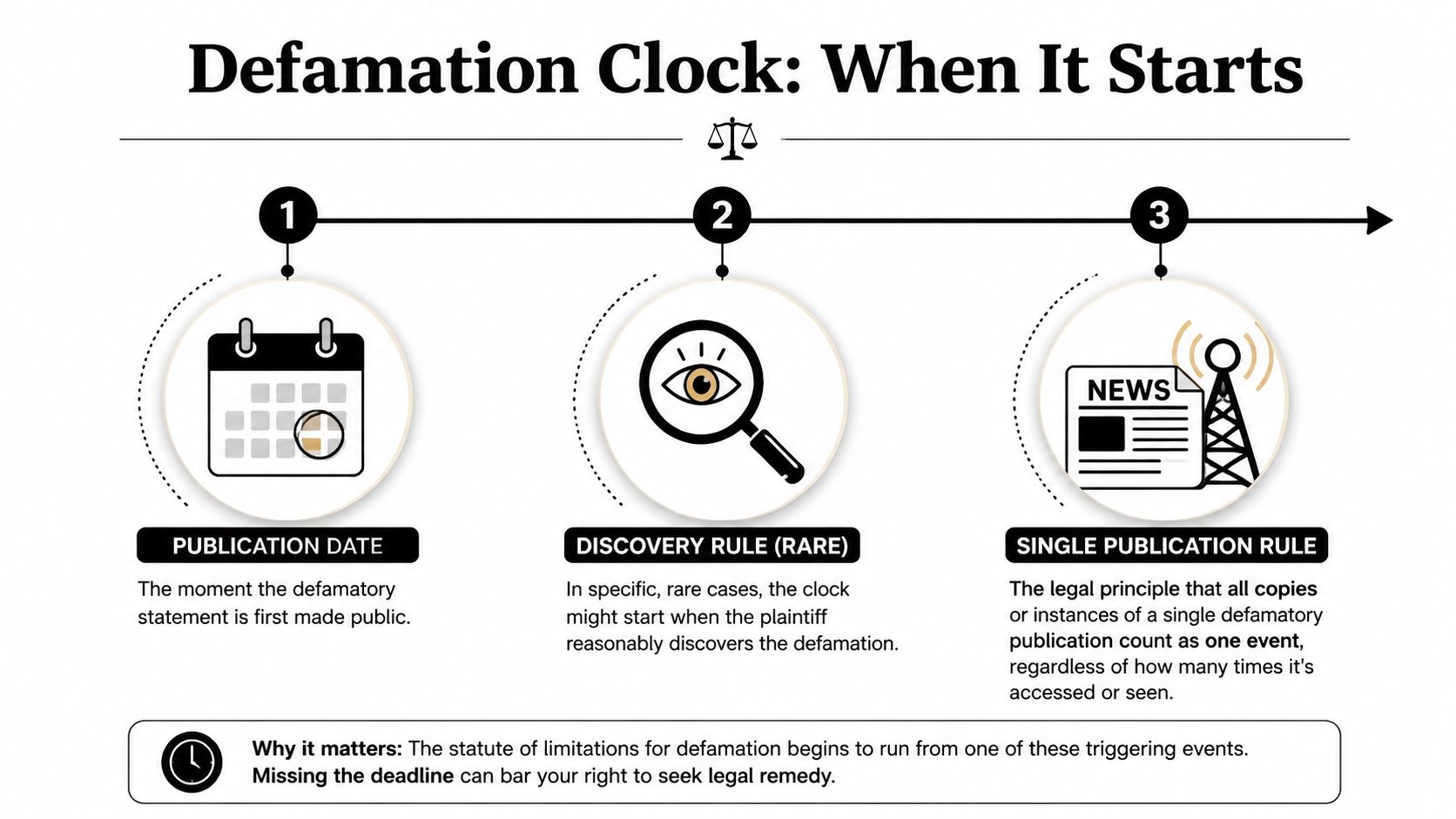
The most misunderstood part of the defamation of character statute of limitations is the start date. Many people assume the deadline begins when they discover the statement, or every time a new person sees it. That's usually wrong.
Publication starts the clock
Under the single publication rule, the cause of action generally accrues on the date the statement is first published to a third party, even if the content stays online. In major markets like Illinois and California, that means the one-year deadline starts immediately upon upload, not when the plaintiff later finds the post, as explained in Nolo's discussion of defamation time limits.
That rule matters because online content can remain searchable for a very long time while the legal filing window keeps moving toward expiration. A founder may discover the statement during due diligence, a financing round, or a sales slump and assume the ongoing visibility keeps the claim current. It usually doesn't.
Why online visibility doesn't usually reset anything
Leaving a post online is not the same as publishing a new statement every day. Courts generally treat one article, one review, one post, or one upload as a single publication event. Repeated views of the same content don't usually restart the clock.
That's where digital businesses get burned. Search results make old content feel active. Algorithms may keep surfacing it. Customers may continue reading it. But continued access is different from a new publication.
If the same post simply stays live, the legal deadline usually tracks the original upload date, not each later impression or click.
What founders should focus on instead
When timing is in question, the useful evidence isn't the latest screenshot alone. It's the earliest provable publication date. That can include the first review timestamp, the original article date, cached results, archived pages, platform metadata, or witness records showing when the statement first appeared.
A practical framework looks like this:
| Issue | What matters most |
|---|---|
| Old review still online | First posted date |
| Blog article updated later | Whether the change was a true republication or just an edit |
| Social post reshared by others | Whether a separate publication created a distinct claim |
| Anonymous account | Whether identity affects tolling under applicable state law |
Tip: Don't build your strategy around the idea that “it's still online, so I still have time.” Build it around the earliest date you can prove and then test for exceptions.
Exceptions That Can Pause or Reset the Clock
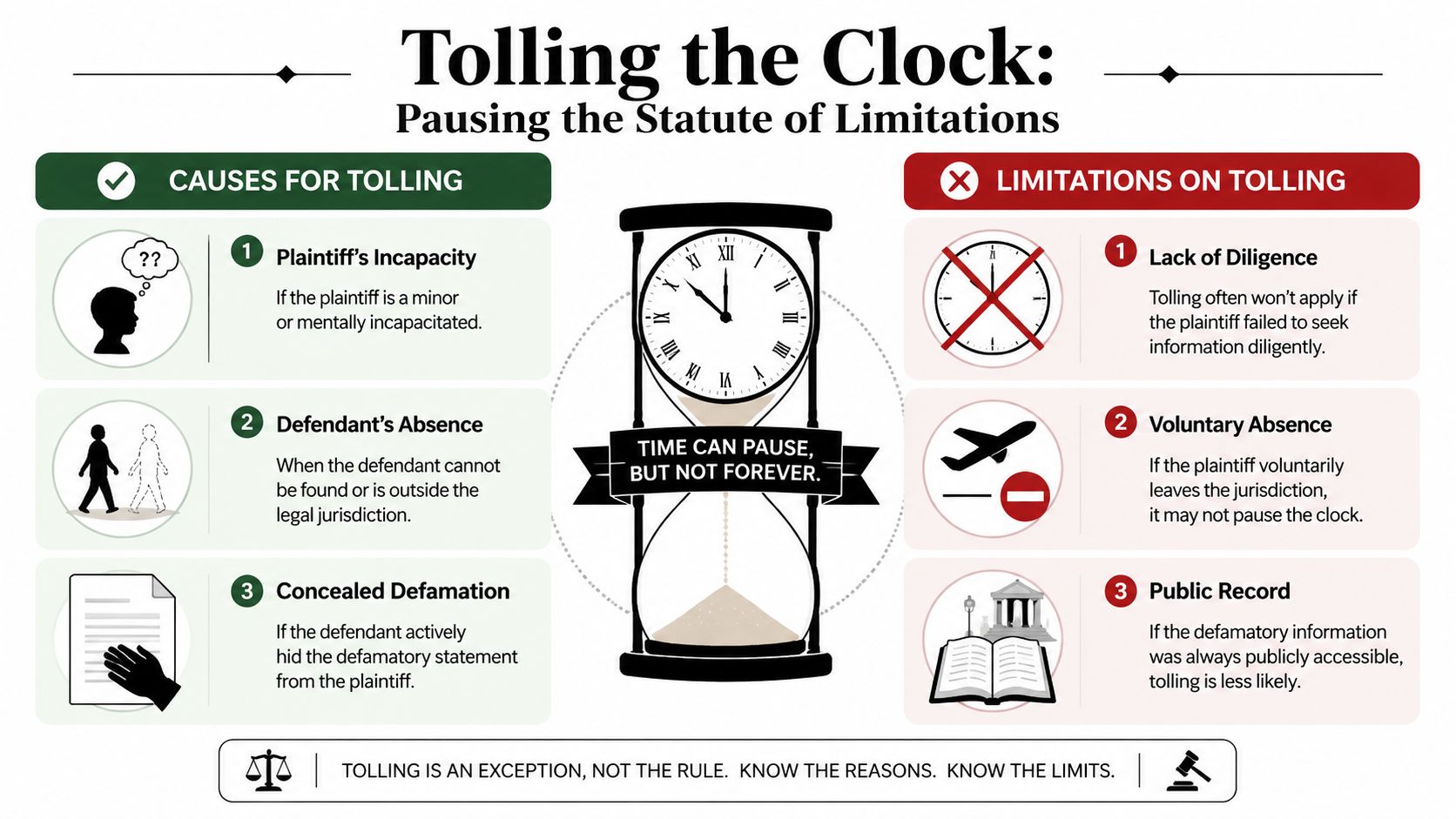
The default rule is strict, but not absolute. In some situations, the law may toll the statute of limitations, which means it pauses the countdown, or it may delay when the claim accrues. These exceptions matter most when the statement was hidden, difficult to discover, or published by someone whose identity wasn't reasonably knowable.
The discovery rule
The discovery rule exists in approximately 40% of states, and it starts the limitations clock when the plaintiff discovers or reasonably should have discovered the defamation, rather than on publication, as discussed in this explanation of defamation filing deadlines and exceptions.
That exception tends to matter in narrower circumstances. A statement buried in an inaccessible report, concealed from the plaintiff, or published in a way that the plaintiff could not reasonably find may fit the logic of the rule better than an ordinary public post on a major platform.
The bar is usually factual, not theoretical. You need a credible explanation for why discovery happened later and why earlier discovery was not reasonably possible.
Tolling for disability or incapacity
Some jurisdictions also pause the statute when the plaintiff is under a legal disability, such as minority or mental incapacity. The same idea can apply when the law recognizes another tolling basis. These rules are highly state-specific, and they should be analyzed carefully rather than assumed.
What works is documentation. If someone plans to rely on tolling, they need records that support the pause and support when the pause ended. What doesn't work is making a general fairness argument without evidence that the state's rule applies.
Anonymous online attacks
Anonymous online defamation creates a special timing problem. You may know a false statement exists but not know who published it. In states like Virginia, the statute for defamation by an anonymous internet user is tolled until the identity is discovered or reasonably should have been discovered through due diligence.
That doesn't mean waiting is safe. It means diligence becomes part of the case.
- Preserve the account evidence: Save the username, profile URL, platform, timestamps, and any linked sites.
- Document your investigation: Keep records of when you reported the content, requested platform information, or pursued identification.
- Track what you reasonably knew: Courts often care about when identity could have been discovered with proper effort.
Anonymous posting can change the timeline, but only if you can show disciplined efforts to identify the speaker.
Tip: If an anonymous account is involved, start the evidence trail immediately. Delay can weaken both the merits of the claim and any argument for tolling.
State Deadlines With a Focus on Florida
There is no single national deadline for defamation claims. State law controls, and the differences are large enough to change strategy from the outset. A company operating across several states can easily assume the wrong filing period if it treats defamation like a uniform rule.
Defamation statute of limitations by state
Defamation statutes of limitations vary from a strict one-year deadline in states like California and New York to a three-year window in Massachusetts, while Florida sets a two-year deadline, creating a meaningful difference for businesses with activity in multiple states.
| State | Statute of Limitations |
|---|---|
| California | 1 year |
| New York | 1 year |
| Texas | 1 year |
| Florida | 2 years |
| Massachusetts | 3 years |
A broader view reinforces the same point. Thirty-five states use a one-year or two-year filing deadline for libel and slander claims, while a smaller group allows longer periods. That spread creates a 200% difference between a standard one-year and three-year limitations period in major jurisdictions.
What Florida's two-year rule means in practice
Florida's two-year deadline sounds generous compared with a one-year state. In practice, it often isn't. A business owner may lose months before discovering the statement, another stretch while trying to handle the issue informally, and more time while evidence goes stale.
For South Florida businesses, the harder cases often involve cross-border facts. A statement may be published by someone in another state, on a national platform, about a Florida company with customers everywhere. That can raise venue and choice-of-law questions fast. The filing deadline remains a threshold issue, and it needs to be analyzed before anyone gets comfortable.
A useful comparison is how limitation periods shape other business disputes. If you want a Florida-specific example outside the defamation context, this overview of the breach of contract Florida statute of limitations shows why state deadlines should never be treated as boilerplate.
A founder's real-world takeaway
Florida gives more breathing room than some states, but not enough to justify delay. If your company finds a defamatory statement today, the right move is to calculate from the earliest plausible publication date, not the date your team finally noticed it.
Tip: If your business operates in more than one state, don't assume Florida's timeline controls just because your office is here. Multi-state publication can complicate the analysis.
Practical Steps to Preserve Your Claim
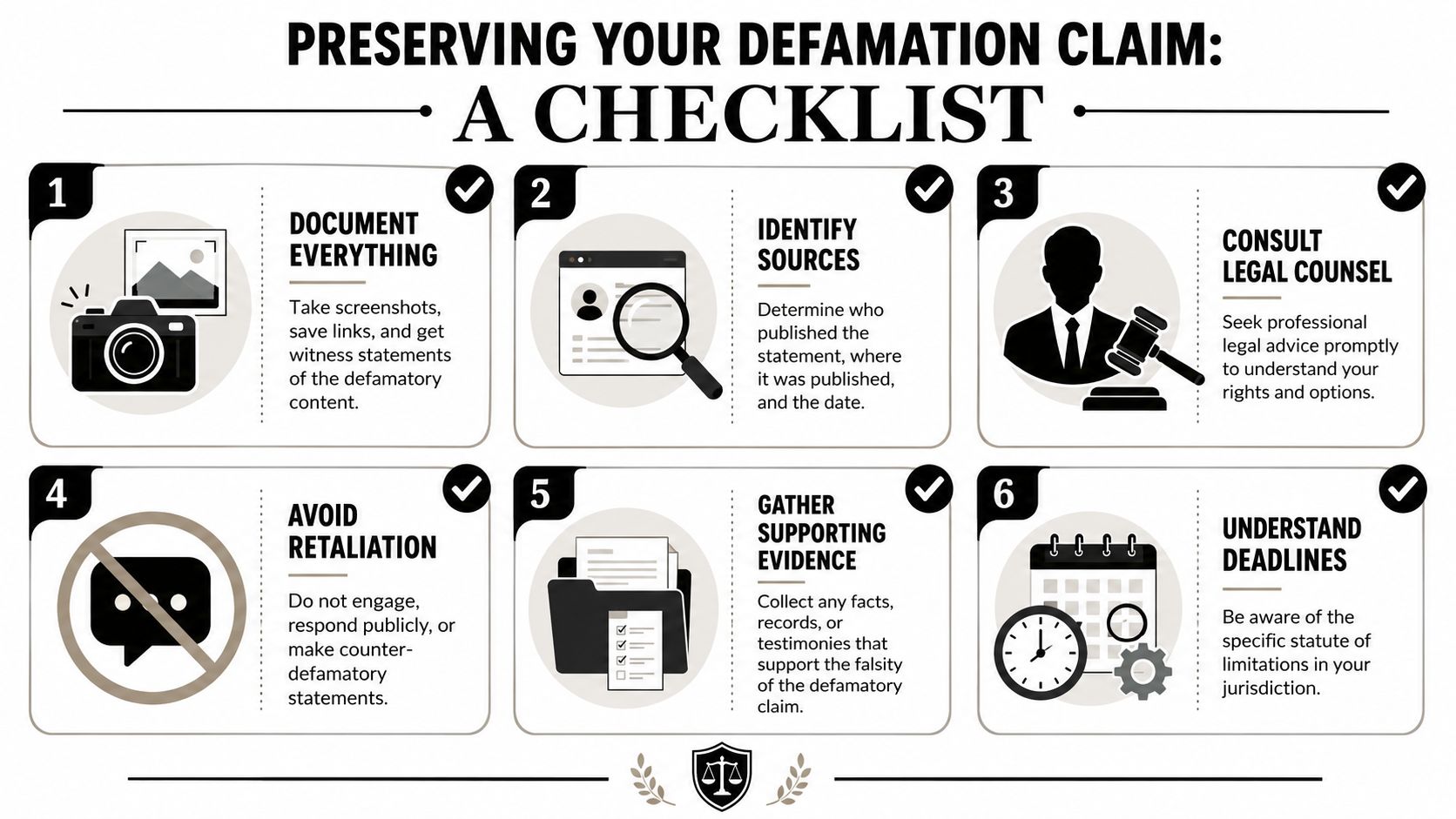
Once you suspect defamation, the first 48 hours matter. Not because every case needs to be filed immediately, but because evidence disappears, platforms change displays, and people make preventable mistakes when they react emotionally.
Your founder checklist
Don't respond publicly right away.
Public arguments often create side issues. A rushed reply can turn a contained problem into a bigger one, especially if emotions lead to exaggerated counterclaims.Capture the content exactly as it appears.
Take screenshots. Save the full URL. Record the date you found it. If there are comments, replies, likes, reposts, or edits, capture those too.Identify the earliest publication date you can find.
Timing drives the analysis. Look for original post dates, article timestamps, cached pages, platform history, and any prior references.Figure out who published it.
If the speaker is obvious, document that. If it's anonymous, preserve every clue tied to the account. In states like Virginia, defamation by an anonymous online user may toll the statute until identity is discovered or reasonably should have been discovered through due diligence, which makes fast investigation important under Virginia Code § 8.01-247.1.Collect proof that the statement is false.
Pull contracts, emails, invoices, customer records, messages, internal logs, or any document that directly contradicts the allegation.Track business impact separately.
Make a simple running log of lost opportunities, canceled meetings, suspicious client questions, hiring issues, or partner concerns.
What usually helps and what usually hurts
| Helps | Hurts |
|---|---|
| Quiet evidence preservation | Public fighting in comments |
| Date-focused timeline building | Assuming online visibility resets the clock |
| Platform and identity investigation | Waiting for the poster to “go further” |
| Counsel review before escalation | Sending threats without a strategy |
If your immediate goal is to stop the spread before moving into a larger legal strategy, a properly handled Florida cease and desist letter may be part of the response.
Save first, assess second, escalate third. That order prevents a lot of avoidable damage.
Tip: Use one folder for screenshots, one for supporting documents, and one timeline document listing publication date, discovery date, platform actions, and business impact.
When to Consult a Defamation Attorney
Some business disputes can wait until next quarter. Defamation usually can't. The deadline rules are strict, the exceptions are narrow, and online publication creates timing traps that are easy to misunderstand.
A lawyer becomes important as soon as one of three things is true. The statement is hurting revenue. The publication date may be older than you'd like. Or the speaker is anonymous and you need a plan to preserve evidence and identify the source without wasting time.
The legal issues that change outcomes
A defamation matter often turns on details that aren't obvious from the post itself:
- Accrual issues: Was there one publication or a later republication?
- State-law issues: Which jurisdiction's deadline applies?
- Exception issues: Is there any realistic tolling or discovery-rule argument?
- Remedy issues: Should the first move be a demand, platform process, negotiated retraction, or litigation?
Founders sometimes wait because they want certainty before calling counsel. That's backward. Counsel helps create certainty by testing the timeline, preserving options, and preventing self-inflicted mistakes.
Waiting can eliminate the case entirely
Failing to file within the applicable statutory window, whether that's one year in Arizona or two years in Florida, results in immediate case dismissal regardless of the claim's merit, and courts strictly enforce those deadlines.
If someone has already sent you a threatening letter or the dispute is escalating from both sides, it also helps to understand the response posture early. This guide on how to respond to a cease and desist letter is a useful starting point for that side of the equation.
Tip: Call a defamation attorney when you still have choices, not when you're hoping for an exception to rescue a missed deadline.
If your business is dealing with a false statement online, a damaging review, or an anonymous attack that may be cutting into revenue, Coto & Waddington, Attorneys at Law can help you assess the timeline, preserve critical evidence, and decide on a business-first response under Florida law. The firm advises South Florida founders and companies with practical, modern counsel that focuses on risk, strategy, and clear next steps.