You open the mail, see a law firm letterhead, and your stomach drops. For a South Florida founder, that moment usually lands at the worst possible time. You're in the middle of a launch, dealing with inventory, pushing paid ads, or trying to close a partnership, and now someone is demanding that you stop what you're doing.
Receiving a cease and desist letter is stressful, but it is not a court order. It is a demand. Sometimes the document is backed by a strong claim. Sometimes it is overreach. Often it is a pressure tactic aimed at a business owner who might panic and provide a tactical advantage in the first reply.
The practical question isn't just legal. It's commercial. You need to know whether to hold your ground, fix a real problem, buy time, negotiate, or prepare for a fight. If you're trying to learn how to respond to a cease and desist letter, the first objective is simple: stop the situation from getting worse.
First Contact Your Initial 48 Hours
The first mistake usually happens fast. A founder sees accusations of infringement, fraud, misuse, or breach, then fires off an email trying to explain everything. That impulse is understandable and often expensive.
The first two days matter because they shape the record. According to cease and desist letter strategy data summarized by Federal Lawyer, 62% of recipients who ignored a cease and desist letter saw claims escalate to litigation within 90 days, compared to 19% for those who engaged professionally. The same source reports that 73% of small businesses mishandled the first 48 hours, which resulted in 2.3x higher settlement costs.
What to do before you say anything
Start with restraint. Don't call the sender. Don't post the letter on LinkedIn or Instagram. Don't ask your marketing manager to "handle it." Don't tell the other side you didn't mean anything by it.
Use a short internal checklist instead:
- Preserve the letter: Save the envelope, email, attachments, and metadata if available.
- Pause any risky cleanup: Don't delete web pages, ads, Shopify listings, Amazon content, Slack messages, or draft files without legal guidance.
- Limit internal discussion: Keep the circle small. Founder, operations lead, and whoever manages the underlying issue.
- Calendar the deadline: If the letter gives a response date, put it on the calendar immediately.
- Acknowledge receipt only if needed: A neutral acknowledgment can be useful, but it should not include facts, excuses, or admissions.
Practical rule: Your first communication should buy time and preserve options, not win the argument.
A safe acknowledgment is usually simple: you've received the letter, you're reviewing it, and a formal response will follow. Nothing more. No apology. No explanation. No "we'll take it down for now" unless that decision is intentional and informed.
What founders often get wrong
In startup and e-commerce disputes, people often confuse speed with control. They think a quick explanation will calm things down. It often does the opposite. You may accidentally confirm use, dates, authorship, intent, access to a work, or awareness of a competitor's brand.
That matters because a cease and desist letter often lands before anyone has organized the facts. Your contract files may be scattered between DocuSign, email, and Google Drive. Your designer may have sourced a logo variation from Figma files you haven't reviewed. Your product pages may have changed across Shopify, Meta ads, and marketplace listings.
The first 48 hours should feel disciplined, not dramatic.
A better first move
Treat the letter like an incident response issue. Gather the facts efficiently. Identify who approved the conduct being challenged. Lock down the relevant records. Figure out whether this is about a business name, a logo, website copy, product imagery, a vendor agreement, a noncompete, a customer list, or something else entirely.
That shift matters. Panic makes founders reactive. Process makes them credible.
Reading and Triaging the Demand Letter
Once the adrenaline settles, read the letter like an operator, not a target. Legal language can make weak claims sound powerful. Your job is to strip the document down to its moving parts.
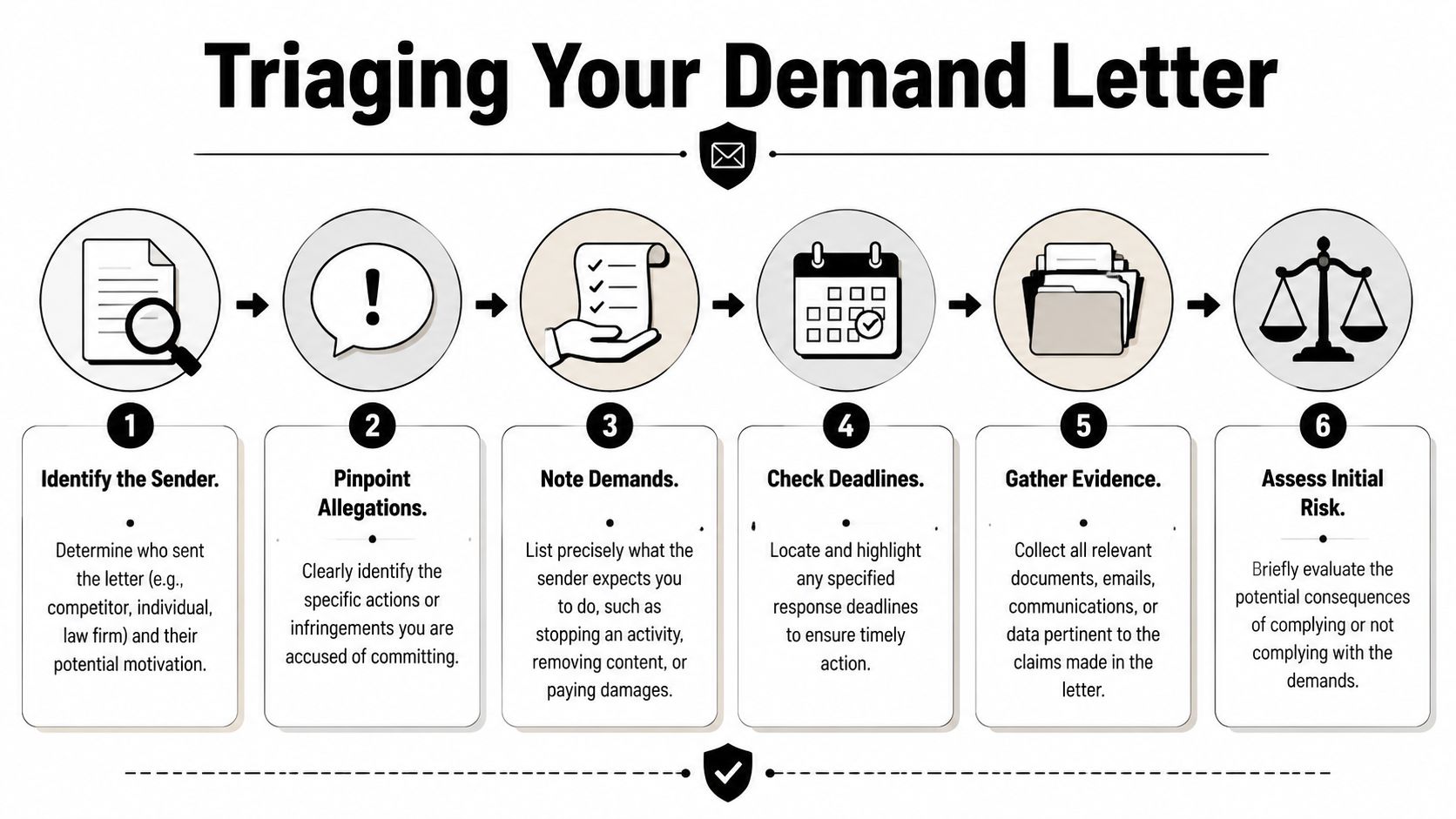
A useful reality check comes from this analysis of cease and desist response practices. It states that unconsulted responses are damaging in 85% of subsequent litigations, and 72% of small businesses who react impulsively face escalated lawsuits. That is why triage comes before argument.
Identify who sent it
Start with the sender. A letter from opposing counsel at a known firm is different from a mass-mailed demand generated by a brand enforcement vendor. Both can be serious, but they don't signal the same thing.
Look for:
- The actual claimant: Is it a company, an individual founder, a franchisor, a former employer, or a marketplace seller?
- The lawyer or firm: Is counsel named? Does the firm practice in this area?
- The legal interest claimed: Are they claiming trademark rights, contract rights, ownership of content, trade secrets, or defamation injury?
- The geography: Does the claim point to Florida activity, federal rights, or cross-border conduct?
For South Florida businesses, this matters because many disputes are messy hybrids. A "trademark" problem may be a marketplace takedown issue mixed with contract language from a vendor or influencer agreement.
Separate allegations from theater
Good triage means isolating what the letter says you did.
Read for four things:
The accused conduct
What exactly are they saying happened? Using a name, copying product photos, breaching a non-solicit, sending marketing texts, reusing code, or making statements online?The demanded action
Stop using the mark? Remove content? Return information? Pay money? Sign an undertaking? Preserve evidence?The support they claim to have
Registration numbers, screenshots, contract excerpts, customer confusion allegations, or references to prior notice.The deadline
A short deadline can signal urgency. It can also be pressure. Either way, it has to be managed.
A strong letter is usually specific. A weak letter is often loud.
If the letter says "upon information and belief," note it. That phrase can indicate the sender is still fishing for facts rather than presenting a complete case. That doesn't mean the claim fails. It means your side should be careful not to supply the missing evidence for them.
Build a one-page triage summary
Before anyone drafts a response, condense the dispute into a short internal summary:
- Claim type: trademark, copyright-adjacent content issue, contract, employment, unfair competition, defamation, privacy, or other
- Business exposure: core brand issue or peripheral issue
- Affected assets: website, packaging, domain use, email campaigns, customer list, social content, contracts
- Urgency: immediate, near-term, or manageable
- Known facts in your possession: dates, approvals, drafts, registrations, screenshots, signatures
That summary forces clarity. It also helps founders avoid a common problem. They start arguing broad principles before they know which fact decides the dispute.
Assessing the Letter's Legal Merit
A demand letter is only half the picture. The other half sits inside your company files, inboxes, design folders, contracts, invoices, ad archives, and registration history. That's where the substantive analysis begins.
In business disputes, structure matters. According to guidance on responding to a cease and desist letter from Lipp Law Firm, valid claims in areas like trademark or contract disputes settle pre-suit via negotiation in about 80% of cases when handled by counsel, while weak evidence, often signaled by phrases like "upon information and belief," is less likely to succeed. That's a good reminder that merit isn't measured by tone. It's measured by evidence.
Run an internal fact audit
Don't start with conclusions. Start with documents.
For a startup or e-commerce company, the audit usually includes:
- Brand history: first use of the name, logo, slogan, or packaging being challenged
- Public use evidence: website archives, Shopify product pages, Amazon listings, social posts, ad creatives, invoices, and customer emails
- Trademark records: registration status, classes, filing dates, and any known common-law use
- Contract chain: founder agreements, contractor IP assignment clauses, licensing terms, white-label arrangements, influencer agreements, and vendor restrictions
- Content origin: who created the copy, image, video, design, or code in dispute
If the letter is contract-based, the dispute may turn less on headline language and more on whether the parties formed the same understanding. A plain-English resource on understanding mutual intent in digital contracts can be useful for founders trying to gather the right documents before counsel reviews them.
Match the claim to the business reality
A trademark accusation requires a different review than a contract or trade secret allegation.
For example:
- Trademark dispute: compare the sender's claimed rights against your first use, actual market, channels, and presentation.
- Contract claim: verify what was signed, by whom, and whether later emails or order forms changed the deal.
- Website or content claim: identify the source file, creator, license path, and publication timeline.
- Former team member dispute: review access rights, NDAs, assignment clauses, and offboarding records.
This is also the moment to preserve evidence. If a dispute may continue, tell the people involved not to delete texts, emails, shared drive folders, Slack threads, Canva exports, or draft agreements. A founder trying to "clean up" the record can create a second problem.
Look for leverage, not just liability
Some letters have merit but overreach on remedy. Others target something that isn't central to your business. Some challenge a core asset, such as your brand name, where the fight matters. Others challenge a product photo set or ad phrase you can replace quickly.
Those are not the same business decision.
If you're dealing with a branding or ownership issue, it's also worth reviewing practical guidance on protecting intellectual property so you can assess whether this letter exposes a one-off issue or a broader weakness in your current protection strategy.
Don't ask only, "Are they right?" Ask, "What would it cost us to resist, revise, rebrand, or resolve?"
That question keeps founders grounded. The best response isn't always the most aggressive one. It's the one that protects the company's actual value.
Drafting Your Response Strategy and Letter
By the time you respond, you should know what you're defending, what you can live without, and what outcome makes business sense. A response letter is not a place for outrage. It's a controlled document designed to shape the next move.
Most responses fall into one of three lanes: comply, negotiate, or reject. Sometimes the best letter combines elements of all three. You might deny liability, reject part of the demand, ask for proof, and still offer a practical adjustment that lowers business risk.
Choose the strategy before drafting the language
A founder often wants to skip straight to wording. That's backwards. The wording only works if the strategic choice is clear.
Consider the options:
- Comply when the challenged conduct is easy to change, legally vulnerable, or not worth defending.
- Negotiate when the other side has some advantage but the issue can be solved through coexistence, revised terms, a phaseout, or a cleanup plan.
- Reject when the claim appears weak, overbroad, or based on facts you can dispute cleanly.
If the matter involves a commercial agreement, founders often benefit from reviewing practical contract drafting habits before they respond. A concise guide on how to write a business contract can help you spot whether the underlying problem came from vague language, sloppy scope terms, or missing ownership clauses.
What the letter should accomplish
A good response typically does four things at once:
- Acknowledges the demand without conceding it
- States your position carefully
- Requests missing support if needed
- Preserves rights while keeping room for resolution
The tone should be professional and flat. Not warm. Not hostile. Not defensive.
The other side reads your response for tells. Sloppy facts suggest weakness. Emotional language suggests inexperience. Precision suggests control.
Response Letter Do's and Don'ts
| Do | Don't |
|---|---|
| Acknowledge receipt neutrally | Apologize reflexively |
| Address the specific allegation | Argue every point in the first reply |
| Request evidence where the claim is vague | Supply missing facts the sender didn't have |
| Preserve all defenses and rights | Promise changes you haven't approved internally |
| Use measured language | Use sarcasm, threats, or indignation |
| Match the remedy to business priorities | Treat every demand as all-or-nothing |
Sample phrasing that protects your position
Useful opening language is often simple:
- We acknowledge receipt of your letter and are reviewing the issues raised.
- Our client disputes your characterization of the facts and reserves all rights.
- Please provide the factual and legal basis for the assertions made in your correspondence, including the materials on which you rely.
- While we do not concede liability, we are willing to discuss a practical resolution.
What you want to avoid is language like this:
- We didn't realize it was your mark.
- We only used it briefly.
- We can take everything down this week if that helps.
- Our freelancer handled that, not us.
Each of those statements can create admissions or weaken bargaining position. The best draft is usually shorter than founders expect.
When to Hire a Florida Business Lawyer
Some cease and desist letters can be triaged internally. Others should move to counsel immediately. Founders lose time when they treat all disputes as equally manageable.

For South Florida businesses, local context matters. According to Miami-Dade business demographic data and related discussion of bilingual IP dispute risk, approximately 35% of Miami-Dade businesses are Hispanic-owned, and they face 22% more IP-related cease and desist letters from Latin American competitors. That same discussion notes that poor handling of dual-language disputes can lead to default judgment risk. For bilingual founders, language isn't a cosmetic issue. It's part of case strategy.
Red flags that should end the DIY phase
Call a lawyer quickly if any of these are true:
- The letter targets your company name, primary brand, or core product
- The sender is represented by established counsel
- The allegations involve federal trademark, unfair competition, trade secrets, or investor-sensitive issues
- You operate across Florida and another state, or cross-border with Latin America
- The letter includes a draft complaint, preservation demand, or threat of emergency court relief
- There are Spanish-language allegations, attachments, or counterpart notices that your team may be reading informally
A Florida business lawyer adds more than legal drafting. Local counsel understands how your entity structure, contracts, registrations, and operating history fit together under Florida and federal law. That matters when a founder is deciding whether to fight, settle, rename, or ring-fence risk.
Why bilingual review matters in South Florida
In Miami and Fort Lauderdale, bilingual disputes often come with hidden problems. A translated summary from a team member isn't enough. Subtle wording can shift meaning, especially in intellectual property, distribution, licensing, and cross-border commercial communications.
That becomes more important when the business itself is bilingual. Marketing claims, product descriptions, consumer communications, and distributor relationships may differ across English and Spanish materials. If the accusation involves one language version and the defense relies on another, counsel needs to see the whole record.
A practical starting point for founders who are trying to budget legal help is this overview of TheLawGPT research on lawyer fees. It won't answer your dispute, but it can help you think clearly about the cost of early review versus the cost of cleaning up a bad first response.
The right lawyer for this problem
You don't need a generic "business attorney" who only reacts to emergencies. You need someone who can connect the immediate letter to the systems behind it. Formation documents, contractor agreements, assignment clauses, brand clearance, website terms, privacy issues, and marketplace enforcement all overlap in these disputes.
A clear primer on what a business attorney does is useful if you're deciding whether this is a one-time letter review or a sign that your company needs ongoing legal support.
A founder usually hires counsel for the letter. The bigger value is often fixing the process that produced the letter in the first place.
Navigating Next Steps and Escalation
After the response goes out, the matter usually moves in one of three directions. The sender goes quiet. The sender engages. Or the sender escalates.
Silence can mean the claim was weak, underdeveloped, or sent mainly to test whether you'd fold. A reply can open a negotiation over timing, wording, scope, or coexistence. Escalation can mean a sharper demand, a takedown process, or a filed lawsuit.
If they engage, treat it like a business negotiation
A second letter often reveals more than the first one. You may learn which facts they care about and where they feel uncertain. That can create room for practical solutions, especially if the issue can be narrowed.
Founders should keep two things in view at once:
- Legal exposure: what claims appear strongest after the first exchange
- Commercial cost: what happens to branding, operations, distribution, fundraising, or customer trust if the dispute drags on
That balance matters more than ego. Winning every point on paper may still be a bad business outcome.
The narrow case for strategic silence
Ignoring a cease and desist letter is usually dangerous. But there are limited situations where silence may be a calculated option, not a mistake.
According to Revision Legal's discussion of cease and desist response strategy, for startups with strong prior use defenses under Florida common law (Fla. Stat. § 495.151), ignoring weak letters from smaller competitors succeeds in about 40% of cases, while unheeded cease and desist letters escalate to litigation in 62% of cases for small businesses. That tension is the point. Silence is not a default strategy. It's a narrow one that depends on a careful legal assessment of the sender, the claim, and your evidence.
Practical tips for the period after your response
- Keep the record clean: Route communications through one decision-maker or counsel.
- Monitor your channels: Watch for marketplace complaints, payment processor issues, ad account flags, or platform takedowns.
- Prepare fallback options: If your brand, listing, or vendor arrangement is targeted, know what the temporary workaround would be.
- Review insurance and contracts: Check whether notice obligations or indemnity rights are triggered.
If you are serious about learning how to respond to a cease and desist letter, remember that the response letter itself is only one move. The essential work is controlling the dispute after that first move, when pressure rises and options narrow.
If you've received a cease and desist letter and need a calm, business-focused response, Coto & Waddington, Attorneys at Law helps South Florida founders, e-commerce companies, and family businesses assess the claim, protect their advantage, and respond in English or Spanish with practical strategy. If you want clear next steps instead of panic-driven decisions, reach out for guidance suited to your business.