Let's get straight to the point: No, an LLC cannot have shareholders. Instead, the owners of a Limited Liability Company are called members. This isn't just a simple vocabulary lesson—it's a fundamental legal distinction that directly impacts how your company is governed, taxed, and funded.
Getting this wrong from the start can lead to serious structural problems down the road.
Why LLCs Have Members, Not Shareholders

Think of it this way: a corporation is like a public company built with standardized "shares" of stock that can be bought and sold on a market. An LLC, on the other hand, operates more like a private partnership where ownership, called a membership interest, is defined by a flexible, internal contract—the Operating Agreement.
This distinction is absolutely critical for founders. In the United States, LLCs are owned by members, while corporations (like C-Corps or S-Corps) are owned by shareholders. Shares are stock certificates issued by corporations under state laws, a structure that enables public trading and the kind of venture capital funding that powers corporate giants. You can see the sheer scale of these entities by reviewing the market caps of the world's largest companies.
In contrast, LLCs were designed to offer pass-through taxation and operational flexibility, which is often ideal for founders who want to avoid the "double taxation" common with traditional corporations.
LLC Members vs. Corporate Shareholders at a Glance
To really grasp the difference, it helps to see the core attributes side-by-side. The table below breaks down the fundamental distinctions between being a member of an LLC and a shareholder in a corporation.
| Attribute | LLC Members | Corporate Shareholders |
|---|---|---|
| Ownership Title | Hold a "membership interest" | Own "shares" or "stock" |
| Governing Document | The Operating Agreement | Corporate Bylaws and Shareholder Agreement |
| Governance Structure | Flexible; can be member-managed or manager-managed | Formal; managed by a Board of Directors elected by shareholders |
| Taxation | Default is pass-through (profits/losses on personal returns) | C-Corps face "double taxation" (corporate and individual level) |
| Transfer of Ownership | Restricted; usually requires approval from other members | Freely transferable (unless restricted by agreement) |
| Investor-Friendliness | Less attractive to VCs due to complexity and tax structure | The standard for venture capital and angel investment |
As you can see, these two structures were built for completely different purposes. Corporations are designed for scale and attracting outside capital through standardized stock, while LLCs are built for operational flexibility and liability protection with a simpler internal structure.
Key Takeaway: The terms "member" and "shareholder" represent entirely different philosophies of ownership. One offers customizable control within a private agreement (the LLC), while the other provides standardized, transferable units built for broad investment (the Corporation).
Pro Tip: Don't get too hung up on the terminology. While an LLC can't issue stock, your Operating Agreement can create "membership units" that function very similarly to shares, allowing you to divide ownership percentages, profit distributions, and voting rights with precision.
Ready to set up your business structure correctly from day one? The legal team at Coto & Waddington specializes in helping Florida founders choose and form the right entity for their goals. Contact us for a consultation today.
Understanding LLC Members vs. Corporate Shareholders
While an LLC can’t have shareholders, it has something far more flexible: members. This isn't just a difference in terminology. Think of corporate shareholders as passive ticket-holders in a large, rigid system. Members, on the other hand, are the active architects of your business's DNA.
Their rights, responsibilities, and how they profit aren't defined by standardized stock certificates. Instead, they are custom-built within a powerful legal document called an Operating Agreement. This flexibility is the LLC's core advantage, allowing founders to design an ownership structure that perfectly matches their business needs instead of being locked into a one-size-fits-all corporate model.
The Strategic Advantage of Membership
The member-based structure offers huge benefits over the rigid formalities of a corporation, especially for family businesses, e-commerce ventures, and small partnerships where a custom approach is invaluable. You can create different classes of membership, tailoring roles and rights with incredible precision.
For example, your Operating Agreement could establish:
- Voting Members: These are the key players involved in day-to-day decisions and steering the company's direction.
- Non-Voting Members: These members might be passive investors or family members who share in the profits but have no management authority.
This ability to separate economic rights from voting rights allows for creative and strategic business planning without getting tangled in the complex legal framework of preferred and common stock required by corporations.
The member-centric model is a cornerstone of modern wealth management. While LLCs lack shareholders, their member ownership structure is the engine behind 60% of global family wealth held in private operating businesses. This demonstrates just how effective the LLC is for asset protection and succession planning. Insights from J.P. Morgan's 2026 Global Family Office Report highlight that many high-net-worth families prefer LLCs for the tax efficiency and control they offer. You can explore more about these trends in their full family office report.
How Membership Units Work
To make ownership tangible, many LLCs issue membership units or percentage interests. These function a bit like a corporation's shares by representing a slice of the company. The crucial difference is that all the rules governing them are entirely defined in your Operating Agreement.
This means you can specify exactly how profits are distributed—and it doesn't have to be proportional to ownership percentage. One member could own 20% but receive 30% of the profits for the first three years as a reward for their initial sweat equity or capital investment. This level of customization is simply not possible with standard corporate stock.
Pro Tip: When creating different membership classes, you must clearly define the rights and limitations of each in your Operating Agreement. Specify voting power, profit distribution schedules, and exactly what happens if a member wants to exit. Ambiguity is the enemy of a healthy partnership and a common source of expensive disputes down the road.
This tailored approach makes the LLC an ideal vehicle for founders who demand control, asset protection, and operational freedom.
Are you looking to structure your LLC's membership to protect your assets and align with your business goals? The experienced team at Coto & Waddington can help you craft an Operating Agreement that prevents disputes and works for you. Schedule a consultation today to build a solid legal foundation for your business.
How to Create Shareholder-Like Equity in an LLC

So, an LLC can't issue stock. But that doesn't mean you can't offer equity. You can absolutely create powerful incentives to attract top-tier investors or reward key employees, all while keeping the simplicity and protection of your LLC.
The secret is using your Operating Agreement to mimic the structures of traditional corporate stock. It's all about how you define and divide ownership.
Using Membership Units and Percentage Interests
The most common way founders tackle this is by creating and issuing membership units. Think of these units as the LLC’s version of corporate stock. Each unit represents a small, quantifiable piece of the company, giving you a clear way to slice up the ownership pie.
For example, you could decide your LLC is made up of 100,000 total units. If you grant an early hire 5,000 units, they now own 5% of the business. It’s a tangible concept that everyone can easily grasp.
Alternatively, some founders skip units and simply assign percentage interests directly. This is a more straightforward approach where your Operating Agreement might state something like, "Founder A owns 60%, and Founder B owns 40%." Both methods get you to the same place—defining who owns what piece of the business.
Your Operating Agreement is where all the magic happens. This is the document where you can build in specific rights and rules for these units or percentages, including:
- Vesting Schedules: Just like with corporate stock, you can require employees or partners to stick around for a set period before they fully own their equity. This is a critical protection for the company if a key person decides to leave early.
- Profit Distributions: You get to define exactly how and when profits are paid out to the owners. You can even create different classes of units, some with more favorable distribution rights than others.
- Transfer Restrictions: Most LLCs want to control who their partners are. You can require members to get approval from the other owners before selling their stake to an outsider. Understanding these rules is crucial, and you may want to define a clear process for members who want to exit by reviewing guidelines on what are preemptive rights.
Advanced Equity Strategies in LLCs
Beyond basic units, you can get even more creative. Two powerful tools for replicating corporate-style equity are "profits interests" and "phantom equity."
A profits interest is a grant of equity tied only to the future growth and profits of the business. This is a game-changer for service partners or key employees because it typically doesn't create a big, immediate tax bill for the person receiving it, unlike getting a "capital interest," which is taxed like regular income.
Phantom equity, on the other hand, isn’t true ownership at all. It’s a contractual bonus that pays out when a specific event happens, like the sale of the company. It gives the holder the financial upside of ownership without handing over any actual membership or voting rights. This is a fantastic way to incentivize your team without diluting control for the core founders.
Pro Tip: Whatever you choose—units, percentages, profits interests, or phantom equity—define every single term with absolute clarity in your Operating Agreement. Vague definitions are a breeding ground for expensive and damaging disputes down the road.
Feeling overwhelmed by the options? You don't have to figure it out alone. Contact Coto & Waddington today to structure your LLC’s equity in a way that attracts talent, secures investment, and protects your vision.
Choosing Your Tax Identity Like a Corporation
While an LLC can't legally have shareholders in the traditional sense, it has an incredibly powerful, and often overlooked, strategic tool: it can choose to be taxed like a corporation. This doesn't change your business's legal structure—it’s still a Florida LLC—but it completely changes how the IRS sees you.
By filing a specific form, you can tell the IRS to treat your LLC as either an S-Corporation or a C-Corporation for tax purposes. This move allows you to keep the operational flexibility of an LLC while accessing the tax structures built for corporations.
The S-Corp Election for Tax Savings
For many profitable LLCs, especially those run by consultants, service providers, or creative professionals, making an S-Corp election is a game-changer. The single biggest reason? Potentially massive savings on self-employment taxes.
By default, every dollar of an LLC's profit passes through to the owners, who then have to pay self-employment tax (Social Security and Medicare) on the entire amount. With an S-Corp election, the game changes. You can pay yourself a "reasonable salary" and take the rest of the company's profits as distributions, which are not subject to self-employment tax.
- Example in Action: Imagine a Miami-based creative agency, set up as a single-member LLC, earns $200,000 in profit. Without an S-Corp election, the owner pays self-employment tax on the full $200,000. But by electing S-Corp status and paying a reasonable salary of $80,000, they only pay self-employment tax on that salary. The remaining $120,000 in distributions is not subject to it, saving them thousands in taxes every single year.
The C-Corp Election for Attracting Investment
Alternatively, an LLC can elect to be taxed as a C-Corporation. This isn't as common for small businesses, but for startups with big ambitions—specifically, raising serious capital from venture capitalists—it’s a critical strategic move.
A C-Corp election signals to investors that you're building a structure they understand and can easily invest in. It allows the business to retain earnings for growth and can make it simpler to eventually convert the entire entity into a C-Corp, which is a common requirement for VC funding.
When choosing your LLC's tax identity, it's essential to understand requirements such as obtaining an EIN. You can find more helpful information on LLCs and EIN considerations to ensure you're compliant from the start.
Pro Tip: To make an S-Corp election, you must file IRS Form 2553. For a C-Corp election, you file Form 8832. These decisions carry significant financial and legal weight, so you should always consult with your tax and legal counsel before moving forward. For a deeper dive into these corporate structures, you might be interested in our guide on the difference between an S-Corp and a C-Corp.
Making the right tax election is a critical decision that can optimize your financial outcome. Contact Coto & Waddington to discuss the best tax strategy for your LLC.
Preparing for Venture Capital by Converting Your LLC
For many high-growth startups, the LLC is the launchpad, not the final destination. While it’s the perfect vehicle for flexibility when you’re just starting out, the LLC structure is a non-starter for most venture capitalists (VCs) and angel investors. If your goal is massive scaling fueled by outside investment, converting to a C-Corporation isn’t just a good idea—it’s a requirement.
Investors, especially institutional ones, need a standardized and predictable framework. The C-Corporation delivers exactly that. It has a familiar governance model run by a board of directors, established stock classes, and clear rules for issuing equity. This structure is built for scale and is the only vehicle that can eventually go public through an IPO.
The Investor's Perspective on C-Corporations
Put yourself in a VC's shoes. They don't want to become "members" of your LLC and get tangled up in a custom operating agreement. They need to hold preferred stock, a special class of ownership with rights and protections that just don't exist in a standard LLC.
Preferred stock gives them priority in payouts if you sell, downside protection if the company fails, and often, specific voting rights to protect their investment. Trying to duct-tape these complex financial instruments into an LLC's operating agreement is a legal nightmare—it’s cumbersome, messy, and often doesn't hold up. A C-Corporation, by contrast, is designed from the ground up for exactly these kinds of deals, making it the gold standard for institutional funding.
The Strategic Conversion Process
Flipping from an LLC to a C-Corp isn't just a handshake deal; it's a formal legal process that has to be done right. While the specifics can vary by state, the general path involves several key steps:
- Drafting a Plan of Conversion: This is a legal document outlining the terms of the change.
- Getting Member Approval: The LLC members must vote to approve the conversion.
- Filing Conversion Paperwork: This includes filing a Certificate of Conversion and a Certificate of Incorporation with the state (very often Delaware).
- Issuing Stock: You’ll formally dissolve the LLC membership interests and issue shares of stock in the new C-Corporation to the owners.
The following graphic shows how an LLC can strategically shift its identity for tax or structural purposes, a core part of preparing for investment.
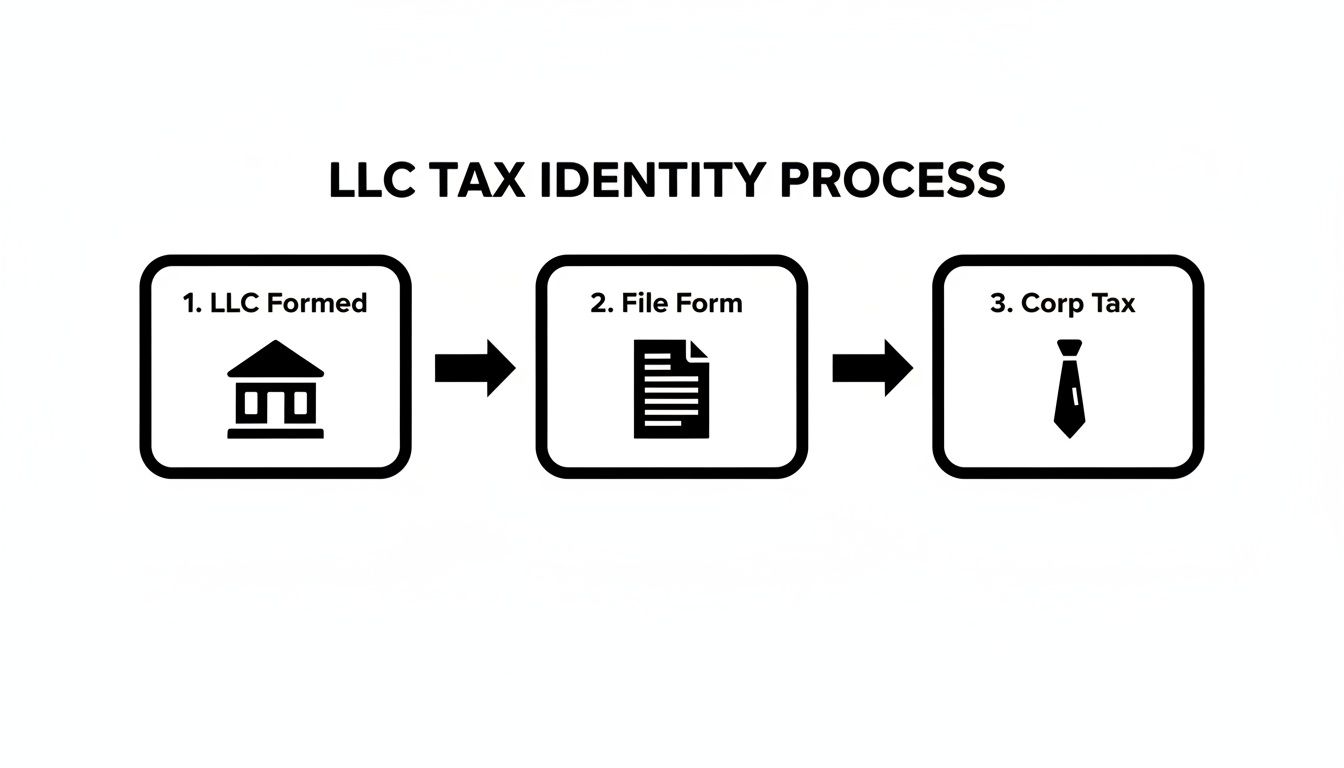
This illustrates that your LLC’s identity isn’t set in stone. As a founder, you can file specific forms to align the entity's structure with your fundraising and tax goals.
Interestingly, choosing an LLC first is a proven strategy. Data shows 70% of unicorns start as LLCs before converting to corporations to accept venture capital. Even as tech giants with shareholder structures dominate the economy, the agile LLC remains the preferred starting point for a majority of successful startups. You can find more data about these economic trends in this 2026 global intelligence report.
Pro Tip: Timing is everything. The best time to convert is typically right before your first priced funding round (like a Series A). If you convert too early, you can saddle the company with unnecessary corporate formalities and tax complexities before you actually need them.
This conversion isn't a sign you made a mistake by starting as an LLC. Think of it as a strategic evolution—it marks the moment your business is ready to graduate from a flexible startup to a high-growth, venture-backed company.
Are you preparing to raise capital and need to convert your LLC? Speak with the legal team at Coto & Waddington to ensure your conversion is seamless and investor-ready.
Drafting Your Operating Agreement Like a Pro

Your Operating Agreement is the private rulebook for your business. It's the one document that keeps your LLC from descending into chaos when the unexpected happens. Founders often grab a generic template online thinking they've checked a box, but this is one of the most dangerous shortcuts you can take. A boilerplate form won't save you when real-world problems arise.
This document is where you and your partners answer all the tough "what if" questions before they turn into expensive, relationship-destroying disputes. If you're looking to create ownership classes that feel like corporate shares, this is the place to define those rights, responsibilities, and limitations with absolute clarity.
Must-Have Clauses for Every Founder
A solid Operating Agreement is your first and best line of defense. In our practice, we’ve seen countless disputes that could have been avoided if the founders had addressed these key points from day one. At a bare minimum, your agreement must clearly outline:
- Profit Distributions: Spell out exactly how and when profits are paid out. Remember, for an LLC, distributions do not have to match ownership percentages. You have complete flexibility here.
- Voting Rights and Management Duties: Who has the final say on hiring, spending, or taking on debt? Define who makes the day-to-day calls and what requires a unanimous vote.
- Buyout Rules (Buy-Sell Provisions): This is critical. You need a clear process for what happens if a member wants to exit, passes away, gets divorced, or needs to be forced out. Without it, your business can be paralyzed.
Pro Tip: Your agreement absolutely must include a dispute resolution clause. This can force members to try mediation or arbitration before suing each other. It's a simple provision that can save you tens of thousands of dollars and months of court battles.
Imagine two e-commerce founders in a 50/50 partnership. One wants to sell their half, but the Operating Agreement has no buyout clause. Now what? The business is stuck in a stalemate, unable to move forward. A properly drafted agreement would have provided a pre-agreed roadmap, protecting both founders and the company they built. For a deeper dive into the specifics, it's worth understanding what goes into a U.S. LLC operating agreement.
Take Action and Get It Right
Don't gamble with your company's future by relying on a one-size-fits-all template. We’ve written a comprehensive guide on what’s required for businesses here in Florida—you can learn more by reading about Florida operating agreement law.
Your business is your most valuable asset. Protect it. Work with experienced legal counsel to draft a custom Operating Agreement that reflects your unique vision and anticipates future challenges.
Common Questions We Hear About LLC Ownership
Once founders settle on an LLC, a new set of questions almost always pops up. These usually revolve around trying to make the LLC behave more like a corporation for investment or partnership reasons. Here are the straight answers to the questions we field most often in our practice.
Can a Corporation Be a Member of My LLC?
Yes, and this is a common strategy for more sophisticated business structures. One of the best features of an LLC is its flexibility—it can have individuals, trusts, and even other business entities like C-Corporations or S-Corporations as its members.
We see this structure used frequently for joint ventures, holding companies, or when one business makes a strategic investment in another. The key is to make sure your Operating Agreement is meticulously drafted. It has to spell out the corporate member's rights, profit distributions, and responsibilities with absolute clarity, just as it would for any individual owner.
Pro Tip: If a corporation is a member of your LLC, ensure the Operating Agreement addresses potential conflicts of interest and outlines how the corporate representative will vote on behalf of their entity.
Do Membership Units Trigger Securities Laws?
Almost certainly, yes. This is a critical point that founders often misunderstand. The second you offer an ownership stake in your business—whether you call them "shares," "membership units," or anything else—in exchange for money, you are likely dealing with a securities offering.
This means you fall under the watch of both federal and state securities laws.
This is not a DIY area. The penalties for getting securities compliance wrong are severe. Always assume your offering is a security and work with a business attorney to find a legal exemption, like Regulation D. Trying to handle this alone is one of the biggest risks a young company can take.
Actionable Tip: Before you even think about accepting money for membership units, schedule a consultation with a business law attorney to ensure you are complying with securities regulations and protecting your company from legal trouble.
How Much Does It Cost to Convert an LLC to a C-Corporation?
The cost is far more than just the state filing fees. A proper conversion is a significant legal project. It involves drafting a plan of conversion, creating a new corporate charter and bylaws, and preparing all the documentation needed to correctly issue stock to the LLC's former members.
Thinking of this purely as an expense is a mistake. Investing in an experienced legal team to run the conversion process prevents the kind of expensive errors that scare off VCs. The smart move is to pay to get it done right the first time, which saves you a fortune in legal fees and headaches when investors are waiting to wire the funds.
Pro Tip: When budgeting for a conversion, factor in legal fees, accounting costs to close out the LLC's books, and any state-specific filing fees. Planning for the full cost upfront prevents surprise expenses during a critical fundraising period.
From drafting a bulletproof operating agreement to strategically converting your LLC for a venture round, navigating ownership complexities requires an expert guide. At Coto & Waddington, Attorneys at Law, we provide founders with the business-first legal strategy they need to build, grow, and protect their companies.
Schedule a consultation to ensure your business is structured for success.