You're probably here because you've reached the same point many Miami families and founders reach. The business is real now. The condo, house, brokerage account, or LLC membership interests have value. Maybe you have young children. Maybe you've watched a relative's estate get stuck in court and you don't want your family dealing with the same mess.
The usual online answer to wills vs trusts pros cons is too shallow for Florida. A will and a trust don't just offer different features. They solve different legal problems. A will can name a guardian for minor children. A trust can keep properly titled assets out of probate and give you tighter control over how money gets distributed. If you pick only one tool without understanding that split, your plan can look complete on paper and fail where it matters.
Table of Contents
- Will vs Trust An Introduction for Floridians
- Understanding the Core Mechanics of Wills and Trusts
- Head-to-Head Comparison Key Decision Factors
- The Florida Probate Process Why It Matters
- Choosing Your Plan for Florida Families and Founders
- Common Mistakes and Advanced Florida Strategies
- Next Steps Working With a Florida Estate Planning Attorney
- Frequently Asked Questions About Wills and Trusts
Will vs Trust An Introduction for Floridians
A South Florida estate plan has to do more than say who gets what. It has to deal with real estate, business interests, privacy, family dynamics, and the possibility that you become incapacitated before anyone expects it.
That's why the right question usually isn't “Which is better?” It's “What risk am I trying to solve?” If your biggest concern is naming guardians for minor children, a will is indispensable. If your concern is avoiding a public court process for a funded estate, a revocable trust usually does more work.
Here's the short version commonly needed first.
| Issue | Will | Revocable Trust |
|---|---|---|
| When it works | After death | During life and after death |
| Probate | Goes through probate | Avoids probate for assets titled in the trust |
| Privacy | Probate makes it public | Remains private |
| Guardians for minor children | Yes | No |
| Asset distribution control | Limited | More flexible |
| Upfront setup | Usually simpler | Usually more involved |
| Best use | Basic planning and guardianship | Probate avoidance, privacy, and structured distributions |
Bottom line: In Florida, a will-only plan is often incomplete for families with real estate, business interests, or children. Many people need both documents working together, not one replacing the other.
A lot of the confusion comes from how these tools are marketed. Wills sound easy, so people assume easy means sufficient. Trusts sound complex, so people assume they're only for the ultra-wealthy. Neither assumption holds up in practice.
For Miami families, the trade-off is between simplicity now and friction later. For founders, the issue is even sharper. A will may say who inherits the company interest, but it doesn't stop court involvement with assets that pass through the estate.
Practical tip: Start by listing what would create the biggest problem if your family couldn't access it quickly. For many people, that list includes the home, business interests, and accounts without direct beneficiary designations.
Understanding the Core Mechanics of Wills and Trusts
A Last Will and Testament is a legal instruction sheet that becomes effective at death. It tells the probate court who should receive your probate assets, who should act as personal representative, and, if you have minor children, who you want the court to appoint as guardian.
A revocable living trust works differently. It's a legal arrangement you create during life. You usually serve as your own trustee while you're alive and competent, so you still control the assets. If you become incapacitated or pass away, a successor trustee steps in and follows the rules you already wrote.

A simple way to think about each document
A will is like a letter of instruction to a judge.
A trust is closer to a rulebook attached to a container you control during life. The trustee follows those rules without opening a probate case for assets already inside.
That difference matters. A will has authority because the probate court recognizes it after death. A trust has authority because the assets have already been assigned to that trust during your lifetime.
The part people miss most often
Trusts only control assets that are funded into the trust.
That means someone has to retitle the relevant assets so the trust, not you individually, is the legal owner. Depending on the asset, that may mean changing deeds, account registrations, or ownership records. If that step never happens, the trust may exist but sit empty where it counts.
A beautifully drafted trust that was never funded often performs worse than clients expect and far worse than they paid for.
Many do-it-yourself plans break down because people sign the trust document and assume the job is done. It isn't. The drafting is only half the work. Implementation is the other half.
For people comparing trust structures more broadly, it also helps to understand the distinction between revocable and irrevocable trusts. The choice affects flexibility, control, and what the trust is meant to accomplish.
Practical tip: After signing a trust, create an asset transfer checklist right away. Don't rely on memory six months later. If the deed, account title, or membership interest assignment never gets updated, the trust can't do the job you built it to do.
Head-to-Head Comparison Key Decision Factors
A Miami founder dies with a signed will, a minority interest in a closely held company, two rental properties, and young children. The family assumes the will covers everything. Then they learn two separate truths at once. The will can nominate guardians, but it does not keep those business and real estate assets out of probate, and it does not give minors direct control rules beyond what the probate process and any later trust arrangement allow.
That is the comparison that matters in Florida. A will and a trust do different jobs, and families get into trouble when they expect one document to do both.
Will vs. Trust At-a-Glance Comparison
| Feature | Last Will and Testament | Revocable Living Trust |
|---|---|---|
| Probate | Required for probate assets | Avoided for properly funded trust assets |
| Privacy | Becomes part of the public probate file | Private document |
| Upfront cost | Usually lower upfront | Usually higher upfront |
| Long-term administration | Court process can add delay and expense | Usually smoother administration for funded assets |
| Guardianship nominations | Yes | No |
| Control over distributions | Limited, typically one-time after probate | Can stagger and condition distributions |
| Incompetency planning | Limited by itself | Allows successor trustee management |
| Business and real property handling | Can still require court process | Better for continuity if properly funded |
Probate exposure and privacy
For probate avoidance, a funded trust usually has the advantage.
A will does not bypass the court process. It tells the probate court who should receive probate assets. That distinction has real consequences for families with Miami real estate, brokerage accounts held in one name, or ownership interests that need quick authority after death. For a fuller explanation of the court process, review this overview of the probate process in Florida.
Privacy is another dividing line. A probate estate creates a public court file. For families with investment property, a family company, a second marriage, or beneficiaries who do not get along, that public record can invite questions, resentment, and litigation pressure.
Practical rule: If privacy and speed matter, a properly funded revocable trust is usually the better vehicle for those assets.
Cost at signing versus cost to the family later
A will usually costs less to prepare at the front end. A trust plan usually costs more because the work is broader. Drafting is only part of it. The plan often includes transfer instructions, coordination of beneficiary designations, and follow-through on titling.
That higher upfront cost is why some families choose a will-only plan. In my practice, the better question is not which document is cheaper to sign. It is which plan is more likely to preserve options, reduce delay, and prevent a forced court process after death or incapacity.
For business owners, this trade-off is often misunderstood. A will may transfer ownership eventually, but the delay in getting a personal representative appointed can create immediate operational problems. Someone still has to deal with payroll, leases, customer relationships, and management authority. A funded trust can make that handoff much cleaner for the assets it owns.
Control, children, and incapacity
Parents often make the wrong comparison.
A will is the document that nominates guardians for minor children. A trust is the document that controls how money is managed for those children. Those are separate functions, and a family with young children often needs both. If parents rely only on a will, the children may still need a court-supervised arrangement or an outright distribution structure that does not reflect the parents' real concerns about age, maturity, or creditor risk.
A trust also gives much better control over timing. Distributions can be staggered, limited to health and education needs, or held back from a beneficiary going through addiction, divorce, or financial instability. A basic will usually does not provide that same level of ongoing asset management.
Incapacity planning adds another layer. A will has no operating role during life. A trust can. If the trust holds the relevant assets, a successor trustee can step in and manage them under the terms you already signed. Families should also coordinate powers of attorney with the estate plan. For readers comparing related incapacity documents, this article provides information on lasting power of attorney.
Which tool fits which problem
A will is often enough for a simpler Florida household with limited probate exposure, no business interests, and no strong privacy concerns.
A trust usually makes more sense when the estate includes real estate in multiple states, meaningful nonretirement accounts, a closely held business, beneficiaries who need protected distributions, or a family that wants to reduce the chances of court involvement and public filings.
For many Florida families, the right answer is not will versus trust in isolation. It is a will for guardianship and backup probate instructions, paired with a trust for asset control, privacy, and continuity. That combination addresses the gap that causes the most confusion. Parents need the will to speak for their children. Families often need the trust to protect the money.
The Florida Probate Process Why It Matters
Florida probate is where many families discover that a basic will didn't create the smooth handoff they expected. The process exists to validate the will, appoint the personal representative, identify assets, pay valid claims, and distribute what remains. The legal structure is orderly. The lived experience often feels slow and expensive.
What probate actually looks like
In practical terms, the sequence usually looks like this:
- Court filing begins the case: The estate opens with a petition and supporting documents.
- A personal representative gets authority: Someone has to be formally appointed to act for the estate.
- Assets get identified and valued: Accounts, real estate, business interests, and personal property have to be gathered.
- Creditors are addressed: The estate has to handle valid debts and claims.
- Expenses get paid: Administrative costs, attorney's fees, and court costs are part of the process.
- Distributions happen at the end: Beneficiaries don't merely collect immediately because the will says so.
For readers who want a fuller walk-through of the court process, this overview of the probate process in Florida is a useful companion.
Why Miami families try to avoid it
The cost issue is not minor. Probate fees, court costs, and attorney expenses can reach 3–7% of an estate's total value, and for a $700,000 estate, that translates to $21,000 to $49,000 in avoidable costs, according to Duffley Law's 2025 wills vs. trusts discussion. The same source notes that only 24% of U.S. adults have a will, which leaves many families exposed to exactly this type of public and costly proceeding.
That percentage also shows something else. A large share of families aren't making a will-versus-trust decision at all. They're making no plan, which leaves Florida law and the court system to do the sorting.
Probate also intersects with incapacity planning in ways people underestimate. If you're trying to understand how authority works when someone can no longer manage their own affairs, this plain-language guide to information on lasting power of attorney gives helpful context on why estate planning documents have to work together rather than stand alone.
Probate isn't always avoidable for every asset. But relying on probate as the main transfer system is usually a choice families regret once the timeline, paperwork, and public exposure become real.
Practical tip: If your estate includes real property, business interests, or accounts without coordinated beneficiary designations, review whether those assets are still set to pass through probate. That's often where the biggest friction sits.
Choosing Your Plan for Florida Families and Founders
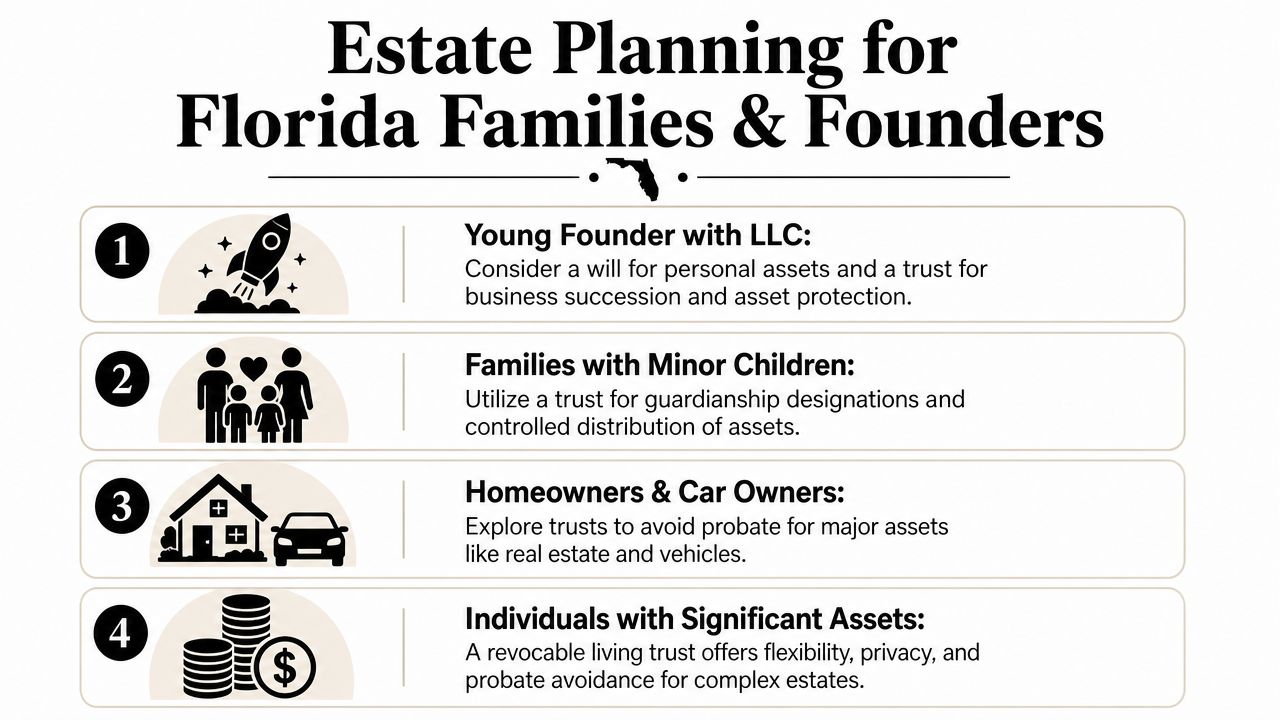
A Miami founder dies with an LLC, a rental property, and two minor children. The family assumes the will covers everything. It does not. The court can sort out who manages assets that stayed in the decedent's name, while a separate question remains about who raises the children and who controls the money for them. That split is where many Florida plans fail.
Young professional with growing assets
A simple will can be enough for a Floridian who is early in the accumulation stage, has straightforward accounts, and needs clear basic instructions in place. That is often true for a single professional or newly married couple with no children and no business interest.
In Miami, that window often closes faster than people expect. A condo purchase, a growing brokerage account, cryptocurrency, a side venture, or family help with down payment money can turn a simple estate into one that needs tighter control and cleaner transfer instructions.
The practical move is often to sign a will, durable power of attorney, health care documents, and then revisit the plan as soon as asset titles start to spread across multiple accounts or entities. Waiting usually means more cleanup later.
Parents with minor children
Parents need to separate two jobs that Florida law treats very differently. A will names guardians. A trust controls how money is managed and when children receive it.
That distinction matters in real life. Parents often focus on who would raise the children and assume the financial piece will somehow follow. Or they create a trust and assume it also handles guardianship. It does not. For many families, the right structure is both documents working together, as explained in Western & Southern's discussion of will versus trust planning for parents.
A will can nominate the people you want the court to consider as guardians. A trust can keep a 19-year-old from receiving a full inheritance outright, can hold funds back for education or health needs, and can give one responsible adult authority to manage money without handing over unrestricted access.
If you have children under 18, put the guardian nomination in a valid will and put the money management rules in a trust if you want real control after your death.
Founder or business owner
Will-only planning is usually where founders in South Florida take the biggest risk.
If the business interest stays in your individual name, your successor may have legal ownership rights on paper but no immediate practical authority to act. Vendors still need answers. Payroll still has to run. Co-owners may have transfer restrictions in the operating agreement. Family members may expect income from an asset they cannot yet control.
A revocable trust often works better for continuity because it gives a private management structure for assets that are properly transferred into the trust during life. That only works if the business records, membership certificates, operating agreement, buy-sell terms, and title work all match the estate plan. For a closer look at how those pieces fit together, review this estate planning guidance for business owners.
Founders also need to think beyond death. Incapacity is often the more disruptive event. If you are alive but unable to sign, direct operations, or handle a sale, a trust-based plan paired with current business documents can reduce confusion inside the company and inside the family.
Blended family or second marriage
Second marriages and blended families need precision, not assumptions.
A basic will that leaves everything outright to a surviving spouse may defeat the larger family plan. I have seen cases where the surviving spouse later changes beneficiaries, remarries, or uses assets in ways the first spouse never intended. Children from a prior relationship are then left to argue about promises that were never written into enforceable terms.
A trust lets you set separate lanes. You can provide income or access for a surviving spouse, preserve principal for children from a prior relationship, and name who controls the process. That level of structure matters when the family includes separate property, business interests, or Miami real estate with uneven contributions and expectations.
Practical tip: Choose the document set based on transfer risk, control needs, and family structure. Minor children, business assets, rental property, and blended families usually call for more than a will standing alone.
Common Mistakes and Advanced Florida Strategies
A Miami founder dies with a signed will, a profitable LLC, and two minor children. The family assumes the documents settled the hard part. Then the surviving spouse learns the will does not transfer control of the company by itself, the operating agreement restricts the ownership change, and the court process now sits between the business and the people trying to keep it running.
That problem is common because estate plans usually fail after signing, not during drafting.
The mistakes that break otherwise good plans
The first mistake is creating a trust and never funding it. Signing the trust does not retitle the house, move the brokerage account, or assign the LLC interest. Those transfer steps have to be completed, documented, and checked against the way each asset is owned.
The second mistake is using a will as if it were an asset-control document for everything the family owns. A will has an irreplaceable job for parents of minor children. It nominates guardians. But it does not give the same level of control over how money is managed for those children. If parents want to delay distributions, protect a child from receiving a lump sum at eighteen, or put one person in charge of business or investment assets, the trust usually carries that load.
The third mistake is relying on generic forms that ignore Florida title issues and business records. I see this with closely held companies, rental property, and family condos in Miami. The estate plan says one thing, but the deed, beneficiary designation, shareholder records, or operating agreement say something else. That mismatch is what creates disputes, delays, and court involvement.
A fourth mistake gets missed until there is conflict. Families assume beneficiary designations and joint ownership will "take care of it." Sometimes they do. Sometimes they override the rest of the plan and send assets to the wrong person, leave one child with less than intended, or bypass the trust structure that was supposed to protect a young beneficiary or a second marriage plan.
Why a pour-over will matters
A pour-over will belongs in many trust-based plans because people forget assets. They open a new account, buy a vehicle, receive an inheritance, or leave an interest in a new entity outside the trust.
The pour-over will directs those stray assets into the trust at death. That preserves one distribution system instead of splitting the estate between trust terms and will terms.
It is still a backstop, not a substitute for funding. If the asset stayed outside the trust during life, probate may still be required before it reaches the trust.
For Florida parents, the distinction matters. The will handles guardian nominations. The trust handles asset management. Treating those jobs as interchangeable is one of the costliest planning mistakes I see, especially where minor children, real estate, or a family business are involved.
For founders, advanced planning often means more than a revocable trust. It may include an assignment of business interests, updates to the operating agreement or shareholder documents, successor management instructions, and clear authority under powers of attorney. Without that coordination, a surviving family can inherit ownership on paper while lacking the authority to operate, vote, sell, or stabilize the company in real time.
Coto & Waddington, Attorneys at Law, works with South Florida families on estate planning and trust implementation. The key concern is not the firm name on the cover. The key concern is whether the plan is fully carried through after signing.
Practical tip: Review the plan after any major asset change. A home purchase, new LLC, refinance, sale of a business interest, remarriage, or the birth of a child can leave the will, trust, and title records out of sync.
Next Steps Working With a Florida Estate Planning Attorney
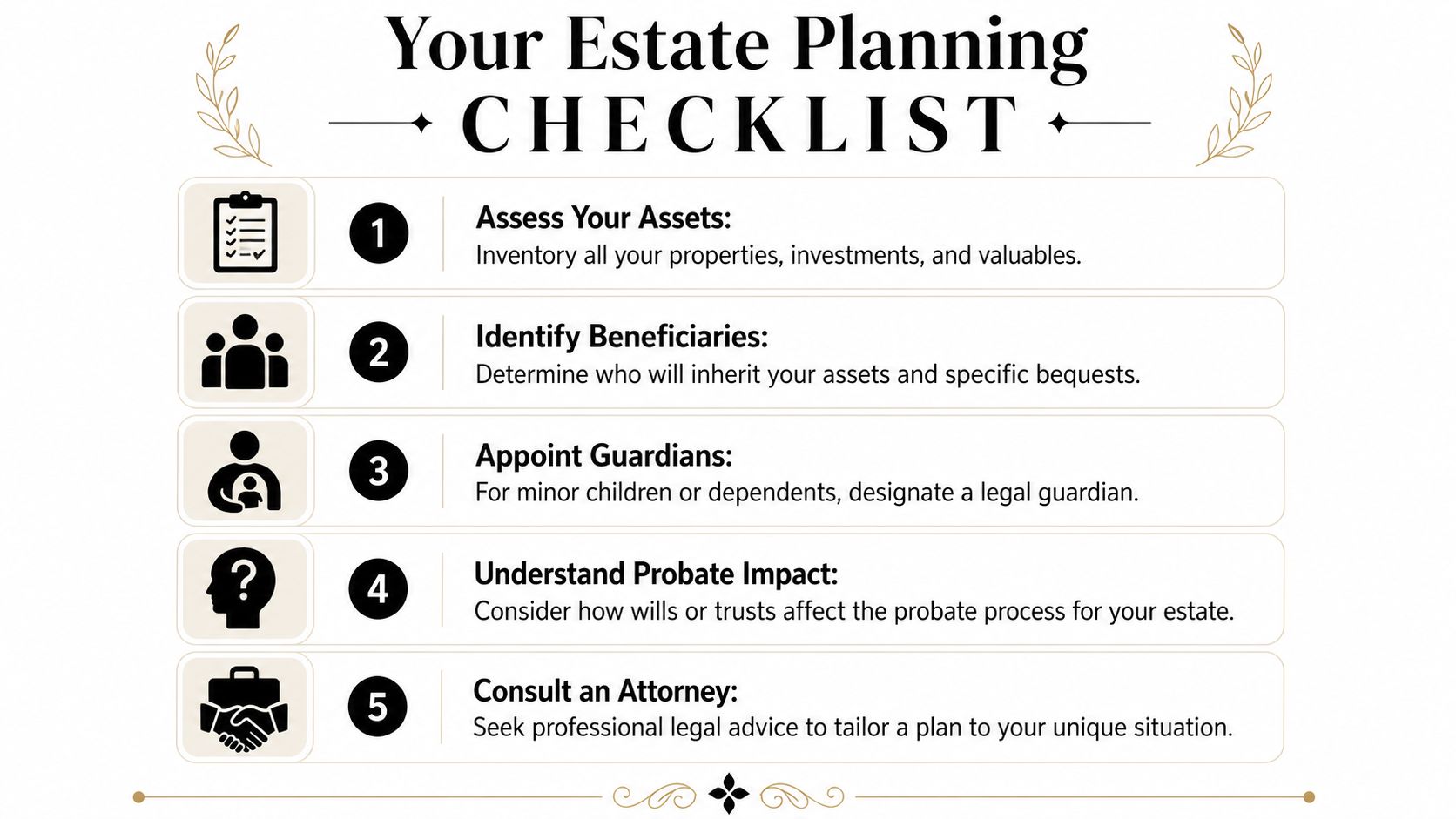
By the time most families schedule a consultation, they already know the answer probably isn't “just download a form.” The better use of that meeting is to make a clean inventory of what you own, who you need to protect, and where court involvement would cause the most damage.
For many readers, the decision framework is straightforward:
- Choose a will at minimum if you need guardian nominations for minor children.
- Consider a revocable trust if privacy, probate avoidance for funded assets, or structured distributions matter.
- Use both together if you want a more complete plan.
How to prepare for a consultation
Bring the facts that drive the legal answer.
- List your assets: Include real estate, bank accounts, investment accounts, business interests, and valuable personal property.
- Identify decision-makers: Note who you want handling finances, trust administration, or estate administration.
- Name beneficiaries clearly: Include full names and think through backup beneficiaries.
- Address family issues directly: Minor children, blended families, and dependents with special needs change the structure.
- Gather business documents: Operating agreements, stock records, and ownership schedules matter for founders.
- Write down your concerns: Privacy, probate avoidance, creditor exposure, and family conflict are all valid planning goals.
The best consultations are practical, not abstract. If you know where the assets are and who should control them, legal planning becomes much more efficient.
Practical tip: Don't wait for the “perfect” time. The right time is when your estate is understandable enough to organize and before a health event, travel emergency, or business disruption forces your family into reactive decisions.
Frequently Asked Questions About Wills and Trusts
Can I have both a will and a trust
Yes. In many Florida plans, that's the most sensible structure. The will handles guardian nominations and catches assets left outside the trust. The trust handles administration of funded assets.
What happens if I move out of Florida
Your documents should be reviewed after a move. Estate planning remains state-specific enough that assumptions can become expensive.
How often should I update my plan
Update after marriage, divorce, births, deaths, major purchases, business changes, or a move. Review even sooner if a named fiduciary can no longer serve.
Can a trust protect assets from every lawsuit
Not automatically. A revocable trust is mainly an estate planning and administration tool. Asset protection needs separate legal analysis.
If you're weighing wills vs trusts pros cons and want a plan built around Florida property, business ownership, and family realities, Coto & Waddington, Attorneys at Law is one place to start. The firm works with South Florida families and founders who need practical estate planning, including wills, revocable trusts, and implementation steps that help the documents work when they're needed.