A Florida employee usually reaches for the handbook after a bad meeting, not after a legal epiphany. A Miami bookkeeper sees vendor invoices being padded, a county employee hears someone talk about dumping costs into the wrong account, or a sales manager realizes the story being pushed internally doesn't match the records. The core question isn't whether the conduct feels wrong. It's whether Florida whistleblower law protects the report, and the answer depends on which statute you're dealing with.
Table of Contents
- What the Florida Whistleblower Act Covers
- Who the Law Protects and What Disclosures Qualify
- How to Report Misconduct and Keep Your Protections
- Why Reasonable Belief Is Not Always Enough
- Federal Overlap and the False Claims Act Connection
- Employer Obligations, Sample Policy Language, and Common Mistakes
What the Florida Whistleblower Act Covers
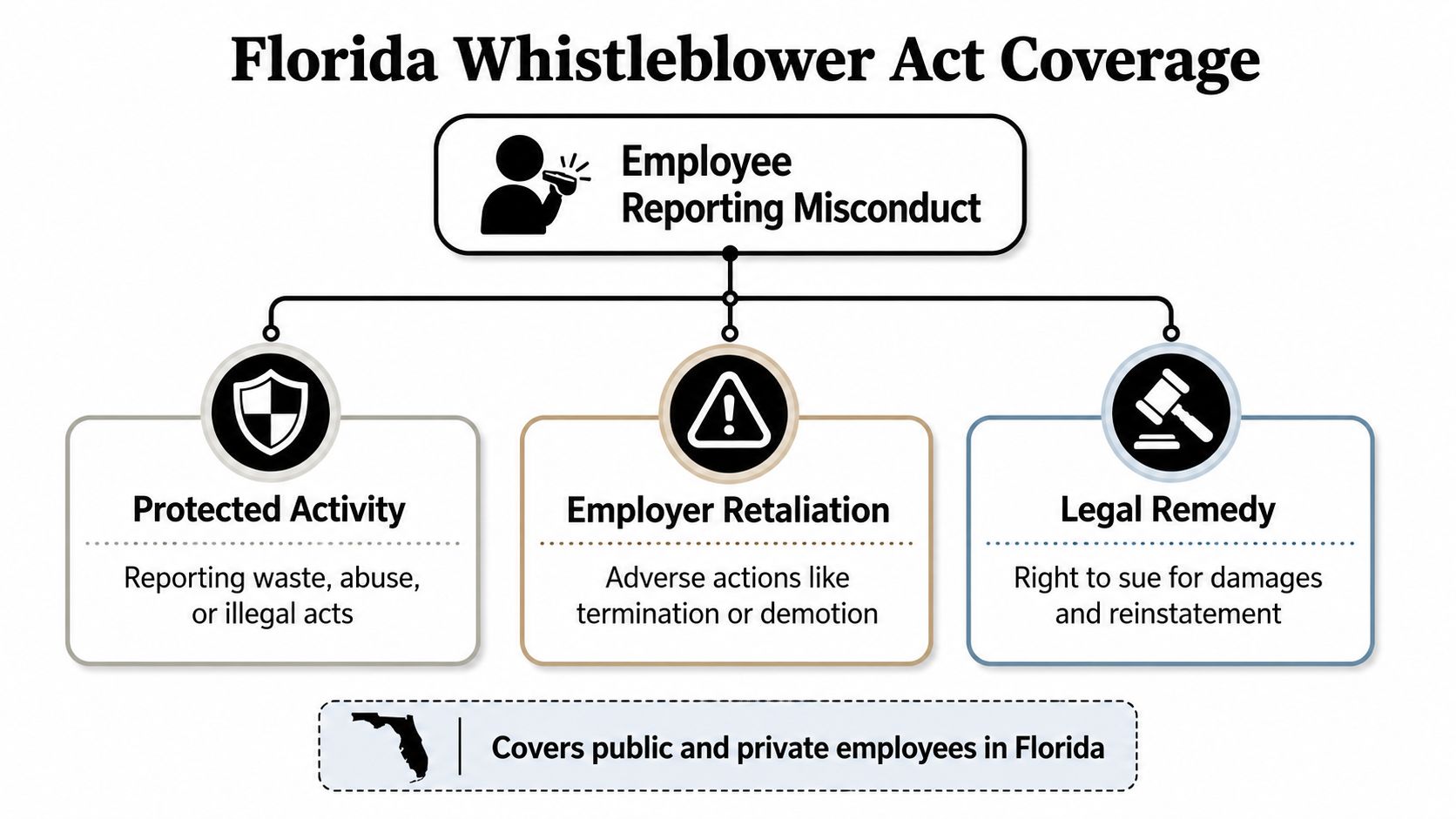
Many practitioners and employees search for “whistleblower act Florida” as if one rule controls every retaliation claim. It does not. Florida divides whistleblower protection into two separate regimes, one for the public sector and one for the private sector. That split controls the statute, the reporting path, and the proof problems from the start.
The public side is about public integrity
Florida's public-sector Whistle-blower's Act sits in Sections 112.3187 to 112.31895 of the Florida Statutes, and the Florida Inspector General brochure says the framework was enacted in 1986. The law protects disclosures about legal violations, gross mismanagement, malfeasance, misfeasance, gross waste of public funds, Medicaid fraud or abuse, and gross neglect of duty. The Florida Inspector General brochure on the Whistle-blower's Act explains the point clearly, the statute exists to stop retaliation when someone reports conduct that creates a substantial and specific danger to the public's health, safety, or welfare. Florida Inspector General brochure on the Whistle-blower's Act
Government workers, and sometimes independent contractors working for public agencies, need to analyze their facts under that standard, not under a generic workplace-grievance theory. A complaint about sloppy supervision may go nowhere. A report about conduct that endangers the public, or fits one of the statute's listed categories, is a different matter.
The private side is narrower and more procedural
The private-sector law is Florida Statutes Sections 448.101 to 448.105. It applies to private employers with 10 or more employees and protects workers who disclose, assist in, or refuse to participate in unlawful conduct by the employer. Courts and commentators have spent years fighting over the notice requirement in that statute, and the practical lesson is simple, details matter early. A useful discussion of exempt status in another Florida employment context appears in this Florida employment-law guide on exempt status. Florida Bar Journal analysis of the notice requirement
Practical rule: before anyone reports, they need to know whether they work for a public agency, a contractor tied to a public agency, or a private employer. That classification changes the case from the start.
Who the Law Protects and What Disclosures Qualify
A Florida whistleblower claim lives or dies on two questions, who is protected and what was reported. Miss either one, and the case can fail before anyone reaches retaliation. That is true in both the public and private regimes, but the rules are different enough that employees and employers routinely get them wrong.
Public-sector coverage tracks the public-danger standard
Under Section 112.3187, protection can extend to agency employees, agents, and independent contractors. The disclosure still has to fit the statute's text. It must concern a legal violation that creates a substantial and specific danger to public health, safety, or welfare, or it must involve one of the listed categories such as gross mismanagement or Medicaid fraud or abuse. Florida Statutes § 112.3187
That wording narrows the field fast. A public employee who complains about a bad supervisor is not automatically covered. A public employee who reports conduct that puts the public at risk, or that falls within a listed statutory category, is in a much stronger position.
Private-sector coverage depends on the employer and the conduct
The private statute starts with a threshold. It applies only to employers with 10 or more employees. It protects employees who disclose, assist in, or refuse to participate in unlawful conduct. Procedure matters here too. Courts and commentators have long treated the statute as requiring a written complaint to a supervisor and a reasonable opportunity to correct the problem before some claims can move forward. The practical point is simple, employees who work in roles that are treated as exempt under wage and hour law should not assume that status changes whistleblower coverage, because the retaliation analysis is separate from pay classification. See this Florida guide to exempt status under the FLSA.
A worker can be right on the facts and still lose on procedure. Florida whistleblower claims punish sloppy reporting.
That is why the statutes are not interchangeable. Public-sector claims turn on public harm and enumerated misconduct. Private-sector claims turn on employer size, unlawful conduct, notice, and retaliation. If you do not sort that out first, you cannot assess exposure or preservation.
| Dimension | Public-Sector (112.3187) | Private-Sector (448.102) |
|---|---|---|
| Covered workers | Agency employees, agents, independent contractors | Employees of employers with 10 or more employees |
| Qualifying disclosures | Legal violations creating substantial and specific danger, plus listed misconduct like gross mismanagement or Medicaid fraud | Disclosure, assistance, or refusal involving unlawful conduct |
| Reporting steps | Written or otherwise protected disclosure to the proper authority matters most | Written complaint to a supervisor and chance to correct can be critical |
| Basic remedies | Retaliation remedies under the public statute | Retaliation claims under the private statute |
If the facts sit near the edges, stop and get a legal read before anyone sends a complaint. Employers often win these cases by narrowing the statute, not by denying that bad conduct happened.
How to Report Misconduct and Keep Your Protections
The biggest mistake employees make is rushing. They send a vague email, vent to coworkers, or make a verbal complaint with no trail. Then, when retaliation starts, they can't prove what they said, who heard it, or whether the right recipient got the message.

Build the record before you open your mouth
Start with dates, names, emails, invoices, texts, and account notes. If the conduct involves records, preserve them legally and keep copies where you can access them. The point is not to create a giant file for drama. The point is to prove chronology and causation later, because retaliation cases often turn on whether the employer can claim it acted for some other reason.
For public agencies, the Florida Office of the Inspector General is often part of the reporting path. For private employers, the right outside agency depends on the underlying law that was violated. If the misconduct implicates payroll, safety, fraud, discrimination, or another regulated area, the relevant agency may be state or federal. A one-size-fits-all complaint is usually a weak complaint.
Report internally in writing and keep it calm
Use a supervisor, compliance hotline, ethics portal, or another designated channel. Put the issue in writing, identify the conduct, and ask for correction. Don't turn the report into a speech about motive or revenge. A clean, factual complaint is harder to attack. If the statute or policy expects a written complaint, treat that as mandatory, not optional.
The data-security side of this process matters too. If your complaint involves customer files, confidential records, or internal documents, review these Florida data security best practices before you forward anything. Careless handling of records can create a second problem that buries the first one.
Preserve the email thread, preserve the attachment history, and preserve the dates. In whistleblower work, memory fades and paper wins.
Use a simple checklist
- Document first: Keep dated notes, screenshots, and source files.
- Name the recipient: Identify the supervisor, hotline, or agency you contacted.
- Stay off social media: Public venting can distort the record and hand the employer defenses.
- Preserve emails: Don't delete the original thread, even if the response is ugly.
- Ask for correction: Give the employer a real chance to fix the problem.
- Choose the right forum: Public and private claims don't start in the same place.
The reporting plan should be boring. Boring is good. Boring is what survives discovery.
Why Reasonable Belief Is Not Always Enough
Many Florida guides get sloppy here. They tell employees that if they “reasonably believed” something illegal was happening, they're protected. That's not always true in Florida private-sector retaliation litigation.
The actual law can matter more than the employee's suspicion
A recent summary of Gessner v. Southern Company says the Florida Supreme Court rejected a reasonable belief standard for claims under Section 448.102(3) and required proof that the underlying activity was unlawful, not merely suspected to be unlawful. Summary of Gessner v. Southern Company That is a big deal. It means the employee's good-faith concern may not be enough if the conduct ultimately doesn't violate a law, rule, or regulation.
Think about a South Florida sales manager who sees referral payments and assumes a RESPA problem. He reports it, but later review shows the arrangement was a permitted marketing structure. Under the stricter reading described in Gessner, that report can fall outside the statute if the underlying conduct wasn't unlawful. The employee may still have workplace issues, but the whistleblower claim becomes much harder.
The practical fix is legal review before escalation
Don't lead with a conclusion you can't support. Build the facts first, then have counsel test the conduct against the actual law. If the conduct is close to the line, document why it's close, not just why it felt wrong. If you report, describe the facts and the suspected violation carefully. Avoid dramatic language that sounds like you're guessing.
For employers, the outcome hinges on a few critical factors. If the employee's report rests on a mistaken legal assumption, the defense should focus on the actual statutory elements, not just the tone of the complaint. If the underlying conduct is unlawful, the employer needs a documented response. If it isn't, the employer still needs to avoid retaliation based on the employee's act of raising the concern.
Bottom line: Florida is stricter than many workers expect. In private-sector cases, documentation plus legal review are the workaround, not a luxury.
That is also why early counsel matters. The right framing can preserve a strategic advantage. The wrong framing can hand the defense exactly what it needs.
Federal Overlap and the False Claims Act Connection
Florida law doesn't sit in a vacuum. A lot of the most serious whistleblower situations touch federal law too, especially where Medicare, Medicaid, or publicly funded contracts are involved. If you assume the Florida statute is your only path, you may leave stronger claims on the table.
State and federal remedies can stack
The federal False Claims Act has its own retaliation structure and its own qui tam mechanism for fraud against the government. It also creates the possibility of a 30-percent to 25-percent bounty range for successful recoveries, depending on the case posture and government involvement. That's why federal claims often attract more attention in fraud matters, even when the conduct started in Florida. When the facts support both state and federal theories, counsel should look at both, not just the local claim.
A South Florida employee who reports Medicare or Medicaid fraud may have parallel state and federal options. The state public-sector statute already flags Medicaid fraud or abuse in its protected categories, and the federal route may be even more powerful when the claim involves billing against a government program. The point is simple. Don't file narrowly when the conduct is broad.
Public companies add another layer
If the employer is publicly traded, Sarbanes-Oxley can come into play. The SEC and OSHA also have narrower whistleblower channels that may matter depending on the violation and the reporting path. That doesn't make Florida law irrelevant. It means the case may need to be coordinated across regimes so one filing doesn't undercut another.
The recent Gessner ruling also changes the strategic picture. If a private-sector Florida claim needs proof of actual unlawfulness, federal claims can sometimes offer a cleaner fit when the conduct clearly violates federal program rules. That doesn't guarantee success. It does mean the claim analysis should be broader than a single Florida statute.
The strongest whistleblower file is usually the one that matches the conduct to the right law before anyone starts arguing retaliation.
For founders and in-house teams, the lesson is just as direct. If a report touches billing, government money, or public-company disclosure, do not treat it like an ordinary HR complaint. The claim map may be much wider than the manager thinks.
Employer Obligations, Sample Policy Language, and Common Mistakes
A whistleblower report usually gets worse when the employer mishandles the first response. A manager gets defensive, HR stalls, and someone starts changing shifts, assignments, or access before the facts are sorted out. That is how a manageable complaint turns into a retaliation case.
What employers need to do immediately
Once a credible report lands, the employer should separate the investigator from the subject of the complaint, preserve records, and document every step. Retaliation under Florida law includes obvious acts like termination or demotion, but employers also get into trouble with informal changes that look minor on paper and punitive in practice. A schedule cut, an exclusion from meetings, a transfer, or a sudden loss of duties can all create litigation risk if they follow a protected report.
Florida courts can shift the burden once a prima facie case is shown, so employers need a legitimate, documented reason for every adverse action. Back pay, reinstatement, and attorneys' fees can all become part of the remedy picture. The cleanest defense is a real record showing the company investigated, corrected what needed correction, and treated the reporter consistently.
For a practical handbook framework, the employer-policy discussion in Benely handbook best practices shows how reporting channels and anti-retaliation language belong in the same written policy.
Sample policy language to adapt
Anti-retaliation statement: The company prohibits retaliation against any employee who reports suspected misconduct in good faith, participates in an investigation, or refuses to engage in conduct that the employee reasonably believes violates the law or company policy.
Reporting channel: Employees may report concerns to their supervisor, Human Resources, compliance personnel, or any designated reporting hotline without fear of adverse action.
Recordkeeping commitment: The company will document reports, investigations, corrective action, and employment decisions affecting any reporting employee.
That language serves a practical purpose. It gives managers clear instructions and gives HR something concrete to enforce.
For broader compliance structures, including privacy and employment controls that often overlap with whistleblower issues, employers can also use resources like this Florida business compliance guide on data privacy and employment compliance. The same documentation discipline protects both data handling and retaliation defense.
The mistakes I see most often
- Waiting too long to investigate: Delay looks like indifference and invites escalation.
- Retaliating informally: Schedule changes and social exclusion can be as damaging as a formal write-up.
- Skipping documentation: If the decision was legitimate, prove it.
- Letting managers freelance: One angry supervisor can create company-wide exposure.
- Ignoring overlap with federal law: A state-only response can miss the bigger risk.
If you are an employee weighing a report, or an employer responding to one, get advice before the next move. The first 30 days often decide whether the matter stays internal or becomes a lawsuit.
Coto & Waddington, Attorneys at Law advises Florida businesses, founders, and employees on whistleblower retaliation issues, internal investigations, and compliance strategy. If you need clear guidance on how a report should be made, or how to respond without creating unnecessary exposure, visit Coto & Waddington, Attorneys at Law and get the issue reviewed before the situation escalates.