A Miami founder can do everything right, close the pitch, get the follow-up meeting, and still watch the deal collapse after a competitor starts making calls they should never have made. The client suddenly gets cold feet. The vendor delays. The hiring process stalls. When that happens, the question isn't just who won the business, it's whether someone crossed the line into tortious interference.
For Florida startups, that line matters because business relationships are often built on fast-moving conversations, not signed paperwork. A supplier relationship can be valuable before the final contract is signed. A key hire can be nearly secured before an outside recruiter steps in. Understanding where lawful competition ends and wrongful sabotage begins helps founders protect revenue, talent, and momentum without guessing.
Table of Contents
- Introduction to Tortious Interference
- Understanding Core Concepts
- Key Elements Required for a Claim
- Distinguishing Contract Interference and Prospective Interference
- Defenses and Justifications Against Claims
- Florida Law and Key Case Examples
- Prevention and Response Strategies for Startups
Introduction to Tortious Interference
A startup in Miami can spend weeks negotiating a vendor deal, line up implementation dates, and exchange draft terms, only to see the opportunity disappear after a third party starts pressuring the vendor to walk away. That's the kind of fact pattern that makes founders ask what what is tortious interference really means in practice. The answer is grounded in common-law doctrine that protects contracts and business relationships from wrongful outsider interference, with a focus on purposeful, improper conduct rather than accidental market rivalry, as summarized by Cornell Law School's Wex entry on tortious interference (Cornell Law School).
Practical rule: A lost deal is not automatically a legal wrong. The legal issue starts when a third party knowingly targets an existing relationship or a real business expectancy and uses improper tactics to disrupt it.
For founders, that distinction is more than academic. Startups rely on suppliers, employees, distributors, agencies, and customers who may not be locked in with a signed agreement yet. The doctrine matters because it covers both existing contracts and profitable business expectancies, which is why it comes up so often in negotiations, hiring, and client onboarding. It also helps explain why courts generally reject claims based on mere competition alone, since business life is allowed to be aggressive without becoming unlawful.
Florida businesses need this framework early, not after a dispute has already hardened into litigation. If a competitor, former partner, or even a disgruntled insider is interfering with a deal, counsel can help sort out whether the facts fit contract interference, prospective interference, or just hard competition. Founders who recognize the issue quickly can preserve evidence, safeguard their bargaining power, and avoid turning a commercial problem into a missed legal deadline. When the facts start pointing toward deliberate disruption, talking to a lawyer sooner is usually better than waiting for the damage to multiply.
Understanding Core Concepts
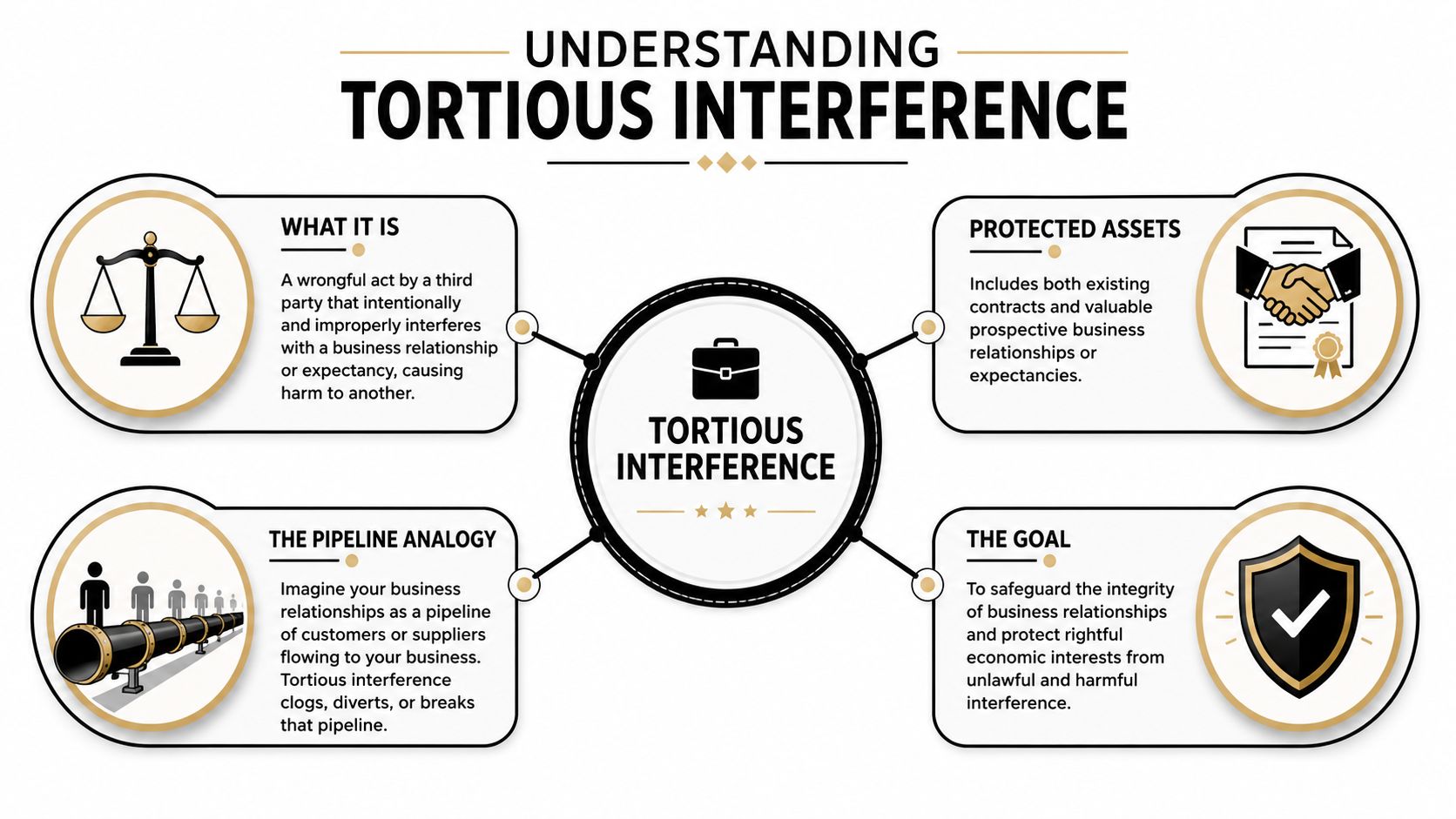
Think of a business relationship as a protected pipeline. Customers, suppliers, and strategic partners move through that pipeline only because trust, timing, and communications are lined up in the right way. Tortious interference is the legal claim that comes into play when an outsider deliberately jams that pipeline and causes measurable economic harm, as opposed to legitimate competition in the marketplace.
What the doctrine protects
The law protects more than signed paperwork. Cornell's summary explains that the tort covers both valid contracts and business relationships, including profitable expectancies that may not yet be formalized (Cornell Law School). That matters in startup life, because a meaningful vendor relationship, a pending customer renewal, or a near-final hiring process can have real value before a final signature lands.
The practical boundary is easier to see with an analogy. If you and a competitor are both bidding for the same customer, that's normal competition. If the competitor lies, threatens, or otherwise uses improper conduct to tear up your existing relationship, the conduct starts looking like tortious interference. The doctrine is built to separate healthy rivalry from wrongful sabotage.
Where the line gets drawn
The key question is not whether someone caused you disappointment. It's whether the defendant knew about the relationship, meant to disrupt it, and acted improperly. A legal glossary used by business readers puts that distinction plainly, liability depends on whether the interference was improper, without justification, or involved improper means, and mere competition alone usually isn't enough (Model Diplomat).
A founder-friendly way to think about it is this, if someone is simply trying to win your business honestly, that's competition. If they're using deception, threats, or similar tactics to break an existing relationship or a real expectancy, that's where the doctrine begins to matter.
The reason this matters for Florida startups is simple. Deals are often informal until they're not. A strong pitch deck, a verbal commitment, or a promising chain of emails can all create real commercial value, but only some of those situations support a legal claim if a third party steps in. The rest of the analysis comes down to proof, causation, and whether the conduct was wrongful enough to cross the line.
Key Elements Required for a Claim
A plaintiff usually has to prove a familiar five-part structure, and each part matters. A valid contract or business expectancy comes first, then the defendant's knowledge of that relationship, then intentional and unjustified interference, then an actual breach or disruption, and finally damages. Legal summaries still frame the claim around those recurring proof points, which is why evidence quality often decides these cases before the legal arguments do.
The checklist courts care about
| Core Elements of Tortious Interference | Description |
|---|---|
| Valid contract or expectancy | The plaintiff had an enforceable contract or a real business relationship with economic value. |
| Defendant's knowledge | The defendant knew about that contract or expectancy. |
| Intentional interference | The defendant deliberately acted to disrupt the relationship. |
| Actual breach or disruption | The relationship was broken, delayed, or materially harmed. |
| Damages | The plaintiff suffered measurable financial loss. |
That structure appears in both contract interference and prospective advantage claims. A business law summary notes that the two major doctrinal branches, interference with an existing contract and interference with prospective economic advantage, both require proof of awareness, wrongful conduct, and financial harm (TBM Lawyers). For founders, that means the claim is not about annoyance. It's about documented economic injury.
How it plays out in real disputes
A vendor example makes the analysis concrete. If your company has a signed supply agreement and a competitor induces the supplier to stop performing, the case likely focuses on the breached contract. If your team is still negotiating with a supplier and the competitor uses improper tactics to stop the relationship from forming, the claim shifts toward prospective interference. The same logic applies in hiring. If someone steps in to derail an employee offer by misleading the candidate or pressuring the employer, the facts may support a claim if the proof shows intentional disruption and quantifiable harm.
The damages side matters just as much as the liability side. Forensic accounting guidance explains that damages can include direct expenses, lost profits, lost business value or goodwill, and in limited situations unjust enrichment. It also describes a standard lost-profit formula, lost revenue, less avoided costs, equals lost profits (Fox Forensic Accounting). That formula is useful because courts want to see a measurable loss, not just frustration.
If the file doesn't show who knew what, what they did, and how much money it cost, the claim is usually weaker than it first looked.
Distinguishing Contract Interference and Prospective Interference
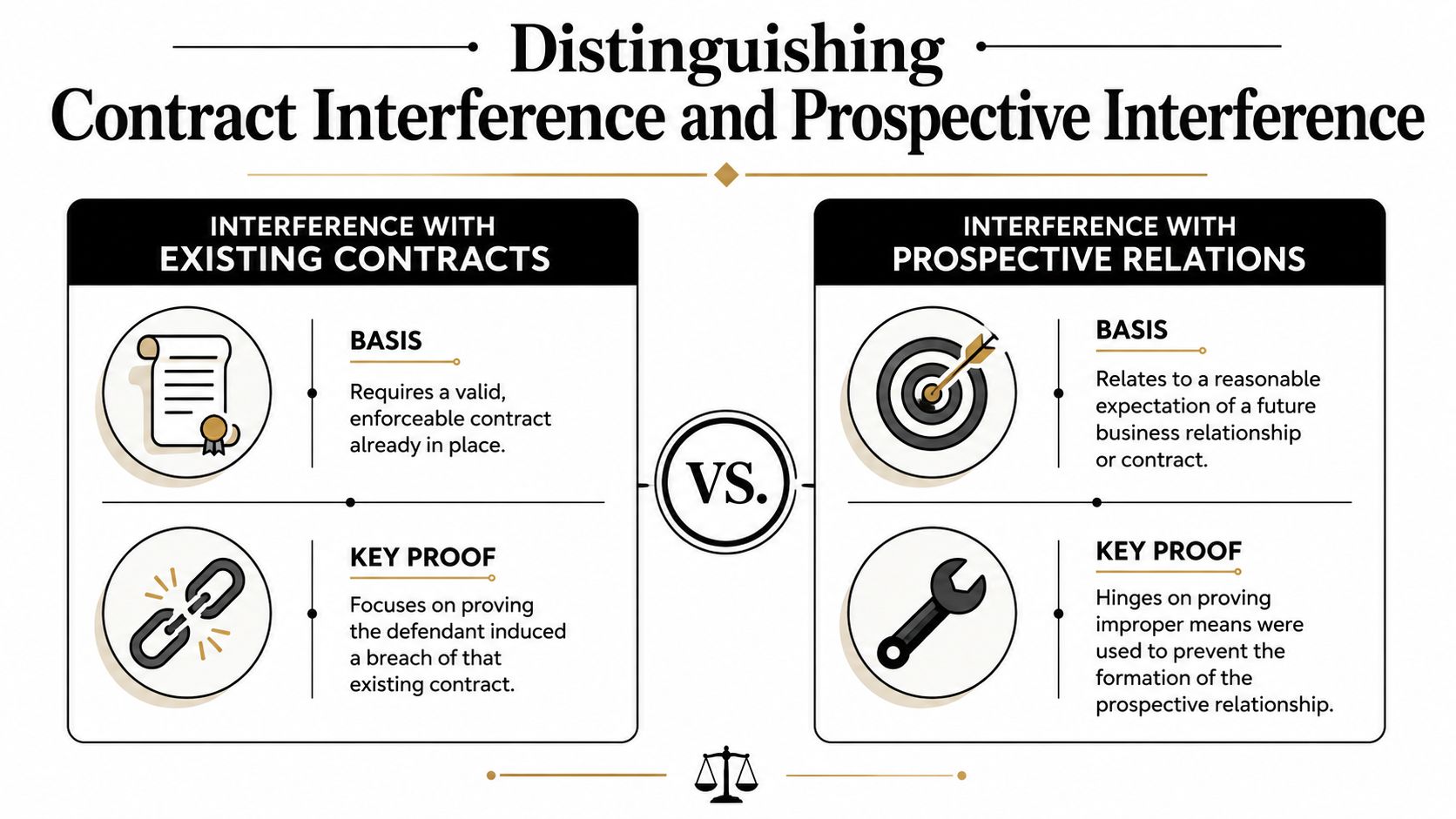
The fastest way to misunderstand this area is to treat every disrupted deal the same. Courts often separate interference with an existing contract from interference with a prospective business relationship, and the proof burdens are not identical. A source used by business readers notes that many jurisdictions treat them as separate theories with different proof requirements (Wikipedia).
Existing contract claims
An existing-contract claim usually starts with a signed agreement that can be enforced. The plaintiff then has to show the defendant knew about it and intentionally caused a breach or termination. That's why these cases often turn on emails, text messages, call logs, and timing. If a startup has a signed services agreement and a competitor persuades the vendor to stop performing, the plaintiff will focus on the contract itself and the disruption it caused.
Prospective relationship claims
Prospective claims work differently. They can apply even when there isn't a finalized contract, but the plaintiff still needs a real expectancy, not just a hope. The business relationship has to be specific enough to show probable future economic benefit, and the defendant's conduct usually has to be improper in a more direct way. That matters a lot in startup life, where term sheets, pilots, pitches, and onboarding conversations are common but not always locked in.
A founder who loses a term sheet because a rival offers better pricing is usually looking at competition. A founder who loses a term sheet because a rival uses misinformation or improper pressure may be looking at prospective interference. The same distinction applies to client pitches and contractor onboarding. One path is market competition. The other is wrongful disruption.
The useful question is simple. Was there a protected relationship or expectancy, and did the other side cross the line to stop it? If the answer is unclear, the case may hinge on how well the plaintiff can prove the expectancy, the defendant's knowledge, and the way the disruption happened.
Defenses and Justifications Against Claims
A startup can lose business and still have no tort claim. The key question is whether the other side used improper means or crossed a legal line, not whether the plaintiff felt harmed. The Restatement (Second) of Torts § 767 asks courts to weigh the nature of the conduct, the motive, the interests involved, and the setting of the dispute. That framework matters for founders because lawful competition often looks aggressive from the outside, especially in crowded sales markets.

When competition stays lawful
Recruiting a customer, employee, or supplier is often allowed if you are truthful and you do not use improper means. A better price, faster onboarding, or more flexible service terms is ordinary competition. Misstating a rival's product, threatening a vendor, or using confidential information you should not have changes the analysis quickly.
Florida founders should also keep the timing of any response in mind. If a dispute is already brewing, a clean record helps show that your team acted to win business, not to sabotage someone else's deal. Written proposals, accurate sales claims, and careful internal messages can separate a lawful pitch from conduct a court may treat as interference.
What founders should avoid
The fastest way to create exposure is to overstate facts or push too hard. Don't tell a prospect that a competitor is insolvent unless you can prove it. Don't pressure someone to breach a live obligation just to close a deal faster. Don't use a departing employee as a messenger to reach clients if you know there is a restrictive agreement in place. If the conduct would look sharp, deceptive, or retaliatory on paper, assume a judge may see it that way too.
A practical safeguard is to keep negotiations factual and narrow. If your team is hiring from a competitor, they should avoid statements that interfere with existing obligations. If your sales team is approaching a customer already in another company's pipeline, the pitch should stand on its own merits. A Florida business attorney can pressure-test these practices before a dispute starts, and Coto & Waddington handles exactly these contract and competition issues for South Florida startups. For related reputational risk, see slander and libel on social media explained.
Florida Law and Key Case Examples
A founder in Florida usually needs two things at the same time, a clear rule set and a deadline check. The rule set matters because Florida follows the same basic common-law framework described above, but local courts focus closely on whether the interference was improper and whether the plaintiff can prove real economic harm. The deadline check matters because a business dispute can age quickly, and entrepreneurs often learn about the problem only after emails, calls, or customer relationships have already shifted.
Why damages and timing matter in Florida disputes
Florida claims often turn on familiar business losses. Courts commonly look at direct expenses, lost profits, and lost goodwill, and those categories help explain why proof must connect the interference to a measurable setback, not just frustration. In practice, that can look like a lost account, a smaller deal value, or a supplier relationship that ended after the interference.
The damage story also needs a clean paper trail. If the record shows lost revenue, courts still expect the claimant to account for avoided costs and explain how the number was built. A startup founder should be able to tie the loss to specific conduct, not just to a general decline in business.
Timing matters just as much. Under Florida statute of limitations for business claims, and under Fla. Stat. § 95.11(3)(o), Florida's limitations period for tortious interference claims is generally four years, so founders should calendar that deadline from the moment they discover the interference. Waiting too long can make a strong claim harder to use, even when the underlying conduct is serious.
Case-driven lessons for founders
Florida courts have made one point clear, the label on the claim matters less than the facts around it. In Ethan Allen, Inc. v. Georgetown Manor, Inc., 647 So. 2d 812 (Fla. 1994), the Florida Supreme Court explained the limits of prospective interference claims and showed that a business must prove more than a hoped-for future customer relationship. That matters for founders because a promising pipeline is not the same thing as an established expectancy with legal weight.
Tamiami Trail Tours, Inc. v. Cotton, 463 So. 2d 1126 (Fla. 1985) is another useful Florida reference because it reflects how closely courts look at purpose, conduct, and whether the interference was justified. For a startup founder, the lesson is simple. A hard-nosed sales push is one thing. Using pressure, false statements, or disruption to break an existing business relationship is something else.
Florida disputes also overlap with contract issues, non-solicitation fights, and relationships that were never fully locked down. Reading a tortious interference claim together with contract remedies often helps, especially when the same facts may also support breach claims. If the relationship was contractual, a contract-focused resource like Florida breach of contract guidance can help founders sort out what remedy fits the facts.
False statements can create a second layer of exposure online. A useful background read is slander and libel on social media explained, which helps separate defamation-style conduct from interference with a contract or with a likely business deal.
In Florida disputes, the facts often decide the case before the label does. A signed agreement, a real expectancy, and a clean timeline can matter more than an aggressive accusation.
Jurisdiction and venue also shape how a case unfolds. A startup in Miami may face a different practical path than a company elsewhere, especially when witnesses, vendors, and key messages are all in South Florida. The safest move is to preserve evidence early, then have a Florida business-litigation lawyer map the facts to the right theory before deadlines and damage calculations become harder to manage.
Prevention and Response Strategies for Startups
The cheapest tortious interference case is the one that never happens. Founders can reduce risk by tightening contracts, documenting communications, and making sure employees know where competition ends and confidentiality begins. A solid agreement set should cover vendor terms, non-disclosure obligations, and non-solicitation issues where appropriate, and a helpful starting point is this resource on non-solicitation agreement basics.
Prevention that actually helps
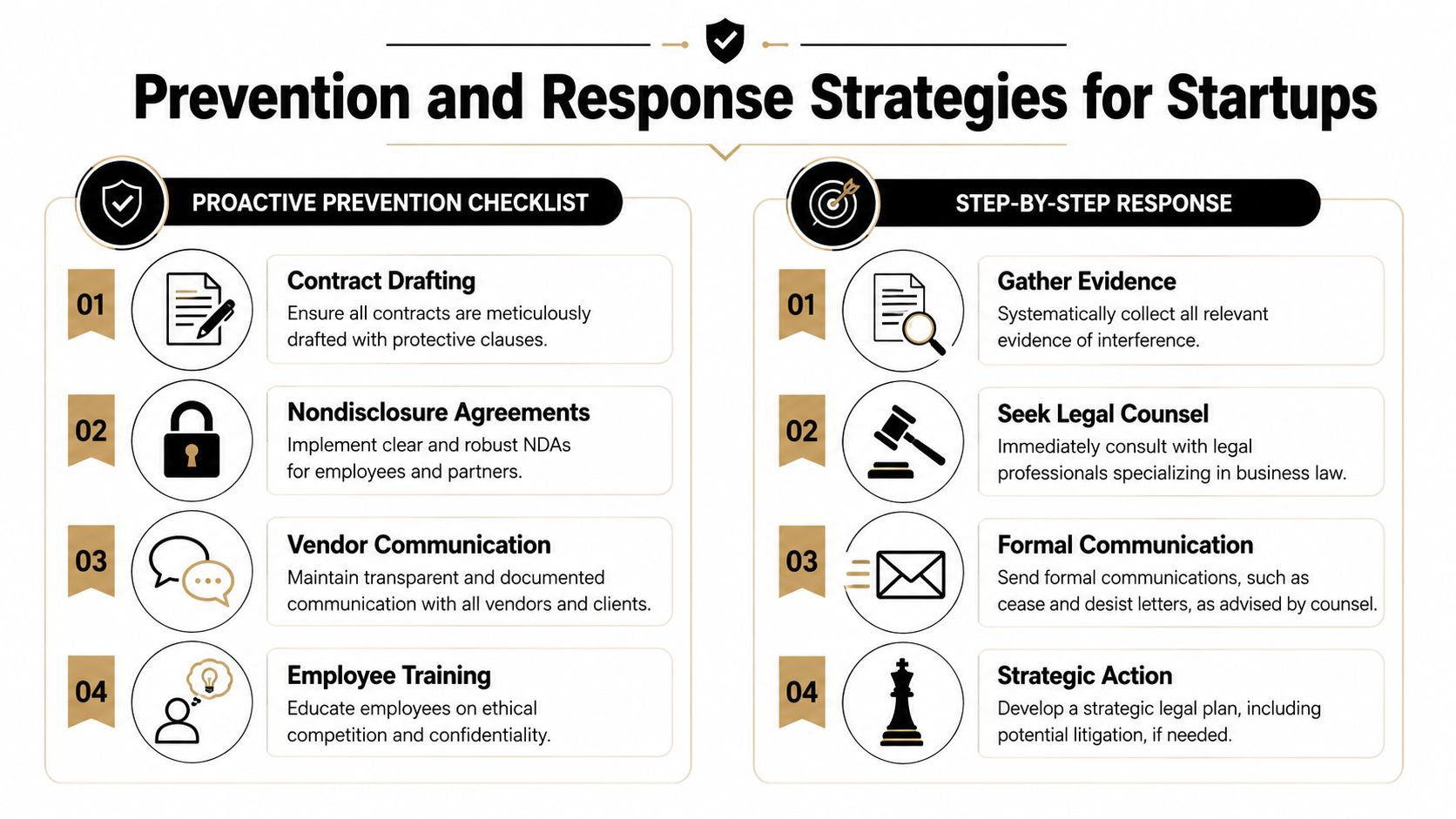
- Contract Drafting: Put service scope, termination rights, confidentiality duties, and dispute terms in writing before the relationship becomes valuable.
- Nondisclosure Agreements: Use clear NDAs with employees, contractors, and partners so confidential deal information doesn't drift into the wrong hands.
- Vendor Communication: Keep written records of key commitments, changes, and approvals.
- Employee Training: Make sure team members understand ethical competition, confidentiality, and who can speak for the company.
When interference does happen, move in order. First, collect the emails, texts, call notes, and dates. Next, get legal counsel involved before anyone responds emotionally. Then send a formal demand letter if the facts support it, and let counsel decide whether a cease-and-desist notice or litigation strategy makes sense.
Sample demand letter language
“Our company has reason to believe your conduct has improperly interfered with an existing business relationship and caused economic harm. Preserve all communications, documents, and records related to this matter immediately. Cease any further contact or conduct aimed at disrupting the relationship, and direct all future communications to counsel.”
That language should be adapted to the facts, but it gives founders a practical starting point. If you need a Florida-focused review of a contract dispute, a startup agreement, or a possible interference claim, reach out early so the evidence and the legal theory stay aligned.
A CTA for Coto & Waddington, Attorneys at Law. If your startup is dealing with a broken vendor deal, a poached client, or a suspicious hiring dispute in South Florida, contact the firm to review the facts, preserve evidence, and get a practical Florida legal strategy before the situation gets harder to unwind.