Progressive discipline is a 20th-century step-by-step process that usually moves from verbal warning to written warning to suspension, then termination if the problem doesn't improve. It exists to give an employee notice plus opportunity to improve, not to force a manager to tolerate the same conduct forever.
You're probably reading this because someone on your team is late, sloppy, or openly pushing back, and you're trying to decide whether you can just end it. In a Florida startup, that question comes up fast, especially when payroll is tight and one bad actor can throw off the whole shop.
Table of Contents
- Why Florida Startups Need Progressive Discipline
- The Progressive Discipline Ladder Explained
- When to Skip Steps for Severe Misconduct
- Documenting Discipline with the FRISK Model
- Coaching First vs Rigid Punitive Ladders
- Legal Risks and Compliance for Florida Employers
- Your Progressive Discipline Action Plan
Why Florida Startups Need Progressive Discipline
A founder's first instinct is often simple. The employee is missing deadlines, ignoring instructions, or showing up late, so the question becomes whether it's easier to cut the cord and move on.
That instinct is understandable, but in a startup, discipline decisions don't live in a vacuum. At-will employment gives Florida employers broad firing flexibility, but it doesn't make a termination lawsuit-proof. A paper trail that shows the employee got notice, a chance to respond, and a real opportunity to improve often becomes the difference between a clean exit and a messy dispute.
Practical rule: if you can't explain the problem, the prior warning, and the next consequence in a few clear sentences, your discipline process isn't ready.
A proper progressive discipline system is a structured management tool, not a ceremonial HR ritual. Academic research on Florida hospitals describes the model as a system where employees are typically given three or four steps to improve, with discipline becoming more severe at each stage, and modern practice usually starts with a verbal warning and moves toward written warnings, suspension, and dismissal if the conduct continues. That structure matters because it creates a defensible record before the employment relationship ends. Florida hospital research on progressive discipline
For South Florida founders, the bigger point is risk control. When discipline is documented and tied to behavior, it's harder for a former employee to reframe the termination as retaliation, discrimination, or a sudden personality clash. That's why startups should treat progressive discipline as part of their operating system, alongside offer letters, handbooks, and contractor agreements like this independent contractor agreement template.
The Progressive Discipline Ladder Explained
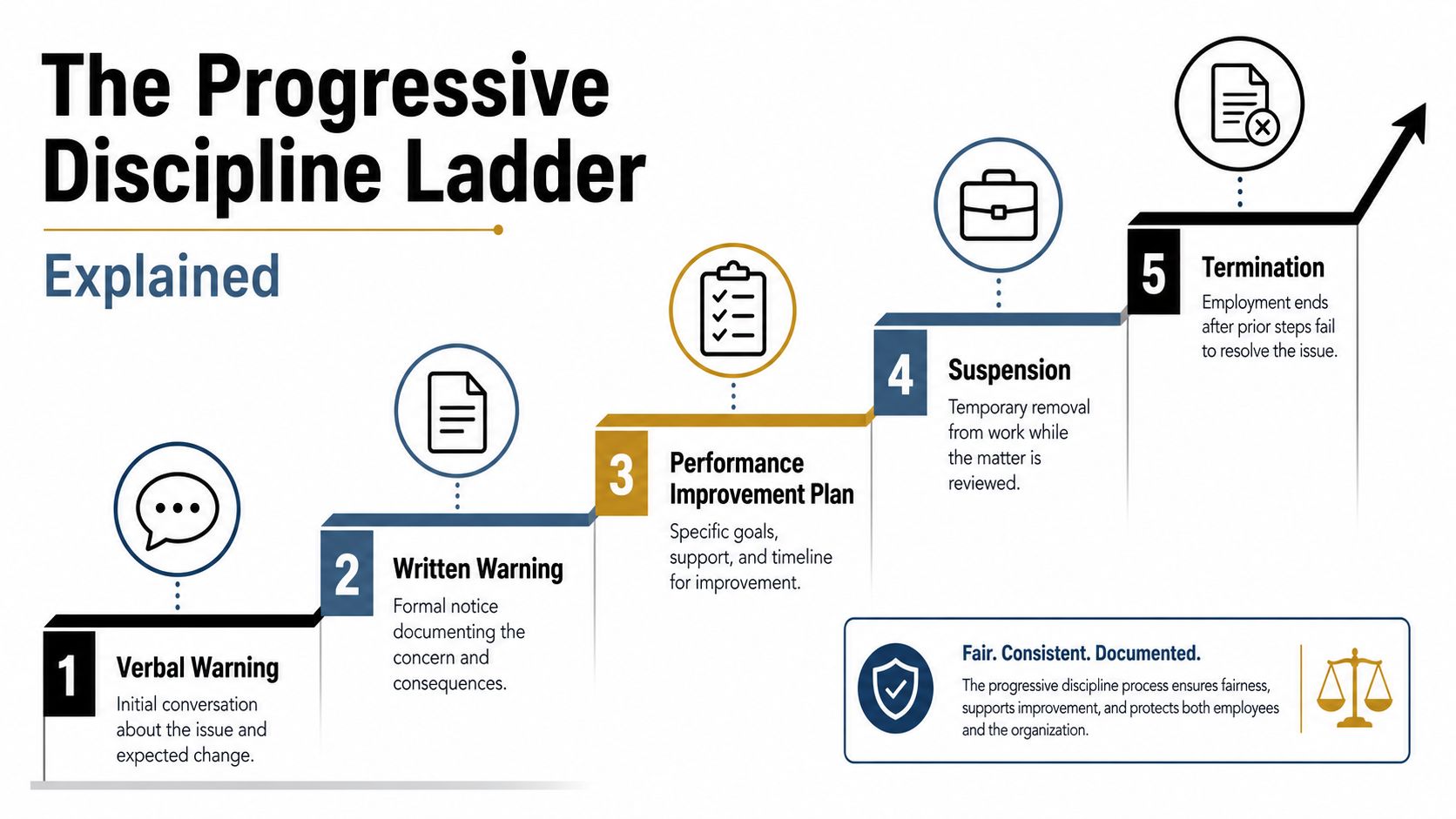
The ladder works because each step answers the same three questions, what happened, what needs to change, and what happens if it doesn't. In practice, the conversation becomes more formal as the issue continues, and the paper trail has to keep up with each stage.
Verbal warning through written warning
A verbal warning is more than a hallway chat. It should identify the conduct, restate the standard, and make clear that the employee's job is at risk if the behavior continues. A manager might say, “You were late three times this week. Your schedule starts at 9:00 a.m., and that expectation does not change. If this continues, the next step is a written warning.”
A written warning should be tighter and more specific. Cornell Law School describes the usual sequence as verbal warning, written warning, suspension, and termination, while also noting that employers can skip steps for serious misconduct if they document a legitimate business reason. A written warning should record the prior discussion, the current deficiency, the expected standard, and the next consequence if the issue continues. Cornell Law School on progressive discipline
PIPs, suspension, and termination
A performance improvement plan, or PIP, is the point where the process shifts from correction to measurable follow-through. The FRISK Model is a practical way to structure that record, facts, rule, impact, suggestions, and the employee's chance to respond. That matters because the best documentation is not emotional, it is tied to conduct and written while the facts are still fresh. FRISK Model overview
A suspension usually comes next when the issue is serious enough that the employee should be removed from the workplace while management reviews the facts. A termination notice should then reflect the steps already taken, the missed expectations, and the final reason the company moved to dismissal. Government guidance also follows that structure, minor misconduct should usually be confronted, discussed, and documented, while severe misconduct may support immediate dismissal. Government of Canada progressive discipline guidance
When to Skip Steps for Severe Misconduct
A Florida startup can follow a progressive discipline ladder for ordinary problems and still skip steps when the conduct is severe enough to break trust, threaten safety, or create immediate legal exposure. The mistake is treating every issue as if it must climb the same ladder. For minor misconduct, a graduated response usually makes business sense. For severe misconduct, a company may be justified in moving straight to suspension or termination, as long as the decision is grounded in facts and documented carefully.
A simple decision framework
Start with the conduct itself. Theft, violence, credible threats, serious harassment, and similar behavior can justify immediate dismissal because the company may not be able to keep the employee in the workplace while it runs through warnings and coaching. The primary question is not the label alone, it is whether the conduct damaged safety, trust, or operations enough that delay would be unreasonable.
Then look at whether the issue is isolated or repeated. Repeated lateness or poor work usually belongs on the ladder, because the employee still has a realistic chance to correct course. A single serious act that undermines trust, safety, or day-to-day operations may justify a faster response.
If the conduct would make a reasonable manager worry about safety, harassment exposure, or immediate operational harm, a warning may be the riskier choice.
What usually fits each path
A graduated process usually fits:
- Attendance issues that continue after prior coaching.
- Performance misses where the employee can still meet the standard with support.
- Policy violations that are disruptive but not catastrophic.
Immediate escalation can be defensible when:
- Violence or threats put people at risk.
- Theft or fraud destroys trust.
- Harassment or serious insubordination breaks the employment relationship.
- Other severe misconduct leaves no realistic path back.
That distinction matters because the issue is not only what the handbook says. It is whether the response fits the conduct and whether the file shows why the company acted the way it did. The Government of Canada guidance on when to skip steps is useful on that point, because it distinguishes ordinary misconduct from behavior serious enough to support immediate dismissal.

Documenting Discipline with the FRISK Model
A discipline file should read like a clean chronology, not a grievance memo. A manager writing it needs to show the rule, the facts, the business impact, the suggestions given, and the employee's chance to respond. That is the part that holds up when a founder later has to explain a termination to counsel, a mediator, or a judge.
What to put in the file
The FRISK Model gives you a practical template:
- Facts. What happened, with dates and observable conduct.
- Rule. Which policy, expectation, or standard was violated.
- Impact. How the conduct affected customers, coworkers, safety, or operations.
- Suggestions. What the employee must do differently, in plain language.
- Knowledge of the right to respond. Proof the employee got a chance to explain.
That structure keeps the warning tied to conduct, not personality. A note that says “you're careless” invites a fight. A note that says “on May 12 you missed the client deadline, the work standard requires same-day submission, and the next step is a written warning if the pattern continues” is much harder to attack because it shows the behavior, the standard, and the response path.
Sample warning language
Use language that sounds factual, not theatrical. A written warning can say, “This notice confirms our discussion on [date]. You failed to meet the required standard of [expectation]. If the issue continues, the company may move to suspension or termination.” A PIP can say, “You're expected to complete [task] by [deadline] and report progress weekly.”
Tip: write the warning while the facts are still fresh. Waiting weeks weakens the paper trail and makes every statement harder to defend.
For startups that need outside review, an employment lawyer can help tighten the handbook language before it is distributed. That is a practical role for Coto & Waddington, Attorneys at Law, especially when the company wants policy language that matches Florida risk and how managers document problems.
| FRISK Documentation Framework | ||
|---|---|---|
| Component | What to Document | Example Phrase |
| Facts | The specific conduct, date, and context | “On June 3, you arrived 45 minutes late without notice.” |
| Rule | The standard or policy violated | “Your schedule requires arrival by 9:00 a.m.” |
| Impact | The business effect | “This delayed client handoff and disrupted the team.” |
| Suggestions | The corrective expectation | “Notify your manager before the shift starts and arrive on time.” |
| Knowledge of the employee's right to respond | The employee's chance to explain | “Please provide your response to this warning by end of day Friday.” |
Coaching First vs Rigid Punitive Ladders
Many companies claim to use progressive discipline, but what they really mean is paperwork before firing. That's the old approach, and it still matters, because documentation is often what shows a good-faith effort before termination.
Modern managers, especially in startups, often get better results with a coaching-first approach. Nolo's framing is helpful here, progressive discipline is increasingly viewed as a coaching model rather than a rigid punitive ladder. The point is to fix performance early, not to march mechanically toward termination when a direct conversation would solve the problem faster. SHRM on the traditional progressive discipline paradigm
When coaching beats formal warning
Coaching is the better tool when the issue is vague, fixable, or rooted in skill rather than defiance. A founder who notices a new sales hire struggling with discovery calls may get farther with live feedback and role-play than with a formal warning letter.
Documentation still matters, but it shouldn't crowd out judgment. If the issue is new and the employee is trying, a sincere coaching conversation can preserve trust and reduce turnover. If the same problem keeps coming back after clear expectations, documentation has to take priority.
The trade-off is this. Coaching improves behavior when the person is capable and willing. Formal discipline protects the company when the behavior is stubborn, risky, or already affecting other people.
What rigid systems get wrong
Rigid ladders can turn managers into box-checkers. They also create false comfort, as if a policy alone will solve a conduct problem. It won't.
The best discipline systems give managers room to act early, document consistently, and escalate fast when the facts justify it. That's a better fit for startups, where roles change quickly and one bad employee can create outsized drag on the team.
Legal Risks and Compliance for Florida Employers
Florida's at-will rule gives employers flexibility, but it doesn't erase the legal exposure that comes from sloppy discipline. The danger usually isn't the final decision alone, it's the inconsistency, the weak records, and the timing around protected activity.
The risks founders actually face
If two employees commit similar conduct and only one gets disciplined, the company invites claims of discrimination or uneven treatment. If a termination follows a complaint, leave request, or whistleblowing activity, the employee may frame the discipline as retaliation. If disability or medical issues are in play, the company can also drift into ADA or FMLA problems by skipping accommodation analysis or treating protected status as a performance defect.
That's why policy upkeep matters. HR guidance says progressive-discipline policies should be updated regularly for legal compliance and should address equal treatment, due process, proper documentation, and anti-retaliation protections. They should also align with federal, state, and local law and be reviewed by counsel before rollout. AIHR on progressive discipline compliance
For wage-and-hour sensitive roles, founders also need to keep classification issues straight. A discipline policy won't fix a misclassification problem, and that's why many startups pair handbook review with a broader audit of employee status, including what FLSA exempt means.
Policy drafting that lowers risk
A good policy should say what happens, who decides, and when the company can skip steps. It should also preserve discretion for serious misconduct and make clear that discipline depends on facts, not a fixed promise of a warning before every termination.
For operational support, founders often want more than a policy draft. They need manager training, a response protocol, and help applying the rules consistently when the pressure is real. Resources on AI strategies for retention can help shape the people side of the process, but the legal side still needs a careful review.
Your Progressive Discipline Action Plan
A founder who handles a harassment complaint with a casual warning, then documents nothing, creates avoidable risk. A better plan starts with a written policy that says progressive discipline is a management tool, not a promise, and that managers still have discretion when the facts call for it. For startups with limited internal support, small business legal services can help turn that policy into something managers can follow.
Train managers to record the facts, the rule that was broken, the business impact, and the next step. Coaching can stay informal for performance issues that are fixable, but the file has to become formal when the conduct is repeated, serious, or could support termination later. That distinction matters because the paper trail is what holds up when an employee challenges the decision.
Use one standard for minor misconduct and a separate path for severe misconduct. A clear policy should say when the company can skip warning steps, especially for theft, violence, harassment, falsified records, or conduct that makes continued employment unsafe or impractical. For PIP templates and manager scripts, it helps to compare proven PIP writing strategies before you send anything to an employee.
Keep records in one secure place, and review the policy at least once a year so it still fits Florida practice and the company's current risk profile. If the process is too rigid, managers stop using it. If it is too loose, employees can argue the company acted inconsistently. The goal is a policy that gives supervisors enough structure to be fair, while leaving room to respond quickly when misconduct is serious.
Coto & Waddington, Attorneys at Law helps South Florida businesses draft and review workplace policies, employee discipline procedures, and the documentation that supports them. If you want a progressive discipline policy that fits your startup's risk, visit Coto & Waddington, Attorneys at Law to discuss a handbook review or fractional general counsel support.