A founder rarely starts searching for “fractional general counsel” on a calm afternoon. More often, the search begins with contracts stuck in email, an investor diligence request approaching, a board meeting that needs coherent reporting, and no one clearly responsible for legal risk. The company has outgrown project-by-project legal help, but a full-time general counsel still feels premature.
That middle ground is where fractional general counsel fits. The role isn't just a cheaper lawyer or an outside firm with a monthly invoice. Properly structured, it becomes a legal operating system for a startup, creating repeatable workflows, clear escalation rules, and senior judgment without requiring a permanent executive hire.
Table of Contents
- The Startup Founder at a Contract Crossroads
- What Fractional General Counsel Actually Means
- Why the Model Grew Out of Outsourced Legal Work
- Three Engagement Levels Founders Can Choose From
- What a Fractional GC Handles Day to Day
- How Fractional General Counsel Pricing Works
- Employee vs Contractor and the Scope Boundary
- Key Takeaways and Your Next Step
The Startup Founder at a Contract Crossroads
A Series A founder I'll call Maya has three problems on her desk at once. Several vendor agreements remain unnegotiated, the investor data room is due in two weeks, and the company's first employee-owned intellectual property policy is overdue. Meanwhile, the board wants a clean update on the cap table, outstanding risks, and the status of key commercial deals.
Maya sees three familiar choices. She can hire a full-time general counsel at $250,000-plus, use outside counsel at $500 an hour, or bring in a fractional GC who works inside the business on a recurring basis. Each option solves a different problem, and each creates a different financial and operational commitment.
The full-time hire offers exclusivity and maximum availability, but the timing may be wrong. Ad hoc outside counsel can handle a particular agreement or diligence question, but that model often leaves the founder repeating the company's history, priorities, and risk tolerance to a new lawyer on every matter. A fractional GC occupies the space between those models, with continuing context and senior oversight at a part-time commitment.

The pressure isn't only legal
Maya's problem isn't just that contracts need signatures. Delayed agreements can slow revenue, incomplete diligence can distract the fundraising process, and unresolved capitalization records can undermine confidence during investor review. The founder is also making legal decisions personally, often between sales calls and product meetings.
Practical rule: If legal work is repeatedly interrupting revenue, fundraising, hiring, or board preparation, the company needs a legal function, not just another document review.
A fractional GC can establish an intake process, create contract templates, coordinate specialist counsel, and give the board one accountable legal point of contact. The remaining question is whether the arrangement is designed as a real operating role or merely a retainer with a more impressive title.
What Fractional General Counsel Actually Means
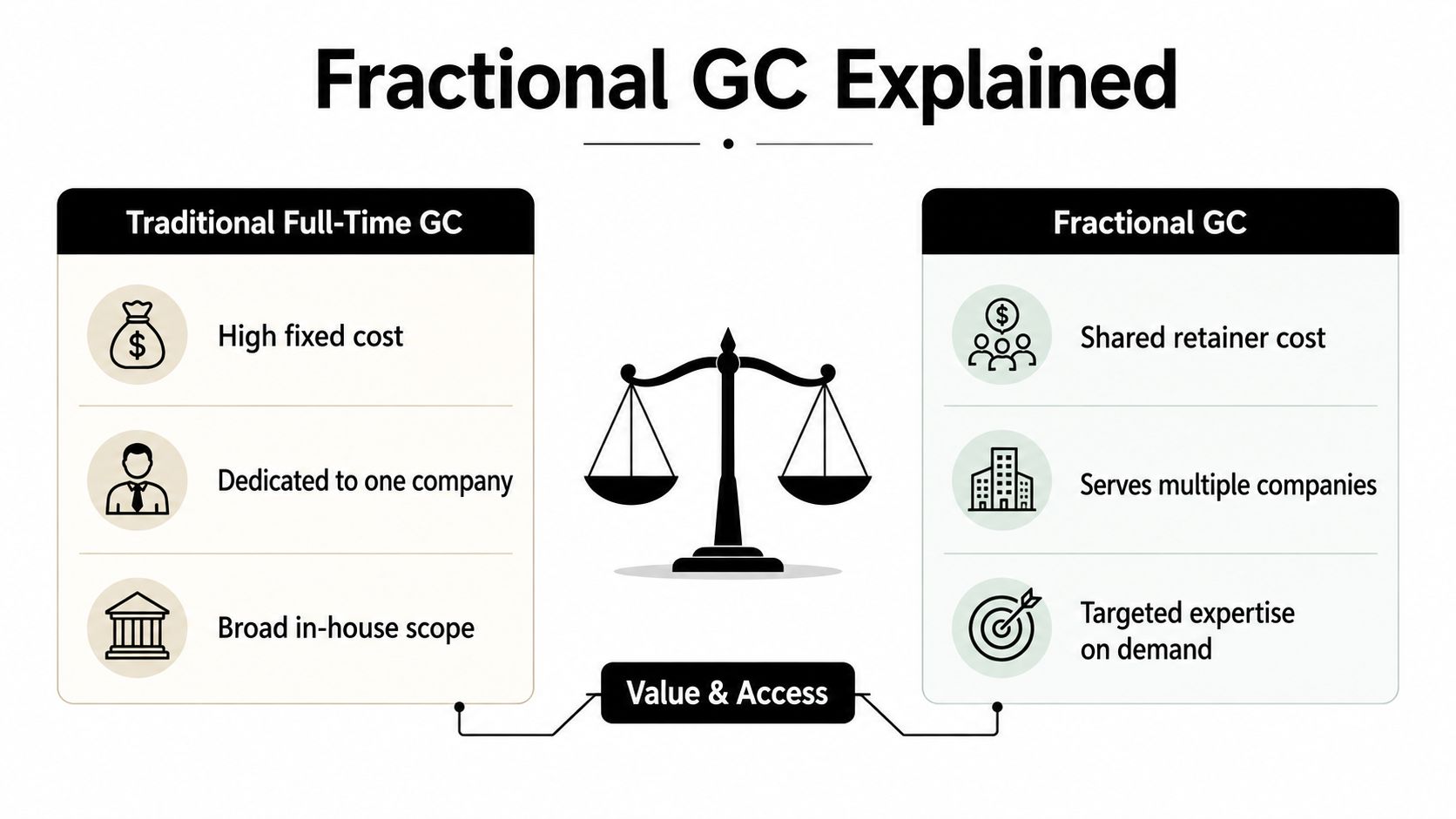
In plain English, a fractional general counsel is a senior in-house lawyer who serves a company part-time, usually through a recurring retainer or subscription arrangement. The lawyer may work with several businesses, but the relationship with each client is ongoing and embedded rather than limited to one isolated project.
The word “fractional” describes the allocation of time, not a reduction in seniority. A fractional GC should be able to advise founders, participate in leadership decisions, organize governance, assess risk, and manage outside lawyers. The role can involve a few hours a month or several days a week, depending on the company's legal workload.
| Legal model | How it operates | Where it fits |
|---|---|---|
| Outside counsel | Usually project-based and reactive | Specialized matters, disputes, major transactions |
| Full-time in-house counsel | Exclusive, integrated, and continuously available | Businesses with sustained legal volume and executive-level need |
| Fractional general counsel | Embedded, recurring, and scoped to a defined cadence | Startups and small companies between those two stages |
A traditional outside lawyer may review a vendor agreement, send comments, and close the file. A fractional GC is more likely to ask why the company keeps receiving the same vendor terms, then build a fallback clause library and approval process. A full-time GC offers the deepest institutional presence, but the company bears the full employment and executive cost whether legal demand is high or uneven.
What the retainer changes
A recurring engagement creates a predictable rhythm. The GC may attend leadership meetings, review contracts during designated office hours, maintain a risk register, and prepare a monthly legal report. The exact arrangement should state availability, response expectations, covered matters, excluded work, confidentiality obligations, conflicts procedures, and the method for approving additional work.
Founders comparing the legal role with financial leadership may also benefit from AmbitionCFO's startup CFO guide, because the underlying idea is similar. A company gains experienced leadership before it needs, or can afford, a full executive department.
A business attorney can also perform many discrete formation, contract, and governance tasks. The distinction is explained further in what a business attorney does. A fractional GC goes beyond individual tasks by accepting continuing responsibility for how legal work flows through the company.
Why the Model Grew Out of Outsourced Legal Work
Fractional general counsel emerged from a broader shift toward outsourced legal work. Corporate legal departments have long used outside counsel for specialized matters, overflow work, and transactions. Over time, companies began outsourcing not only documents, but also recurring legal processes and senior operational judgment.
A 2015 Thomson Reuters study found that 84% of legal departments outsourced half or less of their company's legal work to outside counsel, while 66% said they “never” or “rarely” used outside counsel for contract negotiation and drafting (Thomson Reuters legal insourcing and efficiency report). The same study found that only 4% of departments handled all legal work internally with no outside assistance. Those figures describe a hybrid environment, not a clean choice between total insourcing and total outsourcing.
A separate 2016 survey of corporate counsel reported that 61% of inside counsel had increased the amount of work they contracted out during the prior 12 months, and more than half expected outsourcing to continue growing over the next year, as reported in the same Thomson Reuters source. Companies were already combining internal judgment with external capacity. Fractional GC arrangements developed naturally within that structure.
From document support to legal leadership
Earlier outsourced models often focused on document review, contract abstraction, or overflow production. Modern businesses need someone to decide which contracts require escalation, which risks fit the company's appetite, and which policies should exist before a problem occurs. Remote collaboration tools, shared workspaces, electronic signature platforms, and contract management systems make that kind of embedded leadership easier to deliver across locations.
The model also reflects changes in legal careers. Experienced in-house lawyers can build portfolio practices, while startups can access senior judgment without hiring an executive before the business has sustained demand. Firms and legal service providers have responded with flexible delivery models, much as businesses use law firm virtual assistants to support repeatable administrative work.
The result is a middle layer between hourly law-firm support and a full-time legal department. For a company seeking practical small business legal services, the important question isn't whether legal work is outsourced. It's whether the company has someone accountable for turning that outsourced work into a coherent function.
Three Engagement Levels Founders Can Choose From
Most fractional GC relationships fall into a few practical tiers. The right choice depends less on revenue than on contract volume, compliance density, transaction activity, and how often founders need senior legal judgment.
Advisory access
An advisory arrangement commonly uses about 8 to 20 hours per month, according to legal consultant retainer guidance from Hourtal. This level fits an early company with a manageable contract pipeline and no active dispute or major transaction.
The GC might review priority contracts, join a leadership call, answer questions as they arise, maintain a short risk list, and conduct periodic governance or compliance reviews. The founder still owns much of the day-to-day coordination.
Step up when: contracts are arriving often enough that response time matters, or the founder is making recurring decisions without a consistent legal framework.
Active advisory support
An active advisory retainer generally covers about 15 to 30 hours per month, using the same Hourtal benchmark. This is often the practical fit for a scaling company negotiating customer and vendor agreements, preparing for diligence, managing investor consents, or launching a product with new privacy and employment questions.
The fractional GC can create templates, manage a contract queue, attend recurring leadership meetings, and coordinate specialist counsel. The company receives more than answers. It receives an operating cadence.
Step up when: legal work is no longer occasional, several business teams depend on legal review, or outside counsel needs active management.
Embedded fractional leadership
An embedded arrangement commonly uses about 25 to 50 hours per month, again reflected in the Hourtal guidance. At this level, the GC may own the legal calendar, lead compliance projects, attend leadership standups, manage outside litigation counsel, support the board, and establish the systems that a future internal legal department will inherit.
This model bridges the gap between a retained advisor and a permanent executive. It works when the company needs a legal leader each week but doesn't yet require a full-time seat.
A retainer should state whether unused time expires, whether unused hours roll forward, how urgent requests are handled, and what happens during fundraising, an acquisition, or a regulatory event. Those details prevent the company from buying a nominal tier that cannot support its actual workload.
What a Fractional GC Handles Day to Day
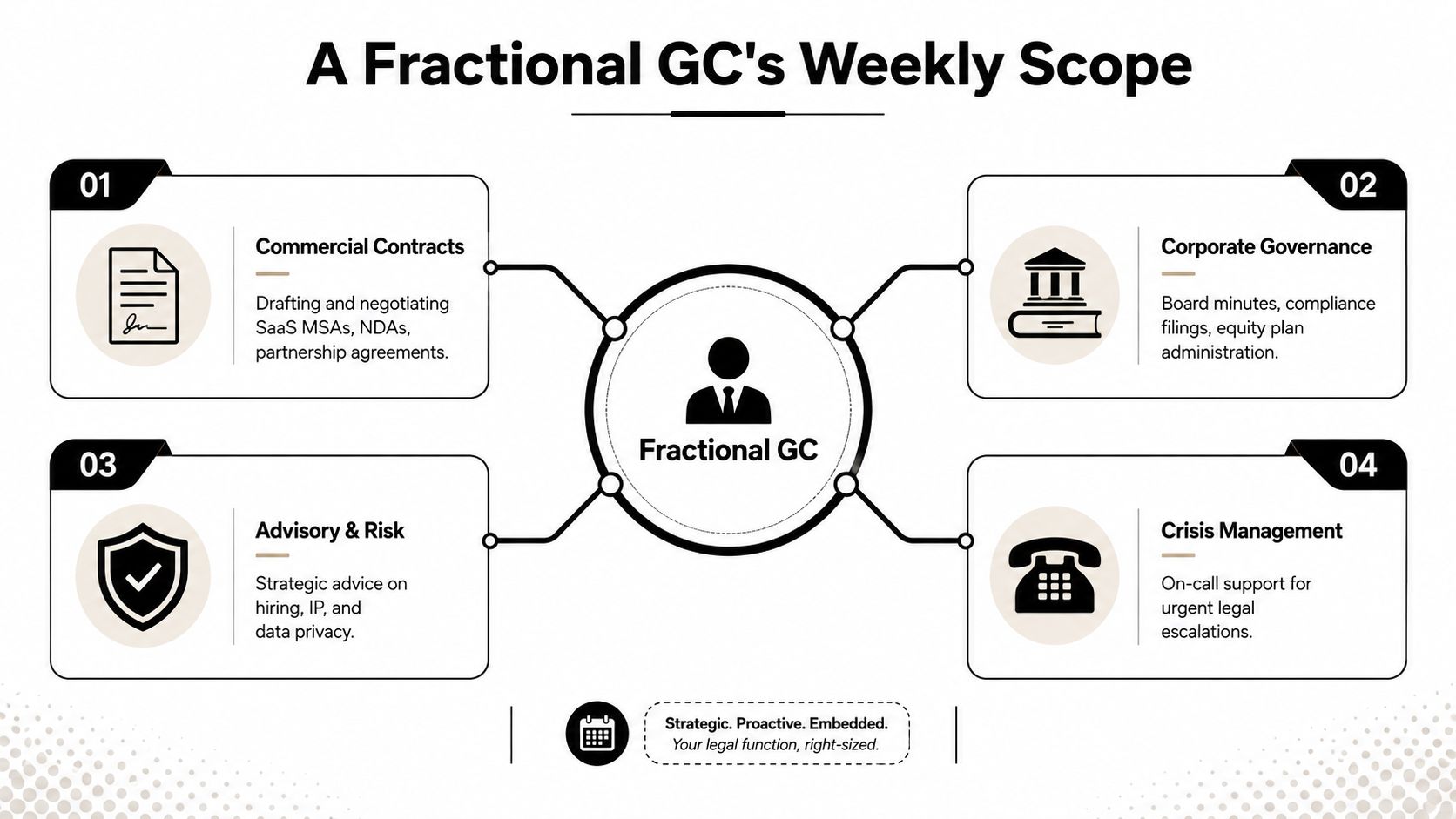
The role becomes clearer when viewed through the company's weekly workflow rather than through a title. A capable fractional GC usually owns recurring legal decisions, organizes the work behind them, and routes exceptions to the right specialist.
Commercial contracts
The GC can create an intake form, establish approval thresholds, and maintain templates for common agreements. Typical work includes:
- Customer agreements: SaaS MSAs, order forms, terms of service, and data processing terms.
- Vendor documents: NDAs, service agreements, procurement terms, and insurance requirements.
- Partnership arrangements: Referral, reseller, distribution, and strategic collaboration agreements.
- Negotiation playbooks: Preferred language, acceptable fallback positions, and issues requiring executive approval.
The point isn't to make every contract identical. It's to stop the company from negotiating the same risk from scratch every time.
Governance and capitalization
Corporate housekeeping often becomes urgent during financing because investors expect coherent records. A fractional GC can maintain board and committee calendars, prepare minutes, organize written consents, coordinate equity plan administration, and work with the company's tax and finance professionals on 409A coordination.
Cap table hygiene also belongs in the operating system. The GC may identify missing assignments, inconsistent equity records, or approval gaps before those issues reach a data room.
Compliance, employment, and IP
The scope may include privacy and data-security policies, industry licensing questions, employee handbook updates, offer letters, restrictive covenant review, and severance analysis. IP work can include trademark strategy, invention assignment audits, and coordination with patent counsel when prosecution requires specialized support.
A fractional GC should also maintain an escalation protocol. Routine contract review and governance can remain inside the relationship. A patent dispute, government investigation, complex securities filing, or litigation defense should usually go to a specialist with the necessary experience and capacity.
Operating principle: The fractional GC should own the legal traffic system, not pretend to be every legal specialist on the road.
How Fractional General Counsel Pricing Works
Pricing usually follows a fixed monthly retainer or subscription-style structure, rather than an open-ended hourly arrangement. The company pays for a defined scope, a service cadence, and access to senior legal judgment. The engagement may include a block of hours, response-time commitments, recurring meetings, and specified deliverables.
The financial comparison starts with the cost of a permanent executive. A compensation benchmark cited by LeanLaw placed median total cash compensation for a full-time General Counsel or Chief Legal Officer at $414,000 in 2024, before benefits, bonuses, and long-term incentives (LeanLaw's fractional GC pricing discussion). Another legal services discussion describes full-time GC compensation at $200,000 or more, plus benefits and incentives, while noting that fractional models avoid employment costs, office space, training, and tax or accounting overhead tied to a permanent hire (Walsh Banks on fractional general counsel).
Two common pricing structures
A flat-fee retainer bundles a defined hour band, covered matters, communication channels, and response expectations. It gives a founder a stable monthly budget, but the scope must be realistic. If the business routinely exceeds the agreed capacity, overflow should be priced in advance.
A subscription or “general counsel as a service” model organizes support into tiers. Each tier may have usage caps, defined categories of work, and separate billing for additional hours or excluded matters. This can work well when legal demand changes but remains predictable enough to plan.
What the fee usually doesn't cover
Filing fees, expert witnesses, court costs, patent prosecution, specialist tax advice, and outside litigation counsel may sit outside the recurring fee. The engagement letter should identify those exclusions and state who approves the added expense.
A Series A company at an active advisory level should compare the monthly retainer not only with a full-time salary, but also with the cost of delay, duplicated context, unmanaged outside bills, and founder time spent negotiating legal terms. The fractional model works when it provides consistent senior judgment on material contracts while preserving flexibility for work that requires separate counsel.
Employee vs Contractor and the Scope Boundary
The label “fractional” doesn't answer whether the lawyer is an employee, an independent contractor, or part of an outside law firm. That classification affects authority, supervision, confidentiality, payroll treatment, benefits, insurance, conflicts, and the way the company manages the relationship.
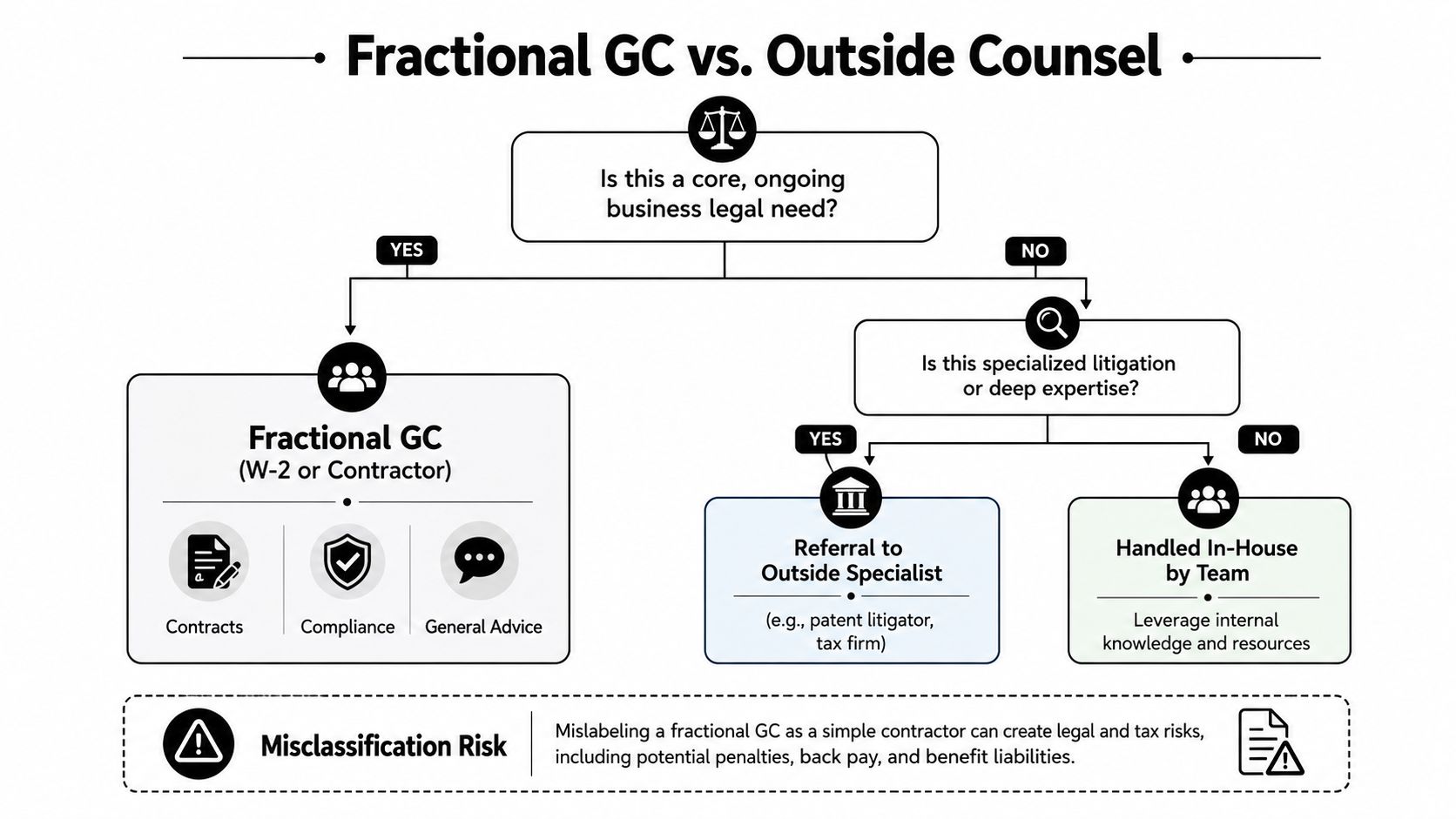
A fractional GC may be engaged as a part-time W-2 employee. That structure can make sense when the company needs a defined reporting line, substantial control over schedule and methods, and continuing institutional knowledge. The company takes on the obligations associated with employment, including payroll administration and applicable benefits and tax responsibilities.
The lawyer may instead work as an independent contractor or through a law firm. That arrangement can provide flexibility and allow the lawyer to serve multiple clients, but the company still can't ignore the substance of the relationship. A contractor who functions like an employee, follows company-controlled hours, and has an improperly defined relationship can create classification concerns. Founders comparing the structural differences should review a practical resource on contracting versus employment.
A practical scope decision tree
Use the following questions before assigning work:
Is the matter a core, recurring business legal need?
Contract review, governance, policy maintenance, ordinary employment guidance, and risk triage usually belong within the fractional GC's operating scope.Does the matter require deep specialist expertise or advocacy?
Patent prosecution, complex M&A, securities filings, tax opinions, regulatory investigations, and litigation defense commonly require referral to specialist outside counsel.Can the fractional GC manage the specialist?
Often, yes. The GC can define the business objective, select counsel, provide context, review budgets, coordinate communications, and report to leadership.Does the engagement letter describe the boundary?
If it doesn't, the company may assume the retainer covers everything while the lawyer assumes the opposite.
The company should also define who can authorize outside counsel, whether the fractional GC can sign documents, who controls legal holds, how conflicts are checked, and how confidential information is stored. A contractor or outside firm may serve as embedded legal leadership, but the company shouldn't describe that person as an employee unless the structure supports that conclusion.
Readiness signals and warning signs
A startup may be ready for fractional GC support when:
- The queue is growing: Legal documents have exceeded the founders' ability to triage.
- Deals are waiting: Contracts sit unsigned because no one owns review.
- Diligence is approaching: Investors or lenders need organized records and explanations.
- Compliance is becoming concrete: The company handles employee data, healthcare information, or other sensitive information.
- Founders are acting as legal department: They personally negotiate vendor terms between operating responsibilities.
The model may be premature when the company has only sporadic legal requests, few recurring contracts, and no documented compliance responsibilities. In that situation, ad hoc outside counsel may remain efficient.
A simple operating score
Founders can use a qualitative score rather than waiting for a revenue milestone:
- Ad hoc outside counsel: Choose this when legal work is infrequent, highly specialized, or limited to isolated projects.
- Fractional GC: Choose this when legal work is recurring, cross-functional, and beginning to block decisions, but doesn't require daily exclusive coverage.
- Full-time in-house counsel: Choose this when the company needs continuous availability, sustained legal volume, and a leader whose entire working capacity belongs to the business.
The score isn't a substitute for legal or tax advice. It forces the right conversation about workload, control, and risk.
A practical engagement letter should identify the parties, relationship structure, scope, exclusions, authority, response times, billing, conflicts, confidentiality, data handling, work product, termination, and transition assistance. Founders looking for a starting point can review an independent contractor agreement template, but a template shouldn't replace advice about the actual relationship.
Key Takeaways and Your Next Step
The useful answer to what is fractional general counsel is not “a part-time lawyer.” It's a structured way to install senior legal leadership before a company is ready for a full internal legal department.
Five principles matter most:
- Treat the role as an operating model. The GC should build intake, templates, approval thresholds, reporting, and escalation rules.
- Match capacity to legal density. Advisory, active advisory, and embedded arrangements should reflect the company's recurring workload.
- Budget for predictability. Fixed retainers and subscription models can make legal spend easier to plan than open-ended project billing.
- Write the boundary. The engagement letter should distinguish ordinary legal operations from specialist work.
- Escalate intelligently. Litigation, patent disputes, investigations, complex M&A, and specialized filings should go to counsel with the right expertise.
The right time to hire isn't necessarily when the company can afford a full-time GC. It's when legal work starts blocking revenue, fundraising, hiring, product decisions, or board confidence. A fractional arrangement can also be transitional. When the company later hires a full-time GC, the fractional leader can preserve institutional knowledge, document processes, and coordinate a cleaner handoff.
Founders usually have practical questions before signing. Engagements can be structured for a defined initial period or continued on a recurring basis, depending on the business need. A company can move to full-time counsel when legal volume and availability justify exclusive capacity. Conflicts should be disclosed and checked because a fractional lawyer serves multiple clients. Confidentiality should cover communications, documents, systems access, and the return or deletion of information when the relationship ends.
Use this checklist before contacting a provider:
- Do contracts repeatedly wait for review?
- Does someone own the legal calendar?
- Is investor or lender diligence approaching?
- Are privacy, employment, IP, or licensing obligations becoming operational?
- Are outside counsel invoices arriving without centralized management?
- Can leadership describe which matters require specialist referral?
If several answers are yes, the company may need a legal operating system now, even if a full-time hire remains premature.
Coto & Waddington, Attorneys at Law offers fractional general counsel support for startups and small businesses, including contract management, corporate governance, capitalization, privacy and compliance policies, and ongoing business advice. Visit Coto & Waddington, Attorneys at Law to discuss a flat-fee, bilingual engagement for your South Florida company.