A dunning letter is a formal written payment demand sent after an invoice is past due, and in the 4-stage collections flow it usually sits somewhere between a friendly reminder and a final notice. In the United States, once a third party gets involved or the wording turns coercive, the same message can start implicating the FDCPA.
You're probably staring at an invoice that's gone from “late” to “problem,” while the client keeps promising payment and buying time. That's where founders often reach for a template without realizing they're drafting a legal communication, not just a finance email.
Table of Contents
- What a Dunning Letter Actually Is
- The Four-Stage Dunning Process
- Dunning Letter vs Demand Letter
- FDCPA and Florida Law for Dunning Letters
- Sample Dunning Letter Template You Can Use
- Escalation Options Beyond the Letter
- Common Pitfalls and How Coto and Waddington Can Help
What a Dunning Letter Actually Is
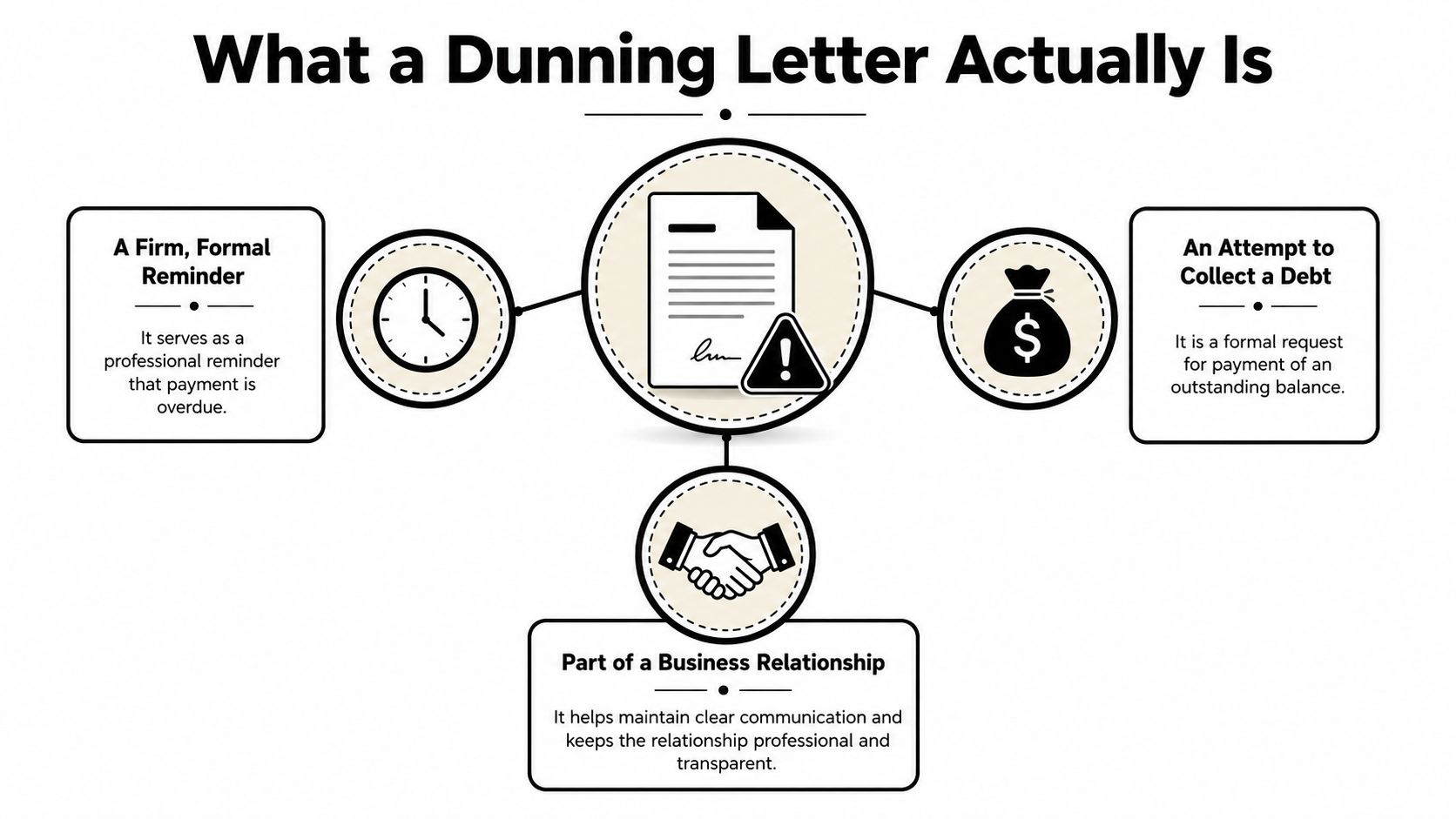
A Miami founder with a 60-day-overdue invoice doesn't need a philosophy lesson. He needs to know whether the next message should be a reminder, a warning, or the start of a documented collection effort. A dunning letter is that written demand, the formal notice that an invoice has passed its due date and payment is now overdue, not just gently delayed.
The term comes from old business practice
The word dunning traces back to the 17th century English verb “to dun,” meaning to demand payment of a debt, and by the 1800s it had become standard business language for formal collection efforts (historical overview of dunning)). That history still matters because the modern letter keeps the same core job, to tell the customer the account is overdue and prompt payment before recovery gets more expensive.
A useful way to think about it is this, a dunning letter is not a casual nudge and it's not the same thing as sending the original invoice again. It's a structured payment demand that belongs inside an accounts receivable workflow, usually after earlier reminders have already gone out.
Why founders should care
In practice, a dunning letter protects two things at once, cash flow and the customer relationship. Used early and professionally, it gives the debtor a clear path to pay without feeling ambushed. Used badly, it can escalate a simple collections step into a dispute.
That's why good AR teams treat it as part of a broader process, not a one-off message. If you want a cleaner operational system behind that process, the most practical finance-side advice is to keep your reminder sequence tight, readable, and consistent, which aligns with the broader approach in AR best practices for business owners.
A business owner also needs to know where the letter sits in the contract stack. If you're reviewing payment obligations alongside the underlying agreement, it helps to compare the reminder against the original terms in a loan agreement framework. The point isn't to turn every late invoice into a legal drama. It's to recognize that the document has legal weight once it starts demanding action on a past-due balance.
The Four-Stage Dunning Process
A good collections workflow rarely jumps straight from silence to threats. The industry pattern is a 4-stage sequence, a friendly reminder, a firmer follow-up, a formal warning, and a final notice before collections or legal action (structured dunning process overview). That staged approach is the difference between a message that preserves goodwill and a message that burns it.
Stage one, friendly reminder
Start with a neutral reminder when the invoice is just slipping. The tone should sound like, “Your invoice is now past due. Please let us know if you need a copy or if payment has already been sent.”
This stage is about catching the customer who forgot, not the one who refuses to pay. A short email, followed by a phone call if needed, keeps the issue visible without making the customer feel accused.
Stage two, firm follow-up
If the invoice is still open, the language can become more direct. “This invoice remains unpaid. Please arrange payment by the new deadline listed below.”
That wording does two things. It confirms the account status and gives the debtor a clear action item. This is also where many teams start adding a more obvious paper trail, because every follow-up becomes part of the file.
Practical rule: The earlier the stage, the shorter and calmer the sentence should be. Clarity beats pressure.
Stage three, formal warning
At this point the communication should sound less like customer service and more like collections. “This is a formal notice that the account is overdue and must be paid by [date]. Failure to pay may result in additional fees, suspension of service, or further collection efforts.”
That kind of wording signals seriousness without pretending the company has already won a legal fight. It works because it is specific, dated, and actionable.
Stage four, final notice
The last stage should state that the matter is moving toward outside collection or legal escalation if payment doesn't arrive. Keep it factual, not theatrical. “If payment is not received by [date], we may refer this account for collection or other enforcement action.”
For a deeper operational framework on tightening recovery without turning every message into a threat, the account-receivable guidance in reduce bad debt strategies is a useful companion resource.
Dunning Letter vs Demand Letter
Founders mix these up all the time, and the confusion causes real problems. A dunning letter is usually an AR tool aimed at a current customer with an overdue invoice. A demand letter usually signals that the matter is moving toward a formal dispute, a breach claim, or litigation posture.
| Criteria | Dunning Letter | Demand Letter |
|---|---|---|
| Sender's intent | Collect an overdue payment and keep the relationship intact | Put the recipient on notice before a dispute, claim, or suit |
| Recipient | Usually a customer who already owes on an invoice | Often a debtor, breaching party, or adverse counterparty |
| Tone | Professional, firm, and staged | More formal, firmer, and often more adversarial |
| Legal exposure | Lower when it stays in ordinary collections language | Higher, because it can set up litigation or a rights dispute |
How to tell them apart fast
If the message is asking for payment on an open invoice and giving a deadline, you're probably still in dunning territory. If the letter starts talking about breach, legal remedies, or preservation of rights, you've moved into demand-letter territory.
That distinction matters because the wrong document can send the wrong signal. A business that uses a demand letter too early can scare off a customer who might have paid. A business that uses a soft dunning note when the dispute is already legal can understate the seriousness of the issue.
A dunning letter says, “Pay what you already owe.” A demand letter says, “We're formalizing the dispute if this isn't resolved.”
For the legal side of that escalation, a related cease and desist letter guide helps show how quickly written communications can change tone and consequences.
FDCPA and Florida Law for Dunning Letters
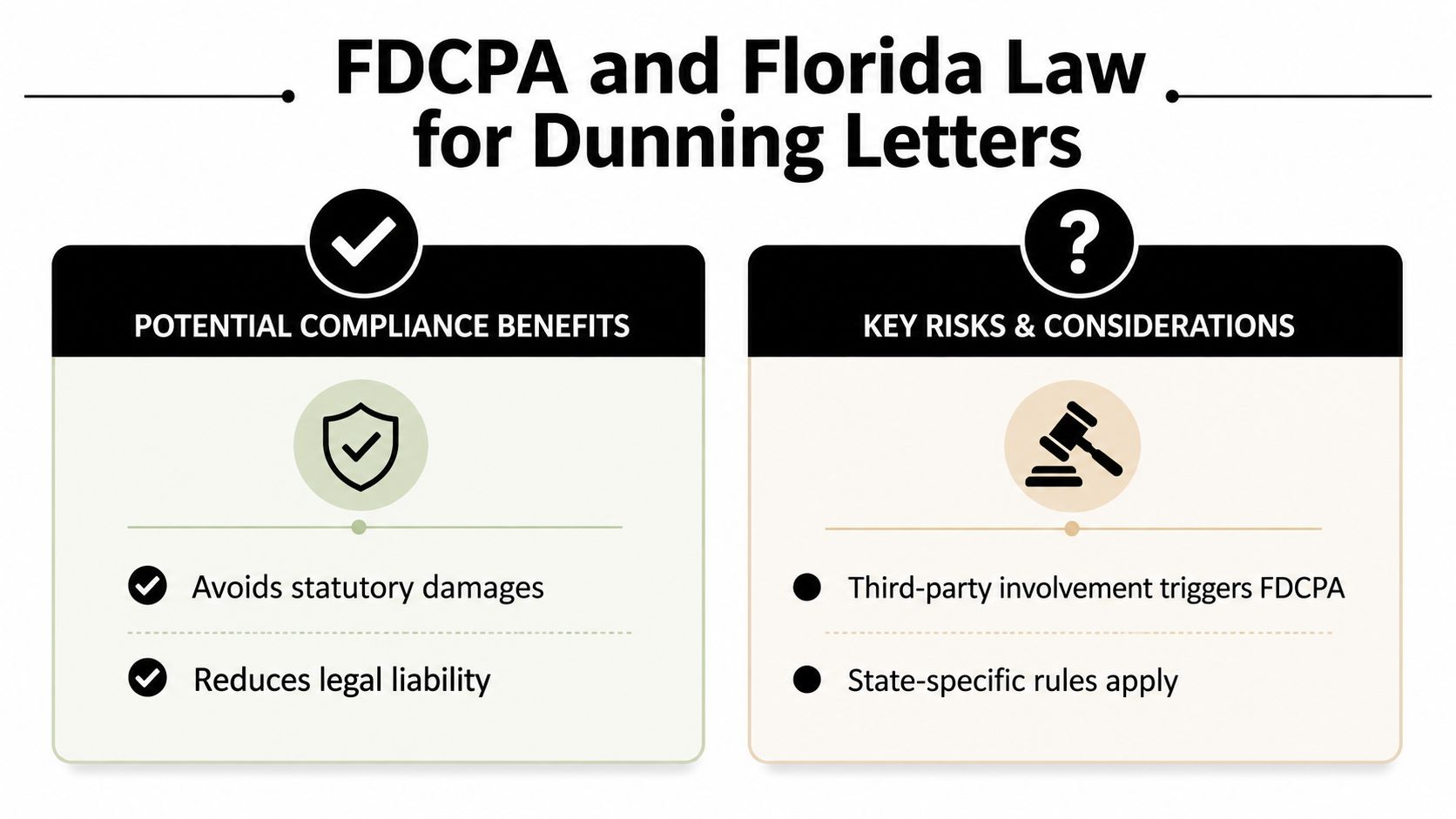
A lot of owners assume federal debt-collection rules only apply to outside collection agencies. That's too narrow. In real life, FDCPA exposure can appear once a third party gets involved, or once the wording becomes coercive enough to look like regulated collection conduct.
What language creates risk
The safest dunning letter language stays factual. It identifies the invoice, the amount due, the due date, the payment instructions, and the deadline for response. Risk goes up when the message starts sounding like a threat, a humiliation tactic, or a misrepresentation of consequences.
Avoid wording that suggests things you can't or won't do. Avoid exaggerating legal status, inflating fees, or implying immediate legal action when no decision has been made. In Florida, consumer-collection practice adds another layer of caution, because the state's rules also care about harassment and misrepresentation.
Timing and disclosure traps
A routine reminder can become a regulated communication if the sender, the channel, or the wording changes. That's why a founder should be careful about mixing internal reminders, third-party collection language, and consumer-debt tone in the same template.
If the debt could later become part of a lawsuit, check the limitations clock early by reviewing the statute of limitations for contracts. Waiting too long can make a hard case worse, and pushing too hard can create avoidable exposure before that point.
Words to cut from your template
- “Final warning” if it isn't final.
- “We will” when the next step hasn't been approved.
- “Immediate legal action” unless counsel has already authorized that path.
- Anything that sounds like harassment, shame, or deception.
The cleanest approach is plain, dated, and documented. If the file later needs to move outside the company, the paper trail should show that the business acted consistently, not emotionally.
Sample Dunning Letter Template You Can Use
A useful template needs more than a polite sentence asking for payment. It should be specific enough that someone can act on it immediately and specific enough that you can defend it later if the customer says the notice was unclear. One practical guide lists the core fields as the company name and contact information, the customer's company name and billing address, invoice numbers and original dates, original due dates, the amount past due, any late fees or interest, the total owed, payment instructions, and a response deadline (template field checklist).
Fill-in template
Subject: Past Due Invoice Notice, Invoice #[invoice number]
Dear [Customer Name],
Our records show that Invoice #[invoice number], dated [original invoice date], with an original due date of [original due date], remains unpaid. The current amount past due is [amount past due], plus any applicable late fees or interest, for a total amount owed of [total amount owed].
Please submit payment by [response deadline] using the instructions below:
[Payment instructions]
If you have already sent payment, please reply with the date and method of payment so we can update our records. If you need a copy of the invoice or have a billing question, contact [company contact information].
Sincerely,
[Company name]
A firmer late-stage version
Dear [Customer Name],
This notice confirms that Invoice #[invoice number] remains past due. Unless we receive payment by [response deadline], we will need to consider further collection steps.
Please note the amount due is [total amount owed], including [late fees or interest] if applicable. You can pay by [payment instructions].
Response note: This paragraph is firmer, but it still stays factual. It doesn't invent consequences, and it doesn't threaten something the company hasn't decided to do.
For a business owner, the goal is not dramatic wording. It's a message that can be copied into a ledger, emailed, and if necessary reviewed by counsel without embarrassment.
Escalation Options Beyond the Letter
A dunning letter can do its job and still leave money on the table. When the balance stays unpaid, the question becomes who should handle the next step, in-house staff, a collections agency, or a lawyer. The right choice depends on speed, cost, relationship value, and how much risk you're willing to absorb.
Three paths, three trade-offs
| Option | Strengths | Weaknesses |
|---|---|---|
| In-house follow-up | Lowest cost, best for preserving the relationship, keeps the file close | Can drag on too long if staff hesitate |
| Third-party collections agency | Moves the burden off your team and adds outside pressure | Can strain customer goodwill and narrow your control |
| Attorney-led escalation | Best when legal posture matters or the file is old | Higher cost and more formal fallout |
The practical rule is simple, keep the matter in-house while the relationship is salvageable and the invoice is still a collections issue, not a dispute. Bring in counsel when the file needs a legal demand, a claim review, or a litigation decision.
If a lawsuit might be coming, don't wait until the last minute to understand the paperwork side. A lawyer or staff member who has to avoid court filing mistakes under deadline pressure can save the business from avoidable procedural problems later.
The cheapest recovery path is the one you choose before the file hardens.
That doesn't mean every overdue invoice needs a lawyer. It does mean the business should stop pretending that every late account is just “one more reminder away” from being solved.
Common Pitfalls and How Coto and Waddington Can Help
The expensive mistakes are usually simple. Owners use threatening language that invites an FDCPA counterclaim, mix consumer and commercial debt language in the same template, miss the limitations clock, or keep making phone promises without written follow-up. Each of those mistakes makes the file harder to collect and easier to challenge.
A short checklist catches most of the risk:
- Keep the tone factual: Don't write like you're trying to scare the debtor.
- Match the debt type: Commercial and consumer language don't belong in the same template.
- Document every stage: Phone calls without written confirmation leave gaps.
- Review old invoices early: If the debt is aging, legal timing matters.
Coto & Waddington, Attorneys at Law helps Florida founders build clean collections workflows, review letter language before it goes out, and keep routine payment demands from drifting into avoidable legal trouble. The firm offers flat-fee contracts, fractional general counsel support, and bilingual English-Spanish service for business owners who want practical drafting instead of guesswork.
If your current dunning template is pulling too hard, too soon, or too vaguely, Coto & Waddington, Attorneys at Law can review it before the next invoice goes out. Visit Coto & Waddington, Attorneys at Law to get help tightening your collections language, reducing legal exposure, and building a process you can use.