The popular advice is to form an LLC while the business is small, then “become an S corp” once profits rise. That sequence can mislead South Florida founders into paying for payroll, tax preparation, and added administration before the tax savings justify those costs.
The better question is not what is better, LLC or S corp. It is which state-law entity fits the business, and whether an S corporation tax election fits the numbers. An LLC is a state-law entity. S corporation status is a federal tax classification. Under Florida law, an LLC can often keep its legal identity while electing taxation under Subchapter S.
The decision depends on profit after a reasonable owner salary, ownership plans, payroll readiness, investor expectations, and compliance costs. A 2026 analysis of 6,908 client businesses found estimated savings of about $470 in the $50,000 to $100,000 revenue range. That amount may disappear after payroll, tax preparation, and other S corporation compliance costs.
The right comparison is the net result after those costs, not projected tax savings alone. An S election can be sensible for a profitable operating business, but the break-even point depends on compensation, deductions, location, and professional fees.
Table of Contents
- Why This Is Not Really an Either Or Decision
- What an LLC and an S Corporation Are
- Side by Side on Liability and Day to Day Operations
- How Each Structure Is Taxed in Practice
- The Break-Even Point for the S Corp Election
- How to Elect S Corp Status Step by Step
- Which Structure Fits Your Scenario
- South Florida FAQs and When to Call a Lawyer
Why This Is Not Really an Either Or Decision
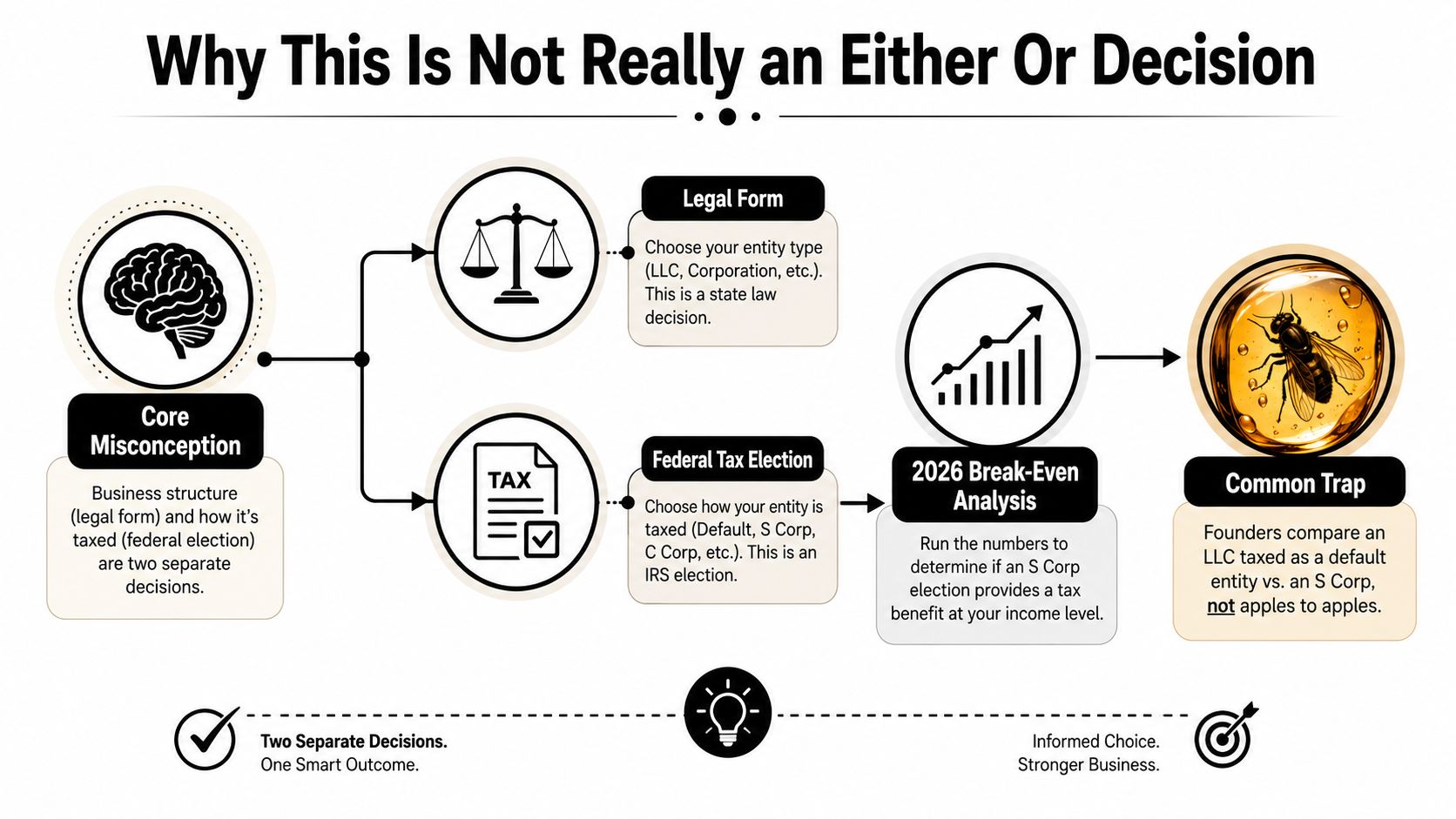
Founders often compare an LLC with an S corporation as if both are state-created entity types. They aren't. Florida Chapter 605 governs LLCs, Florida Chapter 607 governs corporations, and Subchapter S governs a federal tax classification. Those systems operate on parallel tracks.
A Florida LLC can remain an LLC under Chapter 605 while filing IRS Form 2553 to elect S corporation taxation. A Florida corporation formed under Chapter 607 can also make the election if it meets the federal requirements. The election changes how the business is taxed and how an owner is paid. It doesn't automatically change the entity's state-law identity or its liability shield.
The comparison most articles get wrong
The apples-to-apples comparison is usually:
- Florida LLC taxed by default, generally as a disregarded entity if it has one owner or as a partnership if it has multiple members.
- The same eligible LLC after an S corporation election, with payroll, reasonable compensation, and pass-through distributions.
- A Florida corporation with an S election, when corporate governance or ownership planning makes that form preferable.
The common trap is comparing a default LLC with a corporation that has elected S status, then attributing every difference to the word “S corp.” That obscures the core trade-off. A founder may be able to preserve LLC flexibility while changing only the federal tax treatment.
Practical rule: Decide the legal form first, then decide whether the business can economically and operationally support an S corporation tax election.
Florida businesses also need to consider local licensing, registered-agent obligations, contracts, and the way the business will operate in practice. Founders establishing or restructuring a company can review the broader formation process through this guide to setting up a business in Florida.
The historical record explains why S corporation taxation remains mainstream. Congress created Subchapter S in 1958, and by tax year 1997, S corporations had become the most common corporate entity type in the United States. The IRS reported that by tax year 2003, about 61.9% of all corporations filed Form 1120S, with nearly 3.3 million S corporation returns, up 5.9% from nearly 3.2 million in 2002. (IRS S corporation statistics)
Those figures show that S corporation taxation is a mature strategy, not an exotic planning device. They don't prove that it's right for your company. The answer still depends on whether the business produces stable profit above a defensible salary and whether the tax advantage survives the additional administration.
What an LLC and an S Corporation Are
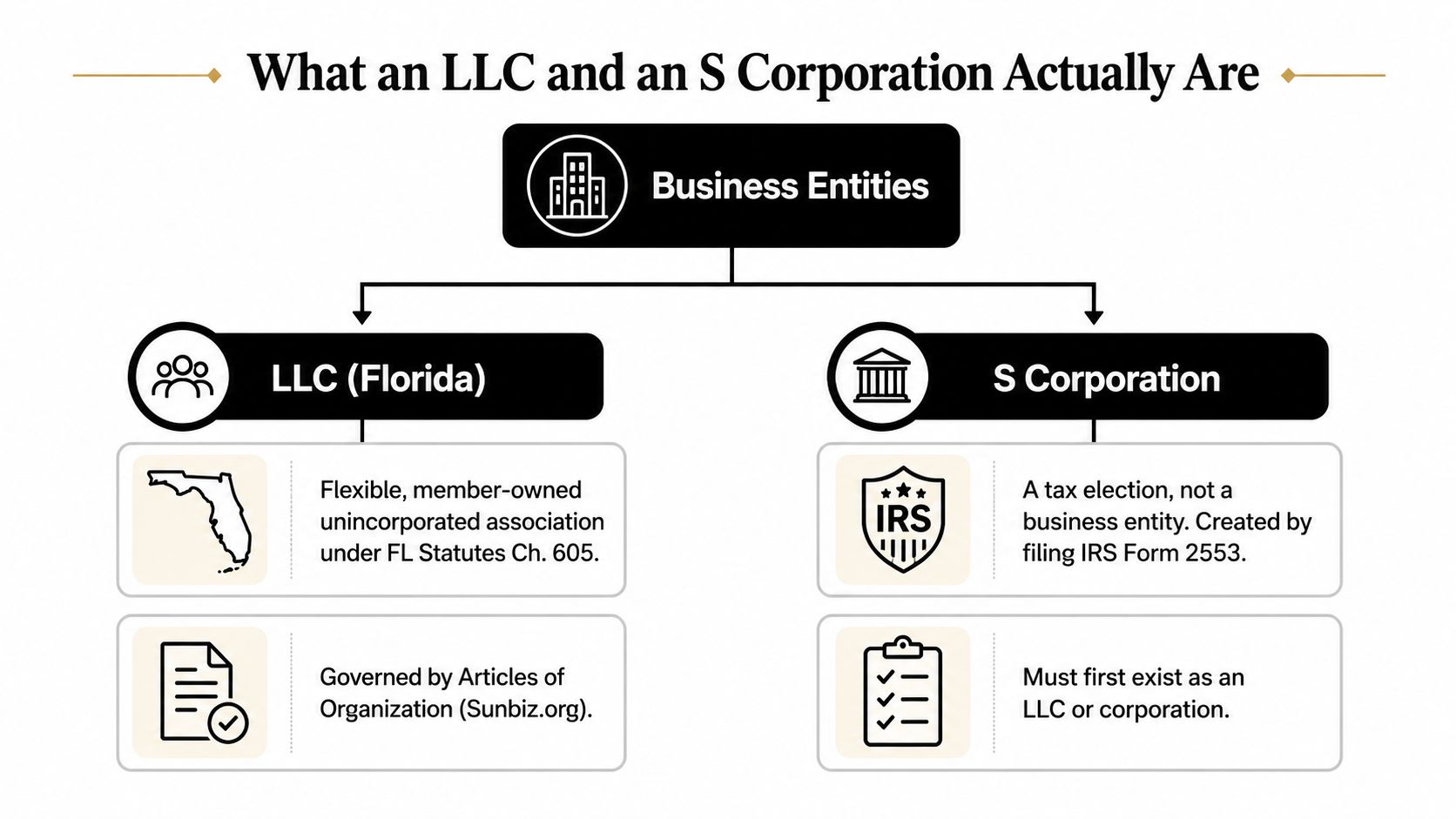
A Florida LLC is a state-law entity created by filing Articles of Organization with the Florida Division of Corporations. Florida Statutes Chapter 605 allows substantial flexibility in management, ownership, and internal arrangements. Its owners are members, and the operating agreement generally sets rules for authority, contributions, allocations, transfers, and disputes.
An LLC may have one member or several. It can usually admit owners that an S corporation cannot, including foreign owners and other business entities. Its default federal tax classification depends on the number of members, although the owners may make a separate election.
The state-law entity
Formation depends on where the company operates and how its owners want it governed. A founder may form in Florida for a Florida-based business, or consider Delaware because Delaware has a specialized Court of Chancery and an extensive body of corporate case law. Delaware formation does not remove Florida obligations. A company conducting business here may still need foreign registration, a Florida registered agent, and compliance with Florida operating requirements.
Articles of Organization and Articles of Incorporation create different legal structures. This Business Loan Warrior filing comparison explains the distinction in plain English.
The federal tax election
An S corporation is not a separate state entity. It is a federal tax status under Subchapter S. An eligible Florida corporation or LLC may request that treatment through an IRS election.
The main eligibility rules include:
- Domestic status: The entity must be domestic.
- Shareholder limit: The corporation generally cannot have more than 100 shareholders. Federal family-aggregation rules may treat qualifying family members as one shareholder for this test.
- Permitted owners: Shareholders generally must be eligible individuals, certain trusts, or estates. Partnerships, corporations, and nonresident aliens ordinarily cannot hold shares.
- One class of stock: Shares must provide identical rights to distributions and liquidation proceeds. Voting differences may be permitted under the applicable federal rules.
A multi-member LLC generally receives partnership tax treatment by default. It does not necessarily have to convert into a corporation before pursuing S corporation status, but its ownership and governing documents must support the election. Partnership allocations, preferred economics, and existing agreements can conflict with S corporation restrictions, so a lawyer and CPA should review the structure before any filing.
Side by Side on Liability and Day to Day Operations
Both an LLC and an S corporation can separate business liabilities from the owners' personal assets when the company is properly formed and operated. Neither structure protects an owner from personal liability for their own misconduct, malpractice, fraud, or unlawful conduct. Commingling funds, ignoring records, and treating the company as a personal bank account also create avoidable problems.
The operational differences become clearer after formation.
| Dimension | LLC (Default) | S Corporation |
|---|---|---|
| Liability protection | Members generally receive a liability shield when the entity is maintained properly | Shareholders generally receive a liability shield, but officers and directors must respect corporate separateness |
| Management | Member-managed or manager-managed arrangements can be tailored in the operating agreement | Directors oversee the corporation, with officers handling day-to-day authority |
| Internal records | Operating agreement, member consents, ownership ledger, and financial records | Bylaws, shareholder and director records, stock ledger, consents, and corporate minutes |
| Ownership | Flexible member types and economic arrangements | Eligible shareholders only, one class of stock, and generally pro rata economic rights |
| Owner compensation | Owners generally take draws or guaranteed payments rather than W-2 wages from the LLC | Shareholder-employees must receive reasonable W-2 compensation before distributions |
| Florida maintenance | Annual report, registered agent, and current public records | Annual report, registered agent, corporate records, and tax compliance |
| Missed annual report exposure | Florida's minimum LLC reinstatement fee is $138.75 | Florida's corporation annual report fee is $61.25 |
| Best operational fit | Flexible ownership, changing economics, and lean administration | Stable operations with payroll discipline and formal governance |
The Florida annual report amounts and reinstatement exposure require attention because missing a filing can interrupt good standing and complicate contracts, banking, financing, or a later sale. Both structures need a registered agent and a reliable compliance calendar.
Governance is not cosmetic
An LLC operating agreement can authorize decisions by written consent, establish manager authority, and create customized transfer restrictions. That flexibility works well for a closely held consulting firm, family business, or agency whose owners need economics that don't follow a rigid stock model.
A corporation has more formal architecture. Shareholders own stock, directors oversee the company, officers carry out decisions, and the company should preserve a stock ledger and corporate minutes. An S election doesn't create those formalities by itself, but a Florida corporation already carries them under Chapter 607.
Liability insurance remains important even with an entity shield. A founder who wants to review personal liability layers can browse Florida umbrella insurance options as part of a broader risk conversation. That coverage doesn't replace business insurance, contracts, or proper entity maintenance.
For an LLC, the operating agreement is the operational constitution. Founders should understand what an LLC operating agreement does before accepting a generic template that fails to address ownership transfers, deadlock, or manager authority.
How Each Structure Is Taxed in Practice
The tax difference starts with how profit reaches the owner's return.
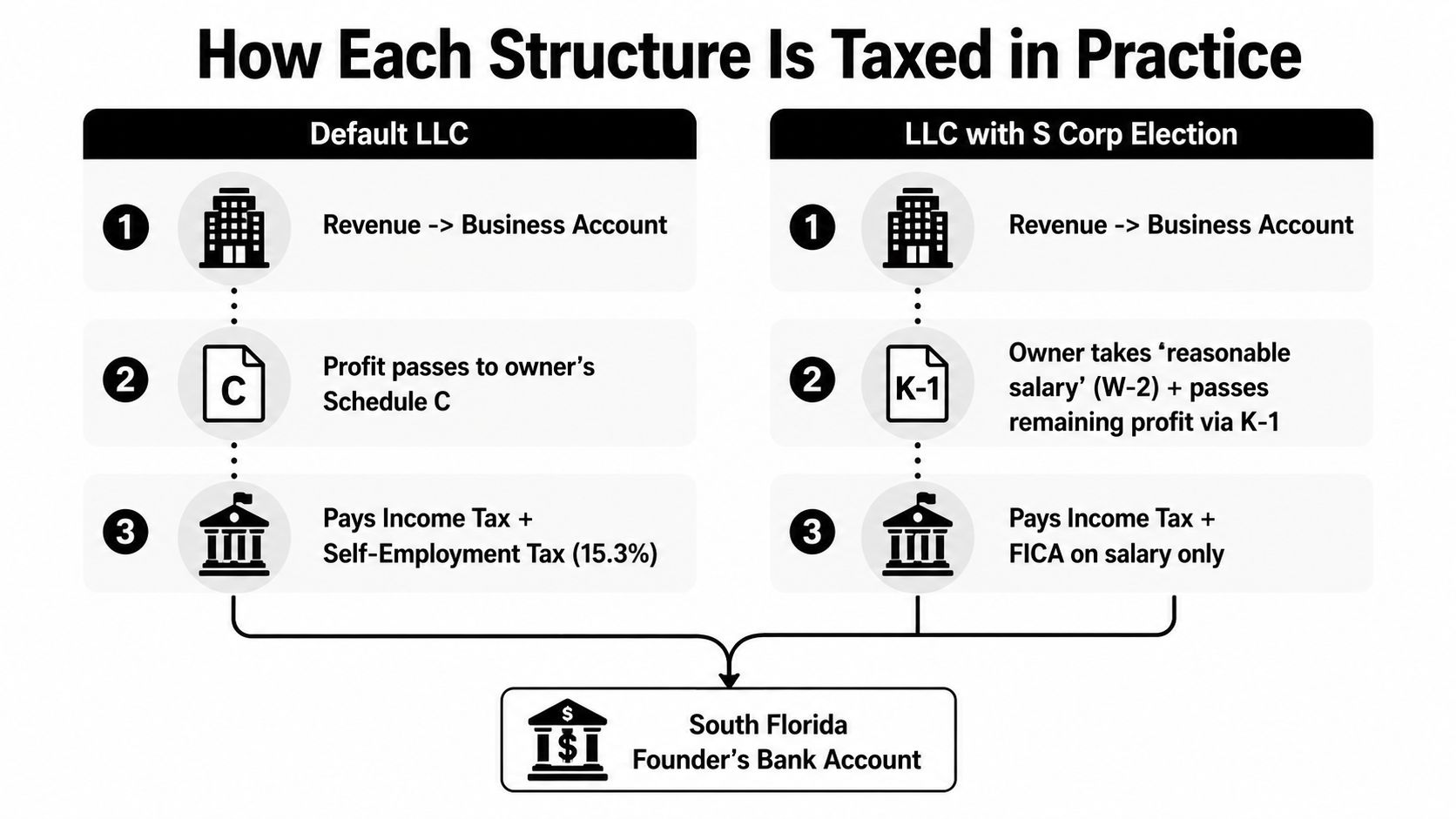
A single-member LLC taxed by default generally reports business activity on the owner's Schedule C. The entire net profit is generally exposed to self-employment tax, which is 15.3%, consisting of 12.4% Social Security and 2.9% Medicare. (IRS guidance on LLC filing classifications)
A domestic multi-member LLC generally files Form 1065, and each member receives a Schedule K-1. The precise treatment can vary with the member's role, the type of income, and the operating agreement, so a partnership return shouldn't be reduced to the single-member LLC model.
What changes after the election
Once an eligible LLC elects S corporation treatment, the business must separate compensation from distributions. An owner who performs services generally becomes a shareholder-employee and receives a W-2 salary. The remaining eligible profit can pass through on a K-1 and generally isn't subject to self-employment tax.
That separation is not permission to label the owner's labor as a distribution. The IRS requires reasonable compensation for services before non-wage distributions. The salary should reflect the owner's role, time, responsibilities, industry, and the company's financial reality. (IRS reasonable compensation guidance for S corporations)
Payroll means more than writing a check. The company needs payroll withholding, employer tax deposits, quarterly employment filings, year-end W-2 reporting, and books that distinguish wages, reimbursements, and distributions. A payroll service can handle calculations and filings, but it can't decide whether the salary is defensible or document the compensation analysis.
A more-than-2% shareholder's health insurance can receive special W-2 treatment. Amounts may appear in Box 1 while escaping Social Security and Medicare tax when the applicable rules are followed. That reporting detail should be coordinated with the payroll provider and tax preparer.
The tax savings are narrower than the marketing
The possible advantage comes from shifting some profit above reasonable salary from payroll-taxed wages to distributions. Distributions still flow through to the owner's individual return and can remain subject to income tax. They aren't tax-free money.
The qualified business income deduction can also affect the outcome. Salary generally isn't QBI, while qualifying pass-through profit may be. A higher S corporation salary can reduce the amount of income available for the deduction, and specified service businesses may face income-based limitations. Model the income-tax effect alongside payroll taxes rather than looking only at the 15.3% rate.
The S corporation also files Form 1120-S and issues K-1s. The separate return, payroll work, bookkeeping, and professional fees add a cost that a default single-member LLC may avoid. Treat the election as a package of tax treatment and administration, not as a free switch.
The Break-Even Point for the S Corp Election
Higher profit does not automatically make an S corporation election worthwhile. The break-even point changes with owner salary, payroll costs, professional fees, bookkeeping, insurance, and filing expenses. The relevant comparison is the net benefit after compliance, not the payroll-tax difference by itself.
Fresh 2026 reporting based on 6,908 client businesses found estimated federal tax savings of only about $470 in the $50,000 to $100,000 revenue band, before the added cost of maintaining S corporation status. The same reporting identified roughly $40,000 to $50,000 of profit as a possible starting point in some cases, not a universal cutoff. (2026 1-800Accountant data reported by Morningstar)
A Miami-Dade sole owner with $200,000 of net profit before salary and a defensible salary of $80,000 illustrates the trade-off. The remaining $120,000 may be treated as a distribution, subject to the rules governing S corporation distributions and basis.
| Line Item | Default LLC | LLC Electing S Corp |
|---|---|---|
| Net profit before owner compensation | $200,000 | $200,000 |
| Owner W-2 salary | None | $80,000 |
| Profit treated as distribution | None | $120,000 |
| Payroll or self-employment tax exposure | Generally applies to the full net profit | Applies to salary, with employer and employee mechanics |
| Illustrative payroll-tax difference on reclassified profit | Not applicable | About $18,360 of 15.3% FICA on $120,000, before other effects |
| Employer payroll burden in example | None as owner payroll | About $12,200 employer payroll taxes |
| Workers' compensation and Florida reemployment tax assumption | None as owner payroll | About $1,750 |
| Payroll provider assumption | None required for owner compensation | $2,500 to $4,000 annually |
| Separate corporate return and bookkeeping | Lower administrative burden | Additional Form 1120-S, payroll, and segregation work |
| Illustrative annual result | Simpler, lower overhead | About $4,400 in annual savings before all other tax effects |
The example includes an estimated employer payroll burden of about $13,950, made up of approximately $12,200 in employer payroll taxes and $1,750 for workers' compensation and Florida reemployment tax. Subtracting that amount from the illustrative $18,360 payroll-tax difference leaves roughly $4,400.
That result is only a model. Salary support, payroll pricing, insurance, the QBI outcome, retirement contributions, health insurance treatment, and other facts can change it substantially. A sole owner with around $70,000 to $90,000 of net profit may warrant a closer review in some circumstances, but that range is not a rule.
The election should pay for itself after compliance costs, not before them.
Below that range, a default LLC often remains preferable because the added filings and payroll work can consume the expected savings. Above it, an S election may deserve modeling, provided the owner salary is documented and the tax return, payroll, bookkeeping, and insurance costs are included in the calculation.
How to Elect S Corp Status Step by Step
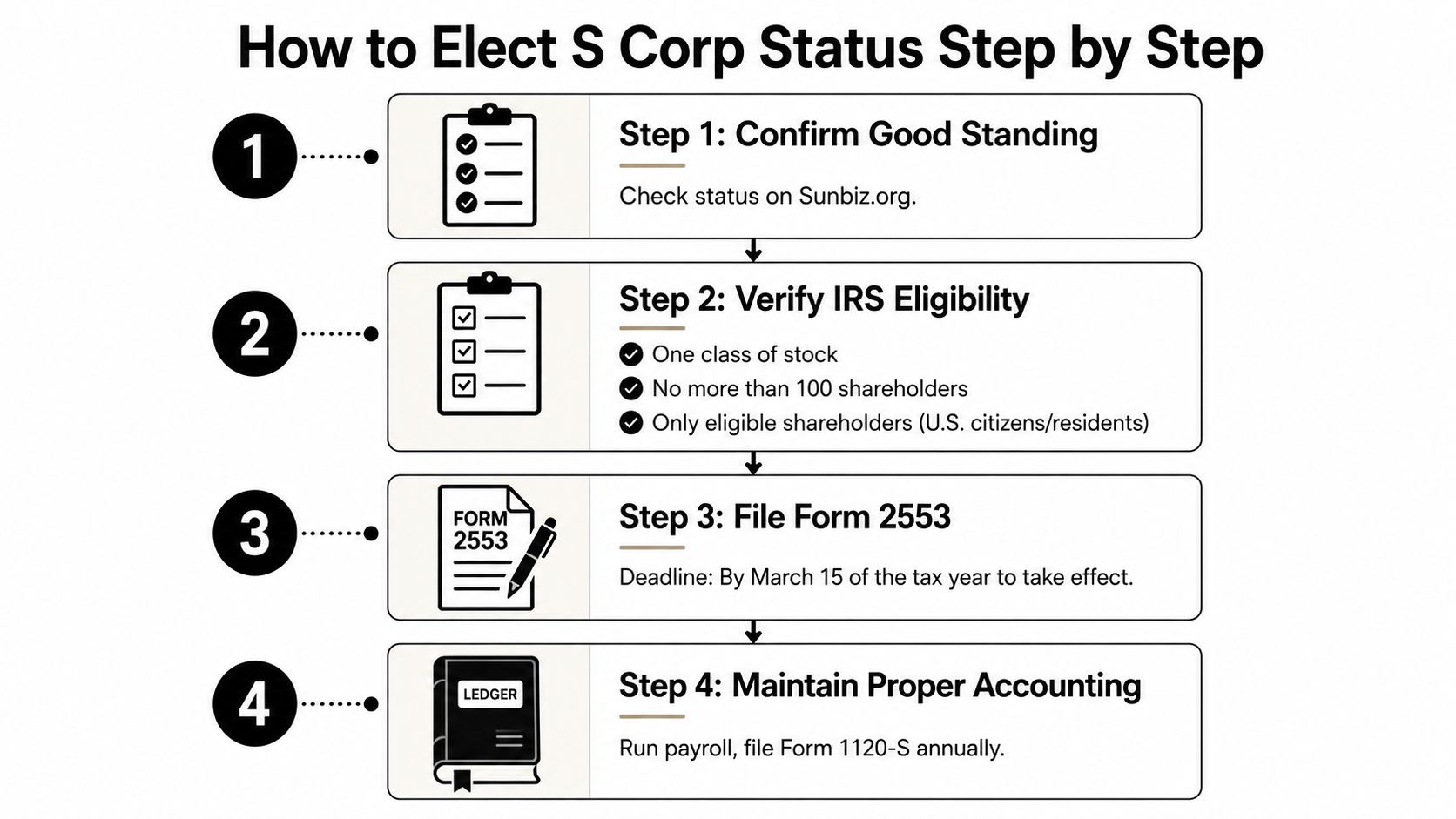
An S election is an operating change, not a last-minute tax idea. Confirm the entity first, test eligibility, file on time, then build payroll and accounting procedures before owner compensation begins.
Confirm the Florida entity
Check the LLC's status through Sunbiz. Annual reports, registered-agent information, and public records should be current. If the business is already a corporation, verify its Chapter 607 records, officers, directors, and stock ledger.
Clean up any good-standing or formation problems before making the federal election. An S election does not fix missing authority, defective formation documents, or an ownership agreement that conflicts with S corporation rules.
Review eligibility and ownership
Confirm that the business is domestic, the owners fit the permitted categories, and the ownership terms support the one-class-of-stock rule. Family-owned companies should review family-aggregation rules before issuing additional interests. Distribution rights must remain economically equivalent, even when the ownership documents are being amended.
Treat the cap table as a legal and tax document, not a clerical detail. A foreign owner, corporate owner, partnership owner, or preferred economic arrangement may prevent the election or end S status later. The IRS S corporation guidance provides the federal framework, but the company's governing documents and ownership history still need separate review.
File Form 2553 on time
Form 2553 generally must be filed within 2 months and 15 days after the intended effective date. The form identifies the entity, EIN, shareholders, effective date, and tax year, and required owners must sign it.
For a calendar-year business seeking a January 1 effective date, prepare the filing before year-end and confirm the deadline with the tax professional handling the election. Keep the submitted form, delivery evidence, and IRS CP261 confirmation notice in the company's records.
A late filing is not automatically fatal. IRS late-election relief may apply when the company acted reasonably and meets the applicable requirements, but the facts and required statements matter. Do not assume a late filing automatically creates retroactive S status.
The election may also affect wholly owned subsidiaries and QSub treatment. Those issues require coordinated tax and legal review, not a casual checkbox.
Build the operating system
Before the first payroll period, establish a payroll account, compensation schedule, expense-reimbursement process, separate accounting classes, and a distribution-approval practice. Document the salary analysis and update it when the owner's duties or business economics change.
Founders considering a corporate conversion can review the Florida corporation filing process before deciding whether the existing LLC should remain an LLC or become a corporation.
Which Structure Fits Your Scenario
The right answer changes with the owner's plans. A South Florida freelancer with one owner and no outside capital has a different problem from a Brickell startup preparing for institutional investment.
| Founder Profile | Typical Profit | Recommended Structure | Key Trigger |
|---|---|---|---|
| Solo Miami consultant | $120,000 | Model an S election, but don't file automatically | Stable profit above a defensible salary after payroll and tax costs |
| Two-member Broward agency | $400,000 | Usually retain LLC partnership taxation unless ownership fits S rules and savings are material | Member economics, eligibility, and whether both owners can be paid through compliant payroll |
| Family-owned Homestead restaurant group | Varies | LLC or corporation with careful tax modeling | Family ownership aggregation, salary documentation, and distribution rights |
| Brickell technology startup expecting a Series A | Varies | Prepare for a Delaware C corporation rather than S status | Venture investors, preferred stock, and financing documents |
The solo consultant
A Miami consultant clearing $120,000 may be in the zone where an S election deserves a real model. The consultant still needs a reasonable salary, payroll administration, clean books, and enough residual profit to make distributions meaningful.
If income fluctuates or the owner's salary would consume nearly all profit, the default LLC may be the better answer. A tax calculation that ignores payroll-provider fees and the owner's time isn't complete.
The Broward agency
A two-member agency with $400,000 of profit has more room for tax planning, but partnership taxation may remain more appropriate. An LLC can allocate economics flexibly, accommodate different contributions, and handle ownership changes that an S corporation may not tolerate.
An S election becomes harder when members want special allocations, different distribution rights, foreign participation, or a new owner that doesn't qualify. Convert only after reviewing the operating agreement, capital accounts, compensation roles, and exit plans.
The family restaurant group
A family business should map who owns what before discussing salary versus dividends. Family aggregation can help with the shareholder test, but it doesn't excuse poor records or unequal economic rights that conflict with the one-class-of-stock requirement.
The owners should document the work performed by each shareholder-employee, use payroll consistently, and separate compensation from returns on ownership. A family relationship doesn't make an IRS compensation issue disappear.
The Brickell startup
A startup expecting a Series A should usually avoid an S election if the financing plan requires venture capital, preferred stock, foreign investors, or multiple economic classes. The S rules can constrain the exact instruments investors expect.
A Florida LLC may be an efficient early structure, but a Delaware C corporation is often the more practical financing target when institutional investors are part of the plan. The company should address conversion timing, intellectual property ownership, founder vesting, and capitalization before the financing process begins.
South Florida FAQs and When to Call a Lawyer
Can a non-Florida resident form a Florida LLC?
Generally, a person doesn't need to live in Florida to form a Florida LLC. The company still needs a Florida registered agent and must comply with Florida filing and operating requirements. If the business is operated in another state, that state may impose its own registration obligations.
Does a Miami-Dade or Broward business need more than a Sunbiz filing?
Often, local business tax receipts, zoning approvals, professional licenses, and industry permits are separate from the Florida Division of Corporations annual report. A Sunbiz filing doesn't automatically authorize a restaurant, home-based business, contractor, healthcare practice, or regulated professional activity.
Can a foreign owner participate in an S corporation?
A nonresident alien generally can't be an S corporation shareholder. Foreign ownership may work under an LLC, partnership, or C corporation structure, but the right answer depends on immigration, tax, financing, and operating facts.
Can a single-member LLC elect S status?
Yes, an eligible single-member LLC can elect S corporation taxation. The election doesn't require dissolving the LLC, but it does impose the payroll, reasonable-compensation, shareholder, and filing requirements discussed above.
What happens if the owner moves?
Moving to another state doesn't automatically end an S election. The owner must review residency, state tax, payroll, foreign qualification, and shareholder eligibility consequences. A move involving a nonresident owner or a change in ownership can create a more serious problem than a simple address update.
A CPA can often handle the initial tax model when the entity is straightforward, ownership is stable, and no restructuring is planned. Call a business attorney before filing if you're forming in Delaware while operating in Florida, electing S status for an existing multi-member LLC, restructuring before a raise, or undoing a previous election.
The most useful next step is to prepare a one-page model showing expected profit, defensible salary, payroll cost, tax-return cost, ownership changes, and investor plans, then have counsel and your CPA review it together.
Coto & Waddington, Attorneys at Law advises South Florida founders on Florida and Delaware LLC, S corporation, and C corporation formation, ownership documents, restructuring, and ongoing business compliance. Visit Coto & Waddington, Attorneys at Law to discuss the legal-form and tax-election decision before you file.