
A living trust is a private legal document you create to hold ownership of your assets. It lets you manage everything during your lifetime and ensures those assets pass to your beneficiaries after your death, completely avoiding court interference.
Think of it as creating a personal rulebook for your property, giving you complete control now and protecting your family from the public probate process later.
Understanding a Living Trust in Simple Terms

The easiest way to picture a living trust is as a secure container you build for your most valuable assets—your home, investments, or business interests. While you're alive and well, you place these assets inside the container, but you still hold the only key.
You can add, remove, or manage anything inside it just like you always have. Nothing really changes in your day-to-day life.
The true power of this "container" only becomes obvious when you pass away or if you become incapacitated. Instead of your assets being frozen and dragged through the often lengthy, expensive, and public probate court system, they can be distributed privately and efficiently according to the exact rules you already set up.
The Three Key Players in Your Trust
Every living trust has three essential roles. Sometimes, the same person fills all three, but understanding each one is the first step to seeing how a trust can work for you.
To help break it down, here is a quick overview of the key components and roles within a living trust.
Living Trust at a Glance: Key Features
| Component | Role and Description |
|---|---|
| The Grantor | Also called the Settlor, this is you—the creator of the trust who transfers assets into it. You set all the rules. |
| The Trustee | The manager of the trust. While you're alive, you are almost always your own trustee, maintaining full control. |
| The Successor Trustee | The backup manager you name to take over when you are no longer able to, either due to incapacity or death. |
| The Beneficiary | The person, people, or organization who will ultimately receive the assets from the trust, according to your instructions. |
These roles work together to create a seamless legal structure that protects your assets and your family’s privacy.
Key Takeaway: For most revocable living trusts, you start out wearing all three hats at once: you are the Grantor, the Trustee, and the Beneficiary. This structure gives you maximum control during your life while setting up a smooth transition for the future.
This kind of proactive planning is critical, yet it's something many families put off. According to the 2025 Trust & Will Estate Planning Report, a mere 11% of Americans have a trust in place. Worse, 55% have no estate plan at all, leaving their life savings and property vulnerable to court delays and disputes.
A Proactive Tip for Florida Families
Tip: Start by making a simple list of your major assets—your house, your primary bank account, and any investment accounts. This inventory becomes the foundation for a productive conversation with an attorney and helps clarify what you need to protect.
Don't worry about getting every detail perfect. Just having a starting point makes the entire process far more manageable.
A living trust offers Florida families both control today and profound peace of mind for tomorrow. By understanding these core concepts, you’ve already taken the first step toward securing your legacy. You can learn more about how to set up trusts and estates in Florida in our guide.
How a Living Trust Shields Your Assets and Privacy
A living trust delivers two huge benefits that a will simply can't: avoiding probate and protecting your family’s privacy. These two advantages are deeply connected and are usually the main reasons people in Florida choose this powerful estate planning tool.
Probate is the formal court process for validating a will and distributing someone's assets after they die. Here in Florida, probate isn't just slow and expensive—it’s also a public spectacle.
That means anyone—a nosy neighbor, a former business partner, or a predatory salesman—can go to the courthouse or search public records online and see the intimate details of your estate. They can find out what you owned, who you owed, and exactly who got what.
The Problem with Public Probate
For many families, especially entrepreneurs and business owners, this kind of public exposure is a non-starter. Imagine a Miami business owner passes away with only a will. Suddenly, the value of their company, their real estate holdings, and their investment portfolio are all laid bare for public consumption.
This public filing can expose the family to unwanted solicitations from financial advisors or even disputes from distant relatives who suddenly see an opportunity. On top of that, the assets are often frozen during the probate process, which can drag on for months or even years. This leaves the family in financial limbo, unable to manage the business or access the funds they need.
A living trust is a private document. It allows for a fast, seamless, and completely confidential transfer of your assets to your beneficiaries, bypassing the entire court system and keeping your family's financial affairs out of the public eye.
This privacy is a critical shield. With a trust, your instructions are carried out by your successor trustee behind closed doors. This protects your loved ones from public interference and added emotional strain during an already difficult time.
Protection During Incapacity
Beyond what happens after you die, a living trust provides a vital safeguard that a will is useless for: protection if you become incapacitated. An unexpected illness or serious injury could leave you unable to manage your own financial affairs.
If all you have is a will, your family would likely have to go to court to get a guardian or conservator appointed to manage your assets for you. This is yet another public, costly, and stressful legal proceeding that strips you of your autonomy.
A living trust, however, is built for this exact scenario.
- You Designate a Successor Trustee: You name a trusted person ahead of time to step in and manage your finances if you're medically certified as unable to do so.
- No Court Intervention Needed: This transfer of authority happens automatically and privately, without a judge's approval.
- Your Assets are Managed Seamlessly: Your successor trustee can immediately step in to pay your bills, manage your investments, or run your business, ensuring your life continues without financial disruption.
This is a powerful advantage of truly understanding what a living trust is and how it works. Unfortunately, too many people are unprepared. A 2025 survey from Caring.com reveals a startling trend: only 24% of U.S. adults have a will, and a mere 11% have a trust. Americans with children under 18 are the largest group without any estate documents, creating a massive risk for their families. You can discover more insights from this concerning estate planning trend by reviewing the survey findings.
A Practical Tip to Ensure Privacy
Tip: When you set up your living trust, you should also create a "pour-over will." This special will acts as a safety net. Its only job is to "pour" any assets you might have forgotten to place in your trust into the trust when you die. While this will does go through probate, it keeps the details private by simply stating that everything goes to your trust—without listing the specific assets or beneficiaries for the public to see.
Ultimately, a living trust is your best defense against the delays, costs, and public exposure of probate court, both after death and during a potential period of incapacity.
Are you ready to protect your assets and ensure your family's privacy? Contact Coto & Waddington today to discuss how a living trust can provide the security and peace of mind you deserve.
Choosing Between a Living Trust and a Will
One of the biggest misconceptions in estate planning is that you have to pick a side: a will or a living trust. The truth is, a solid plan almost always uses both, working in harmony. Thinking of them as competitors misses the point entirely. They’re different tools designed for very different jobs.
A last will and testament is, at its core, a set of instructions for the probate court. It has zero legal power until after you pass away. At that point, a judge has to validate it and then oversee the very public process of distributing your assets.
A living trust, on the other hand, is a private legal entity you create and control during your lifetime. It holds and manages your assets while you're alive, steps in to provide for you if you become incapacitated, and distributes your property after you die—all without a single court filing.
Understanding Their Core Differences
The real question isn't which one is "better," but which one achieves your goals for privacy, efficiency, and control. A will guarantees probate court involvement, while a living trust is specifically engineered to avoid it. This single distinction is the source of nearly all their other differences.
This flowchart shows the two very different paths your estate can take, depending on whether a trust is in place.
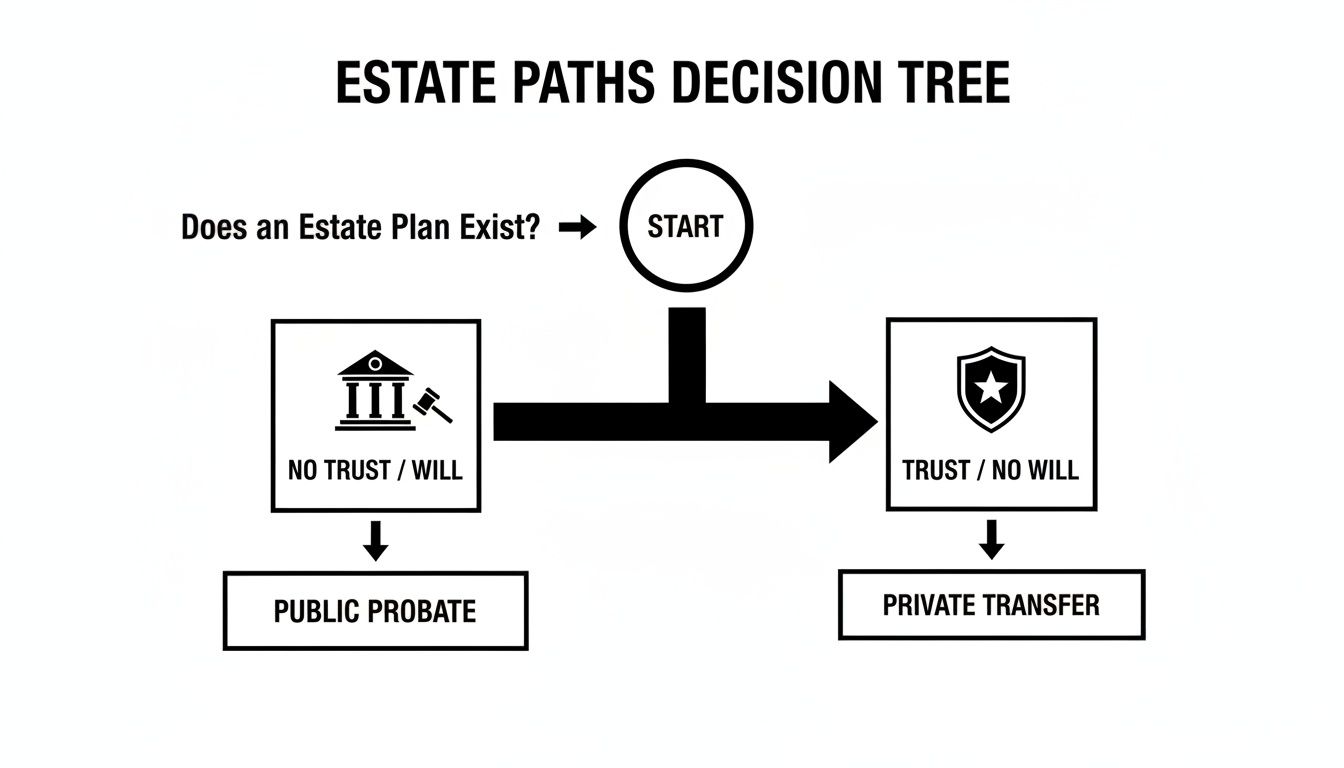
As you can see, a living trust creates a direct, private pipeline for your assets to reach your beneficiaries. It completely bypasses the public, and often painfully slow, court system.
Let's put these two essential documents head-to-head to see how they stack up.
Comparing a Living Trust and a Will
This table directly compares the critical features of living trusts and wills to help you quickly grasp their fundamental differences and purposes.
| Feature | Living Trust | Will |
|---|---|---|
| Effective Date | Immediately upon creation and funding. | Only after your death and court approval. |
| Probate Avoidance | Yes, assets in the trust bypass probate. | No, a will is the primary document for probate. |
| Privacy | Kept entirely private. | Becomes a public court record. |
| Incapacity Protection | Manages assets if you become unable to. | Offers no protection during your lifetime. |
| Initial Cost | Higher upfront investment. | Lower initial cost to create. |
| Long-Term Cost | Often saves significant money by avoiding probate. | Can lead to high probate fees for your heirs. |
The takeaway is clear: while a will is a foundational piece of the puzzle, a living trust offers far more robust protection against the public disclosures, costs, and delays baked into the probate system.
How a Pour-Over Will Completes Your Plan
So, how do they work together? This is where the pour-over will comes in. Think of it as a safety net for your living trust. Its only job is to "catch" any assets you might have forgotten to transfer into your trust and "pour" them into it after you pass away.
For instance, you might buy a new car or open a bank account and forget to title it in the name of the trust. Without a pour-over will, that asset gets stranded outside the trust and is forced into probate. With one, the will directs the asset straight into your trust, making sure it gets distributed according to your master plan.
Key Takeaway: The most secure estate plans use a living trust as the main engine for asset distribution and a pour-over will as the critical backup, ensuring no asset is left behind or exposed to the public probate process.
Tips for Making the Right Choice
Deciding on the best structure for your estate plan comes down to your personal situation and what you want to achieve.
- Tip: Assess Your Need for Privacy. If you own a business or simply want to keep your family's financial affairs out of the public record, a trust is the clear winner.
- Tip: Consider Incapacity. A will does absolutely nothing for you if you become ill or injured. If you want to ensure someone can manage your finances without going to court, a trust is essential.
- Tip: Evaluate Your Assets. For anyone with significant assets, especially real estate in multiple states, a trust can save your family from navigating several complex and expensive probate proceedings.
Ultimately, the first step is to shift away from the "either/or" mindset. By understanding how a will and a living trust can work in concert, you can build a comprehensive shield that protects your assets and provides for your family with certainty and privacy.
Ready to determine the right combination of tools for your estate plan? Contact Coto & Waddington to get clear, practical advice on securing your legacy.
Revocable vs. Irrevocable Trusts Explained
Once you understand what a living trust does for your family, the next step is choosing the right kind. This is the most important decision you'll make, and it boils down to one fundamental choice: will your trust be revocable or irrevocable? Each is built for a completely different purpose, and picking the wrong one can derail your entire estate plan.
The Power and Flexibility of Revocable Trusts
The overwhelming majority of living trusts are revocable. The best way to think of a revocable trust is as a flexible blueprint for your estate—one you can change anytime. As the grantor, you keep total control. You can amend the terms, move assets in or out, change who gets what, or even tear up the whole thing if you change your mind.
This adaptability is precisely why it’s the go-to tool for most families. Life is never static. You might sell a home, welcome a new child, or simply reconsider who should inherit a treasured family asset. A revocable trust is designed to evolve right along with you.
You lose zero control over your property during your lifetime. While the assets are technically titled in the trust's name, you manage them as the trustee, just like you always did. This setup delivers the biggest benefits—avoiding probate and ensuring privacy—without forcing you into rigid, permanent decisions.
Take a young couple in Miami with a growing business and a new baby. A revocable trust is perfect for them. It lets them:
- Adapt to life changes: They can easily add future children or update who they’ve chosen as guardians.
- Manage assets freely: If they want to sell their current home and buy a new one, there are no complicated legal hoops to jump through.
- Maintain complete control: They can manage their investments and bank accounts exactly as they did before.
A revocable living trust gives most people the ideal mix of control and protection. It lets you plan for tomorrow without giving up the power to manage your own life today.
This structure is the workhorse of modern estate planning for a reason. It provides a private, efficient path to transfer wealth while keeping you firmly in the driver's seat.
When Irrevocable Makes Sense
An irrevocable trust, on the other hand, is like setting your plan in stone. Once it's created and you've moved assets into it, you can't just change your mind. You give up control, and the assets now legally belong to the trust, which is managed by someone else as the trustee.
So, why would anyone ever willingly give up that much control? The answer is always tied to very specific, high-level planning goals. Irrevocable trusts aren't for everyone. They are specialized tools used to achieve powerful outcomes that a revocable trust simply cannot.
The main reasons to use an irrevocable trust are:
- Advanced Asset Protection: By legally removing assets from your name and your control, you can shield them from the reach of future creditors or lawsuits.
- Minimizing Estate Taxes: For people with a net worth that exceeds the federal estate tax exemption (currently over $13 million), an irrevocable trust can move assets out of their taxable estate, saving their heirs a fortune in taxes.
- Medicaid Planning: Certain kinds of irrevocable trusts are used to protect family assets while helping an individual qualify for long-term care benefits.
Think of a successful business owner with a massive estate. She might use an irrevocable trust to gift company shares to her children now, locking in their value and removing them from her taxable estate. It’s a purely strategic move, trading everyday flexibility for a huge financial advantage down the road.
Tips for Deciding Which Is Right for You
Choosing between revocable and irrevocable isn’t a small detail; it fundamentally defines your entire plan.
- Tip 1: Assess Your Goals. If your main goal is simply to avoid probate, keep things private, and stay in control, a revocable trust is almost always the answer. If you're more worried about lawsuits, creditors, or estate taxes, an irrevocable trust might be necessary.
- Tip 2: Evaluate Your Need for Flexibility. Be honest with yourself. If you see big life changes on the horizon—selling a business, a potential marriage or divorce, acquiring major new assets—the adaptability of a revocable trust is priceless.
The difference is clear: revocable trusts are for managing your own estate with maximum efficiency. Irrevocable trusts are for permanently separating assets from your estate to gain specific legal and financial protections.
Understanding which path aligns with your financial future is a crucial conversation to have. Contact Coto & Waddington today for a consultation to explore the best trust structure for your family.
A Practical Guide to Creating Your Living Trust

Knowing what a living trust is and why you need one is a great start. The next step is actually bringing it to life. While the process might sound intimidating, creating a living trust is a logical journey broken down into three clear phases: Design, Execution, and Funding.
Each of these stages is absolutely critical to building a plan that protects your assets and secures your family’s future. Working with an experienced attorney makes the entire process feel smooth and ensures every single detail is handled correctly.
Step One: The Design Phase
This is where the real strategy happens. The design phase is the heart of your estate plan, where you sit down with your attorney to map out exactly what you want to happen. It's all about making the key decisions that will control how your assets are managed and eventually distributed.
You’ll name your beneficiaries—the people who will inherit from the trust. You'll also choose your successor trustee, which is the person or institution you trust to step in and carry out your instructions when you no longer can. This decision is huge, as they will have a massive amount of responsibility on their shoulders.
Think of this phase as a series of thoughtful conversations. It's your chance to specify how and when your assets should be passed on, set up protections for young children, or plan for any other unique family dynamics you might have.
Step Two: The Execution Phase
Once the blueprint is finalized, it's time for execution. This is the formal legal step where you sign the trust documents, making everything official and legally binding. It's a straightforward but absolutely essential moment.
In Florida, you will sign the trust agreement in the presence of witnesses and a notary. At that moment, your trust officially exists as a legal entity. But its job is far from over.
Key Takeaway: An executed but unfunded trust is like an empty vault. It has walls, a door, and a lock, but there's nothing inside to protect. The legal document alone provides zero benefit until you complete the final, most important step.
This brings us to the part of the process that is most often overlooked, and the one that actually makes your entire plan work: funding.
Step Three: The Funding Phase
Funding is the process of actually transferring ownership of your assets into the name of your trust. If you skip this step, your trust is powerless, and those assets will get dragged into public probate court anyway. It means retitling your property so it's owned by "The [Your Name] Living Trust" instead of just you as an individual.
How this works depends on the asset:
- Real Estate: Your lawyer will draft and record a new deed, moving your Florida property from your name to the trust's name.
- Bank Accounts: You'll work directly with your bank to change the account title from your individual name to the name of the trust.
- Investment Accounts: You will fill out paperwork with your brokerage firm to retitle your non-retirement investment accounts.
- Business Interests: Ownership shares in an LLC or corporation are formally assigned over to the trust.
A well-funded trust is the only way to guarantee you get the probate-avoidance benefits you're looking for. It’s the action that puts your entire plan into motion.
Tips for a Successful Funding Process
Getting the funding right is non-negotiable. A proactive, organized approach here will make all the difference and ensure no asset gets left behind.
- Tip: Create a Master Checklist. Before you do anything else, make a detailed list of all your major assets. Write down every piece of real estate, every bank account, every investment portfolio, and every business interest.
- Tip: Work Methodically. Go right down your checklist, one asset at a time. This keeps the process from feeling overwhelming and prevents you from missing something critical.
- Tip: Confirm Ownership Changes. After you retitle an asset, always get written confirmation from the bank, county recorder, or financial institution. Keep these confirmation letters with your trust documents.
Properly creating and funding a living trust is a project that provides an incredible amount of security. To ensure every step is handled with the precision it deserves, it's wise to explore the full range of legal services available to protect your assets and legacy.
Ready to build a secure future for your family? Contact Coto & Waddington today to start designing and implementing your living trust with confidence.
Common Living Trust Mistakes and How to Avoid Them
A living trust is an incredibly powerful estate planning tool, but its true power is only unlocked if it's set up and maintained correctly. Unfortunately, we often see a few common—and critical—mistakes that can completely undermine the entire structure, leaving your assets and family exposed to the very probate process you wanted to avoid.
The single biggest error we see is failing to fund the trust. Creating the legal document is just step one. If you don't formally transfer ownership of your assets—like your home, bank accounts, and investments—into the trust's name, the document is basically an empty shell. Any assets left outside the trust will almost certainly end up in probate court.
Choosing the Wrong Successor Trustee
Another frequent misstep is picking the wrong person to be your successor trustee. This individual will be responsible for managing your affairs and distributing your assets exactly as you wished. Naming someone who is disorganized, financially irresponsible, or easily swayed by others can ignite disastrous family conflicts and lead to the mismanagement of your legacy.
Example: Sarah named her oldest son as successor trustee simply because she felt it was expected. Unfortunately, he had a history of poor financial decisions. After her passing, he mismanaged the trust funds, leading to significant losses and a bitter legal battle with his siblings that fractured the family permanently.
Adopting a "Set It and Forget It" Mindset
Finally, too many people treat their trust as a one-and-done task. A living trust isn't a static document; it has to evolve with your life. Forgetting to update it after major life events is a serious oversight that can create massive headaches down the road.
These events include things like:
- A marriage or divorce
- The birth or adoption of a child or grandchild
- The death of a beneficiary or successor trustee
- A significant change in your financial situation
A trust that’s 10 years out of date might not reflect your current wishes or family structure at all, creating confusion and paving the way for potential legal challenges.
Pro Tip: To prevent these mistakes, schedule a review of your entire estate plan with your attorney every three to five years, or immediately after any major life change. This proactive step ensures your trust remains a powerful, effective shield for your assets and stays perfectly aligned with your life's journey.
Making sure your trust is correctly funded, managed, and updated is crucial. If you have questions about an existing trust or are ready to create one that avoids these pitfalls, contact Coto & Waddington for a consultation to ensure your plan provides true peace of mind.
Frequently Asked Questions About Florida Living Trusts
When you start digging into the details of estate planning, a lot of specific questions pop up. We get them all the time. Below are some straightforward answers to the most common things people ask us about living trusts in Florida. Our goal is to clear the air so you can move forward with confidence.
Does a Living Trust Help Me Avoid Estate Taxes in Florida?
This is a big one. For most families, a standard revocable living trust doesn't directly sidestep estate taxes—the assets are still technically part of your taxable estate.
But here’s the good news: Florida has no state-level estate tax.
On top of that, the federal estate tax exemption is incredibly high right now, sitting at over $13 million per person. That means the vast majority of families will never have to worry about it. For those with estates larger than that, we can explore more specialized tools like irrevocable trusts to build in powerful tax-saving strategies.
Can I Be the Trustee of My Own Living Trust?
Yes, absolutely. In fact, that's how it's almost always done with a revocable living trust. When you set one up, you will serve as the initial trustee. This setup gives you complete, uninterrupted control to manage, buy, and sell your assets just like you always have. Nothing changes in your day-to-day life.
In the trust document, you'll also name a "successor trustee." This is a person or financial institution you trust to step in and manage things if you become incapacitated or after you pass away.
Pro Tip: Your successor trustee has an immense responsibility. You need to choose someone who is not only trustworthy but also organized and has the financial sense to carry out your wishes exactly as you've laid them out, without causing conflict.
What Assets Should I Put Into My Living Trust?
To get the full probate-avoidance benefit from your trust, you need to "fund" it by transferring your most significant assets into its name. This is the step that actually makes the trust work.
Common assets to move into a trust include:
- Real Estate: Your primary home, vacation properties, or rental homes.
- Bank and Brokerage Accounts: Your checking, savings, and non-retirement investment accounts.
- Business Interests: Ownership in an LLC or corporation.
However, some assets are better left out. Retirement accounts like IRAs and 401(k)s, as well as life insurance policies, already have their own beneficiary forms. Those forms are what control who inherits them, so retitling them into a trust is usually unnecessary and can sometimes create tax problems.
Is a Living Trust Expensive to Set Up in Florida?
A living trust does have a higher upfront cost than a simple will, there's no doubt about it. But when you look at the big picture, it’s almost always more cost-effective for your family down the road. The legal fees, court costs, and administrative headaches that come with Florida's probate process can easily dwarf the initial investment of creating a solid trust.
Think of it as a one-time investment to save your loved ones a huge amount of money, time, and stress during what will already be a difficult time. A well-prepared trust ensures your legacy is handled privately, efficiently, and exactly the way you wanted.
Securing your assets and protecting your family’s future is one of the most important steps you can take. To ensure your living trust is structured correctly and provides the comprehensive protection you need, partner with legal counsel who understands your goals. The team at Coto & Waddington, Attorneys at Law is here to provide clear, practical guidance for your estate planning needs. Contact us today for a consultation to secure your legacy at https://cotowaddington.com.



