A force majeure clause is a contract provision that excuses or suspends performance when an extraordinary event beyond the parties' control makes performance impossible or impracticable. In business deals, it's the clause that decides whether a hurricane, government order, or other outside event pauses your obligations, or leaves you facing a breach claim.
If you run a company in South Florida, that distinction isn't academic. One storm, one shutdown order, or one disrupted vendor chain can turn a routine contract into a fight over notice, timing, and whether performance was blocked or just harder to complete.
Table of Contents
- Understanding Force Majeure Clauses in Business Contracts
- The Three Legal Elements Required to Invoke Force Majeure
- Common Triggering Events and Post-2020 Contract Evolution
- Force Majeure Versus Economic Hardship and Market Changes
- Drafting Tips and Sample Clause Language for Florida Businesses
- Notice Requirements and Mitigation Obligations
- How Force Majeure Differs from Impossibility and Frustration of Purpose
- Practical Steps When Facing a Force Majeure Event
Understanding Force Majeure Clauses in Business Contracts
A Miami software startup signs a services agreement with a client in another state. Then a hurricane knocks out power and internet for two weeks, the team can't host client systems, and delivery deadlines start slipping. The client wants the work finished anyway, and the startup needs to know whether the contract gives it room to pause performance without automatically breaching.
That's where force majeure matters. It is a risk-allocation tool, a clause that says certain extraordinary events can excuse or suspend performance when the event is outside the parties' control and performance becomes impossible or impracticable, not merely inconvenient. Standard legal references and model clauses treat it that way, and the practical drafting question is always the same, what events are included, what proof is required, and what happens next.
Courts do not automatically excuse nonperformance just because the world gets messy. That's why the clause exists in the first place, to allocate the risk expressly instead of forcing a business to rely on a judge's narrow common-law rescue. In commercial contracts, that express allocation is often the difference between a temporary pause and a litigation fight over breach.
Practical rule: if the contract does not clearly address the event, do not assume the clause will save you after the fact.
A good force majeure clause usually works like a checklist. The event must fit the defined category, notice must be given on time, the event must cause the nonperformance, and the affected party usually has to try to reduce the damage. That makes the clause useful for founders and small business owners, because it turns a vague disaster into a series of concrete questions the contract can answer.
Florida businesses should care about this especially because local operations often depend on weather-sensitive logistics, power reliability, and remote-service continuity. If your company sells services, software, products, or managed support, the clause can define whether a disruption is excused, suspended, or still fully chargeable as a breach under the agreement. For a related Florida breach framework, see breach of contract issues in Florida.
The Three Legal Elements Required to Invoke Force Majeure
A force majeure claim is not automatic. The clause, and the standard legal test behind it, usually requires three things at once, the event must be beyond the party's reasonable control, it must not have been reasonably foreseeable when the contract was signed, and it must not have been reasonably avoided or overcome.
Control and foreseeability
The first two elements often overlap in real disputes. A hurricane that shuts down a warehouse in South Florida usually checks the “outside control” box, and it may also be unforeseeable in its precise timing and severity, even though storms themselves are a known regional risk. By contrast, a recurring seasonal supply issue usually looks far less like force majeure, because the business should have planned for it.
The ICC's model approach treats control, foreseeability, and avoidability as cumulative proof requirements. That matters because a company can't usually say, “This was hard,” and stop there. It has to show why the event fell outside the normal business risk it accepted.
Avoidability and practical proof
The third element is where many claims fail. If a party could have rerouted shipments, used a backup vendor, shifted service delivery, or otherwise worked around the problem, a court may view the situation as a business inconvenience rather than a force majeure event. That's why the analysis is intensely fact-specific, not formulaic.
A clause that looks broad on paper can still fail if the affected party didn't try to avoid or minimize the disruption.
The drafting and evidence both matter. Businesses should preserve emails, outage notices, vendor updates, government orders, and internal mitigation efforts, because those records often decide whether the event was truly beyond control or just a difficult operating period. If you need a general business-contract drafting refresher, this contract drafting guide is a useful starting point.
Common Triggering Events and Post-2020 Contract Evolution
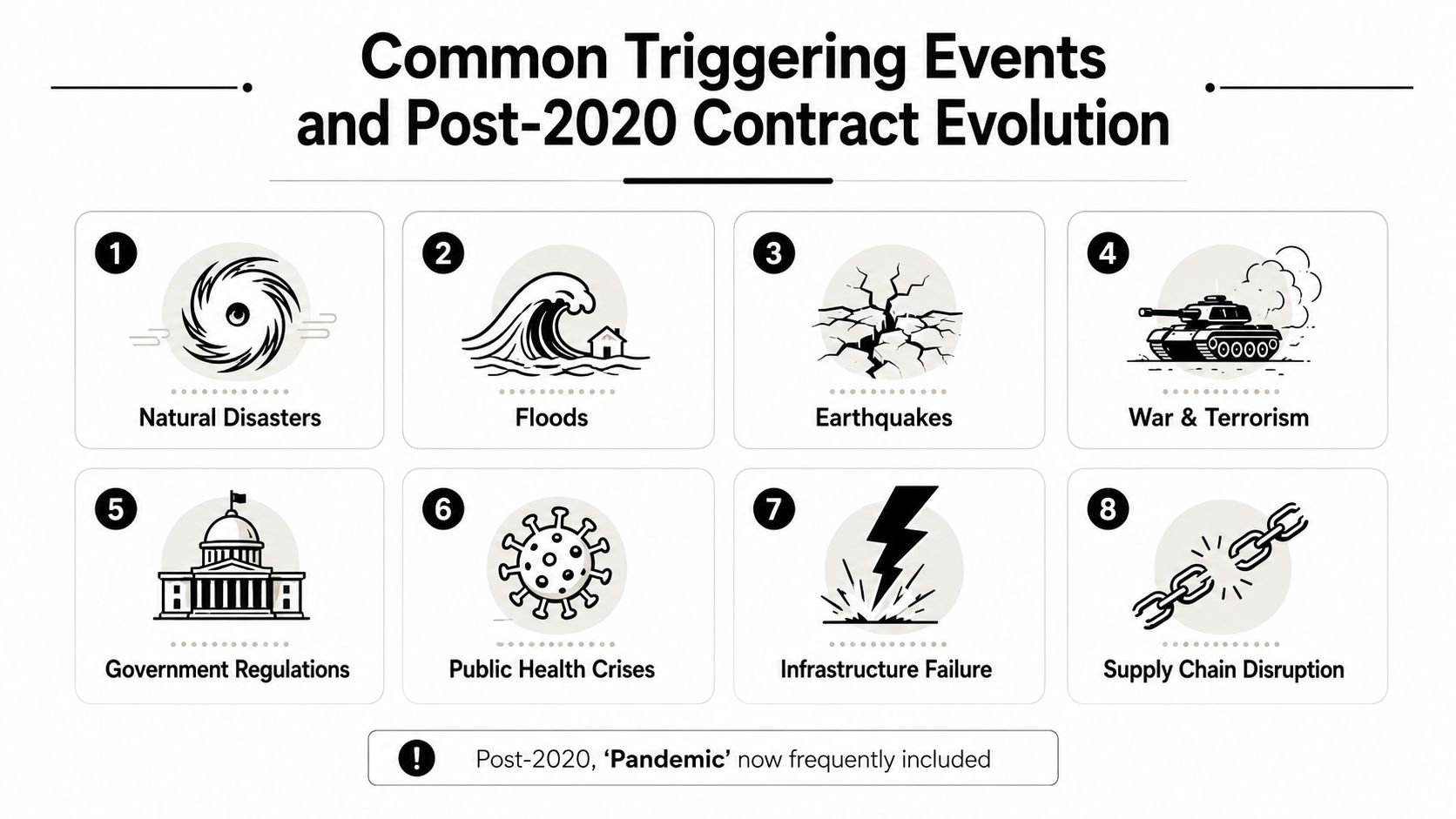
Most force majeure clauses still begin with the classic list, natural disasters, war, government action, public-health emergencies, and sometimes labor disputes or utility failures. Those categories are familiar because they're the kinds of events that can stop performance outright or make it practically impossible to perform on time.
The pandemic changed how parties drafted those lists. Legal commentary citing survey data showed that 85% of new contracts added “pandemic/epidemic” language, 78% added “government action,” 76% added “public health,” and 69% added “quarantine” language after 2020, which shows how quickly contract language adapted to real-world disruption. That shift is important for founders, because it proves the market now expects more specific drafting, not broad reliance on generic boilerplate. The ICC's force majeure materials reflect that same modern approach to drafting and event coverage, including the evolving treatment of public-health disruption.
What businesses usually include
Well-drafted clauses tend to name the events with enough detail that there's little room to argue later. Hurricanes, floods, earthquakes, war, terrorism, emergency orders, epidemics, labor strikes, and extended utility failures often belong in that list when they're relevant to the business model. A service company with cloud dependence may also need explicit language on cyber incidents or vendor outages, because those risks don't always fit neatly into older “Act of God” phrasing.
If your operations changed during COVID, you probably saw how hard it is to work from a generic clause that never anticipated a remote-work shutdown, a health restriction, or a vendor's unplanned outage. For practical small-business support during that period, browse small business support during the outbreak can help frame what kinds of business pressures companies faced.
What businesses often leave out
The biggest gap today is cyber and vendor language. A ransomware event, a cloud-service failure, a data-center outage, or a sudden AI vendor collapse may disrupt performance just as much as a storm, but many older contracts never mention those risks. When the clause is silent, parties end up arguing over whether a catchall phrase is broad enough, which is expensive and uncertain.
That uncertainty is avoidable. Businesses that rely on third-party tech should think hard about whether the contract needs to mention vendor failures, hosting outages, or cyberattacks specifically, instead of assuming a court will stretch a traditional clause to fit a modern problem.
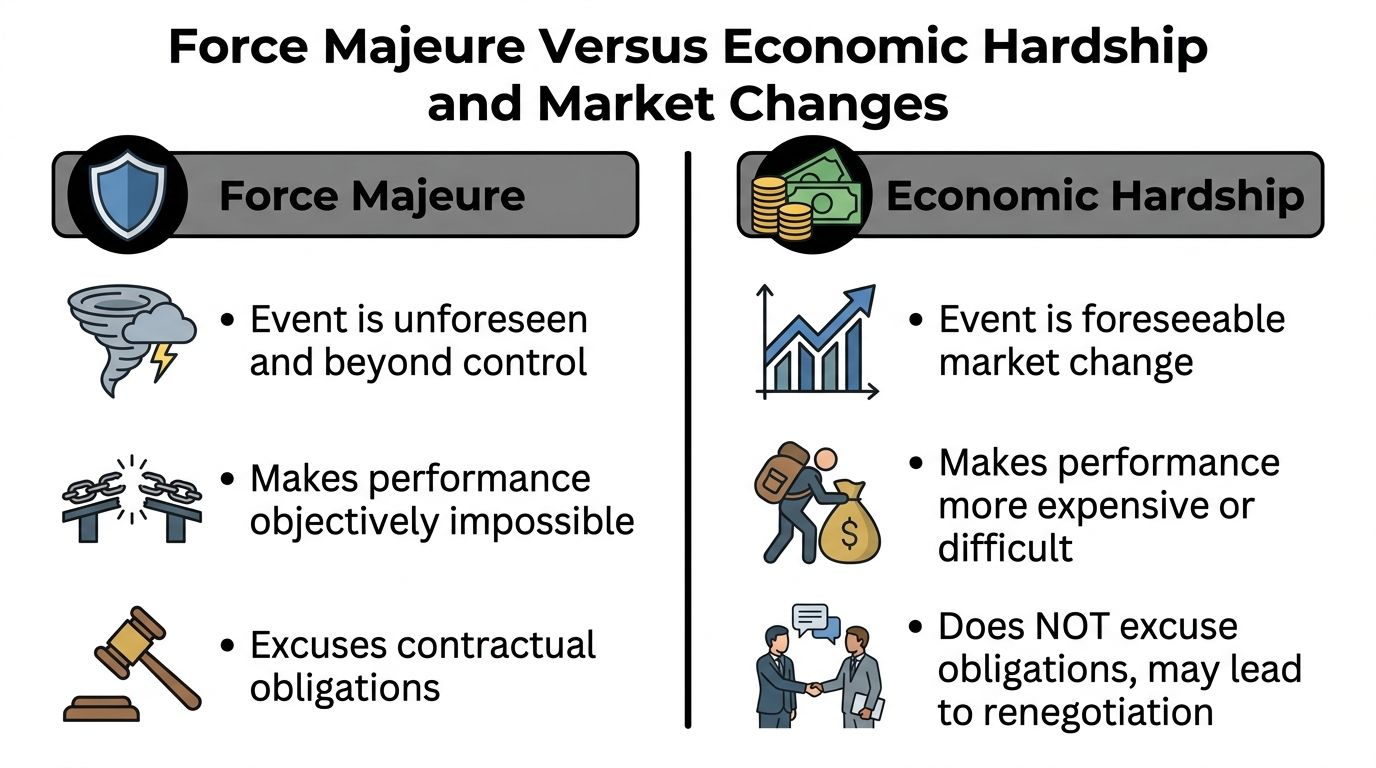
Force Majeure Versus Economic Hardship and Market Changes
The biggest mistake I see is a business treating force majeure like a general hardship clause. It isn't. If performance is still possible but just more expensive, more annoying, or less profitable, the clause usually won't help.
Force majeure addresses impossibility or impracticability. Hardship addresses a serious upset in the economic balance of the deal, which may justify renegotiation in some contracts, but not automatic excuse from performance. That distinction matters because inflation, tariffs, labor shortages, or supply-chain strain can make a deal painful without making it impossible.
What does not usually qualify
A company can't usually invoke force majeure just because its costs went up. If a supplier charges more, a shipment is delayed, or a market shift cuts into margins, that's often a business risk rather than a force majeure event. Courts are skeptical of claims built on poor pricing assumptions or reduced profitability, because the contract was still performable.
Drafting lesson: if the issue is economic pain, not actual inability to perform, you probably need a price-adjustment clause or a hardship renegotiation clause, not a force majeure clause.
The practical boundary is simple. If the event stopped performance, the clause may be in play. If the event merely made performance less attractive, more costly, or slower than planned, force majeure is usually the wrong tool. That's why the analysis should start with the operational effect, not with the business's frustration about the economics.
Better tools for market risk
For founders, alternative drafting becomes valuable. A well-written contract can include price-reset language, reopener provisions, or renegotiation rights for market disruptions. Those tools do not excuse performance the way force majeure can, but they can reduce conflict when the problem is commercial pressure rather than a true external shutdown.
This is also where contract review pays off. If your agreement doesn't separate operational impossibility from economic hardship, you may think you have protection when you really don't. That gap is one of the most common surprises in post-signing disputes.
Drafting Tips and Sample Clause Language for Florida Businesses
Good drafting starts with specificity. A force majeure clause should name the triggering events your business faces, not rely on vague language that sounds protective but does little in a dispute. For a Florida company, that often means naming hurricanes, flooding, emergency orders, power loss, and any third-party infrastructure your operation depends on.
A practical clause also needs to answer three questions, what triggers relief, what the relief is, and how long it lasts. Some agreements suspend performance only, while others allow termination after a prolonged event. If the contract doesn't say which remedy applies, the parties often end up arguing over what the clause was supposed to do in the first place.
Drafting points that matter
- Define events specifically: name the risks that matter to your business, especially weather, government action, cyber incidents, and vendor outages if they're realistic.
- Set a notice window: many businesses use short deadlines, often in the 7 to 30 day range, so the other side knows quickly that performance is at risk.
- Require mitigation: the affected party should have to take reasonable steps to reduce the impact and resume work when possible.
- State the remedy clearly: decide whether obligations are suspended, deadlines are extended, or the contract can be terminated after a defined period.
- Tie the clause to the deal: a SaaS agreement, manufacturing deal, and service contract won't need the same risk language.
For a separate overview of broader contract structure, how to write a business contract is a useful companion resource.
A clause that sounds broad but doesn't say who must do what is often the clause that fails under pressure.
Sample language to discuss with counsel
A starting point might read like this in concept, “A party is excused from performance if it is prevented or hindered by an extraordinary event beyond its reasonable control, including a hurricane, flood, fire, governmental action, or other specified disruption, provided it gives notice, mitigates the effect, and resumes performance as soon as reasonably practicable.”
That language is only a starting point, not a substitute for counsel. If cyber risk, cloud dependence, or vendor outages matter to your company, the clause should say so in plain English rather than hoping a court stretches generic wording to fit a modern failure.
For related business-risk context, business liability risks explained can help founders think more broadly about how contract language and operational risk connect. In practice, the right clause is the one that matches the way your business operates.
Notice Requirements and Mitigation Obligations
A valid force majeure event can still fail if the business misses the procedure. Most clauses require timely written notice, a description of the event, an explanation of how it affects performance, and proof that the affected party tried to reduce the disruption. If the contract makes notice a condition to relief, a late notice can weaken or even wipe out the claim.
The notice should be specific. It should identify the event, the start date, the impacted obligations, and the expected duration if that can be estimated accurately. Vague emails that say “we have issues” are usually too thin to support a serious dispute position.
What to document right away
- The triggering event itself with dates, vendor notices, weather alerts, shutdown orders, or outage confirmations.
- The contract duties affected, so the other side knows exactly what can't be done.
- The mitigation steps taken, such as alternate suppliers, temporary workarounds, remote arrangements, or rerouted deliveries.
- The ongoing status, because a one-time notice is often not enough if the disruption continues.
Mitigation is not optional window dressing. If the business can reasonably reduce the disruption and doesn't, the other side will argue that the company didn't really act like a party seeking contractual relief. The best paper trail is one that shows the business kept working, communicated early, and tried to preserve performance where possible.
Keep the tone professional and factual. The strongest notices avoid drama and focus on the contract language, the actual event, and the specific operational impact. If the matter turns into a dispute, that record often becomes the backbone of the defense.
How Force Majeure Differs from Impossibility and Frustration of Purpose
Force majeure is a contract clause the parties choose to include. Impossibility and frustration of purpose are legal doctrines courts may apply even when no clause exists, but they're narrow and fact-sensitive. That difference matters because many businesses assume they have a legal backstop when the contract is silent, and that assumption is often too optimistic.
Impossibility usually means performance has become objectively impossible, not just difficult or expensive. Frustration of purpose is different, it applies when an unforeseen event destroys the fundamental reason the contract was made, even if performance might still be technically possible. Those doctrines can help in limited situations, but they are not a substitute for a well-drafted clause.
Why the clause is usually stronger
A force majeure clause gives the parties a roadmap. It can define the events, the notice period, the mitigation duty, and the remedy, instead of leaving those issues to a judge's narrow doctrine analysis. That predictability is the key value for a business owner.
By contrast, relying on common-law defenses means arguing after the dispute has already started, with less control over the outcome. The contract clause is where you should allocate the risk before the storm, outage, or shutdown arrives.
Bottom line: if you need certainty, draft it into the agreement instead of hoping a court will fill the gap later.
That doesn't mean the doctrines are useless. It means they are fallback tools, not first-choice protections. For founders and small businesses, the smarter move is to negotiate the clause up front and treat the common-law doctrines as the emergency backup, not the primary plan.
Practical Steps When Facing a Force Majeure Event
Start with the contract, not with assumptions. Pull the agreement, find the force majeure language, and check the exact notice deadline, covered events, remedy provisions, and any requirement that the event be beyond control, unforeseeable, and unavoidable. If the event doesn't fit the clause, don't force the argument, because that can make the later dispute harder.
Then document the disruption carefully. Save vendor messages, outage alerts, weather notices, government orders, and internal emails showing how the event affected performance. If you can't show causation, mitigation, and timely notice, the clause may be much less useful than it looked on paper.
A practical response sequence
- Review the clause immediately: identify the triggering language and the business obligations at issue.
- Send written notice fast: do it in the format the contract requires, and make it specific.
- Keep working on mitigation: explore backup vendors, alternate routing, temporary staffing, or partial performance.
- Update the counterparty regularly: silence creates distrust and can complicate later arguments.
- Get counsel involved early: a lawyer can assess whether the event qualifies, whether the notice was enough, and whether termination or suspension makes sense.
Coto & Waddington, Attorneys at Law handles business contracts for founders and small companies, including clause review, drafting, and dispute response planning. That kind of contract support matters before a disruption hits, because once the event happens, the clock on notice and mitigation may already be running.
The right response is strategic, not emotional. A force majeure clause can protect your business, but only if the contract is drafted well, the notice is timely, and the facts fit the clause.
If your South Florida business relies on customer contracts, vendor agreements, or service commitments, Coto & Waddington, Attorneys at Law can review your force majeure language and help you tighten the parts that matter before a dispute starts. Visit Coto & Waddington, Attorneys at Law to discuss contract drafting, clause revisions, and practical risk protection for your company.