A Delaware corporation is a company governed by Title 8 of the Delaware Code, and Delaware's modern incorporation system made the state the legal home of more than 2.28 million business entities by 2025. It separates the company's state of legal incorporation from its physical place of business, which is why venture-backed founders often choose Delaware even when they operate from Florida or elsewhere.
A Miami founder can learn this distinction over coffee. You're building a SaaS product, hiring locally, and preparing for an angel conversation when the investor says, “Just incorporate in Delaware.” That advice may be sound, but it isn't complete. A Delaware corporation brings an investor-familiar governance structure, a mature body of corporate law, and access to specialized courts. It also brings a registered agent, annual filings, franchise tax exposure, and procedural discipline.
The right question isn't whether Delaware is famous. It's whether the company's expected financing, ownership structure, and operating footprint justify maintaining a corporation there while also complying in Florida.
Table of Contents
- What a Delaware Corporation Actually Is
- The Legal Framework Behind Delaware Dominance
- Benefits and Drawbacks for Startups and Small Businesses
- How to Form and Maintain a Delaware Corporation
- Franchise Taxes and Annual Compliance Requirements
- Delaware Corporation vs Florida Business Entities
- When to Choose Delaware and Your Next Steps
What a Delaware Corporation Actually Is
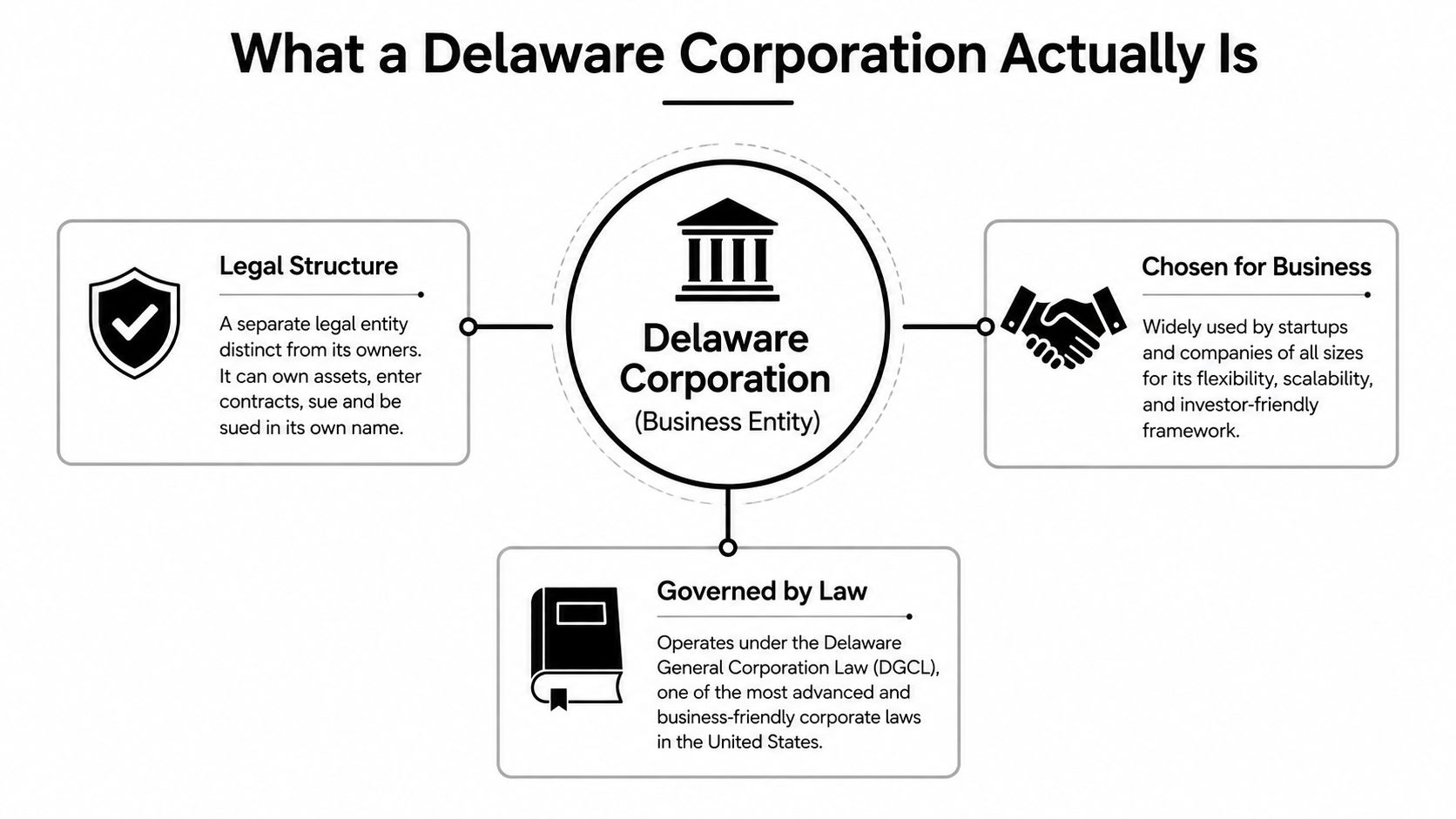
A Delaware corporation is a legal entity formed under Title 8 of the Delaware General Corporation Law, commonly called the DGCL. The company becomes a separate legal person when its certificate of incorporation is filed with the Delaware Division of Corporations. Delaware's statutory framework is codified in Title 8, Chapter 1 of the Delaware Code.
That filing creates a corporation governed by Delaware law, even if its founders live in Miami, its employees work remotely, and its customers are spread across the country. The company still may need to foreign-qualify in Florida and comply with Florida rules because it conducts business there. Incorporation and operation are related, but they're not the same legal event.
What Delaware law governs
The phrase Delaware corporation generally describes the law governing the company's internal affairs. That includes matters such as:
- Board authority: How directors approve major transactions and exercise corporate powers.
- Shareholder rights: How stockholders vote, inspect records, and challenge corporate action.
- Fiduciary duties: The standards that apply to directors and officers.
- Equity structure: How the company authorizes, issues, and transfers shares.
- Corporate disputes: How certain shareholder and governance claims are handled.
The company's registered agent provides a physical Delaware address for service of process, but that address usually isn't the company's operating headquarters. Delaware law requires every business entity to maintain a registered agent with a physical street address in the state, and the agent receives important notices, including the annual franchise tax notification. The Delaware Division of Corporations' formation guidance explains this registered-agent requirement.
Most venture-backed startups choose a Delaware C corporation, because corporations issue stock, support board governance, and accommodate preferred equity financings. A Delaware LLC is a different entity with membership interests and an operating agreement rather than corporate stock and bylaws. A Florida corporation is still a corporation, but its internal affairs are governed by Florida law instead of Delaware law.
Practical rule: Your office location doesn't determine whether you have a Delaware corporation. Your formation documents and governing jurisdiction do.
The Court of Chancery is another part of the Delaware ecosystem founders hear about. It handles many corporate and fiduciary disputes without juries, giving companies and investors a specialized forum for significant governance questions. That familiarity can help during financing, but it doesn't eliminate the need for careful documents or ongoing compliance.
The Legal Framework Behind Delaware Dominance
For a South Florida founder, Delaware can feel like an investor expectation before it feels like a legal necessity. Its appeal comes from an ecosystem: the General Corporation Law, specialized corporate courts, extensive precedent, and a structure familiar to investors, underwriters, directors, and counsel. Choosing Delaware often means adopting a shared legal vocabulary during financing and governance discussions.
Delaware reported that 68.2% of Fortune 500 companies were incorporated in Delaware in 2022, and that 79% of U.S.-based IPOs chose Delaware as their corporate home in 2022. Those figures appear in the state's 2022 Secretary of State reporting. For a startup, that concentration can reduce explanation during diligence because institutional investors already understand the entity structure and its standard documents.
Three pillars support the model
The DGCL gives corporations structural flexibility. Delaware law lets companies tailor governance documents to their ownership and financing arrangements while providing statutory rules for directors, officers, stockholders, and corporate action. That matters when a startup issues preferred stock, creates protective provisions, or adjusts board composition after a financing.
The Court of Chancery supplies specialized adjudication. Corporate disputes commonly involve fiduciary duties, mergers, stockholder demands, and conflicts between directors and investors. Written decisions give counsel a substantial body of precedent to analyze before a dispute reaches a hearing. Specialized jurisdiction improves predictability, although it cannot guarantee a favorable result or replace careful drafting.
The internal affairs doctrine connects the company to Delaware law. A corporation operating in Florida may still have its board decisions and shareholder rights governed by Delaware law. Internal governance follows the company's state of incorporation, while employees, customers, property, and revenue may remain elsewhere.
| Feature | Detail |
|---|---|
| Governing statute | Delaware's General Corporation Law is codified in Title 8, Chapter 1 of the Delaware Code. |
| Corporate adoption | Delaware reported more than 2.28 million business entities by 2025 in its own reporting. |
| Public-company concentration | Delaware reported 68.2% of Fortune 500 companies incorporated there in 2022. |
| IPO preference | Delaware recorded 79% of U.S.-based IPOs choosing the state as their corporate home in 2022. |
| Formation activity | Delaware reported 334,461 new entities in 2025, more than 15% above 2024. |
The 2025 reforms qualify the usual predictability argument. Delaware narrowed stockholder books-and-records access under Section 220, requiring demands to be made in good faith and tied to records specifically related to a proper purpose. The reforms also addressed forum-selection provisions, registered-agent issues, and other filing rules, mostly effective August 1, 2025, as discussed in Harvard Law School Forum commentary on Delaware's 2025 corporate-law reforms.
Delaware remains dominant, yet the legal advantage depends on precise documents and disciplined governance. The state's name does not cure weak board approvals, incomplete records, or careless compliance.
For a closer explanation of shareholder litigation claims, see this guide to derivative suits and corporate disputes.
Benefits and Drawbacks for Startups and Small Businesses
A Delaware corporation works best when the company expects complex equity financing, multiple investor classes, or a board-led governance structure. It works less well when the founder forms it only because someone repeated that “serious companies use Delaware.”
The strongest benefit is investor readiness. Venture capital firms and many angel investors are familiar with Delaware C corporations, standard financing documents, preferred stock, stock option plans, and board approvals. A familiar structure can reduce friction during diligence because counsel isn't translating an unusual entity format into the investor's preferred framework.
Delaware also supports flexible equity planning. A startup may need common stock for founders and employees, preferred stock for investors, protective provisions, and a board structure that changes as financing progresses. A corporation's stock-based framework generally handles that work more naturally than a small-business LLC.
Where the costs show up
The trade-off is operational. A South Florida founder may have to maintain the Delaware corporation, keep a Delaware registered agent, file the Delaware annual report, pay Delaware franchise tax, and separately foreign-qualify in Florida. The founder then has to preserve corporate records, maintain a stock ledger, document board action, and keep bylaws and ownership records current.
Some commercial formation providers quote registered-agent services in the $150 to $300 per year range, but that cost varies by provider and service package. The state's own rules establish the registered-agent obligation, not a universal private-service price.
The commonly repeated claim that every Delaware startup costs more than $1,000 annually in compliance expenses isn't a safe universal rule. Actual costs depend on the franchise-tax calculation, Florida obligations, registered-agent pricing, accounting support, legal work, and whether the company has investors or employees. A bootstrapped local business may receive little value from paying for a corporate structure designed around venture financing.

What tends to work
- Investor alignment: Use a Delaware C corporation when institutional investors have made the structure a financing condition.
- Equity planning: Choose corporate stock when the capitalization table will include preferred shares, employee options, or several financing rounds.
- Governance discipline: Treat board consents, stock issuances, and intellectual-property assignments as core company records, not administrative leftovers.
- Cost control: Avoid authorizing an equity structure without understanding how it affects franchise tax.
The practical trade-off is simple: Delaware can reduce financing friction, but a Florida LLC can reduce day-to-day administration for a company that doesn't need outside equity.
For a services firm, family business, real estate venture, or locally focused company, the LLC may provide liability protection and management flexibility without imposing corporate formalities that don't support the business plan. For a technology startup pursuing institutional capital, the simplicity of an LLC can disappear the moment an investor requires conversion into a Delaware corporation.
How to Form and Maintain a Delaware Corporation
Formation is a sequence of legal and operational decisions, not merely an online payment. The first filing is the certificate of incorporation, submitted to the Delaware Division of Corporations. It establishes the corporation's name, authorized stock, registered office information, and other required provisions.
The filing should match the financing plan. Founders often discuss authorized shares, par value, protective provisions, director rights, and indemnification language before filing. Those choices can affect later equity issuances, tax calculations, and investor diligence.
The formation sequence
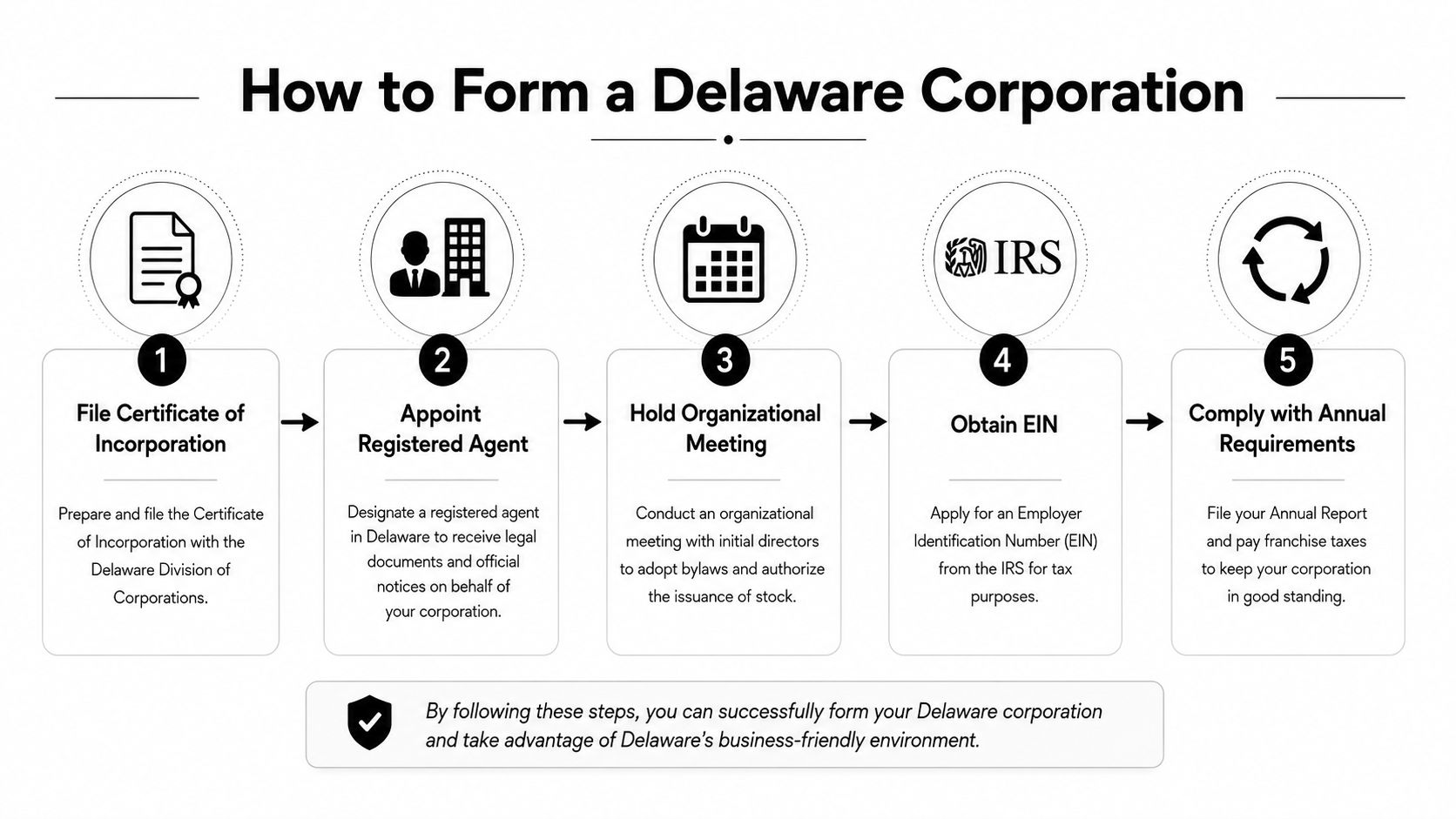
- Prepare and file the certificate. Confirm the corporate name, authorized stock, registered agent, and governing provisions. The Delaware Code requires the certificate to be filed with the Division of Corporations and the company to maintain a registered office in the state.
- Appoint the registered agent. The agent must maintain a physical Delaware street address and accept service of process and state notices. The state explains the registered-agent obligation in its corporate formation instructions.
- Hold the organizational meeting. After filing, the incorporator or initial board adopts bylaws, elects directors or officers, and completes initial organizational acts. Delaware requires at least 2 days' written or electronic notice to each incorporator or director, stating the meeting's time, place, and purpose, under the Delaware corporate statute.
- Authorize the company's operations. The board should approve bank authority, equity issuances, compensation arrangements, intellectual-property assignments, and other foundational actions.
- Complete federal and state registrations. Obtain an EIN, establish accounting records, and determine whether the company must foreign-qualify in Florida or another operating state.
The post-filing work matters more
Founders should sign stock purchase agreements, document vesting arrangements where appropriate, assign company-related intellectual property to the corporation, and maintain a reliable capitalization table. An 83(b) election, when applicable, has a strict filing deadline, so founders should obtain tax advice promptly rather than assume the election can be fixed later.
The corporation also needs bylaws, a stock ledger, board minutes or written consents, and clear approval records. Formation happens once. Maintenance continues for as long as the corporation exists.
Founders who want a fuller filing checklist can review this guide on how to incorporate in Delaware, then have counsel tailor the documents to the company's investors, founders, and ownership plan.
Franchise Taxes and Annual Compliance Requirements
Delaware's franchise tax is not calculated solely from revenue or profit. The amount depends on the corporation's capitalization method, which means the company's authorized and issued equity structure deserves attention before filing.
The state recognizes two principal calculation methods. Under the Authorized Shares Method, the current minimum annual franchise tax is $175. Under the Assumed Par Value Capital Method, the current minimum is $400. The maximum tax is $200,000 for most corporations and $250,000 for large corporate filers, according to the Delaware Division of Corporations' tax guidance.
| Factor | Authorized Shares Method | Assumed Par Value Capital Method |
|---|---|---|
| Minimum annual tax | $175 | $400 |
| Primary driver | Authorized share count | Assumed par value capital |
| Planning concern | A high authorized-share count can increase exposure | The calculation considers the company's asset and share structure |
| Maximum tax | Generally $200,000 for most corporations | Generally $200,000 for most corporations |
| Best practice | Model the share authorization before filing | Compare the method against the company's capitalization and assets |
A founder shouldn't rely on a generic internet example to predict the bill. The result depends on the company's specific capitalization, and Delaware's online filing process calculates the tax using information reported by the corporation.
Every domestic Delaware corporation must file its annual franchise tax report and pay the tax by March 1. The report includes registered-office and registered-agent information plus other details needed to compute the amount due. Missing the deadline triggers a $200 penalty plus 1.5% monthly interest on the tax and penalty, under the Delaware Code.
The state also sends annual franchise-tax notification to the registered agent. That makes mail handling and compliance tracking practical concerns, not merely service-provider conveniences. A company active in Delaware's records can incur liability even when its operational activity is limited.
Founders managing several filings may benefit from practical resources on proven ways to cut red tape, especially when building a calendar for recurring corporate, tax, and licensing obligations. Delaware obligations also sit beside Florida foreign-qualification and annual-report requirements, so one state's filing calendar doesn't replace the other.
Delaware Corporation vs Florida Business Entities
For a South Florida founder, the meaningful comparison isn't Delaware versus “nothing.” It's usually a Delaware C corporation versus a Florida LLC or Florida corporation, with the choice driven by financing plans, tax treatment, governance, and administrative tolerance.
A Florida LLC often fits a bootstrapped company, professional practice, family-owned business, or real estate venture. Its operating agreement can provide management and economic flexibility, and pass-through tax treatment may avoid the entity-level taxation associated with a C corporation. The tax outcome depends on elections and the owners' circumstances, so a CPA should review the structure before formation.
A Florida corporation can provide a corporate stock and board framework without adding a separate state of incorporation. It may suit a company that wants corporate governance but expects to raise capital from owners who don't require Delaware. A Delaware C corporation is more natural when institutional investors, preferred stock, option grants, and national financing are part of the plan.
| Factor | Delaware C-Corp | Florida LLC | Florida Corporation |
|---|---|---|---|
| Investor readiness | Familiar to venture investors and institutional counsel | May require conversion before institutional financing | Corporate form, but some investors may still request Delaware |
| Tax treatment | Can involve entity-level and shareholder-level taxation | Often supports pass-through treatment, subject to tax elections | Depends on tax classification and elections |
| Governance | Board, bylaws, stock, and formal corporate approvals | Flexible management under an operating agreement | Board, bylaws, and corporate stock |
| Operating footprint | Often requires Florida foreign qualification when operating there | Organized in the operating state | Organized in Florida |
| Best fit | Venture-backed technology and scalable startups | Bootstrapped and closely held businesses | Florida businesses needing a corporate structure |
Florida has no state income tax, but that doesn't eliminate federal tax analysis, employment obligations, sales-tax issues, or entity-level filing requirements. A Delaware company operating from Miami may need to maintain compliance in both states, while a Florida entity can avoid the extra incorporation jurisdiction.
Insurance belongs in the same launch checklist as entity selection. A founder using vehicles for the business should separately review Florida LLC commercial vehicle insurance rather than assume that the entity itself answers coverage questions.
Choose the structure for the next financing or operating reality, not for a slogan about what “serious” companies do.
Delaware's incorporation advantages are strongest when investors, counsel, and a planned capital structure will use them. A Florida LLC is often more efficient when the owner expects to operate locally, retain control, and fund the business through revenue.
When to Choose Delaware and Your Next Steps
A South Florida founder can make the decision by looking at the company's likely path, not its aspiration alone.
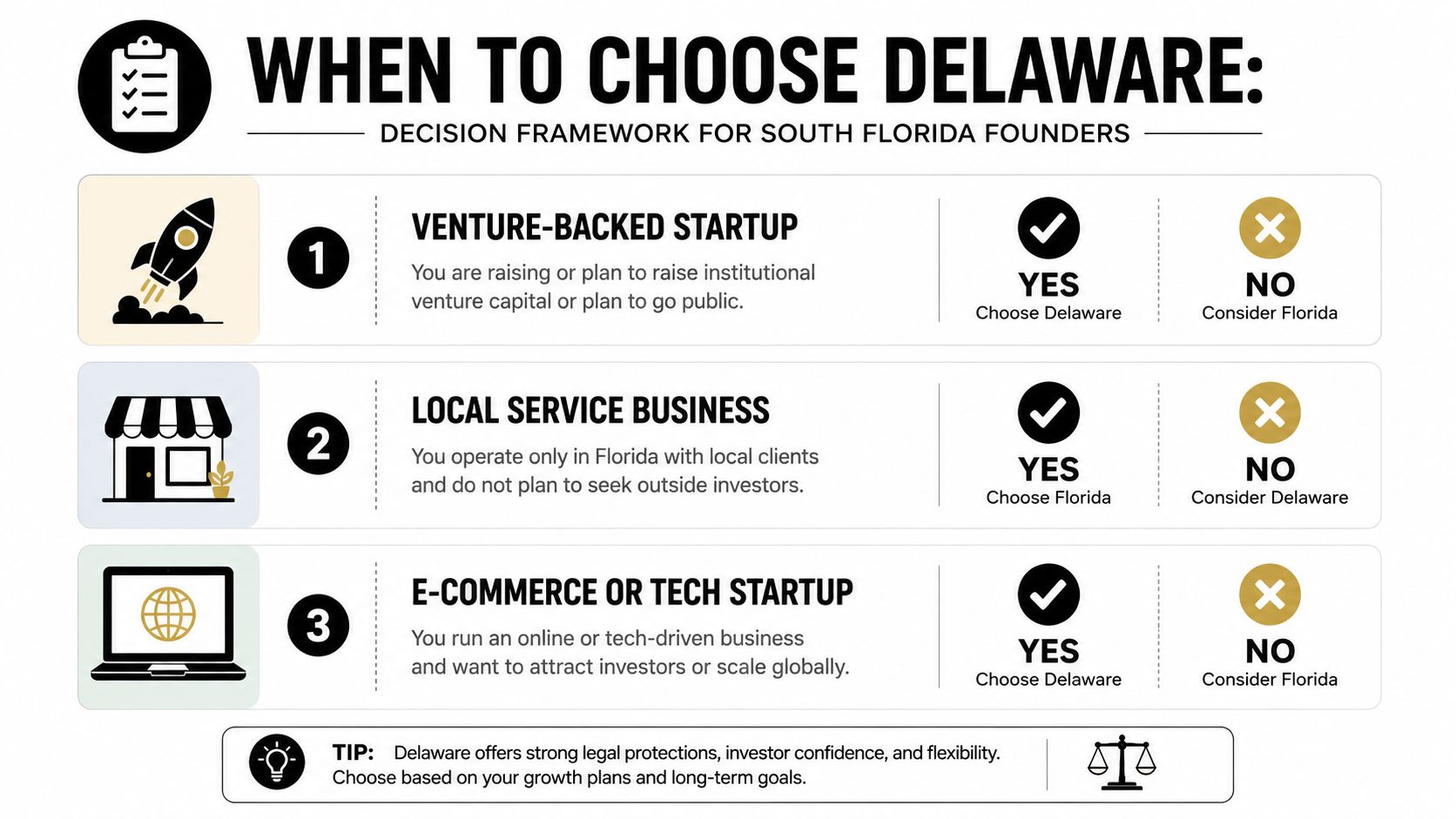
Choose a Delaware C corporation when the company expects institutional financing within the near term, needs preferred stock, plans to grant equity broadly, or expects investors to require Delaware before funding. Delaware's corporate ecosystem is particularly useful when several parties will negotiate board rights, protective provisions, liquidation preferences, and future financing terms.
Stay with a Florida LLC or Florida corporation when the business is local, bootstrapped, family-owned, service-based, or unlikely to seek institutional investment. The simpler structure may preserve time and reduce the need to manage two state compliance regimes.
Consider a later conversion when the founder is still validating the business and doesn't yet know whether outside capital will arrive. A Florida LLC may later convert or merge into a Delaware corporation, but the legal, tax, ownership, and contract consequences should be reviewed before choosing that route.
A practical launch checklist
- Confirm the funding path: Ask whether investors will require a Delaware C corporation before issuing a term sheet.
- Check the name: Search and reserve the intended corporate name through the Delaware Division of Corporations.
- Select the registered agent: Use an agent that reliably handles service of process and tax notices.
- Draft the certificate carefully: Coordinate authorized stock, protective provisions, indemnification, and financing expectations.
- Adopt governance documents: Hold the organizational meeting, approve bylaws, appoint officers, and authorize company accounts.
- Document founder ownership: Issue founder stock with appropriate purchase and vesting documents, update the stock ledger, and address intellectual-property assignments.
- Review tax elections: Discuss any applicable 83(b) election with tax counsel and observe the filing deadline.
- Foreign-qualify in Florida: Register the Delaware corporation before conducting business that requires Florida qualification.
- Build the compliance calendar: Track the Delaware annual report, franchise tax, registered-agent renewal, Florida filings, and corporate approvals.
The Delaware choice can be smart, but it isn't automatically smart. Before filing, have a startup attorney and tax professional review the capitalization plan, investor expectations, Florida operations, and projected compliance costs. Correcting a poorly designed structure after equity has been issued is usually harder than designing it properly at the start.
Coto & Waddington, Attorneys at Law helps South Florida founders form and maintain Florida and Delaware businesses, including certificates, bylaws, capitalization, contracts, and ongoing corporate compliance. Visit Coto & Waddington, Attorneys at Law to discuss the right entity and filing plan for your company.