An executor is the person named in a will who manages the entire estate from death through final distribution, collecting assets, paying debts and taxes, and closing the estate in probate court. In a typical case, the work can take roughly 570 hours over an average of 16 months.
The call often comes suddenly. A Miami adult child answers the phone on a Tuesday and learns that their father named them executor. They may have expected to sign a few forms and hand out property. Instead, they're responsible for protecting assets, dealing with creditors, meeting court deadlines, communicating with beneficiaries, and proving that every major decision served the estate.
Florida uses a different title for the same job: personal representative. The will may nominate you, but the nomination alone doesn't give you authority to act. The probate court must appoint you and issue the documents that authorize estate administration.
That distinction matters from the first day. The following guide explains what an executor does, what the role looks like in Florida, which tasks create the most risk, and when paying for legal help is a sensible business decision rather than an unnecessary expense.
Table of Contents
- What an Executor Actually Is
- The Full Scope of the Executor Role
- Step-by-Step Duties From the Will to Final Distribution
- Deadlines, Tax Filings, and the Calendar That Runs the Estate
- Executor Compensation, Liability, and When You Can Be Removed
- Florida Probate Notes Every Personal Representative Should Know
- Alternatives That Can Skip or Simplify the Executor Role
- A Practical 30-Day Checklist and Common Questions
What an Executor Actually Is
An executor is the person named in a will who is legally responsible for administering the deceased person's estate. The job includes locating and safeguarding property, identifying debts and taxes, handling required court proceedings, and transferring the remaining assets to beneficiaries. Government guidance describes the executor's responsibility as continuing through the administration period, while Queensland's official guidance lists duties such as obtaining probate, notifying beneficiaries, protecting assets, preparing tax returns, selling or transferring property, and distributing the estate. UK government guidance on estate administration provides a useful general description of the role.
Florida generally calls this person a personal representative. The court appoints the personal representative before the person can exercise the legal powers associated with the estate. Until that appointment occurs, reading the will doesn't automatically authorize you to sell property, close accounts, or distribute belongings.
What the role does not mean
Being named in a will doesn't make you a beneficiary. It doesn't make you a co-owner of the decedent's house, bank accounts, business interests, or vehicles. It also doesn't allow you to treat estate property as your own while the probate case remains open.
You're a fiduciary. That means you must act for the benefit of the estate and its interested parties, keep property separate, maintain records, and follow the will and applicable Florida procedure. A personal representative can also be a beneficiary, but those roles remain legally distinct.
If there is no valid will, the court appoints an administrator under Florida's intestacy rules. That person performs the administrative function, but the distribution follows state law rather than instructions in a will. A trustee is different again. A trustee manages property held in a trust, often outside probate, while an executor or personal representative handles the probate estate.
Practical rule: Don't sell, distribute, retitle, or transfer significant property simply because the family agrees. Confirm your authority and the correct probate procedure first.
The terminology varies across states, so readers comparing procedures may find this overview of Arizona personal representative duties helpful. Florida families should also review what to include in a will before assuming a document answers every ownership and beneficiary question.
The Full Scope of the Executor Role
Serving as executor is a 16-month project-management job, not a ceremonial appointment. The work converts an estate from a list of property and obligations into a final distribution. You identify, secure, and value what the decedent owned, resolve debts and taxes, sell assets when needed, and distribute only what remains. The sequence matters. Distributing property before locating an unpaid creditor or tax obligation can leave the estate unable to pay.
A 2026 report citing estate-administration software data estimates that settling a typical estate takes roughly 570 hours over an average of 16 months. The report's executor workload discussion shows why the role involves records, claims, tax filings, valuations, sales, communications, and court submissions. Families should treat it like a managed case with deadlines, documentation, and defined decision points.
The work behind the title
The working file commonly includes:
- Banking: Open a separate estate account and route estate income and expenses through it.
- Property protection: Secure homes, vehicles, valuables, business premises, and digital accounts.
- Ownership changes: Retitle vehicles and other assets when probate procedure requires it.
- Service management: Cancel or redirect utilities, subscriptions, insurance, and recurring payments.
- Government notifications: Contact Social Security, pension administrators, insurers, and other institutions.
- Creditor response: Review claims, separate valid obligations from disputed demands, and preserve supporting records.
- Accounting: Record receipts, payments, sales, reimbursements, and distributions in a dated ledger.
The personal representative owes fiduciary duties throughout the administration. You must act impartially, avoid self-dealing, protect estate value, and document decisions clearly enough to answer beneficiaries or the court.
Use a dedicated estate account, written beneficiary communications, and a calendar assigning each filing to a specific person. Do not pay estate bills from a personal account, mix estate and personal property, rely on memory, or make informal distributions under family pressure. Do not sell, distribute, retitle, or transfer significant property just because the family agrees. Confirm your authority and the correct probate procedure first.
If a dispute, unusual asset, tax issue, or potential conflict appears, stop and call a probate lawyer before acting. The fee can prevent a larger correction later.
Beneficiaries do not need a perfect executor. They need an accountable one with a defensible paper trail.
Step-by-Step Duties From the Will to Final Distribution
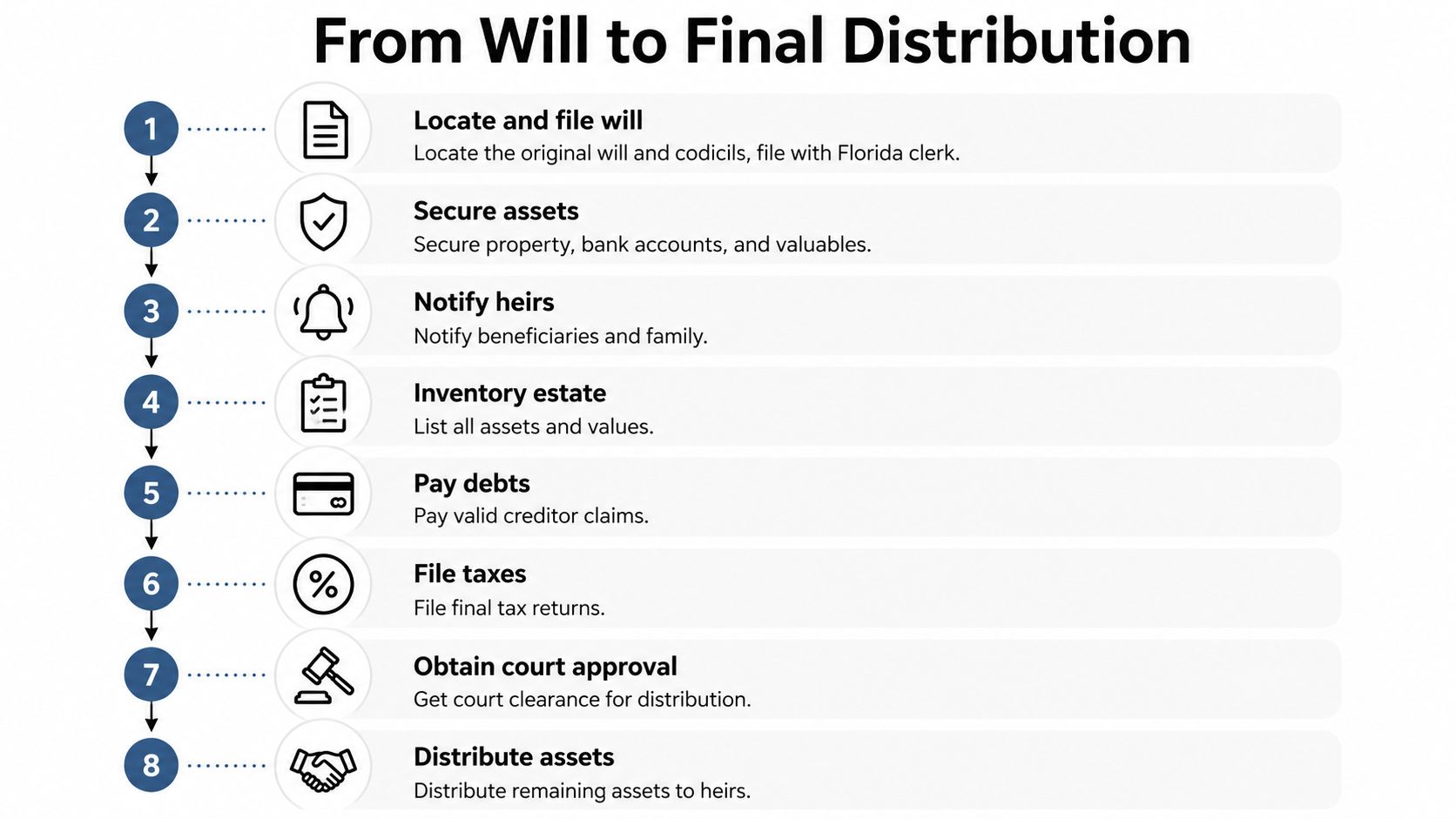
An estate moves through connected milestones. Each step creates information or authority needed for the next one, so skipping ahead can create expensive corrections.
1. Locate and file the will
Find the original will, codicils, trust documents, deeds, account statements, insurance records, business documents, and tax information. File the original will with the appropriate Florida clerk and begin the petition process. A copy may help locate information, but the original document can be critical to establishing the testator's instructions.
2. Secure property immediately
Change locks when appropriate, protect vacant property, preserve vehicles, safeguard jewelry and collectibles, and prevent unauthorized access to digital accounts. Photograph valuable property and record its condition. Insurance coverage can change after death, so confirm that the home and other assets remain protected.
3. Obtain formal authority
Petition the probate court for appointment. Once appointed, the personal representative receives Letters of Administration, which establish authority to communicate with financial institutions, manage estate property, and carry out the administration. The appointment is the legal gateway to the work.
4. Notify interested people
Notify beneficiaries, heirs, and known creditors as Florida procedure requires. Keep proof of notices, returned mail, publication, and responses. Missing an interested person can delay administration and create a dispute that could have been avoided with better tracing and documentation.
5. Build and value the inventory
List probate assets and obtain appropriate valuations. Real estate, privately held businesses, investment accounts, valuable personal property, and unusual assets may require appraisers, brokers, accountants, or other specialists. The inventory is not a guess. It becomes the foundation for creditor decisions, tax work, accounting, and distribution.
6. Resolve debts and tax obligations
Use estate funds to pay valid debts and expenses in the required order. Prepare the decedent's final income tax return, generally Form 1040, and determine whether an estate tax return, Form 706, is applicable. Review creditor claims during the applicable Florida creditor period rather than paying the first demand that arrives.
7. Distribute according to the will
After liabilities, taxes, expenses, and claim issues are addressed, transfer specific gifts and the residue as directed. Confirm that the estate can meet remaining obligations before distributing. A written receipt or beneficiary acknowledgment helps establish what was delivered and when.
8. Account and close the case
Prepare the final accounting, address objections, and petition for discharge. The court's closing process formally ends the personal representative's administration. A clear explanation of every receipt, expense, sale, reimbursement, and distribution makes this stage substantially easier.
For a Florida-focused overview of the court workflow, review the probate process in Florida.

Deadlines, Tax Filings, and the Calendar That Runs the Estate
The calendar controls the administration more than the will does. The will states the desired result, but court rules, creditor procedures, tax obligations, and filing deadlines determine whether you can reach that result safely.
Several U.S. probate systems require an inventory within roughly three months after appointment or qualification. Virginia uses a four-month inventory deadline, Ohio uses three months, and some Texas materials refer to a verified inventory due within 90 days. A probate deadlines overview from Dossey illustrates how sharply these rules vary by jurisdiction. Florida deadlines must be checked against the specific administration and current court requirements rather than borrowed from another state.
Build one master calendar
A practical calendar should list:
- Appointment date: The date authority begins and the date used to calculate later obligations.
- Inventory deadline: The date by which assets and values must be identified and reported.
- Creditor notices: The dates for known-creditor communications and applicable claim periods.
- Tax dates: The decedent's final income tax return, estate income tax filings, and any applicable federal estate tax filing.
- Accounting dates: The expected time for interim or final accountings and objections.
- Distribution conditions: The point at which debts, taxes, claims, and court requirements are sufficiently resolved.
The most common mistake is treating distributions as a family-relations issue instead of a solvency issue. A beneficiary may be eager to receive a house, vehicle, or account, but the personal representative must first know whether the estate needs that asset or its sale proceeds to satisfy creditors and taxes.
Late creditor issues can leave the estate exposed. A missed tax filing can trigger penalties and interest. A premature distribution can force beneficiaries to return property or require the personal representative to cover a shortfall.
Calendar discipline beats memory. Put every deadline, responsible professional, document request, and follow-up call in one system.
The Texas estate-executor guidance also emphasizes that administration can involve appraisal, creditor work, tax returns, accountings, and closure rather than a short checklist. The general lesson applies in Florida, even though the governing rules differ.
Executor Compensation, Liability, and When You Can Be Removed
Serving as a personal representative creates a trade-off. Florida law provides for a reasonable fee, and practitioners often discuss a fee structure that may be interpreted as roughly 3% of the estate for the personal representative, plus 2% of inventory value, depending on the circumstances. The applicable fee can change with estate complexity, extraordinary services, disputes, sales, litigation, and the governing agreement or court review.
Compensation is not a license to take shortcuts. The personal representative may face exposure for failing to protect assets, paying the wrong creditor, distributing too soon, ignoring a tax obligation, or favoring one beneficiary. Beneficiaries and creditors can challenge conduct, seek an accounting, request removal, or pursue recovery for harm caused by a breach.
Simple versus complex administration
| Factor | Simple Estate | Complex Estate |
|---|---|---|
| Compensation | A reasonable statutory fee may reflect routine collection, payment, and distribution work. | Extraordinary services, disputes, business interests, sales, or litigation may support additional compensation subject to applicable review. |
| Liability risk | Lower when assets are liquid, beneficiaries agree, and obligations are easy to verify. | Higher when valuation, creditor, tax, ownership, or beneficiary issues are contested. |
| Records | Bank statements, receipts, notices, and a final ledger may provide a manageable record. | Appraisals, contracts, sale files, tax workpapers, correspondence, and detailed accountings become essential. |
| Bonding | A waiver may simplify the appointment if the will and court rules permit it. | Bond requirements and court protections deserve early review, especially for non-spouse nominees. |
In Florida, a non-spouse executor may need to post a bond unless the will waives that requirement or another applicable rule changes the result. The court can remove a personal representative for mismanagement, conflicts of interest, or failure to perform required duties.
Declining the role may be sensible if you live far away, have no time, face family hostility, lack financial records, or expect the estate to involve litigation. Renouncing at the outset is usually cleaner than accepting, mishandling the administration, and attempting to resign after problems develop.
Florida Probate Notes Every Personal Representative Should Know
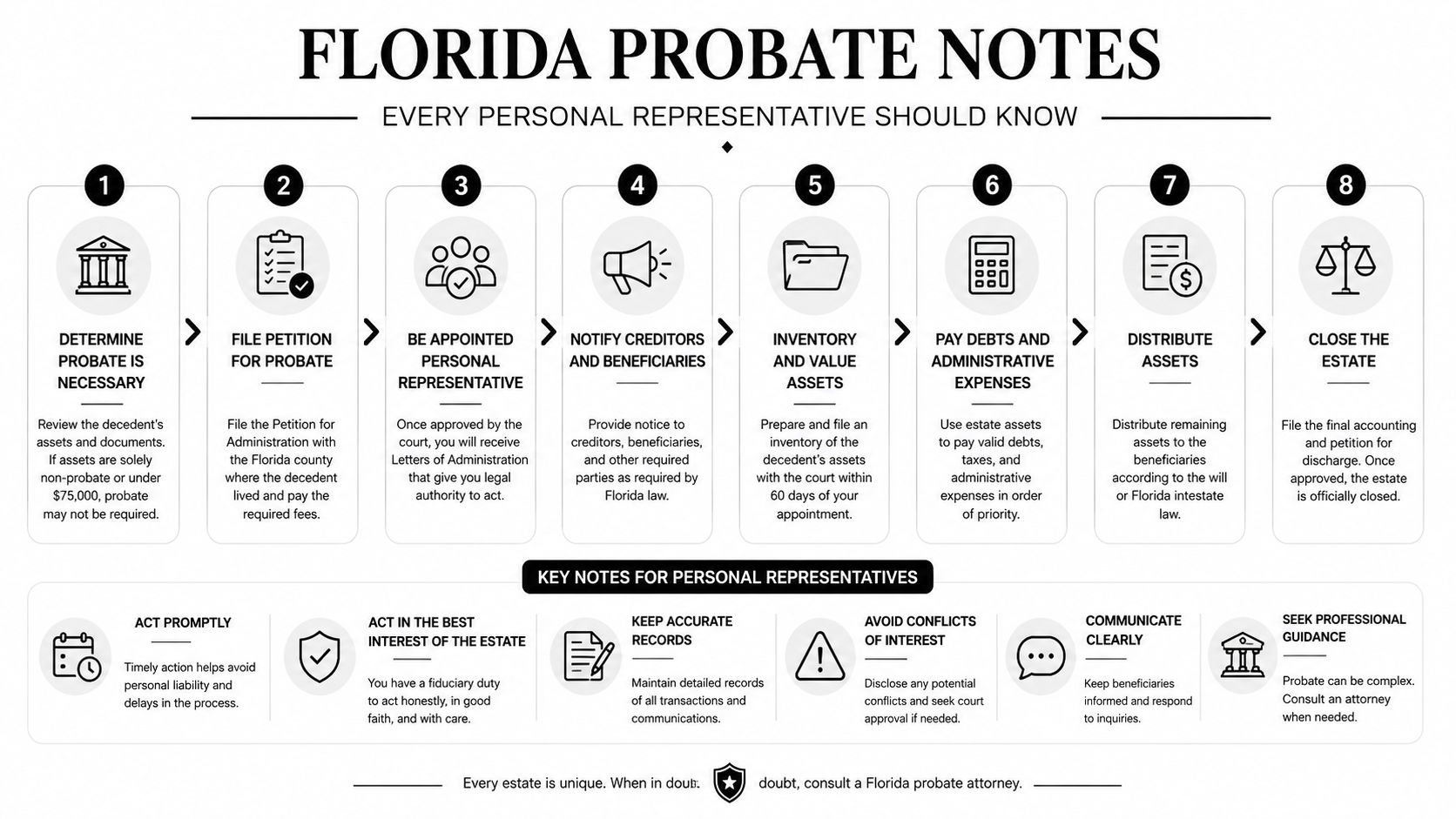
Florida's probate route depends heavily on estate size, ownership, family circumstances, and the presence of disputes. Summary administration may be available for estates under $75,000, or for estates under $50,000 when the decedent has been dead more than two years. Above the applicable threshold, formal administration is generally the expected route, although the facts control.
Summary administration can reduce court involvement, but it doesn't eliminate the need to identify assets, address creditors, verify beneficiaries, and distribute correctly. Formal administration creates a more structured process, including appointment, inventory, notices, creditor administration, accounting, and discharge.
Florida issues that change the analysis
Homestead requires special attention. Florida's constitutional homestead protections can affect who receives the residence and how it passes, even when the property appears in the probate inventory or the will. Never assume that a will controls the home without reviewing title, family status, and applicable homestead rules.
The elective share can protect a surviving spouse against an attempted disinheritance. Florida also recognizes protections involving a pretermitted spouse or child in appropriate circumstances. These rules can override what a family member thinks the will says, so a proposed distribution should be reviewed before property changes hands.
Beneficiary designations deserve early investigation. Life insurance, retirement accounts, payable-on-death arrangements, and transfer-on-death structures may pass outside the probate estate, but outdated forms can produce a result that conflicts with family expectations. Informal discovery at the start should include account statements, policy records, online portals, and employer benefits information.
A Florida personal representative is the same functional role many states call an executor or administrator. If the decedent owned real property in another state, the family may also need ancillary probate there. That second proceeding can add another court, another set of filings, and another professional team.
Properly managed formal administration commonly takes 12 to 18 months, although disputes, tax matters, litigation, and difficult asset sales can extend the process. Use the timeline as a planning range, not a promise.
Alternatives That Can Skip or Simplify the Executor Role
The best way to reduce executor work is often to change how assets are owned before death. A properly funded revocable living trust can move trust assets outside the traditional probate process, but the trustee still has administrative duties. The shortcut works only for assets transferred to the trust.
Beneficiary designations can also bypass probate for life insurance, IRAs, and transfer-on-death or payable-on-death accounts. They're efficient, but the forms control. An outdated designation may send an account to an unintended person or create tax and family complications.
Florida's small-estate procedures can simplify administration. Summary administration may apply under the thresholds discussed above, and disposition without administration may be available for smaller cases in limited circumstances. These options trim court work, but they don't excuse careful asset tracing or lawful payment of obligations.
A bank, trust company, or other professional fiduciary can serve when no family member is willing, available, or neutral. Professional administration costs money, yet it may provide continuity and reduce family conflict.
| Alternative | How It Sidesteps the Executor Role | Best Fit | Key Tradeoff |
|---|---|---|---|
| Revocable living trust | A successor trustee manages funded trust assets without traditional probate administration. | Families with multiple assets or privacy and continuity concerns. | Requires funding, maintenance, and careful coordination. |
| Beneficiary designations | The named beneficiary receives qualifying accounts or policies outside the will. | Retirement accounts, insurance, and designated financial accounts. | Forms must remain current and may conflict with the estate plan. |
| Small-estate procedure | A simplified court route reduces formal administration steps. | Estates that meet Florida's statutory requirements. | Eligibility and creditor issues still require careful review. |
| Corporate fiduciary | A professional institution performs the administration instead of a family member. | Complex estates or families with conflict or no suitable nominee. | Fees continue in exchange for professional continuity. |
Families evaluating these structures can compare the planning options described in how to avoid probate in Florida. The right structure can reduce a 16-month project substantially for the right estate, but no structure eliminates responsibility altogether.
A Practical 30-Day Checklist and Common Questions
The first month should create control, not premature distributions. Use this starter list:
- Secure the original will: Locate the will, codicils, trust documents, deeds, account records, and business files.
- Protect property: Change locks when needed, confirm insurance, preserve vehicles, and restrict access to valuables and digital accounts.
- Notify the family: Identify beneficiaries and heirs, and keep written records of communications.
- Order death certificates: Obtain multiple certified copies for banks, insurers, government agencies, and property transfers.
- Open estate banking: Keep estate receipts and expenses separate from personal money.
- Start the inventory: List real estate, accounts, vehicles, business interests, personal property, and known debts.
- File for probate: Have the Florida probate petition prepared and filed with the appropriate clerk.
- Create the calendar: Record appointment dates, inventory requirements, creditor notices, tax filings, accountings, and distribution conditions.
Questions families ask first
How is compensation calculated and taxed? Florida compensation generally depends on reasonable statutory fees, the estate's circumstances, and any extraordinary work. Treat executor compensation as a documented estate transaction and ask an accountant how it should be reported for tax purposes.
What does personal liability look like? You're not automatically personally responsible for the decedent's debts, but you can face financial exposure if your own breach harms the estate, beneficiaries, or creditors. The strongest protection is disciplined records, timely filings, impartial decisions, and advice before major transactions.
Can I resign after accepting? Usually, resignation requires a court filing and appointment of a successor. Leaving mid-case doesn't erase work already performed or resolve mistakes, so consult counsel before taking the position or before asking to step down.
If you're administering an estate in South Florida, schedule a consultation before deadlines begin compounding and before anyone receives a distribution that may need to be undone.
Coto & Waddington, Attorneys at Law advises South Florida families and personal representatives on probate administration, court filings, creditor claims, fiduciary obligations, tax-related coordination, and estate closure. Visit Coto & Waddington, Attorneys at Law to discuss the estate, organize the first filings, and determine which decisions should wait for formal legal guidance.