You've picked a business name, bought the domain, hired a designer for the logo, and maybe even printed packaging or signage. Then the trademark question shows up. Is this something you need now, or can it wait until the business is bigger?
That's a common fork in the road for founders in Miami, Fort Lauderdale, and across South Florida. A trademark application can feel like legal paperwork you'll “get to later.” In practice, it's often the opposite. If the name matters, the brand matters. If the brand matters, protecting it early can save a lot of expense and chaos later.
The core issue isn't whether trademark registration has benefits. It does. The better question is which level of protection fits your business today, what risk you're carrying, and when federal registration shifts from optional to necessary.
Table of Contents
- Is a Trademark Worth It for Your New Business
- Common Law State and Federal Trademark Rights
- Your Core Legal Shield Nationwide Protection and Deterrence
- Unlocking Commercial Value From Asset to Revenue Stream
- The Five Year Power Up Achieving Incontestable Status
- The South Florida Founder's Calculus When to Register
- Your Next Steps to Secure Your Brand in 2026
Is a Trademark Worth It for Your New Business
A founder opens a bakery in Miami, launches a Shopify store for branded cookies, and starts building a social following. The name feels perfect. Customers remember it. The logo looks sharp on boxes and Instagram. Then someone asks whether the name has been trademarked, and the answer is usually the same: “Not yet. We're still small.”
That's where a lot of trouble starts.
A trademark is not just a filing. It's the legal structure around your brand identity. Without it, you can spend months building goodwill in a name you don't fully control. If another business has better rights, you may end up changing the name after the market already knows you by it. That's expensive, distracting, and avoidable.
Why founders delay
Most startups don't ignore trademarks because they don't care. They delay because cash is tight, launch deadlines are real, and legal work rarely feels urgent until there's a problem. That's understandable. But names are like foundations. You can't evaluate them only by what they cost. You have to look at what happens if they fail.
A brand rename doesn't just change your logo. It can force changes to your website, packaging, contracts, email addresses, social profiles, and customer recognition all at once.
A practical first move is to understand the difference between using a name and owning defensible rights in it. That's why founders should learn how to protect your business name before they invest more in design, content, and advertising.
What makes the cost worth it
Trademark registration benefits aren't abstract for a startup. They show up in three places:
- Risk reduction: You're less likely to get boxed out of your own market.
- Enforcement advantage: If someone copies the brand, you have a stronger position.
- Asset creation: The brand becomes something the business can hold, license, and eventually sell with the company.
For a founder, that's the essential perspective. This isn't only about legal compliance. It's about whether the name on your website is becoming a business asset or just a marketing label you hope no one challenges.
Common Law State and Federal Trademark Rights
A Miami founder launches under a name that looks clear locally, builds early traction, and then gets a demand letter from a company that filed first at the federal level. That founder usually thought using the name was enough. It often is not.
Trademark rights exist on a ladder. Use in commerce can create common law rights. Florida state registration can add a layer of local protection. Federal registration changes the economics of the risk, especially for startups in South Florida that plan to sell online, raise money, or expand beyond one metro area.
What you get without filing
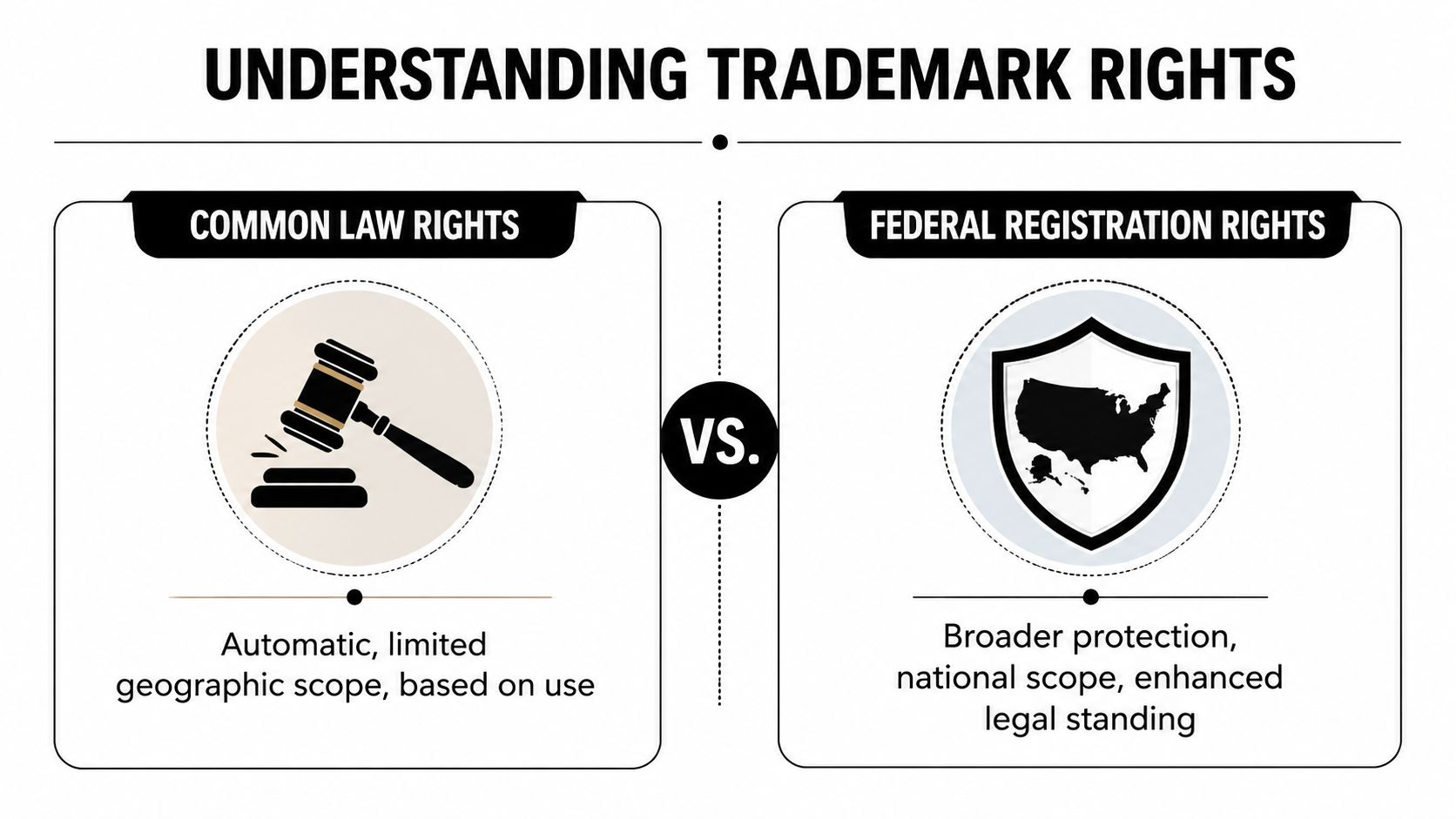
If you use a distinctive name or logo in commerce, you may have common law rights. Those rights are real, but they are usually limited to the area where customers know you and where you can prove consistent use.
That proof issue matters. In a dispute, an unregistered owner often has to show first use, geography, sales history, marketing reach, and customer recognition. A registered owner usually starts from a cleaner position.
Where Florida state registration fits
For some companies, Florida state registration is enough for now. If the business is strictly local, has no near-term interstate sales, and is testing a concept before committing more capital, state filing can be a sensible interim step. It is cheaper, faster, and better than relying on vague common law rights alone.
But founders should be honest about what "local" means. A Boca Raton business that sells through Instagram, ships across state lines, or plans to franchise is already operating in a way that can outgrow state-only protection quickly. For those businesses, a Florida trademark application strategy should be part of a broader decision about whether federal filing belongs on the immediate checklist.
How federal rights change the analysis
Federal registration is not just a larger version of state rights. It gives the brand a different legal profile. The USPTO explains that federal registration can provide nationwide notice of your claim, a legal presumption of ownership, and a basis for bringing an action concerning the mark in federal court, as described on the USPTO page on trademark, patent, or copyright.
That distinction matters more in South Florida than many founders expect. This region produces companies that start local and scale fast through ecommerce, hospitality, health services, consumer products, and multi-location service models. A name that works only inside a narrow geographic footprint can become a liability the moment growth starts.
Here is the practical comparison:
| Type of right | How it starts | Geographic reach | Enforcement strength |
|---|---|---|---|
| Common law | Use in commerce | Usually limited to actual market presence | Fact-heavy and often expensive to prove |
| Florida state registration | State filing | Florida | Better local notice and deterrence |
| Federal registration | USPTO filing and registration | Nationwide | Stronger presumptions and better enforcement tools |
A few founder-level rules help:
- Use alone does not secure broad exclusivity: It may protect only the territory you can prove.
- State filing works best for contained local businesses: It is often a temporary answer, not a scaling answer.
- Federal filing becomes the smarter move once growth crosses borders: Online sales, investors, licensing, and expansion plans all raise the cost of waiting.
- A brand name is legal infrastructure: The design can be great and still create avoidable risk if the rights are thin.
A simple way to frame it is this. Common law rights can help you keep the customers you already reached. Federal rights are designed to help you keep the path open for the business you are trying to build.
Your Core Legal Shield Nationwide Protection and Deterrence
The strongest day-one value of federal registration is defensive. It makes your brand harder to copy and much easier to enforce.
A lot of founders think registration matters only if they're already selling everywhere in the country. That's not how the system works. The filing itself can secure a much stronger position than most founders realize.
Why filing date matters more than most founders think
Federal trademark registration on the USPTO Principal Register creates a legal presumption of ownership and exclusive nationwide rights as of the application filing date, establishing a constructive use date that supersedes later geographic users. That presumption reduces the amount of evidence you need in federal court and shifts the burden to the infringer, which can cut time and expense in a dispute, as described by PSH on trademark registration advantages.
A simpler way to think about it is this: filing plants your flag early.
If a founder in Fort Lauderdale files and later someone in another state adopts a similar mark after that filing date, the registrant can often rely on that earlier federal priority. Without registration, the fight usually becomes fact-heavy. Who used it first, where, how often, in what channels, with what customer reach. That's expensive.
Why registered brands resolve disputes faster
A cease-and-desist letter backed by a federal registration usually lands differently from one based only on unregistered use. The certificate changes the conversation. It tells the other side this isn't just a complaint. It's a claim supported by a federal record and recognized legal presumptions.
That doesn't mean every dispute disappears. It means many weak disputes never become large ones.
Consider the difference:
- Unregistered brand: The owner may need screenshots, invoices, ad records, sales history, and geographic proof just to establish basic rights.
- Registered brand: The owner starts from a stronger legal presumption and can focus the fight on infringement, not first proving ownership from scratch.
- Business result: Greater advantage, lower friction, better odds of early resolution.
Practical rule: If the name is central to customer recognition, don't wait for conflict before building the evidence and legal posture you'll wish you had.
One more point matters for founders who sell goods, not just services. A federal registration also supports stronger remedies later if a dispute escalates. That becomes especially important when counterfeit products or broad online copying start affecting the brand.
A useful next step for businesses evaluating filing mechanics is reviewing the Florida trademark application process alongside the federal strategy, because the right sequence depends on where and how the business operates.
Unlocking Commercial Value From Asset to Revenue Stream
A South Florida founder gets serious investor interest, then the diligence list arrives. One of the first questions is simple: who owns the brand, and can the company keep using it as it grows? If the answer is fuzzy, the valuation discussion gets harder fast.
That is why trademark registration matters beyond enforcement. A registered mark can become a business asset that supports fundraising, licensing, expansion, and an eventual sale. For some local businesses, common-law or Florida rights may be enough for a period. For startups planning regional scale, ecommerce growth, franchising, or a multi-state customer base, brand ownership needs to be easier to prove and easier to transfer.
A trademark can add transaction value
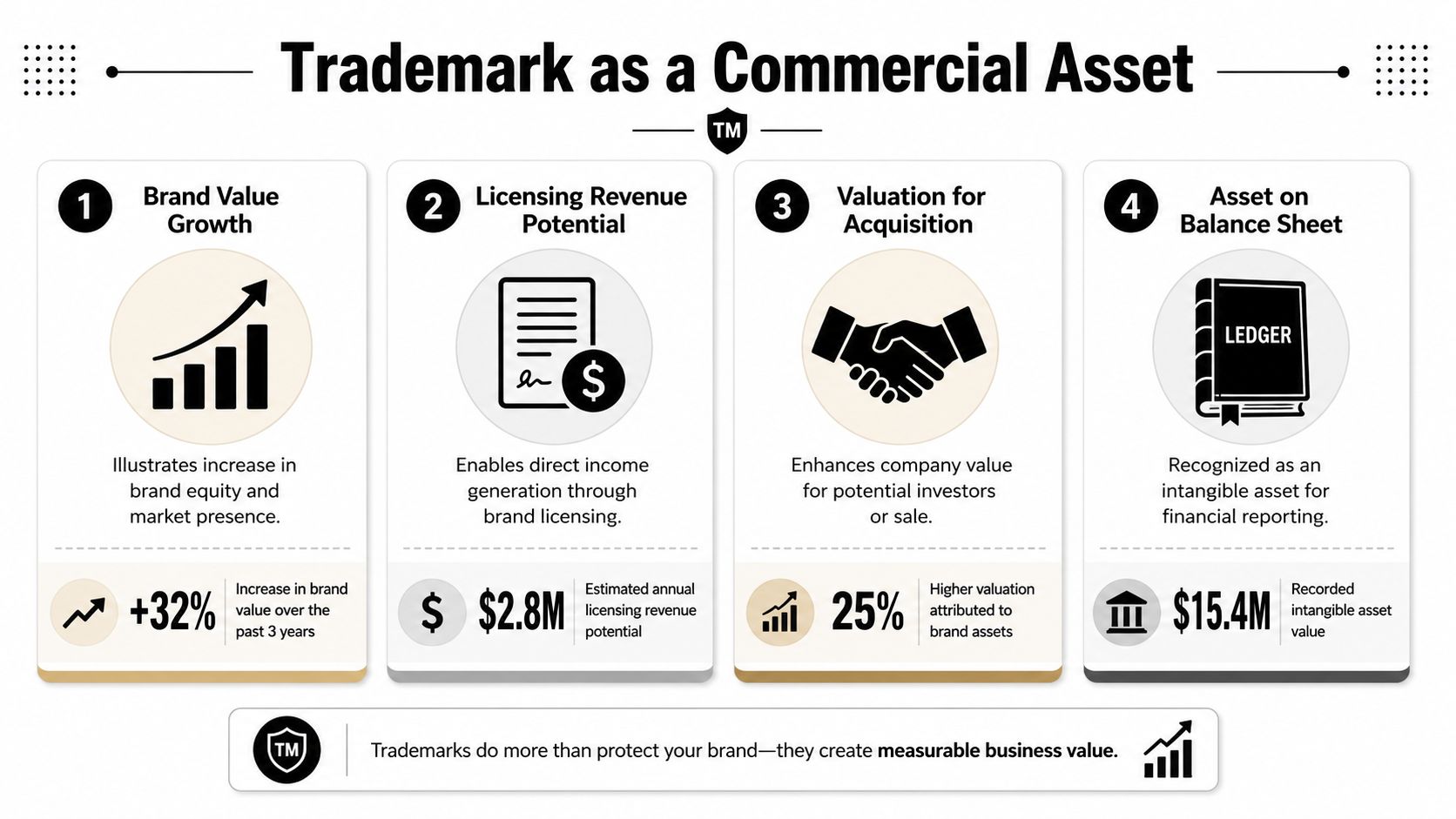
According to empirical market analysis summarized by Erik Pelton on the financial value of trademark registration, the median registered trademark is worth approximately $22.5 million to publicly traded companies based on 2020 stock market data, and trademarks account for one-third of overall corporate value on average.
Those numbers come from public companies, not early-stage startups, so they should be used carefully. Still, the practical takeaway is the same. Buyers and investors do not treat a registered brand like decorative paperwork. They treat it like an asset with ownership, transfer value, and diligence consequences.
Where founders actually see the return
For early-stage companies, the commercial value usually shows up in a few predictable places.
- Fundraising diligence: Investors want to know the company controls the name customers know. If the startup is building traction under one brand but has weak rights to that brand, the risk is obvious.
- Licensing and partnerships: A registered mark is easier to license because the ownership record is cleaner. That matters for distribution deals, co-branded launches, white-label arrangements, and franchise-style growth.
- Exit readiness: Acquirers look for assets they can step into without inherited brand confusion. If they see naming risk, they often lower price, hold back funds, or require cleanup before closing.
This comes up often with Miami and Fort Lauderdale startups that begin locally and then expand online faster than expected. A name that worked fine as a neighborhood or Florida-only brand can become a more expensive problem once customers, partners, or copycats show up in other states.
A trademark works a lot like title to commercial property. The storefront may have value because of location and foot traffic, but clean title makes the property easier to finance, sell, and defend. Brand rights work the same way in a transaction.
Steps that make the mark more valuable
Registration by itself is not enough. The trademark has to match how the company operates.
- Register the brand you really use: If the public sees one version and the application covers another, the file may look better than the actual asset.
- Keep ownership aligned: The operating company should usually own the mark unless there is a deliberate holding-company structure with proper documentation.
- Paper related-party use correctly: If affiliates or sister companies use the brand, document that permission and quality control.
- Protect the full IP stack: Founders building software, content, packaging, or proprietary workflows should review how to protect intellectual property as part of a coordinated brand strategy.
Clear ownership reduces friction. In a financing, partnership, or sale, that can translate directly into speed, price, and fewer last-minute problems.
The Five Year Power Up Achieving Incontestable Status
A lot of founders think registration means the brand is fully locked from day one. It doesn't. Registration is powerful, but the strongest position develops over time.
Many businesses get careless. They file once, save the certificate, and assume the work is over. It's not.

Registration is the start not the finish line
After five years of continuous use, a federal registration can become incontestable, which significantly strengthens the mark by limiting the grounds on which validity can be attacked, as explained by Fish & Richardson on the benefits of U.S. trademark registration.
That's the “power up” most generic trademark articles skip past. Long-term strength comes from maintaining the registration properly and using the mark consistently enough to qualify for that status.
There's also a maintenance trap. Wladislaw Firm's discussion of trademark registration benefits notes that incontestable status requires five years of continuous use plus a Section 8/9 filing, and cites a 27% spike in canceled registrations from missed Section 8 deadlines in recent 2024 to 2025 USPTO data.
What founders should do during the first five years
The risk usually isn't dramatic litigation. It's administrative neglect. An e-commerce brand pauses a product line. A seller changes packaging. A founder forgets maintenance dates after a rebrand. Small gaps create avoidable problems.
A practical maintenance checklist looks like this:
- Keep specimens and sales records: Save examples showing the mark as customers encounter it.
- Use the mark consistently: Don't let the brand drift into multiple versions without thinking through the legal effect.
- Calendar filing deadlines: Put trademark maintenance dates on the same level as tax deadlines and annual reports.
- Review after any pivot: A new product category, logo update, or temporary pause can affect the registration strategy.
Registration gives you leverage now. Incontestability gives you durability later.
The South Florida Founder's Calculus When to Register
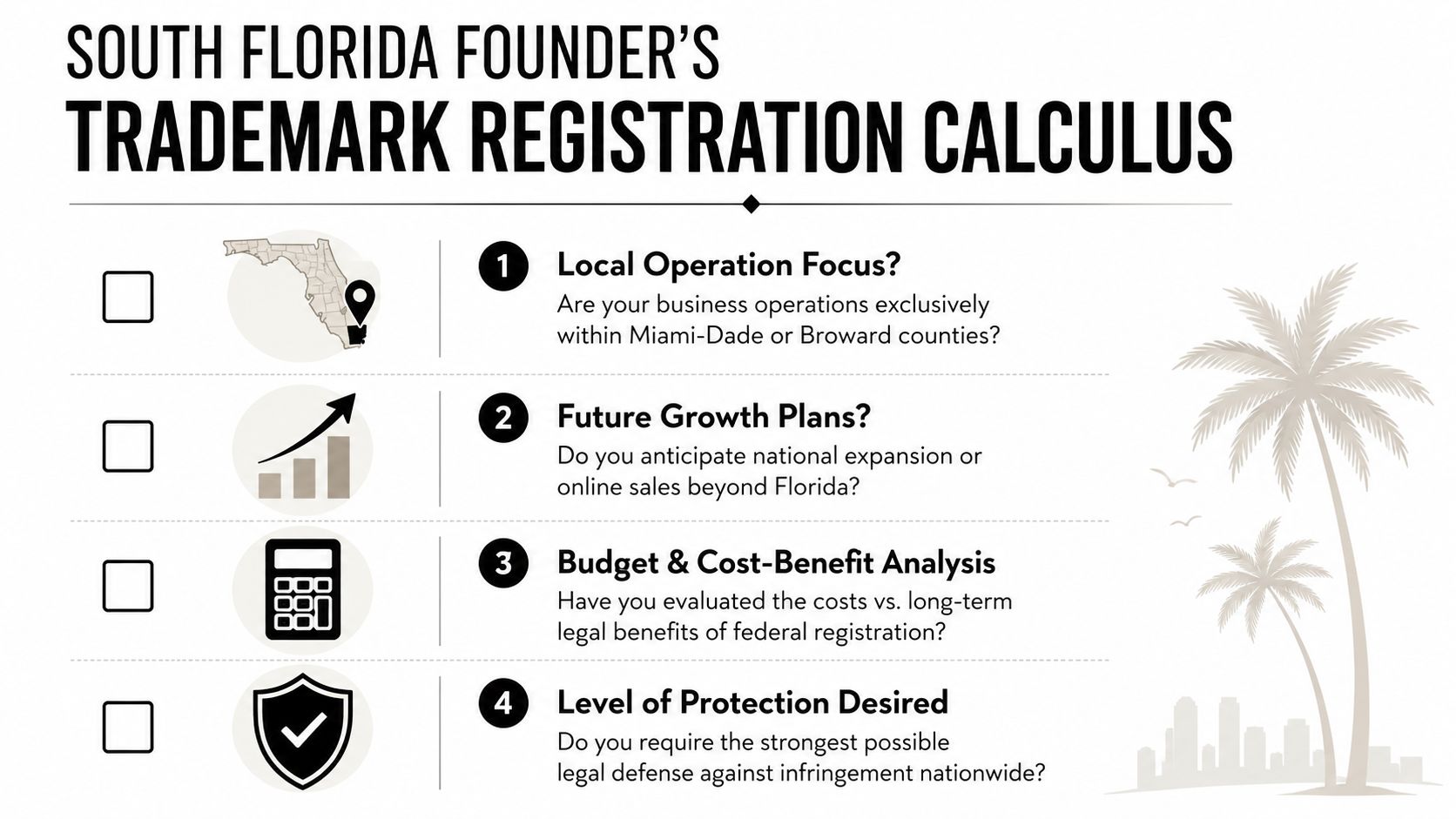
A Miami founder spends months naming a new brand, pays for design, buys packaging, and starts getting traction online. Then a cease and desist lands because someone in another state filed first. That is the core timing question with trademarks. It is not just whether filing fits this quarter's budget. It is whether waiting creates a rebrand bill later.
For South Florida startups, the right answer usually turns on territory, sales channels, and how much brand equity is starting to build. A single-location business in Coral Gables has a different risk profile from a DTC company shipping nationwide from Miami, or a food concept that may later franchise across Florida.
When local protection may be enough for now
Some founders do not need a federal application on day one. If the business is still proving demand, serves a tight local area, and has no meaningful interstate activity, common-law rights plus a Florida filing may be enough for the current stage. The point is to spend legal dollars where they reduce the most risk.
That approach often fits businesses like these:
- Single-location service businesses: A salon, med spa, café, or repair shop drawing customers from one county.
- Early validation stage brands: The founder is still testing pricing, positioning, and whether the name will survive the next six months.
- Businesses with no near-term expansion plan: No national shipping, no licensing model, no franchise strategy, and no serious paid acquisition around the brand name.
For that group, I usually frame the issue this way. If the name changes next quarter, a federal filing may be premature. If the business stays local for now, state registration can still deter some copycats at a lower cost while the company gets clearer on product-market fit.
There is a practical middle ground here too. Before filing anything, founders should at least clear the name, buy the domain, and secure your social handles. That reduces the odds of building around a brand you cannot keep.
When federal filing becomes the clear priority
The math changes once the brand starts reaching beyond South Florida. Federal registration becomes the smarter move when the name is doing real commercial work and exposure is no longer limited to one local market.
Common triggers include:
- Sales across state lines: Through Shopify, Amazon, wholesale, or any other channel reaching customers outside Florida.
- Serious investment in branding: Money is going into packaging, ad campaigns, SEO, signage, or content built around the mark.
- Expansion plans: The company expects to license, franchise, raise capital, or launch in multiple states.
- Crowded categories: Beauty, apparel, food and beverage, supplements, and tech-enabled consumer products tend to attract fast imitators.
- Investor or acquirer scrutiny: Once diligence starts, an unregistered brand often looks like unfinished legal work.
Federal filing is often less about winning a lawsuit and more about avoiding one. It gives the company a stronger position before a conflict starts, while there is still room to fix problems at a manageable cost.
Founders should make this decision with a simple question: if this name takes off, what is the cost of changing it after customers already know it? In many South Florida startups, that answer tells you more than the filing fee does.
Your Next Steps to Secure Your Brand in 2026
A founder launches with a name that looks clear, buys packaging, claims Instagram, and starts getting traction. Then a demand letter arrives from a business that was there first. At that point, the filing fee is no longer the issue. The issue is rebrand cost, customer confusion, and wasted marketing spend.
That is why the next step is not “file as fast as possible.” The right move is to clear the name, match the filing strategy to the business, and lock down the places customers will see the brand.
Step one clear the name properly
Start with clearance. A real search checks more than exact matches in the USPTO database. It should test similar names, related goods or services, and the way the mark will sound, look, and read in the real market.
For South Florida startups, cost-benefit analysis is particularly important. If the business is still validating demand in one local market, the immediate goal may be to avoid a bad name choice before spending more on signs, labels, menus, or ads. If the company is already selling online or preparing to scale, clearance becomes part of a larger filing plan because the downside risk is higher.
A weak search often creates false confidence. Founders see no exact match, assume they are safe, and invest into a name that was always going to be hard to keep.
Step two match the filing strategy to the business
The filing strategy should fit the business model.
- Local service business with a narrow footprint: Common law rights, consistent use, and possibly Florida registration may be enough for now.
- Consumer brand, ecommerce company, or multi-state growth plan: Federal filing usually makes sense early.
- Brand still in testing: Clear the mark first, then decide whether to file now or wait until the offer and positioning are stable enough to keep.
This is a legal decision, but it is also a budgeting decision. A federal application costs far less than a forced rebrand after a product launch. On the other hand, filing too early for a brand that may change in 90 days can waste money too. Founders should treat trademark timing like ordering insurance. Buy the level of protection that fits the exposure.
Step three protect the brand where customers actually find it
Trademark rights and brand control should move together. If you are committing to a name, also secure your social handles before copycats, squatters, or lookalike accounts start siphoning attention.
Registration also gives stronger enforcement options if a dispute turns serious, including access to federal court and stronger remedies in some infringement and counterfeiting cases. Earlier in this guide, those federal advantages were covered in more detail. The practical point is simple. Registered rights give a business more tools and more pressure before a conflict gets expensive.
A workable action plan looks like this:
- Clear the name before investing deeper.
- Choose state, common-law, or federal protection based on actual growth plans.
- Claim the digital assets tied to the brand.
- Track use, filing deadlines, and ownership from day one.
In my experience, founders get in trouble when branding decisions outrun legal decisions. Once customers know the name, changing it gets expensive fast. The smarter move is to treat the mark like a business asset early, before the market decides it matters.