
You just got the 30-page license from a vendor, legal sent a redline, and somebody on your team is asking whether the software is “just a formality.” That's how founders end up signing away negotiating power they didn't realize they had. A software licensing agreement is where the core operating terms live: who can use the tool, how it's counted, what happens to your data, and how hard it is to leave when the relationship goes sideways.
If you're building from Miami, Fort Lauderdale, or anywhere else where software deals move fast and budgets stay tight, treat the license like a business instrument, not paperwork. A useful external primer on licensing concepts is the truelabel licensing overview, but the version that matters for founders is simpler, can you use this software the way your business runs, or are you one clause away from a surprise restriction?
Table of Contents
- What a Software Licensing Agreement Really Does
- Core License Types Every Founder Should Know
- How Licensing Metrics Drive Cost and Compliance
- Essential Clauses You Cannot Afford to Skim
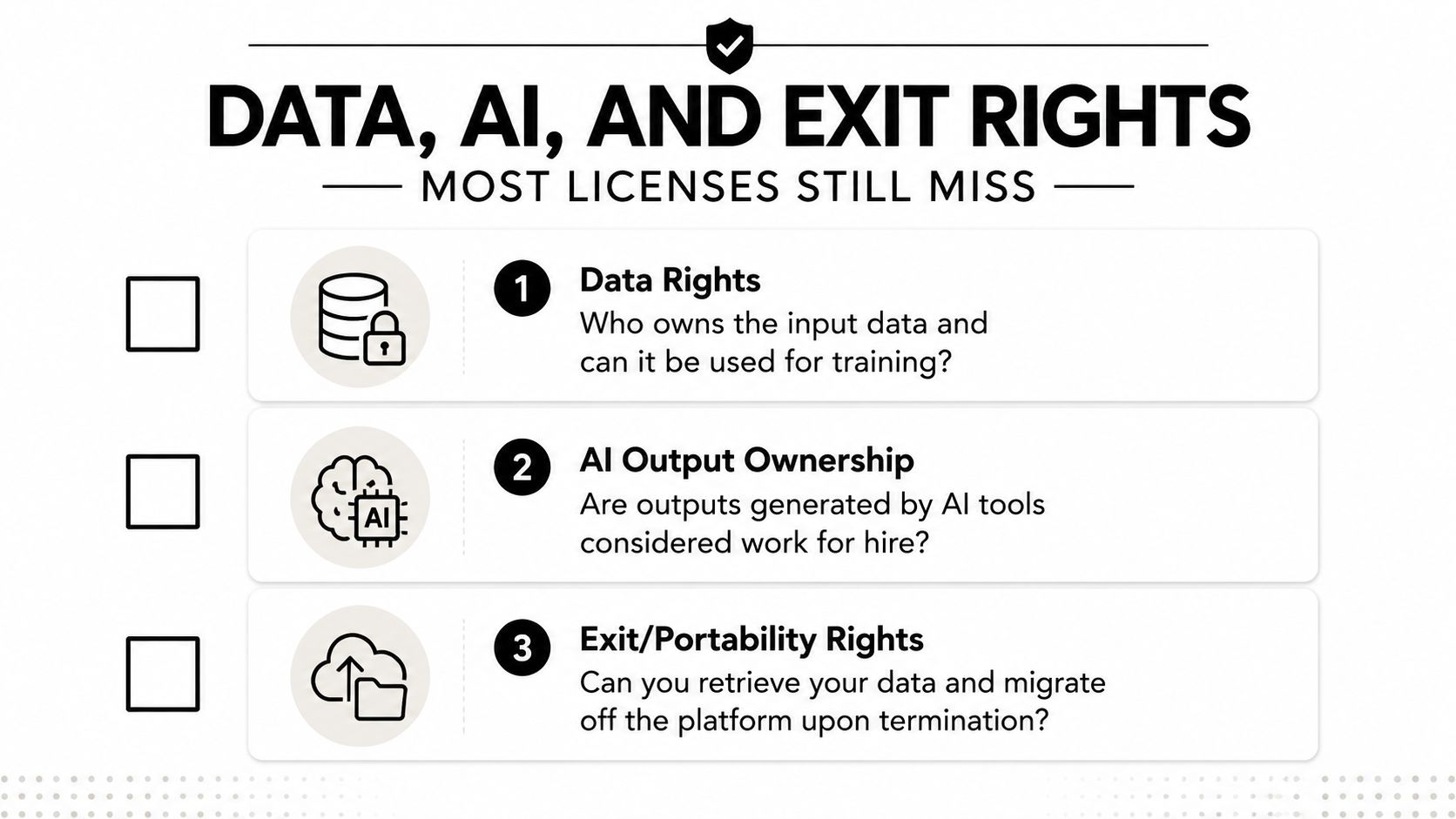
- Data, AI, and Exit Rights Most Licenses Still Miss
- Choosing Florida or Delaware for Your Software Deal
- Red Flags and Negotiation Levers for Founders
- Your Founder Playbook and Next Step
What a Software Licensing Agreement Really Does
A founder once forwarded me a vendor agreement and said, “We'll sign this after lunch.” The document was thirty pages long, the license metric was buried in an exhibit, and the support language was vague enough to hide a lot of pain later. That's the ordinary mistake, people read the price and the start date, then skip the parts that control usage, audits, and exit.
A software licensing agreement is a permission-based contract, not an ownership transfer. It gives the licensee defined rights to install, use, copy, modify, or distribute software only within the limits written into the deal, and those limits are often measured by named users, concurrent users, seats, devices, CPU cores, transactions, or API calls (software licensing agreement overview). That distinction drives almost every fight I see later, because the vendor says the customer exceeded the grant, and the customer says the grant was never clear in the first place.
Practical rule: If the agreement doesn't clearly say who may use the software, where it may be used, and how usage is counted, it's not “flexible.” It's ambiguous.
The smart way to read one is as a commercial instrument. You're not just buying access, you're buying a boundary around access, support, maintenance, renewal risk, and compliance exposure. ServiceNow's metric documentation, for example, distinguishes between per-device, per-user, user subscription, named device, and CPU-core formulas, which shows how granular these contracts can get in practice, and why counting rules matter as much as price (software licensing agreement overview).
A good reference point if you want to compare licensing to other permission structures is the license versus franchise distinction. The point isn't academic. A franchise and a software license both involve controlled permission, but the economics and operational risks are very different.
If you want to treat a vendor draft like a real deal term sheet, not boilerplate, that's where review starts. A founder should be able to ask whether the agreement fits the business model, the deployment model, and the exit plan. If it doesn't, fix it before signatures, not after the audit notice arrives.
Core License Types Every Founder Should Know
A software deal only makes sense once you know what kind of permission you are buying. The label on the front page matters less than the mechanics underneath it, because a perpetual install on your own servers creates different risks than a term-based SaaS subscription, and both are different again from an OEM or embedded arrangement.
Perpetual, subscription, and OEM
A perpetual license usually means you pay once and keep the right to use the software indefinitely, subject to the contract terms. That removes renewal pressure, but it also pushes more cost upfront and often leaves support, maintenance, and upgrades as separate issues. By contrast, a subscription or SaaS license ties access to a term, which aligns vendor revenue with ongoing service and makes the customer dependent on renewals and price changes. For founders buying across borders, the operating questions show up fast, and the SaaS licensing for global companies discussion is a useful reminder that territory and access rights need to be spelled out, not assumed.
An OEM license comes into play when software is embedded in another product or bundled into a broader solution. Founders use this structure when they are reselling, integrating, or white-labeling technology, and the question becomes whether the license lets you distribute the software downstream without breaking the vendor's limits. That is a practical issue, not a drafting nicety. The deployment model and distribution rights need to match the actual business plan, not a generic form.
Source code, object code, and open-source overlays
A separate issue is whether the customer is getting source code or only object code. Object code is what most customers receive, source code access is rarer, and the difference matters if your team needs to maintain, customize, or troubleshoot the product long term. If the software touches proprietary workflows or regulated systems, the agreement should say what can be modified, what cannot, and who owns any custom work.
Open-source components need care too. GPL, MIT, and Apache are not interchangeable in a commercial stack, and mixing them with proprietary code without counsel can create unintended obligations. That becomes especially important when a startup plans to ship, sublicense, or embed software inside a product that customers will depend on.
The license form also affects how much control the vendor keeps after signing. If you are comparing a software arrangement with other permission structures, the license versus franchise distinction helps show why the same word, license, can hide very different operating realities.
Takeaway: Match the license type to the way money actually moves in your business, then negotiate the rest of the form around that choice.
How Licensing Metrics Drive Cost and Compliance
Most license disputes don't start with price. They start with math. The agreement says “users,” the vendor says active logins, finance says headcount, and the audit team says you owe more because contractors, affiliates, or shared devices were never counted the same way on both sides.

The metric drives the control
A named user model means one person is tied to one license. A concurrent user model allows a certain number of people to use the software at the same time, which is different from total headcount and can be much easier or much harder to police depending on your access workflow. A seat model usually tracks assigned access, while a device model follows the machine or hardware identity.
CPU cores, transactions, and API calls are different again. Those metrics show up in infrastructure, developer tools, and high-volume platforms, where usage scales with compute or traffic rather than people. The practical point is simple, the more technical the metric, the more your ops team needs to understand it before procurement signs.
Why vague counting rules create audit problems
The biggest compliance mistake is assuming the vendor defines these terms the same way you do. In practice, a startup might think a contractor is outside the license, while the vendor counts them as a user because they log in through the company workspace. The same problem appears with shared devices, test environments, and service accounts.
Modern enterprise tools show how fine the counting can get. ServiceNow's license metric documentation distinguishes among per-device, per-user, user subscription, named device, and CPU-core formulas, and even uses 1:1 consumption calculations for certain tables (software licensing agreement overview). That's your signal to demand the same precision in your own form.
Tip: Before signing, ask the vendor to define what counts as a billable user, a billable device, and a billable transaction in plain English.
If the metric matches how the startup works, the contract is manageable. If it doesn't, the compliance burden lands on your team, not theirs. Pick the metric that fits real usage, not the one that makes the sales quote look clean.
Essential Clauses You Cannot Afford to Skim
A vendor form looks harmless until you read clause by clause and notice how many decisions it makes for you. The license grant, scope, restrictions, ownership, support, termination, and dispute language are where the deal either protects the company or boxes it in.
License grant, scope, and restrictions
The grant clause should say whether the license is perpetual, subscription-based, non-transferable, non-exclusive, and worldwide or limited by territory. It should also say whether the software can be installed, stored, used, or interfaced with other systems, because those verbs shape how your team deploys the product day to day (grant and scope issues). A perpetual right removes renewal risk, while a non-transferable or non-exclusive grant strips away resale and competitive-exclusivity assumptions.
Restrictions matter just as much. The agreement should say whether the licensee can copy, modify, distribute, or reverse engineer the software, and whether those restrictions apply to all users, affiliates, and contractors. A startup that plans integrations or embedded use should not accept vague wording here, because the deployment model and the grant have to line up.
IP ownership, warranties, support, and termination
IP ownership should be split cleanly between preexisting vendor code, customer data, and anything newly created in the relationship. A law-firm analysis recommends limiting derivative works and reverse engineering, and narrowing IP promises to the time the agreement is signed and the relevant jurisdiction's IP in force at that time (IP ownership and restrictions). That approach is cleaner than broad, future-facing promises that no one can really police.
Support, updates, and maintenance belong in the document too. A practical licensee-focused guide notes that maintenance and support are “almost always needed,” and that delivery timing, training, installation rights, backup copies, and on-premise use should be spelled out rather than assumed (operational mechanics for licensees). If the vendor won't commit to service expectations, you're left with a valid license and no real path to keep the software usable.
Practical rule: A strong termination clause doesn't just end access, it tells you how to extract data, unwind permissions, and keep operating during the transition.
If you want a drafting shortcut for the business side, use the current form as a checklist against your operating model. Coto & Waddington, Attorneys at Law handles startup contract review and can pressure-test whether your license language tracks the way the company uses the software. That kind of review matters most before the vendor starts treating the draft as settled.
For teams that also need a broader template reference, the software development agreement template is a useful companion piece because custom build work and licensing often collide in the same project. The practical move is to align delivery, ownership, and exit language before you accept the final redline.
Data, AI, and Exit Rights Most Licenses Still Miss
The most expensive gaps in a modern software licensing agreement are often the least visible ones. Founders focus on price and term, then discover later that the contract says almost nothing about prompts, generated outputs, training rights, or how the company gets its data back if the vendor relationship breaks down.

Data and AI rights need explicit language
A modern software licensing agreement should say who owns input data, whether the vendor can use it for training, and whether prompts and generated outputs stay confidential or become vendor property. That is no longer a side issue. Generative AI is now part of normal enterprise tooling, which makes training restrictions, auditability, and output ownership more consequential than older boilerplate suggests (modern AI licensing risk overview).
Separate the data flows instead of grouping them into one vague label. Input data, prompts, outputs, logs, and analytics can each need different permissions, retention rules, and review rights. If your team is using the software to make business decisions, you need to know what the vendor can keep, analyze, or reuse later. A practical starting point is to compare the draft against data security best practices so the license matches your actual controls.
Exit rights should be written for the real migration
Termination language also has to answer the ugly questions. What format will the data be returned in, how long will it stay available, and what help does the vendor owe during cutover? If the contract does not answer that, your team may end up with access turned off before the migration is complete.
A practitioner guide aimed at business owners flags that generic software articles often stop at use rights, while the risk now sits in data flow, AI output treatment, and migration support. That is the gap founders should close in negotiation. Ask for a data return clause, an AI training opt-out, and a defined transition assistance window.
Do not wait for renewal to inventory every system that touches the licensed platform. By then, the vendor controls the timeline and your leverage is already smaller.
Coto & Waddington, Attorneys at Law handles startup contract review, including the clauses that decide whether your company can recover its data and keep operating during a handoff. That review matters most before the vendor treats the draft as settled.
Choosing Florida or Delaware for Your Software Deal
Florida and Delaware solve different problems, and founders often mix them up. The choice of law clause, the venue clause, and the entity formation state do not have to match, but they should be chosen together rather than as separate afterthoughts. That's especially true in software deals, where the customer, vendor, and development team may all sit in different states.
Florida keeps things close to home
Florida law is often the simpler path for startups based in Miami, Fort Lauderdale, or the broader South Florida market. It can keep negotiation grounded in the same legal environment where the business is already operating, which reduces friction when the deal is smaller or the relationship is straightforward. If you're dealing with local vendors, local employees, and mostly local performance, simplicity has value.
Delaware is often used for cleaner corporate structure
Delaware is often preferred for larger SaaS transactions and venture-backed companies because parties are used to its corporate framework and predictable drafting conventions. That can matter when investors, acquirers, or counterparties expect Delaware entity documents and want consistency across deals. A lot of founders choose Delaware governing law for the software contract even while operating physically from Florida, because the legal stack lines up better with the company's growth plan.
Practical rule: Don't accept the other side's home jurisdiction by default. Ask who will litigate, where witnesses are located, and what body of law your company is actually prepared to live with.
Three questions usually surface the issue. First, does the clause govern only interpretation, or does it also control venue and enforcement? Second, do confidentiality, non-solicit, and related restrictions match the state law strategy you want? Third, if the deal breaks, are you willing to fight there?
The practical mistake is treating formation state, governing law, and venue as separate checkboxes. They're one strategy. If you want to keep the contract and the company aligned, choose the state posture before the negotiation gets emotional and the redlines start to pile up.
Red Flags and Negotiation Levers for Founders
The fastest way to lose negotiating power is to assume every vendor form is standard and fixed. It usually is not. The same handful of terms show up again and again in startup deals, and the ones that hurt most are often the ones people skim because the sales team says they are “just legal.”
Red flags to slow down on
Auto-renewal without clear notice is a common trap, especially when procurement calendars are already crowded. Unilateral price increases are another, because they let the vendor reset economics without a matching business decision on your side. Broad audit rights deserve a slow read too, since they can turn a routine compliance check into a distraction for finance and IT.
Uncapped liability is rarely a good customer position, especially where the software touches sensitive data or revenue-critical workflows. IP assignment over customer data is another red flag, because your company should not casually give away rights in material it creates or uploads. If the language is broad enough to catch your own content, ask for a narrower definition immediately.
Levers that usually move terms
The best negotiation levers are often boring and effective. Tie renewal to a clear notice period, push for a price cap on renewal, and narrow audit scope to a reasonable cadence with advance notice. If the vendor wants broad access rights, ask for written procedures, limited scope, and confidentiality around results.
A liability cap tied to fees paid in a prior period is a common commercial anchor, because it gives both sides a number they can price around. If the agreement touches source code or custom development, that is a separate risk layer and usually deserves counsel. Cross-border arrangements deserve the same treatment, because territory, privacy, and enforcement questions compound quickly when more than one jurisdiction is in play.
Tip: Hire counsel before the vendor says the draft is final. Your negotiating power is already weaker once the commercial team has mentally closed the deal.
If you want a practical outside review, a flat-fee contract review makes sense. It keeps the work fast, helps founders decide what to push back on, and avoids turning every clause into a billing event. When the contract is tied to product launch, customer onboarding, or regulated data, a quick review is cheap compared with the cost of cleaning up a bad grant later.
Your Founder Playbook and Next Step
A good software licensing agreement comes down to five decisions, and every one of them has operational consequences. First, pick the license type that matches the business model. Second, define the metrics clearly so you know what gets counted and billed. Third, tighten the core clauses, especially scope, IP, support, and termination.
Fourth, write down the data, AI, and exit rights instead of leaving them implied. Fifth, choose the jurisdiction with the rest of the deal strategy in mind, not by habit. Most disputes don't start with a dramatic breach, they start with an assumption nobody tested before signing.
Founders who treat licenses as living operational documents usually do better than the ones who treat them as one-time approvals. The document should evolve with hiring, affiliates, contractors, international growth, and product changes. If it doesn't, the contract starts fighting the business instead of supporting it.
The fastest next step is simple. Pull your current vendor forms, mark every undefined scope item, every unclear metric, and every missing exit term, then decide whether the form can be fixed or needs a full redline. If you want a startup-minded review that focuses on the actual business trade-offs, schedule a contract review before the next signature lands on your desk.
Coto & Waddington, Attorneys at Law helps founders review, redline, and negotiate software licensing agreements with a focus on practical risk, clean scope, and workable exit terms. If you want contract language that fits how your company operates, visit Coto & Waddington, Attorneys at Law and ask for a review before your next vendor deal closes.



