A South Florida founder usually meets contract law at the worst possible moment. A supplier sends over a “standard” agreement on Friday afternoon. An investor wants a cleaned-up cap table and signed founder documents by next week. A new hire wants to start Monday, but your contractor agreement came from an online template that doesn’t quite fit what your business does.
That’s when most owners realize the issue isn’t whether they have a contract. It’s whether the contract protects the company they’re trying to build.
A small business contract attorney doesn’t just draft paperwork. Done right, that lawyer helps you decide what risk you’re taking, what risk you’re shifting, and what obligations you’re accepting before your signature locks you in. In Miami and Fort Lauderdale, that matters even more. Deals move fast, many businesses operate in both English and Spanish, and founders often juggle vendors, family ownership issues, e-commerce exposure, and growth plans at the same time.
Good legal help should feel practical. You should understand what you’re signing, what needs to change, and what the legal bill will look like before the work starts. That’s why flat-fee and bilingual counsel matter so much in this market.
Your Founder's Guide to Business Contracts in South Florida
A founder in Miami gets a vendor agreement for a new product launch. The pricing looks fine. The scope seems clear enough. Then page nine says the vendor can cap its liability at a low amount, but your company has to indemnify it for a broad list of claims. A few paragraphs later, the dispute clause points to another state, and the intellectual property section is vague enough that ownership of deliverables isn’t obvious.
That contract isn’t unusual. It’s exactly the kind of agreement that gets signed when a business is moving fast.

In South Florida, founders often operate in a market that is multilingual, relationship-driven, and deadline-heavy. A handshake may open the door, but the contract decides who bears the loss when something goes wrong. If your business sells services, uses independent contractors, stores customer data, ships products, licenses content, or relies on outside developers, your contracts are already shaping your risk.
Why this matters early
Many owners still wait too long to get legal help. Nearly 60% of U.S. small businesses experienced significant legal events in the past two years, but 54% of them did not seek attorney help, often handling contract reviews and disputes themselves, according to The Legal Needs of Small Business Survey.
That gap shows up every day in founder-side contract work. People don’t avoid lawyers because contracts don’t matter. They avoid lawyers because they assume review is optional, too expensive, or something to do later. Then “later” arrives as a payment dispute, a messy breakup with a contractor, or a customer claim tied to language they never noticed.
Practical rule: If a contract affects cash flow, ownership, customer promises, or your ability to exit a bad relationship, it deserves legal review before signature.
What useful counsel looks like
Founders usually need three things from a contract lawyer:
- Clear advice: What are you agreeing to, in plain English?
- Business judgment: Which terms matter, and which ones are noise?
- Predictable cost: Can you get the work done without fearing an open-ended bill?
That’s the standard to look for in Miami. Not legal theater. Not jargon. Just contracts that support growth instead of undermining it.
What a Small Business Contract Attorney Really Does
Most founders think a contract lawyer writes documents and redlines agreements. That’s part of the job, but it’s not its core value.
A small business contract attorney is more like the architect for your business relationships. The architect doesn’t just draw walls. The architect decides where the load-bearing points are, where stress will hit first, and whether the structure will still work when the business expands. Contracts work the same way.
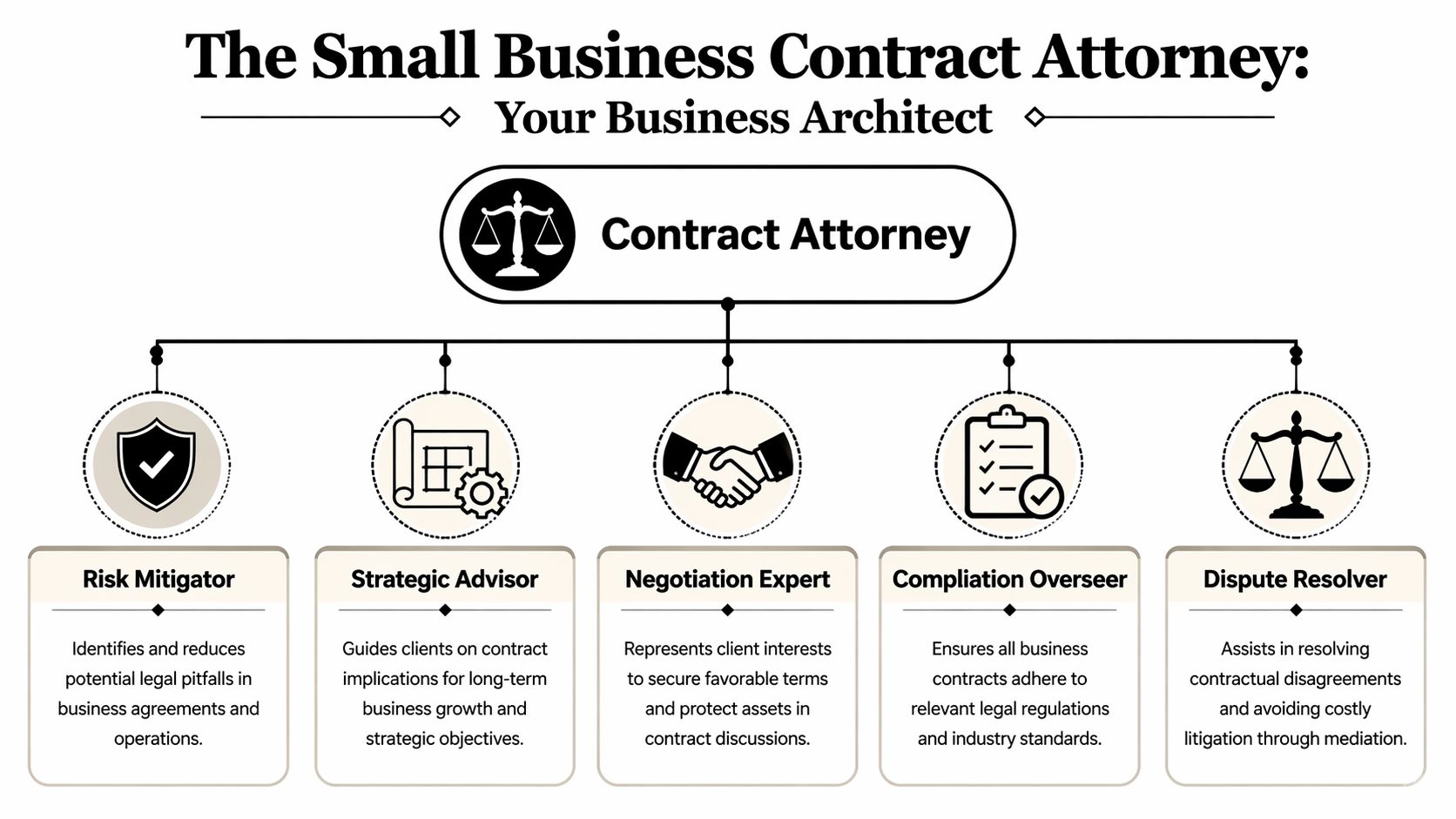
Risk mitigation
The first job is spotting liability that doesn’t look dangerous until there’s a problem. That includes one-sided indemnity language, silent renewal terms, broad non-competes, weak termination rights, unclear payment triggers, and clauses that hand over ownership of work product when that wasn’t the business deal.
A lawyer also sees what’s missing. Sometimes the biggest problem isn’t a bad clause. It’s the absence of one. If your SaaS agreement has no clear limitation of liability, or your contractor agreement doesn’t address intellectual property assignment, you may be relying on assumptions instead of enforceable terms.
Deal facilitation
Good contract work helps deals close. It doesn’t just slow them down with edits for the sake of edits.
A practical attorney figures out where to push and where to let a point go. If a founder is negotiating a customer agreement, the key issue may be payment timing and scope control. If it’s a software development agreement, the key issue may be ownership of code, acceptance criteria, and post-launch support. If it’s a distribution deal, the issue may be territory, exclusivity, and exit rights.
That approach matters because contracts and commercial issues affect 19% of firms, making them the most common legal matter, according to a Kingston University survey discussed by JD Supra. For founders, contract work isn’t edge-case legal work. It’s daily operational risk.
A contract should make performance easier, not create a second business problem after the first one is solved.
Strategic growth support
The best contract lawyers also look around the corner. They ask whether the agreement will still make sense if you hire more people, raise money, expand to another state, license your brand, or bring in a strategic partner.
That shows up in places founders often overlook:
- Founder documents: If ownership, decision-making, and exit rights aren’t clean, investors will notice.
- Customer terms: If refund language, service levels, or data-use provisions are sloppy, scale makes the problem worse.
- Vendor agreements: If a critical vendor can terminate on short notice or disclaim all responsibility, your operations sit on weak footing.
Proactive lawyer versus reactive litigator
A litigator handles the fight after the contract fails. A contract attorney tries to prevent the fight, or at least make it cheaper to resolve.
Those are different jobs. One asks, “How do we win this dispute?” The other asks, “How do we keep this from becoming a dispute in the first place?”
What founders should expect
When you hire a contract lawyer, expect more than markup comments. Expect answers to these business questions:
- What is the risk if I sign this as-is?
- Which clauses are market-standard, and which ones are unusually unfavorable?
- If this deal goes bad, how do I get out?
- Does this agreement fit how my company operates?
If you’re not getting those answers, you’re paying for editing, not counsel.
Critical Moments to Hire a Contract Lawyer for Your Startup
Most startups don’t need a lawyer in every meeting. They do need one at the moments when one document can lock in a bad decision for years.
The easiest way to think about timing is to follow the life of the company. Legal risk doesn’t show up all at once. It appears in stages, and each stage has a contract trigger that deserves attention before the business commits.
Before launch
The first high-risk moment usually happens before revenue.
If you have co-founders, someone needs to define ownership, roles, voting, departures, and what happens if one person stops contributing. If you’re forming an LLC or corporation, the internal governing documents need to match how you plan to run the company. If they don’t, the first serious disagreement becomes much harder to unwind.
Founders often skip this step because everyone is aligned at the beginning. That’s exactly why it should be done then. Agreements drafted during goodwill are almost always cleaner than agreements drafted during conflict.
When the product or service goes live
The next trigger is customer-facing paperwork. That may be terms of service, website terms, a service agreement, order forms, privacy policies, refund terms, or custom client contracts.
Many startups expose themselves without realizing it. Sales language may promise more than operations can deliver. Privacy terms may not match actual data practices. A “simple” customer agreement may have no meaningful limitation of liability or no defined process for handling changes in scope.
When you start hiring and delegating
A growing startup brings in employees, independent contractors, agencies, developers, creatives, or consultants. That creates immediate contract issues.
You need documents that address confidentiality, ownership of work product, payment terms, scope, and post-engagement restrictions where appropriate. Without that, a founder may pay for deliverables but still face a real dispute over who owns them.
Bring in contract counsel before the relationship starts, not after someone has already produced the work and sent an invoice.
When operations start depending on third parties
At this juncture, vendor and supplier agreements become serious.
A fulfillment partner, marketing agency, software provider, manufacturer, or commercial landlord can become operationally critical very quickly. Once your company depends on that relationship, your negotiating power diminishes. The right time to negotiate termination rights, service standards, and risk allocation is before your business is tied to the deal.
According to the earlier Kingston University survey, contracts and commercial issues affect 19% of firms, which is more common than employment, tax, or regulatory matters in that dataset. Founders should treat this as a normal stage of growth, not an unusual legal event.
When outside money enters the picture
Investment conversations magnify every old shortcut.
Due diligence tends to uncover what founders postponed: missing IP assignments, unsigned contractor agreements, inconsistent equity documents, vague advisor arrangements, and customer contracts that create obligations the company can’t clearly track. Investors don’t like uncertainty, especially when the uncertainty sits inside the company’s core agreements.
A simple hiring timeline for legal review
- Pre-launch documents: founder agreements, operating agreements, formation decisions
- Go-to-market contracts: customer agreements, website terms, privacy-related language
- Team growth: contractor and employment-related documents
- Operational scale: vendor, supplier, distribution, licensing, and lease agreements
- Fundraising and exits: diligence cleanup, investment documents, assignment and consent issues
What doesn’t work
What doesn’t work is waiting for a contract to “feel important.” By the time it feels important, the advantage usually belongs to the other side.
The better approach is simpler. If the agreement affects ownership, money, deliverables, data, or your ability to end the relationship, call a lawyer before you sign.
Essential Contracts and Clauses That Protect Your Business
Some contracts show up in almost every startup. Others depend on the business model. Either way, founders should know which documents matter and which clauses carry the actual risk.
The contract itself is only half the story. The protection usually lives in a handful of provisions that control money, liability, ownership, and exit.

The agreements most startups actually use
A South Florida startup may not need a stack of complex corporate documents on day one. It almost always needs a clean core set.
- Operating agreement or shareholder agreement: This governs internal ownership, control, voting, transfer restrictions, and exits.
- Non-disclosure agreement: Useful when sensitive information is shared before a deeper deal is signed.
- Master service agreement: Sets the baseline legal terms for ongoing services.
- Statement of work: Defines the actual project, deliverables, deadlines, and pricing under the larger service framework.
- Independent contractor agreement: Covers scope, payment, confidentiality, and IP ownership.
- Vendor or supplier agreement: Controls reliability, timing, warranties, and remedies if performance fails.
- Website and customer terms: Important for e-commerce, digital services, subscriptions, and online sales.
If you want a practical primer on structure before legal review, this guide on how to write a business contract is a useful starting point. It won’t replace counsel, but it can help founders ask better questions before a document goes out or comes back marked up.
The clauses that do the heavy lifting
Most contract disputes don’t happen because the title of the agreement was wrong. They happen because one critical clause was vague, overly broad, or never negotiated.
Indemnification
This clause decides who pays when a third-party claim shows up.
In plain English, indemnity shifts loss. If a customer sues over something tied to your work, does your company pay? Does the other side pay? Is the duty mutual? Does it apply only to third-party claims, or does it try to cover direct disputes between the contracting parties too?
This is not boilerplate. A 2023 American Bar Association study found that 68% of small business contract litigation stemmed from ambiguous risk allocation in clauses like indemnity, leading to average defense costs exceeding $150,000 for businesses with under $5M in revenue, as summarized in this discussion of business contract drafting.
A better indemnity clause is specific. It says what claims are covered, who controls the defense, whether there are carve-outs, and whether the obligation is limited by fault or tied to a particular kind of breach.
Limitation of liability
This clause caps exposure.
A founder should read it with one question in mind: if something goes wrong, what is the most either side can owe? Some agreements cap liability at fees paid under the contract. Others exclude certain categories of damages but leave room for direct losses. Some carve out confidentiality breaches, IP infringement, or intentional misconduct.
The problem is mismatch. A startup may accept broad obligations in one section and a tiny liability cap in another. That leaves the company holding obligations it can’t realistically insure or control.
A contract isn’t balanced if one party has broad indemnity duties while the other party has almost no meaningful liability exposure.
Intellectual property ownership
This clause decides who owns what gets created.
That matters for software, branding, content, product design, photography, consulting deliverables, and internal systems. Founders often assume payment equals ownership. It doesn’t. If the agreement says the creator retains rights, or if the assignment language is incomplete, the business may end up with a license instead of ownership.
For startups, this can become a due diligence problem later. Buyers and investors want a clear chain of title to the company’s valuable assets.
Governing law and dispute forum
This clause decides where and how a dispute gets resolved.
Founders skim it because it feels procedural. It isn’t. If your Miami company signs an agreement requiring disputes to be handled elsewhere, the cost and inconvenience of enforcement can change the economics of the entire deal. The same issue applies to mandatory arbitration, venue restrictions, and notice requirements before claims can be filed.
A fast founder review before signature
Use this short checklist before any meaningful contract goes out the door:
- Follow the money: Are payment triggers, late fees, refunds, and scope changes clear?
- Find the risk-shift: Who indemnifies whom, and for what?
- Check the cap: Is liability limited in a way that matches the transaction?
- Confirm ownership: Does your company own what it’s paying for?
- Test the exit: Can you terminate without wrecking the business?
Founders don’t need to memorize legal language. They do need to know where the danger tends to hide.
Decoding Attorney Pricing Models in the Miami Market
Legal pricing shapes behavior. If founders are afraid every email will generate another charge, they delay asking questions. Delay is expensive in contract work because the cheapest fix usually happens before signature.
In the Miami market, startups generally run into three pricing structures for contract work: hourly billing, flat fees, and retainers. None is automatically wrong. The better choice depends on the type of work, the urgency, and how much predictability the company needs.
Comparing legal pricing models for startups
| Model | Best For | Pros for Startups | Cons for Startups |
|---|---|---|---|
| Hourly | Unpredictable matters, heavy negotiation, disputes, custom projects with uncertain scope | Flexible when the work may expand or change | Hard to budget, founders may hesitate to ask questions, invoice surprises are common |
| Flat fee | Defined projects like contract drafting, review, policy packages, entity formation, standard negotiations | Predictable cost, clear scope, easier planning, encourages early review | Needs a well-defined scope, major changes may require a new fee |
| Retainer | Ongoing legal support for active businesses with recurring needs | Regular access to counsel, useful for frequent reviews and day-to-day questions | Can be wasteful if the business doesn’t actually use the time or scope provided |
Why founders often prefer flat fees
Flat-fee work tends to fit startups because startup legal needs often come in discrete chunks. Review this agreement. Draft that contractor package. Prepare a customer services template. Clean up the founder documents. Those are defined tasks.
That’s why flat fees usually create better alignment. The founder knows the cost. The lawyer knows the scope. The conversation shifts from “How long will this take?” to “What’s the smartest way to solve this?”
For a more detailed breakdown of cost predictability and scope management, this comparison of flat-fee vs hourly rate for a Miami startup lawyer is worth reviewing.
When hourly still makes sense
Some matters don’t fit a fixed box. If negotiations are likely to be prolonged, the other side is difficult, or the facts are shifting, hourly billing may be reasonable. The issue isn’t the model itself. The issue is whether the founder understands what can drive cost upward.
Ask direct questions:
- What is included?
- What usually falls outside scope?
- Who on the team will do the work?
- How are revisions handled?
- At what point will the firm warn me that fees are rising?
The practical trade-off
Founders usually care about cost, but what they really need is cost certainty. A predictable legal spend lets you use counsel early, while there’s still time to negotiate from strength.
That’s especially important for small businesses. If legal review only happens after something goes wrong, you’re no longer buying prevention. You’re buying repair.
Your Vetting Checklist for Finding the Right Attorney
Hiring a lawyer for contract work shouldn’t feel like guessing. You’re choosing someone who may shape founder relationships, revenue terms, IP ownership, vendor risk, and the paper trail investors will inspect later. The right way to vet that person is to test judgment, not just credentials.
What to check before the first call
Start with fit. Not personality fit alone, but business-model fit.
- Startup familiarity: Has the attorney worked with early-stage companies, founder teams, and growing service or product businesses?
- Industry context: Do they understand your world, whether that’s e-commerce, tech, creative services, consumer products, or a family-owned operating business?
- Contract depth: Can they talk about indemnity, limitation of liability, IP ownership, and termination rights in plain English?
- Communication style: Do they answer directly, or hide behind vague legal language?
- Pricing transparency: Can they explain scope and billing without confusion?
A good local option should also understand how South Florida deals move. That includes multilingual counterparties, fast-turn contracts, and the practical issues that come with owner-managed businesses. Founders comparing local counsel can use this page on finding a small business attorney near me to frame what local responsiveness and business-focused service should look like.
Questions that reveal strategic depth
A strong interview isn’t about asking, “Do you handle contracts?” Most attorneys can say yes. Ask questions that expose how they think.
Consider these:
- How would you approach protecting our IP in a vendor or contractor agreement?
- What clauses do you look at first in a service contract, and why?
- How do you handle contracts for bilingual business relationships?
- When do you recommend pushing hard in negotiation, and when do you tell clients to move on?
- If our business grows quickly, which agreements usually create the first cleanup problems?
- What is your approach to asset protection beyond contract drafting?
That last question matters. Some attorneys use multi-entity LLC structures to create liability firewalls, a strategy reported to reduce risk in creditor judgments by 78%, according to this discussion of asset protection structures. You’re not hiring a contract technician. You’re looking for someone who can connect contracts to the larger protection strategy of the business.
The right attorney should be able to explain both the clause in front of you and the business system behind it.
Red flags founders should take seriously
Some warning signs are obvious. Others are subtle.
- Guaranteed outcomes: No serious attorney should promise a perfect result.
- Jargon without translation: If you leave the call more confused than when it started, that won’t improve once the bills arrive.
- No process: If they can’t explain intake, scope, turnaround, and revision handling, expect friction later.
- Template-only practice: Templates are useful starting points. They are not strategy.
- No questions about your business: A lawyer who jumps into drafting before understanding operations, ownership, customers, and growth plans is probably papering over risk, not managing it.
A founder-friendly selection process
You don’t need a marathon. Use a short, disciplined process:
- Step one: Gather the documents you have now.
- Step two: Make a list of the deals or relationships most important to revenue and operations.
- Step three: Speak with counsel who can explain risk in plain terms.
- Step four: Compare not just price, but clarity, responsiveness, and business judgment.
- Step five: Choose the attorney you’ll call before signing the next deal.
That last point matters more than founders think. The best lawyer for your company is often the one you’ll use early, not the one you only contact after a problem matures.
How Our Founder-Focused Approach Protects Florida Businesses
South Florida founders don’t need more generic legal content. They need counsel that matches how business gets done here.
That means speed, plain-English advice, and contracts that work across a market where business owners, customers, and counterparties often negotiate in both English and Spanish. It also means pricing that doesn’t discourage preventive review. If a founder is afraid to send over a draft because the meter is running, small problems stay hidden until they become expensive ones.
Why bilingual counsel matters in Miami
In Miami-Dade, language is not a side issue. It’s part of the deal environment.
With 70% of Miami-Dade's population being Hispanic or Latino, bilingual contract support is critical, yet most legal content overlooks this. This gap leaves founders vulnerable to miscommunications, a risk that increases as 40% of small businesses now use AI-generated contracts that often miss Florida-specific nuances, as noted in this discussion of underserved small business legal needs.
That matters in practical ways. A founder may negotiate a relationship in Spanish, receive a draft in English, and assume the language reflects the business understanding. Sometimes it doesn’t. A term that sounds commercially reasonable in conversation can become much broader on paper. A bilingual lawyer helps catch that mismatch before it becomes a dispute.
Why flat-fee support changes behavior
Predictable pricing helps founders use lawyers the right way. Instead of saving legal review for emergencies, they bring counsel in at the stage where edits are still easy and advantage still exists.
That’s one reason many founder-side businesses prefer a scoped, flat-fee arrangement for drafting, review, contract standardization, and recurring operational documents. For companies with more ongoing needs, fractional general counsel support can also make sense because it creates a steady review process instead of sporadic cleanup.
Where modern founders need sharper review
AI-generated contracts are now a common feature. They can be useful for brainstorming language or producing a rough first draft. They can also create false confidence.
AI often misses state-specific issues, misstates ownership logic, overreaches on indemnity, or stitches together clauses that don’t work well together. Founders who use AI should treat it like a rough intern draft, not signed-ready legal work.
Operationally, responsive systems matter too. Law firms that serve fast-moving businesses often rely on intake and communication workflows that keep founders from waiting days just to get a status update. For firms thinking about client communication at that level, this piece on a Virtual Receptionist For Law Firms is a practical look at how responsiveness can support client experience.
What that looks like in practice
Coto & Waddington, Attorneys at Law provides bilingual, flat-fee business counsel for South Florida founders, including contract drafting, review, startup formation, trademarks, privacy-related policies, capitalization work, and fractional general counsel support. The practical value for a founder is straightforward: clearer agreements, more predictable legal spend, and advice shaped to how Miami businesses operate.
If your company is growing, signing more complex deals, or relying on AI and templates as a starting point, this is the stage to tighten the legal foundation before the next signature adds avoidable risk.
Frequently Asked Questions About Business Contract Law
Can I just use an online legal template for my Florida business
You can, but that doesn’t mean you should rely on it without review. Templates are usually written to be broadly reusable, which is exactly why they often fit your business poorly. They may miss Florida-specific issues, fail to match your actual operations, or include risk-allocation language that looks standard but works against you. A template can be a draft. It shouldn’t be the final word on a contract that affects revenue, ownership, or liability.
What’s the difference between a contract attorney and a general business lawyer
A general business lawyer may handle a wide range of operational legal issues, from formation to governance to compliance questions. A contract attorney focuses more on drafting, reviewing, negotiating, and structuring agreements. In practice, many small business lawyers do both. The question for a founder is less about the label and more about whether the lawyer has real depth in contract risk, negotiation strategy, and the clauses that drive disputes.
How does a fractional general counsel arrangement work
It’s ongoing legal support without hiring a full-time in-house lawyer. The business gets regular access to counsel for recurring needs like contract review, founder questions, vendor issues, policy updates, and growth-stage cleanup. This model can work well for startups and small businesses that have steady legal needs but don’t yet need a full internal legal department. The value is continuity. Your lawyer learns the business, spots patterns, and helps you make cleaner decisions before issues pile up.
If you’re building a company in South Florida, signing customer or vendor agreements, or trying to clean up contracts before a financing or growth push, it’s worth getting practical guidance early. Coto & Waddington, Attorneys at Law works with founders and small businesses on bilingual, flat-fee business counsel designed for the Miami market. If you want contracts that are clear, workable, and built around how your company operates, reach out for a consultation.