
You're probably staring at a definitive agreement right now, or you will be soon, and the reps and warrants section looks like the part you can skim because it sounds like legal repetition. That's the trap. In a real deal, those clauses decide who eats the loss if the cap table is messy, a permit is missing, a tax return is wrong, or the buyer finds a problem after closing.
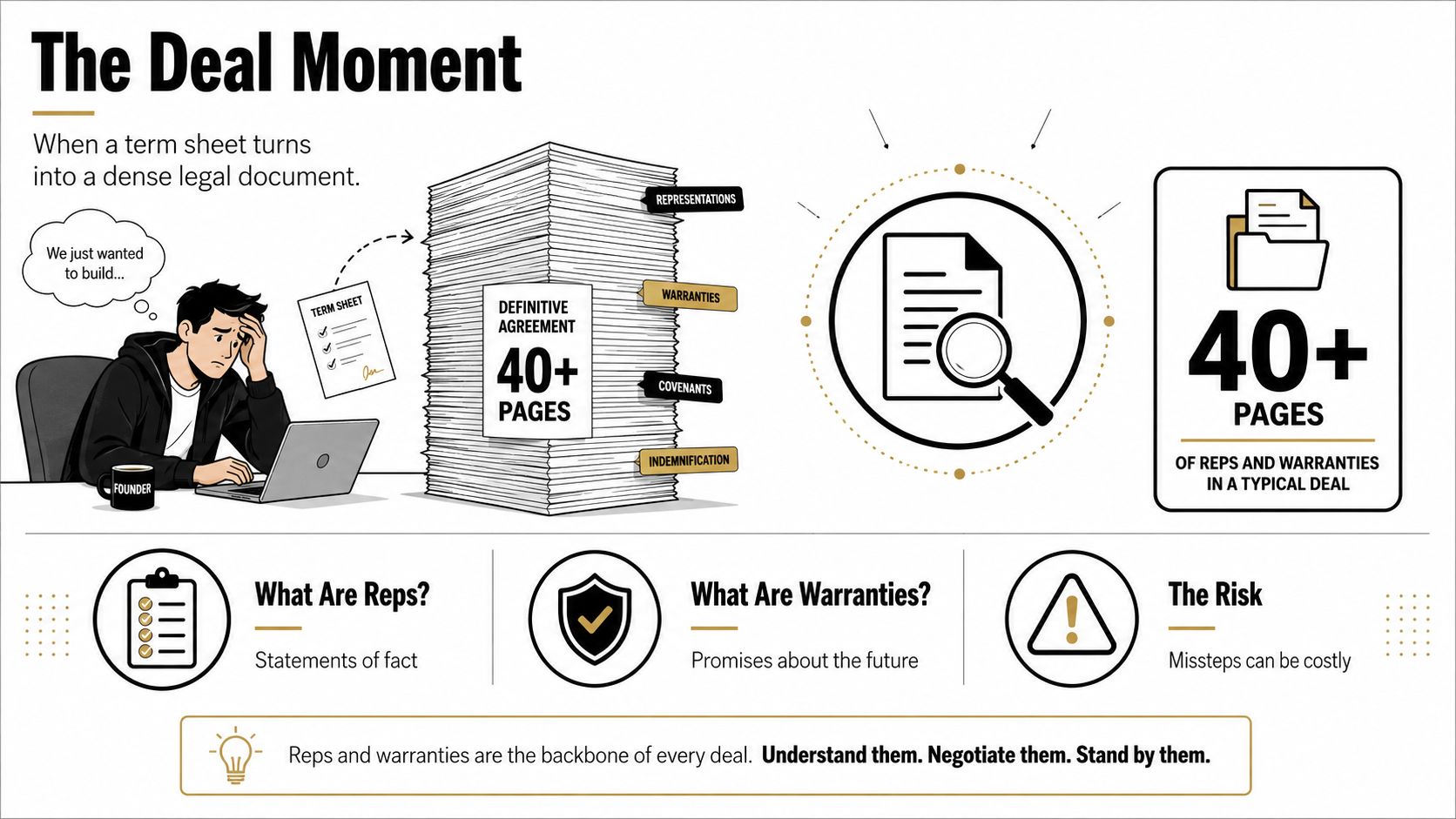
Here's the uncomfortable truth. Reps and warrants are not legal wallpaper, they're the risk-allocation engine in the deal. The American Bar Association reports that roughly one-third of North American M&A disputes arise from an alleged breach of seller reps and warranties, which is why founders who treat the section as boilerplate usually end up negotiating from a weaker position later (SRS Acquiom fast facts).
How Rep and Warranty Claims Drive M&A Disputes
| Dispute Driver | Share of M&A Disputes |
|---|---|
| Alleged breach of seller reps and warranties | Roughly one-third |
A founder usually feels this moment when the term sheet becomes a 40-page agreement and the buyer's lawyer starts marking up statements that sound harmless. They're not harmless. They're the clauses that tell you who pays if something turns out to be wrong after closing.
Use the deal process as your map, not your anxiety. If you want the broader transaction sequence in plain English, start with the mergers and acquisitions process overview and then come back to the reps section with a sharper eye. The biggest mistake is reading passively and assuming the only real negotiation is over price.
Table of Contents
- How Rep and Warranty Claims Drive M&A Disputes
- What Reps and Warrants Mean
- The Core Reps Every Founder Should Know
- Sample Clause Language for Startup Transactions
- Survival Periods and Remedies That Decide Who Pays
- Indemnification, Escrow, and Rep and Warranty Insurance
- How Reps and Warrants Connect to Due Diligence
- Florida and Delaware Considerations and Next Steps
What Reps and Warrants Mean
A founder signs a purchase agreement and finds a sentence about the roof, the books, the code, or the customer contracts. That sentence is doing real work. A representation is a statement of fact, like saying the roof is new. A warranty is a promise that the fact is true, or will stay true for a set period after closing.
Statement of Fact Versus Promise
That distinction changes the fight if the statement turns out to be wrong. Under contract-law treatment, a breach of warranty usually leads to damages, while a misrepresentation may support rescission as well as damages in appropriate cases (EM Law). In a real deal, that can decide whether the buyer can try to unwind the transaction or only seek money after the close.
The ABA has criticized the phrase “represents and warrants” as unnecessary in some settings, while also recognizing that the words can carry different ideas because a representation is a statement of fact and a warranty is a promise of fact (ABA Business Law Today). Deal documents still use both words together. Sometimes that is only drafting habit. Sometimes it tells you the buyer wants the broadest possible remedy path.
Practical rule: if a clause only says what is true today, treat it as a representation. If it also promises continued truth or performance, treat it as a warranty.
Founders should stop asking whether the phrase is just boilerplate. The question is what remedy follows if the statement is wrong. If the clause gives the buyer a rescission-style argument, it carries more weight than a sentence that only supports a damages claim. Read every rep with the remedy in mind, not just the wording.
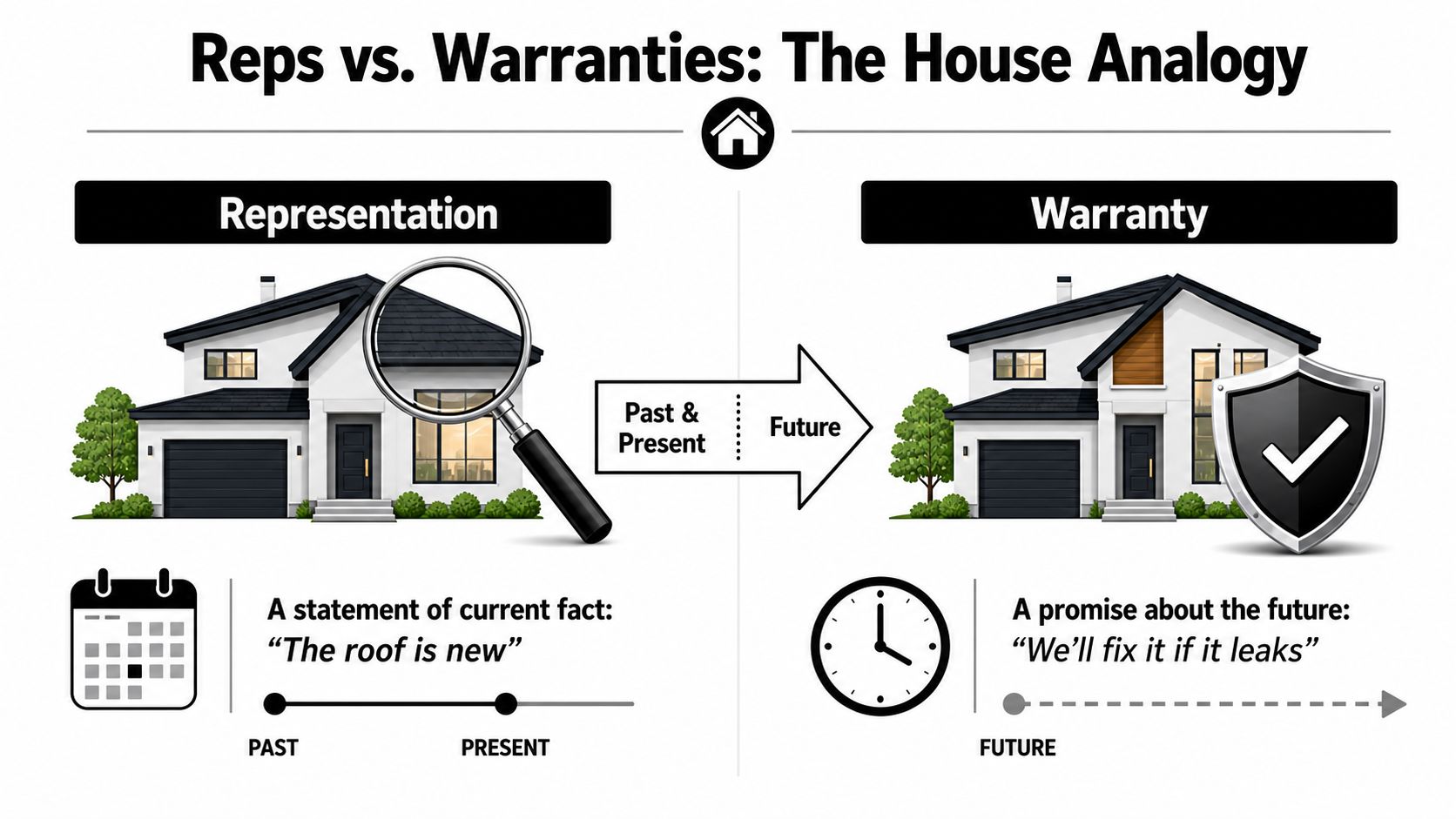
A founder negotiating in Florida or Delaware feels this most when the buyer's lawyer starts pressing on survival, indemnity, and disclosure schedules. A broad rep can become a post-closing claim route, while a narrower one limits the buyer's power to what the contract says. The trade-off is simple, even if the drafting is not. More buyer protection usually means more seller exposure, and the money often moves through escrow, holdback, or rep and warranty insurance instead of a clean post-closing lawsuit.
That is why the label matters less than the deal mechanics behind it. In a private-company sale, the clause is not there to sound formal. It sets the buyer's burden of proof, the seller's defense, and the timing for any claim. A founder who reads the section that way can push back on overbroad language before it turns into a closing problem.
The Core Reps Every Founder Should Know
The most common startup reps are practical, not mystical. They test whether the buyer is getting the business it thinks it's buying, with the right authority, ownership structure, records, and compliance posture. A practitioner guide lists core topics such as corporate authority, broker fees, insurance, compliance with laws, employee benefits, and product liability and warranties (Chuhak).
What Buyers Really Test
Corporate authority says the company is properly organized and can sign the deal. If this is wrong, the buyer may have a consent problem before the ink is dry. Capitalization is more than a clean cap table, it's a promise that every option, warrant, convertible, and restricted share was issued correctly and is accounted for.
Broker fees sound minor until an undisclosed finder expects payment after closing. Insurance reps usually tie into whether policies exist, are valid, and haven't been misrepresented. Compliance with laws is the broad bucket that pulls in permits, licenses, privacy, labor, and regulatory issues. Employee benefits and product liability matter when the company has people, equipment, inventory, or customer-facing risk.
What to Verify Before Signing
- Authority documents: board consents, member approvals, and signature authority.
- Cap table support: stock ledger, option grant records, conversion notices, and consent forms.
- Compliance proof: permit files, license renewals, and policy acknowledgments.
- Financial support: reviewed statements, bank reconciliations, and tax filings.
- Operating history: any non-ordinary-course actions, side letters, or unusual promises.
A founder should spend the most time on the reps that can break a transaction or create hidden liability. Authority, capitalization, tax, and compliance deserve the closest review because they tend to generate the messiest post-closing fights. The rest still matters, but they're usually less likely to trigger existential problems if the diligence file is strong.
Sample Clause Language for Startup Transactions
Real purchase agreements usually sound short on the page and heavy in consequences. A typical organization rep says the company is duly formed, validly existing, and in good standing. Authority language says it has the power to enter the agreement and perform it. Capitalization language says the issued equity is accurate and no hidden ownership claims exist.
The Levers That Narrow the Promise
A clause that looks absolute often isn't absolute once you read the qualifiers. A knowledge qualifier limits what counts as a breach to what specified people knew, while a broad disclosure schedule can carve out exceptions that shrink the promise. That's why founders should never review the rep language in isolation.
The disclosure schedule is the battleground. If a risk is listed there properly, the seller has usually turned a potential misrepresentation into a disclosed exception. That's also why contract tracking matters. A practical guide to contract management workflows is useful here because the same discipline that tracks obligations and versions is what keeps rep schedules from drifting out of sync during the last 48 hours before signing.
Keep the schedule synced to the reps, not to memory. If the schedule and the agreement tell different stories, the buyer will use the inconsistency against you.
Common Limiting Devices on Reps and Warrants
| Device | What It Does | Why Founders Care |
|---|---|---|
| Knowledge qualifier | Limits liability to what named people actually knew | Reduces surprise liability |
| Disclosure schedule | Lists exceptions to the reps | Turns known issues into disclosed risks |
| Materiality qualifier | Narrows the rep to meaningful issues | Avoids claims over trivial deviations |
| Survival period | Sets how long the rep can be enforced | Controls how long the seller stays exposed |
Define Knowledge carefully. In founder-led deals, that should usually mean actual awareness of named officers, not a broad duty to investigate every corner of the company. Also, don't sign a disclosure schedule without cross-referencing every rep against the agreement, because a good schedule can save you and a sloppy one can create contradictions that buyers will exploit. If you're using a stock sale format, the structure is similar even when the business terms change, so it helps to review the purchase agreement form before the markups start (stock purchase agreement overview).
Survival Periods and Remedies That Decide Who Pays
The survival clause is where the paper becomes economics. In market practice, general reps often survive about 12 to 18 months, while fundamental reps such as title, authority, capitalization, tax, and environmental matters often survive 3 to 6 years or longer (ContractKen glossary). A shorter survival period sounds seller-friendly, but it can also push the buyer to demand stronger escrow, insurance, or indemnity terms elsewhere.
What the Clock Really Controls
Think of survival as the deadline for bringing a claim, not as a moral ending point. If a representation survives only a short period, the buyer has less time to discover a problem and assert it. That can protect the seller, but it can also make the buyer dig harder into the diligence package before closing.
Baskets and caps do the next layer of work. A basket sets the threshold before claims become payable, and a cap limits total exposure. In a mini-basket structure, small claims fall below the threshold and don't trigger recovery. If too many issues get grouped together, though, the basket can disappear faster than founders expect.
Compare the Risk Settings
- Short general-rep survival, better for sellers, but it puts pressure on buyers to front-load diligence.
- Long fundamental-rep survival, better for buyers, because core ownership and authority issues can surface later.
- Deductible basket, the seller pays only after losses exceed the threshold.
- Tipping basket, once the threshold is crossed, recovery can run from dollar one.
A 1% basket feels small until three issues are stacked into one claim package.
Ask for a longer survival period on reps the buyer can only verify through diligence, especially where the company's records are scattered or the asset history is messy. Also ask that any cap be measured against escrowed funds plus insurance where possible, not just the purchase price in the abstract. The cap is only real if there's money attached to it.
Indemnification, Escrow, and Rep and Warranty Insurance
The rep language itself does not move money. Indemnification, escrow, and representations and warranties insurance do. Indemnification is the contractual duty to cover losses caused by a breach, escrow is the cash held back at closing to fund those claims, and RWI is the insurance layer that can shift the recovery path away from the seller.

Why Insurance Became Standard
In larger M&A deals, RWI has become a common way to allocate post-closing risk. It changes the conversation at signing, because the buyer may be willing to accept a smaller escrow if an insurer is standing behind the general reps, while the seller may agree to less trailing exposure in exchange for a cleaner close. The trade-off is straightforward. You give up some control over the recovery path, and you gain a better chance of keeping more cash at closing.
For a founder, that matters more than the brochure version of the product. Policy terms can shift the economics of the deal, but only if the exclusions, disclosure carve-outs, and claims process are understood before signatures go on the page. A policy that looks broad on paper can leave real gaps if the buyer and seller do not line up the indemnity package with the diligence file and the disclosure schedule. For a practical look at how cash protection works in deal structures, the Escrow Consulting Group financial risk tips are useful because they focus on the mechanics of keeping risk from leaking through loose controls.
What to Push On
- Escrow size: keep it tied to the actual deal risk, not a habit copied from the last transaction.
- Known issues: expect anything in the disclosure schedule to be carved out, or at least treated as outside the clean recovery path.
- Claims control: decide who gives notice, who talks to the insurer, and who keeps the paper trail.
- Special indemnities: if diligence surfaces a real problem, isolate it instead of letting it spread through the whole indemnity package.
The shape of the indemnity itself also matters. A well-drafted indemnification definition tells you who pays, for what loss, and under which process, which is why the remedy section should be read side by side with the rep package and the escrow mechanics. In practice, that means the seller wants tight limits and clear exclusions, while the buyer wants enough room to recover if a core statement turns out to be wrong.
Deal lawyers in Florida and Delaware often approach that balance differently in the details, but the basic pressure point is the same. Founders should ask which risks are truly covered by escrow, which are pushed to insurance, and which are left on the seller's balance sheet after closing. The answer determines whether the rep and warranty package is real protection or just polished language.
Claims, Costs, and Closing Discipline
The claims process is where theory meets paperwork. If the buyer waits too long to notify, misses a required form, or fails to document the loss, recovery gets harder fast, even when the underlying claim is strong. If the seller agrees to indemnity language without a clean procedure, it can spend months arguing about notice and proof before anyone reaches the actual issue.
That is why the closing checklist needs to match the risk allocation. Escrow should be sized with the likely claims path in mind, not only the purchase price, and RWI should be reviewed for exclusions that would send the parties back into a direct indemnity fight. The best result is not the widest promise on paper. It is the structure that pays if the facts turn bad.
How Reps and Warrants Connect to Due Diligence
Every rep should have a document behind it. If it doesn't, the buyer is guessing or the seller is overpromising. Capitalization reps are backed by cap table audits and stockholder consents, financial statement reps are backed by reviewed or audited financials plus bank reconciliations, and IP or litigation reps are backed by assignment chains, inventor records, searches, and disclosure schedules.
Proof Behind the Promise
The disclosure schedule is the seller's defense. If the issue is disclosed accurately, the buyer can't later act shocked that it existed. That's why the schedule should be built from diligence findings, not from a late-night scramble before signing.
A clean rep section with a sloppy diligence file doesn't help anybody. The buyer will still find the gap, and the seller will still have to explain why the paper said one thing and the records said another. For vendor-side diligence, the vendor background check advice is useful because third-party relationships often surface risks that end up in compliance or disclosure schedules.
A Useful Diligence Sequence
- Collect core corporate records. Start with formation docs, consents, and the cap table.
- Match financial support. Tie statements to bank records and accounting files.
- Pull legal and operational exceptions. Find permits, licenses, claims, and side agreements.
- Draft the schedule as you go. Don't wait until the end to build exceptions from memory.
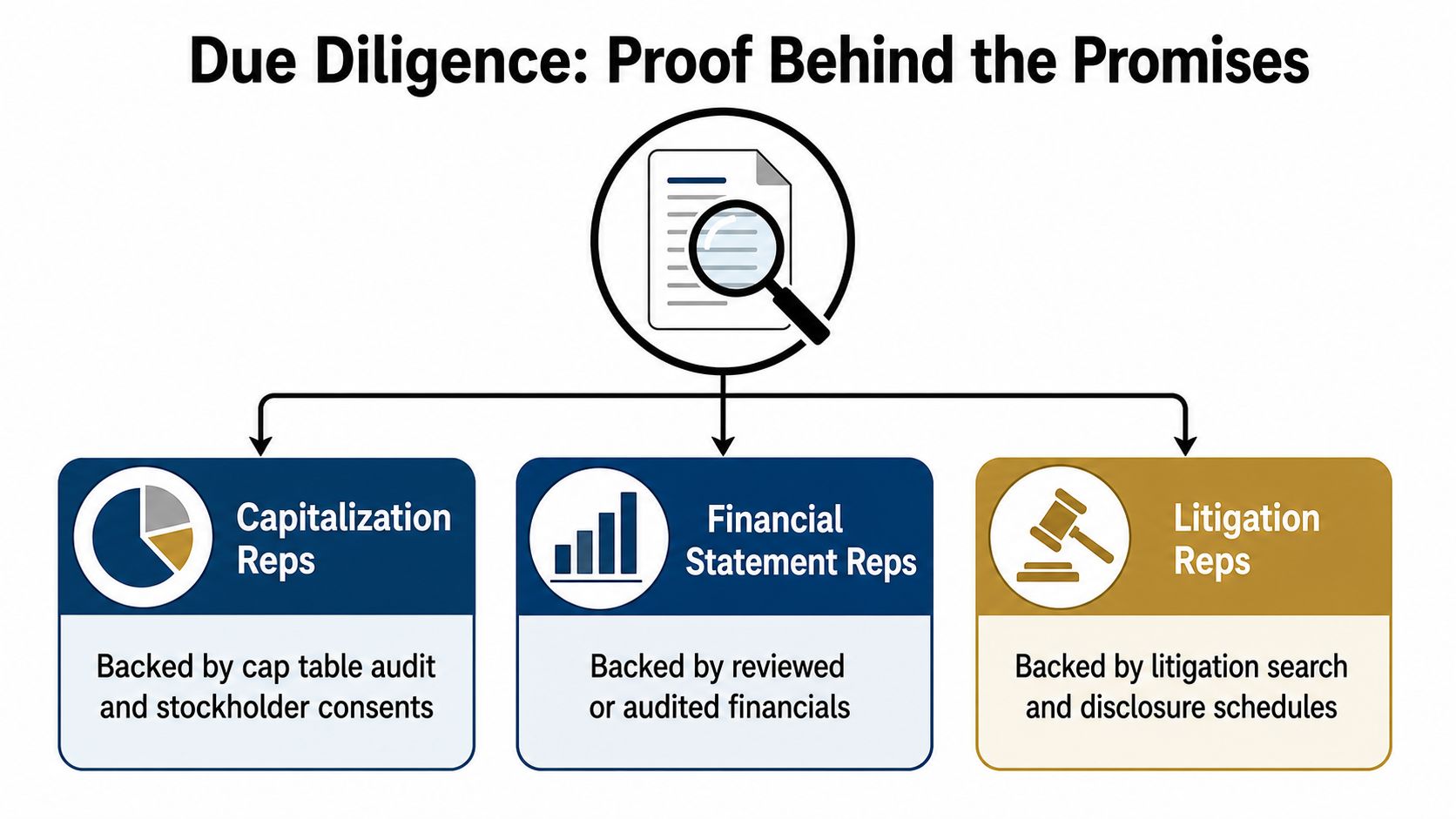
Keep the schedule internally consistent. If one rep says there are no material disputes and another schedule lists an unresolved claim, the contradiction becomes a problem that the buyer's counsel will notice immediately. Treat the schedule as a living document, because that's how it works in real transactions.
Florida and Delaware Considerations and Next Steps
Choice of law matters more than most founders expect. Delaware is the default for a lot of venture-backed companies because its corporate case law is deep on indemnification caps, fiduciary duties, and statutory protections like DGCL Section 102(b)(7). Florida applies its own corporate statutes and the Florida Revised Limited Liability Company Act, which affect operating agreements, member rights, and fiduciary duties in ways founders should not assume away.
Why State Law Changes the Deal
For South Florida founders, the key question is whether the purchase agreement should follow the company's formation state or a different governing law chosen by the buyer. Matching the governing law to the formation state often makes the paper cleaner and the rights easier to track, especially when the company is already organized in that state. A Florida LLC should also make sure its operating agreement and internal approvals line up with Florida-specific requirements.
Florida can also affect product and warranty disputes in ways Delaware doesn't. Florida's economic loss rule may change how certain product-related claims are framed, so don't assume a standard reps package will behave the same way in every forum. The point is not that one state is “better,” it's that the law you pick affects the way the clause works when something breaks later.
Florida vs Delaware Key Differences for Reps and Warrants
| Issue | Delaware | Florida |
|---|---|---|
| Corporate framework | Deep case law on M&A and indemnification | State corporate and LLC statutes govern local entities |
| Fiduciary-duty context | Highly developed and widely used in deal practice | Statutory and operating-agreement driven |
| Entity structuring | Common default for startups | Important for Florida-organized companies |
| Deal drafting focus | Cap structure, remedies, and enforceability | Operating agreements, member rights, and state-specific compliance |
If you're heading into a financing or acquisition, bring counsel in before the disclosure schedule is locked. Once reps and warrants are signed, the negotiation usually moves from drafting to damage control.
If you're negotiating a financing, sale, or investor-led acquisition, Coto & Waddington, Attorneys at Law can help you read the reps, tighten the disclosure schedule, and protect the cash you're keeping. Visit Coto & Waddington, Attorneys at Law if you want founder-focused guidance on startup transactions, corporate contracts, and deal documents that don't leave avoidable risk on the table.



