A lot of people search for a power of attorney florida sample when something has already gone wrong. A parent is in the hospital. A spouse can't sign a closing package. A founder is traveling when a bank needs an original signature. An LLC member becomes incapacitated, and suddenly nobody can access an account, approve a wire, or sign a routine document.
That's when people learn an uncomfortable truth. Good intentions don't give legal authority.
A Florida power of attorney can solve that problem, but only if it's drafted for practical application and executed correctly. Online samples often look serviceable until a bank, title company, or investor reads them closely. Then the gaps show up fast. Missing formalities. Vague powers. No coordination with an operating agreement. No backup agent. No practical plan for how the document will be used.
For families, that can mean bills go unpaid and decisions stall. For business owners, it can freeze operations at exactly the wrong time.
Why a Florida Power of Attorney is Non-Negotiable
A founder is on an overseas trip when a lender demands updated loan documents. An LLC member suffers a sudden medical event the same week payroll is due. A spouse knows exactly what needs to be done, but has no legal authority to touch the account, sign the resolution, or deal with the bank.
That is the practical reason to have a Florida power of attorney in place before there is a problem.
For individuals, a power of attorney lets an agent handle banking, taxes, bills, and property matters when the principal cannot act. For business owners, the document often carries a second job. It helps keep the company operating while the owner is unavailable, incapacitated, or out of reach for a time-sensitive transaction. I regularly see business owners rely on a generic form that names an agent broadly but says nothing useful about company authority. That is where deals stall.
The business piece is where many online samples fail. A Florida power of attorney does not override an LLC operating agreement, shareholder agreement, or corporate bylaws. If those documents restrict who can vote membership interests, approve a sale, sign contracts, or access company records, the agent may still be blocked. A workable plan usually requires the power of attorney and the governance documents to match. If they do not, the bank, the title company, opposing counsel, or your own business partners may reject the agent's authority.
This is not limited to incapacity planning. Owners use powers of attorney during travel, closings, litigation, refinancing, and routine banking problems. The question is not whether someone trustworthy exists. The question is whether that person has authority a third party will accept on the day it matters.
Florida also requires careful drafting and execution under Chapter 709. Institutions review these documents closely. If the authority over real estate, entity interests, or specific financial actions is unclear, many institutions will refuse to honor the form and ask for court involvement instead. That delay is expensive for families. It is worse for a business with payroll, vendor deadlines, or an active transaction.
Families dealing with managing a parent's legal affairs run into this problem all the time, but business owners face an added layer. They need a document that works in practical situations and fits the company's governing documents.
Before using any sample, review the other documents that should coordinate with it. This estate planning documents checklist is a useful starting point if you want financial authority, healthcare directives, and business continuity documents to work together instead of conflicting with each other.
Choosing the Right Type of Florida Power of Attorney
A founder flies overseas for a supplier meeting. While he is gone, the bank freezes a wire because the signer on file is unavailable, a lease amendment needs approval, and a buyer asks for updated corporate resolutions. His spouse has a broad personal power of attorney from an online form. The LLC operating agreement says management authority stays with the manager, member approvals are required for certain actions, and transfers of company interests are restricted. The form may be valid. It still may not solve the business problem.
Choosing the right Florida power of attorney starts with the job the document needs to do. A document built for incapacity planning is different from one built for a single closing, and neither one automatically fits an LLC or corporation.
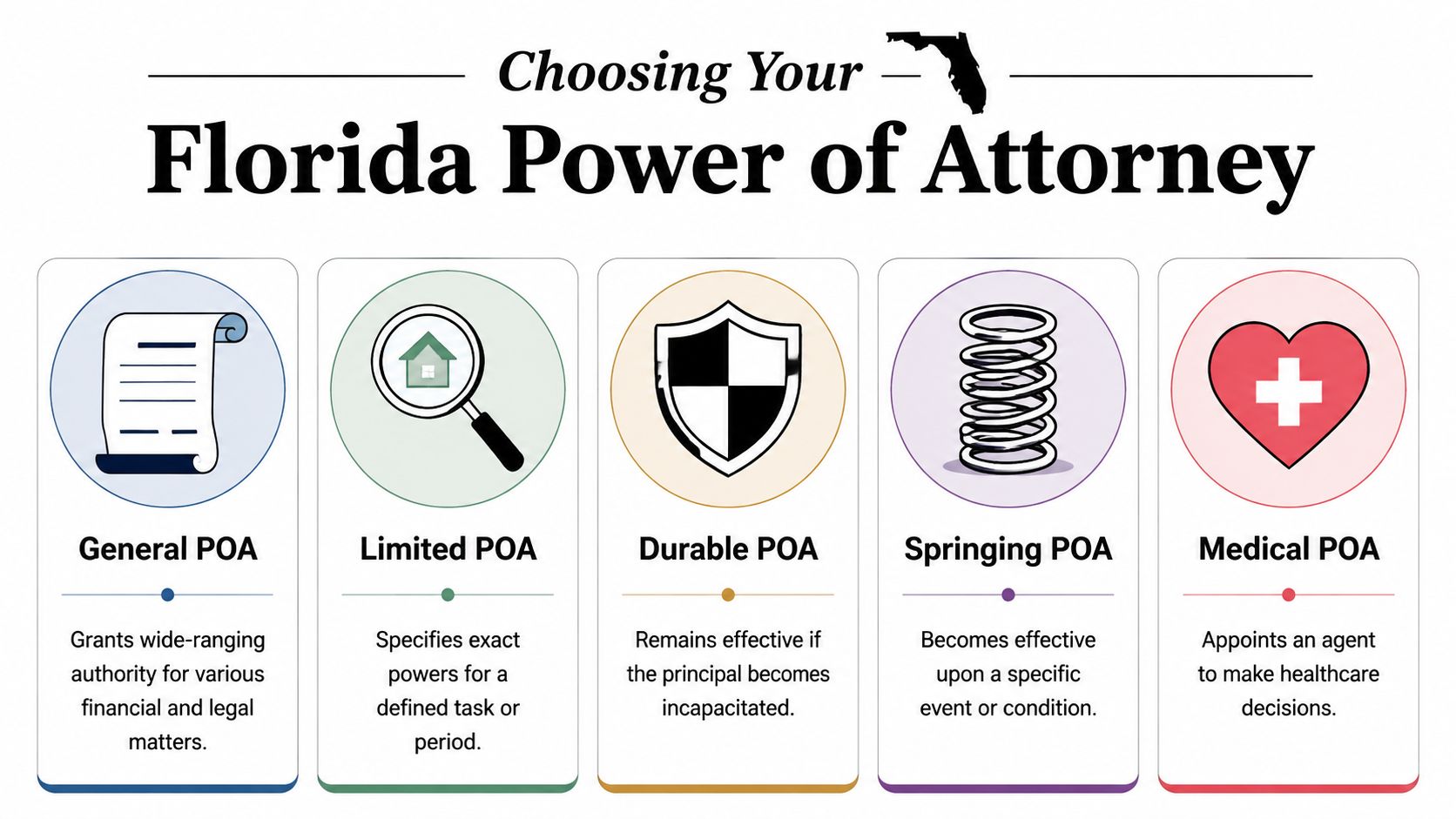
Durable versus limited authority
The first choice is usually between a durable power of attorney and a limited power of attorney.
A durable power of attorney is designed to keep working if the principal later loses capacity. For families, that often means bill payment, banking, tax matters, and handling property. For business owners, it can also mean keeping operations moving if the owner cannot sign, approve, or instruct staff.
A limited power of attorney does one narrower job. It can authorize an agent to sign a deed, handle one loan closing, deal with a title company, or address a specific banking issue during travel. That narrower scope is often the safer choice for owners who want help with one transaction without giving someone broad control over personal and business matters.
Use the wrong format and the document may create friction instead of authority.
| Type | Best use | Main strength | Common limitation |
|---|---|---|---|
| Durable POA | Incapacity planning, ongoing finances, owner absence planning | Continues if the principal later cannot act | Broad authority can be risky if the powers are not tailored |
| Limited POA | One transaction or short-term delegation | Restricts authority to a defined task | Third parties may reject it if the task is described too narrowly |
| Financial POA | Banking, taxes, property, contracts | Covers legal and financial acts | Does not authorize healthcare decisions |
| Healthcare surrogate designation | Medical decision-making | Lets someone work with providers on care decisions | Separate from financial and business authority |
Financial powers are separate from healthcare authority
Florida does not use one form for both money and medical decisions. A financial power of attorney does not let an agent consent to treatment or access the full range of healthcare decision-making authority.
That requires a separate document, usually a Designation of Health Care Surrogate. If you want a clear explanation of the difference, this overview of a Florida healthcare surrogate is a useful reference.
Business owners often miss a second split. Personal financial authority is not the same as company authority. An agent may have power to access the owner's personal bank account and still have no power to vote membership interests, sign on behalf of the LLC, approve a stock action, or amend governance documents unless the company records and the POA line up.
Immediate effectiveness matters in Florida
Florida generally does not allow new springing powers of attorney. In practice, that means the document is usually effective when it is properly signed.
That makes agent selection more important than any template language. If the principal is not comfortable giving present authority, the answer is often a narrower limited POA, tighter drafting, a better choice of agent, or all three.
I regularly see founders focus on the form and ignore the company documents. That is backwards. If the operating agreement requires manager action, board approval, or member consent for a major act, the power of attorney should be drafted with those rules in mind. A personal POA does not rewrite an LLC operating agreement or corporate bylaws.
What usually works for families, LLC owners, and founders
For many families, the starting point is a durable financial power of attorney plus healthcare documents. Families handling managing a parent's legal affairs are often focused on account access, bill payment, insurance, and coordination with medical decision-makers.
For Florida business owners, the analysis is narrower and more technical. The document should answer specific questions. Can the agent deal with the company bank. Can the agent sign tax filings. Can the agent approve a real estate lease or sale. Can the agent exercise voting rights tied to membership interests or shares. Does the operating agreement allow an attorney-in-fact to act, or does it require a manager, managing member, officer, or board resolution instead.
Those are not drafting details. They determine whether the document will work when a payroll issue, closing, lender request, or partner dispute lands on someone's desk.
Annotated Florida Power of Attorney Sample Walkthrough
A founder is in the hospital the week payroll is due. The bookkeeper needs a signature. The bank wants written authority. The operating agreement says only the manager can approve a wire over a set amount. A generic online form sitting in a desk drawer does not solve that problem unless it was drafted to match the company's actual governance.
A useful power of attorney florida sample shows more than fill-in-the-blank language. It shows how the clauses fit together, what authority is being granted, and where a personal planning document can fail for a business owner. The sample language below is a teaching tool. It is not a finished document.

Naming the agent and backup agents
The opening clause should identify the principal, the primary agent, and at least one successor agent with complete legal names.
I, [Principal Name], appoint [Agent Name] as my attorney-in-fact to act for me and in my name as provided in this Power of Attorney. If [Agent Name] is unable or unwilling to serve, I appoint [Successor Agent Name] as successor attorney-in-fact.
Clients often rush past this paragraph. That is a mistake.
The right agent is the person who follows instructions, keeps records, answers questions from banks and accountants, and does not treat the principal's assets as a shared pool of money. For business owners, the wrong choice can create more than family conflict. It can create deadlock inside the company if the named agent is also a partner, creditor, disgruntled member, or someone with a personal interest in a transfer, loan, or sale.
A personal POA also does not amend an LLC operating agreement, shareholder agreement, or bylaws. If those documents limit who may act for the company, the power of attorney must be drafted with those limits in mind.
Defining the granted powers
Florida POAs work best when the powers are stated with precision. Vague catch-all language invites rejection from banks, title companies, and anyone reviewing the document under time pressure.
A cleaner grant of authority reads more like this:
My attorney-in-fact may conduct banking transactions, access and manage deposit and investment accounts, sign tax documents, manage real property interests, handle insurance matters, and take other actions specifically authorized in this instrument.
That clause is only the starting point. A usable document for a founder usually needs sharper drafting. It should say whether the agent may deal with payroll accounts, merchant processors, state and federal tax filings, lease amendments, contract renewals, insurance claims, and entity ownership interests. If the POA is meant for one closing, one refinance, or one dispute, limit it to that job. Broad authority is not always better. Broad authority is often what creates fraud risk and internal suspicion.
Addressing business powers directly
Business authority should be spelled out in its own section, not buried in a generic property paragraph.
My attorney-in-fact may exercise my rights relating to any membership interest, shares, or ownership rights I hold in a business entity, subject to the governing documents of that entity, including any operating agreement, bylaws, shareholder agreement, or board resolution.
That last phrase does real work. It tells everyone reviewing the document that the agent's authority must be read together with the company's governing records.
For an LLC owner, the drafting should address whether the agent may vote membership interests, sign written consents, approve capital calls, inspect records, or transfer interests if the operating agreement allows it. For a corporation, the language may need to separate shareholder rights from officer authority. Those are different roles. A shareholder's personal POA does not automatically let an agent sign as president, manager, or managing member unless the company documents and corporate actions support it.
I often recommend a separate schedule for business owners that lists:
- Exact legal names of each entity
- The principal's title or ownership role in each entity
- Specific banks, lenders, landlords, or vendors the agent may need to deal with
- Actions that require separate member, manager, or board approval
- Any transfer, gifting, or sale authority that is prohibited
That extra page saves real time when a lender, CPA, or compliance department asks whether the document covers the transaction in front of them.
Durability language
If the document is intended to remain effective after incapacity, the language needs to say so clearly.
This Durable Power of Attorney is not terminated by my subsequent incapacity, except as otherwise provided by Florida law.
For families, that clause is about continuity during illness or cognitive decline. For founders, it is also about business continuity. If the owner becomes incapacitated during a financing, litigation matter, acquisition, or tax issue, the absence of valid durability language can freeze decisions at the worst possible moment.
The fallback is often a court proceeding, added delay, and tighter supervision over major decisions. That is why durability language should be reviewed with the same care as the grant of powers.
Powers that need extra care
Some powers should never appear in a form by accident. Gifting authority, trust-related authority, beneficiary changes, and transfers of ownership interests need narrow drafting and a clear purpose.
A cautious clause might read:
My attorney-in-fact may make gifts only to the extent expressly authorized in this instrument and only as consistent with my estate planning objectives and legal obligations.
That language should usually be tightened further. A parent may want limited gifting for tax or Medicaid planning. A business owner may want an absolute ban on transferring membership interests or shares. A married client may want an agent to handle joint household accounts but have no authority to alter business ownership or succession rights.
Poorly drafted gift provisions are one of the fastest ways to turn a planning document into a lawsuit exhibit.
Acceptance language and institutional friction
A sample should also show how to reduce resistance from third parties reviewing the POA.
Any third party may rely upon the representations of my attorney-in-fact as to all matters relating to powers granted under this instrument, unless otherwise limited by law.
That clause helps, but it does not cure bad drafting. Institutions compare the POA to the transaction they are being asked to honor. If the names are inconsistent, the entity is listed incorrectly, the authority is too vague, or the company documents point in a different direction, the document may still be rejected.
The practical review checklist is simple:
- Use exact legal names for the principal, agent, and every business entity.
- State sensitive powers directly instead of relying on broad general language.
- Name successor agents so authority does not collapse if the first choice cannot serve.
- Check the operating agreement, bylaws, shareholder agreement, and resolutions before finalizing the POA.
- Revisit older forms copied from another state or prepared before major changes in the client's business structure.
A sample is useful for spotting the moving parts. It is not enough by itself. The document has to match the principal's assets, the company's governance rules, and the actual decisions someone may need to make under pressure.
Executing Your Florida POA Correctly The First Time
A founder is in the hospital. Payroll is due Friday. A lender needs signatures. The company bank has the power of attorney in hand and still says no.
That usually happens because the document was signed incorrectly, the notary block is defective, or the authority in the POA conflicts with the company's own governance documents. I see this with self-prepared forms that look fine on a kitchen table and fall apart the first time a bank, title company, or closing agent reviews them.

Florida's execution requirements
Florida requires a valid power of attorney to be signed by a competent adult principal in the presence of two witnesses and a notary. Those formalities are not paperwork trivia. If the signing ceremony is defective, the POA may be rejected at the worst possible moment.
Witness choice matters too. Keep the named agent out of the witness line. Avoid witnesses with a direct financial stake in the principal's affairs. That reduces the chance of later challenges and removes an easy excuse for a third party to question the document.
For business owners, execution is only part of the analysis. The POA also has to fit the company records. An LLC operating agreement may restrict who can bind the company, approve transfers, admit members, or access books and records. Corporate bylaws, shareholder agreements, and board resolutions can create the same problem. A properly signed POA does not override internal governance just because it uses broad language.
How the signing should happen
Run the signing like a controlled legal event.
Start with the final draft. Do not walk into the room with blanks, sticky notes, or plans to make quick edits at the table. Last-minute handwritten changes create authenticity questions that are hard to answer later.
Then get the right people in the room at the same time. The principal, both witnesses, and the notary should participate in one continuous signing session. Names on the identification should match the document. Dates should match. The acknowledgment should be complete before anyone leaves.
I also tell business clients to bring the supporting company documents into the review before signing day. If the POA says the agent can manage LLC interests, sign contracts, deal with lenders, or handle ownership transfers, compare that language against the operating agreement or bylaws first. Otherwise, you can end up with a valid POA and no actual path to complete the transaction.
Common execution mistakes
The mistakes are repetitive, and expensive:
- Using an interested witness or the named agent as a witness. That invites scrutiny.
- Relying on a generic notary certificate. If the acknowledgment is incomplete or inconsistent, title companies and banks may refuse it.
- Signing a version that does not match the final business documents. Entity names, member names, share ownership, and titles must be exact.
- Leaving attachments unfinished. If the POA refers to schedules, special instructions, or incorporated powers, those pages need to be attached and final.
- Assuming broad authority beats company governance. It does not. The bank may ask for resolutions, incumbency certificates, or proof that the agent can act under the governing documents.
- Storing the original where nobody can reach it. A perfect document in a locked safe is useless during a medical emergency or closing deadline.
Banks do not fix defective POAs. They reject them and move on.
Real estate and business use
If the agent may sign a deed, mortgage, or other real estate instrument, recording the POA may be necessary in the county where the property transaction occurs. That is a separate practical step many DIY forms never mention.
Business owners have another layer of risk. A POA can authorize an individual to act for the principal, but it does not automatically rewrite an LLC operating agreement, remove manager approval requirements, or let an agent bypass investor consent rights. If the founder owns interests through a holding company, the review gets even tighter because the authority chain has to work at each entity level.
Some clients handle drafting and execution through one law office so the signing ceremony and the governance review happen together. In South Florida, one example is Coto & Waddington's estate planning attorney services when the POA needs to coordinate with business ownership, founder authority, or family planning.
Agent Responsibilities and Common Costly Mistakes
A Florida POA usually fails in practice after the signing, not at the signing.
The pattern is familiar. A spouse, adult child, COO, or co-founder gets named as agent. Everyone assumes that person can step in if the principal is sick, traveling, or unavailable. Then money moves without a paper trail, contracts get signed without checking the company documents, or an agent treats personal and business authority as the same thing. That is where expensive disputes start.

An agent is a fiduciary. In plain terms, the agent must act for the principal's benefit, stay within the authority granted, avoid self-dealing, and keep records that can survive scrutiny from family members, lenders, accountants, and sometimes a court.
Recordkeeping is where many agents get in trouble
Bad records create suspicion, even when no one stole anything.
I regularly see the same sequence. The agent pays ordinary bills from the principal's account. Then one expense goes on the agent's personal card for convenience. Later, the agent reimburses himself or herself. A transfer gets made between accounts with no memo line, no ledger entry, and no supporting note. Once another family member, business partner, or investor asks for backup, the explanation sounds weak because the file is weak.
A careful agent keeps a running ledger from the first day of service. That record should show what was paid, the date, the account used, the purpose, and how the payment benefited the principal. Receipts matter. Notes matter. Separate accounts matter even more.
For business owners, this gets stricter. If the principal owns an LLC or corporation, company funds are not a family reserve account. An agent with authority over the principal's interests still cannot treat payroll money, operating cash, or retained earnings as if they were personal household funds.
Borrowing, reimbursement, and gifts are common failure points
The phrase "I was going to pay it back" shows up in many bad POA situations.
Agents should not borrow from the principal, make undocumented advances to themselves, or take an early inheritance unless the document clearly permits the transaction and the facts support it. Reimbursements should be tied to actual expenses paid for the principal, with receipts and a clear explanation. Gifts raise the same problem. If gifting authority is unclear, the safe move is to stop and get advice before money leaves the account.
That restraint matters even more in a closely held business. A transfer that looks minor in a family setting can trigger major tax, accounting, or ownership issues when business interests are involved.
Florida business owners face a different set of risks
Generic POA forms are usually written for personal bill paying, banking, and medical-adjacent planning. They often ignore how authority works inside an LLC or corporation.
That omission causes real trouble. A founder signs a broad POA naming a spouse or trusted executive as agent. Months later, the agent tries to sign loan documents, approve a lease amendment, deal with a merchant processor freeze, respond to a capital call, or handle a bank compliance request. The other side does not just ask for the POA. It asks whether the company documents allow that act, whether member or board approval is still required, and whether the principal had authority to delegate that specific decision in the first place.
A POA does not amend an LLC operating agreement. It does not override bylaws. It does not cancel manager-consent provisions, investor veto rights, buy-sell restrictions, or bank signature rules. If the business is owned through a holding company, the authority chain may need to work through more than one entity. That is the gap many online templates miss, and it is exactly why business owners should review the POA alongside the operating agreement, shareholder agreement, bylaws, and banking resolutions before anyone relies on it.
What a careful agent should do
Agents who avoid trouble usually follow a disciplined process:
- Read the POA closely before acting. Broad assumptions cause narrow problems.
- Check the related business documents. Operating agreements, bylaws, shareholder agreements, and resolutions may limit or condition the agent's authority.
- Sign in the correct representative capacity. The signature should show the agent is acting for the principal, not personally.
- Keep backup for unusual transactions. Major transfers, contract approvals, ownership actions, and real estate decisions should have written support in the file.
- Pause in gray areas. Paying a bill is one thing. Changing ownership rights, approving financing terms, or moving company money without governance review is another.
The agents who create the fewest problems are usually the least dramatic. They document everything, keep roles separate, and refuse to guess. That approach protects families. It also protects founders, managers, and the businesses that depend on clear authority.
How to Revoke or Change a Florida Power of Attorney
Power of attorney documents shouldn't be treated as permanent just because they were signed correctly once. Relationships change. Businesses change. People move, divorce, retire, or lose trust in the person they originally named.
Revocation needs to be done deliberately.
What revocation should look like
A written revocation should clearly identify the original power of attorney, the date it was signed, and the fact that the principal is canceling all authority granted under it.
A simple form of language often looks like this:
I, [Principal Name], hereby revoke and terminate the Power of Attorney executed by me on [Date], in which I appointed [Agent Name] as my attorney-in-fact. Effective immediately, all authority granted under that instrument is withdrawn.
That document should then be signed with the same level of care you would use for the original. If third parties already have the old POA, revocation isn't complete in any practical sense until they receive notice.
The practical checklist
Use a methodical process:
- Prepare a written revocation that identifies the prior POA precisely.
- Sign it with formalities that reduce later arguments about authenticity.
- Deliver it to the former agent so there's no doubt the authority has ended.
- Notify banks, brokerages, title companies, and other institutions that may have relied on the old document.
- Replace the old POA if needed rather than leaving a gap in authority.
Destroying your personal copy isn't enough if a bank still has the old one in its file.
Digital signatures and remote execution issues
Remote and hybrid business owners ask about e-signatures all the time, especially when they want fast execution from different locations.
The problem is that Florida's 2023 to 2024 updates to the Power of Attorney Act do not clearly address e-signatures or remote online notarization for all POAs, which leaves uncertainty about whether digitally signed documents will satisfy bank and title-company requirements in practice, as discussed in this article on Florida POA digital-signature issues.
That doesn't mean digital workflows are never usable. It means you shouldn't assume every institution will accept them. If the POA may be used for banking, title work, or a founder-level transaction, confirm acceptance standards first and document that confirmation.
Next Steps and When to Consult a Florida Attorney
A founder is on a flight when the company bank freezes a wire request, the registered agent needs a signed filing, and the operating agreement says only a manager or properly authorized agent can act. The generic POA downloaded last year does not answer the bank's questions or the company's governance questions. That is the point where cheap drafting gets expensive.
A Florida power of attorney form helps you identify the core clauses. It does not resolve the harder issues that come up when a bank, title company, investor, or business partner asks whether the agent has authority to act for the company and under the governing documents.
Get legal advice before signing if any of these apply:
- You own an LLC or corporation and the POA needs to work with an operating agreement, bylaws, shareholder agreement, or manager consent requirements.
- You have co-owners, investors, or lenders who may question whether an agent can bind the business.
- You need authority over business banking, payroll, contracts, or state filings and cannot afford delays caused by a rejected form.
- You want the agent to handle real estate, entity transfers, or high-value accounts where institutions review POAs closely.
- You expect conflict between family members, business partners, or a successor manager.
- You need gifting, compensation, or self-dealing limits drafted with precision so the agent's authority is clear and defensible.
- You work across states or sign remotely and need to confirm what each institution will accept before there is an emergency.
- You already signed an older POA but are not sure it still fits your current business structure or banking setup.
Business owners miss one issue more than they should. A personal POA and company governance documents have to match. If the operating agreement requires manager approval for a major act, the POA does not override that requirement by itself. The same problem shows up in corporations when bylaws, board resolutions, or signing-authority policies say something different from the POA. Online templates rarely address that conflict, and banks notice it.
Timing matters too. A POA ends at death, which means the agent cannot keep running personal affairs or company ownership matters under that document after the principal dies. For a plain-English explanation of that boundary, see this article on power of attorney roles after death.
If the document has to hold up under real scrutiny, have a Florida attorney review the POA together with the LLC operating agreement, corporate records, title issues, and succession plan. A Fort Lauderdale estate planning attorney can also spot the practical conflicts that cause rejections later, such as mismatched entity names, missing special powers, or authority that exceeds what the company documents permit.
If you need a Florida power of attorney that works when a bank, title company, healthcare provider, or business counterparty reviews it, Coto & Waddington, Attorneys at Law can help prepare and coordinate the document with your estate plan and business records. The goal is simple. A POA that is valid, usable, and matched to how your family and company operate.