You finished the work. The client approved the deliverable. The invoice went out. Then the waiting starts.
For a Miami founder, that gap between delivery and payment is where stress shows up fast. Payroll doesn't wait. Software subscriptions don't wait. Rent doesn't wait. If your contract gives the client a long runway to pay, or says almost nothing about timing, you may have a revenue problem on paper and a cash crisis in real life.
That's why payment terms in contracts matter far more than most startups think. They are not boilerplate. They are a financing decision, a risk allocation tool, and often the difference between a healthy client relationship and a collections dispute. If you want a broad primer before tightening your own forms, Legitt AI's guide to payment terms is a useful starting point. Then bring that general guidance back to your own operation, your service model, and your bookkeeping discipline, especially if you're still cleaning up inconsistent invoicing and weak business expense tracking practices.
Table of Contents
- Why Payment Terms Are Your Cash Flow Lifeline
- The Anatomy of a Strong Payment Clause
- Common Payment Models and When to Use Them
- Enforcing Your Terms When Payments Go Wrong
- How to Negotiate Payment Terms That Protect You
- Advanced Considerations for Florida Businesses
- Frequently Asked Questions on Contract Payment Terms
- What's the difference between payment terms on an invoice and payment terms in the contract
- Can I change payment terms for an existing client
- What's a reasonable late fee in Florida
- Should I use Net 30 for every client
- Is an upfront deposit really necessary
- What if the client says their procurement policy won't allow my terms
Why Payment Terms Are Your Cash Flow Lifeline
A Miami founder signs a new client, puts the team to work on Monday, and sends the invoice after delivery. Two weeks later, the client says the invoice is still routing through procurement, then accounts payable, then final approval. Payroll is due before the client's process is.
That gap is where early-stage companies get squeezed. Payment terms decide who funds the work in the meantime. If your contract lets the client delay the invoice trigger, stretch the due date, or dispute vague milestones, your business becomes the lender.
Mature markets treat late payment as a real commercial risk, not a drafting detail. Under European Directive 2011/7/EU, commercial buyers generally cannot push payment terms past 60 days without consequences, and creditors may recover late-payment interest and a fixed recovery amount, as outlined in Corcentric's summary of commercial payment term rules. Florida law does not hand most founders that kind of automatic protection in ordinary service contracts. The contract usually does the heavy lifting.
Payment terms shape cash flow, risk, and client behavior at the same time. They control when you can invoice, how long money can sit outstanding, whether deposits are required, and when you can stop work without creating a new dispute. They also affect the relationship. Clear terms reduce friction because each side knows what happens before the first invoice goes out.
Founders often focus on headline price and miss the financing cost buried underneath. A $40,000 project on net 60 with no upfront deposit can strain a young company more than a $30,000 project with 50 percent paid at signing and milestone billing after that. The second deal may produce less revenue on paper, but it often creates healthier cash flow and less collection risk.
This is why I treat payment terms as an operating tool, not a formality. Good terms help you fund growth without relying on a credit line every time a client pays late. They also give you cleaner records, which matters when you are reviewing receivables, forecasting payroll, or trying to tighten business expense tracking for growing companies.
If you want a broader primer before revising your contracts, Legitt AI's guide to payment terms covers the basics. The real work, though, is matching the clause to your business model. A design studio, SaaS company, contractor, and product distributor should not be using the same payment structure.
Start with your actual exposure. Review every active customer agreement and flag language such as “payment upon completion,” “payment upon receipt,” or “net terms as agreed.” Those phrases create room for delay, internal approval excuses, and avoidable collection fights.
Before you sign the next client, revise your template so the payment clause supports your cash needs, your delivery process, and your tolerance for risk.
The Anatomy of a Strong Payment Clause
A strong payment clause does one thing very well. It removes room for argument.
Founders often focus on scope, pricing, and intellectual property, then leave payment language thin and generic. That's a mistake. In practice, the payment clause is where operational discipline meets legal enforceability. If you need a real-world example of how a business presents its payment framework, Intelligent Contacts payment policy is worth reviewing for structure and drafting ideas.

What must be stated clearly
At a minimum, your clause should identify the pieces that need no guesswork. Payment terms clauses must legally disclose specific components including the invoice date, total payment amount, the due date, the payment period, stipulations for advances or deposits, and a list of accepted payment methods, as discussed in this video explanation of contract payment clause essentials. Listing accepted payment methods matters because it prevents friction when payment is due.
Use this checklist when reviewing your form:
- Invoice trigger: State when the invoice may be issued. On signing, on delivery, monthly, on milestone completion, or on acceptance.
- Exact due date: Use a calendar-based formula that can be counted. “Due within 15 days of invoice date” is better than “promptly.”
- Accepted methods: Specify ACH, wire, credit card, check, or another method you accept.
- Deposit terms: If there's an advance, say when it's due and whether work starts before receipt.
- Late charges: State the interest or fee structure clearly if you intend to enforce it.
- Work suspension rights: Reserve the right to pause work if invoices become overdue.
For founders using layered agreements, this clause should also line up with your master agreement and your statement of work. If the MSA says Net 30 but the SOW says half upfront and half on launch, you've created a dispute before the project even starts. This is one reason businesses spend time tightening clauses in a contract instead of treating each section as isolated boilerplate.
What weak language looks like
Weak clauses usually have one of three problems.
First, they use vague timing. “Upon receipt” sounds clear until the client treats it as a courtesy request instead of a due date.
Second, they skip operational detail. If you don't say who pays processing fees, where payment is sent, or whether partial payments are accepted, those issues get negotiated after the invoice is already late.
Third, they separate legal language from business reality. A startup doing custom development, design, marketing, or consulting should not use the same payment language as a seller shipping simple goods.
A payment clause should answer every collection question before the invoice is sent.
Tip: Read your clause from the perspective of the client's accounts payable department. If a stranger can't tell exactly when, how, and why payment is due, rewrite it.
Call to action: Pull your standard contract today and mark every phrase that could support two different interpretations. If a sentence can be argued both ways, it will be.
Common Payment Models and When to Use Them
A Miami founder signs a custom build contract on Net 30 because the client says that is “standard.” Three weeks later, payroll hits, subcontractors need to be paid, and the first invoice is still sitting in the client's approval queue. The problem is not only late payment. The problem is that the contract financed the client's project with the founder's cash.
Payment terms shape who carries the cost of delay, scope drift, and internal approval slowdowns. Used well, they do more than define due dates. They help you protect margin, control working capital, and reduce the odds that a good client relationship turns into a collection problem.
Choosing the right model for the job
The right payment model should track two things: when you incur cost and when the client can reasonably confirm value. If those two points are far apart, a bad billing structure creates strain fast.
| Payment Model | Best For | Cash Flow Impact | Client Risk |
|---|---|---|---|
| Upfront deposit plus final payment | Creative services, consulting, strategy work, small fixed-fee engagements | Strong early cash flow and lower collection exposure | Moderate, because the client pays before full delivery |
| Net 30 invoicing | Established client relationships, repeat work, straightforward service cycles | Slower cash conversion | Lower, because payment follows invoice cycle |
| Milestone payments | Software builds, branding projects, implementation work, custom production | Better cash alignment during the project | Balanced, because payment ties to defined deliverables |
| Monthly retainer | Ongoing advisory, marketing support, outside general counsel, maintenance | Predictable recurring cash flow | Moderate, depending on termination rights |
| Progress billing with retention | Construction and performance-sensitive work | Partial funding during performance, delayed final release | Lower for the client due to holdback protection |
A deposit-plus-final model works well when your labor ramps up before the client sees a finished product. Designers, consultants, agencies, and developers often absorb real cost in discovery and early production. If payment waits until the end, any dispute over revisions can freeze the entire fee. A deposit reduces that exposure.
Net 30 works best when the work is repeatable, the client has a reliable accounts payable process, and the amount at risk on any one invoice is manageable. It is often acceptable for routine monthly services. It is usually a poor fit for custom project work with heavy front-loaded labor.
Milestone billing is often the strongest middle ground. It gives the client clear checkpoints and gives your business cash during performance, not only after delivery. The key is to tie each invoice to an objective event such as completion of wireframes, approval of a prototype, launch of a defined module, or delivery of a stated quantity of goods. If the milestone is vague, payment gets vague too.
Retention can make sense in construction, specialty manufacturing, or other performance-sensitive work, but founders should price for the delay. A holdback shifts risk to the service provider and can trap profit for months. Before agreeing to it, review what happens if the client refuses signoff, whether the retention release date is fixed, and what remedies are available for breach of contract if the holdback is never paid.
For recurring revenue businesses, the analysis changes. Predictable billing often matters more than stage-based verification. If your company sells subscriptions, replenishment products, or ongoing access, the contract should support recurring charges, renewal timing, failed payment handling, and cancellation rules. Founders building that model can borrow practical ideas from mastering subscription ecommerce growth.
Where founders often choose the wrong model
I see the same mistake often. A founder accepts the client's preferred terms without matching them to the founder's own cost structure.
That is how profitable work creates cash pressure.
Common mismatches include:
- Net terms for custom work: You pay employees and vendors now, but the client pays after internal processing.
- Single final payment for a long project: One disagreement can stall the full invoice.
- Monthly billing for high upfront setup: Early labor goes unpaid while your team carries the load.
- Retention on thin-margin work: The delayed amount may be the profit.
- Retainers without refill rules or auto-billing terms: Work continues after the paid period ends, and collection gets harder.
A better way to choose is simple and operational.
- Short, defined engagements: Use a deposit and a final payment.
- Long projects with clear phases: Use milestone payments tied to specific deliverables or approvals.
- Ongoing services: Use a monthly retainer billed in advance when possible.
- Goods or high-cost procurement: Use partial prepayment before ordering materials.
- Work where post-delivery performance matters: Use retention only if the contract strictly defines release conditions.
The client's preferred structure reveals how much risk they want to push downstream. Your contract should put that risk where it belongs, not where cash is easiest for the client.
Tip: Build one default payment model for each service line you sell. If every proposal starts from a blank page, sales pressure will keep weakening your terms.
Call to action: Review your last three client deals and compare invoice timing to when you paid labor, software, and vendors. If your money goes out before theirs comes in, change the model before your next contract goes out.
Enforcing Your Terms When Payments Go Wrong
Friday afternoon, your team is still working, the client has the deliverables, and the invoice is ten days past due. If you do not act quickly, you start financing payroll, vendors, and overhead with your own cash while the client decides payment on their timeline.
A payment clause matters most after the relationship gets uncomfortable. Good terms give you a clear collection path, preserve your options, and show the client that your process is serious.
Start with a disciplined collections process
Founders often wait because they want to preserve goodwill. In practice, silence usually creates more risk. The client gets used to delay, your team keeps working without payment, and any future dispute becomes harder to sort out.
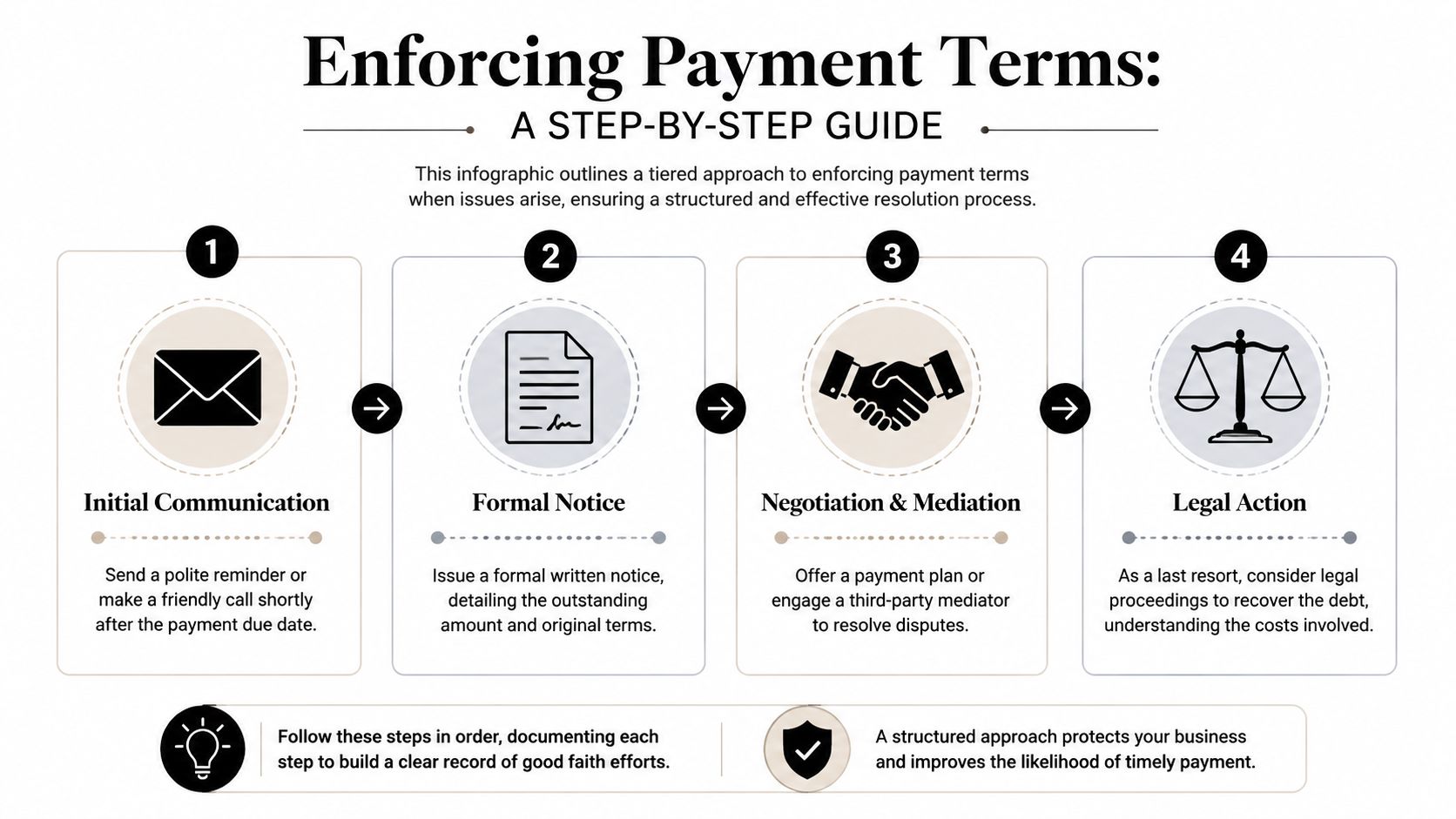
Use a written sequence and follow it every time.
- Send a reminder as soon as the invoice becomes overdue. Keep it short and professional.
- Attach the invoice and the payment clause. Do not make accounts payable hunt for documents.
- Ask one direct question. Is this an internal processing delay, or is the client claiming a problem with the work?
- Give a firm follow-up date. Open-ended emails invite more delay.
This is an operations issue as much as a legal one. Automated reminders, clean invoice records, and one owner for collections usually solve routine late payments before they become legal disputes.
If your contract allows late fees or interest, apply them consistently. The point is not punishment. The point is to put a real price on late payment so the client does not treat your company like a free credit line.
Escalate in steps, with facts
If informal follow-up does not work, send a formal notice. That notice should identify the contract, the invoice number, the amount due, the due date, any authorized late charges, and the deadline to cure the default.
Then decide what the contract lets you do next. Typical options include:
- Pause future work. This is often the fastest way to get attention in service agreements.
- Hold delivery of unfinished items. Only do this if the contract clearly allows it and the facts support it.
- Place the account on credit hold or apply setoff rights. This matters in ongoing commercial relationships with repeat orders.
- Escalate the nonpayment as a breach claim. Before taking that step, review the available remedies for breach of contract and make sure your notice matches the contract requirements.
Florida businesses also need to think about industry-specific collection tools. Construction, procurement, and project work can involve lien rights, bond claims, or statutory notice rules with short deadlines. Those remedies can be powerful, but they are technical and timing-sensitive. Empty threats hurt your credibility. Use them only when the statute, the contract, and the project record all support the claim.
One clear notice sent on time usually does more than a week of apologetic emails.
Tip: Build a collections ladder now. Decide who sends the first reminder, when work stops, when management steps in, and when counsel reviews the file.
Call to action: Audit your current overdue invoice process this week. If there is no written trigger for reminders, work suspension, and formal notice, your contract is stronger on paper than it is in practice.
How to Negotiate Payment Terms That Protect You
A Miami founder lands a great client, signs the client's form agreement, delivers the first phase on time, and then waits 45 days for an invoice to clear “internal approval.” The work was profitable on paper. The payment terms turned it into a cash squeeze.
That is why payment terms need to be negotiated with the same care as price and scope. Price sets revenue. Payment structure decides whether your business funds payroll with collected cash or with its own balance sheet.
Ask earlier and frame it better
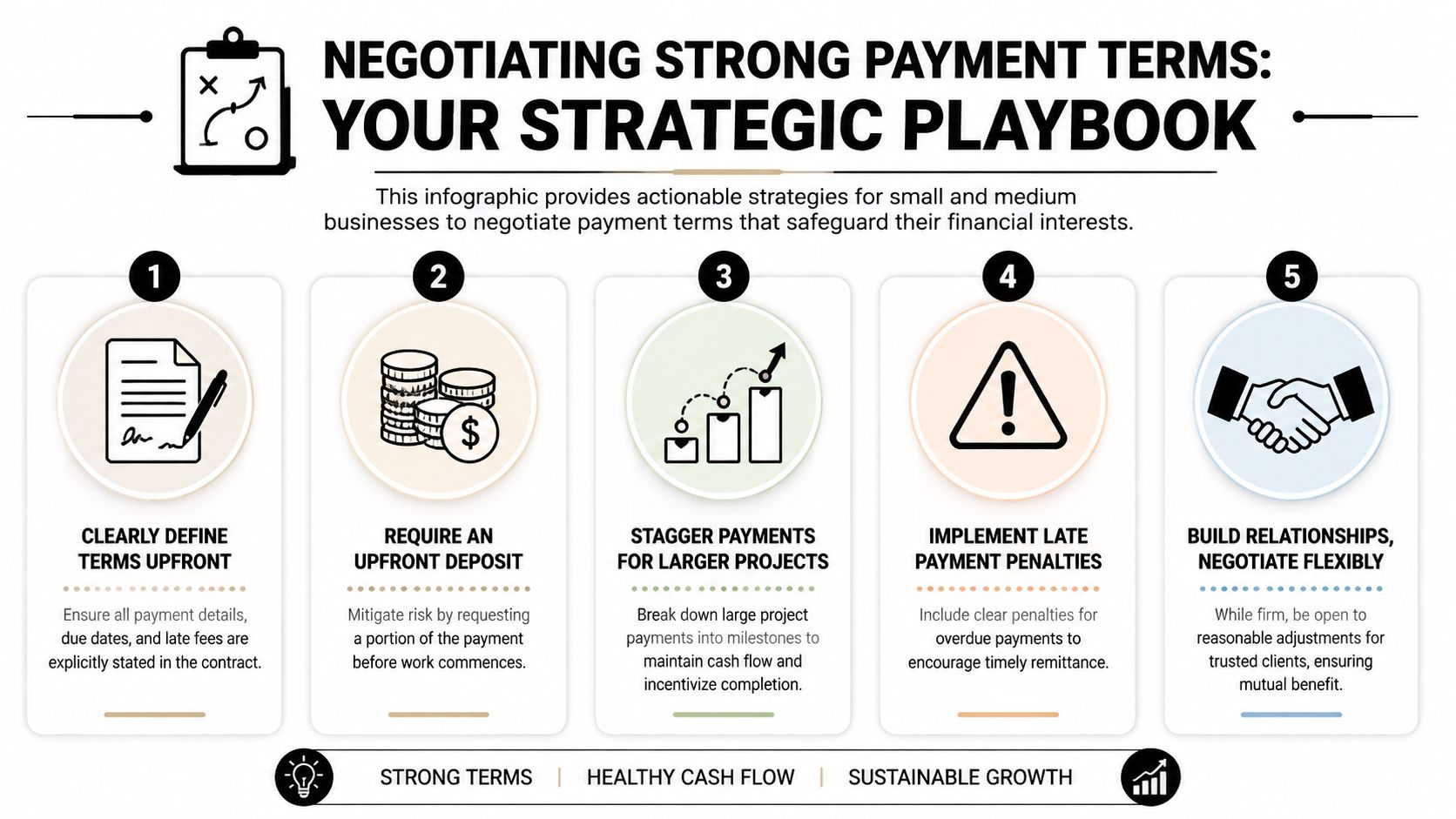
Negotiate payment terms before the client's template hardens into “standard.” The best window is during the proposal, scope review, or procurement intake stage, when both sides are still deciding how the project will run.
Frame the request as operational discipline, not suspicion. A deposit is not just partial prepayment. It reserves calendar space, covers kickoff time, and confirms the client is ready to proceed. For startups and service businesses, that matters. If your team starts work without money in the door, you are extending unsecured credit.
Use plain language:
- For custom work: “We begin after the deposit is received because we are assigning team time and scheduling the project at kickoff.”
- For long engagements: “We invoice by milestone so payment stays tied to completed phases.”
- For ongoing services: “Recurring billing keeps delivery and payment on the same schedule.”
A calm explanation usually works better than a hard stance. Procurement teams hear payment requests all the time. What they need is a business reason they can approve internally.
Trade concessions for something concrete
Some clients will push back on deposits, especially larger companies with rigid accounts payable systems. Do not respond by absorbing the risk for free. If you give ground on one point, get protection somewhere else.
That might mean a smaller upfront payment paired with faster milestone billing. It might mean shorter acceptance periods, automatic approval if the client does not respond by a set date, or a tighter invoice due date after delivery. It can also mean an early payment discount if the margin supports it.
The point is simple. Every concession has a cost. If the client wants more time to pay, the contract should reduce your exposure somewhere else.
For larger or more complex matters, milestone billing often works better than a single invoice at the end. It limits how much cash is tied up at any one time. It also narrows disputes. If the client argues about phase three, they should not be holding phase one and two money.
Negotiate the terms behind the due date
Founders often focus on “Net 30” and miss the language that really controls payment timing. Key negotiation usually sits in the definitions.
Watch these points closely:
- Invoice trigger: State exactly when you can invoice. Do not leave it to “upon client approval” or another vague event.
- Acceptance standard: Define what counts as acceptance and how long the client has to object.
- Dispute process: Limit disputes to specific, documented issues. The client should still pay the undisputed amount on time.
- Change orders: Extra work should create extra payment, not get folded into the original price.
- Expenses and pass-through costs: Say whether they are billed in advance, monthly, or at cost with markup if allowed.
These details protect cash flow more than abstract promises about partnership or trust.
Match the ask to your actual risk
The right payment structure depends on the deal. A startup selling a fixed-price website build should not use the same terms as a company providing monthly managed services or a manufacturer carrying inventory for a custom order.
Ask three questions before you mark up the contract. How much do you spend before the client pays? How hard is it to reuse the work if the project stops? How much damage does a late payment cause to payroll, vendors, or tax obligations?
If the upfront cost is high, ask for more money at signing. If the work is easy to divide into phases, use milestone billing. If the relationship is ongoing, shorten the billing cycle and keep acceptance mechanics simple. Good negotiation is less about sounding tough and more about matching terms to risk.
Counsel can help with that analysis in a concrete way. Businesses often use firms such as Coto & Waddington, Attorneys at Law for contract drafting support that aligns payment mechanics with deliverables, acceptance criteria, and work-stoppage rights, instead of treating payment language like boilerplate.
Tip: Before sending a contract, decide your walk-away point. For example: no work without an initial payment, no unlimited approval window, and no clause allowing the client to withhold the full invoice over a partial dispute.
Call to action: Review your current template and mark the places where payment can be delayed without breaching the agreement. If you find vague approval language, weak milestone triggers, or open-ended dispute rights, revise them before the next proposal goes out.
Advanced Considerations for Florida Businesses
A Miami founder lands a foreign client, sends the invoice in dollars, gets paid in another currency, and then learns the client withheld tax without warning. The work may be finished, but the cash flow problem is just starting. Florida businesses, especially in South Florida, need payment terms that address how money moves in practice, not just when an invoice is due.

Cross-border and tax issues matter in South Florida
If a client, vendor, or affiliate is outside the United States, the contract should identify the payment currency, the payment method, and who absorbs wire fees or exchange-rate loss. Leaving those points open invites dispute. It also creates a bookkeeping mess when the contract, invoice, and bank records do not match.
Tax language matters just as much. State whether taxes are included in the price, billed on top of the price, withheld by the payor, or paid directly by one party. If foreign withholding applies, address whether the client can deduct it from the invoice and what proof they must provide. Otherwise, a founder may discover too late that the amount received is less than the amount expected, with no clean contract remedy.
Florida founders should also watch enforcement risk. A judgment clause that works fine against a local customer may do little good if the other party has no reachable assets in the United States. In cross-border deals, payment security often matters more than legal theory. That can mean a larger advance, shorter billing intervals, or a right to pause work the moment payment slips.
Construction and project work need extra care
Project-based businesses face a different problem. Revenue may look strong on paper while cash gets trapped in retainage, approval delays, change-order disputes, or owner-funded payment chains. That is common in development, trades, fabrication, and installation work across Florida.
Retention can protect the buyer, but it can also force the contractor to finance the job. If you accept retention, define the release date, the documents required for release, and whether partial release happens at specific milestones. Do not rely on words like "substantial completion" or "final completion" unless the contract defines them with enough detail that both sides will read them the same way.
Pay-close attention to pay-when-paid and pay-if-paid language if your business sits in the middle of a project chain. Those clauses can shift serious collection risk downstream. Before signing, determine whether you are agreeing to a timing mechanism or taking the risk that someone else never pays at all. That difference affects payroll, vendor obligations, and whether the project is worth taking.
One practical rule applies across both international and project work. The more parties, approvals, jurisdictions, and conditions involved, the less room there should be for vague payment language.
Tip: For any Florida contract involving foreign parties, retention, withholding tax, or layered project payments, review the payment clause line by line before signature. Standard template language usually fails where cash flow pressure is highest.
Call to action: Pull your current contract template and test it against one real deal in your pipeline. If you cannot tell, from the contract alone, what currency will be paid, what can be withheld, when funds are due, and when you can stop work, fix the clause before you send the next draft.
Frequently Asked Questions on Contract Payment Terms
What's the difference between payment terms on an invoice and payment terms in the contract
The contract controls the legal relationship. The invoice implements it. If your invoice says one thing and your signed agreement says another, the contract usually creates the stronger position. The safest practice is to make the invoice mirror the contract exactly.
Can I change payment terms for an existing client
Yes, but don't do it informally. Put the revised terms in a signed amendment, updated statement of work, or new service order. If you begin writing different due dates on invoices without written agreement, you may create confusion instead of enforceable change.
What's a reasonable late fee in Florida
Reasonableness depends on the contract, the business relationship, and whether the charge is drafted as interest, a fee, or another remedy. The key point is clarity and consistency. Don't impose charges that your contract never authorized.
Should I use Net 30 for every client
No. Net 30 may work for repeat clients and low-risk work, but it's often a poor fit for custom projects or labor-heavy engagements. Choose terms based on how quickly your business incurs cost and how much payment risk the project creates.
Is an upfront deposit really necessary
For many startups, yes. A deposit confirms commitment and protects cash flow before your team starts spending time and money. It is especially important when the work is customized, capacity-constrained, or difficult to repurpose if the client walks away.
What if the client says their procurement policy won't allow my terms
That's common. Negotiate around it. Ask for milestone billing, tighter invoice approval windows, payment on acceptance deadlines, or reduced scope until the first payment clears. Procurement policy is a constraint, not the end of the discussion.
Tip: Keep a short internal playbook with approved fallback terms so your sales team doesn't improvise under pressure.
Call to action: If your contracts still treat payment terms as boilerplate, update them now. It's much easier to negotiate before work starts than to collect after the relationship turns tense.
If your startup or small business in South Florida needs payment terms that match how you deliver work, invoice clients, and manage risk, talk to Coto & Waddington, Attorneys at Law. The firm advises founders and growing businesses on contract drafting, MSA and SOW structures, and practical revisions that help prevent payment disputes before they start.