
You've just filed your Florida LLC, opened the business bank account, and now the tax question lands on your desk before your first payroll run. Should the company stay in default LLC treatment, elect S-corp status, or move into corporate-style taxation? For South Florida founders, that choice affects who reports the income, how payroll gets handled, and whether the IRS sees the entity as a disregarded business or a partnership for federal tax purposes. If you want a practical Florida-focused overview, start with this LLC resource from Coto & Waddington.
Table of Contents
- Introduction to LLC Tax Classification
- Understanding LLC Tax Classification
- Default Federal Classifications
- Elective Corporate Classifications
- Tax and Payroll Implications by Classification
- How to Make LLC Tax Elections Step by Step
- Pros and Cons for South Florida Startups
- Next Steps and Checklist for LLC Tax Classification
Introduction to LLC Tax Classification
A founder in Miami often thinks the LLC paperwork ends once the state filing comes back approved. Tax season proves otherwise. The IRS doesn't treat LLC as one fixed federal tax box, so determining how your company is classified based on ownership and elections is central.
That distinction matters because the same legal entity can be taxed in different ways. A single-owner shop usually lands on the owner's personal return, while a multi-owner business often files a partnership return. If the business elects corporate treatment, the rules shift again, and payroll becomes part of the picture.
South Florida entrepreneurs feel this quickly because payroll timing, contractor payments, and owner compensation all intersect. A mistake here can mean filing the wrong return, missing a deadline, or setting up payroll too late for a growing team. The cleanest way to think about it is simple. Legal structure tells you what the business is under state law, while tax classification tells you how the IRS taxes it.
Understanding LLC Tax Classification

The IRS starts with ownership, not the letters LLC
A Miami founder can form an LLC and still end up with a tax result that looks nothing like another LLC across town. The IRS does not treat “LLC” as a standalone federal tax category. It looks at how many members the company has and whether the owners filed an election to be taxed another way. A domestic LLC with two or more members is generally treated as a partnership unless it files Form 8832 and elects corporate treatment, while a single-member LLC is generally a disregarded entity unless it also elects corporate treatment.
That framework works like a label on a package. The LLC gives you legal separation under state law, but the IRS classifies the tax treatment by ownership and elections. A solo consultant in Coral Gables and a two-founder software company in Wynwood can both use the same legal wrapper and still follow different federal filing paths.
Practical rule: don't ask, “What is my LLC?” Ask, “How many members does it have, and did we elect something else?”
Why the classification matters in real business planning
This choice reaches far beyond the return itself. It affects who reports income, who handles payroll, and how much room you have to plan around deductions, offsets, and owner compensation. South Florida founders often feel that pressure earlier than expected because contractor payments, payroll setup, and local hiring decisions can all pull the tax treatment in different directions.
A Congressional Research Service overview reported that in 2015 the IRS received approximately 35.0 million corporate and pass-through business tax returns, and LLCs accounted for 7.2% of those filings. By 2022, LLCs made up 72.7% of all partnership returns and generated 39.1% of overall pass-through income reported by partnerships Congressional Research Service overview.
That shift tells founders something simple. LLC tax classification is part of the main structure of U.S. business taxation, not a side issue for accountants alone. Owners in South Florida also need to think about payroll timing and owner pay early, because a classification choice that fits the tax return can still create avoidable friction if the business grows before its payroll setup is ready.
For planning purposes, resources that claim R&D tax incentives can help you think more broadly about offsets, deductions, and entity-level strategy before you settle on a tax posture. A founder who understands that connection usually makes cleaner decisions, because the tax classification affects more than income tax. It shapes reporting responsibility, payroll design, and the way the business absorbs the cost of growth.
Default Federal Classifications
Single-member and multi-member LLCs follow different paths
A founder in Brickell who runs the company alone usually faces a different federal filing path than two co-founders in Fort Lauderdale. The IRS default rules are straightforward once the jargon is cleared away. A single-member LLC is generally treated as a disregarded entity, so the owner usually reports the business on a personal return, often on Schedule C. A multi-member LLC is generally treated as a partnership, which usually means the business files Form 1065 and issues partner schedules, according to the IRS IRS LLC tax classification rules.
Same state-law structure, different federal reporting. That distinction is where new founders often get caught off guard, because the LLC label does not by itself decide the tax result.
A default tax classification is not a business strategy by itself. It is a starting point.
Default classification comparison
| Classification | Members | Tax Form | Reporting Method |
|---|---|---|---|
| Disregarded entity | 1 | Personal return, often Schedule C | Owner reports business income directly |
| Partnership | 2 or more | Form 1065 | Business files partnership return and issues partner schedules |
One exception matters for owners who assume “disregarded” means invisible in every tax category. Even when a single-member LLC is disregarded for income tax, the IRS still treats it as a separate entity for certain employment taxes and excise taxes IRS LLC tax classification rules. That is a common point of confusion, especially when payroll starts before the owner has sorted out the full filing picture.
For South Florida startups, the practical move is to match the operating agreement to the expected filing posture before payroll begins. If a partner joins, the tax treatment can shift in the same year the business expands. If the founder stays solo, the owner's return usually remains the main filing unless the company chooses a corporate election.
Elective Corporate Classifications
S-corp and C-corp treatment change the reporting model
A Florida LLC can stay in its default federal tax lane, or it can elect to be taxed as an S-corp or C-corp. That choice changes the reporting model, so the question becomes which tax system the LLC should sit inside, not whether the company exists under state law.
For a South Florida founder, that distinction often shows up the first time payroll enters the picture. A single-member LLC can feel simple at the start, then the owner brings on workers or starts paying themselves through wages, and the filing picture changes. The federal election can make sense when the business needs a different split between wages and owner draws than the default LLC rules provide.
How the election process usually differs
An S-corp election is commonly tied to Form 2553, while Form 8832 is used for corporate classification changes. One election tells the IRS the company wants S-corp treatment, and the other tells the IRS how to classify the entity for corporate tax purposes. The right choice depends on the business structure and the tax posture you want to create.
Timing matters. The S-corp election has a filing window that founders should check before the year begins. If that window closes, the business may stay in its default treatment longer than expected, and that can change both tax and payroll costs for the year.
South Florida owners also need to match the election with the realities of bookkeeping and cash flow. A corporate election can add administrative work if the books are still messy or payroll is not ready. A founder with steady profit and a clear plan for wages and distributions may still find the election useful, especially when comparing owner compensation with the rules explained in what FLSA exempt status means. For planning around deductions, the same decision often sits beside optimising your business tax deductions, because salary structure and write-offs affect the total tax picture together.
Tax and Payroll Implications by Classification
Income tax is only the first layer
An LLC's tax classification changes more than the income tax return. It also changes self-employment tax, payroll withholding, how owners take money out of the business, and how compensation is recorded. Founders who look only at the return can miss the larger cash-flow picture, especially when the business is trying to balance taxes with payroll costs.
A disregarded single-member LLC usually passes business income through to the owner's return. A partnership LLC passes items through the partnership filing. An LLC taxed as a corporation moves into corporate-style reporting, and that shift often puts payroll at the center of owner compensation decisions, as noted earlier.
Payroll and employment issues in Florida
Florida does not have a state income tax, but payroll rules still matter because wages, withholdings, and reemployment obligations still apply. Owners often underestimate how quickly payroll setup becomes necessary once they choose corporate treatment or hire employees. In South Florida, that timing can create a practical deadline trap if the entity election is in place before the payroll system is ready.
Budgeting tip: if you're planning owner pay, build payroll costs into the tax model before you choose the classification, not after.
For founders trying to map compensation correctly, the wage-versus-distribution question is only part of the picture. Payroll classification can also affect how benefits, officer pay, and employment exemptions are reviewed. A helpful cross-check is what FLSA exempt means, especially when a South Florida business is deciding whether an owner-operator should be on payroll.
A founder story comes up often in this area. The business starts with one compensation plan, then the books and payroll facts change faster than expected, and the owner has to clean up the structure after the fact. That is why tax classification should be matched with payroll capacity, bookkeeping quality, and the actual pace of the business, not treated like a paper-only election.
If you are comparing deductions and overhead, another useful angle is optimising your business tax deductions, because entity choice and deduction strategy belong in the same conversation. The smartest founders look at compensation, compliance, and tax posture together, not one at a time.
How to Make LLC Tax Elections Step by Step
Get the ownership and filing facts straight first
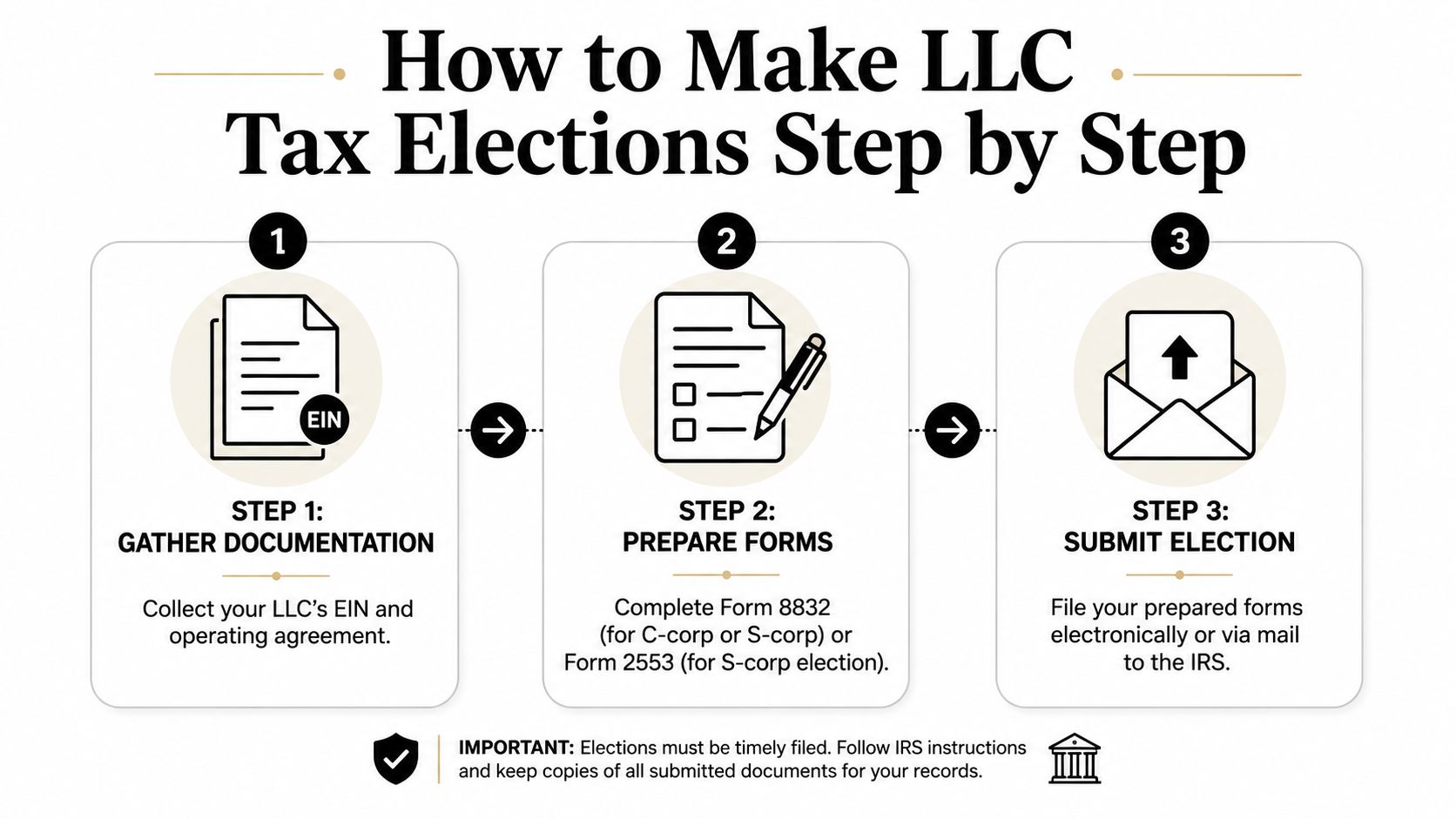
Before any election goes out, gather the LLC's EIN, operating agreement, and the exact member structure. That paperwork tells you whether the LLC is acting as a single-member or multi-member entity under the default federal rules. If the agreement is outdated, fix that first, because the IRS will not care that the internal documents were “basically right.”
Then match the filing goal to the form. If you're aiming for corporate classification, Form 8832 is the core federal election document. If you're pursuing S-corp treatment, Form 2553 is the form founders usually hear about. The election should be filed with enough time to meet the IRS timing rules, and the business should save proof of submission.
Submit, track, and keep the records together
Once the forms are prepared, file them electronically or by mail depending on the current IRS filing path for that election. After submission, store the confirmation with the operating agreement, EIN letter, and payroll records in one folder. That way, when your CPA or payroll provider asks how the entity is classified, you don't have to reconstruct the decision from memory.
A local practical tip for South Florida founders is to coordinate the election with your payroll setup date. If the business will pay owner wages, the payroll system should be ready before the first paycheck, not after. When businesses later need to change classification, Coto & Waddington's conversion guidance can help illustrate the documentation discipline those changes usually require.
Keep one rule in mind. A tax election is only useful if the business can operate under it. If the books are incomplete or the payroll process is informal, fix those systems first, then file the election. That saves founders from changing status on paper without being ready in practice.
Pros and Cons for South Florida Startups
A Miami e-commerce founder may value simplicity first
A Miami e-commerce founder usually cares about speed, cash flow, and staying lean. A default single-member LLC keeps the reporting simple because the owner's return usually carries the business income. That can be a good fit when the company is still testing products, suppliers, and ad spend.
The downside is that simplicity can hide planning gaps. If the business grows and the owner never revisits payroll or tax posture, the company can drift into a structure that no longer matches how money moves. Founders often notice that only after hiring starts or profit becomes more predictable.
A Fort Lauderdale consultancy may want a different balance
A Fort Lauderdale consulting shop with two owners often lands in partnership territory by default. That can work well when both founders want pass-through treatment and a straightforward way to divide economics. The trade-off is more partnership reporting, more attention to allocations, and more coordination between owners.
If the same consultancy later wants to separate owner compensation from distributions, the team may start comparing corporate-style options. That's where the administrative burden starts to matter as much as the tax outcome. The business can save in one area and spend more in another, especially if payroll becomes part of the structure.
A family restaurant feels payroll pressure faster
A family-owned restaurant in Broward or Miami-Dade usually feels classification issues sooner because labor costs are visible every week. Payroll, tips, scheduling, and owner compensation all meet in one place, so the wrong classification can create confusion fast. A corporate election may make sense for some businesses, but it also adds compliance work that a busy kitchen team can't afford to ignore.
The right classification is the one the business can sustain, not the one that sounds clever in a meeting.
For South Florida startups, the primary question isn't “Which classification is best?” It's “Which one fits how this company makes money, pays people, and keeps records?” A freelancer with one client base, a two-founder agency, and a multi-location restaurant will not need the same setup. That's why a customized review matters before the tax year gets too far along. Coto & Waddington, Attorneys at Law also handles business structure work, including LLC, S-corp, and C-corp planning in Florida, which makes that review easier to connect with formation and operating-agreement decisions.
Next Steps and Checklist for LLC Tax Classification
Use a decision checklist before the deadline passes
Review your member count first, because that determines the default federal starting point. Then look at whether you want default treatment or a corporate election. After that, check whether the operating agreement still matches the way the company operates.
A simple founder checklist looks like this:
- Confirm ownership: Make sure the LLC is single-member or multi-member under the current agreement.
- Match the tax goal: Decide whether default treatment, S-corp treatment, or C-corp treatment fits the business model.
- Prepare the forms: Gather the EIN, the operating agreement, and the election paperwork.
- Track deadlines: Confirm the filing window before the tax year starts or closes.
- Organize payroll records: If wages are involved, set up payroll before the first payment goes out.
Keep the documents together in one digital folder and one hard-copy binder. That small habit prevents a lot of frustration later, especially when a CPA, payroll provider, or lender asks for proof of the election.
If you're still unsure, talk to counsel and a tax professional before you file. The right move usually comes from matching the classification to the business's actual cash flow, payroll needs, and growth plan, not from copying another founder's setup.
Coto & Waddington, Attorneys at Law helps South Florida founders sort out LLC, S-corp, and C-corp planning, along with the formation and operating-agreement work that supports those decisions. If you're deciding how your LLC should be taxed, visit Coto & Waddington, Attorneys at Law to discuss the structure that fits your business and get guidance before the next filing deadline.



