At its core, the difference is simple. A joint venture is a temporary, focused collaboration between businesses for a single project. Think of it as a special mission. A partnership, on the other hand, is a broader, ongoing business relationship—more like a long-term commitment.
Your choice comes down to one question: is your goal a specific, short-term project or a continuous, long-running business?
Choosing Your Collaboration Structure: A Quick Guide
For entrepreneurs, deciding between a joint venture and a partnership is a foundational choice with lasting effects on liability, control, and taxes. While both involve working together, their legal and operational mechanics are worlds apart. We see founders run into trouble when they mix them up.
A joint venture (JV) is like a special-ops mission—highly focused, temporary, and with a crystal-clear objective. The parties form a brand-new legal entity, usually an LLC, just to house the project. This is critical because it shields the parent companies' assets from the JV’s debts and liabilities.
A general partnership is more like a marriage; it’s an ongoing union created to run a business together indefinitely. It can be formed incredibly informally—sometimes just by your conduct—and usually means the partners share unlimited personal liability for the business's debts. That distinction is everything for a founder looking to protect their core business while chasing a new opportunity.
This decision tree helps visualize that first critical choice. It all starts with the purpose of the collaboration.
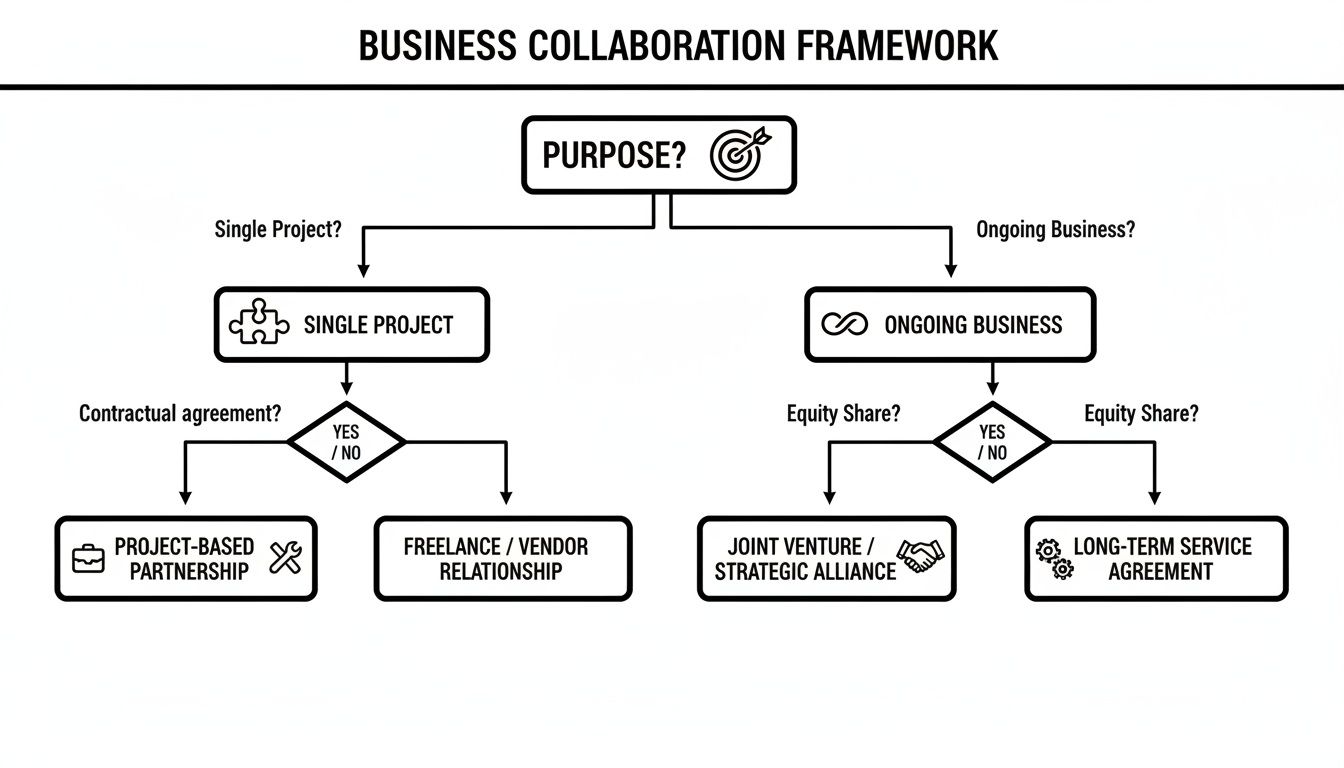
As you can see, understanding your goal—a single project versus an ongoing business—is the most important factor in picking the right legal structure.
At a Glance: Joint Venture vs. Partnership
This table gives you a quick snapshot of the key differences between a joint venture and a general partnership. It’s a good starting point for guiding your initial thinking.
| Attribute | Joint Venture | Partnership |
|---|---|---|
| Scope & Duration | Single project; temporary | Ongoing business; indefinite |
| Legal Structure | Separate legal entity (e.g., LLC) | Often no separate entity |
| Liability | Limited to the JV's assets | Unlimited personal liability |
| Formation | Formal agreement required | Can be formed informally |
The bottom line here is that JVs offer a protective shell for a specific purpose, while general partnerships expose you completely.
From our experience, verbal agreements are a recipe for disaster. Always get it in writing. Even for a general partnership, you absolutely need a comprehensive written agreement to define responsibilities, profit-sharing, and what happens when someone wants out. This document is what will save you from costly and stressful disputes down the road.
Pro Tip: Choosing the right entity is one of the first and most important steps. If you’re at that stage, you might find our detailed guide on setting up a business in Florida helpful.
Ready to collaborate but not sure which structure fits your specific situation? Contact an experienced business attorney. Getting it right from day one ensures your new venture is built on a solid legal foundation, not on risky assumptions.
Why Joint Ventures Thrive in Volatile Markets

When the economy gets shaky, businesses pull back. Big, expensive moves like mergers and acquisitions suddenly feel like betting the farm when capital is tight and no one knows what’s coming next. This is exactly the environment where the joint venture (JV) proves its worth. It offers a path to growth without the all-or-nothing commitment of a merger.
A JV lets companies pool their resources for a specific, high-stakes project while keeping their main businesses completely separate. It’s a tactical alliance, not a corporate marriage. This structure is perfect for sharing the heavy financial risks and capital needed to chase ambitious goals, like breaking into a new international market or funding expensive R&D.
This isn't just theory. Market data shows a clear pattern: when companies get nervous about buying each other outright, they team up. In 2022, as rising interest rates slammed the brakes on M&A, the global volume of new joint ventures and non-equity partnerships actually grew by 13%. The trend is clear: when big capital investments feel daunting, smart businesses share the risk. You can dig deeper into this data in the full 2022 joint venture and partnership review.
The Power of Flexibility and Focus
One of the biggest advantages of a joint venture is its laser focus. Unlike a general partnership that’s built to last indefinitely, a JV is created for a single mission. It has a defined start, a clear goal, and a planned end date.
This project-based approach comes with some major perks:
- Preserved Autonomy: Each parent company keeps its own independence, culture, and day-to-day operations. You don’t have to waste time and money trying to merge two completely different organizations.
- Focused Execution: The JV entity can pour all its energy into achieving one specific objective without getting distracted by the parent companies' other priorities.
- A Clean Exit: Once the project is done—the product is launched, the real estate is sold, the research is complete—the venture simply dissolves. This avoids the messy and expensive "business divorces" that plague so many partnerships.
A joint venture is like building a specialized vehicle for a single, difficult race. You engineer it for that one track and that one purpose. Once you win, you can take it apart. You don't have to scrap your everyday car in the process.
This structure is a natural fit for tech startups and innovators. Imagine a Miami startup with killer AI software wanting to team up with a hardware engineering firm in Broward to build a new smart device. A JV lets them collaborate intensely on that one product, sharing costs and expertise, while protecting the core intellectual property and assets of their individual businesses.
Mitigating Risk in High-Stakes Plays
Ultimately, the joint venture vs. partnership debate often boils down to managing risk. In a general partnership, all partners are typically on the hook for unlimited liability. But when you structure a JV as a separate legal entity—like an LLC—the liability is contained inside that new entity. If the project goes south, the parent companies' core assets are shielded.
This liability shield is non-negotiable for high-risk, high-reward moves. The fact that 15% of all JV deals in 2022 were valued at $1 billion or more shows just how critical this structure is for facilitating huge strategic plays that would be too dangerous for one company to go it alone.
Pro Tip: When setting up a joint venture, you should always form a new, separate legal entity, most often an LLC. Don't rely on a simple contract. That legal firewall is the single most important step in protecting your main business from the venture's potential liabilities.
If you’re thinking about a strategic collaboration but aren’t sure if a JV is the right move for your Florida business, a consultation can help. Speaking with an experienced business attorney will clarify your options and help you build an agreement that fuels growth while protecting what you’ve already built.
Comparing Formation, Governance, and Control
When you’re weighing a joint venture against a partnership, the differences in how they’re formed and run are night and day. A joint venture is built with deliberate, formal steps. A general partnership, on the other hand, can spring into existence almost by accident—a critical distinction that has massive consequences for who’s in control.
The formation of a joint venture is an intentional process. It almost always starts with creating a separate legal entity, usually a Limited Liability Company (LLC) or a corporation. This isn't just a formality; it's a non-negotiable step for liability protection. It creates a distinct legal "person" to house the project, complete with its own assets, debts, and a clear governance structure.
In stark contrast, a general partnership can be formed with almost frightening ease. A simple verbal agreement or even just the actions of the parties can be enough. If two people start a business together and agree to share profits, they may have just legally formed a partnership without signing a single document, exposing both to unlimited personal liability.
Establishing the Legal Framework
For any joint venture, the cornerstone document is the joint venture agreement. Think of this as the constitution for your new, separate business. It’s a detailed, comprehensive contract that meticulously outlines every facet of the collaboration, leaving as little as possible to chance.
A rock-solid joint venture agreement must include:
- Purpose and Scope: A laser-focused definition of the specific project the JV will tackle.
- Capital Contributions: Exactly what each party is bringing to the table—cash, intellectual property, equipment, or even just sweat equity.
- Governance and Management: How the entity will be run, who sits on the management committee, and what their decision-making powers are.
- Profit and Loss Distribution: The specific formula for how financial wins and losses will be shared.
- Exit Strategy: A clear plan for how the venture will end, whether it’s after achieving its goal or if things go sideways.
A partnership agreement serves a similar function, but here's the dangerous part: it isn't legally required to form a general partnership. Operating without one is a huge gamble. If you don't have an agreement, state law imposes default rules that almost certainly won't match what you and your partners intended. For a deeper dive into the legal mechanics of different business structures, expert resources on corporate law are invaluable.
Who Is in Control?
Governance is another area where joint ventures and partnerships couldn't be more different. In a joint venture, control is highly structured and spelled out in the operating agreement or shareholder agreement. Typically, a management committee or a board of directors is created with representatives from each parent company.
This structure forces clarity from day one. Voting rights can be tied to ownership percentages or specific leadership roles. More importantly, major decisions—like taking on significant debt, changing the project's scope, or bringing in new members—often require unanimous consent. This is a built-in safeguard ensuring no single party can make a critical move without everyone else’s buy-in.
A joint venture’s governance is like a pre-flight checklist for a commercial airliner; every role is defined, procedures are clear, and major decisions require multiple approvals. A general partnership without a strong agreement is more like two people arguing over a single steering wheel while the car is already on the highway.
Partnerships, by default, often operate under a rule of equal management rights. In a general partnership, this means each partner may have the authority to legally bind the entire business to a contract. That’s a terrifying prospect. Without a detailed partnership agreement that designates specific roles and limits authority, one partner's reckless decision can create a legal and financial catastrophe for everyone involved.
To make these differences crystal clear, here’s a side-by-side look at how these structures are formed and governed.
Formation and Governance: Joint Venture vs. Partnership
This table breaks down the core structural, governance, and liability differences you’ll face when choosing between a joint venture and a general partnership.
| Criterion | Joint Venture | Partnership (General) |
|---|---|---|
| Legal Entity | Required (e.g., LLC, Corp) | Not required; can be informal |
| Governing Document | Joint Venture Agreement (Essential) | Partnership Agreement (Highly Advised) |
| Management Control | Structured via committee or board | Often assumed equal rights |
| Decision-Making | Formally defined in agreement | Informal; each partner may bind the business |
| Duration | Defined, project-based, temporary | Typically indefinite and ongoing |
As you can see, the formal, rigid structure of a joint venture offers far greater control and predictability, which is exactly what you need for complex, high-stakes projects. A partnership provides more flexibility, but that flexibility comes at the cost of clarity and adds significant risk if it isn't locked down with a meticulously drafted agreement.
Pro Tip: No matter which structure you choose, always define management roles and decision-making authority in writing. Specify which actions require a simple majority vote versus which ones demand unanimous consent. This single step can prevent the most common and damaging disputes that tear collaborations apart.
Unsure how to structure your governance model? A business lawyer can help you design a decision-making framework that fits your collaboration perfectly. Schedule a consultation to get started.
Understanding Your Liability and Tax Obligations
Beyond the structure and control, what truly separates a joint venture from a partnership comes down to liability and taxes. These two factors have a direct, immediate impact on your bottom line and your personal financial risk.
Getting this wrong is one of the most dangerous mistakes a founder can make. It can expose your primary business—and even your personal assets—to debts and lawsuits from the new project.

The Liability Shield: A Critical Advantage
The single most powerful reason to structure a joint venture as a separate legal entity, like an LLC, is the liability shield. This isn't just a minor detail; it’s the core of modern asset protection.
By creating a new LLC for the joint venture, you’re building a legal firewall. That JV now operates as its own "person" in the eyes of the law, with its own assets and its own debts. If the project runs into trouble or gets sued, creditors can only go after the assets held inside that specific JV LLC.
The liability shield of a joint venture LLC is like having a quarantine zone for risk. Any financial contagion from the project is contained within the JV, preventing it from infecting the parent companies' healthy balance sheets.
This protection is invaluable. Your main company—the business you poured everything into—remains insulated and safe. It gives you the freedom to pursue ambitious, high-risk projects with a calculated, manageable level of exposure.
A general partnership, on the other hand, offers zero protection. Partners are hit with joint and several liability, a legal concept every business owner should dread. This means each partner isn't just on the hook for their share of the debt; they can be held 100% personally liable for the entire debt, no matter which partner created it. A creditor can chase one partner's personal assets—their home, car, and savings—to pay off a business debt racked up by someone else.
Navigating Your Tax Treatment
Taxes are the other major fork in the road, and the two structures offer very different levels of flexibility that can shape your financial strategy.
Most partnerships are considered pass-through entities. The partnership itself doesn’t pay federal income tax. Instead, all profits and losses "pass through" to the individual partners, who report them on their personal tax returns and pay taxes at their individual rates. This is a simple way to avoid the "double taxation" that hits some corporations.
A joint venture formed as an LLC gives you more options. By default, a multi-member LLC is also taxed like a partnership, enjoying the same pass-through benefits. But an LLC can choose to be taxed differently if it’s a better fit.
A JV LLC can file IRS Form 8832 to elect to be taxed as a corporation (either a C-Corp or an S-Corp). This is a strategic decision. It completely changes how profits are taxed and distributed, allowing founders to pick the most efficient tax position for the project. For more on this, learning about choosing between an LLC, S-Corp, and C-Corp in Florida can give you crucial context.
Pro Tip: This is not a DIY decision. Always talk to both a business attorney and a CPA before finalizing anything. The interaction between legal liability and tax strategy is incredibly complex. The right structure depends entirely on your specific goals, the nature of the project, and your risk tolerance. Your business's future stability hinges on getting these foundational decisions right.
Real-World Scenarios: When to Use Each Structure
It’s one thing to understand the legal theory behind joint ventures and partnerships, but it’s another to know which one makes sense for your specific business goal. Making the right choice comes down to your project's scope, timeline, and how much risk you're willing to take. Let's move past the textbook definitions and look at how this plays out in the real world.
The decision often gets a lot clearer once you define the mission. Are you teaming up for a single, high-stakes project, or are you building a long-term business relationship meant to last for years?
The Tech Startup and Hardware Manufacturer
Picture two South Florida tech companies. One has developed incredible software but has zero experience building physical products. The other is a veteran hardware engineering firm that can build anything but lacks the software to create a truly next-gen device.
They decide to collaborate on a new "smart home" hub. This is a perfect scenario for a joint venture (JV), most likely structured as a new, separate LLC.
- Why a JV? The project is laser-focused, complex, and expensive. It involves a single product line with clear R&D, manufacturing, and marketing phases.
- The Structure in Action: They form “Smart Hub Innovators, LLC.” Both parent companies contribute capital and their respective intellectual property to this new entity. Critically, their JV agreement states that the LLC's sole purpose is to develop and sell this smart hub.
- The Benefit: This creates a financial firewall. If the smart hub fails to find a market, the losses are contained entirely within the new LLC. The core businesses and assets of the two parent companies are completely shielded from the venture's creditors.
Once the product's lifecycle ends or a set time passes, the JV can be dissolved according to the terms laid out in their agreement. This focused, protected approach is exactly what a high-risk, high-reward project calls for.
The Marketing and Web Design Consultants
Now, let's consider two independent consultants. One is a marketing pro who excels at brand strategy and lead generation. The other is a talented web designer who builds stunning, functional websites. For years, they've referred clients to each other and now realize they could offer a much more powerful, integrated service by officially joining forces.
This situation is a classic fit for a general partnership.
- Why a Partnership? Their goal isn’t a one-off project; it’s to merge their services into a single, ongoing business with no end date. They plan to serve clients together for the foreseeable future.
- The Structure in Action: They need to draft a detailed partnership agreement. This document is the rulebook for their business, defining how they'll share profits, manage clients, and handle expenses. A well-drafted agreement is essential, as it overrides the state's default rules and prevents devastating disputes down the road.
- The Key Consideration: By forming a general partnership, they are both personally liable for the business's debts. It’s a risk they are willing to accept because their service-based business has far lower overhead and financial exposure than a tech hardware launch.
A joint venture is for a single, well-defined destination. A partnership is for a long-term journey with no specific end point in sight. Your choice depends on whether you're building a rocket for one mission or a car for a lifetime of road trips.
The trend toward more structured collaborations is undeniable. A McKinsey survey found that 68% of executives expect their company's joint venture activity to increase, viewing them as a smart alternative to expensive buyouts. This shift is happening because a JV's governance and equity structure provides the clarity and protection that informal partnerships often lack. You can see the full breakdown of why JVs are on the rise in this McKinsey analysis.
Pro Tip for Founders: Before you commit to anything, map out your collaborative goal on a timeline. If your timeline has a clear finish line—like a product launch, a real estate sale, or a specific event—a joint venture is probably the right move. If the timeline is indefinite, you are likely heading toward a partnership and should get legal counsel immediately to draft a strong agreement.
Still not sure which path is right for you? A focused legal consultation can clarify your risks and obligations before you make a costly mistake. Schedule a call with an experienced business attorney to ensure your collaboration is built on a solid legal foundation that protects both your vision and your assets.
Drafting Your Agreement and Taking Action
Whether you decide on a joint venture or a partnership, your next step is the most critical: turning your handshake deal into a legally sound agreement. This is the moment your vision becomes a defensible business structure. A well-drafted agreement doesn't just prevent future disputes; it provides a clear roadmap for operating your business.
Before you even talk to a lawyer, it’s smart to prepare. Many founders find it helpful to first outline a memorandum of understanding (MOU). This isn't a final contract, but it gets all parties aligned on the big-picture terms from day one, which makes the formal drafting process much smoother.
Key Clauses Your Agreement Must Address
Your agreement is the constitution for your collaboration. In our practice, we see countless disputes that could have been avoided if the initial contract had been clearer. Certain clauses are non-negotiable for protecting everyone involved.
Your agreement should meticulously detail the following:
- Scope and Purpose: What is the precise, narrow goal of this collaboration? A tight definition prevents "scope creep" and keeps everyone focused on the mission.
- Capital and Resource Contributions: Who is bringing what to the table? This needs to be specific, covering everything from cash and equipment to intellectual property (IP), real estate, and even sweat equity.
- Governance and Management: How will decisions be made? Detail the management structure, voting rights, and which critical decisions require unanimous approval.
- Intellectual Property Ownership: This is a big one. Who owns the IP created by the venture? Define ownership rights both during the collaboration and after it ends.
- Dispute Resolution: When you disagree—and you will—what happens? Outline a clear process, like mandatory mediation before litigation, to handle conflicts without destroying the business.
- Exit Strategy and Dissolution: Every business relationship ends. Define the triggers for dissolution, whether it's achieving a goal, a specific date, or a mutual decision to part ways.
For a deeper dive into the mechanics of contract language, our guide on how to write a business contract offers a solid foundation.
Your Term Sheet Checklist
Before you engage legal counsel, using a term sheet to organize your discussion is one of the most efficient steps you can take. It acts as the skeleton for your formal agreement and ensures your first meeting with an attorney is incredibly productive.
Walk through this checklist with your potential partners:
- Define the Parties: Who are the legal entities or individuals involved?
- State the Purpose: What is the single, clear objective of this venture?
- List Contributions: What will each party contribute (e.g., $50,000 cash, specific software, a client list)?
- Outline Governance: Who is on the management committee? How are votes allocated?
- Detail Profit Distribution: What is the exact formula for sharing profits and losses?
- Set the Exit Conditions: What specific events trigger the end of the collaboration?
This guide provides a strong educational foundation for understanding the joint venture vs partnership decision, but it is not a substitute for professional legal advice. The nuances of business law, especially in Florida and Delaware, require tailored guidance.
Your vision deserves a solid legal foundation. Don't leave your hard work and future growth to chance by relying on generic templates or verbal agreements.
Protect your assets and ensure your collaboration is set up for success from day one. Schedule a consultation with an experienced business attorney today.
Common Questions From Founders: JV vs. Partnership
When you're deciding between a joint venture and a partnership, the theoretical differences are one thing. The practical questions that keep you up at night are another. I've heard them all from founders, and here are the answers to the most common ones.
Can a Partnership Become a Joint Venture?
Absolutely. In fact, it's a smart strategic move we see all the time. Existing partners often identify a new opportunity that's either too risky or requires a different ownership structure than their main business.
To pull this off, they form a brand new, separate legal entity—almost always an LLC—just for that one project. This new LLC is the joint venture, owned by the original partners' businesses. They then draft a rock-solid JV agreement that dictates exactly how that new, separate company will operate, insulating their original partnership from the new project's liabilities.
What Is the Most Common Reason a Joint Venture Fails?
While money and market shifts can kill any business, JVs are uniquely vulnerable to two things: misaligned objectives and poor governance. A joint venture is created to achieve a single, specific goal. When the partners have different ideas about what that goal is, or how to get there, conflict is baked in from the start.
A joint venture agreement must be a crystal-clear roadmap. If one party thinks they're building a highway and the other thinks they're building a scenic route, they're bound to crash.
A close second is the lack of a clear exit plan. This traps partners in a venture that has either failed or run its course, with no clean way to walk away. It all comes back to the agreement—you have to define the mission, the rules of engagement, and the escape plan before you even begin.
How Long Does It Take to Set Up a Joint Venture LLC?
Don't be fooled by how fast you can file an LLC online. The paperwork with the state might only take a few days, but that's the easiest and quickest step by far. The real work—the part that matters—is negotiating the joint venture agreement.
That negotiation can take a few weeks or even several months, depending on how complex the deal is. This is where you hammer out the critical terms: who puts in what capital, who controls what decisions, how IP is owned, how profits are split, and how you'll dissolve it all when the time comes. Rushing this negotiation is the most expensive mistake a founder can make.
Actionable Tip: To speed up the process, draft a detailed term sheet with your partners before you meet with your lawyers. Agreeing on the major points upfront will make the formal drafting process much faster and more cost-effective.
Are Joint Ventures Only for Large Corporations?
That’s a myth. While you hear about global giants using them for massive international deals, JVs are an incredibly powerful tool for startups and small businesses. In our practice, we see startups use JVs to:
- Scale Without the Capital: A small e-commerce brand partners with a logistics company to handle all its fulfillment.
- Enter New Markets: A Miami software company forms a JV with a firm in Colombia to gain instant local expertise and a customer base.
- Bid on Bigger Projects: Two small construction firms form a JV to land a contract that neither could handle alone.
The strategic power of JVs is recognized globally, though used differently across regions. Cross-border JVs account for 70% of this activity for North American firms but just 30% for Chinese companies. Despite global tensions, executives are committed to their JV strategies. A BCG study even found that 60% of business leaders see JVs as more resilient than acquisitions during economic downturns. You can explore more on the resilience of global joint ventures on weforum.org.
For a startup, a JV is a ticket to playing in a bigger league by borrowing a partner’s strengths.
Deciding on the right business structure is a foundational step that can define your company's future success and stability. At Coto & Waddington, Attorneys at Law, we provide founder-minded legal strategy to help you navigate these critical choices with confidence. Don't leave your vision to chance—schedule a consultation today by visiting us at https://cotowaddington.com to ensure your collaboration is built to last.