Two founders finally find a small warehouse in Miami that can handle inventory, content shoots, and a few desks. A brother and sister inherit a rental property from a parent and want to keep it in the family. An unmarried couple buys a home together after contributing very different amounts to the down payment. In each of these situations, people focus on price, financing, and closing dates. They often treat the deed as paperwork.
That's a mistake.
How you hold title can decide who inherits the property, whether probate gets involved, whether one owner's creditor creates a bigger problem for everyone else, and whether your ownership plan falls apart because the deed uses the wrong language. Before closing, I tell clients to treat title review the same way they treat due diligence on the property itself. A solid process helps, and a document workflow like Superdocu's real estate checklist is useful for making sure the deed, financing terms, and ownership structure are reviewed together instead of in isolation.
Table of Contents
- Why Your Property Title Is a Critical Business Decision
- Understanding the Two Paths to Co-Ownership
- A Detailed Comparison of Key Differences
- How Creditors and Taxes Impact Your Choice
- Choosing the Right Title for Your Florida Property
- How to Draft or Change Your Property Title
Why Your Property Title Is a Critical Business Decision
In Florida, co-owners usually end up choosing between joint tenancy and tenancy in common. That choice isn't cosmetic. It affects control during life and transfer at death.
For a startup founder, the title decision can shape what happens if a co-founder dies, gets sued personally, or wants out. For a family, the same decision can determine whether children from a prior relationship inherit anything from a shared property interest. For unmarried buyers, the risk is often worse because people assume the law will fill in the blanks the way they intended. It usually won't.
The deed controls more than ownership
A deed doesn't just name owners. It allocates rights.
If you choose the wrong structure, one owner may gain survivorship rights they were never supposed to have. In the opposite direction, a survivor may expect to receive the whole property automatically and then learn the deceased owner's share is now tied up in probate and passing to heirs.
Practical rule: If co-owners have different financial contributions, different heirs, or different risk profiles, title should be negotiated like any other major contract term.
Florida founders and families need a risk lens
The cleanest way to think about joint tenancy vs tenancy in common is this:
- Joint tenancy favors automatic transfer to surviving owners.
- Tenancy in common favors flexibility, separate ownership percentages, and inheritance control.
That sounds simple. In practice, it affects lending, estate planning, disputes, and bargaining power between co-owners. The right answer depends less on what sounds easier and more on what problem you're trying to prevent.
Understanding the Two Paths to Co-Ownership

Joint tenancy and tenancy in common are both forms of concurrent ownership, but they operate very differently from the start. The legal mechanics matter because they determine whether the structure works at all.
According to National Property Authority's explanation of joint tenancy and tenancy in common, joint tenancy is strictly defined by the legal requirement of the “four unities” of Possession, Interest, Time, and Title. In contrast, tenancy in common imposes no requirement for equal shares or simultaneous acquisition, and co-owners can hold distinct, divisible fractional interests in any percentage, such as 60/40 or 75/25, acquired at different times.
What joint tenancy requires
Joint tenancy is rigid by design. All owners must take their interests at the same time, through the same title instrument, in equal shares, and with equal rights to possess the whole property.
That rigidity exists for one reason. It supports the right of survivorship. When one joint tenant dies, that owner's interest transfers automatically to the surviving joint tenant or tenants by operation of law. It doesn't pass under the deceased owner's will.
That can be useful when co-owners want simplicity and a direct transfer at death. It can also be dangerous when one owner assumes their children, siblings, or other beneficiaries will inherit their share.
What tenancy in common allows
Tenancy in common is more flexible. Owners can contribute different amounts, receive different ownership percentages, and acquire interests at different times.
Each owner holds a separate fractional interest, but each still has a right to possess the property as a whole. The key difference is that there is no survivorship feature built into the title.
A tenant in common can own a defined share that becomes part of that person's estate instead of disappearing into the surviving owner's title.
Why this distinction matters in real life
For business partners, tenancy in common often tracks reality better. One founder may fund most of the purchase. Another may contribute less cash but more labor. Joint tenancy can't reflect that if unequal shares are intended.
For families, the question is usually about inheritance control. Joint tenancy simplifies transfer to the survivor. Tenancy in common preserves the ability to pass a share to heirs or beneficiaries.
Use this as a first filter:
- Choose joint tenancy when the owners want equal interests and automatic survivorship.
- Choose tenancy in common when the owners want unequal shares, separate estate planning, or flexibility to transfer their own stake.
- Stop and review the deed language carefully when the owners are unmarried, blending families, or using the property in connection with a business.
A Detailed Comparison of Key Differences
The fastest way to evaluate joint tenancy vs tenancy in common is to compare them by consequence, not by vocabulary.
| Feature | Joint Tenancy | Tenancy in Common |
|---|---|---|
| Right at death | Surviving owners take automatically | Deceased owner's share passes through the estate |
| Ownership shares | Must be equal | Can be unequal |
| Creation | Requires the four unities and proper deed language | Can be created more flexibly |
| Transfer during life | A transfer can disrupt the structure | Each owner holds a separate transferable share |
| Best fit | Co-owners seeking simplicity and survivorship | Investors, family members, and partners with separate interests |
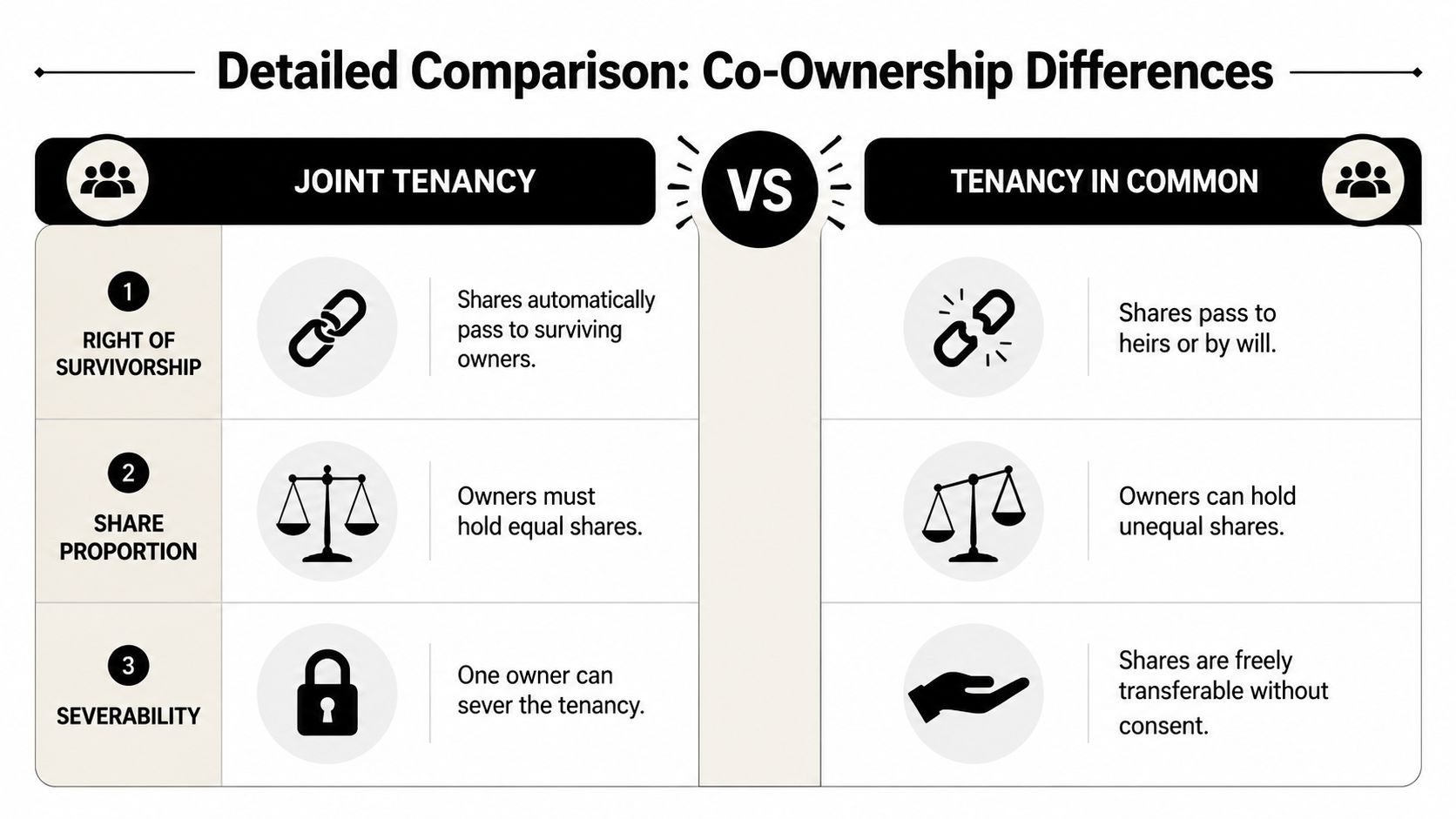
A useful framing comes from Ocampo Wiseman Law's discussion of Nevada deeding options, which notes that the right of survivorship functions as a critical performance metric for estate transfer efficiency: joint tenancy assets transfer immediately to surviving co-owners by operation of law, eliminating probate court delays and associated administrative costs, whereas tenancy in common interests mandate probate proceedings.
Death and inheritance
This is the issue widely considered important, and the one many misunderstand.
In joint tenancy, death transfers ownership to the survivor. In tenancy in common, death transfers a share into the deceased owner's estate.
That means a will doesn't override survivorship in a valid joint tenancy. If your plan is to leave your portion to your children, a sibling, or a trust, joint tenancy may directly defeat that intention.
Tenancy in common gives the opposite result. It keeps each owner's interest separate for inheritance purposes. That creates more planning options, but it also means probate becomes part of the conversation unless the owner uses additional planning tools.
Ownership percentages
Joint tenancy works only when all owners hold equal shares. If one person contributes substantially more capital, joint tenancy often creates a mismatch between legal title and economic reality.
Tenancy in common handles unequal contributions much better. If one partner funds most of the acquisition and another contributes less, the deed can reflect different percentages. That matters in any later sale, refinance, internal buyout, or dispute over proceeds.
Control during life
Many people assume joint tenancy locks everyone together. It doesn't work that cleanly.
Under UK HMRC guidance on severance of a joint tenancy in IHTM15082, a joint tenant can sever the arrangement by notice, which converts the ownership into tenancy in common and destroys survivorship. The practical lesson applies broadly: survivorship is not always as durable as owners think.
Tenancy in common starts from separate ownership. Each owner holds a defined stake. That tends to make transfers, gifts, sales, and estate planning more predictable because the structure already recognizes separate shares.
Creation and default rules
Another real difference is what happens when a deed is sloppy.
In some jurisdictions, joint tenancy requires express language showing survivorship intent, and tenancy in common is the default if the deed doesn't clearly create survivorship rights. That default rule catches co-owners who assumed “co-owning together” automatically meant “survivor gets everything.”
Quick decision cues
If you're weighing the structures in a practical way, these cues help:
- You want probate avoidance between co-owners: Joint tenancy may fit.
- You want unequal percentages: Tenancy in common is the workable option.
- You want your heirs to receive your share: Tenancy in common aligns better.
- You expect future transfers, investor changes, or business risk: Tenancy in common is often easier to manage.
- You're relying on a template deed: Slow down and confirm the exact title language before signing.
How Creditors and Taxes Impact Your Choice
For Florida founders, creditor risk is where the title decision becomes operational instead of theoretical. This shows up when a property is used as collateral, when one owner has personal debt exposure, or when a judgment creditor starts chasing assets.
According to the cited Florida discussion in this analysis of creditor severance issues, in tenancy in common, a creditor can lien only the debtor's fractional share, whereas in joint tenancy, a lien on one tenant's interest severs the joint tenancy entirely, converting it to tenancy in common and destroying survivorship rights. Recent Florida case law shows 22% of startup property co-ownership disputes involve creditor severance.
Why creditor exposure changes the math
That distinction is easy to miss and expensive to ignore.
If you hold title as tenants in common, one owner's creditor generally targets only that owner's share. The non-debtor co-owner still has a problem, but the legal damage is more contained. If you hold title as joint tenants, the lien can do more than attach to an interest. It can break the survivorship structure itself.
A survivorship plan that disappears when one owner hits financial trouble isn't much of a plan.
That's why startup teams should be very cautious about putting business-use real estate into personal co-ownership without thinking through debt exposure first.
The tax side needs separate review
Tax consequences are real, but they're highly fact-specific. They can depend on contribution amounts, whether owners are married, whether someone is being added to title after purchase, whether the property is held for investment, and what happens at death.
The practical takeaway is straightforward:
- Creation can trigger tax questions if one owner gives another an interest without equal payment.
- Sale can create uneven tax outcomes if ownership percentages don't match contributions or expectations.
- Death can change basis treatment depending on the overall estate plan and ownership context.
Because title affects probate exposure, it's smart to review it alongside broader estate planning. A basic starting point is understanding ways to avoid probate in Florida so the property title isn't working against the rest of the plan.
What works better for risk mitigation
For founders and investors, these approaches usually work better than casual co-ownership:
- Match title to actual economics. If contributions are unequal, reflect that.
- Separate business risk from personal ownership where possible. Many co-owners are better served by an entity structure than by personal joint title.
- Review lending documents before closing. Debt terms can interact with title in ways owners don't expect.
- Coordinate title with estate documents. The deed and the will or trust should not be telling opposite stories.
Choosing the Right Title for Your Florida Property

In Florida, the most common title mistake isn't choosing the wrong structure after careful analysis. It's never making a clear choice at all.
That problem is especially common with unmarried co-owners, blended families, and business partners. The deed gets drafted from a template, everyone signs, and years later someone discovers the title created a very different legal result than the parties intended.
Florida-specific survivorship language matters. As noted in this Florida discussion of deed ambiguity and survivorship language, 34% of title disputes in Florida arise from unmarried co-owners who fail to explicitly state “right of survivorship” in the deed, automatically defaulting to tenancy in common and triggering probate. Most guides omit that Florida law requires the four unities plus an express survivorship clause for joint tenancy.
Married couples
Married couples often assume joint tenancy is the default best answer because it sounds simple. Sometimes simplicity helps. Sometimes it leaves better planning opportunities on the table.
For many Florida married couples, another structure may be more appropriate depending on asset protection and estate planning goals. If your objective is to transfer residential property efficiently while preserving planning flexibility, it's worth comparing title options with tools such as a Florida Lady Bird deed overview before deciding that co-ownership language alone solves the problem.
Unmarried partners and family members
I find the most avoidable trouble often occurs.
Unmarried buyers often want survivorship, but they also want fairness if one person paid more. Family co-owners may want flexibility because each person has different heirs. Those goals can conflict. Joint tenancy demands equal shares. Tenancy in common preserves separate percentages and inheritance control.
If an unmarried couple wants the survivor to receive everything, the deed must say so clearly and correctly. If siblings want each child's branch of the family to inherit separately, tenancy in common is usually the cleaner fit.
The law won't rescue an ambiguous deed by guessing what the family probably meant.
Business co-founders and investors
For founders, personal co-ownership is often the wrong frame from the outset. If the property is tied to a venture, entity ownership may do a better job of containing risk, managing transfers, and documenting economics.
When direct personal ownership is still the chosen route, tenancy in common is often more workable than joint tenancy because it can reflect different capital contributions and separate exit rights. It also avoids building a survivorship expectation into an asset that may later be affected by investors, creditors, or internal disputes.
A practical Florida checklist
Before closing or retitling, answer these questions in writing:
- Who should inherit each owner's share? If the answer isn't “the surviving co-owner,” survivorship may be the wrong approach.
- Are contributions equal or unequal? Unequal funding usually points away from joint tenancy.
- Could one owner face creditor issues? If yes, survivorship can be more fragile than expected.
- Is the deed explicit? In Florida, assumptions are not enough.
- Would an LLC or trust-based strategy fit better? Sometimes the best answer isn't either of the two classic forms.
How to Draft or Change Your Property Title
Changing title usually means preparing and recording a new deed. That sounds easy. It often isn't.
Most deed problems come from language that is close, but not precise enough. Owners use online templates, copy title language from another state, or assume the county recording office checks legal sufficiency beyond recording formalities. It doesn't function as your legal editor.
Drafting rules that prevent expensive mistakes
If you're creating or revising co-ownership, focus on precision:
- State the ownership form clearly. If survivorship is intended, the deed must say so with explicit language appropriate to Florida.
- Match percentages to reality. If one owner holds a larger stake, the deed and supporting agreements should reflect that.
- Coordinate title with estate planning documents. A will, trust, operating agreement, or buy-sell arrangement should support the deed, not contradict it.
- Review transfer consequences before signing. A deed can affect inheritance, creditor exposure, and future sale rights immediately.
When changing title makes sense
Retitling is common after marriage, divorce, inheritance, new financing, a co-owner buy-in, or a shift in estate planning goals. It also makes sense when owners discover the recorded deed doesn't reflect what they intended.
If broader planning is involved, title review should happen alongside trust and asset-structure planning. A property deed rarely stands alone, especially when families and business assets overlap. For that reason, a related review of Florida trust laws can help determine whether deed changes should be paired with a trust-based strategy.
Tips before you record anything
Use a short checklist before filing a new deed:
- Confirm the legal description. Street addresses are not enough.
- Verify the grantee language. Survivorship and percentage errors are frequently found here.
- Check consistency with financing documents. Existing loan terms may matter.
- Think one death ahead. Ask what happens if an owner dies next month.
- Think one dispute ahead. Ask what happens if an owner wants out or a creditor appears.
Good title drafting prevents future litigation because it answers those questions before conflict starts.
If you're buying, inheriting, restructuring, or retitling Florida property, get the ownership language right before it becomes a probate, creditor, or partnership problem. Coto & Waddington, Attorneys at Law advises South Florida founders, families, and business owners on practical title strategy, business risk, and asset protection so the deed matches your real goals, not a template's assumptions.