A Miami family often starts this conversation the same way. A parent comes home from a hospital visit, the house is still in their name, the adult children are comparing notes at the kitchen table, and someone finally asks whether an irrevocable trust Florida families use for asset protection, long-term care planning, and legacy transfer is the right move. That question is usually not about forms. It's about whether the family can protect a home, keep control where it matters, and avoid leaving a mess for the next generation.
The right answer depends on the assets, the family structure, and the risk the family is trying to solve. In Florida, that analysis matters because trust law is not casual, and an irrevocable trust is not something you download, sign, and forget. It is a legal structure with continuing duties, formal notice rules, and significant limits, especially when the settlor keeps the wrong kind of control.
Table of Contents
- A South Florida Family Faces the Irrevocable Trust Question
- What an Irrevocable Trust Really Means in Florida
- Why Florida Families Choose an Irrevocable Trust
- How an Irrevocable Trust Is Drafted, Funded, and Administered
- What an Irrevocable Trust Can and Cannot Protect in Florida
- Common Mistakes Florida Families Make with Irrevocable Trusts
- Your Next Steps and When to Call a Florida Trust Attorney
A South Florida Family Faces the Irrevocable Trust Question
A Broward couple sits down after a hospital discharge and realizes their plan never got beyond “we should do something soon.” Their home has equity, one spouse is worried about care costs, and the children are already asking how the property should pass when the time comes. That is the moment many families first hear the phrase irrevocable trust Florida, and it usually arrives with confusion, not clarity.
The emotional stakes are real, but the legal question is narrower than many assume. The family is not deciding whether they love their children enough or whether they should panic about taxes. They are deciding whether a trust can be built to fit the goal, who would control it, and whether Florida law supports the protection they want.
Practical rule: if the goal is vague, the trust design will be vague too. The trust has to match a specific problem, such as preserving a home, managing a business interest, or protecting inheritances from later claims.
Florida makes this conversation especially important because the state has no state income tax, no estate tax, and no inheritance tax as described in this Florida trust planning guide. That tax environment is one reason families look at irrevocable planning seriously, but the trust still has to be drafted and administered correctly. A generic online form will not tell a Miami-Dade family how to handle beneficiaries, trustee notices, or a homestead-related decision, and Florida trust law itself still controls how those choices work in practice see Florida trust laws.
A second reason the issue feels urgent is that Florida law treats revocable and irrevocable trusts very differently. A revocable trust generally becomes irrevocable at the settlor's death, and the trustee then has beneficiary notice duties and accounting obligations once the trust is irrevocable. That means the family table conversation is really about control, timing, and responsibility, not just paperwork.
What an Irrevocable Trust Really Means in Florida
A South Florida family often reaches this topic after one hard question keeps coming up, who should control the asset and what happens if circumstances change later. An irrevocable trust is the legal answer when the family is willing to give up day-to-day ownership in exchange for a defined planning result. The settlor transfers specific assets into the trust, the trustee holds and manages them, and the named beneficiaries receive whatever the document says they receive. Once the trust is signed and funded, the settlor generally cannot just change their mind and pull the assets back out on their own.
That split between control and protection is the whole point. The arrangement works like handing the keys to a homeowners' association after deciding the property needs a different management structure. You no longer control the property the same way, but the property is also no longer sitting in your personal pocket for every creditor, lawsuit, or family dispute to reach.
Florida's default rule matters here because many people assume a signed trust must be irrevocable. It does not work that way. Florida presumes a trust is revocable unless the instrument expressly says it is irrevocable, and that presumption applies to trusts created on or after July 1, 2007 see this Florida trust overview. For a plain-English Florida trust law overview, the document itself has to be read first, not the title page.
A trust's label is not enough. The document controls, and the funding has to match the document.
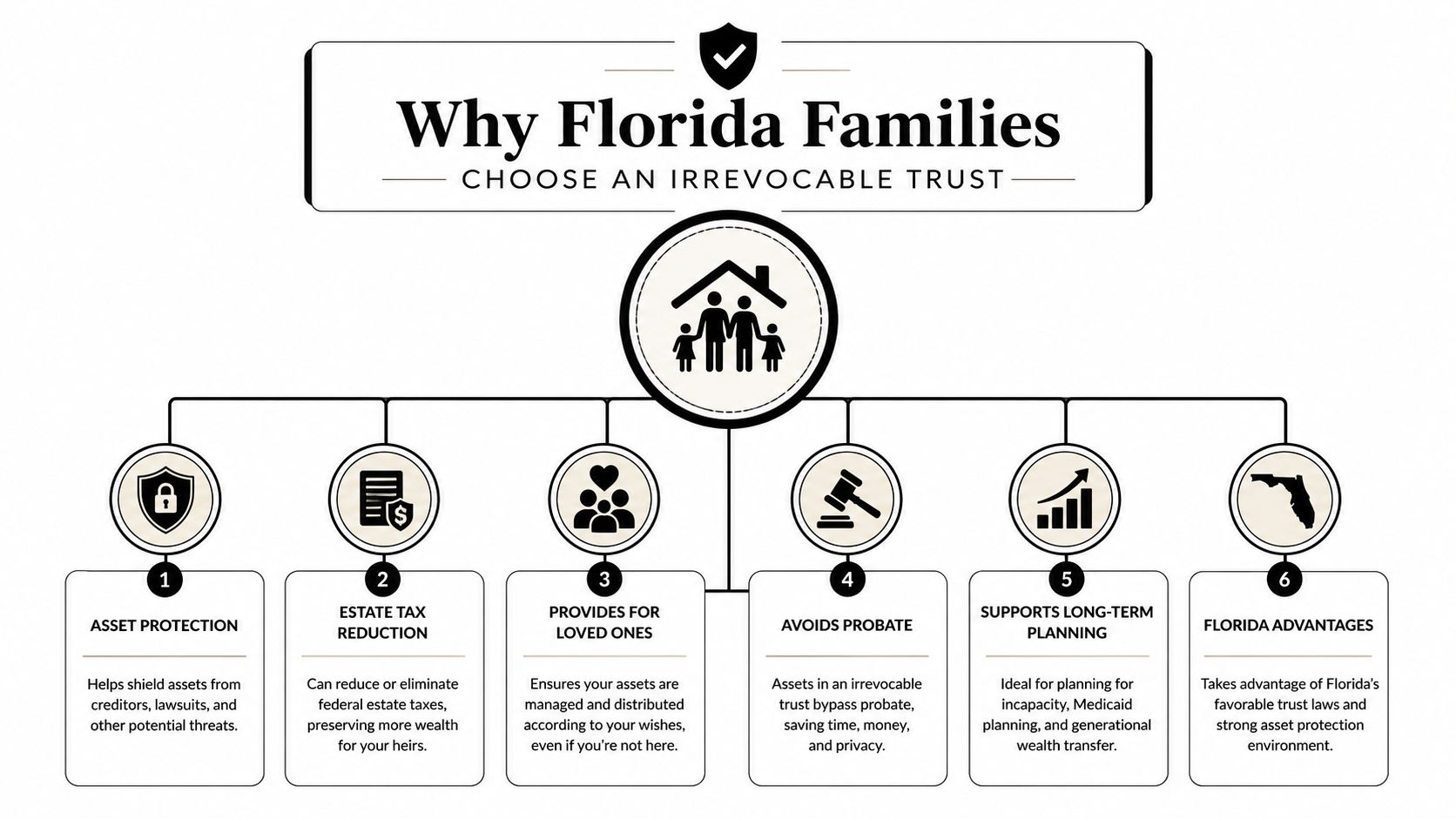
A revocable trust and an irrevocable trust often sit next to each other in a Florida estate plan because they solve different problems. A revocable trust is usually about flexibility and probate avoidance. An irrevocable trust is about moving assets out of the settlor's hands for a defined reason, whether that is creditor planning, beneficiary protection, or a specific transfer strategy.
In South Florida practice, the right structure often follows the asset itself. A Brickell business owner with a growing home equity position may want appreciation kept outside the estate so later transfer issues do not swallow the family's planning, which is why families looking at real estate succession planning in Florida often end up asking about irrevocable trusts. A Homestead condo owner may ask a different question, whether a future care event could consume the estate they meant to leave behind. Families also use these trusts to separate a meaningful asset from day-to-day ownership while the rest of the estate is organized around care planning.
A Miami professional may have an adult child with business exposure, creditor risk, or a marriage that may not stay stable. An irrevocable trust can help keep inheritance terms controlled by the settlor's instructions instead of by the beneficiary's life choices. That does not fit every family, and it should not be forced onto one.
That is why the better question is whether giving up control solves the family's actual problem. If it does, the structure can make sense. If it does not, the family may need a revocable trust, a will, or a different planning tool entirely.
Why Florida Families Choose an Irrevocable Trust
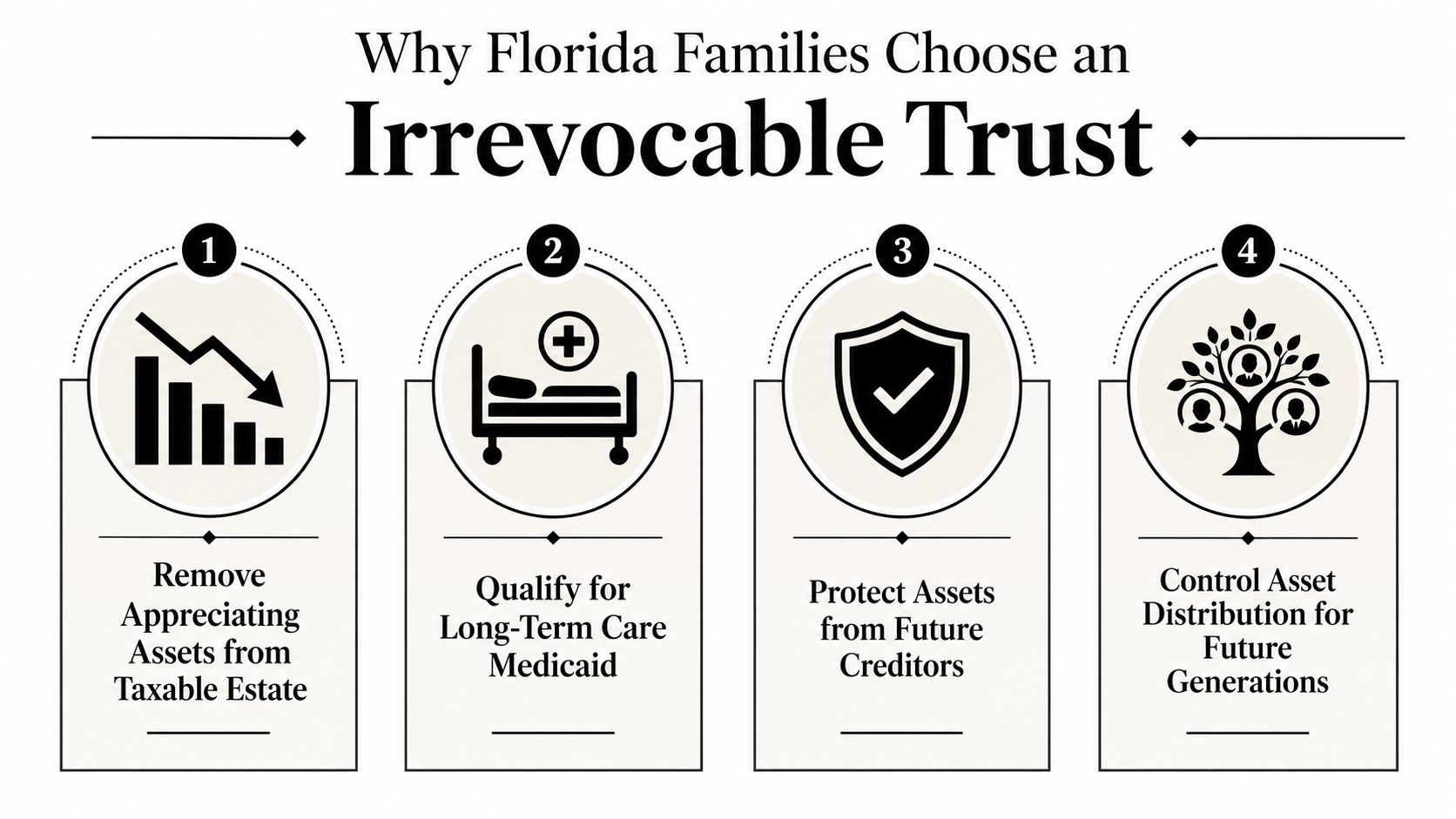
Families usually choose an irrevocable trust for one of four practical reasons, and each reason points to a different structure. The wrong motive leads to the wrong trust. The right motive usually shows up in a specific family story, not in a brochure.
Wealth preservation for the next generation
A Brickell business owner with a growing home equity position may not want appreciation to sit in an estate that will later pass through a messy transfer process. An irrevocable trust can move assets out of the settlor's control and direct how they pass to children or grandchildren. In South Florida, that often comes up in conversations about real estate succession planning in Florida, especially where one property has become the family's most important asset.
Planning around future care costs
A Homestead condo owner may worry that a future care event will consume the estate they meant to leave behind. Families often explore irrevocable trust planning when they want to separate a meaningful asset from day-to-day ownership and keep the rest of the estate organized around care planning. That does not mean every home belongs in this type of trust, but it does mean the trust can fit into a broader protection strategy when the facts fit.
Protecting beneficiaries from their own risks
A Miami professional may have an adult child with a business, a risky profession, or a shaky marriage. In that setting, the trust is less about the parent and more about what happens after the parent is gone. A properly structured third-party irrevocable trust can preserve a child's inheritance without handing the child outright control on day one.
Supporting a vulnerable family member
Some families use trust planning to support a loved one with special needs without harming benefit eligibility. That kind of planning needs careful drafting, not a template copied from another state. Florida families who need that structure should also think about how the rest of the estate plan fits together with a Florida probate avoidance strategy.
Florida is attractive for all of this because the state's tax rules are generally friendly to wealth transfer and asset preservation, as noted in the Florida trust taxation guide. The tax picture never replaces the family problem. The trust should solve a real need, not just sound impressive.
How an Irrevocable Trust Is Drafted, Funded, and Administered
A South Florida family usually starts this process with a concrete problem, not a legal theory. One child may need creditor protection. A parent may want to move business assets out of a risky balance sheet. A family may be trying to keep control over property without leaving it exposed to the wrong hands. A Florida trust attorney should begin by identifying that goal, then draft around it, not around a generic form.
Drafting choices that matter
The trust instrument has to do real work. It should spell out who the trustee is, who the beneficiaries are, what powers the trustee has, and when distributions can happen. It also needs clear rules on information rights, because vague language is where trustees start guessing and beneficiaries start fighting. I see problems later when a document tries to be flexible about everything and specific about nothing.
The distribution standard matters just as much. Some trusts use mandatory distributions, some give the trustee discretion, and some tie distributions to an outside standard. Those choices are not cosmetic. They determine whether the trust is useful for long-term family control, tax planning, or protection against a beneficiary's future problems.
Funding is where many do-it-yourself trusts fail. A trust is only paper until the assets are moved into it. Deeds, account titles, business records, and beneficiary forms all have to line up with the trust document, or the trust does not own what the family thinks it owns.
Here is a practical checklist for funding a Florida irrevocable trust.
| Asset Type | Funding Action | Common Pitfall |
|---|---|---|
| Real estate | Record a new deed into the trust name | No recorded deed is filed with the county records, so title never actually moves |
| Brokerage account | Re-register the account to the trust | The firm keeps the old ownership record, even though the client has a trust certificate |
| Bank account | Open or retitle the account properly | Trust funds get mixed with personal money, which muddies the records and invites disputes |
| Business interest | Amend ownership records or operating documents | Transfer restrictions in the company paperwork are ignored |
| Insurance planning | Coordinate ownership and beneficiary designations | The policy structure does not match the trust plan, which leaves the design incomplete |
A trust that holds life insurance needs the same kind of coordination. The ownership chain, beneficiary designations, and trust language have to point in the same direction, which is why life insurance in a trust needs to be planned instead of assumed.
Administration does not stop after signing
Once the trust is signed and funded, the trustee still has work to do. Florida trustees have disclosure duties under the trust administration rules, including notice to qualified beneficiaries within 60 days after accepting appointment, after learning the trust was created, or after learning a revocable trust became irrevocable as reflected in this Florida bar consumer guide. Qualified beneficiaries are also entitled to at least annual accountings unless that right is waived as reflected in this Florida bar consumer guide. A trust that sits in a drawer is not being administered.
A trustee also needs to keep records, track distributions, and treat the trust as its own legal arrangement, not as an extension of the trustee's personal checkbook. That is where families get into trouble. The document may be valid, but weak administration can still create conflict, delay, or a fight over whether the trustee followed the terms.
Tip: if the trust was funded badly, the legal language will not fix it. The deed, the account title, and the trustee's records have to match.
For families already considering insurance as part of the plan, estate planning with life insurance trusts is a useful reminder that structure matters more than assumptions. A policy can fit inside a broader estate design, but it has to be coordinated with the trust and the beneficiary chain from the start.
What an Irrevocable Trust Can and Cannot Protect in Florida
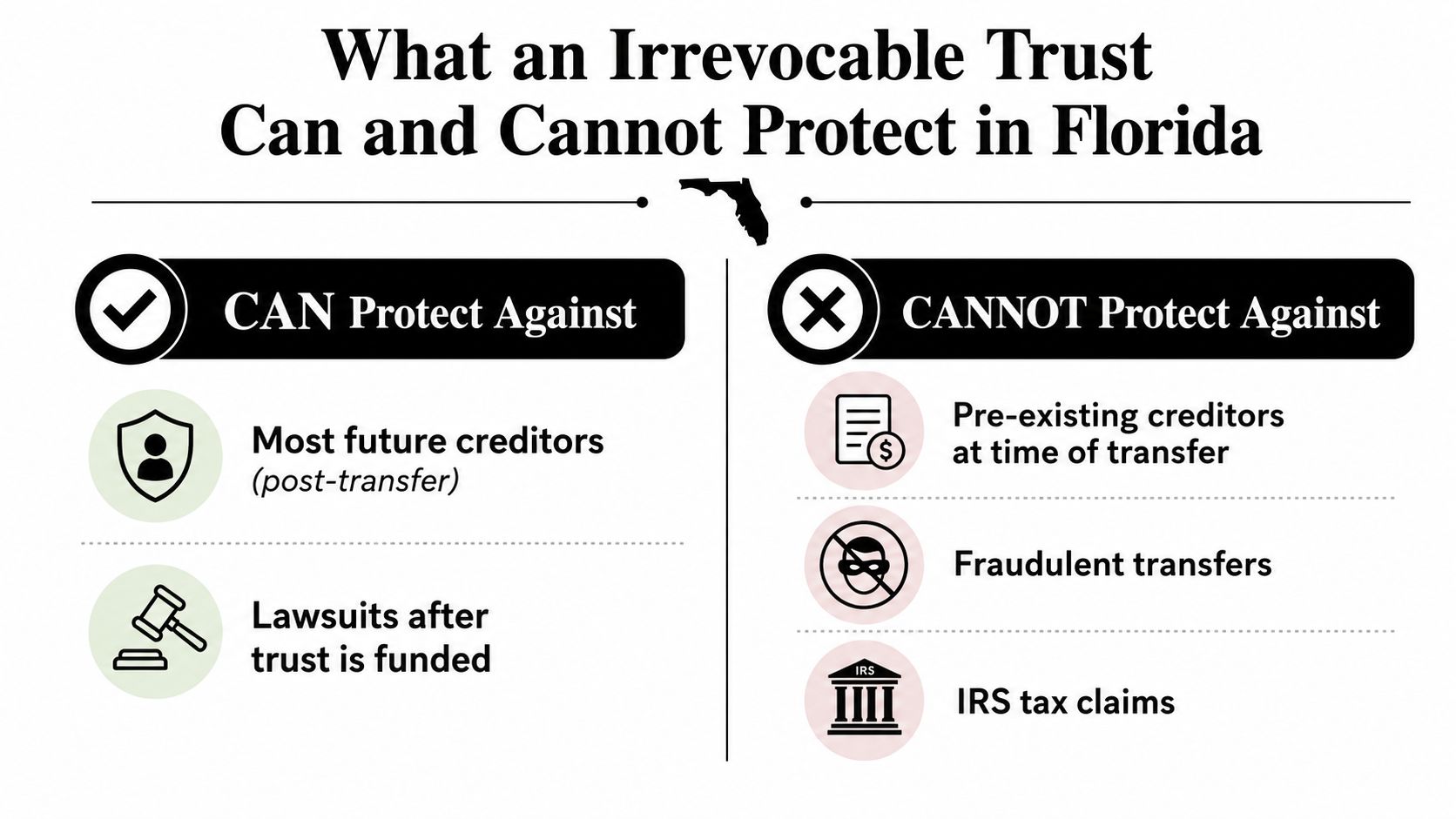
Florida law gives real protection when the trust is set up correctly, but the protection is not universal. Once a grantor transfers assets to an irrevocable trust and gives up revocation power, those assets are generally outside the grantor's personal creditors' reach as reflected in Florida asset protection guidance. That's the basic appeal of the structure.
The hard part is the self-settled issue. If the settlor is also a beneficiary, Florida law allows a creditor to reach up to the maximum amount that could be distributed for the settlor's benefit as noted by The Florida Bar. That rule is why a trust can protect a child's inheritance from the child's future problems, while still failing to protect the parent if the parent kept a beneficial interest.
Two common Florida scenarios
A parent sets up a third-party irrevocable trust for adult children and funds it with a Homestead condo interest. The parent is not a beneficiary. In that scenario, the trust can be designed for spendthrift protection and long-term family control, because the asset is being held for someone else.
A second family uses an irrevocable trust for Medicaid planning, but the settlor keeps a beneficial interest. That structure may still be useful for planning purposes, but the creditor-protection result is different because the settlor did not fully step away from the benefit stream. The same document can do one job well and fail at another.
A trust that protects the next generation is not automatically a shield for the person who created it.
Families also need to remember that strong drafting has limits. The law does not reward transfers made to evade known claims, and federal creditor rights can still matter depending on the facts. Florida lawyers spend time on this because the line between smart planning and a bad transfer theory is where litigation starts.
If you want a practical overview of how timing and trust structure affect protection, the internal guide on life insurance in a trust is useful because it shows how beneficiary design and trust ownership have to work together.
Common Mistakes Florida Families Make with Irrevocable Trusts
The most common mistake is assuming an irrevocable trust is the answer to every estate problem. It isn't. Some families need a revocable trust, some need a will, and some need a trust only for one asset or one beneficiary. The tool should match the problem, not the other way around.
Another mistake is thinking the trust can be unwound later if life changes. Florida does allow modification in limited ways, but those changes are not casual. They require proper statutory procedures, and the trust document itself doesn't get the final word if the law says otherwise. That's why “we'll fix it later” is a dangerous plan.
Mistakes that show up in real consultations
Wrong trustee choice: Naming someone who can't manage records or won't follow the document creates more trouble than it solves. What to do instead: choose a trustee who can administer the trust and keep records clean.
DIY templates: Online forms often miss Florida-specific fiduciary language, beneficiary notice issues, and homestead-sensitive planning. What to do instead: use a Florida-specific document reviewed by counsel who works with these trusts regularly.
Unfunded trusts: Families sign the paper but never retitle the house, account, or business interest. What to do instead: treat funding as a required step, not a follow-up task.
Self-settled overconfidence: A parent assumes the trust will protect them from their own creditors even while keeping a beneficial interest. What to do instead: confirm whether the trust is third-party or self-settled before relying on creditor protection.
A fourth mistake is ignoring the rest of the estate plan. A trust does not live alone. It has to work with beneficiary designations, homestead planning, and sometimes business succession documents. Families in South Florida often discover that the trust is only one part of a larger transfer plan.
Your Next Steps and When to Call a Florida Trust Attorney
The family in the opening scenario usually ends up with three decisions. First, they need to decide whether an irrevocable trust fits the goal. Second, they need to choose the right Florida-specific structure. Third, they need to decide who should serve as trustee and who should not.

What to gather before the consultation
- List of assets: real estate, bank accounts, brokerage accounts, business interests, and insurance policies.
- Existing documents: wills, trusts, powers of attorney, and beneficiary designations.
- Family details: names of beneficiaries, trustees, and any vulnerable or minor heirs.
- The actual problem: creditor protection, care planning, legacy transfer, or special needs support.
- Any current concerns: pending litigation, business succession issues, or family conflict.
For caregivers sorting through the practical side of this, this estate planning guide for caregivers is a helpful resource because it keeps the focus on decision-making, not just document names. That's the right mindset before a trust meeting.
If the goal is to protect a South Florida home, coordinate business succession, or build a trust that works with the rest of the estate plan, this is the point to speak with a Florida trust attorney. In Miami-Dade and Broward, families do better when one lawyer is willing to look at the trust, the Homestead issues, and the transfer structure together instead of treating each piece in isolation.
Coto & Waddington, Attorneys at Law helps South Florida families evaluate whether an irrevocable trust fits their estate plan and how it should be drafted, funded, and coordinated with other documents. If you want a practical review of your assets, beneficiaries, and Florida-specific planning goals, visit Coto & Waddington, Attorneys at Law to schedule a consultation.