You've already filed the LLC. The state accepted it. The bank account is next. Then someone asks for the operating agreement, and you realize you've been treating the most important internal document in the company like a formality.
That's the moment most founders reach for a free template.
Sometimes that works for a very simple business. More often, it creates avoidable problems. The template doesn't match the deal between the owners, doesn't reflect Florida or Delaware realities, and doesn't say what happens when money gets tight, a spouse gets involved, a partner wants out, or a new investor comes in. If you want to know how to write an operating agreement that protects you, you need more than blanks to fill in. You need a document that can survive growth, disagreement, and change.
Table of Contents
- Why Your LLC Needs More Than a Generic Template
- The Foundational Building Blocks of Your Agreement
- Defining Your Management and Voting Structure
- Drafting Key Clauses That Prevent Future Crises
- Common Pitfalls and Florida Delaware Considerations
- Executing Amending and Living With Your Agreement
Why Your LLC Needs More Than a Generic Template
Most operating agreement problems start before the first signature. They start when founders assume the document is just backup paperwork for the Articles of Organization. It isn't. It's the internal contract that governs ownership, control, money, and exits.

The U.S. Small Business Administration explains that operating agreements are critical for defining members' ownership percentage, voting rights, responsibilities, profit distribution, and buyout rules, and that they should be kept with core business records rather than filed with the state, even where they aren't legally mandated in many states (SBA guidance on operating agreements). That's the practical starting point. This document is for the owners, not the filing office.
If you're still at the formation stage, it helps to understand how this fits into the broader setup process for a Florida company. A formation walkthrough like how to form an LLC in Florida gives the state filing sequence. The operating agreement is where you decide how the company will function after the filing is done.
A template fails where the deal gets specific
A generic template usually does four things poorly:
- It oversimplifies ownership: It asks for names and percentages, but not the reasoning behind those numbers.
- It leaves voting vague: That sounds harmless until members disagree on debt, payroll, or adding a partner.
- It treats distributions casually: In practice, owners often mean different things by “split everything equally.”
- It ignores the next phase: The business you have at formation isn't the business you'll have a year later.
Practical rule: If the agreement doesn't answer “what happens if someone wants out, stops working, dies, gets divorced, or asks for more control,” it isn't finished.
In South Florida, that matters even more. Family businesses, real estate ventures, e-commerce brands, restaurant groups, and startup teams often move fast and mix capital, labor, and relationships in ways a stock template doesn't capture. The agreement has to match the actual business deal. Otherwise, state default rules step in where your document stays silent.
What works in the real world
A usable operating agreement reads like a private rulebook. It tells the members who owns what, who can do what, how money moves, what requires a vote, and how a bad situation gets handled before it becomes a lawsuit.
That's why founders should stop asking, “Do I need one?” and start asking, “Does mine match the business we're building?”
The Foundational Building Blocks of Your Agreement
Before anyone debates arbitration, deadlock procedures, or buyouts, get the core facts right. Basic mistakes at the front of the agreement create expensive arguments later because every later clause depends on those opening definitions.
Start with the company's identity
Your agreement should match the LLC's formation records. Use the legal name exactly as filed. Include the principal business address, the state of formation, and the company purpose in plain language that fits the business.
For many founders, the purpose clause is where sloppy drafting starts. If the language is too narrow, the company may outgrow its own document. If it's too vague, it doesn't help guide management decisions. A practical middle ground is broad enough to allow related business activity while still identifying the company's main line of work.
A clean opening section should identify:
- Legal name: Match the state filing exactly.
- Principal office: Use the current business address, not a guess.
- Formation details: State of formation and effective date.
- Business purpose: Broad enough for growth, specific enough to reflect reality.
Identify every member and what each person contributed
Many founder disputes often begin in situations like these. One owner put in cash. Another brought equipment. Another agreed to handle operations or development. Everyone says they're “equal,” but no one writes down what that means.
An operating agreement must explicitly define each owner's initial capital contribution, percentage of ownership, and the priority or order of profit and loss distributions, including whether additional contributions can be required later (HHM Law on key operating agreement provisions). That point matters because people rarely fight over abstract ownership. They fight over who funded what and who gets paid first.
Write the contribution schedule like someone outside the company will read it during a dispute. Because one day they might.
For each member, list full legal name, address, contact information, contribution type, agreed value, and resulting ownership percentage. If a contribution includes services, describe the services with enough detail that nobody can later claim they delivered more than they did.
Don't leave future funding to wishful thinking
A good agreement doesn't stop at initial contributions. It also answers what happens if the company needs more money.
Consider these drafting points:
Additional capital calls
State whether members can be required to contribute more, or whether new funding is voluntary.Failure to contribute
Decide the remedy in advance. Dilution, loans to the company, or other consequences should be spelled out.Distribution order
If one member gets repaid before general distributions, say so clearly.Recordkeeping
Keep a capital ledger attached as an exhibit and update it when the facts change.
This part of the document isn't glamorous. It is one of the few sections that can stop a lawsuit before it starts.
Defining Your Management and Voting Structure
When founders ask how to write an operating agreement, they usually focus on ownership. Control is just as important. Your agreement should say who has authority on ordinary business matters and who has authority on major decisions.
Choosing the right management model
Most LLCs use one of two models: member-managed or manager-managed. The right choice depends on how involved the owners are and whether some of them are really investors rather than operators.
A small Miami family restaurant often fits a member-managed structure. The owners are in the business, making daily calls on staffing, vendors, and spending. A startup with passive investors usually needs a manager-managed model so decision-making doesn't get stuck in routine approvals.
One more issue deserves attention if you're a solo founder. According to 2026 industry data, 52% of single-member LLCs add partners within three years, yet 74% of their operating agreements require complete re-drafting because they lack bridge clauses to transition ownership without restructuring the entity (ContractsCounsel on single-member LLC operating agreements). If you're starting alone but expect future partners, draft for that now.
A practical comparison
| Consideration | Member-Managed | Manager-Managed |
|---|---|---|
| Day-to-day authority | All members typically participate | Managers handle operations |
| Best fit | Small teams, family businesses, hands-on owners | Growth companies, passive investors, layered ownership |
| Investor expectations | Less attractive for passive owners | Easier to separate economic rights from control |
| Decision speed | Can slow down if everyone expects a say | Usually faster if authority is clearly delegated |
| Risk of confusion | High if roles aren't defined | High if manager powers are too broad |
| Future scaling | Works if members stay active | Often better when the company plans to add people or capital |
The label alone doesn't solve anything. The agreement has to define scope.
For example, routine operational authority might include signing vendor contracts, opening accounts, hiring employees, and paying ordinary expenses. Reserved matters should be listed separately and require member approval. That list often includes admitting a new member, borrowing money above a threshold, selling major assets, changing tax treatment, amending the agreement, or dissolving the company.
Voting should be specific, not polite
Many operating agreements say decisions require a “majority vote” and stop there. That's not enough. Majority of what? Members by headcount? Ownership interests? Voting units? All members, or only those present?
Otherwise functional businesses frequently break down. Owners think they agreed to democracy, but they didn't define the system.
Use clear categories such as:
- Ordinary decisions: handled by managers or by a simple ownership vote.
- Major decisions: require a higher approval threshold.
- Extraordinary actions: may require unanimous written consent.
If you want peace, define the vote before the disagreement. Don't leave the company to discover its constitution during a fight.
For founders expecting growth, include a bridge clause now. That clause can state how a future member is admitted, how valuation is determined, how percentages adjust, and when governance shifts from single-member control to shared voting. That's cleaner than rewriting the whole agreement under pressure.
Drafting Key Clauses That Prevent Future Crises
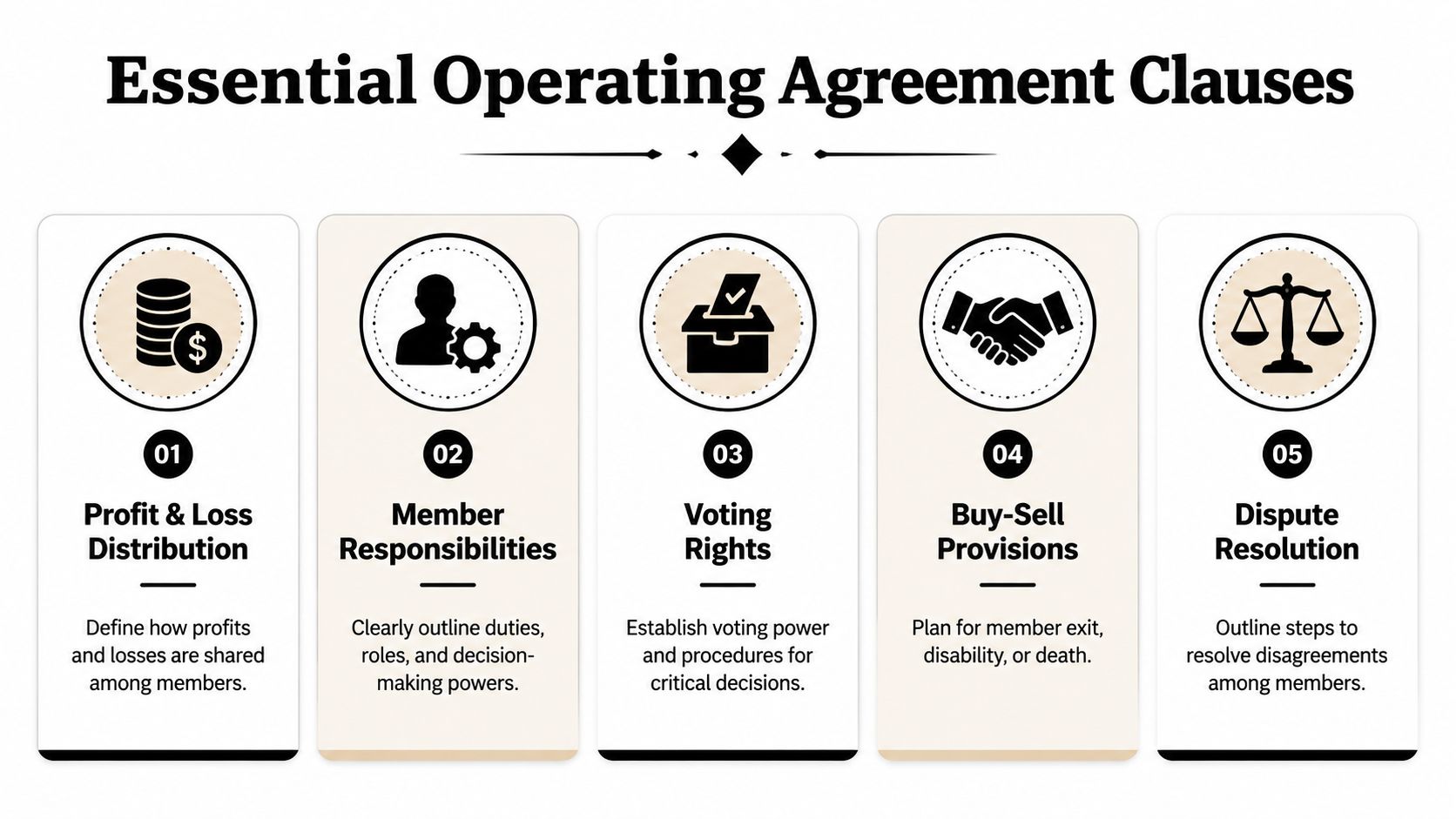
The document commences its real protective work. A resilient agreement doesn't just describe the company. It anticipates stress.
Economic terms that need precision
Profit and loss language should answer two different questions. First, how are profits and losses allocated on paper? Second, how and when does cash get distributed?
Those aren't always the same. If the agreement treats them casually, owners can end up with tax consequences or expectations that don't line up with the company's cash position.
Draft with precision around:
- Allocations: State whether they follow ownership percentages or another agreed formula.
- Distributions: Define timing, priority, and any manager discretion.
- Tax treatment: Coordinate the agreement with how the LLC expects to be taxed.
- Additional contributions: Address whether members must fund shortfalls.
A model concept might read like this:
Net profits and net losses shall be allocated among the Members in accordance with their Percentage Interests, unless this Agreement expressly provides for a different allocation for a specified class of distributions.
That's only a starting point. The right language depends on the business model.
Transfer and dispute clauses that do real work
The transfer section is one of the most underrated parts of an operating agreement. It should limit when a member can transfer an interest, to whom, and on what conditions. Without that, owners can find themselves in business with an ex-spouse, heir, creditor, or outsider they never approved.
Buy-sell provisions should address voluntary exits, disability, death, default, and forced sale events. Spell out the valuation method. If you don't, the buyout process itself becomes the dispute.
Dispute resolution deserves the same care. Expert drafting methodology requires a severability clause and formalized dispute resolution procedures, often through arbitration, and notes that arbitration can reduce litigation costs by approximately 40% compared to standard court proceedings. The same methodology also requires majority approval for admitting new members (PandaDoc on writing an operating agreement).
That doesn't mean every dispute belongs in arbitration. It means you should decide deliberately.
A practical clause often addresses:
Negotiation first
Require the members to try informal resolution for a short defined period.Mediation or arbitration
If you choose arbitration, identify the forum, location, and governing rules.Court access for limited issues
Preserve the ability to seek injunctive relief when necessary.Severability
If one clause fails, the rest of the agreement should remain enforceable.
Any dispute arising under this Agreement that the Members cannot resolve by direct negotiation shall be submitted to binding arbitration in the Company's city and state under applicable arbitration rules, and judgment on the award may be entered in a court with jurisdiction.
That example is not one-size-fits-all, but it shows the level of specificity you want.
Dissolution language that keeps a bad ending from getting worse
No founder likes drafting the ending at the beginning. Do it anyway.
Your dissolution section should identify trigger events, who has authority to wind up the business, how debts get paid, and how remaining assets are distributed. If one member dies, becomes incapacitated, files bankruptcy, or disappears from the business, the agreement should already tell everyone what happens next.
This is also the place to name who handles winding up, what records must be maintained, and what approvals are needed for closure steps. If you leave dissolution vague, the final chapter of the business can become the most expensive chapter.
One practical drafting tip is to include an exhibit or short schedule for notices, valuation procedures, and transfer restrictions. Founders use those schedules because they're easy to find. Dense paragraphs buried in the middle of the agreement get ignored until there's already a problem.
Common Pitfalls and Florida Delaware Considerations
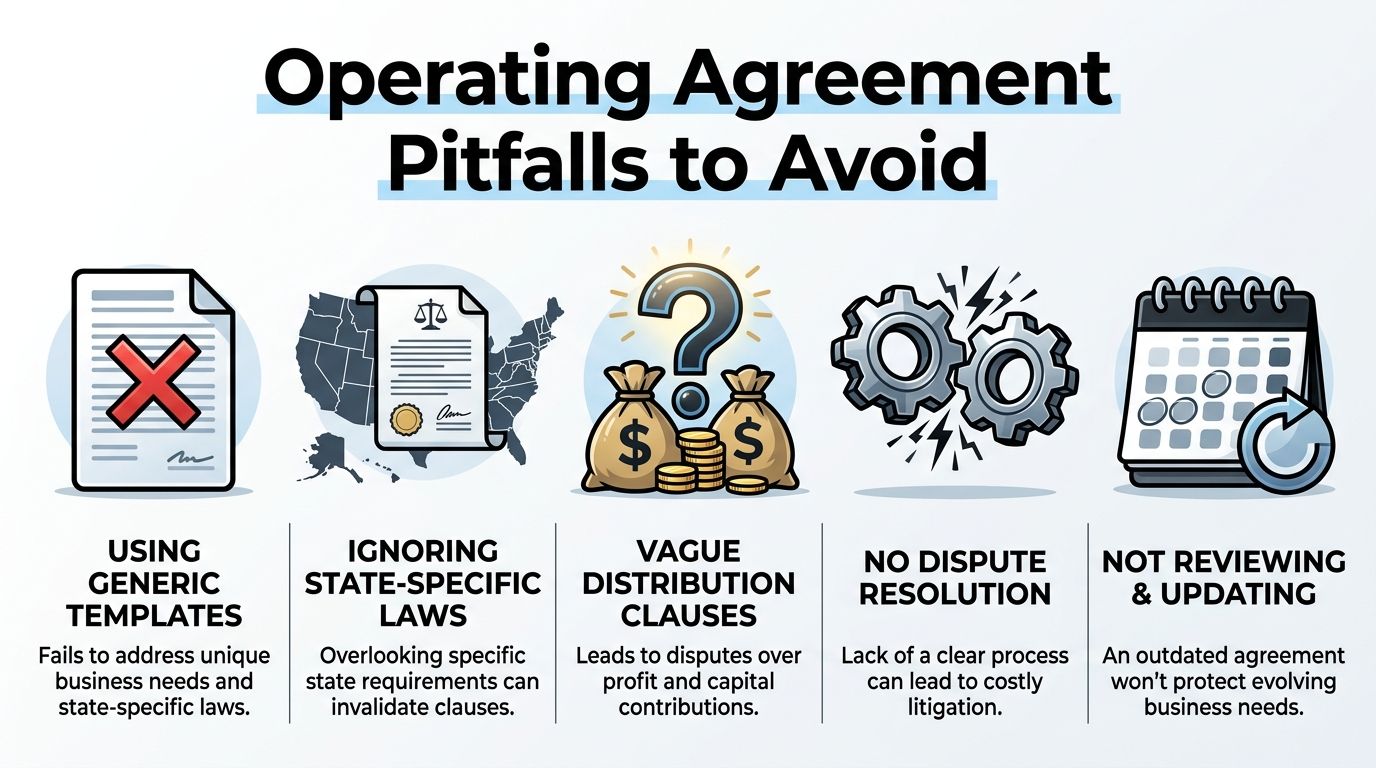
Templates usually fail in predictable ways. They don't fail because the format is short. They fail because they leave the hard parts unresolved.
What most templates miss
Statistical analysis of LLC dissolutions shows that 65% of failed partnerships result from ambiguous voting rights or undefined profit allocation, and neglecting dissolution terms leads to a 50% higher probability that assets are incorrectly distributed to creditors instead of members (LegalShield on operating agreement mistakes). That tracks with what lawyers see in practice. The damage usually starts with vagueness, not with some exotic legal issue.
The most common weak spots are easy to identify:
Ownership language that sounds clear but isn't
“Equal partners” means very little unless ownership, capital, and distributions line up.No death or disability planning
A member's family may inherit economic rights, but that doesn't mean they should inherit management power.Silent transfer restrictions
If the agreement doesn't restrict transfers, the business may lose control over who becomes an owner.No update mechanism
An agreement drafted at formation often stops matching the business once it hires, borrows, or raises money.
Why Florida and Delaware require different drafting instincts
Florida founders often want a practical, readable document that works for owner-operated businesses, family companies, and service businesses. Delaware formations often involve investors, holding structures, or future financing plans, so the drafting usually has to be more deliberate about manager authority, fiduciary expectations, and transfer mechanics.
If you're deciding whether Delaware is the right home for the entity, Delaware incorporation benefits can help frame the broader legal and strategic trade-offs. Tax treatment is another part of that analysis, and founders comparing entity choices often find Jumpstart Partners on Delaware LLC tax useful for understanding the payment side of the decision.
One practical point matters in both states. An operating agreement is a creature of state law, so the drafting should match the jurisdiction that governs the LLC. Delaware gives parties broad contractual freedom. Florida also allows flexibility, but founder-friendly drafting still has to fit the state's LLC framework and the realities of local operations.
A good operating agreement doesn't just fit the company. It fits the state law that will interpret it when something goes wrong.
If you're using counsel, this is one place where local business lawyers add real value. Firms such as Coto & Waddington, Attorneys at Law draft operating agreements designed for Florida and Delaware entities, which is often more useful than trying to retrofit a national template after the deal terms have already shifted.
Executing Amending and Living With Your Agreement
A strong draft still fails if nobody executes it correctly or updates it when the business changes.
How to make it binding
An LLC operating agreement is a contract that binds the members once signed, and it should be kept with the company's core records rather than filed with the state. States generally don't accept operating agreements for filing, so this is an internal governance document, not a public filing (Northwest Registered Agent on operating agreement mechanics).
That means the execution process matters. Every member should sign. Keep a clean final version. Store it with formation records, membership records, and any amendments. If the company uses exhibits for ownership schedules or capital contributions, those exhibits should be attached and signed or clearly adopted with the agreement.
If you need a starting point before legal review, a structured business operating agreement template can help you gather the right issues in one place. The key is not to stop at the template.
When to amend instead of waiting for a problem
Founders often treat the agreement like a one-time document. That's one of the most expensive assumptions in this area. Data from 2025 to 2026 shows that 68% of LLC disputes arise from agreements that fail to address future events like new investors or profit model shifts, and the proposed solution is to build a living agreement framework with predefined review dates and amendment protocols (Anderson Advisors on operating agreement loopholes).
You don't need a complex corporate bureaucracy to do this well. You need triggers.
Use amendment reviews when any of these happen:
- A new member joins: Update ownership, voting, transfer rules, and exhibits.
- Roles change: If a passive owner becomes active, or an active founder steps back, revise management authority.
- The revenue model changes: Product sales, subscriptions, licensing, and service revenue can create different distribution expectations.
- The company takes outside money: Investor rights and manager authority usually need tighter drafting.
- A major life event occurs: Marriage, divorce, death, disability, relocation, and estate planning all affect closely held businesses.
Review the agreement at the same moments you'd review your cap table, tax position, or banking authority. Governance should move with the business.
A resilient operating agreement isn't static. It's maintained.
If your LLC agreement still looks like a downloaded form, it's worth revisiting before the next partner, investor, or dispute forces the issue. Coto & Waddington, Attorneys at Law advises South Florida founders and small businesses on operating agreements, entity structure, and practical business governance for Florida and Delaware companies.